

Hawaiian White Ginger Fragrance: Notes, Pairings, Uses

You uncap a bottle labeled Hawaiian white ginger and expect the fragrance of a flower lei. Instead, you get something sharp, green, and almost medicinal.
Another bottle with the same name smells sweet and airy. Neither label tells you enough to explain the difference.
Table of Contents
Why One Hawaiian White Ginger Bottle Smells Different From the Next
The Real Scent Profile of Hawaiian White Ginger - How to smell the chemistry
Notes That Pair Well With White Ginger - Choose a direction before mixing
Why Flower, Leaf and Root Smell So Different - What processing means for your purchase
White Ginger, Yellow Ginger and What the Hawaiian Name Really Means - Why the Hawaiian association matters
Putting White Ginger to Work in Diffusers, Candles and Soap - Test the finished product, not just the bottle
What Natural Really Means for Safety and Claims - Practical safety boundaries
Why One Hawaiian White Ginger Bottle Smells Different From the Next
Hawaiian white ginger fragrance is a scent description, not a complete ingredient specification. A bottle might contain a compounded interpretation of the blossom, an essential oil from underground stems, or a blend that uses ginger as a loose creative theme.
That distinction matters before you pour anything into a diffuser or soap batch. The flower's delicate sweetness and the underground stem's cooling sharpness come from different balances of aromatic compounds. A stronger root-like smell isn't necessarily a more concentrated version of the floral scent.
Start with the target: Are you buying a lei-flower impression or a botanical oil? Those are different purchasing decisions.
A useful description should tell you whether the fragrance is floral, green, creamy, or camphoraceous. Useful documentation should also identify the material and its intended applications. Together, those details tell you much more than a tropical name on a label.
The Real Scent Profile of Hawaiian White Ginger
The flower-inspired scent is a soft, sweet, airy white floral with a cool green lift, not the warm bite you associate with grated ginger. Think of an open window beside fragrant blossoms rather than a spice cupboard.
A published floral headspace analysis of Hedychium coronarium identified 39 compounds accounting for 98% of the measured volatile fraction, including the classes and individual compounds shown below.
What each part of the white ginger scent is made of
Scent layer | Key compound or class | Share of volatiles | What you smell |
|---|---|---|---|
Overall lift | Monoterpene hydrocarbons | 34.9% | Airy, green, diffusive top |
Sweet floral core | Oxygenated monoterpenes | 34.4% | Soft, sweet floral character |
Body and depth | Sesquiterpene hydrocarbons | 13.2% | Supporting depth beneath the brighter notes |
Star note | (E)-β-ocimene | 28.7% | Sweet-green, fresh, slightly herbal |
Softness | Linalool | 19.3% | Clean floral, lavender-adjacent |
Brightness | 1,8-cineole | 14.5% | Cooling, camphoraceous, eucalyptus-like edge |
The table combines broad chemical classes with individual members of those classes. Don't add every row together: that would count some compounds twice. The odor descriptions are sensory shorthand, not a promise that each compound smells identical in isolation and in a finished perfume.
How to smell the chemistry
Ocimene helps explain the blossom's floating, sweet-green quality. Linalool supplies a softer floral impression, while cineole explains why an otherwise delicate fragrance can have a clean, cooling edge. A convincing accord balances these effects rather than making everything sweeter.
Headspace analysis samples the aromatic air around a flower. It doesn't give a manufacturer a finished fragrance recipe, and its percentages aren't recommended blending concentrations. For a broader explanation of constructed floral scents, the flower fragrance oil guide helps distinguish a floral impression from a literal extract.
Evaluate a sample on a blotter when freshly applied and again after it settles. Look for a floral heart that remains recognizable once the first burst has softened, rather than expecting a fixed wear time. Cultivar, maturity, climate, harvesting, and extraction can change the balance, so the published profile is a benchmark, not a universal specification.
Notes That Pair Well With White Ginger
Treat white ginger as an airy floral heart. Your partner note should give it direction without hiding the fresh blossom character.
Citrus makes the scent feel brighter; coconut and vanilla make it feel warmer. Other white florals create a fuller lei impression, while green notes emphasize the leafy surroundings rather than the blossoms alone.
White ginger pairings and starting ratios
Partner note | Why it works | White ginger : partner | Best format |
|---|---|---|---|
Bergamot, yuzu, lime | Adds sparkling contrast to the floral heart | Begin floral-led; increase citrus gradually | Diffuser, linen spray |
Coconut milk, vanilla, tonka | Softens the cooling edge with creamy sweetness | Keep the creamy partner subordinate | Candle, body oil |
Sandalwood, cedar | Supplies a quieter woody foundation | Begin with a trace of wood | Incense, solid perfume |
Ylang-ylang, jasmine, pikake | Builds a layered lei-style accord | Compare equal-strength blotters before combining | Personal fragrance, lei blends |
Violet leaf, bamboo, sea salt | Emphasizes a green or aquatic direction | Keep white ginger clearly identifiable | Room spray, soap |
White musk, amber | Gives the composition a fuller dry-down | Add incrementally until the base becomes perceptible | Leave-on products, candles |
Clove, cinnamon, patchouli | Creates contrast but can overwhelm the blossom | Use only a trace in a separate trial | Incense experiments |
These are olfactory starting rules, not safety limits. There's no universal mixing ratio for finished fragrance oils because their strengths and formulations differ. Any intended format must also be approved for the particular materials you choose.
Choose a direction before mixing
For a lei accord, compare white ginger with jasmine or pikake and stop before the partner becomes the main flower. For an island-morning accord, choose a green bamboo or violet-leaf interpretation and keep the result crisp rather than detergent-like.
For warm coconut, introduce coconut first, then decide whether the composition needs vanilla. Adding every sweet note at once makes it harder to identify what flattened the floral detail.
A base note can change the shape of a fragrance without guaranteeing extra hours of wear.
The sandalwood and musk fragrance guide offers useful context for choosing between woody structure and softer background fullness. Record each trial by weight so you can reproduce the version you prefer.
Why Flower, Leaf and Root Smell So Different
A plant doesn't distribute its aromatic chemistry evenly. Blossoms, leaves, and rhizomes, the underground stems often called roots, serve different functions and yield different fragrance materials.
Processing changes the result again. A living flower's headspace isn't interchangeable with distilled oil, and drying a rhizome can alter its aromatic balance before distillation even begins.
A study of fresh and dried Hedychium coronarium rhizome oils measured 1,8-cineole at 41.42%, β-pinene at 10.39%, and α-terpineol at 8.8% in fresh material, compared with 37.44%, 17.4%, and 6.7%, respectively, in dried material.
How white ginger materials differ by plant part
Material | Key constituents | Odor impression | Where it turns up |
|---|---|---|---|
Fresh flower headspace | Ocimene, linalool, cineole | Sweet, airy, lei-like floral | Reference for fragrance-oil and fine-fragrance accords |
Flower extract or absolute | Extraction-specific floral mixture | Potentially richer and less airy than living-flower headspace | Botanical perfumery materials |
Fresh rhizome oil | Cineole, β-pinene, α-terpineol | Cooling, camphoraceous, green | Botanical oil formulations |
Dried rhizome oil | Higher β-pinene share in the cited comparison | More resinous or medicinal in character | Formulations seeking a root-like aromatic effect |
Leaf oil | Terpene-rich profile distinct from flower material | Greener and less blossom-like | Specialist botanical materials |
What processing means for your purchase
The increased pinene share in the dried material helps explain why a root-derived oil can suggest resin or sharp greenery rather than a soft lei. It doesn't mean every dried-rhizome batch will smell identical, or that drying alone determines the whole odor.
Likewise, flower headspace isn't a bottled ingredient. It's a way to measure what the flower releases into the air. A perfumer can use that information to construct a blossom-like accord without including a direct flower extract.
Ask for the plant part and extraction method when buying a botanical material. When purchasing a compounded fragrance, ask whether its intended character is blossom-like or root-like. Don't assume that distilling the underground stem will reproduce the scent of the flower above it.
White Ginger, Yellow Ginger and What the Hawaiian Name Really Means
The word ginger creates confusion because shoppers encounter it in flower names, essential-oil catalogs, and grocery stores. Those uses don't describe the same scent.
White ginger lily, Hedychium coronarium, is the blossom associated with this floral fragrance. Yellow ginger belongs to the related lei-flower tradition. Kitchen ginger is the culinary rhizome you grate into food, not a reliable model for how white ginger flowers should smell.
Label language | What to establish before buying |
|---|---|
White ginger lily or butterfly ginger | Whether the product evokes the blossom or contains a specified botanical material |
Yellow ginger | Which species and scent interpretation the seller means |
Ginger or ginger root | Whether the seller means culinary ginger, another botanical oil, or a fragrance accord |
Hawaiian white ginger | Whether Hawaiian describes the scent inspiration, ingredient origin, or both |
Why the Hawaiian association matters
Hawai'i Forest & Trail's account of ginger in the islands describes the introduction of white ginger and related species by Chinese sugar-plantation immigrants in the mid-to-late 1800s, followed by cultivation for fragrant blossoms, leis, and fragrances.
The Hawaiian name therefore carries a place-based association formed through cultivation and cultural use. It doesn't mean the species originated in Hawai'i, and it doesn't prove that a bottle's ingredients were grown there.
A University of Hawai'i investigation of white ginger rhizomes obtained a fragrant, amber-colored oil fraction and identified its principal isolated compound as coronarin D using spectroscopic methods. That finding concerns rhizome chemistry, not a complete explanation of the lei flower's airborne fragrance.
Read origin claims literally: Hawaiian-inspired fragrance and Hawaiian-grown botanical extract are different descriptions.
At checkout, look beyond the place name. A seller can accurately describe a Hawaiian floral inspiration without claiming local cultivation or direct flower extraction. Conversely, a botanical label should identify the material clearly enough that you don't have to infer its plant part from a photograph.
Putting White Ginger to Work in Diffusers, Candles and Soap
A white ginger oil that smells like a lei in the bottle can turn peppery in a candle if the blend leans toward rhizome or kitchen-ginger notes. Choose the application before choosing the dose: a fragrance suitable for incense is not automatically suitable for skin, and an oil-warmer product is not automatically compatible with an ultrasonic diffuser.
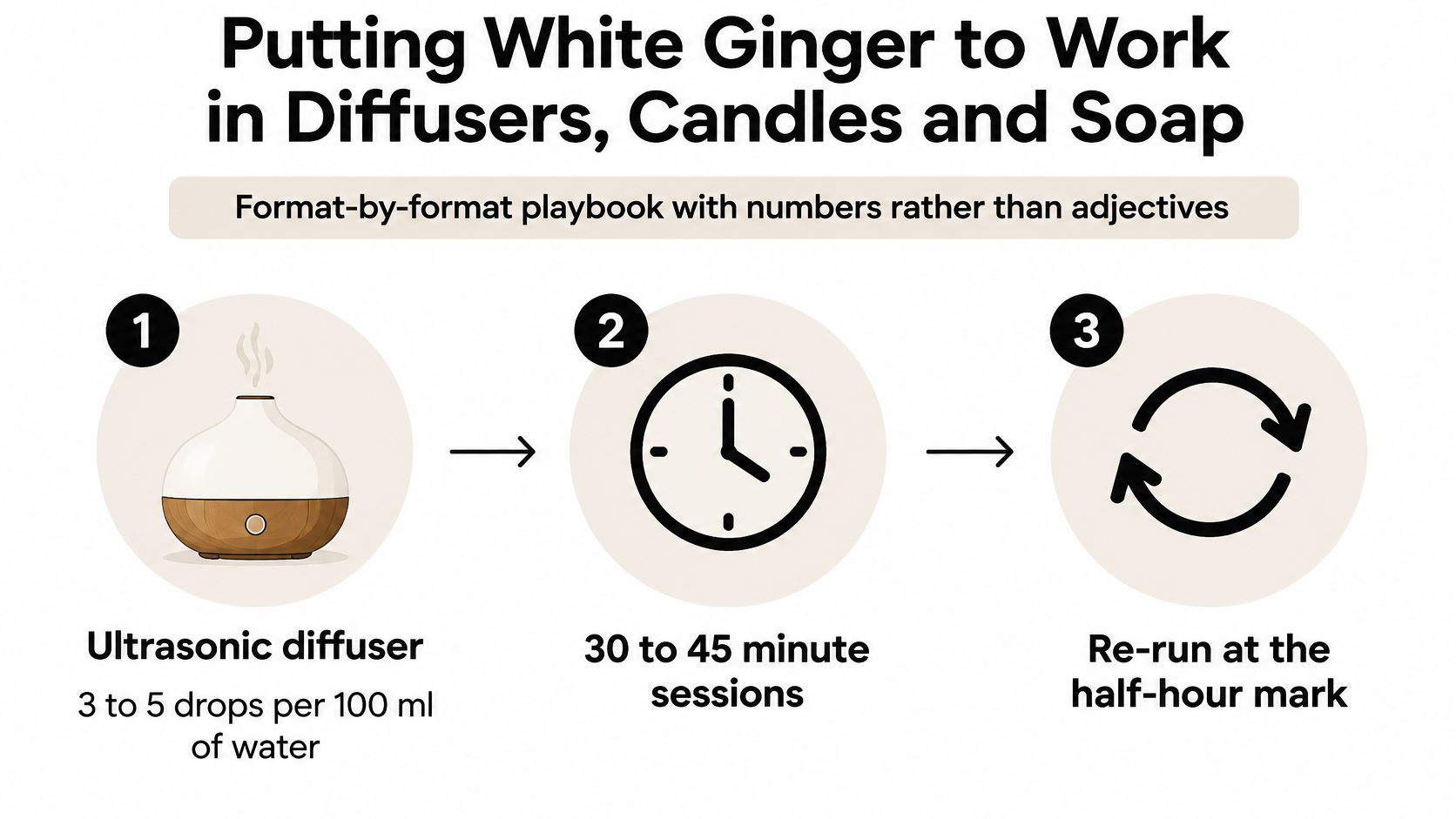
The visual below illustrates a diffuser routine, but its measurements aren't a universal instruction for every bottle or appliance. Use a fragrance only when both its documentation and the device instructions permit that application.
Format limits and performance
Format | Set the level by | How long it lasts | Main thing to watch |
|---|---|---|---|
Ultrasonic diffuser | The lowest fragrance amount the device manual permits, in a cleaned reservoir | One timed cycle, then reassess before another session | Olfactory fatigue can make a scented room seem unscented too soon |
Soy candle | The highest loading the wax, wick and burn tests still hold without sweating or a poor flame | Judge after full cure and across controlled burns | Excess fragrance can impair candle performance |
Cold-process soap | The rinse-off level stated for the formula, measured by batch weight | Judge after cure, not at pour | The finished scent can differ from the bottle, and delicate floral top notes may thin |
Hand-dipped incense | One stick in an ash-catching holder for a first room test | One burn cycle, then ventilate | Smoke and fine particulates require airflow |
Perfume or body oil | The category-approved concentration in a suitable carrier, confirmed by wear testing | Through dry-down on skin or fabric | Alcohol perfume and body oil need separate formulation decisions |
Linen or room spray | A validated spray formula with suitable solubilization, after a hidden fabric spot test | Assess the dry surface and the room after a few passes | Residue, separation, staining, and preservation |
Test the finished product, not just the bottle
For candles, record the wax, wick, vessel, fragrance loading, processing conditions, and cure procedure. Evaluate hot throw during a controlled burn rather than increasing fragrance because the unlit candle seems quiet. A soft cold throw can still open up when the melt pool forms.
For soap, make a small trial and assess it after curing. A woody companion may improve the perceived body, but it won't guarantee that every delicate floral component survives processing. If the cured bar reads sharper than the bottle, suspect spice-leaning ginger materials before blaming the soap base.
This video provides an additional visual reference for fragrance use.
A practical daily routine should alternate formats rather than layer them continuously:
Morning: Try a compatible white-ginger-and-citrus diffuser blend, then switch the device off.
Afternoon: Use a formulated linen spray only after testing an inconspicuous fabric area.
Evening: If you choose incense, use an ash catcher and ventilate rather than adding it over an already heavily scented room.
The guide to fragrance oil uses can help separate these applications. If the room smells more like a candle shop than a garden, reduce the fragrance rather than chasing a stronger effect.
What Natural Really Means for Safety and Claims
Natural doesn't mean universally safe. A plant extract, an essential oil, a compounded fragrance oil, and a finished lotion are different materials. Their names alone don't establish an appropriate exposure level.
A laboratory investigation of Hedychium coronarium extracts reported no irritation signals in specific experimental tests, but its screening also included substance-specific toxicological exceptions, including (E)-caryophyllene. Those findings don't establish that every commercial white ginger fragrance is non-irritating or suitable for undiluted use.
Practical safety boundaries
Check the category: Use current IFRA documentation for the intended application, alongside the rest of the product's safety assessment.
Dilute appropriately: Never apply concentrated fragrance neat. Patch testing a properly formulated leave-on product doesn't replace formulation review.
Control exposure: Ventilate scented rooms and stop use if discomfort develops.
Consider pets: Don't assume human fragrance instructions establish pet safety. Seek veterinary advice and avoid exposing animals in enclosed spaces they can't leave.
Keep claims sensory: Describe the aroma or atmosphere without promising treatment for anxiety, pain, acne, or other conditions.
Ingredient conversations also need context. Green Living Guy on parabens discusses a separate cosmetics concern; it shouldn't be treated as proof that a preservative-free product is safer.
The clean beauty fragrance guide offers another starting point for evaluating marketing language. Concentration, route, carrier, and documentation matter more than a reassuring adjective.
How to Choose a Bottle That Smells Like the Flower
Buy for the scent you want in the format you'll use. A beautiful blotter impression is only the beginning.
Define the target. Write down lei-floral or aromatic root, then name the finished application.
Identify the material. For botanical oils, obtain the species, plant part, and extraction method. For fragrance oils, establish the intended scent character.
Review documentation. For volume purchases of botanical materials, request batch-specific or representative GC-MS information. For compounded fragrances, prioritize application and safety documentation.
Sample first. Evaluate on a blotter and in a small finished-product trial. Test on skin only after appropriate formulation.
Reassess after processing. Compare the finished candle, cured soap, or stored blend with your original scent notes.
The PROSEA botanical account of Hedychium coronarium describes a complex flower composition and substantial differences among botanical materials. A floral fragrance oil isn't interchangeable with white ginger essential oil.
Our quality fragrance oil evaluation guide can help structure that comparison. At Aroma Warehouse, we pour fragrance oils fresh upon order and offer 1/8-ounce tester drams for $1.10 each in over 100 fragrances. We don't accept returns on fragrance, incense, or perfume oils because of possible contamination, so sampling is the sensible first purchase.
For a blossom-inspired bottle, keep the final sensory test simple: it should suggest a lei at dusk, not a pharmacy aisle.
Frequently Asked Questions
These questions introduce additional search opportunities without repeating the article's existing headings or directly duplicating its discussions.
FAQ 1: Does Hawaiian white ginger fragrance smell like traditional ginger spice?
No. Hawaiian white ginger fragrance is generally associated with a delicate, sweet white-floral aroma with fresh green undertones. Traditional culinary ginger has a warmer, sharper, spicy character. The two fragrances come from different parts of the plant and have distinctly different scent profiles.
FAQ 2: Is Hawaiian white ginger fragrance suitable for blending with fruity scents?
Yes. White ginger can complement tropical and fruity fragrance notes such as pineapple, mango, coconut, and citrus. Its airy floral character adds balance to sweeter blends without necessarily making the finished fragrance overly heavy.
FAQ 3: Why does white ginger fragrance sometimes smell stronger after sitting in a room?
Fragrance perception changes as aromatic materials disperse through the air. Room temperature, airflow, the delivery method, and individual sensitivity can influence how strongly a fragrance is perceived. Allowing a fragrance to disperse before adjusting its amount can help prevent over-scenting.
FAQ 4: Can Hawaiian white ginger fragrance be used in homemade wax melts?
It can be used in wax melts when the specific fragrance oil is documented as suitable for that application. Follow the supplier's usage guidance and the wax manufacturer's recommendations, then test a small batch to evaluate fragrance performance after cooling and curing.
FAQ 5: What fragrance families complement Hawaiian white ginger the best?
White ginger works particularly well with floral, citrus, tropical, green, and soft woody fragrance families. Jasmine, bergamot, coconut, sandalwood, and white musk are useful choices for creating everything from fresh island-inspired fragrances to warmer floral blends.
Visit Aroma Fragrance Warehouse to explore fragrance oils, incense, and accessories for your chosen scent format. Start with a small tester, compare its fresh impression with its dry-down, and evaluate it in a suitable finished application before committing to a larger bottle.


