

Brass Elephant Incense Burner Guide: Design, Uses and Care

You unwrap a small brass elephant, set it on a shelf, and realise it feels lighter than it looked online. The carving is lovely, but the practical questions start immediately: where does the incense sit, how much ash will the body catch, and will the feet stay steady when the lid is lifted?
A brass elephant incense burner is best judged from the bottom up. Its contact with the table, the position of its weight, and the shape of its incense chamber matter more than the height of its trunk. Once you understand those parts, you can choose a decorative piece that also works sensibly as a burner.
Table of Contents
Sizes and Weights of Brass Elephant Burners - Brass elephant burner sizes, weights and listed prices
How the Elephant Form Holds Heat and Ash - Read the body, smoke path and lid - Inspect the working chamber
Which Incense Works in an Elephant Burner - Incense types and how they suit an elephant burner - Match the support to the incense
How to Choose a Brass Elephant Burner - Examine the supporting structure - Check access and workmanship
How to Use a Brass Elephant Burner Safely - Follow a deliberate lighting routine - Ventilate without creating a cross-draft
Cleaning and Caring for Brass Burners - Clean according to the finish - Inspect before returning it to service
Worked Example and Final Choice - Make the missing details decide
Sizes and Weights of Brass Elephant Burners
Unboxing a surprisingly light elephant doesn't necessarily mean you've bought a poor burner. It does mean you should check whether its apparent size comes from a hollow body, an extended trunk, or a broad supporting base.
Product photographs make these differences hard to judge. Use the measurements below as comparison points, not as proof that any particular model is suitable for every kind of incense.
Brass elephant burner sizes, weights and listed prices
The prices are listing snapshots, not guaranteed checkout prices. “Not stated” means the available description doesn't establish that detail.
Listing or reference | Height and footprint | Weight | Listed price |
|---|---|---|---|
6 in high, 3.5 in wide, 3.5 in deep | About 700 g combined | Not stated | |
7.5 in high, 9 in at its widest point | 7 lb | $169 | |
Listed dimensions 5.75 × 4.25 × 6.5 in | Not stated | $304.00, reduced from $395.00 | |
Approximately 7 cm; dimension orientation not specified | Not stated | €14.00 | |
Not stated | Not stated | $8.99 | |
Not stated | Not stated | ₹1,229, reduced from ₹1,554 |

Overall width isn't necessarily footprint. A trunk, bell, or bowl can extend beyond the feet without adding support. Ask for an underside photograph and the dimensions between the outer contact points, especially when a listing gives only the widest point.
Historical metal burners also extend beyond the scale of small household accessories. The Metropolitan Museum of Art records a nineteenth-century brass incense burner measuring 31.5 cm high, 28 cm wide, and 23.2 cm deep, with casting and several decorative finishing techniques.
Compare the part that touches the table before comparing the part that reaches highest.
Also separate solid-brass construction from brass inlay. Inlay describes decoration, not necessarily the material of the entire burner. A low-priced coffin-style holder and a cast elephant vessel aren't interchangeable products because both descriptions mention brass and elephants.
Before buying, mark the proposed footprint on your intended surface with paper. Leave room to remove the lid and collect ash without bumping neighbouring objects. For shop displays, make sure the usable dimensions remain visible on the product card rather than relying on a photograph alone.
How the Elephant Form Holds Heat and Ash
Think of an enclosed elephant burner as a tiny hearth inside an animal-shaped shell. The body contains the burning material, while the openings provide a route for air and smoke. Not every elephant-shaped holder is enclosed, so identify the actual working parts before lighting anything.
The diagram separates those parts by function.
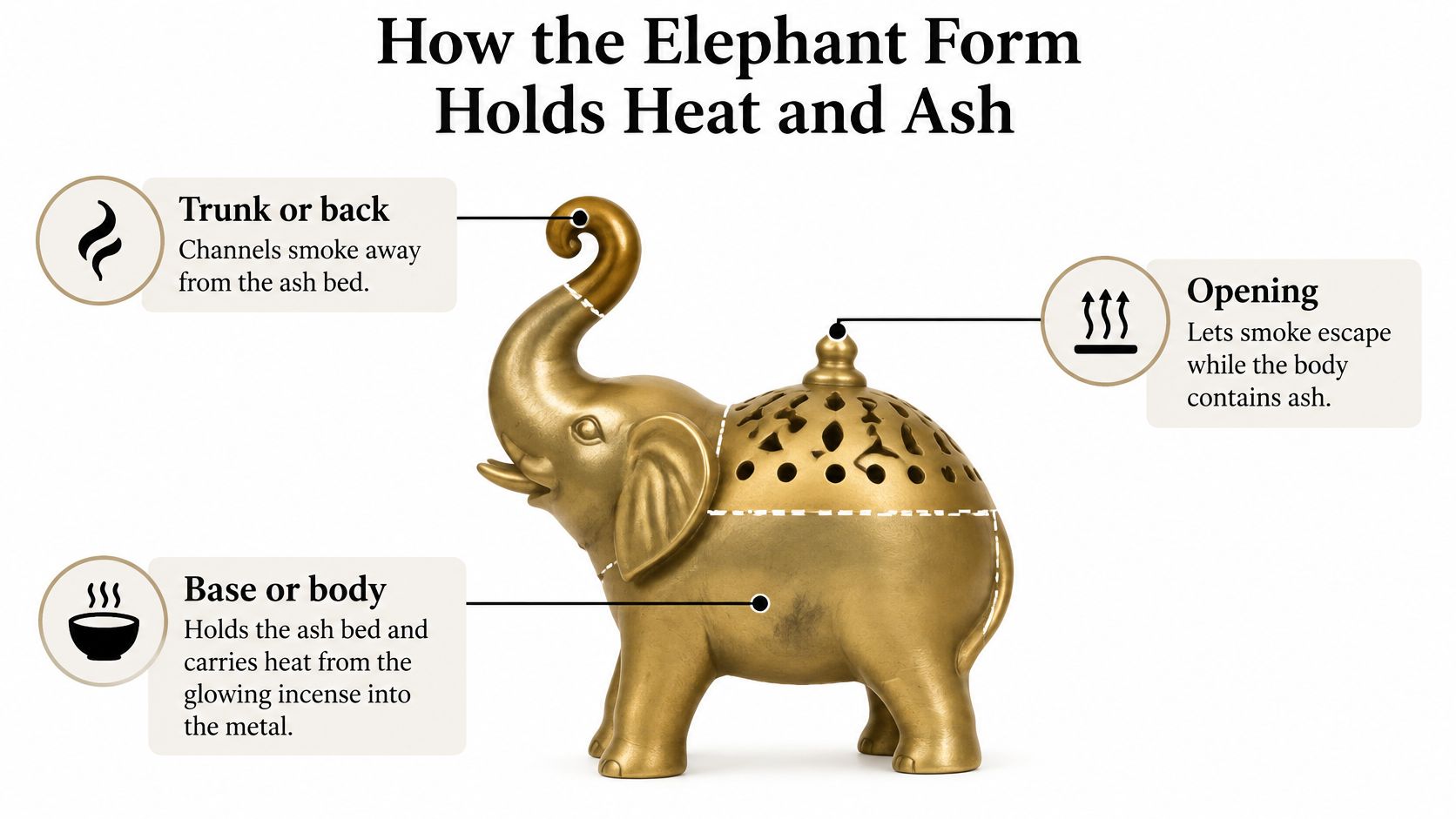
Read the body, smoke path and lid
Base or body: This supports the incense receptacle and collects residue. Heat can travel from the burning material into the metal, including surfaces you can't see from above.
Trunk or back: Depending on the design, these may contain smoke outlets or be decorative. Never assume a narrow trunk is a stick socket unless it's made for that purpose.
Opening and removable lid: These provide access and influence airflow. A fitted lid should sit securely without sealing the combustion chamber or pressing against the incense.

Brass doesn't make the heat disappear. An attractive outer shell can become hot even when the ember is hidden, and decorative handles aren't automatically safe to touch during use.
The elephant form has a substantial history. The Los Angeles County Museum of Art identifies an elephant-shaped incense burner made around 1250, with a separate lid; its materials are wood, metal, crystal, and pigments, not brass. That distinction matters: historical ancestry establishes the form's longevity, not the performance of a modern retail model.
Inspect the working chamber
Look inside while the burner is empty and cold. You want a secure receptacle, enough surrounding space to contain residue, and access that lets you remove spent incense without shaking the whole elephant.
A lid that rocks can shift when you brush against the table. A shallow chamber may collect cone residue but fail to catch ash from an angled stick. Our guide to whether ash catchers are worth it helps distinguish holding incense from collecting what falls from it.
A tray is backup containment, not a repair. It can protect the surrounding area from stray ash, but it doesn't make a cracked body, unstable base, or badly fitting lid suitable for burning. Keep those pieces as unlit ornaments until the defect is resolved.
Which Incense Works in an Elephant Burner
Choose by combustion method and holder design, not fragrance. Sandalwood sticks and sandalwood resin may smell related, but they require different support and heat management. An elephant silhouette tells you nothing about compatibility on its own.
Incense types and how they suit an elephant burner
Incense type | Burner fit | Ash and heat behaviour | Main risk |
|---|---|---|---|
Hand-dipped sticks | Suitable with a purpose-made socket and an ash-catching area beneath the burning length | Ash falls along the stick's burn path | Stick slips or ash lands beyond the body |
Incense cones | Suitable on a flat, noncombustible cone well approved for the burner | The glowing portion approaches the supporting surface as it burns | Cone tips or overheats an unsuitable receptacle |
Resin and loose powder | Only in a design intended for the particular heating method | Resin may need charcoal or a separate heater; loose powders have different requirements | Heat overload or embers spilling through gaps |
Charcoal-based dhoop | Only where the manufacturer permits that incense form and heat load | Can retain heat after visible smoke subsides | Hot residue and excessive heat transfer |
Herb bundles and palo santo | Generally unsuitable for a compact elephant chamber; use a purpose-made fireproof bowl | Irregular shapes leave exposed burning ends and loose embers | Embers escape or material rests against the lid |
This example shows the decorative smoke effect, but the hidden receptacle still needs checking.
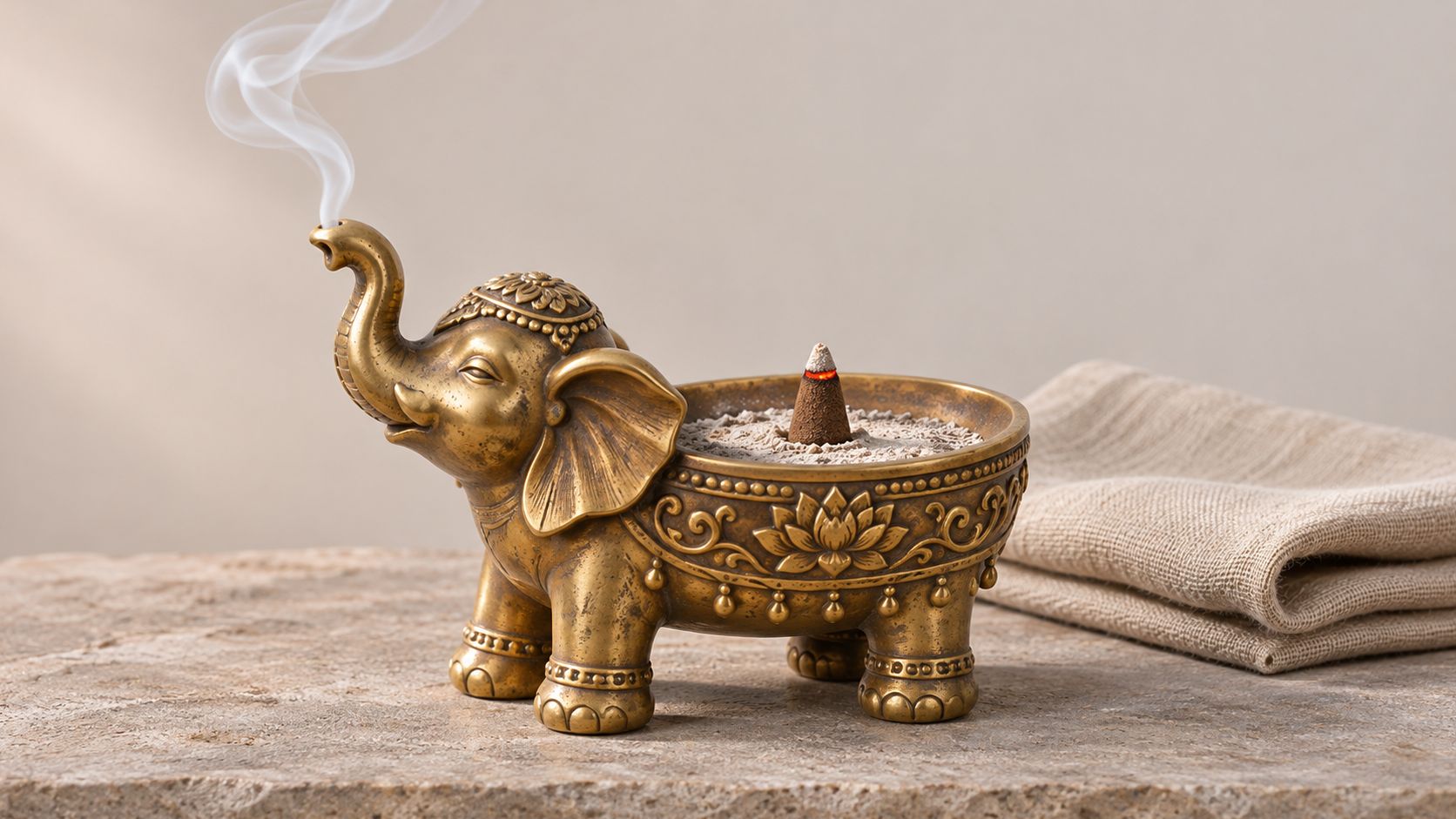
Match the support to the incense
For sticks, check the angle while the incense is unlit. The entire burning section should remain above the ash-catching area, and the socket should grip the uncoated end securely. Choosing good incense sticks won't compensate for a holder that lets them lean beyond its edge.
Cones need a level seat rather than a convenient-looking hollow. Don't tip hot ash from a burning cone to improve its appearance or airflow. Let the session finish and the residue cool before cleaning.
Resin requires particular care because resin and loose powder aren't one interchangeable category. Some preparations burn directly; others need an external heat source. Don't put charcoal inside a decorative elephant unless that exact burner is designed for charcoal use.
A backflow cone also needs a compatible air channel to produce its intended effect. A trunk-shaped smoke outlet doesn't automatically make a burner a backflow model.
If the incense doesn't fit securely while cold, don't try to make it fit while burning.
When compatibility isn't stated, leave the piece unlit until you have clear instructions. A trial on a tray cannot establish whether an unsuitable coating, joint, or chamber can tolerate the heat.
How to Choose a Brass Elephant Burner
The deciding question is straightforward: will this burner stay upright and contain the residue produced by your incense? Treat appearance as the final selection criterion, after the functional checks.
Use a cold, empty inspection in a shop. Online, look for underside photographs, an open-lid view, and explicit compatibility information rather than relying on staged smoke photographs.
The checklist illustrates the main physical checks.
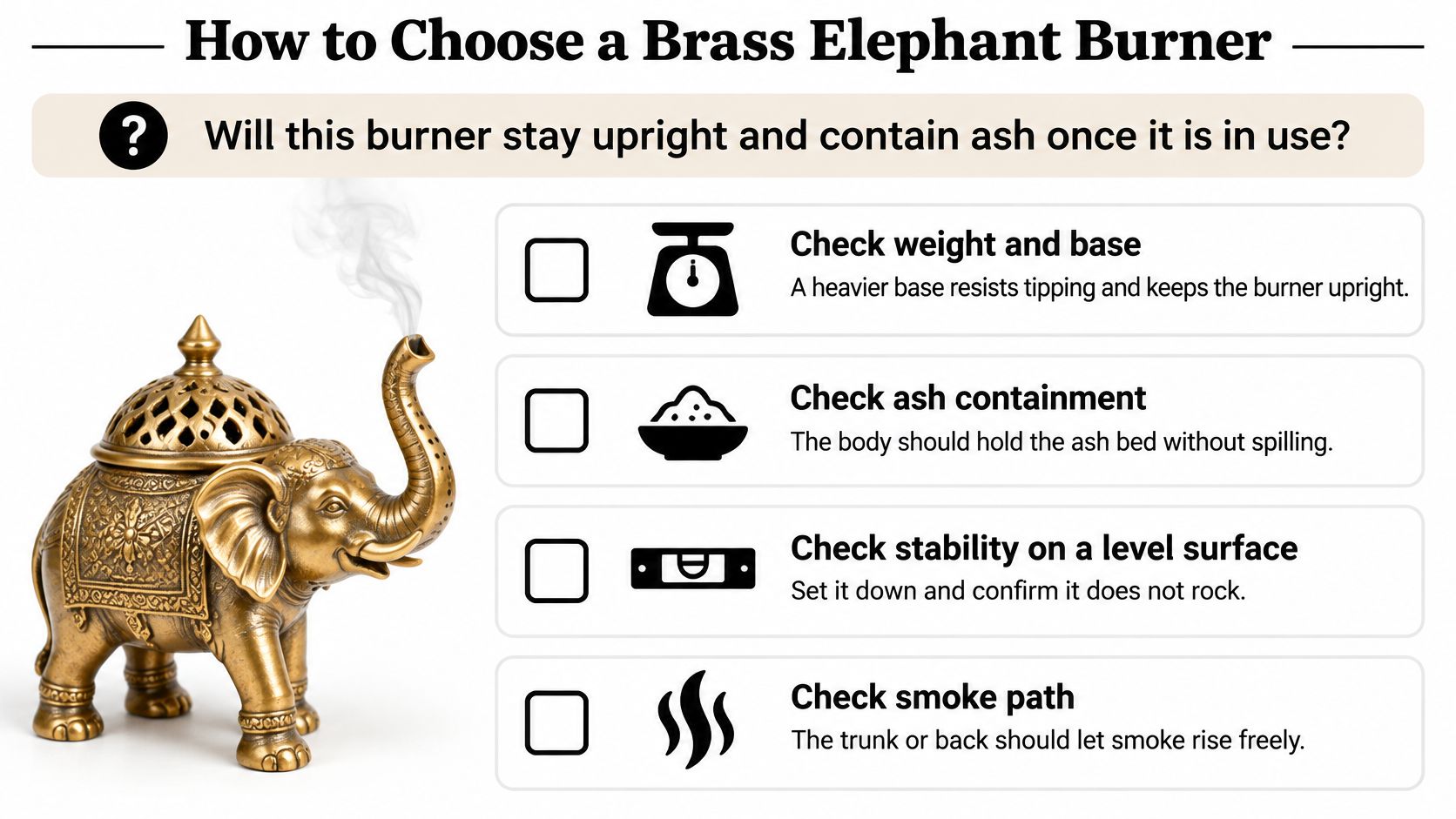
Examine the supporting structure
Weight and footprint: Check whether the mass sits low and whether every intended foot touches the surface. More weight can help resist a nudge, but a heavy top on narrow feet can still be awkward.
Ash containment: Follow the likely path of falling ash. A deep body doesn't help if the stick projects beyond it or a side opening sits level with the ember.
Heat management: Look for a designated inner receptacle and instructions for any insulating fill. Sand or ash may be appropriate in some vessels, but neither replaces a suitable supporting surface.
Press gently near the lid while the empty burner sits on a level counter. If it rocks, examine the feet for uneven casting rather than assuming its weight will settle it. Avoid purchasing a piece that needs improvised wedges.
Check access and workmanship
Openings: Confirm that the intended smoke route is clear and that glowing material can't easily roll through a low gap. Don't drill extra vents into a finished burner to solve poor performance.
Lid and cleaning access: Remove and replace the cold lid. It should seat predictably, and you should be able to reach the chamber with a soft brush without forcing a tool into a narrow passage.
Casting and finish: Inspect seams, edges, and interior surfaces for cracks, burrs, loose parts, or unidentified coatings near the burning area. Decorative patina isn't evidence of heat suitability.
For resin use, apply the more specific requirements in our guide to incense burners for resin. A broad bowl alone doesn't establish charcoal compatibility.
Mark each criterion confirmed, unclear, or failed. Don't let several attractive features cancel a failed safety requirement. Between otherwise comparable pieces, prefer the one with a broader actual support area, lower weight distribution, and clearer instructions.
For retailers, keep an unlit display sample available for inspection. Customers should be able to see the chamber and understand the intended incense format without dismantling a crowded shelf.
How to Use a Brass Elephant Burner Safely
Set up the burning area before opening the incense packet. Once an ember is established, you shouldn't need to move the elephant, search for a tray, or clear paper from beside it.
This visual outlines the initial setup, with the full procedure below.
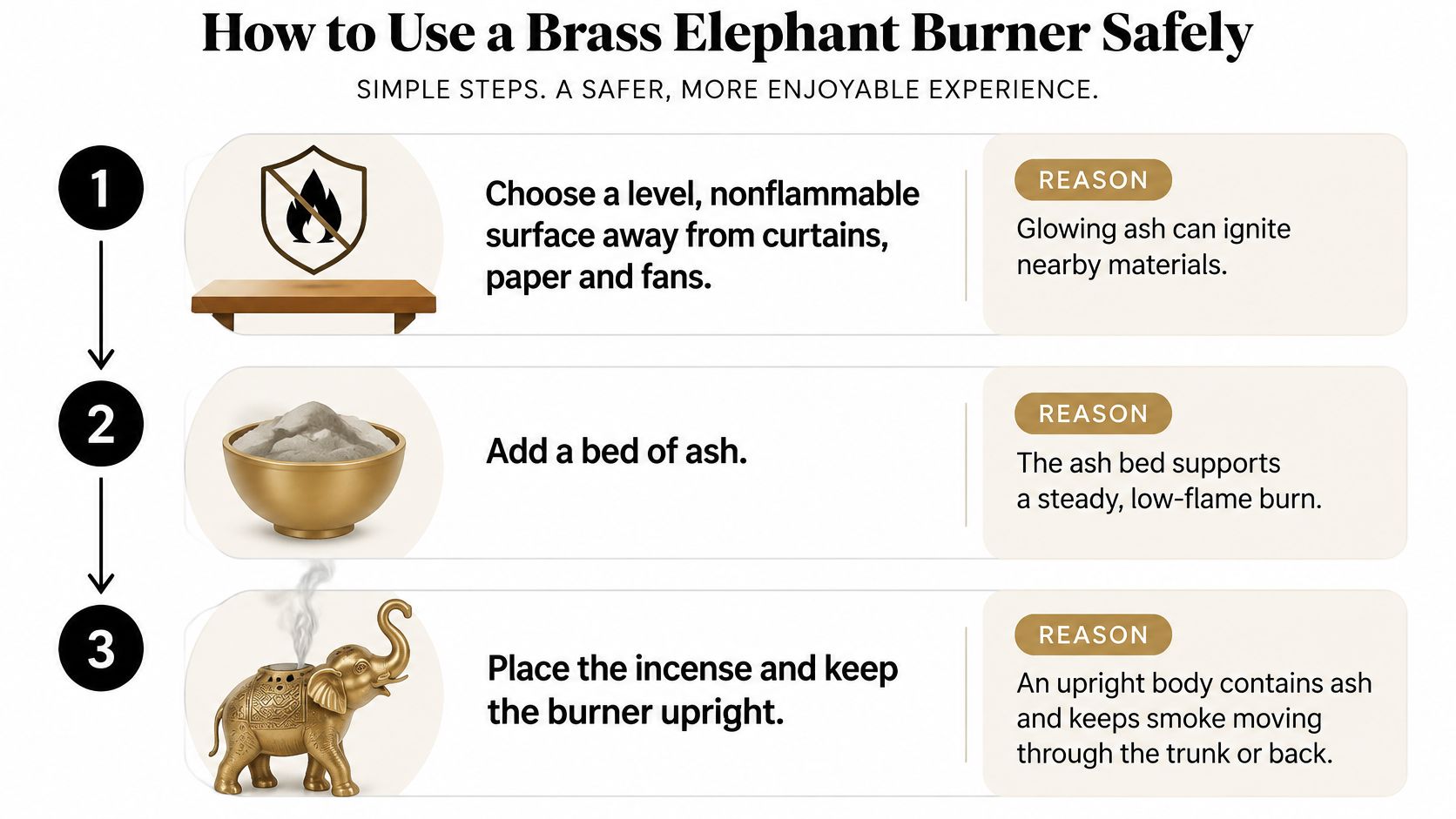
Follow a deliberate lighting routine
Prepare a level, nonflammable location. Use a heat-resistant tray on a suitable surface, away from curtains, paper, shelving overhangs, and direct fan airflow. Brass won't burn like wood, but nearby materials can still ignite from escaped embers.
Prepare the receptacle as instructed. If the burner calls for clean sand or an ash bed, spread it evenly without covering vents. Don't add improvised fill to a stick socket or assume loose ash will secure an otherwise unsupported stick.
Position the incense while cold. Fit the stick into its socket or place the cone centrally in its well, then check clearance around the lid. This prevents adjustments that would otherwise require handling hot parts.
Light according to the incense instructions. For ordinary sticks and cones, extinguish the initial flame once the tip is established and confirm a steady smoulder. Watch the first use closely for shifting incense, falling ash, or unusual smoke from a finish or joint; stop if anything seems wrong.
Stay present and restrict access. Keep children and pets away from the entire setup, including tablecloths and trailing objects they could pull. Don't leave incense burning when you leave the room or go to sleep.
Extinguish and allow complete cooling. Use the method appropriate to the incense, such as a dedicated snuffer or quenching a removable burning tip in a separate noncombustible container. Never assume that no visible smoke means no remaining ember, and don't pour cold water over hot brass.
Ventilate without creating a cross-draft
Opening a window may reduce smoke accumulation, but ventilation doesn't make incense smoke harmless. Position the burner away from the direct air stream, and stop burning if anyone experiences irritation or discomfort.
A decorative elephant is a museum object category as well as a modern accessory, illustrated by the Roots heritage collection. A collection record isn't a consumer stability test or indoor-air safety certification, so assess the actual retail piece rather than assuming the form guarantees safety.
Don't cover, disconnect, or relocate an alarm to accommodate incense. Our explanation of whether incense can set off a smoke detector addresses that practical concern.
For an additional visual reference, the following video is available.
A controlled session leaves ash inside the intended receptacle, with no displaced incense or scorched surrounding material. After extinguishing, leave everything undisturbed until fully cool before handling or putting it away.
Cleaning and Caring for Brass Burners
Care starts with cooling, not polishing. A hidden ember can remain among residue after the visible smoke stops, so don't empty a recently used chamber into household rubbish.
Once everything is cold, lift loose ash with a small metal spoon and loosen remaining dust with a soft brush. Collect it in a metal container kept away from combustible material until you're certain it's extinguished.
Clean according to the finish
Routine wiping: Use a soft, dry cloth first. For a washable, uncoated brass surface, a cloth dampened with warm water and mild soap can lift residue without aggressive rubbing.
Interior residue: Work gently with a soft brush. Don't gouge the chamber with a knife or force metal wire through a decorative opening.
Drying: Remove soap with a clean damp cloth, then dry thoroughly, including the lid seat and recessed details. Avoid soaking mixed-material pieces or allowing water to remain inside hollow sections.
Brass can darken with exposure to air and moisture. That patina isn't necessarily damage, and polishing is a cosmetic choice rather than a requirement for use.
Before applying polish, establish whether the piece is bare brass, lacquered brass, plated metal, or an intentionally patinated finish. Use a product compatible with that finish, keep it out of the burning chamber unless expressly permitted, and remove residue thoroughly.
Preserve the finish you actually have, not the shine you expected from the photograph.
Inspect before returning it to service
Check for cracks, loose feet, distorted lid edges, and blocked openings. Stop using a piece that has become unstable or no longer closes as intended; polish can't repair structural damage.
Avoid household acid mixtures and abrasive pads, particularly around fine engraving, inlay, or unknown coatings. If you're comparing construction styles, our Chinese incense burner guide provides useful context for looking beyond the decorative surface.
Make a regular care routine of removing cold residue, wiping the exterior, checking the lid, and storing the burner dry. For a display-only collectible, dusting may be more appropriate than washing or polishing.
Worked Example and Final Choice
Suppose you're choosing between the compact Etsy elephant and the broader Lotus Sculpture holder in the comparison table. You mainly burn sticks, but you'd like the option of using cones later.
The smaller listing gives you a starting point for shelf fit and handling. It doesn't establish the internal socket, ash-catching area, or permitted incense types, so you can't responsibly classify it as stick-only, or cone-safe, from its dimensions and weight.
The larger holder offers more mass and a wider overall outline. However, its widest point may include a bowl or ornament rather than the supporting feet. Dividing overall width by height wouldn't give you a reliable stability rating, and it wouldn't establish suitability for resin or charcoal.
Make the missing details decide
Candidate | Useful information already available | Detail needed before choosing |
|---|---|---|
Compact Etsy elephant | Overall dimensions and combined weight | Contact footprint, socket design, and intended use |
Lotus Sculpture holder | Height, widest point, and weight | Foot spacing, receptacle details, and heat instructions |
Oriental Furnishings elephant | Listed dimensions and price | Dimension orientation, weight, and internal ash capacity |
For a stick-burning setup, choose the candidate whose socket and catchment area you can verify. For cones, require a designated level well. If neither seller establishes those details, choose neither for burning and use a purpose-made holder instead.
Your action today is to write down the incense format you use most, trace the available space on paper, and photograph the surrounding area. Then compare each candidate against the actual installation rather than the product photograph.
The final choice should be the burner with the fewest unresolved functional questions, not the most impressive silhouette. A modest elephant with a secure receptacle and accessible chamber is a better working purchase than an elaborate piece whose burning arrangement remains unclear.
Frequently Asked Questions
1. Are brass elephant incense burners made from solid brass?
Not all brass elephant incense burners are made entirely from solid brass. Some feature brass plating, brass-colored finishes, or decorative brass inlay over another material. Check the manufacturer's material specifications before purchasing if solid brass construction is important to you.
2. Can you put essential oils in a brass elephant incense burner?
A traditional brass elephant incense burner is designed for incense rather than liquid fragrance. Essential oils should only be used in a burner specifically designed for oil heating. Adding oils directly to an incense chamber can create residue, damage the finish, or expose the burner to unsuitable heating conditions.
3. What does an elephant symbolize in incense burner decorations?
Elephants are commonly associated with wisdom, strength, good fortune, protection, and prosperity in various cultural traditions. An elephant-shaped incense burner can therefore serve as both a functional incense accessory and a decorative accent with symbolic meaning.
4. Can you use a brass elephant incense burner outdoors?
A brass elephant incense burner may be used outdoors if its manufacturer permits it and the burner can sit securely on a level, heat-resistant surface. Avoid windy conditions, uncovered areas where rain can enter the chamber, and locations where children or animals could disturb the burning incense.
5. Does brass affect the fragrance of burning incense?
A properly maintained brass incense burner should not significantly change the intended fragrance of your incense. However, accumulated ash, old fragrance residue, and contamination inside the burning chamber can introduce unwanted odors. Regular cleaning after each completely cooled session helps preserve a cleaner fragrance experience.
At Aroma Fragrance Warehouse, we offer hand-dipped incense sticks and cones, along with ash catchers, cone holders, and other incense accessories. Visit us to choose your preferred incense format and a matching holder, then use that format's requirements to assess your brass elephant before its first burn.


