

Gardenia Incense Sticks: Scent, Burning and Storage

You open a pack of gardenia incense sticks expecting the smell of a flowering bush outside an open window. Instead, the unlit bundle smells sweet and creamy, and once you light it, a greener note appears beside the smoke. Is that what gardenia should smell like, or did you choose the wrong pack?
The answer starts with a useful distinction: gardenia describes a fragrance profile, not a fixed recipe. A good stick can suggest the richness of the flower without reproducing it exactly. Choosing well means noticing the layers, checking what survives heating, and treating the smoke as smoke, however pleasant the floral scent.
Table of Contents
The Gardenia Scent You Should Expect - A floral chord rather than a single ingredient - Give the flower some definition
How to Choose a Stick That Still Smells Floral - Compare the package with the burning product - A bright opening isn't the same as lasting character - Record useful details rather than chasing strength
How to Burn One Stick With Less Smoke - Set up before lighting - Put exposure figures in context
Rooms and Routines That Suit Gardenia - Match the scent to the occasion - Choose gardenia over its neighbors deliberately
How to Store Sticks So the Floral Note Holds - Close the pack and separate the scents - Judge condition rather than inventing a shelf life
Start With One Gardenia Pack - Make the trial answer a buying question - Buy for the experience you'll actually use
The Gardenia Scent You Should Expect
Before deciding whether your pack smells convincing, give yourself a few words beyond sweet or strong. These are useful sensory descriptions, not a promise that every formula will show every facet.
Gardenia scent facets on a stick
Facet | What you notice | Linked chemistry | Cold stick vs smoke |
|---|---|---|---|
Creamy white floral | Soft, rich, almost lotion-like gardenia | Complex floral accord, not one molecule | May feel fuller in the room than on the dry stick |
Green leaf | Fresh-cut stem or crushed leaf | cis-3-hexenol, its esters, cis-3-hexenoic acid | Look for it on the cold sniff; heating can change its clarity |
Sweet-green signature | The note that reads as gardenia rather than plain jasmine | Jasmin lactone plus green esters and tiglic acid | Can fade or sharpen once the stick is hot |
Fruity jasmine | Light peach or jasmine-like sweetness | Esters in the flower absolute and in fragrance accords | Can become generic floral perfume if sweetness dominates |
Powdery drydown | Soft soap or face-powder finish | Less volatile materials in some finished accords, not a universal gardenia marker | Assess the lingering room scent after extinguishing |
Say your first impression is something like floral hand cream. Smell again without

pressing the stick against your nose. You might notice a cut-leaf edge behind the softness, or a fruity sweetness that makes the flower feel ripe rather than powdery.
That combination is more informative than sheer strength. Gardenia belongs among the richer white florals, but a convincing interpretation needn't smell sugary or overwhelming.
A floral chord rather than a single ingredient
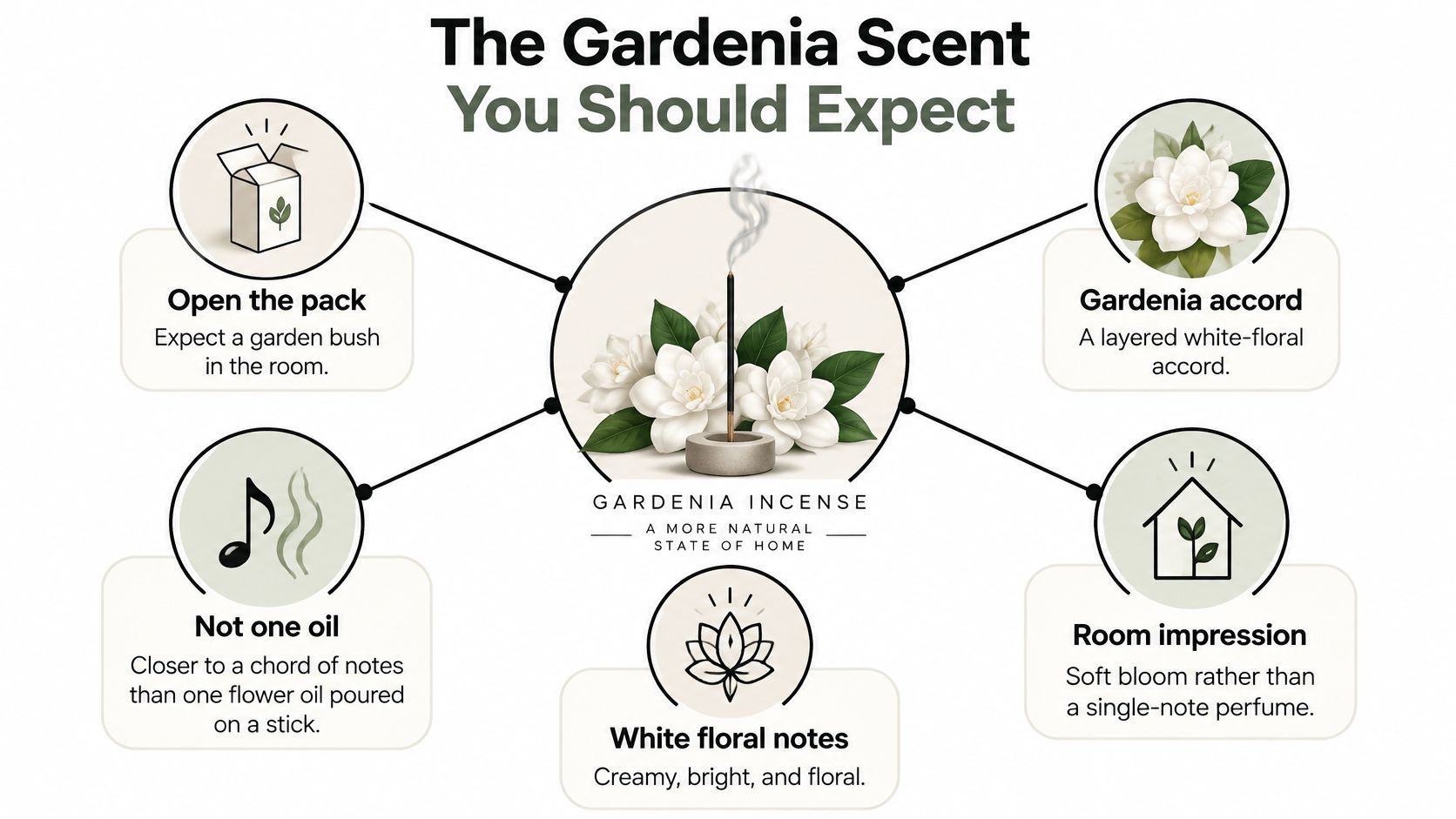
Think of a fragrance accord as a musical chord. Several notes combine into an impression you recognize, even though no individual note sounds like the whole chord.
A 1978 analysis of gardenia flower absolute published in Agricultural and Biological Chemistry identified 130 chemical components and associated its characteristic sweet-green odor especially with jasmin lactone, cis-3-hexenol and its esters, cis-3-hexenoic acid, and tiglic acid. That doesn't mean you need to memorize ingredient names. It means the flower itself is more complicated than a single gardenia oil ingredient might suggest.
Commercial gardenia incense may use botanical extracts, a composed fragrance accord, or both. Different materials and formulations can emphasize the creamy heart, the green edge, or the fruity-floral impression without making either pack automatically wrong.
The scent map below offers a simple way to organize those impressions.
Give the flower some definition
If you're comparing gardenia with rose, jasmine, or lily, use the floral incense sticks guide to place it within the wider scent family. Gardenia generally suggests a fuller, creamier bloom rather than a light petal scent.
Don't reject a pack because it doesn't resemble a living bush at close range. Instead, ask whether you can distinguish a floral center from the sweetness surrounding it.
Practical sniff test: Look for a creamy or green edge that gives the flower shape, rather than sweetness alone.
How to Choose a Stick That Still Smells Floral
Start with the product format, an unlit sample, and a burn test. Those checks answer different questions: what you're buying, whether you like the fragrance direction, and whether the finished stick performs well.
Read stick versus cone, the quantity or weight, and any description of the construction. Hand-dipped and hand-rolled describe manufacturing approaches, not guaranteed scent quality or smoke levels. A thicker body gives you a different product to evaluate, but appearance alone won't tell you how much particulate matter it releases.
Compare the package with the burning product
Where sampling is possible, smell an unlit stick outside its plastic sleeve. Don't inhale loose powder or hold the bundle against your face. You're looking for a recognizable floral impression without an unpleasant solvent-like bite.
Then test the finished stick in the room where you intend to use it. Notice the opening, the established burn, and the room after extinguishing. A simple note such as creamy at first, sharp later is more useful than strong.
What to check before you buy gardenia sticks
Check | Pass | Fail | Why it matters |
|---|---|---|---|
Cold sniff | Green or creamy floral, not only sugar | Flat sweet perfume or solvent-like bite | The unlit stick is only part of the experience |
Heated plume | Floral character holds as burning settles | Scent turns sharp, overwhelmingly smoky, or faint | Smoldering evaporates and can degrade volatile materials |
Formula clue | Balanced accord rather than a dominant fruity note | A generic jasmine-like impression that doesn't suit your goal | A minor ingredient can matter more than its concentration suggests |
Stick body | Even coating and a stable smolder without disintegrating | Crumbs, wet oil, or repeated failure to stay lit | The base and burn behavior affect scent delivery |
Smoke amount | A restrained visible plume with ventilation | Thick black smoke or a persistent flame | Visible appearance is a practical warning, not an air-quality measurement |
The formula row is a sensory judgment, not something you can diagnose from a label. You can't identify an ingredient concentration by sniffing a stick. Ask for formulation information if it's available, but judge the product you burn.
A perfumery analysis in Perfumer & Flavorist discusses benzyl acetate, linalool, and linalyl acetate as important materials, while noting the disproportionate contribution styrallyl acetate can make to a gardenia impression. Increasing a prominent fruity-floral ingredient isn't necessarily the way to make an accord more recognizable.
The same technical distinction explains why a rich-smelling packet can disappoint after lighting. Heat causes evaporation and can break down fragrance materials through pyrolysis. You're evaluating fragrance, combustible base, and heating together, not just perfume on a dry stick.
A bright opening isn't the same as lasting character
Extraction can change the balance before a manufacturer even makes the incense. A study of Gardenia jasminoides extracts indexed by PubMed detected 79 aroma components in a water extract and 56 in a carbon-dioxide supercritical-fluid extract; the latter had a stronger opening fragrance but shorter aroma retention.
Those are extract findings, not burn-time specifications for incense. They illustrate why a more intense opening doesn't automatically mean a longer-lasting or more faithful floral experience.
Say you're comparing a bright, green sample with a softer, creamier sample. The bright version might be your favorite before ignition, while the creamy version leaves a more pleasing room impression. Neither result can be predicted from a bloom photograph on the package.
For a broader buying checklist, the guide to choosing good incense sticks helps separate fragrance preference from basic construction quality.
Record useful details rather than chasing strength
For a home comparison, keep the holder, room, and ventilation arrangement consistent. For a shop or studio, add the product name, batch information when available, and any declared fragrance loading or base materials to your notes.
Opening impression: Write down green, creamy, fruity, powdery, or sharp rather than nice.
Established burn: Check whether the gardenia identity remains distinguishable from the combustible base.
After extinguishing: Notice whether you enjoy what remains, without relighting merely to chase the opening.
Burn behavior: Record repeated extinguishing, crumbling coating, or an ember that behaves unpredictably.
There's no supported universal burn time for gardenia incense sticks. Length, thickness, base, and formulation determine the useful specification, so don't borrow a duration from an unrelated product.
How to Burn One Stick With Less Smoke
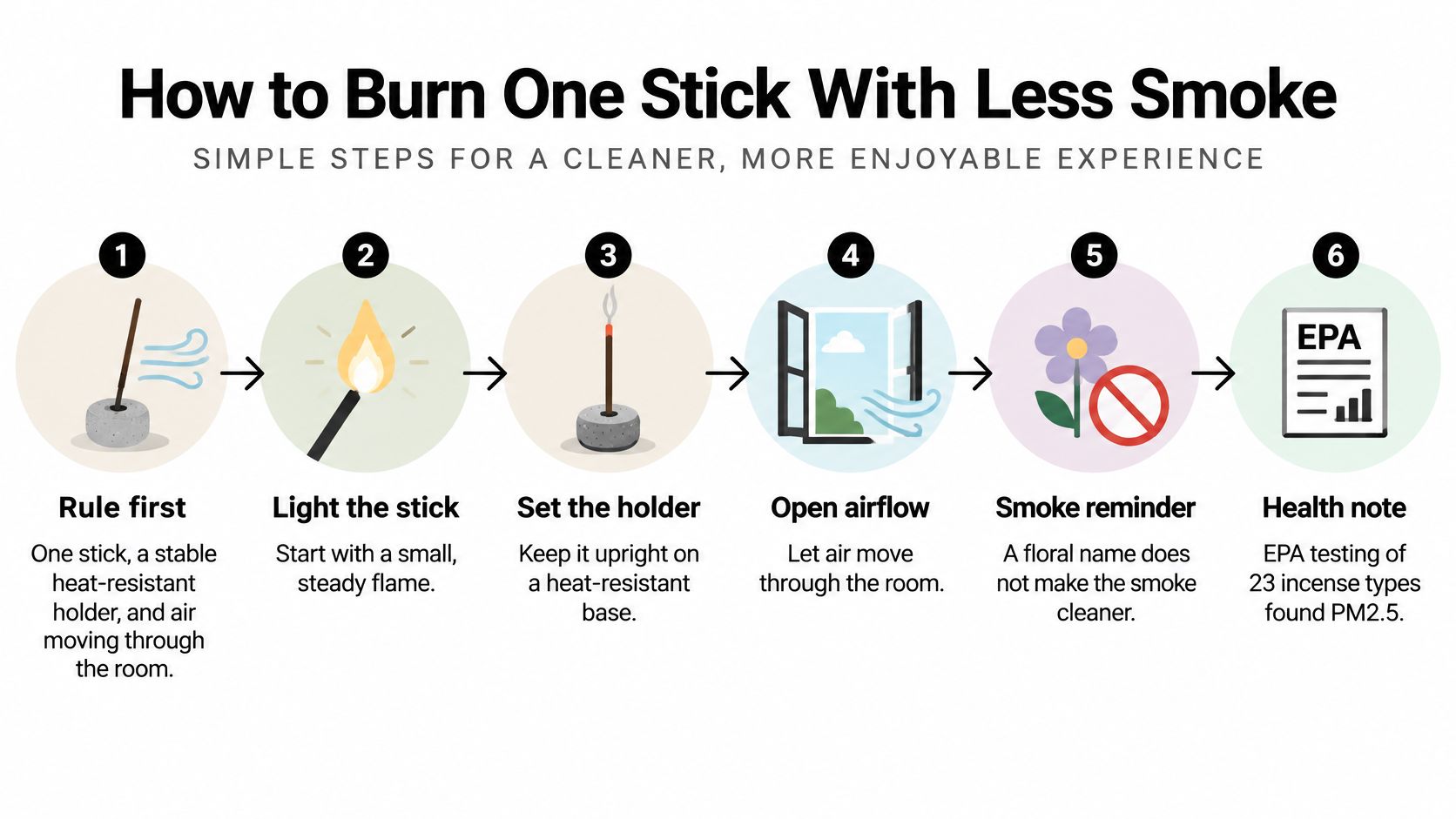
One stick, a stable heat-resistant holder, and a path for smoke to leave the room: that is the whole setup. Gardenia may smell soft and creamy in the air, but a floral name changes nothing about combustion. Heating a layered floral accord releases the same kinds of fine particles as any other stick, and a faint visible plume can still carry particles you cannot see.
The EPA characterization of incense emissions measured PM2.5 emission rates of 7 to 202 mg per hour across 23 incense types, with emission factors of 5 to 56 mg per gram burned. Those are ranges across tested products rather than a rating for any single scent. Exposure scales with mass burned the way seasoning scales with spoonfuls: half a stick produces roughly half the smoke.
Set up before lighting
Choose a secure position. Put a nonflammable holder on a stable, heat-resistant surface. Its ash-catching area should extend beneath the burning section, away from curtains, paper, bedding, and shelf edges.
Ventilate to outdoors. Open a window where practical or use an exhaust fan that vents outside. A recirculating fan moves room air around without removing smoke.
Light the tip only. Let the tip catch, then gently blow out the flame. The stick should smolder with a glowing ember, not continue flaming.
Use a short portion. You don't have to finish the stick. Extinguish it when you've achieved the room impression you wanted.
Keep people out of the plume. Position the holder away from faces and seating. Distance isn't a substitute for ventilation, and there's no universal safe placement distance.
Extinguish completely. Press the glowing tip into sand in a heat-resistant container and check that no ember remains. Continue ventilating afterward.
Treat the sequence below as a placement and handling reminder rather than a promise of clean indoor air.
Put exposure figures in context
An incense-emissions review indexed by EPA HERO puts average particulate emissions at about 45 mg per gram burned. A gentle-smelling stick still burns grams, so the amount you burn matters more than how mild the result smells.
Incense smoke numbers that change how you burn
Measure | Figure | What to do with it |
|---|---|---|
PM2.5 emission rate across tested incense types | 7 to 202 mg per hour | Avoid burning several sticks together |
PM2.5 per gram burned | 5 to 56 mg per gram burned | Use shorter burns to reduce the amount consumed |
Average particles in the review | About 45 mg per gram burned | Judge exposure by mass burned, not by floral scent |
Never leave burning incense unattended. Keep it away from babies, pets, people with asthma, or anyone who reacts to smoke; if irritation occurs, extinguish the stick and leave the smoky area.
Cramped rooms leave less margin for error. The guide to choosing incense for small apartments can help you assess the setup; if you cannot ventilate adequately, skip the burn rather than trying to mask smoke with more fragrance.
Rooms and Routines That Suit Gardenia
Gardenia makes more sense as an occasional room accent than as an all-day air freshener. Choose a moment when you can notice the fragrance without competing cooking odors, a crowded room, or another strong perfume.
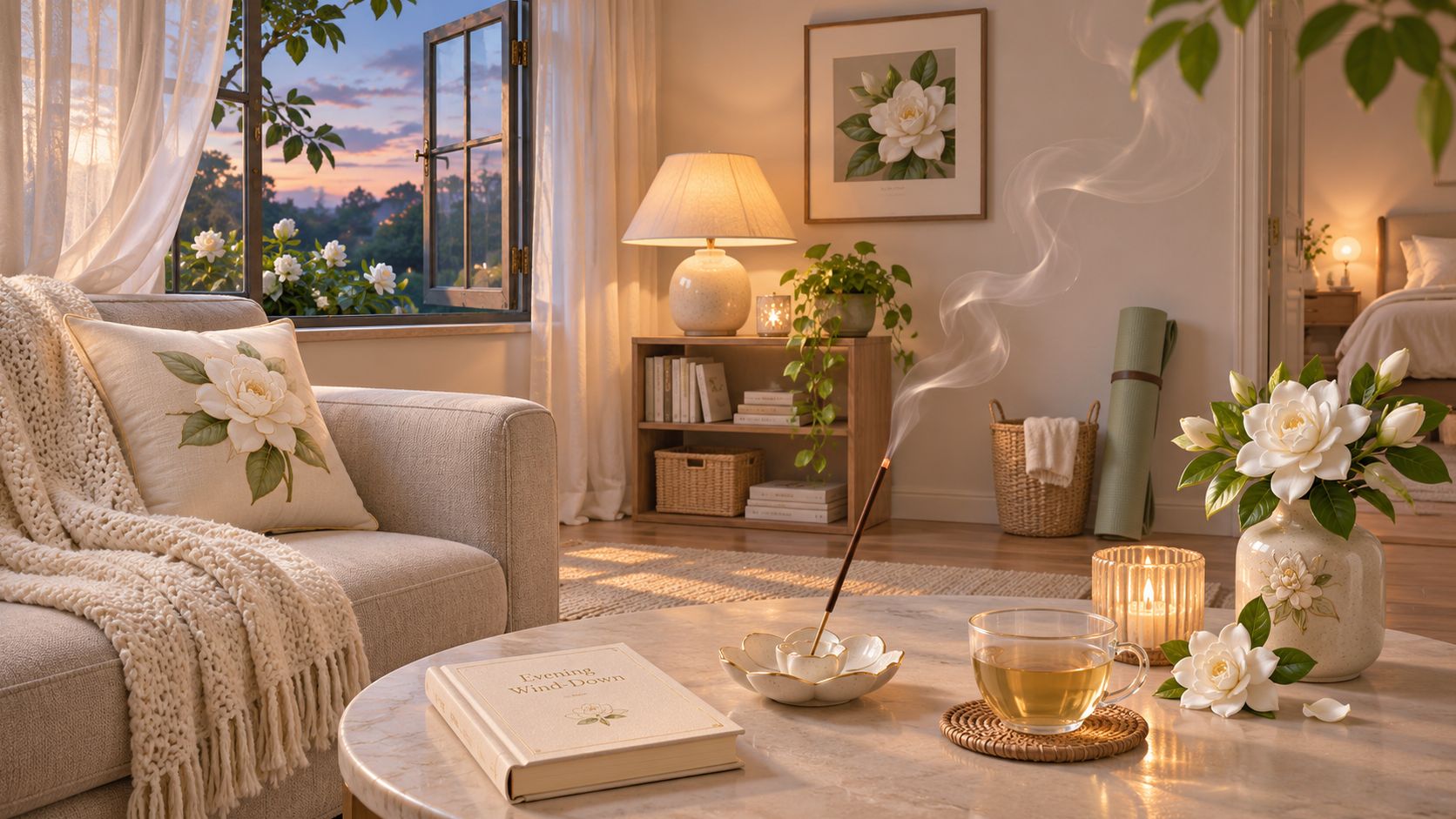
A living room with an openable window is a more practical starting point than a small bathroom. The room should let you position the holder securely and keep the scented plume away from people.
The setting can be simple: a clear side table, a drink placed well away from ash, and enough space around the holder.
Match the scent to the occasion
Before guests arrive, a brief, attended burn can give you a floral room impression without keeping an ember going throughout the visit. Extinguish it, air the room, and don't assume guests will share your fragrance preferences.
For meditation or gentle stretching, treat lighting and extinguishing as deliberate bookends rather than leaving incense burning in the background. The routine may help you mark a transition, but gardenia incense isn't a treatment for stress or a requirement for relaxation.
A gift shop or studio needs a different approach. Offer an unlit tester first; if a burn demonstration is appropriate, use a designated ventilated area rather than continuously scenting the sales floor or an occupied class.
A customer should be able to choose a fragrance without having to stand in its smoke.
Choose gardenia over its neighbors deliberately
Gardenia's appeal is its rounded white-floral character. Lavender usually reads more herbaceous, sandalwood more woody and dry, and nag champa often sweeter and more traditionally incense-like. These are scent-family comparisons, not guarantees about every manufacturer's formula.
Choose gardenia for a floral centerpiece. It suits a restrained setting where you want the bloom itself to be noticeable.
Choose an alternative for less floral sweetness. A woody or herbal profile may better match your taste.
Leave the room unscented when needed. Strong cooking smells, fragrance-sensitive visitors, or poor ventilation are good reasons not to light anything.
Don't use a scented routine to mask a pet area. Consult the guide to incense safety around pets, and keep animal comfort ahead of the room fragrance.
Pick a recurring occasion you can keep brief and attended, such as settling down with a book. There's no need to scent the whole evening.
How to Store Sticks So the Floral Note Holds
An open bundle is a little like a bar of scented soap left unwrapped: fragrance escapes into the surrounding air, and nearby odors can complicate what you smell. The goal is to preserve the original balance, not just keep the sticks dry enough to burn.
Choose a cool, dry, dark cupboard. A sunny windowsill, humid bathroom, or hot car is a poor storage place, even if the packaging looks decorative there.
Close the pack and separate the scents
Keep the original sleeve inside a resealable bag or a well-closing container if the sleeve doesn't seal. Protect the coating from rubbing against rough surfaces, and avoid bending the bundle to make it fit a short container.
Separate strong fragrances. Store gardenia away from open sandalwood, nag champa, sage, and household cleaning products.
Support the bundle. Lay it flat in a suitable box or keep it upright in a closed container without crushing the tips.
Limit repeated handling. Take out the stick you need, then close the remaining supply.
Keep stock orderly. For a shop or studio, mark when a pack was opened and finish that pack before opening another of the same fragrance.
A sealed container shouldn't become an excuse to store damp sticks. If a bundle feels unusually wet, has visible mold, or shows damaged coating, set it aside rather than testing whether burning will improve it.
Judge condition rather than inventing a shelf life
There isn't a universal shelf life you can assign to every gardenia formula. Packaging, storage conditions, and the original materials all affect how well the fragrance holds.
Smell an older stick in fresh air before lighting. A weaker floral impression may mean it no longer suits your taste; a rancid, musty, or otherwise unpleasant odor is a reason not to use it.
Storage rule: Protect the fragrance you bought. Burning won't restore missing top notes or correct a spoiled smell.
Don't refrigerate incense as a preservation shortcut. Moving a cold container into warm, humid air can introduce condensation, while ordinary cool cupboard storage avoids that complication.
The guide to whether incense expires or goes bad explains the distinction between fading fragrance and deteriorating condition. For gardenia, your useful benchmark is the pack's original floral character, not whether an old stick can still hold an ember.
Start With One Gardenia Pack
A trial pack and a suitable holder make a more useful first purchase than a bulk assortment. You're testing a particular fragrance in a particular room, not committing to the entire white-floral category.
For price context, a 2025 Juniper Aberdeen retail listing priced gardenia incense sticks at £3.60 per pack. That's a historical example from a UK retailer, not a current quote or a price comparison across stores.
Make the trial answer a buying question
Decide what would make the pack worth buying again. Perhaps you want a recognizable green-floral opening, or perhaps the soft room impression matters most. Write that preference down before comparing alternatives so that intensity doesn't become your only criterion.
For a shop, the decision also includes how clearly you can describe the product. Creamy floral with a green edge tells a customer more than luxurious gardenia, and it sets a more realistic expectation.
For home use: Keep the initial purchase small enough that you can change direction without leftover stock.
For a studio: Evaluate whether fragrance is appropriate for the people using the space before planning a recurring routine.
For resale: Sample the finished product before expanding the assortment, and describe scent separately from ventilation guidance.
Buy for the experience you'll actually use
At Aroma Warehouse, our hand-dipped incense sticks are soaked in pure incense oil for no less than 24 hours. We offer sticks and cones in various scents and sizes, alongside fragrance oils and handcrafted wooden incense burners.
That manufacturing detail describes our process, not a guarantee that every scent will suit every room. Your own short, ventilated trial remains the deciding factor.
Keep the pack if you enjoy the fragrance as a complete experience, including the room afterward. If the floral character feels too heavy, choose a different scent family rather than adding another stick in search of a better result.
Frequently Asked Questions
1. Can gardenia incense smoke trigger a smoke detector?
Yes. Depending on the detector's sensitivity and the amount of smoke produced, burning incense can activate a smoke alarm. Never cover or disable a smoke detector to burn incense. Follow the detector manufacturer's safety recommendations and maintain appropriate ventilation.
2. Can you relight a partially burned gardenia incense stick?
Yes, provided the stick has been completely extinguished and cooled, and enough unburned material remains. Check that the tip is free of glowing embers before storing or handling it. When relighting, place it securely in an appropriate incense holder and never leave it unattended.
3. Does burning gardenia incense leave residue on furniture or walls?
Incense smoke contains fine particles that can gradually settle on nearby surfaces. Repeated burning may contribute to residue on walls, furniture, windows, and other household items. Limiting burn time, maintaining ventilation, and keeping incense away from delicate surfaces can help reduce buildup.
4. Can gardenia incense be used alongside scented candles or fragrance diffusers?
It can, but combining multiple fragrances may create an overpowering or confusing scent. Gardenia has a naturally rich floral profile that can compete with other fragrances. For a more recognizable gardenia experience, try enjoying it on its own before introducing additional scents.
5. How should you dispose of gardenia incense ashes?
Allow the ashes to cool completely before disposal. Check carefully for any remaining glowing embers, then place the cooled ashes in an appropriate waste container. Never dispose of warm ashes in a trash bin, near combustible materials, or anywhere they could create a fire hazard.
Aroma Warehouse offers hand-dipped incense sticks and cones, fragrance oils, and handcrafted wooden incense burners for a practical fragrance setup. Visit Aroma Incense Warehouse to explore the selection, choose a suitable holder, and start with a small purchase you can evaluate at home.


