

Rose Incense Sticks: Scent, Burn and Storage Guide

You light a stick, sit back, and wait for a flower garden. The first thirty seconds hand you something greener and sharper instead, a crushed-stem smell with a dry, woody edge underneath it. Two minutes later the room softens and the rose you paid for finally arrives.
That arc is how a rose stick is built to burn. It also explains the two complaints that fill review sections: sticks that smell like a bonfire wearing perfume, and sticks that smell wonderful for five minutes and then fade to nothing. Both come down to the same contest between fragrance and combustion, and both are easier to manage once you know what each part of the burn is doing.
Table of Contents
What Rose Incense Sticks Smell Like - Three reasons people reach for rose
Best Rooms and Rituals for Rose Incense - Where rose earns its place
How to Light and Burn Rose Incense Sticks - When the burn misbehaves
When Smoke Is Too Much for the Room - Who should skip the stick entirely
How to Store Rose Incense Sticks - Freshness window by blend
What Rose Incense Sticks Smell Like
Heat peels fragrance off a stick from the lightest molecules down, so the opening minute reads bright and slightly green, like petals rubbed between your fingers rather than a rose candle. For most of a 20 to 40 minute stick the heart is unmistakably rose, and it tends closer to tea rose or damask than to the single garden bloom people picture. Then the base lands as the ember nears the holder.
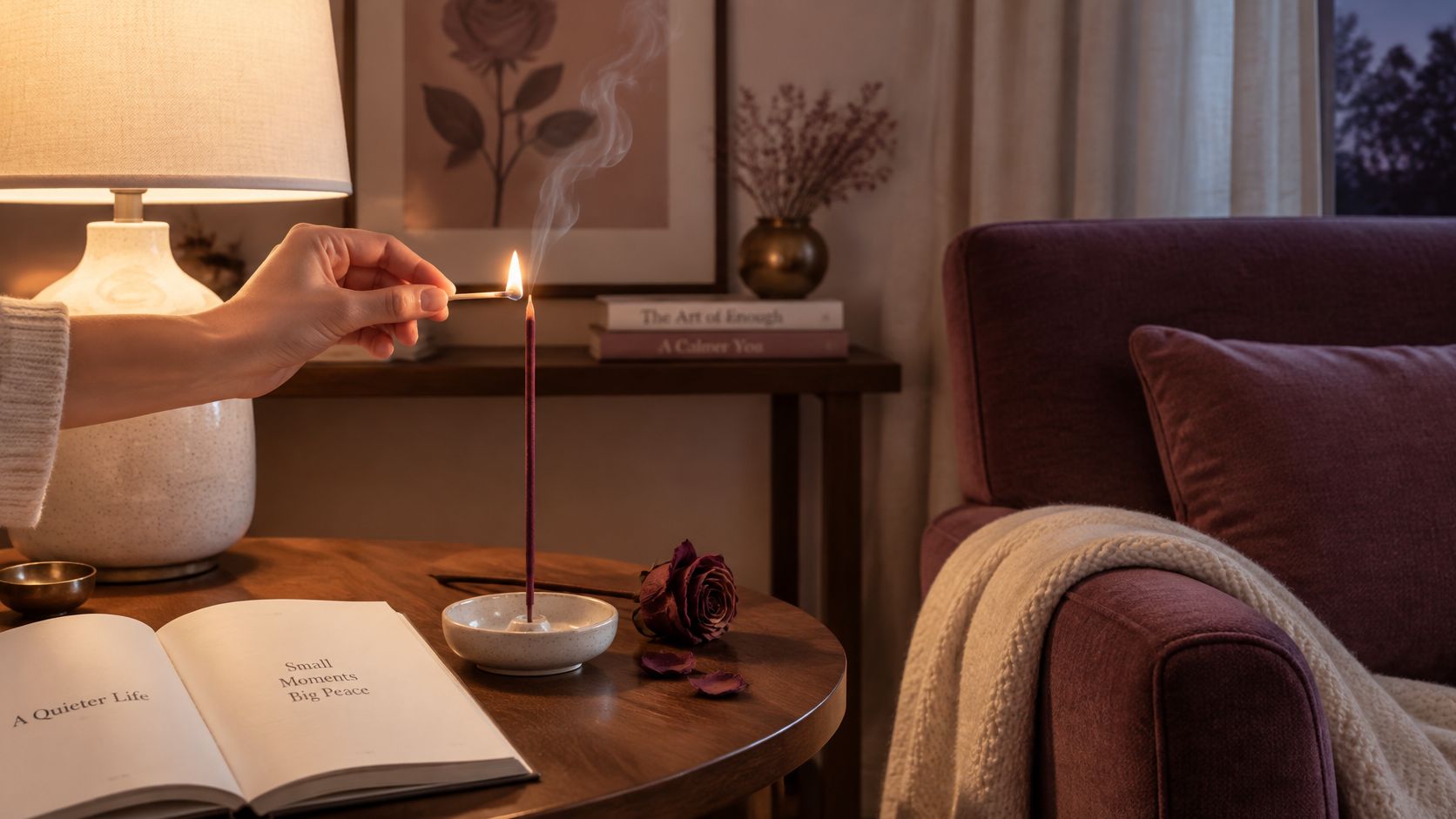
The finish depends on the blend. Sandalwood gives a warm, dry close. Vanilla and musk round it out sweeter, and a faint honey note shows up in some formulas. A masala or hand-rolled stick often carries spice and green plant material alongside the flower, while a hand-dipped stick smells smoother and closer to a room spray, with less botanical edge.
The cold stick lies a little. Unlit, rose incense smells sweeter and louder than it ever will while burning, because heat changes the oils and the core adds its own dry note once it smolders. A stick that smells like a perfumed drawer can turn sharp in the air, and a faint one can bloom in a warm room.
Three reasons people reach for rose
A short wind-down. Ten quiet minutes at the end of a workday, with something softer than a resin or a smoke-heavy wood.
A gentler room anchor. Yoga and meditation spaces often want a scent that sits behind the breath rather than on top of it, which is where rose beats sage and nag champa.
Flowers without a plug-in. A living room that needs floral warmth without an outlet, a refill schedule, or a plastic diffuser on the shelf.
Rose is the easy part. Matching the stick to the room, and knowing when to put it out, is where many beginners get surprised.
Best Rooms and Rituals for Rose Incense
You light one rose stick in the living room after dinner, expecting a soft floral haze. Twenty minutes later the petals are still there, and so is a thin gray layer at lamp height. The scent you bought and the fine smoke every stick still makes are not the same thing. Picking the room, and a hard stop, is how you keep the first and limit the second.
Setting | Session length | Sticks at once | Airflow | Why rose fits |
|---|---|---|---|---|
Evening wind-down | 20-30 minutes | 1 | Cracked window | Soft floral, less sharp than resin |
Meditation or yoga | 15-25 minutes | 1 | Door open, low fan | Calmer than sage or nag champa |
Living room fragrance | 30-40 minutes, one full stick | 1 | Cross breeze | Floral scent without a plug-in |
Bedroom before sleep | 10-15 minutes, then air out | 1 | Window open, extinguish before bed | Avoids sleeping in smoke |
Small bathroom | Skip, or 5 minutes | 0-1 | Exhaust fan | Room is usually too small |
Altar or gift ritual | Full stick if the room allows | 1 | Normal airflow | Traditional floral offering |
Read each row as a ceiling, not a target. The minutes assume an ordinary room with air moving through it. A smaller space needs less time, still with one stick. Two sticks in a tight room double the particles. They do not double the rose. Your nose stops noticing the flower within minutes while the smoke keeps building, the way a perfume sample fades on a card while the card itself stays in the room.
A hotel room, a closet studio, or a bedroom with one small window sits under those assumptions. Halve the session. Leave the door open. The floral note still lands.
Where rose earns its place
Meditation is the clearest fit. A floral background can sit under breath and slow movement without taking over the way a heavy resin does. Place the stick across the room from the mat, not beside your knee, so the plume thins before it reaches your face.
In a living room, rose reads as hospitality. Guests notice a flower and rarely ask what it is. Wood, linen, and an open window help. A cross breeze clears particles faster than lighting a second stick.
Bedrooms need the strictest cutoff. Scent the room while you get ready, put the stick out, and let the air settle before you lie down. Smelling a room that was burned an hour ago is a lighter exposure than sleeping inside an active plume.
Bathrooms usually fail the test. Tile and a low ceiling hold smoke at head height. If you still want a short ritual, run the exhaust fan and stop after a few minutes.
For an altar or a gift, burn the full stick only when the room can move air normally. The gesture is the offering. Extra smoke is not a stronger ritual.
A calm corner does some of this work before any stick is lit. Light, layout, and texture set the mood, and these ideas for relaxing home design for Greene County stay on that room-building side, separate from the burn itself. If one evening session is too much smoke for every day, more ways to use incense sticks cover shorter or occasional uses so the routine can change with the room.
One stick stays the default in every row. If the air looks hazy before the timer ends, put it out early. The rose you wanted has already done its job.
How to Choose a Rose Incense Stick
The most common buying mistake happens in the shop, not at home. People sniff the unlit stick, fall for the sweetest one on the shelf, and then discover that sweetness was surface fragrance that scorches off in the first minute. Judge the pack by how it's made, then judge the burn in your own room.
Start with form. A hand-dipped stick carries fragrance oil on a coated core, usually bamboo splint under a charcoal and binder paste. A masala or hand-rolled stick mixes botanicals into the dough itself. Neither form guarantees real rose, and neither is automatically low-emission, because the bamboo core, binder, charcoal, and fragrance carrier all burn alongside the flower you wanted.
Work through these checks before you pay.
Even coat, straight stick. Patchy coating means uneven fragrance and a stick that goes out halfway down.
Sealed packaging. If the wrapper feels oily or the box smells like perfume from the outside, the fragrance has already migrated.
A seller who knows the build. Ask how the blank was dipped or rolled and whether the fragrance load holds from batch to batch. A scent name alone tells you nothing about smoke density.
Pairing notes you want. Rose with sandalwood, vanilla, or lavender is common. A lavender-heavy blend smells sharper, and it isn't the same burn story.
That last point has data behind it. In a 2015 chamber study of rose, lavender, and aglaia incense, lavender released substantially more particles than the other two fragrances under the same conditions, while fine particles below 2.5 micrometers still formed the major fraction of particulate matter for all three. The researchers recommended ventilation and moderate use across the board.
Emissions don't track the label in any simple way. A review of incense emission studies notes that chamber and field work has detected benzaldehyde, linalool, benzyl alcohol, phenethyl alcohol, formaldehyde, and acetaldehyde before or during burning, with benzene, toluene, and diethyl phthalate appearing once combustion starts. That's why product guidance for studios and shops should specify one stick at a time, in a ventilated room, rather than implying that a floral stick is a clean one.
Skip anything that smells like plain perfume alcohol, feels greasy through the wrap, or is sold as smoke-free because it's floral. Then test properly: buy one small pack, burn a single stick in a ventilated room, and keep it only if the rose heart is still soft after the first five minutes. Our guide to choosing good incense sticks covers the same checks for other scent families.
How to Light and Burn Rose Incense Sticks
A clean burn is mostly preparation, and it takes under a minute. The sequence below is the one to repeat until it's automatic. Here it is as a single flow you can follow at a glance.
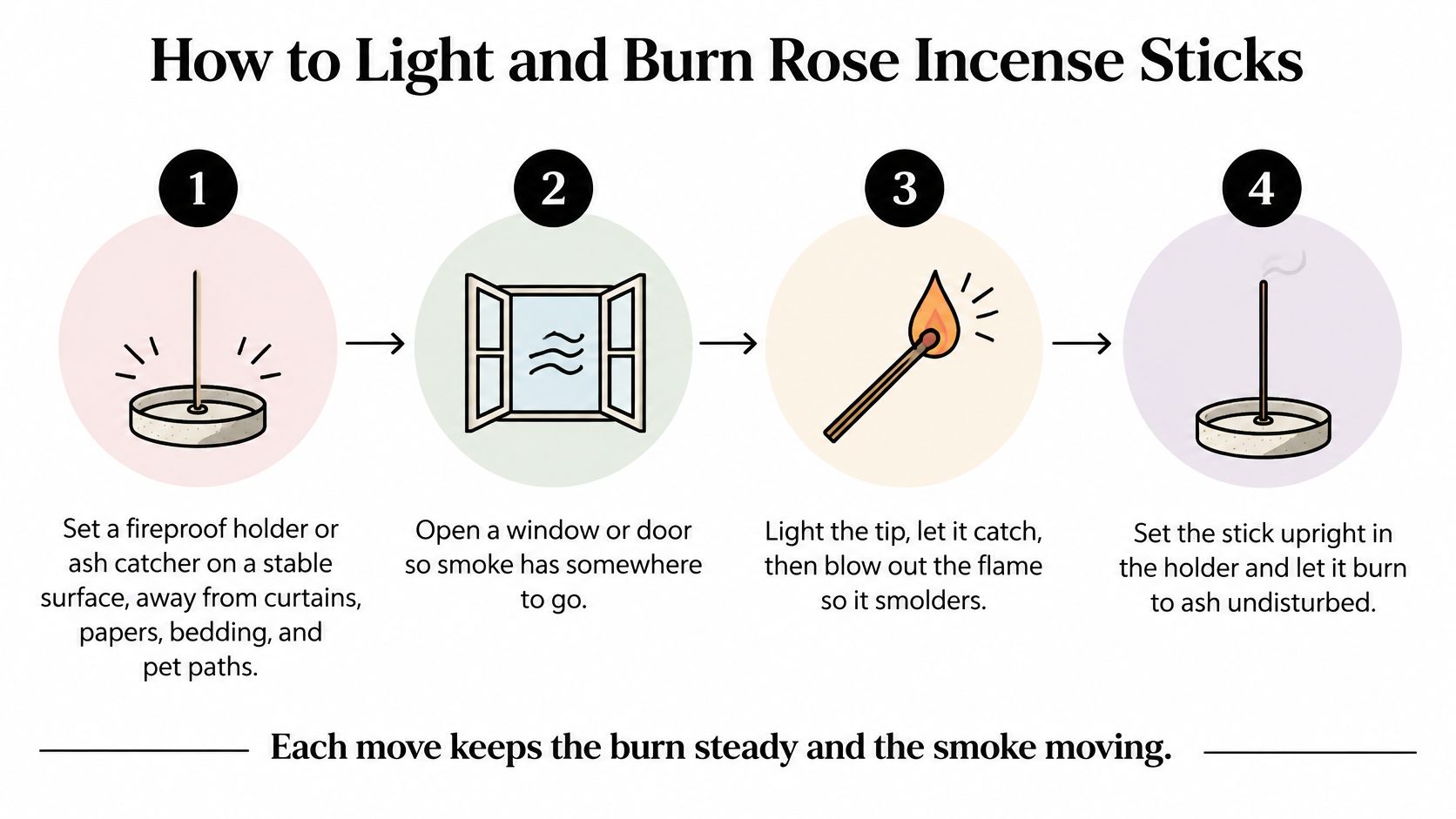
Set a fireproof holder or ash catcher on a stable surface. Keep it clear of curtains, paper, bedding, and the path your cat uses at 2 a.m. Ash falls whether or not you're watching.
Open a window or door so air moves across the room. You want drift, not a blast. Direct airflow on the tip makes the stick race and shortens the burn.
Hold the stick at a slight angle and light only the coated tip. Five to ten seconds is usually enough for a small flame to take. Lighting the bare handle wastes a match and chars the part you hold.
Let it burn a few seconds, then blow the flame out. The tip should glow and smoke. A flame left burning gives you burnt sugar and soot instead of rose.
Seat the stick upright so ash falls into the catcher. A loose hole tips the stick into furniture. If it wobbles, fix the holder before you light anything else.
Sit several feet back from the plume. Close enough to smell the heart, far enough that you're not breathing directly into the smoke column. Stop at the session length that matches the room.
Extinguish by pressing the glowing tip into ash or sand until no ember remains. Don't flick it, and don't douse it with water, which spatters ash and cracks ceramic holders.
If you'd rather see the sequence once before you try it, this short walkthrough covers the same moves.
When the burn misbehaves
A stick that keeps dying is usually damp or standing in a draft. Relight the tip once. If it goes out again, dry the pack somewhere warm and dry for a day before the next attempt, and move the holder out of the airflow.
Bitter smoke in the first minute is often the core, not the rose. If the smell never sweetens, that stick is a poor burn rather than a ventilation problem, and no amount of window opening will rescue it. Set it aside and try another from the pack.
Thick, rolling smoke means the session ran long or more than one stick went in. Put it out, open the room up, and let it clear before you judge the scent. A stick that fell over is a holder problem, so replace the loose one before the next burn.
Burn rule: one stick, one room, one open window. Everything else in this guide is detail around that sentence.
When Smoke Is Too Much for the Room
Rose smells gentle. It still burns. A glowing ember produces the same category of combustion products whether the coating is floral, woody, or resinous, and the floral label is a fragrance description, not an emissions rating.
The scale of it is worth knowing plainly. A review of incense smoke and indoor exposure reports that burning incense releases particulate matter, volatile organic compounds, carbon monoxide, nitrogen dioxide, sulfur oxides, and polycyclic aromatic hydrocarbons, with average particulate emissions of about 45 milligrams per gram burned. The same review cites a 2025 controlled study in which home-use incense carried far more fragrance load than temple incense, with household samples ranging from 1,100 to 9,200 micrograms per stick against 15 to 84 micrograms per stick in temples. Measured by time rather than weight, a 2024 California residence study put PM2.5 emission rates across tested incense products at 7 to 202 milligrams per hour.
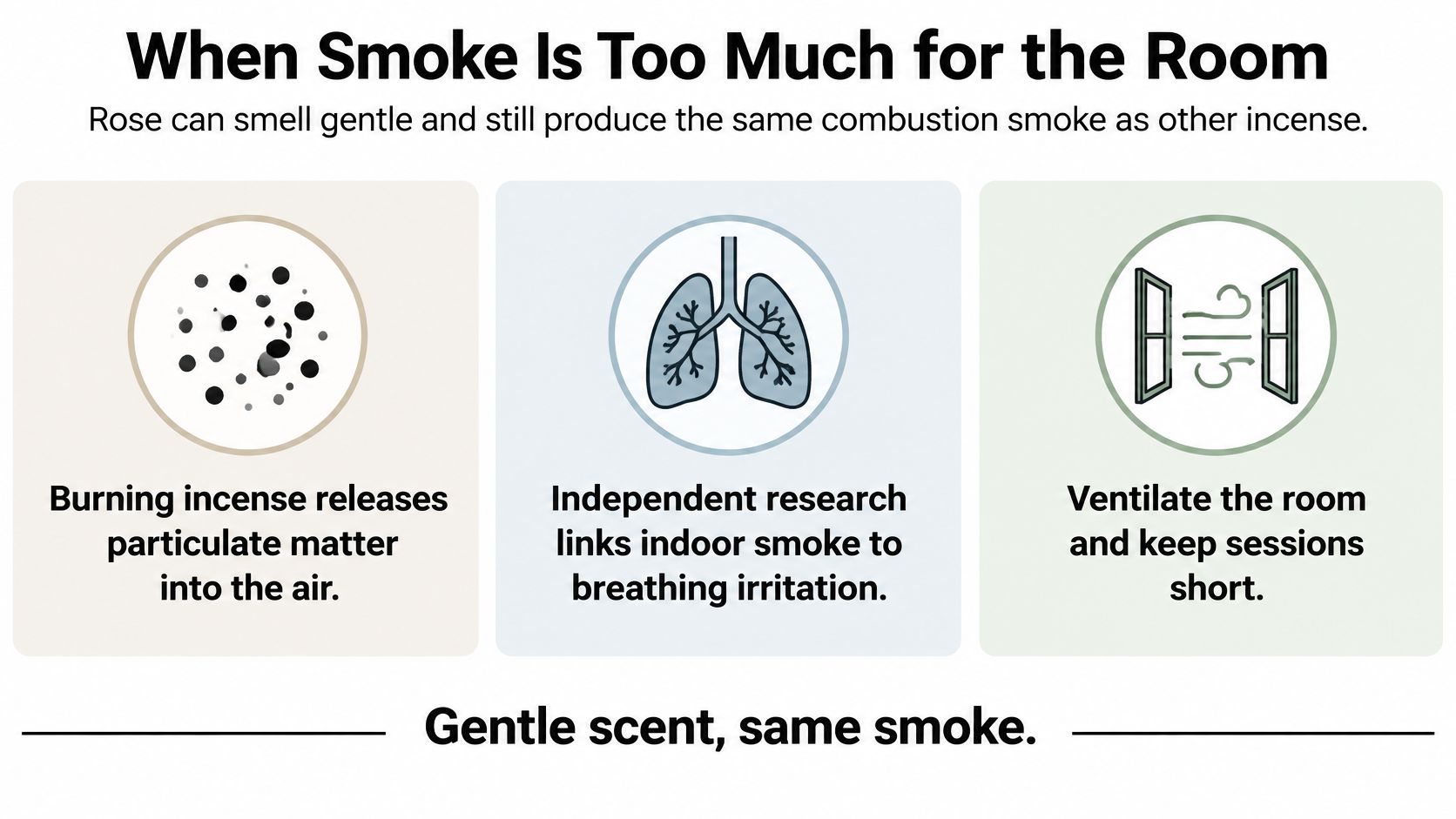
None of that means a rose stick is dangerous in every room. It means the dose comes from the room, the minutes, and the airflow, which you control. Treat the choice as exposure management, not a wellness claim in either direction.
Who should skip the stick entirely
Smoke is the wrong tool for some spaces and some people. Households with asthma, small children, or birds and other sensitive pets should default to an electric diffuser or a rose fragrance oil. So should anyone working in a small treatment room with the door shut, where a plume has nowhere to go and a client has no way to step out.
Rose-type fragrance materials can also contain or resemble geraniol, a rose-like terpene associated with contact allergy and dermatitis. A floral label isn't an allergen-free label, and that applies to the diffuser too, just without the smoke.
Watch for the stop signals and act on them the first time. Irritation in the eyes, throat, or chest means put the stick out, leave the room, and get fresh air. A headache that arrives twenty minutes into a session is your cue to shorten the next one. Anyone who feels tightness in the chest should not be experimenting with session lengths at all.
Studios and teachers can print one line for the wall: the room limits apply, and the stop rule overrides any session plan.
Small spaces need their own approach rather than a shortened version of a large-room habit. These notes on incense for small apartments cover the airflow and timing adjustments that keep a studio-sized room from filling up.
How to Store Rose Incense Sticks
Rose is a light floral, and light florals are the first thing to leave a stick. Storage is really about protecting volatile oils from air, light, and the scents sitting next to them on the shelf.
Pick the place first. A cupboard that stays under about 25°C (77°F), away from the stove, the water heater, and the bathroom steam, is enough. A windowsill or a hot car will flatten a rose note faster than a dark shelf ever will.
Then seal it. Reseal the original pack with its zip strip if it has one, or move the sticks into a tin or glass jar with a tight lid. Keep the wrapper dry and the sticks upright so the coating doesn't rub off against the sides.
Freshness window by blend
Blend | Freshness window | Storage | Note |
|---|---|---|---|
Rose-citrus blend | Toward the short end of 12-24 months | Tight lid, cool dry cupboard | Fades first |
Rose-sandalwood or rose-vanilla blend | Longer end of 12-24 months if sealed | Tight lid, cool dry cupboard | Holds longest when sealed |
Any rose blend stored near nag champa, patchouli, or sage | Not recommended | Separate bag or tin | Odors migrate into the rose |
That window is a working rule of thumb rather than a hard expiry date. A sealed stick is at its best for roughly 12 to 24 months, and the seal matters more than the calendar.
Separation is the rule people break most often. Nag champa, patchouli, and sage are heavy, persistent scents, and they migrate into whatever shares an open box. The next burn then reads as rose with a woody shadow over it. Keep each scent in its own bag, and in a studio cupboard, label the bags so nobody grabs the wrong one at 6 p.m.
For travel, use a rigid tin. Sticks snap in a soft bag, and a tin keeps hotel-room air and luggage smells out of the coating.
Retire a pack when the cold scent turns flat or sour, the stick feels brittle or gummy, the wrapper is oil-stained, or the lit smoke never develops a rose heart. Burning two faded sticks doesn't restore the note, it just doubles the smoke for the same disappointment. If you're unsure how long a stash has been sitting, this explainer on whether incense expires or goes bad walks through the signs in more detail.
Match a Stick and Holder to Your Space
Pick the room you have, not the room you'd like to have, and buy the smallest setup that fits it. That means one small pack of a soft rose or rose-wood blend and one stable, fireproof holder before you consider a bulk order. Our hand-dipped sticks are soaked in pure incense oil for no less than 24 hours, which is the kind of detail worth asking any supplier about, and ceramic incense stick holders solve the wobble problem that causes most accidents.
Check the pack the way you'd check produce: even coat, straight stick, sealed wrapper that isn't oily. Then run one test. Burn a single stick in the room you chose, with the window or door open, and keep the pack only if the rose heart stays soft after the first five minutes. If the room is small, closed, or shared with people who have asthma, children, or pets, skip the stick and use an electric diffuser or a rose fragrance oil instead.
Retailers, studios, and gift shops can hand clients the same two rules: one stick at a time, and stop at the first sign of irritation. That's a more honest promise than a smoke-free floral. We stock premium incense sticks, cones, fragrance oils, and handcrafted wooden burners, along with ash catchers, cone holders, and coffin boxes, so a shop or a home can build the whole setup in one order.
Frequently Asked Questions About Rose Incense Sticks
1. Are rose incense sticks made with real rose petals?
Not necessarily. Rose incense sticks can be made using fragrance oils, botanical ingredients, or a combination of aromatic materials. Some traditional blends incorporate dried flowers or plant extracts, while others use formulated rose fragrances to achieve a consistent floral scent. Check the manufacturer's ingredient information if natural rose ingredients are important to you.
2. What is the difference between rose incense and rose-scented candles?
Rose incense releases fragrance through the smoldering of aromatic materials, while scented candles release fragrance as their wax melts and fragrance ingredients evaporate. Incense produces combustion smoke, whereas candles produce their own combustion emissions. The scent experience, intensity, and fragrance distribution can also differ between the two.
3. Does the color of a rose incense stick indicate its quality?
No. The color of an incense stick is not a reliable indicator of fragrance quality, ingredient purity, or performance. Coloring can vary depending on the base materials, fragrance formulation, and manufacturing process. Packaging information, consistency between batches, and the actual burning experience are better indicators when evaluating a product.
4. Can rose incense be combined with other floral fragrances?
Yes. Rose can complement several floral fragrance families, including jasmine, lavender, geranium, and ylang-ylang. The resulting aroma depends on the fragrance formulations and their relative intensity. If experimenting with different scents, introduce them separately rather than burning multiple sticks simultaneously, particularly in smaller indoor spaces.
5. How can retailers keep rose incense fragrances consistent across their inventory?
Retailers should purchase from suppliers that maintain consistent manufacturing practices, fragrance formulations, and packaging standards. Keeping inventory sealed, storing different fragrance varieties separately, and rotating older stock before newer shipments can help preserve the intended scent profile. Ordering from the same supplier can also make it easier to maintain product consistency for repeat customers.
Ready to put the room table into practice? Aroma Warehouse carries hand-dipped rose incense sticks and the holders, ash catchers, and burners that keep a single stick burning cleanly, with retail and wholesale pricing for homes, studios, and shops. Start with one small pack, run the single-stick test in your own space, and stock up only on the blend whose rose heart survives the first five minutes. Visit Aroma Incense Warehouse to choose your sticks and holder.


