

White Sage Incense Sticks: Scent, Uses and Safe Burning

If a packet says natural white sage, what does that tell you about the plant inside, where it came from, or the smoke you'll breathe? Less than you might expect. White sage incense sticks can contain botanical material, added fragrance, or a blend, and the front label rarely answers every useful question.
A better choice starts with separating the living plant from the manufactured product. Learn its botanical name, understand the scent you're buying, and treat burning it as a small combustion process rather than a way to purify indoor air.
Table of Contents
What White Sage Incense Sticks Are and Where the Plant Grows - A regional plant with a broader history
How White Sage Differs From Blue and Desert Sage - What a scent description can't establish
What White Sage Incense Smells Like and Why - Essential oil isn't finished incense
How to Burn a White Sage Stick Step by Step - Set up, light and extinguish deliberately - Keep the activity separate from the flame
Smoke Symptoms, Ventilation and Who Should Avoid It - Respond to the room and the people in it - Ventilation isn't a guarantee
Choose a Traceable White Sage Pack Before You Buy - Ask what the sourcing description actually means - Apply the same standard to product claims
What White Sage Incense Sticks Are and Where the Plant Grows
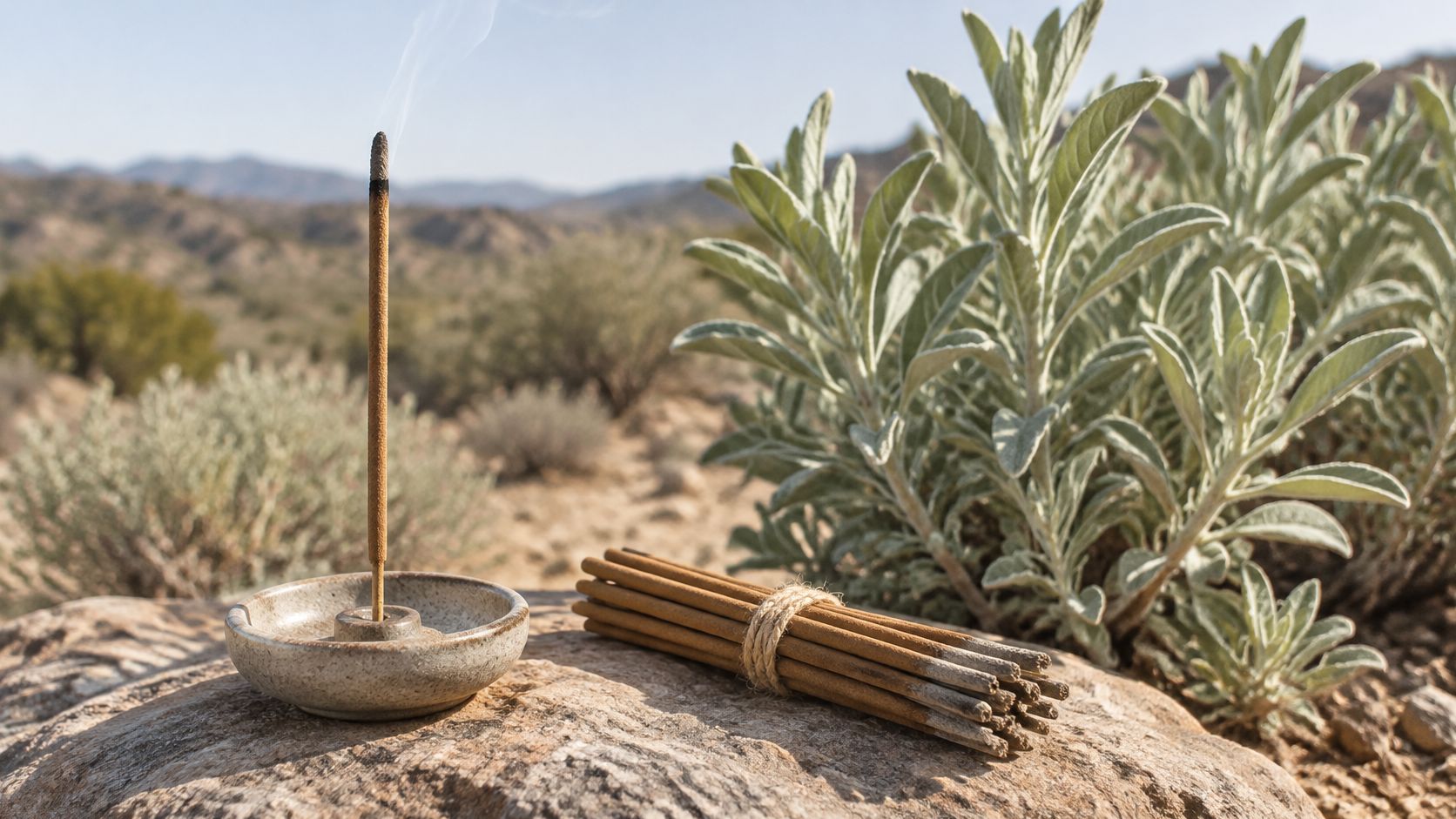
A white sage incense stick is a processed incense product made from or infused with Salvia apiana, a sage shrub. A manufactured stick may combine aromatic material with a binder around a supporting core, or use a coreless format. It isn't the same thing as a bundle of dried sage leaves, even when both sit on the same shop shelf.
Say you're comparing a slender incense stick with a tied leafy bundle. The stick's ingredient list should explain its formulation; the bundle should identify the plant material. Neither format, by itself, proves where the sage grew or establishes a connection to an Indigenous ceremony.
The difference between those retail formats is visible here.
A regional plant with a broader history
The USDA Forest Service's white sage account places its natural range from Santa Barbara County, California, south through northern Baja California, and east toward the western edge of California's Colorado Desert, and records Indigenous uses including seeds parched and ground into meal for pinole and dried leaves and stems burned in purification ceremonies. That limited native range makes the origin of commercial material important.
Traditional uses involved a plant with food, practical, medicinal, and spiritual significance, not just a fragrance category. A modern incense stick doesn't reproduce a ceremony merely because its packaging uses ceremonial language.
Keep the distinction clear: Botanical identity tells you which plant is involved. It doesn't grant a product cultural authority.
For a familiar comparison with handling ordinary garden herbs, Cottagestead: The Home & Garden Companion offers guidance on air-drying basil, mint, and rosemary. That's useful household herb knowledge, but it shouldn't be treated as guidance for harvesting wild white sage or interpreting its traditions.
On a label, look for Salvia apiana. Treat sweeping promises about universal cleansing as marketing, not as a botanical description.
How White Sage Differs From Blue and Desert Sage
Three packets can sit side by side with “sage” printed in large type and still contain plants from different genera. The front label is a starting clue. The botanical line and ingredient list provide the essential information.
White, blue and desert sage at a glance
Sage type | Botanical name | Common use | Scent profile |
|---|---|---|---|
Salvia apiana | Smudging and cultural ritual in specific traditions | Pine, camphor and eucalyptus-like | |
Salvia clevelandii on products using this identification | Aromatic and smudging use | Varies with formulation and added fragrance | |
Artemisia tridentata, a sagebrush rather than a true sage | Smudging in some Western communities | Often described as sharp, resinous and earthy |
A common name works like a nickname on a mailbox: useful only if it points back to the right house. White sage belongs to Salvia. The desert sage in the table is Artemisia, a sagebrush, so choosing it is not a softer or stronger version of Salvia apiana. It is a different plant group being sold under a familiar word.
Blue sage is the row that most often needs a second look. Some products use it for Salvia clevelandii, but the common name can travel across blends, regions and supplier habits. Match the packet in your hand to a species name, not to a shelf sign shared by several products.
Species also changes identity and aroma, not the basic physics of burning. Any incense stick produces smoke when lit because plant material and base combust; choosing white, blue or desert sage changes what is in the stick, not whether combustion particles exist.
What a scent description can't establish
Don't choose blue sage solely because someone calls it softer. There isn't a supported comparative scent test here establishing that it will smell milder than white sage in your room, and a different recipe or added fragrance can change the result.
The same caution applies to a white sage fragrance name. A product named after a plant may describe an intended aroma rather than confirm that the plant itself is present. If the ingredient list identifies fragrance but no sage material or sage-derived ingredient, don't assume otherwise.
Use these quick checks while comparing packets:
Read the ingredients. Separate named botanical ingredients from general fragrance descriptions.
Find the botanical name. Match the product to the plant you intend to buy.
Check the plant part. Leaves, stems, powder, and oil are different ingredient descriptions; a missing detail deserves clarification.
Palo santo adds another shelf-side confusion because it is sold near sage and discussed in the same rituals, yet it is a separately named wood rather than a sage species. Aroma Warehouse's guide to the difference between palo santo and white sage separates those products without treating them as interchangeable supplies.
For a retailer, keep each supplier's botanical description attached to its own stock record. Don't copy the description from a neighboring product because the packets look similar.
For a home buyer, the order stays simple: compare botanical identity first, formulation second, and scent preference third. Your nose can tell you what you enjoy. It cannot authenticate the species or verify the ingredient list.
What White Sage Incense Smells Like and Why
White sage's characteristic aromatic impression combines resinous sharpness, a cool eucalyptus-like lift, and a camphor edge over pine and herbal notes. In a burning stick, those impressions sit alongside the smell of the burning base. Clean, in this sensory description, doesn't mean that the smoke cleans the air.
This visual separates the main scent impressions from the chemistry behind them.
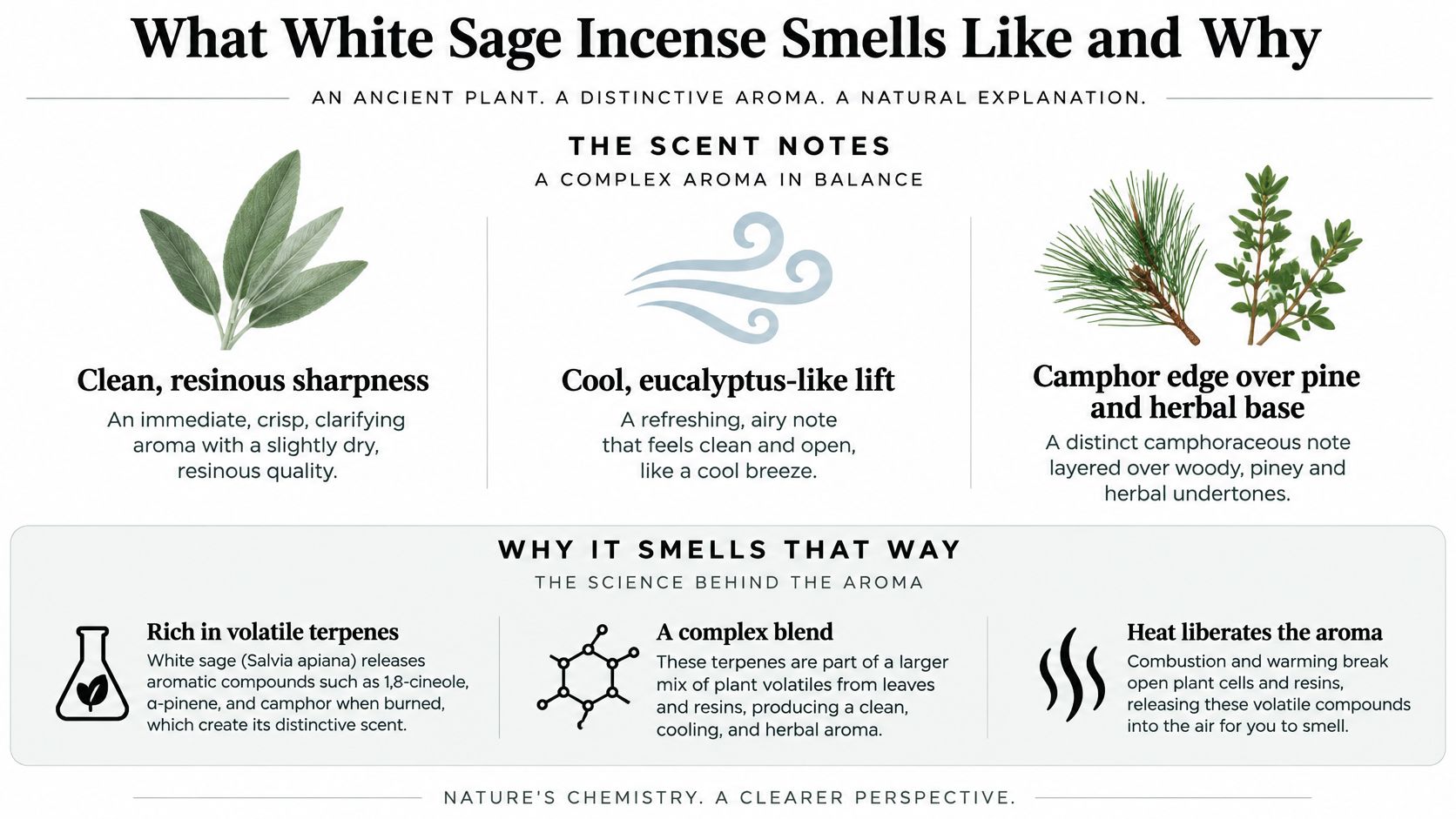
A peer-reviewed Scientific Reports analysis identified 42 compounds representing 97.87% of the white sage volatile fraction, with 1,8-cineole, beta-pinene, alpha-pinene, beta-myrcene, and camphor as the principal terpenoids. The scent impressions below are useful sensory shorthand, not a formula predicting exactly how a finished stick will smell.
Main aroma compounds in white sage
Compound | Scent impression | Role in the aroma |
|---|---|---|
1,8-cineole | Eucalyptus-like, cool and clean | Lifts the top of the scent |
Camphor | Sharp and camphoraceous | Gives the scent its edge |
Alpha-pinene | Fresh pine | Brightens the middle |
Beta-pinene | Woody pine | Adds depth to the middle |
Beta-myrcene | Green and herbal | Supports the herbal base |
Essential oil isn't finished incense
The analysis examined sage-derived essential oil, not manufactured incense sticks. Binders, charcoal, additional fragrance, drying, storage, and combustion can all affect the aroma you experience. A powerful sage-like smell therefore doesn't prove that a stick contains a large amount of white sage.
If you particularly enjoy the cool note, our eucalyptus incense sticks guide provides another fragrance comparison. Similar notes don't make the underlying plants or formulations identical.
For an additional visual reference, the following video can accompany your product comparison.
Compare samples in separate, well-aired sessions rather than burning them together. Write down whether you notice coolness, pine, an herbal base, or mostly the burning carrier, and keep the packaging beside your notes.
A retailer can retain an unburned sample with its batch identification for future comparisons. If a replacement batch smells noticeably different, check whether the formulation or sourcing changed before describing it to customers as the same aromatic experience.
How to Burn a White Sage Stick Step by Step
Prepare the space before you strike a match. If anyone present has asthma, is an infant or young child, or reacts badly to smoke, choose a setting away from them or skip burning altogether. Don't use a shared room as a test of someone else's tolerance.
Burning incense means burning material, not just releasing vaporized fragrance. An environmental-chamber incense study indexed by the EPA documented particulate and gaseous emissions, supporting the need for careful placement and ventilation rather than treating the plume as harmless aroma.
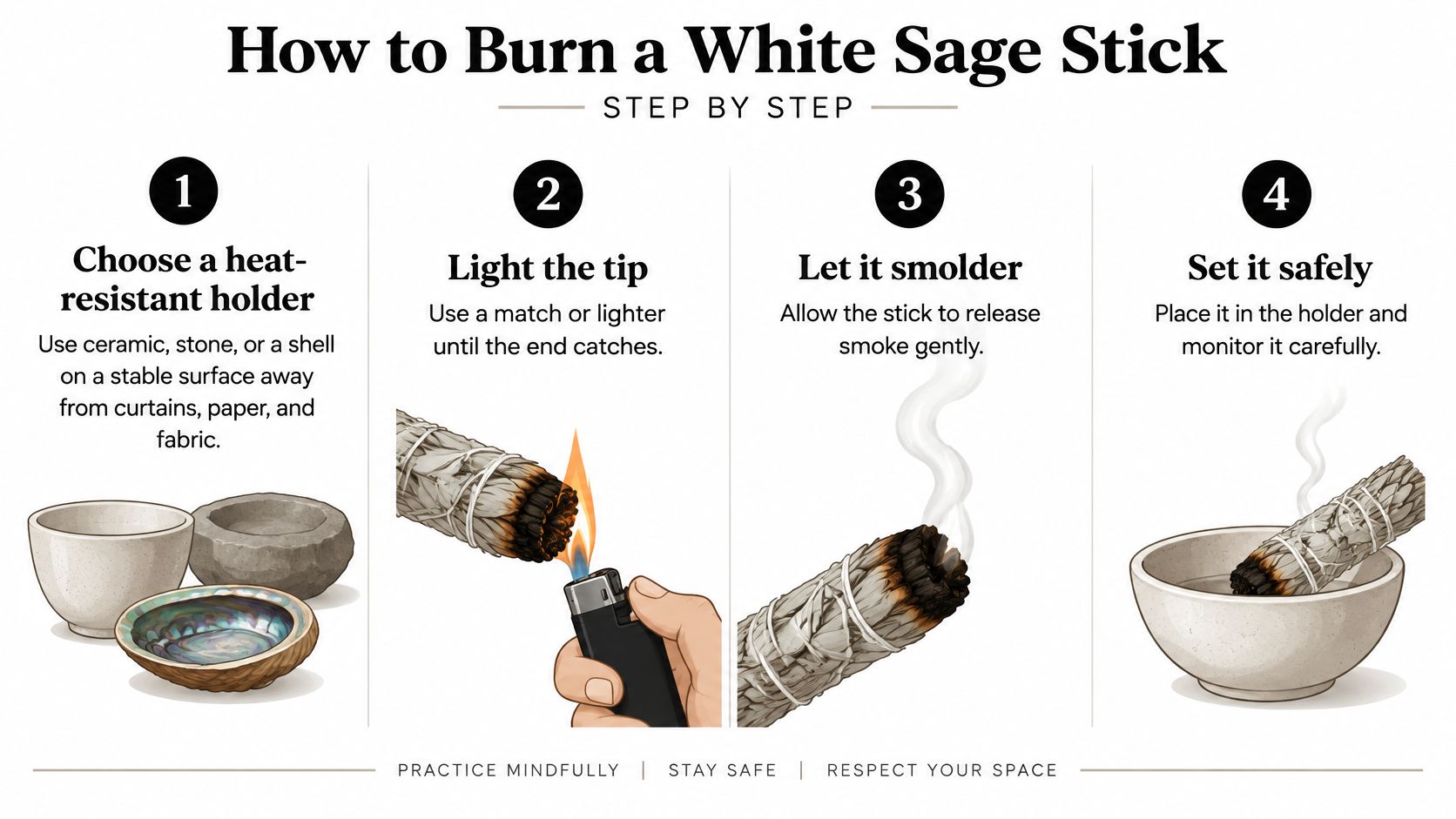
The basic setup is illustrated below; a manufactured incense stick needs a holder that fits its particular shape.
Set up, light and extinguish deliberately
Choose a stable, heat-resistant holder. Use a ceramic incense holder or another purpose-made holder on a level, noncombustible surface, well away from curtains, paper, and fabric. A stone dish or shell needs a secure support and a suitable sand bed; don't balance a slender stick loosely against its rim.
Light the aromatic tip with a match or lighter until it catches, then gently blow out the flame. You want a smoldering tip, not a continuing open flame; keep your face out of the rising smoke.
Secure the stick in its holder. Keep it upright if that's how the holder is designed, with the entire ash fall contained over the catcher. Leave the holder stationary rather than walking through rooms with a glowing stick.
Burn a single stick rather than lighting several to intensify the fragrance. Use the shortest session that meets your purpose, and extinguish it early if the room becomes smoky instead of waiting for the whole stick to finish.
Watch the ash and ember. Check regularly that ash lands inside the holder and that the stick hasn't tilted or loosened. Don't place the setup near a fan or a strong draft that could scatter hot fragments.
Press the burning tip into sand in a heat-resistant container until the glow disappears. Check that it has stopped smoking, allow everything to cool, and never put a warm remnant or ash straight into a wastebasket.
A controlled burn has a glowing tip and a relatively thin, steady smoke trail, without sparks or an ongoing flame. Those visual signs help you supervise the ember, but they aren't an air-quality test.
Never leave burning incense unattended, even when the holder appears secure.
Keep the activity separate from the flame
If you use incense while studying cards, Tarot Chats' tarot guides can support the learning activity without making smoke a requirement. Set the holder away from cards, cloths, notebooks, and sleeves, and extinguish it before your attention shifts fully to the reading.
A leafy bundle requires different physical support from a slender stick. Our juniper smudge stick guide is a separate format reference, not a reason to hold either product over furnishings or carry falling embers around a room.
Smoke Symptoms, Ventilation and Who Should Avoid It
Natural doesn't mean smoke-free. The relevant exposure includes fine combustion particles, whether the original aromatic ingredient came from a plant or a fragrance formulation. White sage incense sticks haven't been established as uniquely safer than other incense.
The U.S. EPA's incense-emissions study measured PM2.5 emission rates of 7–202 milligrams per hour across 23 incense types, and modeling found that indoor concentrations could exceed ambient air-quality standards under some conditions. Those measurements aren't a product-specific rating for white sage, but they explain why a botanical label can't answer the safety question.
Respond to the room and the people in it
People with asthma or other respiratory conditions should avoid direct exposure. Don't burn incense near infants or young children, and don't continue a session when anyone develops discomfort. For animal-specific considerations, consult our guide to incense sticks and pet safety rather than assuming that a scent acceptable to you is suitable around pets.
Smoke symptoms, causes and actions
Symptom | Likely cause | Action |
|---|---|---|
Thick smoke that lingers | Excess smoke for the available airflow; possibly an overly vigorous burn | Extinguish it, open windows, and choose an outdoor setting for any later use |
Stick keeps going out | Possible dampness or a formulation or lighting problem | Let it cool, store it dry, and inspect it before relighting the tip |
Throat or eye irritation | Exposure to smoke or fragrance, potentially worsened by poor ventilation | Stop the burn, leave the smoky space, and ventilate |
Strong chemical smell after burning begins | Possible fragrance or binder characteristics; smell alone can't identify the cause | Extinguish it and check the ingredients before using it again |
These are troubleshooting possibilities, not diagnoses. A chemical-smelling note doesn't prove a particular additive is present, and a pleasant smell doesn't prove that the air is safe.
Ventilation isn't a guarantee
Cross-ventilation means giving air a path through the room, for example through openings on different sides. Keep the holder away from the direct draft, and don't use an open window as permission for a long burn in an otherwise enclosed space.
A low-smoke claim also needs supporting measurements if you're using it to compare exposure. Visible plume size alone doesn't tell you the fine-particle concentration.
Stop rule: If smoke lingers, the room is small, or anyone reacts, extinguish the stick. Choose a later outdoor session away from others, or don't burn it.
Seek medical help for significant breathing difficulty or symptoms that don't settle after leaving the exposure.
Choose a Traceable White Sage Pack Before You Buy
Traceability is a stronger buying criterion than natural, wildcrafted, or eco-friendly. Those words don't tell you who grew or collected the sage, whether they had permission, or how the supplier protected the remaining plants. A credible purchase needs a documented origin, not just attractive packaging.
A 2024 peer-reviewed review of smudging plants reported indications of unsustainable harvesting for Western demand and cited rangers' estimate that more than 20,000 pounds of white sage had been stolen from a Southern California preserve over a five-year period. The same review discusses NatureServe's distinction between potentially damaging commercial collection and traditional Indigenous harvesting methods, which aren't considered responsible for the decline.
That distinction matters. Treating every collector as equally responsible obscures both commercial theft and Indigenous stewardship. It also makes a vague wild-harvested label sound more reassuring than it deserves to be.
Ask what the sourcing description actually means
An ethnographic account of Kumeyaay white sage knowledge describes rotational harvesting aligned with the plant's reproductive cycle and threats including habitat loss and commercial overharvesting. Stewardship involves decisions about place, timing, regeneration, and access, not just choosing a plant-based ingredient.
Cultivated material is a useful preference, but the word cultivated still needs an identifiable grower or supply chain behind it. For wild-collected material, permission and regeneration practices deserve particular attention. Neither category should be accepted solely on a seller's adjective.
Use this buying checklist for an individual packet or a wholesale order:
Confirm the species. Look for Salvia apiana in the product information and ask what sage-derived ingredient is included. A scent name is not an ingredient declaration.
Establish cultivation status. Request a clear statement that the material was cultivated or wild-collected. If the supplier handles both, the answer should apply to the batch you're buying, not just its general business practices.
Document origin and access. Ask for the region, harvest information, and evidence of permitted collection where relevant. Request an explanation of regeneration practices and any claimed Indigenous partnership or benefit sharing, without assuming that a partnership exists.
Read the complete formulation. Identify botanical ingredients, binders, the supporting base, and fragrance additions. A blend can be a perfectly reasonable purchase, provided it's sold as a blend rather than represented as pure white sage.
Separate burn information from emissions evidence. Burn-time guidance helps plan a session; it doesn't establish low particle emissions. If a seller makes a low-smoke comparison, request the test method and product-specific results, or record that no measurements are available.
Keep a comparison sample. Retailers should retain an identified sample and the accompanying paperwork so later deliveries can be checked. Home buyers can keep the packet and a brief scent note rather than relying on memory.
Apply the same standard to product claims
Our Sonavi Nature's Collection incense sticks are hand-rolled and made with sustainably sourced wood and carefully selected botanical ingredients. Sonavi releases light aromatic smoke and fine particulates during use, as all incense does; sustainably sourced wood shouldn't be read as a separate certification of every botanical ingredient's origin.
That distinction is useful across the shelf. A claim about packaging, wood, or hand-rolling answers a particular question, not every sourcing or exposure question a buyer might have.
For larger orders, our guide to buying California white sage in bulk can help organize purchasing decisions. Keep botanical identity, provenance, formulation, and handling instructions together in the stock record, so staff don't have to improvise answers at the counter.
Choose a seller who answers the checklist in writing, including an honest statement when information isn't available. If origin or permission remains unclear, choose another product rather than filling the gap with assumptions. Once you've bought a traceable pack, evaluate the first stick in a supervised, appropriately ventilated setting before committing to regular use.
Frequently Asked Questions
1. How should you store white sage incense sticks to preserve their fragrance?
Store white sage incense sticks in a sealed container or airtight bag in a cool, dry location away from direct sunlight, humidity, and strong competing fragrances. Proper storage helps preserve their aromatic qualities and prevents moisture from affecting how they burn.
2. Do white sage incense sticks have an expiration date?
White sage incense sticks generally do not have a strict expiration date, but their fragrance can gradually weaken over time. Exposure to air, heat, sunlight, and moisture can affect their scent and burning characteristics. Check the manufacturer's storage recommendations for the best results.
3. Can white sage incense trigger residential smoke alarms?
Yes. Burning incense produces smoke and airborne particles that can activate sensitive residential smoke alarms, particularly in small or poorly ventilated rooms. Always follow fire-safety precautions and never cover, disable, or disconnect a smoke detector to burn incense.
4. Can you extinguish a white sage incense stick halfway through and relight it later?
Yes, provided the stick can be extinguished safely. Press the glowing tip into sand or another suitable heat-resistant extinguishing material until completely cool. Once cooled, store the remaining stick in a dry, nonflammable location and inspect it before relighting.
5. Does white sage incense leave residue on furniture or walls?
Burning incense can release fine particles that gradually settle on nearby surfaces. Frequent use, heavy smoke, and inadequate ventilation can contribute to residue on furniture, walls, and decorative objects. Keeping incense away from valuable furnishings and limiting burning sessions can help reduce buildup.
Aroma Warehouse offers incense sticks, cones, fragrance oils, and incense holders for home buyers and wholesale customers. Visit Aroma Incense Warehouse to compare aromatic options, including white sage blends, and choose a suitable holder alongside your incense.


