

Middle East Incense Guide: Types, Uses and Safe Burning
A burner comes around the circle at a family gathering, a thin ribbon of smoke lifts off a dark chip, and the room fills with something between resin, woodsmoke and sweetness. Weeks later you try to buy the same thing and hit a wall of names: bakhoor, oud, frankincense, myrrh, chips, cones, sticks. Half of them look identical in photographs and cost wildly different amounts.
The confusion isn't only about names. Two products sold as oud can contain entirely different materials, burn at different temperatures and leave a very different room behind them. The global incense market was valued at more than USD 3.69 billion in 2024 and is projected to grow at a 7.04% CAGR from 2025 to 2030, according to Research and Markets' incense market overview, which means plenty of sellers and almost no shared vocabulary for what's inside the box.
What follows sorts the forms by material, burn method and scent, then works through the tradition, the charcoal question and the exposure picture. By the end you'll know what to buy for your room, how to burn it without fogging the house, and which labels carry information.
Table of Contents
Middle East Incense Types Compared at a Glance - Where the labels mislead
Origins and Customary Uses of Bakhoor - The burner at the door
How to Burn Bakhoor Safely, Step by Step - What a good session looks like
Indoor Exposure and Who Needs Extra Care - What controls the dose - Rules that do the most work
Resin Chemistry and Buying Decisions - Why two blends with the same name burn differently - A buying checklist
Middle East Incense Types Compared at a Glance
Five forms cover almost everything sold as Middle East incense, and each one exists because it solves a different problem: how much you want to spend, how long the scent should last, and whether the occasion calls for a burner at all.
Form | Typical base | Burning method | Scent character |
|---|---|---|---|
Wood chips, resins and oils | Charcoal-heated burner | Sweet, woody, smoky | |
Boswellia resin | Charcoal or heated burner | Bright, citrusy, balsamic | |
Commiphora resin | Charcoal burner | Warm, earthy, heavier smoke | |
Aged agarwood chips | Charcoal burner or oud oil warmer | Deep, rich, animalic | |
Wood powder, resin and oil | Self-burning on a holder | Light, sweet, often sandalwood or rose |
Bakhoor is the workhorse of the group. It's a blend of wood chips, resins and oils, sometimes pressed into tablets or small blocks, and it's heated on a charcoal burner rather than burned directly. The result is a sweet, woody, smoky scent that fills a majlis within minutes and clings to fabric for hours.
Oud wood chips sit at the top of the price range. They come from agarwood, the resin-soaked heartwood that forms in Aquilaria trees after damage or infection, and the deep, rich, faintly animalic smoke is what many picture when they say a room smells of oud. The same chips get distilled into oud oil, which is worn on skin or warmed slowly in an oil burner.
Loose frankincense and myrrh are the two classical resins, and they behave differently on the coal. Frankincense, from Boswellia trees, gives a bright, citrusy, balsamic smoke that rises fast and fades. Myrrh, from Commiphora trees, burns warmer and earthier, with a heavier smoke that hangs in the room longer.
Where the labels mislead
Two boxes with the same name on the front can share almost nothing inside. Bakhoor ranges from a simple mix of chips and resin to a pressed tablet held together with binders and scented with synthetic oils. Many sticks sold as oud carry a synthetic oud accord and no agarwood at all, which is fine if you want the smell rather than the price of real chips.
Quick rule: choose loose resin, oud chips or bakhoor when the occasion is the point and guests will notice, and reach for sticks or cones for everyday scenting in small rooms.
The trade-off is honest either way. The burner forms give depth and ritual. The self-burning forms give convenience and a lighter smoke load, which matters more than expected in a bedroom.
Origins and Customary Uses of Bakhoor
Long before it reached a shop shelf, Middle East incense was a logistics business. The Incense Route began at Shabwah in Hadhramaut, in what is now Yemen, and ran north to Gaza, linking caravan stations, Red Sea ports, Egypt, the Levant and the markets of Rome, as the Metropolitan Museum of Art's essay on trade between Arabia and the empires of Rome and Asia sets out. Frankincense and myrrh came from trees in southern Arabia, Ethiopia and Somalia, then moved by camel caravan and by ship.
The trade was already running at scale by the start of the 1st millennium BC. Cities along the route grew rich by taxing caravans and selling shelter, water, storage and protection, and the Smithsonian's National Museum of Asian Art, quoted in the same essay, describes Arabia as both a producer and a controller of incense distribution. That double position is what made the region so prosperous, and the same routes carried artistic and linguistic influence along with the resin.
Rome's appetite shows the scale. Estimates summarised in the CABI Digital Library review of the Roman incense trade put roughly 1,300 to 1,700 tons of frankincense entering the empire each year, carried in about 7,000 to 10,000 camel loads, with another 211 tons of myrrh arriving in around 1,184 loads. The best frankincense sold for about 5 to 6 denarii a pound, close to a week's wages for a skilled laborer, and myrrh could fetch twice that.
What the route explains: the price was never just the smell. Origin, purity and the cost of moving resin across a desert set the value, and those same three things still separate a good bakhoor from a cheap one.
The burner at the door
At home, the ritual works on a smaller scale but follows a familiar sequence. A charcoal disc is lit and bedded into the burner, a pinch of bakhoor goes on top, and the burner is passed from hand to hand while guests sit close and hold the smoke under their clothing so it clings to the fabric. The mabkhara, the traditional burner, does three jobs at once: it welcomes, it perfumes, and it signals that the visit matters.
Families use it differently. Some scent the house before prayer or before a holiday, some keep oud chips for weddings and formal occasions and a cheaper bakhoor for ordinary days, and many apply oud oil to clothing, hair or a beard as part of grooming. Practice shifts by country, generation and budget, so there's no single correct routine to copy.
What has changed is frequency. Bakhoor once marked an occasion; in many households it's now part of the daily round, lit while the coffee is made rather than only when visitors arrive. That move from ceremony to habit is why the smoke itself deserves closer attention than most buying guides give it.
If the harvest and grading side of the two classical resins interests you, our guide to frankincense and myrrh incense covers how they differ at the tree.
Choosing a Burner and Charcoal
The setup decides more about your session than the bakhoor does. Get the burner and the fuel right and a pinch of resin scents a room for twenty minutes. Get them wrong and you'll have a bitter, sooty burn and a headache.
Choose a heat-proof burner with a lid and a bed of sand or ash. The coal sits low in the sand, the lid holds heat around the resin instead of letting it flare, and the sand cushions the metal against direct heat. Our guide to the bakhoor burner walks through traditional mabkhara shapes and the electric alternatives.
For charcoal, plain natural discs are the better default. Quick-light discs are treated so they catch fast, and that treatment adds fumes of its own to a small room. A disc that takes a flame at the edge and holds a steady glow is all you need, and a quality one catches without spitting. Quick-light discs stay popular because they're easy to start, so if you use them, light them by an open window and let them ash over completely before they come indoors; Pink Smoke Shop's Three Kings quick-lighting charcoal briquettes are a commonly used option for burner and hookah setups.
Set the burner on a level, non-flammable tray away from curtains, shelf edges and smoke alarms.
Keep a metal tin for the ash and never tip warm ash into a plastic bin.
Pick sticks or cones for a small room. They need only a holder and no coal at all.
Test an electric warmer with a small piece first. Warming resin without combustion is cleaner, but it changes the scent.
Ventilate for the whole session. An open window or an extractor fan does more for the room than any burner design.
How to Burn Bakhoor Safely, Step by Step
The sequence below is worth memorising, whichever form you're burning. Each step comes with the reason behind it and the mistake that spoils the batch.
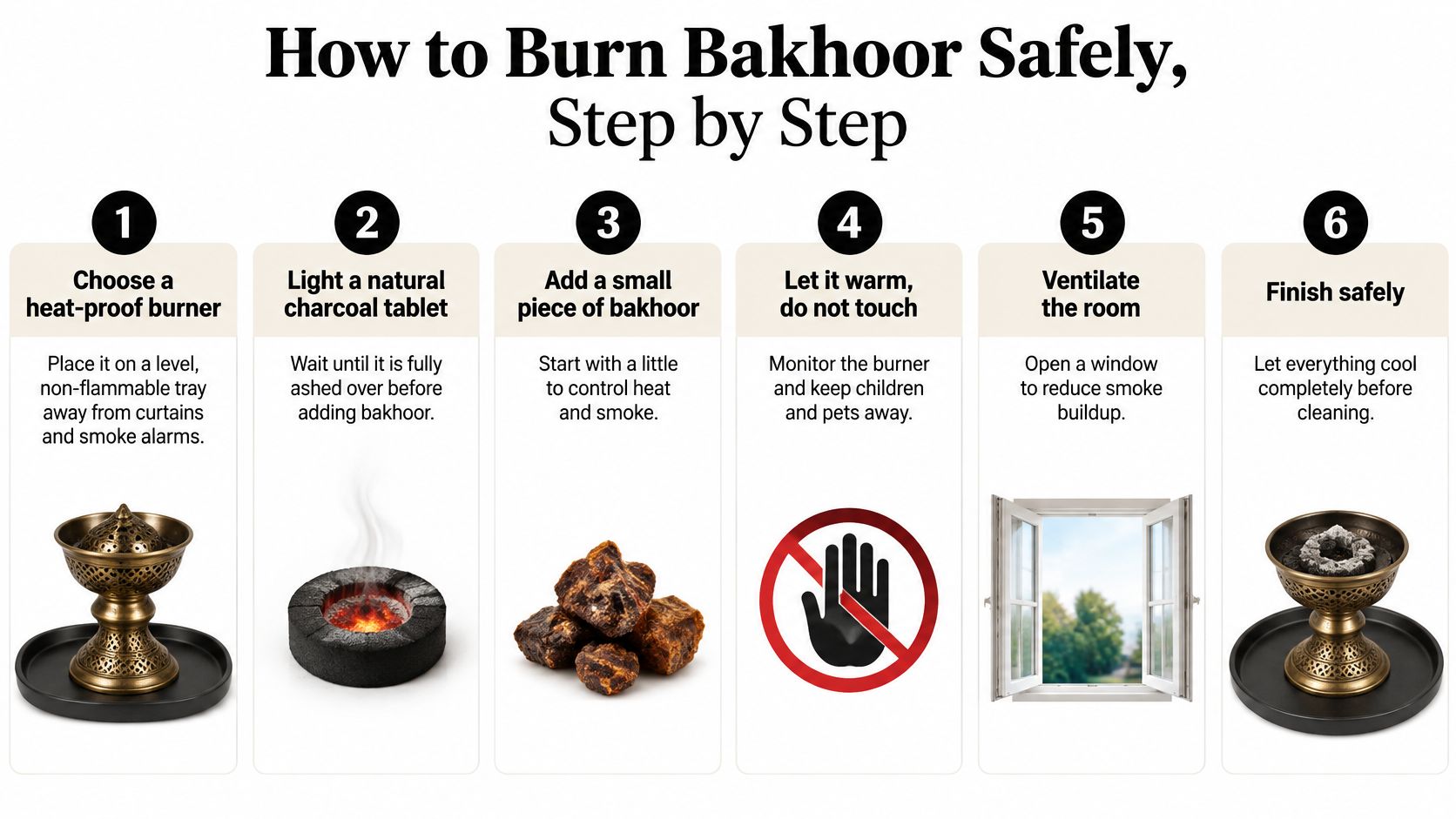
Set up on a safe surface. A heat-proof burner on a level, non-flammable tray, away from curtains, paper and smoke alarms. The usual slip is burning on a wooden shelf or a cloth runner, where radiant heat alone can scorch the surface under the burner.
Light a natural charcoal disc. Hold the edge over a flame until it takes and glows, then set it on the sand or ash bed. Unlit charcoal releases no aroma, so there's nothing to gain by rushing; the mistake here is quick-light or chemically treated charcoal, which adds its own fumes to the room.
Wait until the disc is grey. This takes several minutes at the edges and then across the face. Adding bakhoor to a still-black coal puts the resin in the flame, so it burns instead of vaporising, and that's how you get a sharp, acrid note.
Add a pinch, roughly half a teaspoon. Drop it at the centre of the coal, not in a heap. Too much smothers the heat, produces bitter smoke and wastes material you could have used in a second session.
Cover loosely and let it rise. Rest the lid so air still reaches the coal, and let the smoke build for 10 to 15 minutes. Sealing it tight puts the coal out and leaves the room smelling of extinguishing charcoal.
Open a window or run an exhaust fan. Keep sessions to about 30 minutes, which is enough to scent a room and short enough to keep the air reasonably clear.
Let everything cool, then empty the ash. Warm ash goes into a metal container, never a bin, because it can stay hot enough to melt plastic long after the smoke stops.
What a good session looks like
A good session gives a thin, steady ribbon of smoke and an even, sweet scent that settles rather than shouts. A thick, bitter cloud that clings to the walls means too much resin, too hot a coal, or both, and the smell will follow you into the next room.
If the smoke stings your eyes within a minute of lighting, put the lid on and open a window. Fixing the room beats fixing the blend.
In a small room with children, pets or anyone with asthma, shorten the session and place the burner near an open window instead of in the middle of the seating area. Fifteen minutes of scent is usually plenty; the room doesn't need a fog. For resins specifically, our piece on how to burn incense resin goes deeper on coal temperature and portion size.
Indoor Exposure and Who Needs Extra Care
A faint ribbon of smoke above a mabkhara carries two separate exposures. The incense supplies the fragrance, while the charcoal works like an engine: it provides the heat but adds its own combustion products. That distinction explains why the same blend can feel light in one home and heavy in another.
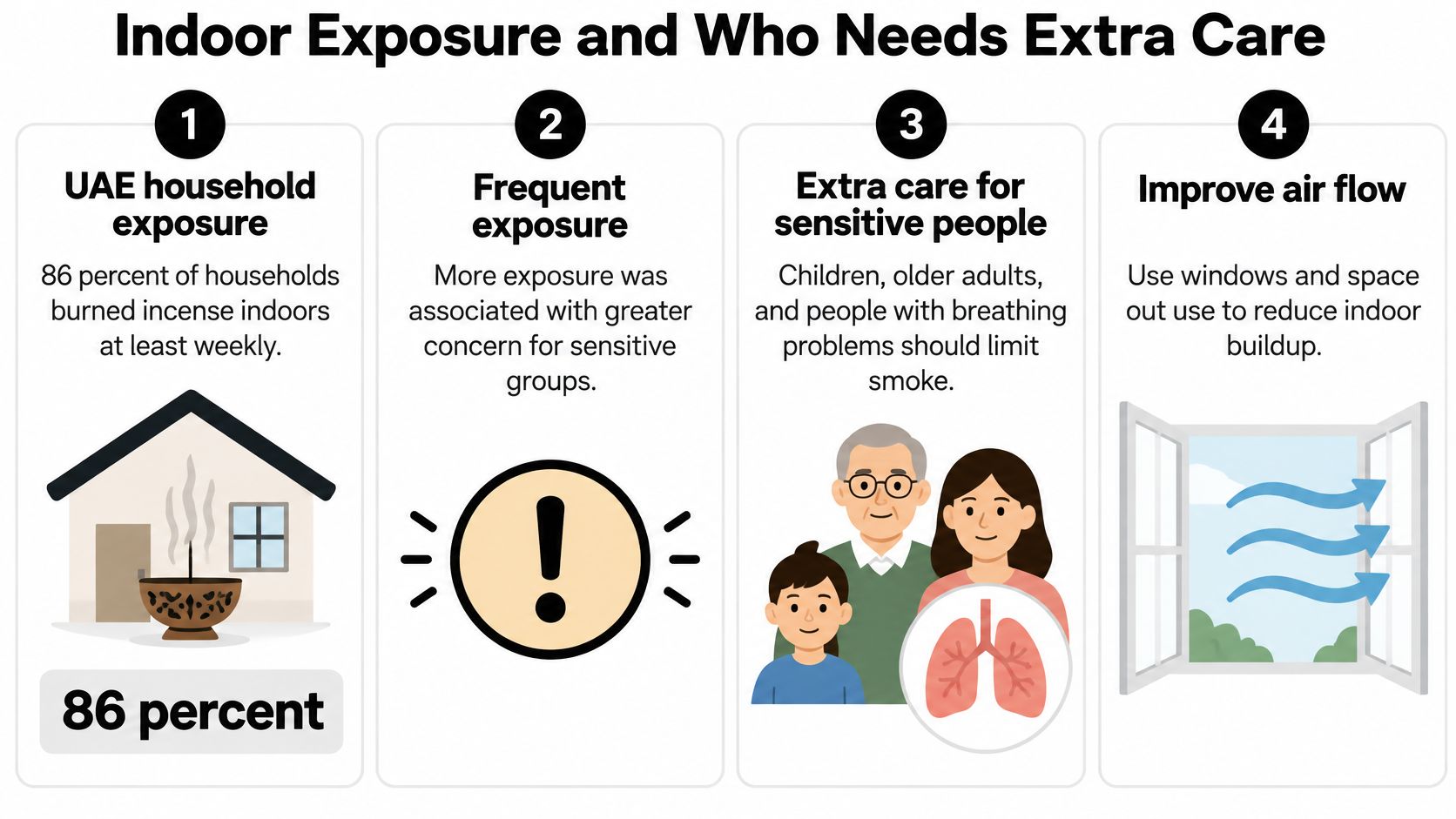
In the UAE research described in the study of incense exposure among UAE households, 86 percent of households burned incense indoors at least weekly, and chamber measurements of Arabian-incense burning peaked at 1.42 mg/m³ of particulate matter, 122 ppm of carbon monoxide, 0.3 ppm of nitrogen oxides and 85 ppb of formaldehyde, with charcoal named as the main contributor to the carbon monoxide and nitrogen oxide levels. Frequent incense exposure was also associated with more neurological symptoms.
Pollutant | Peak measured | Main source | What lowers it |
|---|---|---|---|
Particulate matter | 1.42 mg/m³ | Incense smoke and fine particles | Ventilation and shorter sessions |
Carbon monoxide | 122 ppm | Charcoal, identified as the main contributor | Avoiding quick-light charcoal and ventilating |
Nitrogen oxides | 0.3 ppm | Charcoal, identified as the main contributor | Ventilation and a shorter burn |
Formaldehyde | 85 ppb | Incense combustion | Ventilation and burning less often |
Composition adds another variable. A health-risk assessment of tested bakhoor samples reported 859 emitted compounds, including 42 suspected or confirmed carcinogens and at least 200 identified irritants, according to the assessment of bakhoor emissions. Those findings describe particular products under test conditions, so they should be read as evidence of how much formulations can differ.
This is also where labels can mislead. “Traditional” describes heritage, “natural” describes origin and “synthetic” describes how an ingredient was made. None of those terms measures smoke. A blend can carry deep cultural meaning and still require ventilation; cultural value and air quality answer different questions.
What controls the dose
Indoor exposure works like a budget. Combustion adds pollutants, while room volume and fresh air dilute them. Charcoal quantity, burn time, room size, airflow and distance from the burner decide the balance.
A short session beside moving air in a large room creates a different exposure from a longer burn in a closed bedroom. The fragrance may be equally pleasant in both, yet the emissions reaching each person are not.
Rules that do the most work
Start airflow before lighting the coal. Fresh air entering during the burn removes emissions as they form.
Give the smoke a route away from seating. Keep the burner out of bedrooms and position it so the plume moves toward ventilation rather than across people.
Keep the exposure window short. Use enough charcoal and incense to scent the room without extending the burn beyond what the space needs.
Allow more distance for children, people with asthma, older adults, pregnant people and pets. Our guide to burning incense during pregnancy covers the practical precautions in detail.
Clean the hardware after it cools. Resin and soot leave a tacky film on metal parts, so soak removable pieces in warm, soapy water before scrubbing. Residue on a smooth surface generally needs loosening before it can be removed, a principle also applied to a different kind of washable item in a guide to cleaner dental appliances.
The measurements above come from a specific region, chamber setup and set of products, so they show the scale of what can happen rather than predict every living room. The levers remain consistent: less combustion time, no unnecessary charcoal, more air exchange and greater distance for people whose lungs are less tolerant.
Resin Chemistry and Buying Decisions
Two resins can look identical in a photograph and behave completely differently on hot charcoal. The difference is measurable, and it explains most of what buyers describe as quality.
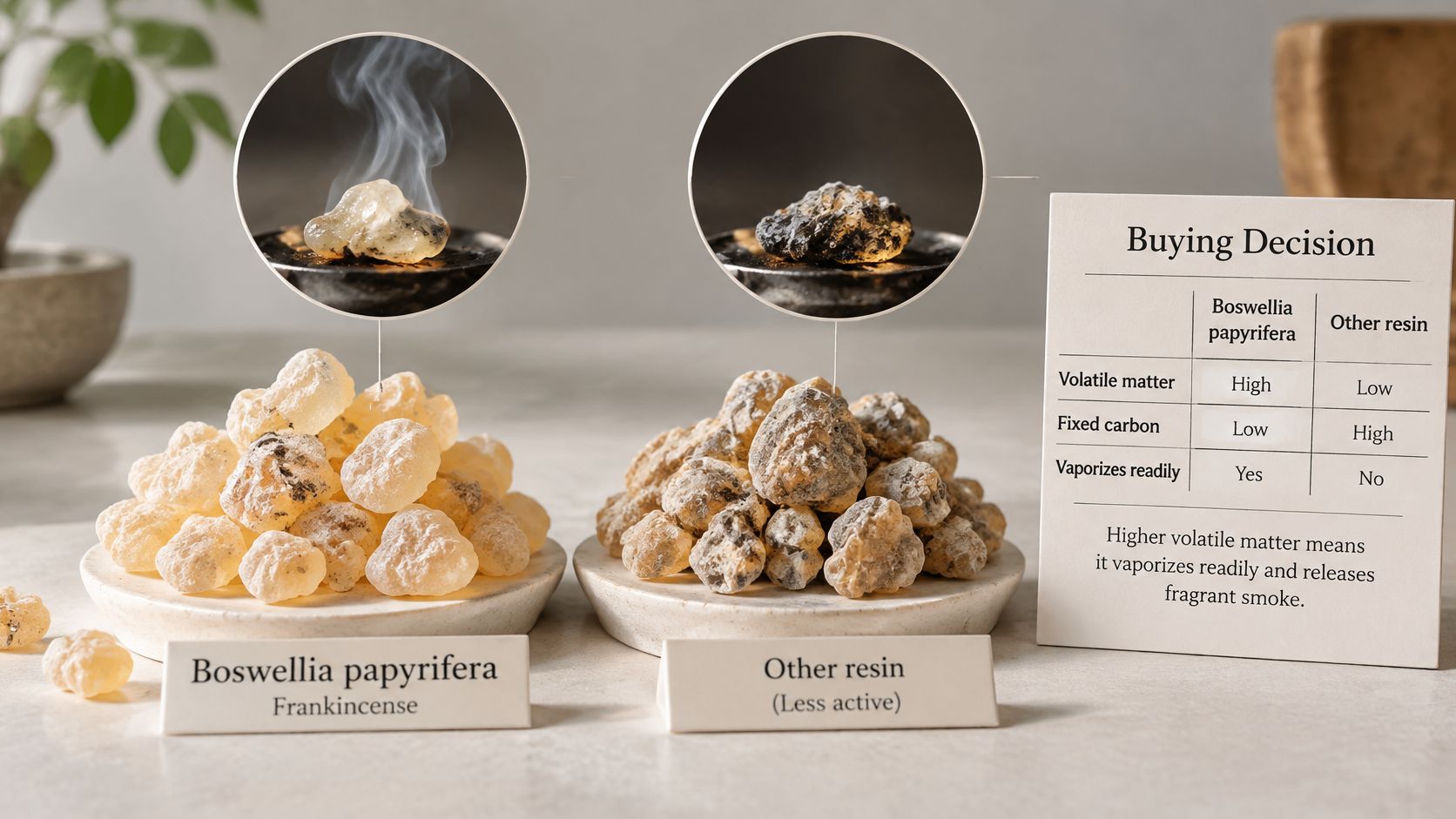
Frankincense is mostly volatile material. A controlled chamber study of two natural fumigants found that frankincense-type Boswellia papyrifera contained 88.7 ± 1.0 percent volatile matter and only 1.9 ± 0.0 percent fixed carbon, while myrrh-type Commiphora myrrha held 71.1 ± 5.1 percent volatile matter and 10.1 ± 4.0 percent fixed carbon, as published in the resin study on frankincense and myrrh. Volatile matter is the part of the resin that turns into aroma under heat. Fixed carbon is what stays behind and keeps smouldering, working like the ember in a campfire that glows long after the flames are gone.
That one gap predicts how each resin burns. Frankincense vaporises readily and gives a fast, clean aromatic cloud that thins out quickly. Myrrh smoulders longer, throws heavier smoke and leaves more residue in the burner. The same analysis detected resin-derived terpenoids, the chemical family behind the balsamic, citrus-like, woody and medicinal notes people recognise in both.
Resin | Volatile matter | Fixed carbon |
|---|---|---|
Frankincense (Boswellia papyrifera) | 88.7 ± 1.0% | 1.9 ± 0.0% |
Myrrh (Commiphora myrrha) | 71.1 ± 5.1% | 10.1 ± 4.0% |
The practical rule: a higher volatile share means a scent-forward, shorter burn, while more fixed carbon means a slower, heavier smoulder. Natural and traditional describe how a resin was produced. Neither word rates the smoke it gives off, so the buying decision runs through composition and ventilation rather than the word pure on a label.
Why two blends with the same name burn differently
Bakhoor is a blend, so the front of the box tells you very little. The same name can cover wood chips, resin, oils and a binder in any proportion, and two products labelled alike may burn hot and fast or slow and heavy depending entirely on what's inside them. Oud incense is the loosest term of all, since it can mean agarwood chips, a bakhoor blend scented with oud oil, or a stick carrying a synthetic oud accord. Three different products, one word on the label.
To see how the raw material behaves when it's handled properly before you commit to an order, this walkthrough is a useful reference:
If the terms gum, resin and oleoresin still blur together, our explainer on gum and resin covers how each one behaves over heat.
A buying checklist
Match the form to your setup. Loose bakhoor and resin need a burner, sand and charcoal; sticks and cones need a holder. Buying resin before you own a burner is a common first-order mistake.
Judge a blend by its ingredient list. Named botanical sources and a full list of contents tell you more than the word oud printed in large type.
Ask about botanical identity and testing. Resins sold under the same name can differ widely in purity, which is why supplier traceability and periodic testing matter for loose resins and blended bakhoor.
Buy the smallest size first. Run three tests: smell the material cold, burn it for 15 minutes with a window open, and watch how the smoke behaves in the room. Do that before any larger order, because incense and fragrance oils often can't be returned once opened. Our own policy excludes returns on fragrance, incense and perfume oils because of the possibility of contamination.
One form, one small pack, one test session under the ventilation rules. That's the cheapest way to learn whether a supplier's material suits your room before you buy a year's worth. We stock both sides of the choice, from resin to hand dipped sticks, cones, Satya, Auroshikha and Tulasi, and our hand dipped sticks are soaked in pure incense oil for no less than 24 hours.
FAQs
FAQ 1: How should Middle Eastern incense be stored to preserve its fragrance?
Store incense in airtight containers in a cool, dry location away from direct sunlight, humidity and excessive heat. Keep different fragrance varieties separated to prevent their aromas from mixing. Proper storage helps preserve the original scent and prevents moisture from affecting the material.
FAQ 2: Can you combine different types of incense to create a custom fragrance?
Yes. Combining compatible incense materials can create a more personalized fragrance. For example, frankincense can complement woody scents, while myrrh can add a deeper, earthy character. Start with small quantities and experiment with different combinations before preparing a larger blend.
FAQ 3: What is the difference between traditional bakhoor and modern scented bakhoor?
Traditional bakhoor commonly features aromatic wood chips, natural resins and fragrance ingredients, while modern commercial varieties may incorporate synthetic fragrance oils, binders and processed materials. Both can produce appealing aromas, but their ingredients, fragrance profiles and burning characteristics can differ considerably.
FAQ 4: Why does incense sometimes smell different when burned compared to its original fragrance?
Heat changes how aromatic ingredients release their fragrance. Some volatile compounds evaporate quickly, while other materials release deeper woody, earthy or smoky notes as they warm. The burner temperature, ingredients and surrounding airflow can also influence the final scent.
FAQ 5: What should wholesale buyers look for when purchasing Middle Eastern incense?
Wholesale buyers should evaluate ingredient transparency, fragrance consistency, packaging quality, product variety and supplier reliability. Requesting samples before placing larger orders is a practical way to compare scent quality and burning characteristics. Buyers should also consider whether their customers prefer traditional resins, bakhoor blends, oud-inspired fragrances or everyday incense sticks.
Aroma Warehouse carries the forms this guide covers, from loose resins and hand dipped incense sticks to cones, wooden burners and ash catchers, with retail and wholesale pricing and shipping from Buckeye, Arizona across the United States. If you're still deciding between a burner setup and everyday sticks, start with a small pack of each and test them under the ventilation rules above. Visit Aroma Fragrance Warehouse to see the current range.


