

Floral Incense Sticks Guide for Calm and Retail

You get home, drop your keys on the counter, and reach for something small that changes the mood of the whole room. Maybe it's a rose stick before a bath. Maybe it's jasmine before evening prayer or meditation. If you run a shop, the moment looks different but feels familiar. A customer picks up a floral box, smiles at the label, and asks, “Is this one soft or strong?”
That's where floral incense sticks earn their place. They feel familiar because flowers already live in our memory. Rose can feel romantic or comforting. Lavender can feel clean and settled. Jasmine can feel rich and dreamy. Floral scents don't need much introduction, which is one reason they work so well for first-time incense buyers and for retailers building approachable displays.
They also aren't a tiny corner of the market. Incense sticks are the dominant format in the global incense category, estimated at about 62% of the market in one estimate and 65% of worldwide incense-market revenue in 2023 in another, according to incense market reporting summarized here. That matters because floral incense sticks sit inside the stick format people already know and use across home fragrance, meditation, and ritual settings.
This guide takes the plain-spoken route. We'll look at what floral incense sticks are, how they're made, why one floral burns softer or smokier than another, how to choose quality, and how to use or merchandise them responsibly. If you're buying for your living room, yoga room, gift shop, botanica, or online storefront, the details that matter most usually aren't on the front of the box.
Table of Contents
Introduction to Floral Incense Sticks and Why They Captivate - Why floral scents feel easy to live with - Why this category deserves a closer look
How Floral Incense Sticks Are Made and How They Work - The basic build of a floral stick - Natural flower notes versus fragrance blends - Why burn behavior changes from one floral to another
Popular Floral Scent Profiles and What Each One Evokes - The floral families shoppers ask for most - Floral Scent Profiles at a Glance - How to choose when labels sound pretty but vague
Everyday Uses and Retail Displays That Make Florals Shine - At home, florals are usually about tone - On the sales floor, context sells faster than labels - Why florals are useful for mixed customer bases
How to Choose Quality Floral Incense and Buy Smart Wholesale - What to check before you light one - Why sourcing origin matters - Buying wholesale without buying blind
Storing Floral Incense and Burning It Safely at Home or in Store - Storage that protects the scent - Why ventilation matters more than the floral label - Safer habits for everyday burning
Floral Incense Sticks FAQs for Buyers and Resellers - Does floral mean natural - Are floral incense sticks safer than other incense types - Can hidden fragrance chemicals show up in floral incense smoke - What should a retailer say when customers ask for a clean floral incense
Introduction to Floral Incense Sticks and Why They Captivate
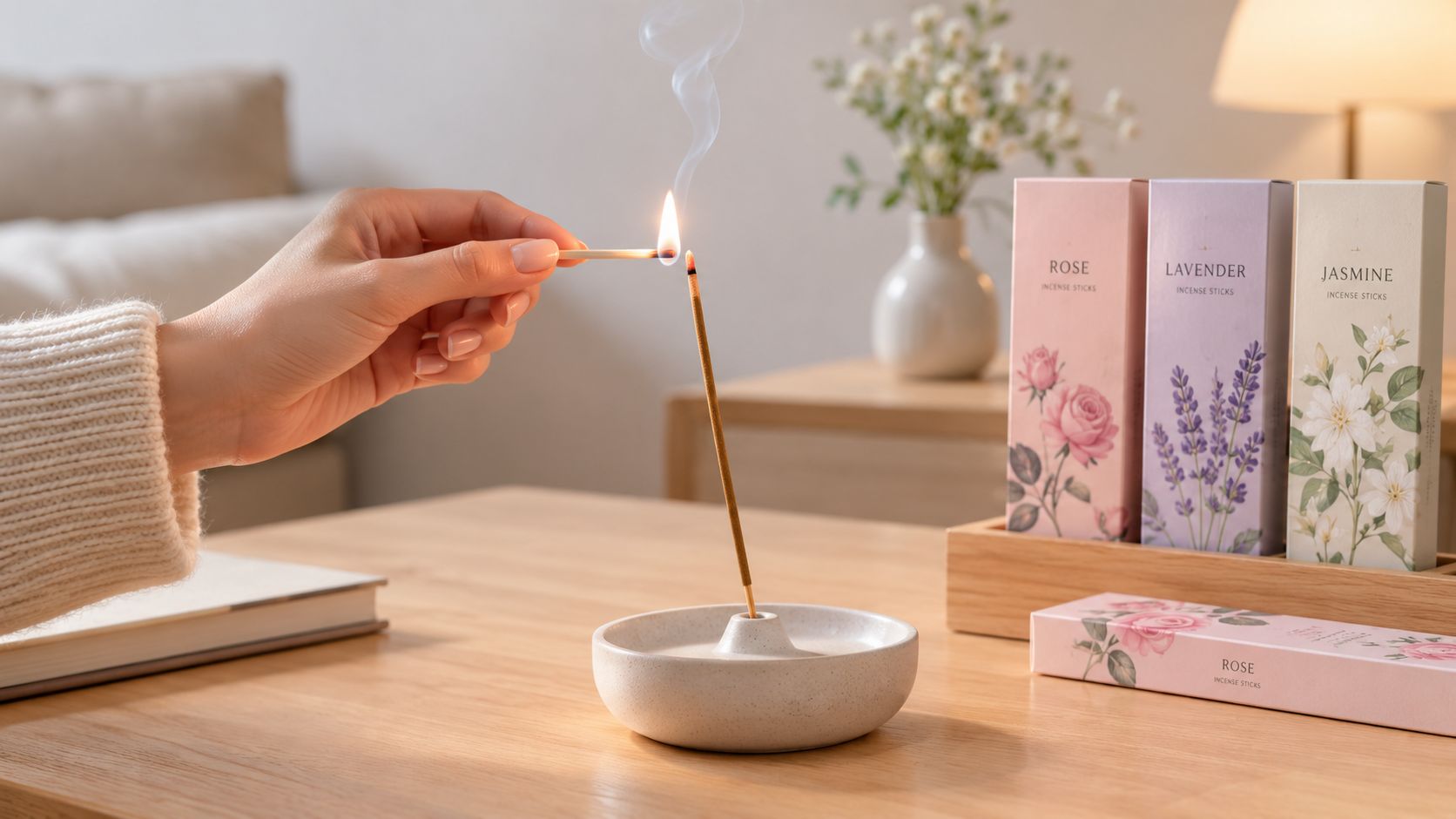
Floral incense sticks are incense sticks scented to smell like flowers or flower-forward blends. That sounds simple, but the category is broader than many shoppers expect. Some smell like a single bloom, such as rose, jasmine, or lavender. Others mix floral notes with woods, musks, herbs, or resins so the result feels less like a bouquet and more like a rounded perfume.
Why floral scents feel easy to live with
Floral scents are the bridge between perfume and place. A resin incense can feel solemn. A heavy wood scent can feel grounding but dense. Florals often land in the middle. They can soften a room without making it feel like a temple or smoke lounge.
That's useful at home and on the sales floor.
For home users: floral scents are often the first style people try because the scent family already feels familiar.
For retailers: florals help hesitant buyers step into incense without having to decode terms like resinous, balsamic, or earthy.
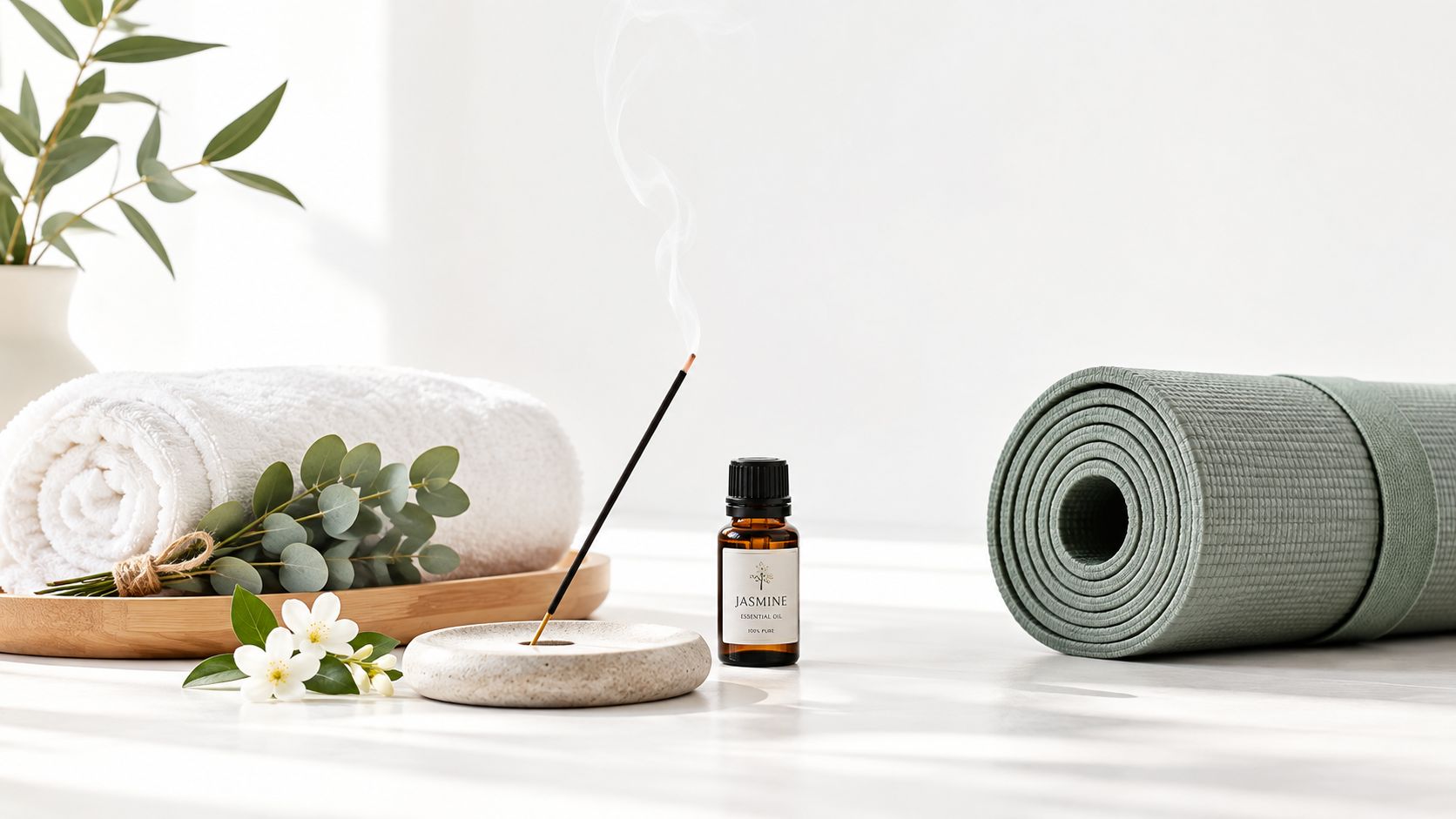
For wellness spaces: floral notes can sit comfortably beside towels, oils, bath salts, and diffusers without clashing.
Floral incense sticks sell best when people can quickly imagine where they'd use them. Bedroom, bath, prayer corner, treatment room, or front counter.
Why this category deserves a closer look
A floral label tells you the scent direction. It doesn't tell you how the stick burns, how strong it throws, or how much smoke it makes in a small room. Those are practical questions, and they matter.
They matter for buyers who want calm without a heavy cloud in the air. They matter for retailers who don't want returns from customers expecting a soft rose and getting something powdery, sharp, or overly smoky. They matter for anyone trying to match product to space.
How Floral Incense Sticks Are Made and How They Work
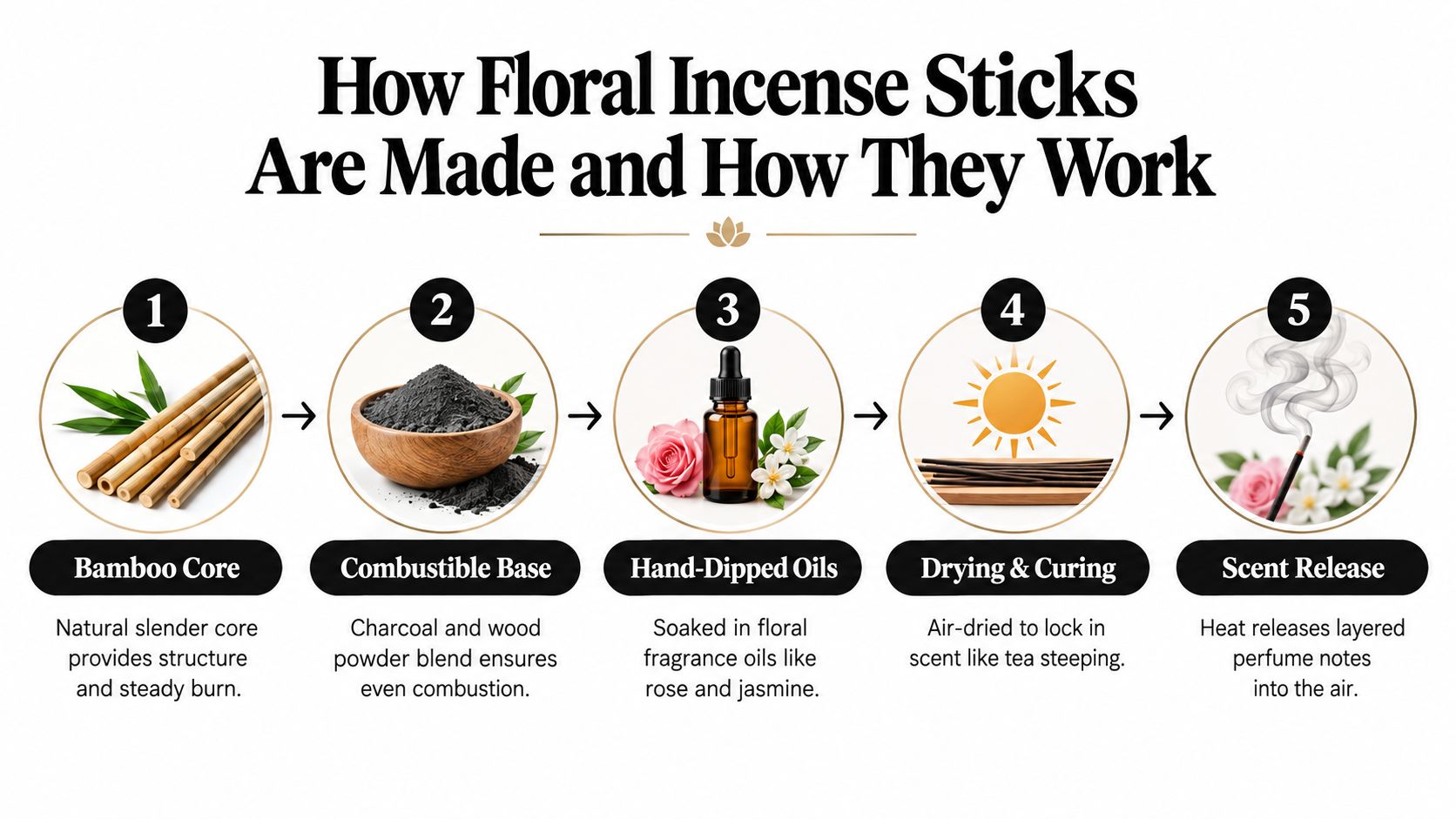
Most floral incense sticks are built in layers. Think of them like tea and perfume combined into one slow-burning format. The stick provides structure, the base carries combustion, and the fragrance layer shapes what you smell as heat moves through the material.
The basic build of a floral stick
Many sticks start with a bamboo core. Around that core sits a combustible coating, often made from wood powder, charcoal, binders, and scent-bearing material. After forming, the sticks are dipped or coated with fragrance blends and then dried or cured.
If you want a closer look at the craft side, Aroma Warehouse has a plain-language explainer on how incense sticks are made.
Here's the simplest way to picture it:
The core holds the shape. It helps the stick stay straight and burn steadily.
The base feeds the ember. This is the part that keeps the burn traveling.
The fragrance gives the personality. Floral oils or blends soak in or coat the surface.
Drying sets the product. This helps scent cling to the stick instead of feeling wet or flat.
Heat releases the aroma. As the ember moves, it warms and burns the fragrance-bearing material.
Natural flower notes versus fragrance blends
Many first-time buyers get confused. A floral incense stick can smell like jasmine without being made only from jasmine flower material. Some formulas use natural extracts. Some use fragrance oils. Many use a blend of natural and synthetic aroma materials.
That isn't automatically good or bad. It changes the result.
Natural extracts can smell nuanced and less “perfumey,” but they may be subtler.
Fragrance oils often give stronger cold sniff and room presence.
Blended formulas can create a more stable scent from batch to batch, which retailers usually appreciate.
Why burn behavior changes from one floral to another
A rose stick and a lavender stick can look nearly identical in the box and still behave differently when lit. The reason is formulation. Fragrance load, base density, moisture, and coating thickness all shape burn speed, smoke character, and scent release.
A controlled study found incense-stick PM2.5 emission factors ranged from 5 to 56 mg per gram of incense burned, with emission rates of 7 to 202 mg/h in a California residence, while another lab study reported 0.4 to 44.5 mg/g across products, showing how much emissions can vary by product design and formulation, as reported in this controlled incense emissions study.
Practical rule: Don't judge a floral stick only by its scent name. The recipe under the fragrance matters just as much as the flower on the label.
Popular Floral Scent Profiles and What Each One Evokes
If you've ever smelled three jasmine sticks from three brands and thought, “Why are these so different?” you're not imagining it. Floral names point you in a direction, not to one exact aroma. Some are airy. Some are creamy. Some smell fresh-cut, and others lean powdery or incense-like.
The floral families shoppers ask for most
Rose Incense usually lands as soft, romantic, powdery, or classic. Some rose sticks smell like fresh petals. Others lean toward old-fashioned perfume. They're easy to pair with bedrooms, gift baskets, and self-care displays.
Jasmine Incense tends to be richer. It can smell lush, sweet, and almost velvety. In a small room, jasmine often feels fuller than rose, so it suits evening use, meditation corners, and stronger fragrance lovers.
Lavender is the familiar clean floral. It often reads herbal as much as floral, which makes it useful for people who don't want a sweet room scent.
Lily often feels watery, crisp, and elegant. It's a good fit for shoppers who want floral without much powder.
Gardenia usually runs creamy and heady. It can be beautiful in larger spaces, but some buyers find it too full-bodied for a tiny room.
Ylang ylang is tropical, warm, and slightly exotic. It's often the floral people choose when plain florals feel too polite.
Floral nag champa blends sit between flower and resin. They give floral softness with a deeper incense character underneath.
Floral Scent Profiles at a Glance
Floral Note | Aroma Character | Best For |
|---|---|---|
Rose | Soft, classic, sometimes powdery | Bedrooms, gift sets, gentle evening use |
Jasmine | Rich, lush, sweet | Meditation, larger rooms, evening mood |
Lavender | Clean, herbal-floral, calming | Baths, yoga spaces, winding down |
Lily | Fresh, airy, elegant | Daytime use, entryways, lighter scent lovers |
Gardenia | Creamy, heady, full | Spacious rooms, strong floral fans |
Ylang ylang | Warm, tropical, deep | Spa mood, layered fragrance setups |
Floral nag champa blend | Floral with resin depth | People who want floral plus traditional incense character |
For readers comparing scent materials more broadly, this overview of flower fragrance oil helps explain why two floral products can smell related but not identical.
How to choose when labels sound pretty but vague
When shoppers see names like Moon Rose, Temple Jasmine, or White Floral Bouquet, they often assume softness. That's not always how the stick performs. A better shortcut is to ask three questions:
Do I want sweet or fresh? Jasmine and gardenia often feel sweeter. Lavender and lily usually feel fresher.
Do I want the scent to sit close or fill the room? Rose can go either way. Jasmine and gardenia often feel broader in the air.
Do I want perfume-like or incense-like? Floral nag champa and floral-resin blends smell more traditionally “incense.”
A good floral pick should fit the room as much as the nose. A rich bloom in a tiny powder room can feel crowded. A pale floral in a large lobby can disappear.
Everyday Uses and Retail Displays That Make Florals Shine
Floral incense sticks work best when they're tied to a real moment, not just a scent name on a shelf. People rarely buy jasmine because they've analyzed top notes. They buy it because they want their room to feel softer at night, or because they want the meditation corner to feel finished.
At home, florals are usually about tone
Rose, lavender, and lily often do well in spaces where people want ease instead of intensity. That can mean a bath tray, a bedroom holder, or a few quiet minutes before journaling. Jasmine and gardenia often suit slower evening use because their scent lingers in memory even after the stick is out.
A few simple pairings tend to work:
Lavender with a bath or bedtime routine: keeps the room feeling clean and settled.
Rose with reading or reflection: adds warmth without needing much ritual around it.
Jasmine with meditation or prayer: gives a more enveloping atmosphere.
Lily in an entryway or studio: feels neat and less syrupy than sweeter florals.
On the sales floor, context sells faster than labels
Retailers often get better results when they merchandise by use, not only by scent family. A shelf card that says “For evening wind-down” helps more than one that says “floral.” Pair floral sticks with wooden burners, ash catchers, bath salts, or oils so customers can picture a complete setup.
If you're building gift shop or boutique assortments, this guide to wholesale supplies for gift shops gives good pairing ideas for incense and complementary items.
A few display approaches work especially well:
Color grouping: pinks and whites for rose and lily, purple for lavender, gold or cream for jasmine and gardenia.
Tester strategy: keep one unlit sample open for cold sniffing. Many shoppers decide before they ever see smoke.
Cross-merchandising: place florals near bath items, yoga tools, or quiet-space decor rather than only in a general incense wall.
This video shows the kind of calm, product-linked atmosphere many customers are trying to create at home.
Why florals are useful for mixed customer bases
Florals can bridge customer types that don't always shop the same way. The yoga student, the gift buyer, the person restocking altar items, and the online shopper looking for “clean-smelling incense” may all reach for different floral notes. That makes floral incense sticks flexible inventory for small retailers.
A floral display does better when it answers one unspoken question: “Where would I use this tonight?”
How to Choose Quality Floral Incense and Buy Smart Wholesale
Quality is easier to spot than many buyers think. You don't need a lab. You need your eyes, your nose, and a little patience.
What to check before you light one
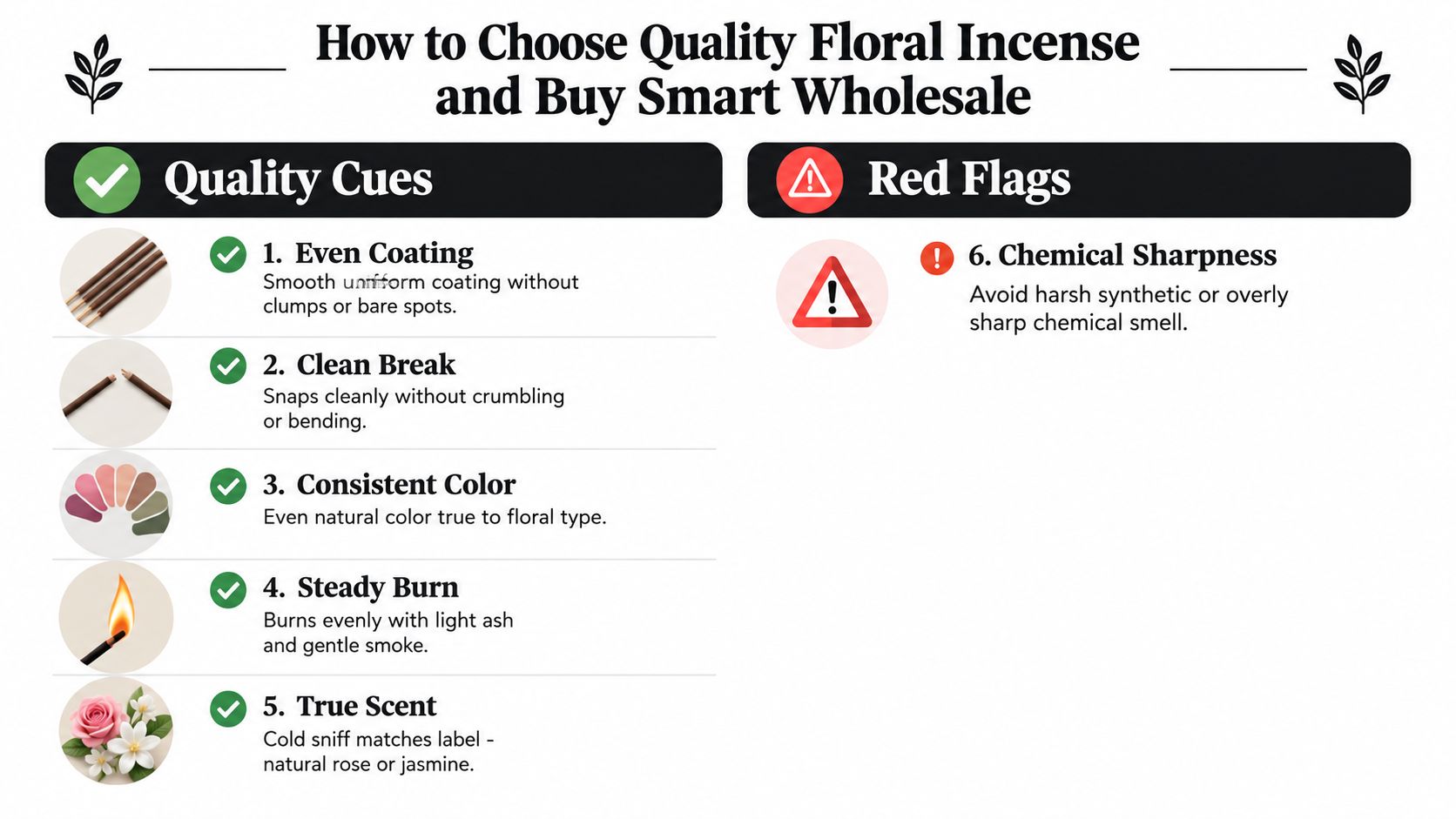
Start with the unlit stick. A quality floral incense stick should look intentional, not messy. Coating should be fairly even. The stick shouldn't shower powder into the box when handled gently, and the cold scent should resemble the floral name instead of hitting your nose like sharp solvent.
Look for these cues:
Even coating: bare patches and heavy clumps often lead to uneven burn.
Clean break: a stick that bends too much or crumbles too easily was likely stored poorly or made weakly.
Consistent color: wild variation inside one pack can point to inconsistent dipping or curing.
True cold sniff: rose should read rosy, not like generic perfume. Lavender should smell floral-herbal, not candy-like.
Calm ash behavior: when burned, the ash should hold reasonably well instead of collapsing instantly in chunks.
Why sourcing origin matters
India remains the central manufacturing base for incense sticks, and the scale of that role is significant. One estimate places the India incense sticks market at USD 1.28 billion in 2025, rising to USD 1.80 billion by 2031, while another projects India's incense sticks and dhoop market to grow from USD 1.3 billion in 2025 to USD 2.2 billion by 2034. A separate industry data point says India produced 1.2 million tons of incense sticks in 2022. The same research stream also values aromatic incense sticks at USD 770 million in 2025 and says they held 38.5% of the global incense-sticks market in one report, according to this India incense stick market report summary.
For wholesalers and resellers, that matters because mature manufacturing ecosystems usually make it easier to source repeatable fragrance styles, larger runs, and private-label-ready stock.
Buying wholesale without buying blind
If you're stocking a shop or reselling online, sample first whenever possible. Floral names can hide major differences in sweetness, smoke level, and room presence. Ask practical questions about pack style, scent freshness, and whether the fragrance was recently poured or has been sitting sealed for a long time.
If you want a shopper-facing example of a small-format option, a listing like this 20 count incense for home shows how some sellers present floral incense in formats that work for both trial use and giftable packaging.
For wholesale supply, Aroma Warehouse wholesale incense sticks is one example of a U.S.-shipping source that carries bulk incense and related accessories for retailers and resellers.
Buy with your customer's room in mind, not just your own nose. The best-smelling sample isn't always the easiest product to live with.
Storing Floral Incense and Burning It Safely at Home or in Store
A floral stick can lose its charm long before it loses its ability to burn. Storage makes a real difference. So does the way you use it once it's lit.
Storage that protects the scent
Keep floral incense sticks in a cool, dry place away from direct light, bathroom humidity, and strong competing odors. Incense can pick up surrounding smells more easily than many people expect. A jasmine box stored beside harsh cleaning products won't smell like pure jasmine for long.
A few habits help:
Seal what you can: closed boxes, tins, or bags help preserve the fragrance.
Separate strong scent families: florals can absorb heavier resin or musk odors nearby.
Avoid heat: warmth can flatten or distort fragrance over time.
Handle gently: rough handling sheds coating and affects how evenly the stick burns.
If you want a more general reference for responsible use, Aroma Warehouse has a page on incense safety.
Why ventilation matters more than the floral label
People often ask whether floral incense sticks are gentler than woodsy or resin styles just because they smell lighter. The scent impression can be softer. The smoke still comes from combustion.
Studies of incense smoke have detected carbonyls and other volatile organics, including formaldehyde, with measured concentrations in smoke ranging from 46.65 ± 4.44 to 596.89 ± 279.17 μg/m3 across tested sticks, and emissions continued during combustion and for an hour afterward before ventilation reduced levels, as described in this incense smoke chemistry study.
That doesn't mean people need to panic. It means the flower name doesn't erase the realities of indoor smoke.
Safer habits for everyday burning
Use a stable holder and an ash catcher. Burn for shorter periods instead of treating one stick like an all-evening room spray. Open a window or crack a door, especially in small rooms or at a retail counter where scent can build up across the day.
A simple checklist works well:
Place it securely: on a heat-safe surface away from curtains, papers, and shelves.
Vent the room: moving air matters, especially in enclosed spaces.
Burn less, not longer: you don't need to finish the whole stick in one session.
Never leave it unattended: this is basic fire safety, at home and in-store.
Keep it away from kids and pets: both for flame risk and smoke exposure.
Floral Incense Sticks FAQs for Buyers and Resellers
Does floral mean natural
Not necessarily. Floral describes the scent style, not the full ingredient story. Some formulas use natural extracts, some use fragrance oils, and many use blends.
Are floral incense sticks safer than other incense types
You can't assume that from the scent family alone. Comparative reporting shows emissions vary by product and formulation. One study found some incense sticks produced PM10 around 247–342 μg/m³ depending on the type, and another California-home study reported incense burning significantly contributed to indoor PM10 and particulate PAHs. The same reporting says incense produced the highest pollution among common fragranced products and that average indoor PM2.5 was nearly three times outdoor levels in homes that use incense, according to this comparative indoor air discussion of incense emissions. The practical takeaway is to compare products carefully and ventilate well.
Can hidden fragrance chemicals show up in floral incense smoke
Yes. A mass-spectrometry study found incense aerosols contained diethyl phthalate (DEP) as a dominant ester species, averaging about 18.8% of identified molecular features in incense aerosols. Fragrance-product safety data also show floral scent formulations may contain recognized allergens such as citronellol and geraniol, as discussed in this analysis of incense aerosol composition and fragrance chemicals.
What should a retailer say when customers ask for a clean floral incense
Keep it honest and useful. Say that different floral incense sticks can burn very differently, that stronger perfume doesn't always mean better quality, and that shorter burns with airflow are a smart habit. Customers usually appreciate practical clarity more than perfect-sounding claims.
Frequently Asked Questions How long do floral incense sticks typically burn?
Burn time varies by stick length, thickness, density, and formulation. Rather than assuming every floral incense stick has the same burn time, check the product specifications or test a sample before setting expectations for customers.
Can floral incense sticks be used in a bedroom?
They can be used in a bedroom when burned responsibly. Use a stable incense holder on a heat-safe surface, provide adequate airflow, keep the stick away from bedding and other combustible materials, and never leave a burning incense stick unattended.
How should floral incense be displayed in a retail store?
A useful display can organize floral incense by scent, color, occasion, or shopping purpose. Grouping related scents together and allowing customers to smell an unlit sample can make it easier to compare options before purchasing.
Can floral incense sticks be mixed with other incense scents?
Yes, some users experiment with burning different scent profiles at separate times or combining compatible fragrances to create a personalized atmosphere. If experimenting, start with small quantities because floral scents can vary considerably in strength and character.
How should you choose floral incense for a small room?
For a smaller room, consider a floral scent with a lighter or less overpowering character and use shorter burning periods with ventilation. Jasmine and gardenia, for example, are described in this guide as fuller-bodied florals, while lavender and lily can offer a lighter-feeling alternative.
If you're choosing floral incense sticks for home use, resale, or a wellness space, Aroma Warehouse carries hand-dipped incense, burners, fragrance oils, packaging supplies, and bulk options that fit this kind of careful, practical buying. You can browse current incense and accessory options, then match scent, format, and setup to your space at Incense Warehouse.


