

Solar Plexus Chakra Incense Scents Rituals and Safety

You're about to walk into a difficult meeting, lead a class, or make a decision you've been postponing. Your mind is active, but your confidence feels distant. You light a stick of incense, take a breath, and hope the familiar aroma can help you feel more centered.
That experience can be meaningful without treating incense as a miracle cure. Solar plexus chakra incense works best as a sensory anchor, a consistent smell that signals a shift from hesitation to deliberate action. The scent doesn't have to “activate” anything by itself. It can help you pause, focus on an intention, and connect a physical ritual with qualities such as confidence, motivation, and personal power.
The solar plexus tradition gives that ritual a clear symbolic language. It also helps you choose aromas with more care instead of reaching for a product because its label promises confidence. This guide covers the meaning of Manipura, traditional scent families, buying decisions, a simple meditation ritual, and practical indoor-burning precautions. For a broader overview of chakra-based fragrance choices, explore this chakra incense guide for the best scents for each chakra.
The most useful approach is both respectful and grounded. You can work with fire symbolism, choose a scent that feels personally energizing, and build a repeatable ritual while still paying attention to smoke, airflow, and the physical environment.
Table of Contents
Introduction to Solar Plexus Energy and Scent as an Anchor - A practical role for fragrance - What this guide keeps in view
Understanding the Solar Plexus Chakra and Its Core Qualities - From symbolism to daily experience - Why aroma enters the practice
Traditional Aromas That Support Solar Plexus Balance - Bright notes for a clear starting point - Spice for warmth and determination - Woods and resins for grounded confidence
How to Choose the Right Solar Plexus Chakra Incense - Start with the fragrance itself - Compare the format - Match the product to its purpose
Step by Step Ritual and Meditation With Solar Plexus Incense - Prepare the space - Light with attention - Breathe and focus - Use a grounded affirmation - Close deliberately
Safety Ventilation and Best Practices for Indoor Burning - Airflow changes the experience - Adjust the ritual for the setting
Introduction to Solar Plexus Energy and Scent as an Anchor

Incense has a much older history than modern chakra-branded products. An
independent wellness guide traces incense-burning practices to ancient Egyptian and Greek civilizations, where aromatic smoke supported spiritual connection long before retailers marketed products for individual chakras. Contemporary solar plexus incense combines that older ritual language with a newer aromatherapy and wellness format, so the category isn't based on one universal recipe (historical and chakra context).
That distinction matters when you're choosing a product. A package labeled “solar plexus” may contain a bright citrus blend, warming spices, frankincense, or another aroma associated by the maker with confidence and willpower. It isn't a standardized formula, and no current evidence validates the claim that a particular incense can directly balance a chakra.
A practical role for fragrance
Scent can still shape a ritual in a useful way. A familiar aroma gives your attention something concrete to notice. The act of lighting, placing, and sitting near the incense creates a boundary around meditation, journaling, breathwork, or preparation for a challenging task.

Think of the fragrance as a doorbell, not the person answering the door. It may remind you to become present, but your breathing, reflection, and choices do the deeper work. If ginger makes you feel alert, or sandalwood helps you settle, that personal association can make the ritual feel more natural than a scent selected only because it appears on a chakra chart.
A simple practice might begin before a presentation. You place the incense in a stable holder, open a window, and state a direct intention such as, “I'll speak clearly and make one decision at a time.” The aroma becomes linked with that behavior. Over time, the ritual can help you recognize the mental state you want to cultivate, without requiring a supernatural promise.
What this guide keeps in view
A good solar plexus practice brings together three considerations:
Symbolism: Manipura is traditionally associated with fire, yellow, confidence, and personal power.
Preference: Your response to an aroma depends on memory, context, and whether the fragrance feels clear rather than overwhelming.
Practical care: Indoor burning creates smoke, so ventilation, burn duration, room size, and product type belong in the ritual design.
Understanding the solar plexus concept first makes scent selection more intentional. It also keeps the ritual effective in the ordinary sense, helping you create a repeatable moment for focus, courage, and action.
Understanding the Solar Plexus Chakra and Its Core Qualities
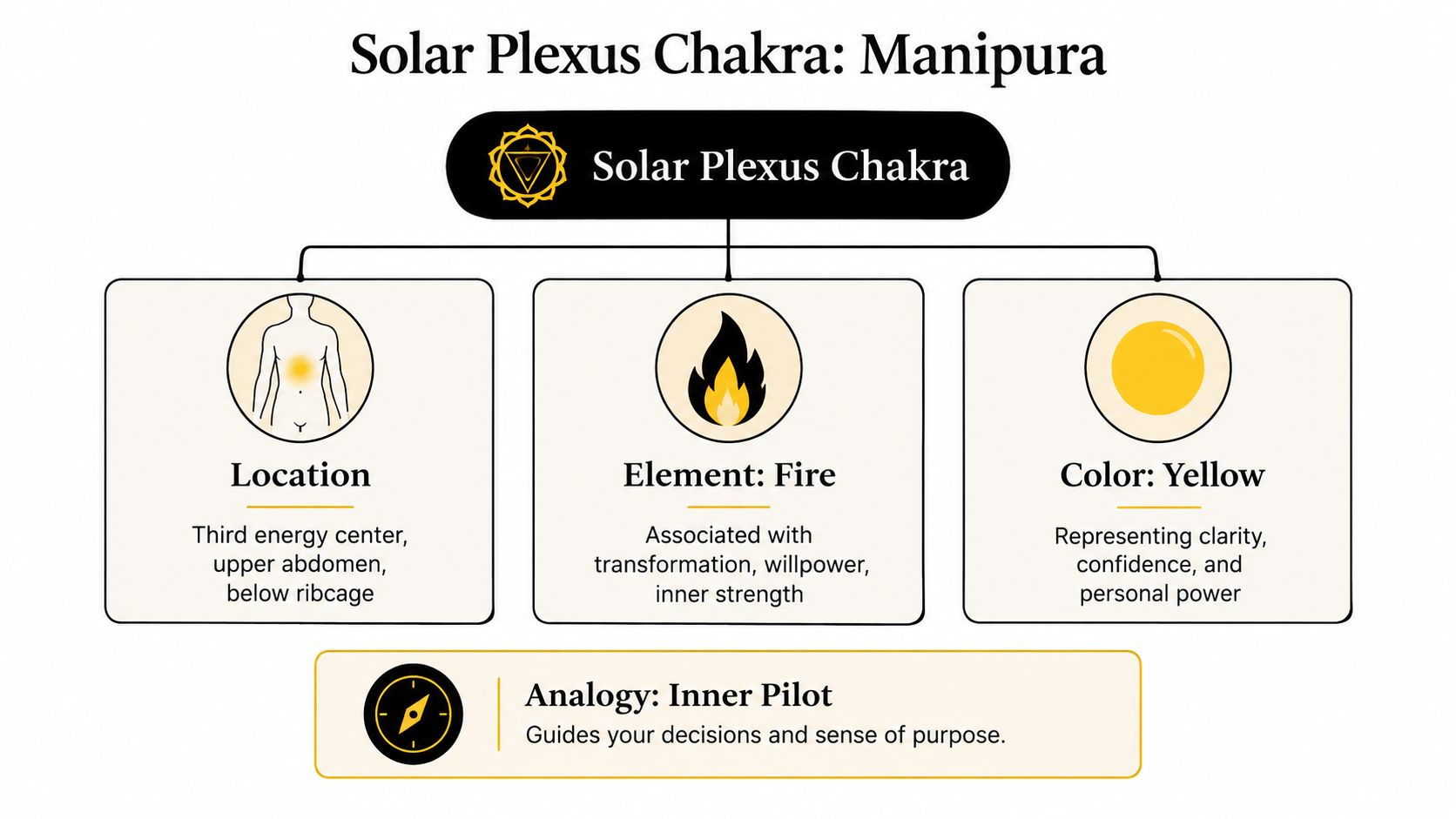
In chakra traditions, the solar plexus chakra is called Manipura. It's described as the third energy center, located in the upper abdomen below the ribcage. Guides commonly associate it with the yellow color and the fire element, along with motivation, willpower, ego, self-esteem, and personal power (chakra symbolism and traditional associations).
A simple analogy is an inner pilot light. A pilot light isn't a roaring fire, but it provides a steady source of ignition. In the same way, the solar plexus is often used as a symbolic map for the part of you that decides, begins, persists, and takes responsibility. When that inner pilot feels steady, you may find it easier to state a preference, finish a task, or act without waiting for perfect certainty.
From symbolism to daily experience
The fire association suggests transformation and directed energy. Fire can warm, illuminate, and help prepare food, but it can also become difficult to manage when it spreads without control. That contrast offers a useful way to understand the two ends of solar plexus symbolism.
A person who feels disconnected from this quality might describe indecision, self-doubt, low motivation, or difficulty trusting their own judgment. Someone who overidentifies with it might become controlling, reactive, or determined to prove their worth through constant effort. These are reflective descriptions, not medical diagnoses. They're prompts for noticing patterns in your behavior.
The yellow color adds another layer. Many practitioners use it as a visual reminder of clarity, brightness, and self-recognition. You might include a yellow cloth, notebook, candle, or imagined field of light during meditation. The object doesn't need inherent power to be useful. Its purpose is to keep your intention visible.
Why aroma enters the practice
Scent fits the fire metaphor because fragrance changes the atmosphere quickly, even though the physical room remains the same. A sharp citrus note may feel bright and direct, while ginger or cinnamon may feel warmer and more activating. Frankincense or sandalwood can give the ritual a grounded character when a bright aroma feels too intense.
The key is not to force an interpretation. Ask what quality you want to practice, then choose an aroma that supports your attention. If your intention is speaking with confidence, select a fragrance that helps you sit upright and remain present. If your intention is easing over-control, choose something softer and use the ritual to practice steady breathing rather than stronger effort.
Traditional Aromas That Support Solar Plexus Balance
Solar plexus incense isn't a single standardized product. One traditional guide recommends clove, cinnamon, and saffron, while another names lemongrass, ginger, and frankincense for confidence and personal power (traditional scent associations). These differences aren't necessarily a problem. They show that scent selection depends on symbolic tradition, sensory character, and the maker's interpretation.
A practical way to compare options is by fragrance family. Think about the atmosphere each family creates, then match it to the kind of attention you want to bring to your practice.
Scent Family | Example Aromas | Sensory Profile | Traditional Ritual Intent |
|---|---|---|---|
Bright citrus and grasses | Lemongrass, lemon, orange | Crisp, fresh, lively, direct | Clarity, alertness, motivation |
Warming spices | Ginger, cinnamon, clove, saffron | Dry, sweet, hot, enveloping | Courage, willpower, personal power |
Resin and woods | Frankincense, sandalwood | Resinous, smooth, grounded, meditative | Stability, presence, purposeful reflection |
Clarifying herbs | Rosemary, chamomile | Herbal, green, clean, gentle | Focus, composure, a calm sense of direction |
Bright notes for a clear starting point
Lemongrass can suit a morning ritual or a short focus practice because its character is clean and noticeable. Orange offers a softer citrus impression, while lemon tends to feel sharper. These descriptions concern fragrance experience, not proven energetic or medical effects.
Citrus and grassy scents may be a good fit if heavy smoke or dense resinous aromas distract you. Still, a bright fragrance can become overpowering in a small room. Sample it in the space where you'll use it, not only from the package.
Spice for warmth and determination
Ginger, cinnamon, clove, and saffron bring a warmer interpretation of the fire element. Ginger often reads as lively and pungent. Cinnamon and clove can feel sweeter and more enveloping, while saffron may add a dry, distinctive note.
These aromas work well when the ritual needs a sense of commitment rather than quiet relaxation. Use a lighter touch if you're sensitive to strong fragrance or if the room holds smoke easily. The intended feeling is directed warmth, not sensory overload.
Woods and resins for grounded confidence
Frankincense and sandalwood offer a slower, more contemplative profile. They can support a ritual that combines confidence with steadiness, especially when you're trying to act without rushing. Their association with spiritual practice also connects modern chakra rituals with older incense traditions.
Some readers also explore essential-oil approaches when they want fragrance without burning material. For background on that adjacent topic, this resource on science-backed air purification with essential oils may help you compare formats, though it shouldn't be treated as proof of chakra effects or as a substitute for ventilation.
For a closer look at one warming option, see this guide to cinnamon incense benefits. Choose the aroma that makes your intention easier to remember, not the one marketed as a guaranteed solution.
How to Choose the Right Solar Plexus Chakra Incense
Choosing a solar plexus blend starts with the room and the ritual, not the label. A product that feels pleasant in a spacious studio may be too dense for a desk, bedroom, or compact treatment room. Consider the physical format, smoke output, aroma strength, and purpose before buying several varieties.
Start with the fragrance itself
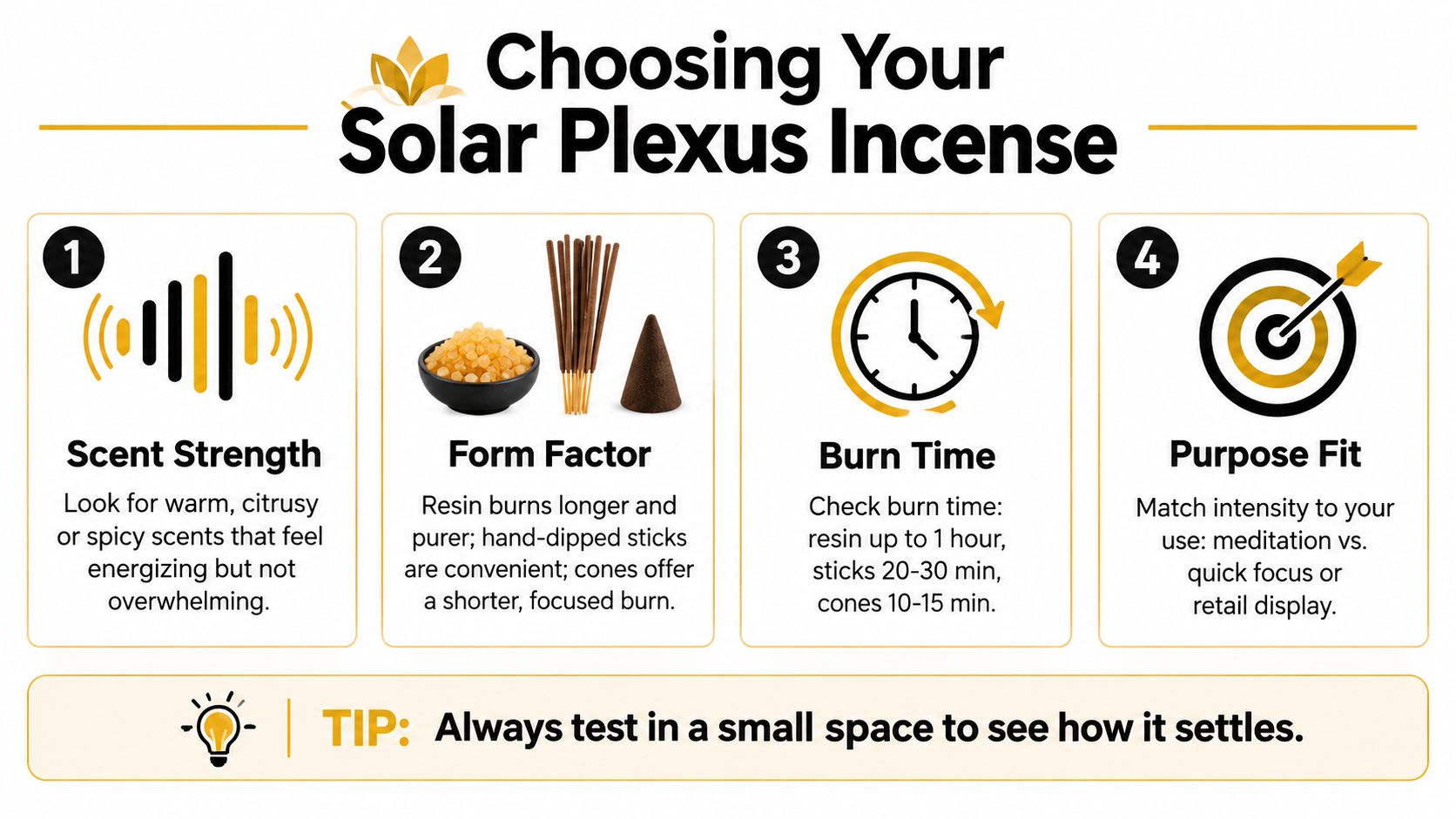
Read the scent notes, but trust your response during sampling. A warm, citrusy, or spicy aroma may feel energizing to one person and distracting to another. If you're buying for a studio or shop, test fragrances in the environment where customers will encounter them.
Look for a clear aroma that doesn't become harsh as it burns. Fresh-poured fragrance oils can offer a strong scent profile in products that use them, but strength alone isn't quality. A powerful aroma may be unsuitable for a small room or a long session.
Compare the format
Resin offers a traditional experience and requires a suitable heat source and burner. It can create a rich atmosphere, but it may be a poor choice when you need simple, controlled use.
Hand-dipped sticks are convenient for regular practice and easy to place in a holder. Their scent can vary according to the base material, fragrance, and dipping process. A comparison of hand-dipped incense and masala incense can help clarify what you're buying.
Cones suit a short, concentrated ritual. They're compact and useful for sampling a scent family, but their smoke can feel dense because the material burns in a small area.
Match the product to its purpose
For a quiet meditation, choose an aroma that stays present without pulling your attention away from breathing. For a quick pre-meeting pause, a crisp citrus or ginger profile may create a more immediate sensory cue. For retail display, consider whether the packaging, scent, and holder can work together without filling the entire store.
Check the maker's instructions, use an ash catcher, and test one product before ordering a broad assortment. Your best choice may be the lower-smoke option with an aroma you personally associate with alertness, because exposure is measurable while chakra-specific effects remain unproven.
Step by Step Ritual and Meditation With Solar Plexus Incense
A useful ritual doesn't need complicated language. It needs a safe place, a clear intention, and enough repetition for the sensory cue to become familiar. Set aside a short period when you won't need to answer messages or move through the room while the incense burns.
Prepare the space
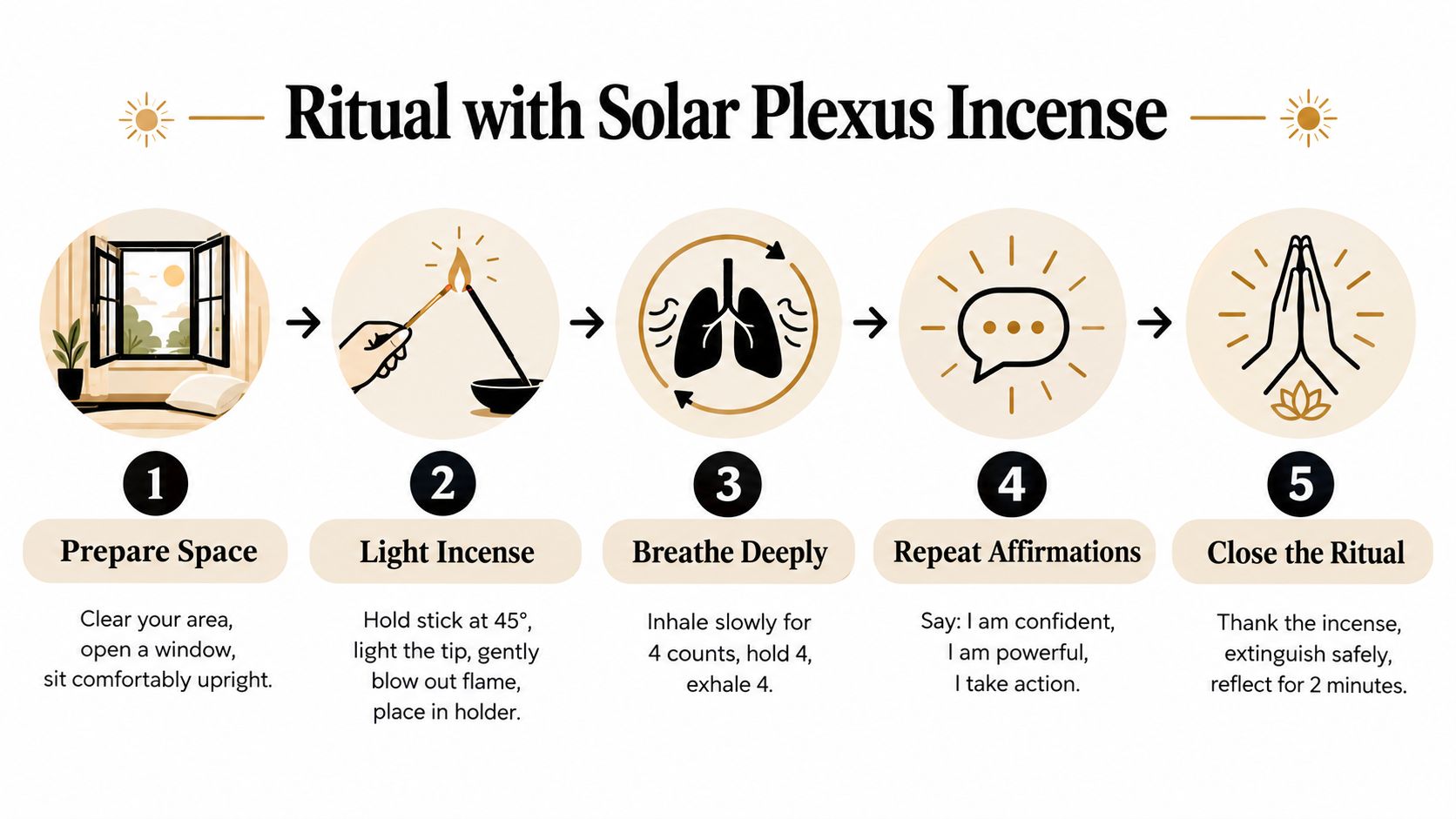
Clear a stable surface and place the incense holder on a heat-resistant base. Crack a window or provide gentle airflow before lighting, then sit upright with both feet supported if that feels comfortable.
Choose one intention. “I'll take the next clear step” is more useful than a vague request to become a completely different person. The intention gives the aroma a job within the ritual.
Light with attention
Hold the stick at an angle, light the tip, and allow a small flame to appear. Gently blow out the flame and place the stick securely in its holder. A commercial listing for Solar Plexus Chakra Incense instructs users to wait 30 seconds after ignition before blowing out the flame, so follow the instructions on your own product rather than assuming every format behaves identically.
Watch the first thread of smoke for a moment. You don't need to stare at it or inhale at all. Let the scent remain in the background while you bring your attention to your posture.
Breathe and focus
Use a comfortable breathing rhythm. You might inhale for four counts, hold for four, and exhale for four, as shown in the ritual visual. If holding your breath feels uncomfortable, skip that part and breathe naturally.
Bring awareness to the upper abdomen below the ribcage. Some practitioners visualize a warm yellow light there, not as a medical treatment but as a simple image for steadiness and directed energy.
Use a grounded affirmation
Choose one or two statements that sound believable enough to repeat:
Confidence: “I can speak clearly and stay present.”
Action: “I'm willing to take the next step.”
Self-trust: “I can make a decision and adjust if needed.”
Repeat the words slowly. The goal isn't to force an emotional peak. It's to practice responding to hesitation with a chosen statement and a calm physical posture. A broader guide to aligning your energy centers can offer additional meditation ideas if you want to develop a longer practice.
Close deliberately
Let the incense smolder only as long as the room and your comfort allow. Extinguish it safely when you're finished, confirm that no ember remains, and give yourself a quiet moment to record what you noticed. Two minutes of reflection can be enough to write one sentence about your mood, your intention, and the next action you'll take.
For more context on using fragrance as part of contemplative practice, read about the power of incense in meditation. Consistency matters more than elaborate ceremony.
Safety Ventilation and Best Practices for Indoor Burning
A calm ritual still needs clean-air planning. Recent research reports that burning incense can generate ultrafine particles and strong oxidative activity, while a 2025 perspective reports that indoor incense smoke can exceed U.S. air-quality limits and has been linked with cardiovascular risk during long-term exposure (research on incense smoke and indoor air). Those findings don't mean every brief ritual creates the same exposure. They do mean you shouldn't treat smoke as harmless because the product is natural or spiritually labeled.
Airflow changes the experience
A small closed room allows smoke and fragrance to concentrate. An open window, an operating exhaust fan, and a shorter burn can reduce how much smoke remains around you. One clinical study discussed in the same research source found PM10 and PM2.5 returned to background levels within an hour after burning in a monitored setting. That observation points to the importance of duration, ventilation, and product type, rather than relying on one universal warning.
Practical rule: If you can smell the incense long after the ritual ends, the room may need more airflow or a shorter burn next time.
Use an ash catcher and a stable holder. Keep burning incense away from curtains, paper, bedding, children, pets, and drafts that could move ash or tip the holder. Never leave it burning while you sleep or leave the space.
Adjust the ritual for the setting
Home users can burn less often, choose a lower-smoke product, and ventilate before and after use. Wellness studios and retailers need to consider several people sharing the same air, including visitors who may be sensitive to fragrance. Staff should know how to extinguish products and when to pause burning.
Avoid indoor burning if smoke worsens your breathing, causes discomfort, or creates symptoms that concern you. People with respiratory sensitivities should choose a non-burning alternative or ask a qualified healthcare professional for personal guidance. A ventilation professional's overview of Arizona ventilation system installation costs may be useful for businesses considering broader airflow improvements, though a home ritual usually begins with simple window and fan use.
For smaller homes, review practical suggestions in this guide to the best incense for small apartments. Safety isn't separate from the ritual. It's part of designing a practice you can repeat without creating an avoidable indoor-air problem.
Finding Quality Solar Plexus Incense for Home and Wholesale
A versatile solar plexus assortment should serve more than one interpretation of confidence. Stock bright citrus and lemongrass for customers who want a clean, energetic aroma, warming ginger or cinnamon for a fire-oriented ritual, and frankincense or sandalwood for people who prefer a slower, grounded atmosphere. This range acknowledges that personal scent association matters more than a miracle aroma.
For home use, select a format that fits your space and attention span. Sticks are straightforward for regular meditation, cones can provide a compact ritual option, and resins suit buyers who already have the appropriate burner and enjoy a more traditional setup. Accessories such as wooden burners, ash catchers, oil warmers, and electric diffusers help customers choose a format that matches their ventilation needs.
Wholesale buyers should assess consistency, packaging, and assortment flexibility alongside fragrance. A useful inventory can include hand-dipped sticks and cones, classic sandalwood, established brands such as HEM, Auroshikha, and Tulasi, fresh-poured fragrance oils, and unscented sticks for repackaging or private-label projects. Retail and wholesale purchasing can support individuals, wellness studios, independent shops, and resellers, and no business license is required according to the publisher information provided for the retailer.
A practical buying plan starts with a small test assortment. Burn or display products in the actual environment, note how quickly the scent becomes strong, and ask whether the aroma supports the intended mood without dominating the room. Businesses can then expand the families that suit their customers instead of treating every item labeled “solar plexus” as interchangeable.
The strongest ritual is simple: choose a scent you enjoy, name the quality you want to practice, use the incense carefully, and connect the moment with a concrete action. Confidence grows through repeated choices and behavior. Fragrance can help mark that process, but it doesn't replace it.
Frequently Asked Questions
1. Can solar plexus chakra incense be used before yoga or journaling?
Yes. Solar plexus chakra incense can be incorporated into a yoga or journaling routine as a sensory cue that marks the beginning of the practice. Choose a fragrance that you find pleasant and use the same scent consistently if you want it to become associated with your routine.
2. How long should a solar plexus chakra incense ritual last?
There is no required ritual length. A short five- to ten-minute practice can be enough to establish an intention, breathe comfortably, and reflect before moving on to another activity. The incense does not need to burn for the entire meditation.
3. Can I use solar plexus incense without meditating?
Yes. Incense can be incorporated into other intentional activities such as journaling, reading, stretching, preparing for a presentation, or creating a quiet transition between activities. The ritual can be as simple as lighting the incense safely, identifying an intention, and spending a few quiet minutes with it.
4. What should I do if I dislike the scent marketed as solar plexus incense?
Choose a different fragrance family rather than forcing yourself to use a scent because of its chakra label. Solar plexus products can feature citrus, herbs, spices, woods, or resins, so there are many sensory profiles to explore. Personal preference is an important part of creating a ritual you will actually repeat.
5. Can solar plexus chakra incense be used in a meditation room shared by several people?
It can be used only when the environment allows burning incense safely and the people sharing the space are comfortable with the smoke and fragrance. In a shared meditation room, consider ventilation, room size, burn duration, and whether anyone is sensitive to smoke or strong scents before lighting incense.
Aroma Warehouse offers hand-dipped incense sticks and cones, classic fragrances, chakra-oriented scent options, fresh-poured fragrance oils, and burners and ash catchers for practical ritual use. Visit Aroma Warehouse to explore home and wholesale supplies for a solar plexus practice that fits your space, scent preferences, and customers.


