

Citronella Incense: Does It Really Keep Mosquitoes Away?

The most common advice is to light citronella incense fifteen or twenty minutes before anyone sits down, so a "protective cloud" forms around the patio. That picture is wrong. A burning stick doesn't build a fence. It sends up a thin, scented trail, and that trail only matters where the smoke passes.
On a still porch the trail can cross a few chairs. A fan, a cross-breeze, or an open lawn carries it off, and mosquitoes keep landing. Treat the stick as an ambiance product with a modest, placement-dependent deterrent. It is not a substitute for a registered skin repellent, screens, or dumping standing water.
If you sell it or burn it at home, the useful question isn't whether the label says citronella. It's whether the smoke will still be over the seats when people are sitting there.
Table of Contents
What Citronella Incense Is and How It Works - Fragrance and deterrent are different jobs
How Well Citronella Incense Repels Mosquitoes - A woodlot trial, then a controlled comparison
Placing and Burning Citronella Incense Safely - Where the stick should sit - A safe burn routine
Smoke Exposure, Pets and Children - Household rules that match the risk
Limits, Hot Weather and Common Misconceptions - Four claims that don't hold
Choose Citronella Incense Only If It Fits Your Situation - Which evening gets which product
What Citronella Incense Is and How It Works
A thin stick glows at the tip. A pale ribbon rises, then slides sideways across a patio table. That ribbon is the product in action.
Citronella incense is usually bamboo or wood dust coated with citronella oil. The oil is distilled from citronella grass, a lemongrass relative long grown in Asia. Heat from the smouldering tip lifts the fragrance into the smoke. The oil doesn't stay on the wood. It rides the air.
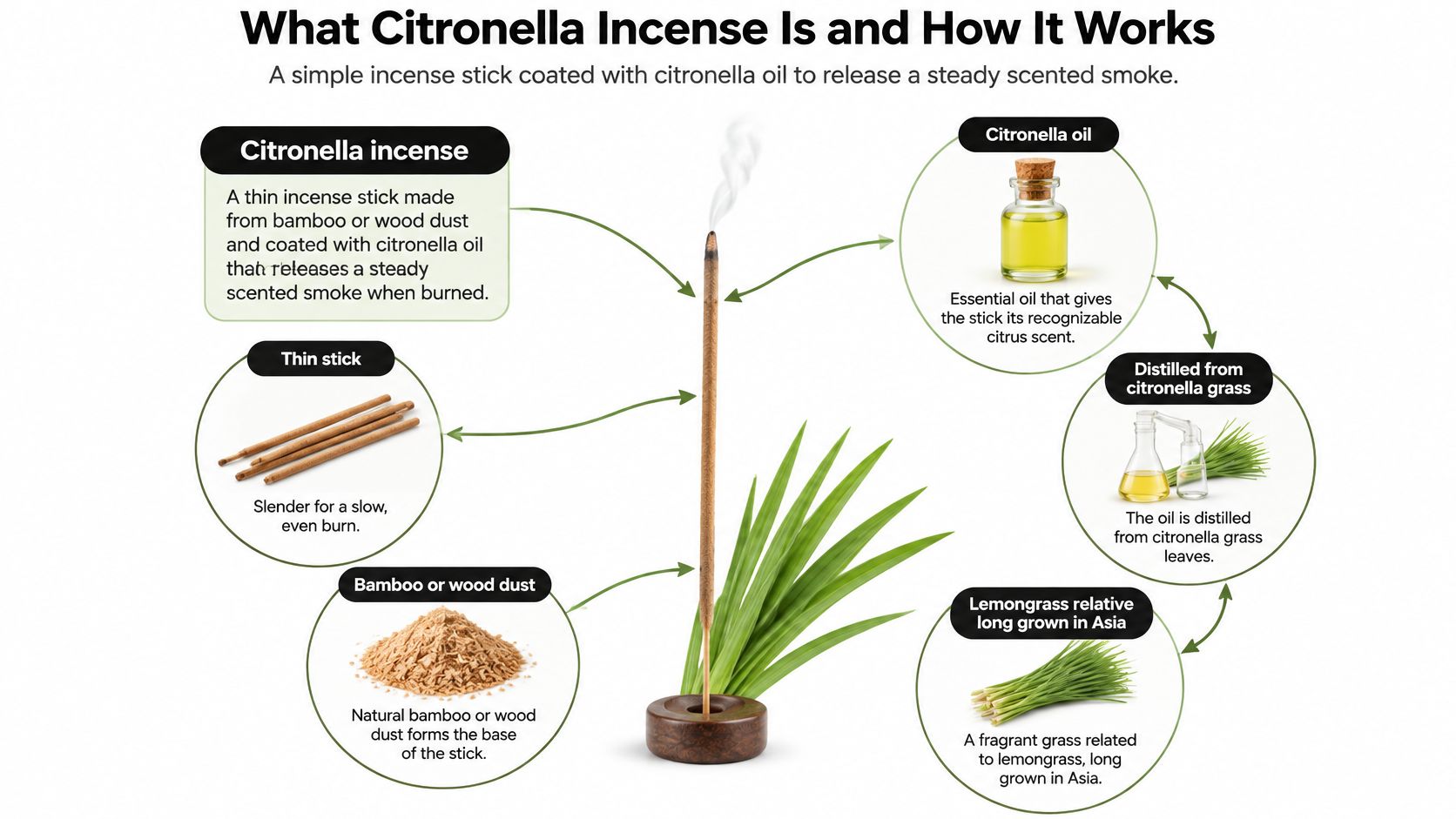
Think of the smoke the way you think of a neighbor's barbecue. A breeze delivers it. It isn't a wall around the yard. Still air lets the trail linger near the chairs. Moving air takes it over the railing before anyone notices.
Fragrance and deterrent are different jobs

People light a stick before dinner outside, on a porch that should smell clean, at a campsite, or on a deck in July. Fragrance can do that job well. Keeping mosquitoes off is a second job, and it only has a chance if enough oil stays in the air around the people sitting there.
Three variables set what happens next:
How much oil reaches the air. A light coating and a weak smoulder put less scent into the plume.
How far the smoke travels before it thins. A chair two steps away is a different problem from the far side of a lawn.
How still the air is. A sheltered corner holds the trail. An open side of the house does not.
Shape changes the trail too. Our guide to the five main types of incense covers sticks, coils, resin, powder, and joss sticks, so you can see which form holds a plume and which one burns off fast.
What you're holding is a coated stick and a drifting scent, sold first as ambiance. Any talk of mosquitoes comes after that.
How Well Citronella Incense Repels Mosquitoes
The honest answer is underwhelming: citronella incense helps a little, in the right air. It works like a faint scented draft that can bother some mosquitoes near the plume, while the rest of the yard stays open for business.
Product and setting | Measured result | What it tells you |
|---|---|---|
Citronella incense (5%) outdoors, 1995 Guelph field study | 24.2% fewer bites than untreated areas | Measurable but modest |
Citronella candles (3%) outdoors, same 1995 study | 42.3% fewer bites than untreated areas | Stronger than incense in that trial |
Citronella candles indoors, 2009 controlled study | 14% repellency | Weak in enclosed rooms |
Citronella continuous-release diffuser, 2009 controlled study | 68% repellency | Steady vapour outperforms smoke |
Citronella diffuser outdoors, 6 meters from traps, 2009 study | 22% repellency | Effect drops with distance |
A woodlot trial, then a controlled comparison

From July 26 to August 10, 1995, researchers worked in a deciduous woodlot in Guelph, Ontario, and published the work in 1996. They watched field populations of Aedes mosquitoes. Incense with 5% citronella cut bites by 24.2% versus untreated locations, while candles with 3% citronella cut bites by 42.3%, in the 1996 Journal of the American Mosquito Control Association field note. Both reduced bites, and plenty still landed.
Release method changes the picture. In a Journal of Vector Ecology comparison of botanical repellents, indoor citronella candles reached 14% repellency, a continuous-release citronella diffuser reached 68%, and the outdoor diffuser measured 6 meters from traps reached 22%. A stick smoulders in fits, so its plume arrives in pulses. A diffuser feeds vapour steadily, which is why a closed room treats those two products so differently.
Wind thins both. One woodlot stretch does not predict every patio, because mosquito density, airflow, and distance rewrite the evening.
Citronella incense produces a measurable but modest effect, not a barrier.

The same oil is a weak answer for other small pests. If fruit flies are the main complaint at a counter or in a kitchen, find out citronella's fruit fly limitations before you promise a stick will clear them.
For mosquitoes, pair any incense with a smarter second layer, starting with oils used to repel mosquitoes. Then watch your own seats over several evenings. If bites stay high, the stick is not the layer doing the work.
Placing and Burning Citronella Incense Safely
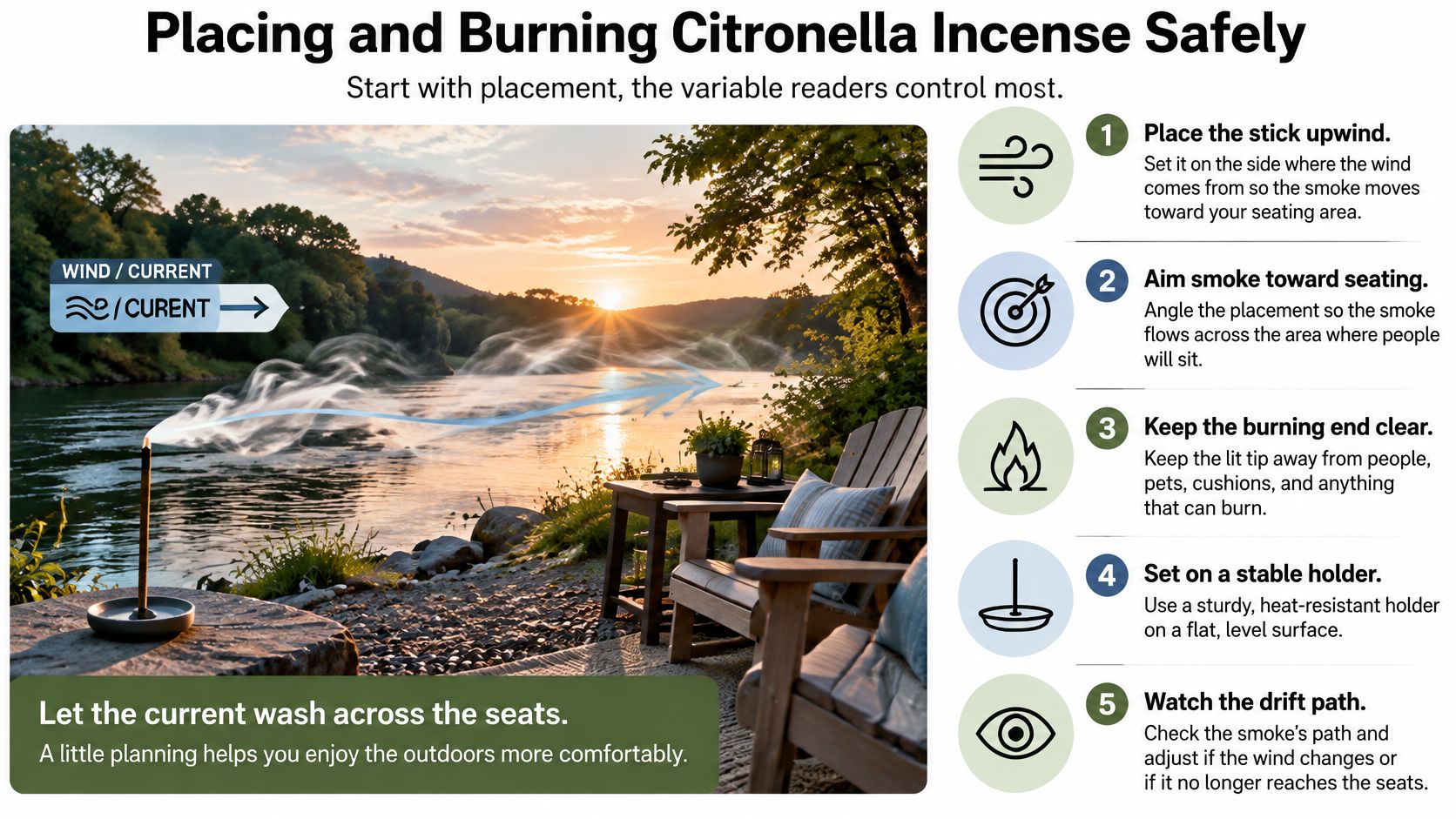
Placement is the variable you control. Picture the smoke as a slow river and the chairs as the shore. You want that current to wash across the seats, not shoot over the railing or pool under the table.
Field notes summarized by the University of Wisconsin mosquito site say citronella candles and related devices generally produce only small reductions in biting. Iowa State University, cited there, notes that standing directly in candle smoke can cut biting by approximately 40%, while dispersed smoke gives no meaningful benefit. The plume has to stay where people sit.
Where the stick should sit
Upwind or beside the seats. Let smoke drift toward people. Don't park the burner directly under a chair, where heat hits legs and the trail shoots past faces.
Out of a fan's path. A box fan looks helpful and then empties the plume in seconds.
A sheltered patio corner, not an open lawn. A wall or roof edge slows the air. Open grass does the opposite.
Close enough that the trail arrives before it thins. If you can't catch a light scent from your seat, move the holder closer.
Extra burners only when air can still move. Packed sticks in a closed nook make harsh smoke, not better protection. A holder keeps a stick upright. It can't fight open-air dilution.
A safe burn routine
Use a stable, heat-resistant holder with an ash catcher or a sand tray. A tipping stick is a common way cushions and decks get scorched.
Clear about 18 inches of dry leaves, cushions, fabric, and paper. Embers land farther than they look.
Set it on a level, non-flammable surface, off walkways and railings, and out of reach of children and pets.
Light the tip until it glows, then blow the flame out so the stick smoulders instead of flaring.
Stay nearby, and never burn it where people sleep. Combustion adds irritants, so a closed room is the wrong place.
Drown or bury the glow in water or sand, confirm no ember remains, and tip the ash into a metal container.
Shops that bundle sticks with burners should hand over a short safety card, not just a scent name. The safe use of mosquito repellent incense from The Green Advantage is a practical page to share, and our incense safety notes cover holders and burn habits in plain steps.
A short placement walk-through helps before the first evening on your own furniture.
Light one stick, sit in your usual chair, and check within a few minutes. You want a thin, steady trail at the seats, with no sparks and no sooty column.
Smoke Exposure, Pets and Children
The plume that smells pleasant at arm's length is the same plume that bothers lungs once a room holds it. Outdoors it thins fast. Under a tight patio roof, or indoors with the windows shut, it builds.
Household rules that match the risk
Burn indoors only in a larger room with a window or door open. A closed room concentrates whatever the stick gives off. In a tight space, skip smoke and pick a format that doesn't burn.
Keep holders out of sleeping rooms. Never leave a lit stick where a baby or small child is asleep. The tip stays hot after the scent fades.
People with asthma, COPD, or other breathing trouble shouldn't sit in the plume. Coughing, wheezing, or a headache means fresh air and an extinguished stick. Don't wait it out.
Keep burning sticks away from children and pets. A fallen stick burns skin, rugs, and fur. A chewed stick is a burn plus a mouthful of ash. If a pet coughs, sneezes, or acts distressed, move that animal outside the smoke. If symptoms continue, call a vet. Our notes on whether incense sticks are safe for pets list signs worth watching.
Burn only commercially labelled products. Homemade oil mixes don't come with safety data. Don't test them on a household.
Retail counters and yoga rooms have the same limit as a living room. If the people in the space include children, dogs, or anyone who wheezes, burn outside the occupied room or don't burn. If the smoke bothers anyone, stop. Lighting another stick makes the air worse, not safer.
Limits, Hot Weather and Common Misconceptions

Heat is where a lot of summer evenings fall apart. Scent lifts off a burning stick faster as temperatures climb, and a thin plume that held together at dusk can scatter before dinner on a very hot afternoon. The honest numbers we do have come from oil and repellent products rather than incense: a rapid review of Cymbopogon nardus, the grass citronella oil comes from, found repellency against Aedes aegypti ranging from 12 to 480 minutes depending on concentration and formulation, per the Cambridge rapid review of Cymbopogon nardus. That review also called for more controlled work on homemade mixes and safety.
A burning stick delivers an unmeasured dose that rides the wind, so plan around the short end of that range, not the long one. A strong smell on a very hot patio can still mean a weak deterrent. Dose and formula change how long any citronella product lasts, and the fragrance name on the box tells you neither.
Four claims that don't hold
A strong smell means it's working. Smell means oil is near your nose. It doesn't mean mosquitoes have lost you, especially once the afternoon is very hot.
Natural means safe anywhere. The oil comes from a plant, and a burning stick still makes smoke. Children, pets, fabric, and anything flammable still need distance.
One stick covers a whole yard. The trail is local. The far corner of the lawn never sees it.
Incense protects bare skin. Nothing in the smoke coats an arm. A mosquito that reaches skin isn't stopped by a scent across the patio.
Wind, open lawns, heavy mosquito numbers, and very hot afternoons all weaken the result, while an unventilated room trades weak deterrence for stale smoke. A small apartment makes that trade-off sharper, which is why incense choices for small apartments matter as much as the scent on the label.
On those nights, a registered skin repellent and getting rid of standing water do most of the work. In a wet city, find mosquito breeding grounds in Miami and deal with the water first. A stick can't outrun a breeding site beside the patio.
Choose Citronella Incense Only If It Fits Your Situation
Match the format to the evening before you match the scent to a brand. A stick you can aim behaves differently from a candle sitting in one spot, and the right choice depends on how long you stay outside and how the air moves around the seats.
Format | Typical burn time | Best for | Main trade-off |
|---|---|---|---|
Incense sticks | About 30 to 60 minutes | Short patio dinners and precise placement | Burn down quickly and need a stable holder |
Incense cones | Often 15 to 30 minutes | Heat-safe tabletop use | Sharper smoke and more ash build-up |
Incense coils | Several hours | Long evenings in a sheltered space | Bulky, and the hot ash needs a stand |
Citronella candles | Several hours | Lounging areas with a flame | Open flame needs close supervision |
Citronella diffusers | Continuous while powered | Enclosed or semi-enclosed spaces | Needs power and releases vapour, not smoke |
Which evening gets which product
A small dinner on a sheltered patio suits sticks in a stable holder. You can aim one plume and put it out when the plates are done.
A long deck evening suits a coil on a sturdy stand, if the air is calm enough to hold the trail near the chairs.
A cleaner indoor or semi-enclosed room suits a diffuser more than smoke. In a controlled study published in 2009, citronella from a continuous-release diffuser beat citronella candles, and outdoor diffusers of linalool and geraniol repelled female mosquitoes by 58% and 75% in the PubMed record of that botanical trial.
A windy open lawn is a poor match for any smoke product. The plume leaves before it can matter.
On the label, look for citronella oil as an ingredient, a stated concentration when the maker prints one, and language about ambiance or less mosquito activity nearby. Skip any line that promises you won't get bitten.
Use citronella incense for ambiance, with a modest deterrent that depends on placement. Add a registered skin repellent when mosquitoes are a real problem.
The holder matters as much as what burns in it. Aroma Warehouse carries hand-dipped incense sticks and cones, wooden burners, incense holders, and ash catchers, so a stable base can go out with whichever stick you choose for the patio.
Run a one-week test on the seats you use. Note which evenings feel more comfortable, where you set the burner, and which way the breeze carried the plume. If nothing changes, shift the burner upwind of the chairs or shorten the distance to the seats before you change scents. Placement fails more often than the fragrance does.
Frequently Asked Questions
1. How can you tell if citronella incense contains real citronella oil?
Check the product packaging for citronella oil listed as an ingredient rather than relying solely on the fragrance name. Look for manufacturer information, ingredient disclosures, and any stated oil concentration. A citronella-scented product does not necessarily contain a measurable amount of actual citronella oil.
2. Does citronella incense work against different mosquito species?
Mosquito species can respond differently to repellent ingredients and delivery methods. Results from one mosquito species or outdoor study should not automatically be applied to every species. Local mosquito populations, environmental conditions, and product formulation can all influence results.
3. Can citronella incense lose its effectiveness while sitting in storage?
Yes. Exposure to heat, sunlight, humidity, and air can affect fragrance ingredients over time. Store incense in its original packaging or an airtight container in a cool, dry location away from direct sunlight to help preserve its fragrance.
4. Is citronella incense suitable for use around outdoor dining areas?
It can be used outdoors around dining areas when positioned in a stable holder away from food, serving surfaces, and foot traffic. However, smoke should not blow directly across diners or food. People sensitive to smoke should avoid sitting near burning incense.
5. What is the difference between citronella incense and citronella essential oil?
Citronella incense is a combustible product that releases fragrance through smoldering, while citronella essential oil is a concentrated aromatic oil extracted from citronella grass. Essential oil can be used in compatible diffusers or other appropriate applications, depending on the product instructions. Neither format should be assumed to provide reliable mosquito protection without supporting product-specific evidence.
For patios, shops, and studios that want scent without inflated pest claims, start with a stick you can place precisely and a burner that stays upright through a long evening. Visit Aroma Incense Warehouse to see current incense, fragrance oils, and burners shipping across the United States.


