

Eucalyptus Incense Sticks: Scent, Safe Burning and Uses

The popular advice to burn eucalyptus incense for cleaner air gets the most important detail backward. A clean-smelling room isn't necessarily a room with cleaner air.
Eucalyptus incense sticks can make a pleasant cue for meditation or an evening pause, but choosing where the smoke goes matters more than choosing how fresh it smells.
Table of Contents
Why Eucalyptus Incense Smells Clean but Burns Like Smoke - A ritual needs a room plan
What Gives Eucalyptus Incense Its Scent - Species help explain the differences - An oil certificate isn't a smoke certificate
Where People Use Eucalyptus Incense and Why - Let the activity determine the arrangement
Who Should Limit Eucalyptus Incense and Why - A conservative household screening guide - Occasional use isn't permission for continuous burning
Ventilation Setups That Actually Clear the Smoke - Build an outward path - Repeated use needs a fixed policy
How to Burn Eucalyptus Incense Step by Step - Prepare, light and extinguish deliberately - Why the room needs recovery time
Storing Eucalyptus Incense So the Scent Lasts - A practical storage routine
Choose Your Burning Setup Before You Light a Stick - Make the decision repeatable
Why Eucalyptus Incense Smells Clean but Burns Like Smoke

Say you settle into a reading chair and light a eucalyptus stick. The first impression is cool, sharp and leafy, a scent you might associate with outdoor air or a freshly opened bathroom cabinet. It's easy to interpret that sensation as the room becoming fresher.
The catch is combustion. A typical cored incense stick has aromatic material around a bamboo or wood support, although coreless versions also exist. As that material smolders, fragrance reaches the room alongside smoke, not as a neutral, particle-free vapor.
The useful distinction: Enjoying the aroma and controlling the smoke are separate jobs.
That distinction changes the setup. Instead of putting the holder beside your face to catch every fragrant curl, place it where you can direct emissions away from occupied areas. Instead of letting the whole stick finish automatically, decide when you'll extinguish it before you light it.
A ritual needs a room plan

For a home meditation corner, the practical questions are airflow, supervision and who shares the space. A yoga studio also needs an agreed policy for participants. A shop needs a way to demonstrate the fragrance without turning every customer visit into a burn session.
There's no universally safe indoor burn arrangement. There is a more considered approach: understand the aromatic ingredients, screen for people who shouldn't be exposed, and prepare ventilation and an extinguishing method before tonight's session.
What Gives Eucalyptus Incense Its Scent
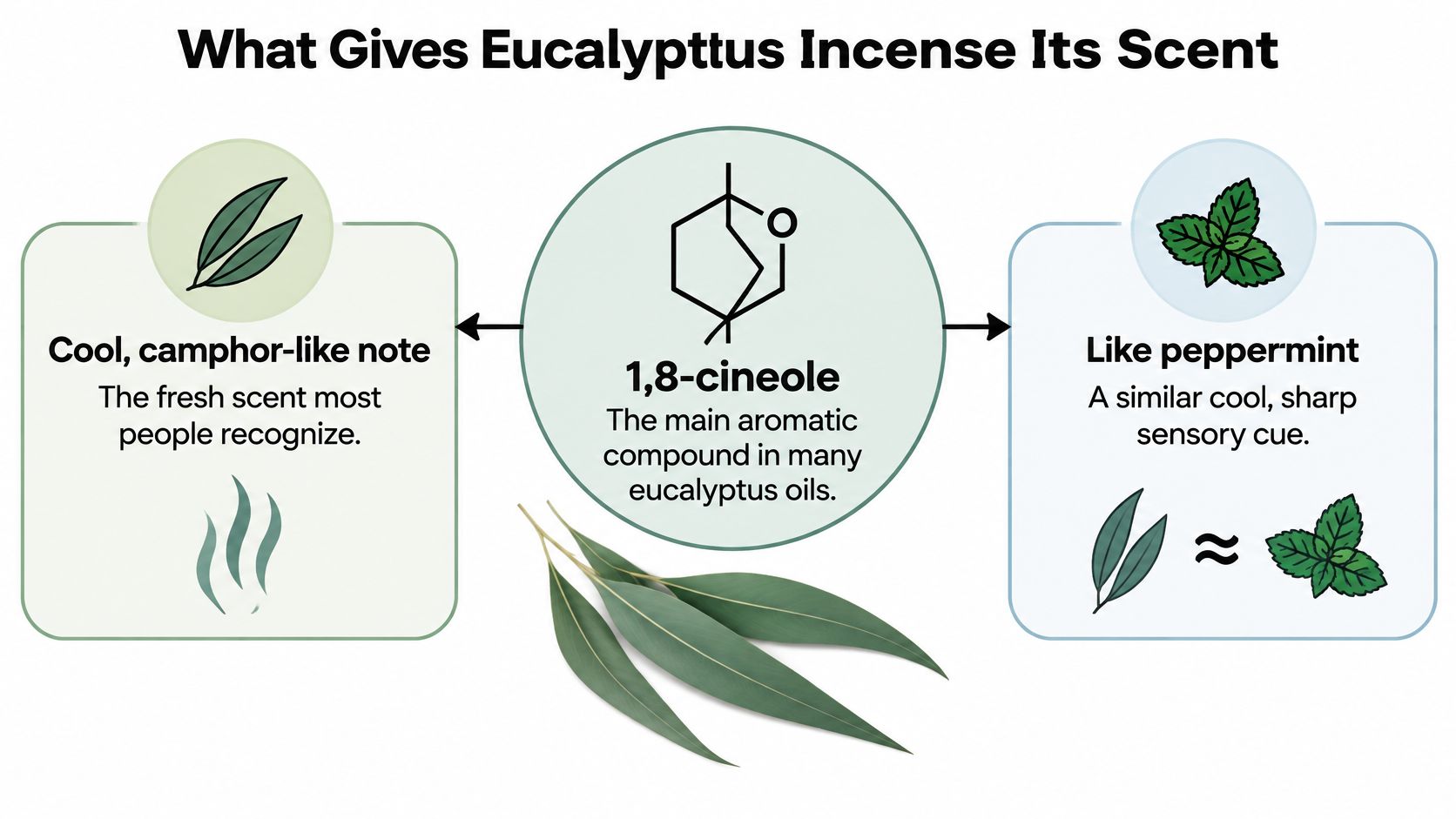
1,8-cineole, also called eucalyptol, is the main aromatic compound in many eucalyptus oils. It contributes the cool, camphor-like note that makes the scent recognizable. Think of the peppermint note in mint gum: one prominent aromatic ingredient can establish the character your nose identifies first.
That doesn't mean every eucalyptus plant produces an identical oil. Species, growing conditions and genetic differences can change the balance of aromatic compounds. The infographic captures the central relationship between cineole and the familiar scent.
Species help explain the differences
A comparative GC-MS study published in Scientific Reports reported the following 1,8-cineole shares of oil constituents for the eucalyptus species tested; the scent descriptions are practical interpretations, not measured fragrance ratings.
Species | 1,8-cineole share | What the scent tends to be |
|---|---|---|
83.5% of oil constituents | Strong, cool and classic; the most recognizable eucalyptus note | |
Eucalyptus camaldulensis | 64.1% of oil constituents | Clean and cooling, with more background notes |
Eucalyptus microtheca | 29.5% of oil constituents | Softer and more varied, with other terpenes contributing more prominently |
These aren't fixed specifications for every oil from those species. A cineole-forward oil generally suggests a more pronounced classic eucalyptus character, but the remaining ingredients and the incense formulation also shape what you smell.
For background on aromatic oils before comparing products, SEYANTE's an overview of essential oil essentials is a useful starting point. If you're comparing related herbal profiles, the guide to eucalyptus and tea tree offers another point of reference.
An oil certificate isn't a smoke certificate
For wholesale or private-label buying, request the botanical source and batch-level oil or fragrance documentation. Keep a sealed reference sample so you can compare incoming stock against the profile you intended to buy.
A cineole percentage describes the aromatic input, not the finished smoke. Heat changes ingredients, while wood powder, charcoal, binders and fragrance carriers contribute to the airborne mixture. An oil analysis therefore doesn't establish that burning the finished stick is safer or therapeutically equivalent to using unburned oil.
If burning is appropriate for your household, compare an unlit stick's scent with the room aroma during a ventilated session. Don't lean over the ember to sniff: notice from your normal seating position how the bright top note mixes with the warmer combustion smell.
Where People Use Eucalyptus Incense and Why
A home user might choose eucalyptus as a cue to put down their phone and begin meditation. The purpose is a recognizable transition, not a promise that the smoke improves concentration.
These settings illustrate how the same fragrance can serve different routines.
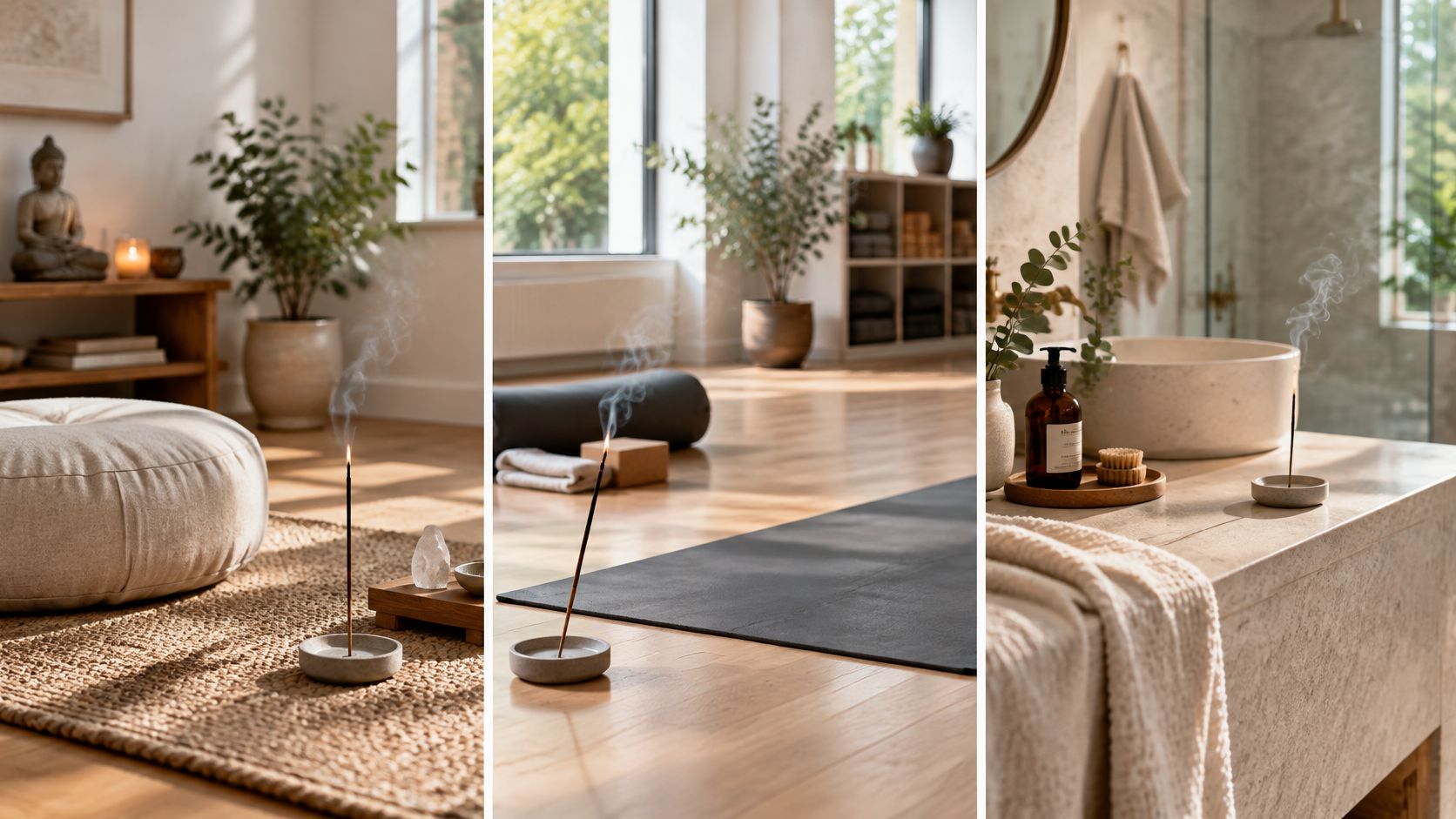
In a yoga studio, an instructor might consider eucalyptus incense for the transition out of practice. That becomes a shared-air decision: participants need advance notice and a genuine smoke-free option. At a retail counter, a sealed, unlit sample lets customers explore the scent without requiring a live demonstration.
A scholarly review of eucalyptus cultivation describes its broad international planting base, useful context for why eucalyptus-derived aromatic materials aren't confined to Australian products. That availability doesn't establish a single traditional use or a uniform fragrance recipe.
Let the activity determine the arrangement
Home routines: Keep the holder out of walkways and separate from cushions, throws and reading materials.
Classes and appointments: Agree on smoke policies before guests arrive, rather than asking once the room is already scented.
Retail browsing: Offer unlit samples and clear ingredient information wherever available.
For a compact meditation corner, Enky Journal's living room furnishing tips for flat dwellers can help you think through furniture placement. Treat the burner as a heat source that needs its own clear surface, not another decorative object between soft furnishings.
For a visual reference alongside these use cases, the following video is included.
The broader guide to incense stick uses can help distinguish fragrance preferences from ritual purposes. In each setting, decide how much material will burn, how long people will remain nearby and whether emissions can leave the building.
Who Should Limit Eucalyptus Incense and Why
The association between eucalyptus and easier breathing isn't evidence that eucalyptus smoke helps the lungs. Burning a stick is a different exposure from using diluted oil in a diffuser, and neither method should be assumed suitable for everyone.
Poison Control's eucalyptus oil guidance warns that inhaled eucalyptus oil, especially when insufficiently diluted, can irritate the nose and throat and cause coughing or difficulty breathing. That guidance concerns the oil itself. It doesn't establish a safe incense dose, and it's another reason not to treat a familiar botanical scent as a respiratory treatment.
Labels describing ingredients as natural, herbal or essential-oil-based don't establish respiratory safety. Likewise, a strong smell isn't a useful measure of benefit or danger: your nose detects fragrance, not the full composition of the air.
A conservative household screening guide
The approaches below are precautionary choices, not diagnoses or medically validated exposure limits.
Group | Why caution applies | Practical approach |
|---|---|---|
People with asthma or breathing conditions | Smoke particles can trigger airway irritation | Prefer no burning; discuss exposure with a clinician rather than testing tolerance |
Children | Avoidable smoke exposure and access to a hot ember are concerns | Keep sticks and smoke out of their rooms and keep supplies out of reach |
Older adults | Existing breathing conditions or sensitivity may make exposure harder to tolerate | Prefer a smoke-free setting; don't assume ventilation makes burning suitable |
Pets, especially birds | Animals can't reliably communicate discomfort or choose their exposure | Keep their living areas smoke-free and ask a veterinarian about household fragrance use |
Anyone sensitive to strong scents | Aroma can be uncomfortable, and scent strength doesn't measure exposure | Skip burning if fragrance causes symptoms; an unlit sample isn't a safety test |
For a pet-specific household assessment, consult the guide to incense sticks and pet safety. Moving an animal across the room isn't a reliable way to prevent exposure.
Don't ask someone to tolerate smoke because the fragrance is described as calming.
Occasional use isn't permission for continuous burning
A brief, occasional session creates a different exposure pattern from replenishing sticks throughout the day. That distinction supports minimizing burning, but it doesn't establish a harmless duration for a sensitive person.
In shared spaces, ask about fragrance preferences privately and before the appointment or class. A participant shouldn't have to disclose a medical condition publicly to request clean, unscented air. If anyone objects, choose a non-fragrance ritual, such as changing the lighting or using a quiet closing cue.
If coughing, throat irritation or breathing discomfort develops, extinguish the stick and move away from the exposure. Seek urgent medical help for significant breathing difficulty. When you're unsure whether incense fits your health circumstances, consult a clinician; for animals, consult a veterinarian.
Ventilation Setups That Actually Clear the Smoke
Opening a window or switching on a fan is incomplete advice. The direction of airflow matters. A fan that sends smoke past everyone's chair can spread the emissions before they eventually leave.
A ventilation paper on incense-generated particles describes the advantage of source capture over mixing room air and reports an initial particle increase of 18.3% to 21.5% when ventilation began in a particle experiment. The comparison below separates the tested findings from practical applications; it isn't a certification of any household fan arrangement.
Setup | What the study found | Best use |
|---|---|---|
Whole-room fan | Mixing can redistribute pollutants; a recirculating fan alone doesn't remove them outdoors | Use an outward exhaust arrangement, not a breeze across occupied seats |
Whole-room ventilation | Reduces levels but can agitate the air and disperse pollutants | Continue air exchange after extinguishing |
Local exhaust at the source | Most effective and most energy-efficient of the tested strategies | Preferred approach for studios, shared rooms and repeated burning |
Starting ventilation | Measured particles rose briefly before continued ventilation cleared them | Don't interpret an initial increase as a reason to stop ventilation |
Build an outward path
Place the holder near a suitable exhaust route without exposing the ember to a strong draft. Keep curtains, blinds and insect screens clear of the hot tip and falling ash. An extractor must discharge outdoors to function as exhaust; a device that only recirculates room air isn't the same thing.
Start airflow before lighting rather than waiting until smoke becomes obvious. Continue afterward, and avoid sweeping ash or dust into the moving air. Let ash cool completely before gently collecting it.
For a small bedroom, the decision may be not to burn there at all, particularly before sleeping. If the room is unoccupied by sensitive people and burning is otherwise appropriate, an outward-facing window fan can provide an exit path, provided it doesn't destabilize the holder or scatter ash.
Repeated use needs a fixed policy
A studio shouldn't treat a larger floor area as permission for continuous burning. Source-capture exhaust, predetermined operating limits and smoke-free appointments provide a more controllable arrangement than a ceiling fan.
The guide to incense choices for small apartments can support product selection, but fragrance choice can't compensate for poor exhaust. If you can't direct emissions away from people and outdoors, don't light the stick.
How to Burn Eucalyptus Incense Step by Step
Begin with the minimum material needed, a planned stopping point and a room you can ventilate. You don't need to finish a eucalyptus incense stick just because you've lit it.
The illustration shows the basic sequence. For exposure control, start ventilation before lighting, not only when the session ends.
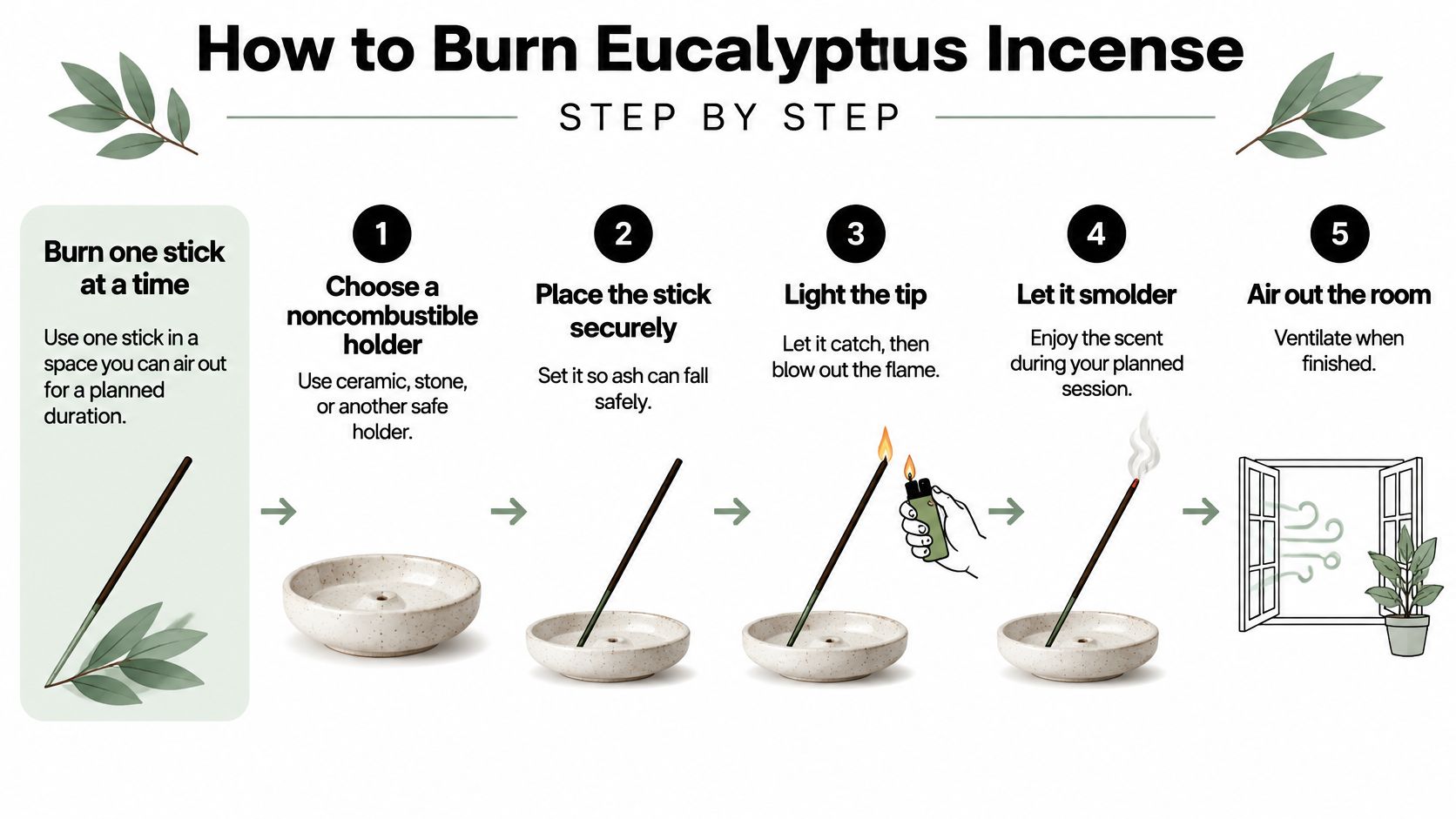
Prepare, light and extinguish deliberately
Choose a noncombustible holder. Use ceramic, stone or suitable metal with a secure stick socket and an ash-catching surface. Put it on a heat-resistant base because the holder itself may become warm.
Clear the surrounding area. Choose a stable surface away from curtains, bedding, paper and shelves above the ember. Keep the entire setup inaccessible to children and pets.
Establish exhaust before ignition. Open the outward ventilation path and check that airflow won't blow ash around. Don't position a fan so it pushes smoke toward your seat.
Light the aromatic tip. Let it catch, then gently blow out the flame so the tip smolders. Follow the product's lighting directions if its construction requires a different technique.
Stay outside the smoke plume. Keep the holder away from your face and normal breathing zone. Enjoy the room aroma without deliberately inhaling directly from the burning tip.
Use a planned stopping point. Set a timer for a brief session rather than leaving the stick burning in the background. Never leave it unattended, and extinguish it before leaving or going to sleep.
Put the ember fully out. Press the burning tip into sand in a noncombustible dish, or use the product's specified extinguishing method. Confirm that no glow or smoke remains before considering it extinguished.
Keep ventilating and let everything cool. Don't immediately close the room or empty warm ash into a wastebasket. Wait until the holder, tip and ash are cold before cleanup.
Why the room needs recovery time
An EPA-indexed residential study measured organic PM2.5 emission factors of approximately 7–31 mg per gram of burned incense; separate indoor monitoring summarized with this evidence found particle levels highest about 30 minutes after incense burning, returning to background after roughly one hour under the study conditions.
Those measurements aren't a countdown to guaranteed clean air in your room. Airflow, furnishings, product formulation and the amount burned can differ. Avoid immediately replacing an extinguished stick with another.
If a stick won't remain lit, use the guide to troubleshooting incense stick burning problems rather than repeatedly relighting it beside your face.
Storing Eucalyptus Incense So the Scent Lasts
Good storage helps preserve the fragrance you bought and keeps unused sticks separate from soot, ash and household odors. Heat, light and exposure to air can alter aromatic ingredients, so a decorative open jar beside a sunny window isn't the best stock container.
Keep the original label with the sticks. It identifies the product and preserves any ingredient, handling and burning instructions you may need later.
A practical storage routine
Seal between uses: Close the original protective packaging securely or use a clean, airtight container that doesn't transfer its own odor.
Choose a cool, dry cupboard: Avoid direct sunlight, radiators and steamy bathrooms.
Separate stock from the burner: Don't leave open bundles where smoke and ash can settle on them.
Restrict access: Keep stored sticks, matches and lighters out of reach of children and pets.
Rotate deliberately: Mark the purchase or opening date and use older suitable stock before opening a replacement.
Before a session, assess the unlit stick from a comfortable distance. A recognizable eucalyptus note suggests the fragrance remains familiar, but smelling pleasant doesn't prove that burning it is safe. If the odor has become sour, paint-like or unexpectedly stale, set the stick aside rather than trying to correct it with added oil.
For stock control: Keep a sealed reference sample away from the display and burning area.
Shop and studio staff can compare a suspect bundle against that sample before selling or using it. Record the batch information where available, and don't mix unidentified leftovers into fresh stock. There's no need to invent a universal shelf life: follow any product-specific storage guidance and investigate obvious changes.
Choose Your Burning Setup Before You Light a Stick
The botanical ingredients help determine the fragrance. Your room, exhaust arrangement and household determine whether burning is an appropriate way to enjoy it.
Choose the arrangement before choosing the moment. A smoke-free decision is a complete solution, not a failed incense routine.
Situation | Setup | Limit |
|---|---|---|
Solo home burn | Minimal material in a noncombustible holder, with a clear outward exhaust path | A brief, supervised session; don't automatically light a replacement |
Shared room or studio | Local exhaust at the source, advance consent and a written operating log | A fixed daily limit set in advance, plus smoke-free appointments |
Asthma, young children or sensitive pets | No burning in their occupied environment | Seek individual advice from a clinician or veterinarian rather than testing tolerance |
Make the decision repeatable
For a home session, attach a note to the storage container with your stopping point and extinguishing method. Keep the timer somewhere you'll notice it. Don't put adhesive notes on a holder that becomes hot.
For a business, record burn duration, room size, occupancy, ventilation status and any complaints. That gives staff a practical way to investigate conditions without assuming either the product or the customer is the problem.
Our Sonavi incense is intended for indoor use in well-ventilated spaces and releases light aromatic smoke and fine particulates during use, as all incense does. That operating requirement belongs in the decision, not just on packaging.
If you want fragrance without combustion, diluted eucalyptus oil in a suitable diffuser is a different exposure, not an automatically harmless substitute. Follow the oil and device directions, and retain the same caution around respiratory sensitivity and pets.
Today, choose your room arrangement, write down when you'll stop and read the product instructions before lighting. If you can't make the setup suitable for everyone sharing the air, keep the ritual and leave out the smoke.
FAQs for Eucalyptus Incense
1. What scents pair well with eucalyptus incense?
Eucalyptus incense pairs well with fragrance profiles such as peppermint, citrus, lavender, rosemary, and fresh woods. These combinations can create different aromatic experiences, ranging from crisp and invigorating to softer herbal blends. Personal preference plays an important role when choosing complementary fragrances.
2. Is eucalyptus incense a good choice for people who dislike sweet fragrances?
Eucalyptus incense is generally a good option for people who prefer fresh, herbal fragrances over sugary or dessert-inspired scents. Its recognizable camphor-like character offers a sharper aromatic profile. However, individual products can vary depending on their fragrance formulation and additional ingredients.
3. How does eucalyptus incense compare with peppermint incense?
Eucalyptus incense typically has a cool, camphor-like herbal character, while peppermint incense generally features a sharper, mint-forward aroma. Both offer fresh fragrance profiles, but eucalyptus tends to have a more medicinal or woody aromatic impression, whereas peppermint is often associated with a recognizable mint scent.
4. Can you burn eucalyptus incense and lavender incense together?
Although eucalyptus and lavender have complementary fragrance characteristics, burning two incense sticks simultaneously increases the amount of smoke released into the room. A better approach is to enjoy each fragrance separately during different sessions rather than combining burning sticks in the same space.
5. What should you look for when purchasing eucalyptus incense in bulk?
When purchasing eucalyptus incense in bulk, consider fragrance consistency, stick construction, packaging quality, ingredient information, and supplier reliability. If you're buying for resale, request a sample before placing a larger order. This allows you to evaluate the unlit fragrance and compare the product against your customers' preferences.
At Aroma Fragrance Warehouse, we offer incense sticks and cones, fragrance oils, and accessories for home routines and retail or studio supplies. Explore the available scents and holders with your ventilation plan in mind, and choose only what fits the space and people who'll use it.


