

Aromatherapy Diffuser Sticks: How They Work and Stay Safe

If a bottle of sticks never burns, never plugs in, and never makes smoke, is the scent really "just décor"? That assumption is where most guides stop. Aromatherapy diffuser sticks are a fragrance-emission product.
The liquid is the dose, the reeds are the wick, and the room decides how much of that dose you breathe. Storage matters as much as the scent you pick, because the hazard sits in the bottle, not in a flame.
Table of Contents
What Aromatherapy Diffuser Sticks Are and How They Work - The mix-up with incense
Diffuser Sticks Compared With Incense and Other Diffusers - Reed diffuser sticks - Incense sticks - Ultrasonic diffusers - Heat diffusers - What the table can't tell you
Choosing Reed Count, Fragrance and Bottle for Your Room - What actually carries the liquid - Liquid, strength, and who shares the room - A five-point check before you fill
Fixing Weak or Overpowering Scent Through Placement - Symptom lookup
How Much Scent Is Too Much for Sensitive People - Dose rules that actually change the air
Safe Storage and Your First Week - Where the bottle lives - The first seven days
What Aromatherapy Diffuser Sticks Are and How They Work
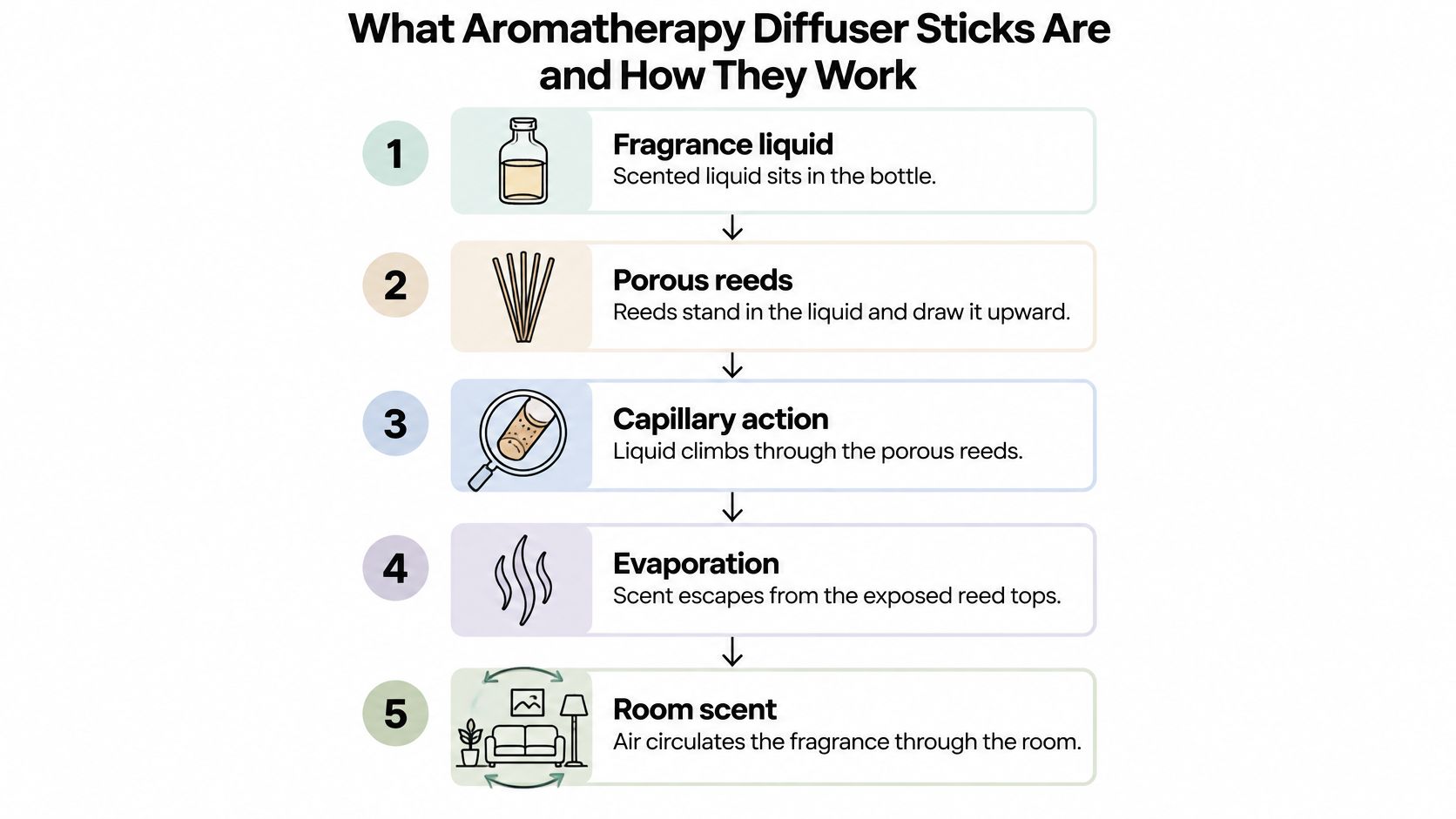
Aromatherapy diffuser sticks are porous reeds standing in a bottle of fragrance liquid. The liquid climbs the reeds and leaves the exposed tips as vapor. There is no flame, no electricity, and no smoke.
Think of a reed the way you think of a paper towel touching a spill. The fibers pull liquid upward. That climb is capillary action. A wick in an oil lamp does the same job, except nothing is lit here. Scent leaves only when the liquid turns to vapor at the reed surface.
Three things set the pace.
The liquid. A light blend in a slow base throws a softer scent and lasts longer. A heavier fragrance load, or a thinner base, reaches the air faster. If you are choosing that base, our guide to a reed diffuser base walks through what the liquid has to do before the reeds can carry it.
The reed count. Each extra reed is another wet surface. More surface means more vapor per hour, and a bottle that empties sooner.
The room. Warm air and a soft current speed evaporation. The scent reads stronger, and the level drops faster. A cold, still room does the opposite.
The mix-up with incense
Incense sticks burn a scented material. Diffuser sticks evaporate fragrance without combustion. Those are not two versions of the same product.
Picture a hotel dresser. A reed bottle on that surface adds scent and nothing else you can see. A lit incense stick on the same wood sends up smoke, leaves ash, and needs someone in the room. A U.S. Environmental Protection Agency study measured 23 types of incense and found PM2.5 emission rates from 7 to 202 milligrams per hour, with emission factors of 5 to 56 milligrams per gram burned. Those particles generally fell within about 0.06 to 2.5 micrometers, with peaks between 0.26 and 0.65 micrometers. The EPA concluded incense can emit fine particulate matter in large quantities compared with other indoor sources, and modeling showed indoor PM2.5 may exceed national ambient standards under some conditions.
Practical rule: If the product needs a match, treat it as combustion. If the only moving part is liquid climbing a reed, treat it as evaporation.
You can check the mechanism today without any meter. Watch whether the liquid level drops over a few days. Look at whether the reed tips stay damp rather than bone-dry and pale. Notice whether the room still smells the way it did on day one. The reeds are the wick, the liquid is the fuel, and placement plus airflow decide how far the scent travels.
A calmer room plan helps that scent stay in the background instead of competing with clutter and glare. Groen's Fine Furniture's notes on how to design your room to reduce stress pair well with a single, quiet fragrance source rather than several strong ones at once.
Diffuser Sticks Compared With Incense and Other Diffusers
Pick the release method before you pick a scent. The table below sorts four common products by how scent leaves the device, what it needs to run, whether you get smoke or particles, and where it fits.
Type | How scent is released | Power or flame | Smoke or particles | Best fit |
|---|---|---|---|---|
Reed diffuser sticks | Passive evaporation from porous reeds | No power, no flame | None | Bedrooms, offices and small rooms with a steady scent |
Incense sticks | Burning scented material | Open flame | Smoke and fine particles | Short sessions, ritual use with ventilation |
Ultrasonic diffuser | Water mist carrying oil | Electricity and water | Mist, no smoke | Larger rooms and timed use |
Heat diffuser | Warmed oil releases scent | Electricity | No smoke | Quick, adjustable scent in small rooms |
Reed diffuser sticks
Scent leaves by evaporation alone. You don't plug anything in, and you don't light anything. There is no smoke. Output stays on until the liquid is gone, so this fits a bedroom, an office, or a small retail nook where you want a steady, quiet scent and nobody has to babysit a device. You adjust strength by adding or removing reeds, not by turning a dial. Cleanup is mostly a wiped bottle and spent reeds.
Incense sticks
Scent leaves because the stick burns. You need an open flame, a holder, and a plan for ash. Smoke and fine particles come with the session. A peer-reviewed study of two incense-stick types found particle generation rates of about 561 and 661 micrograms per minute. On a mass basis, one gram emitted about 19.8 and 43.6 milligrams of particulate matter, and particle-bound polycyclic aromatic hydrocarbons were about 17.1 and 25.2 micrograms per gram. That profile suits a short ritual, not an all-day background. Open a window, keep the burn attended, and put it out when the session ends. Our comparison of oil burners and reed diffusers covers the flame-versus-wick choice in more detail.
Ultrasonic diffusers
A small plate vibrates water into a cool mist that carries oil. You need electricity, a water fill, and a cleaning habit, because a damp tank grows film fast. There is mist, not smoke. A timer lets you run twenty minutes and stop, which helps in a larger treatment room or a studio that shouldn't smell the same at 9 a.m. and 6 p.m.
Heat diffusers
A warming element lifts scent from oil without a flame and without smoke. Power is required. Heat gives a quick, strong throw in a small room, and you can switch it off the moment the scent is enough. Don't leave a hot unit on an unattended desk, and don't set it on finished wood that can mark.
What the table can't tell you
Coverage still changes with room volume, airflow, and the blend. A bold oil in a tiny bath will fill the space on four reeds. The same oil in a drafty shop floor may barely register. Households that need fragrance-free air some days should be able to remove the bottle entirely. That's easier with sticks and a heat unit you unplug than with incense already lit.
If you want silent, flameless scent and no cord, choose sticks. If you want fast, switchable scent and you'll clean a tank or a dish, choose an electric diffuser. If you want ritual smoke, accept the ventilation that burn requires.
Choosing Reed Count, Fragrance and Bottle for Your Room
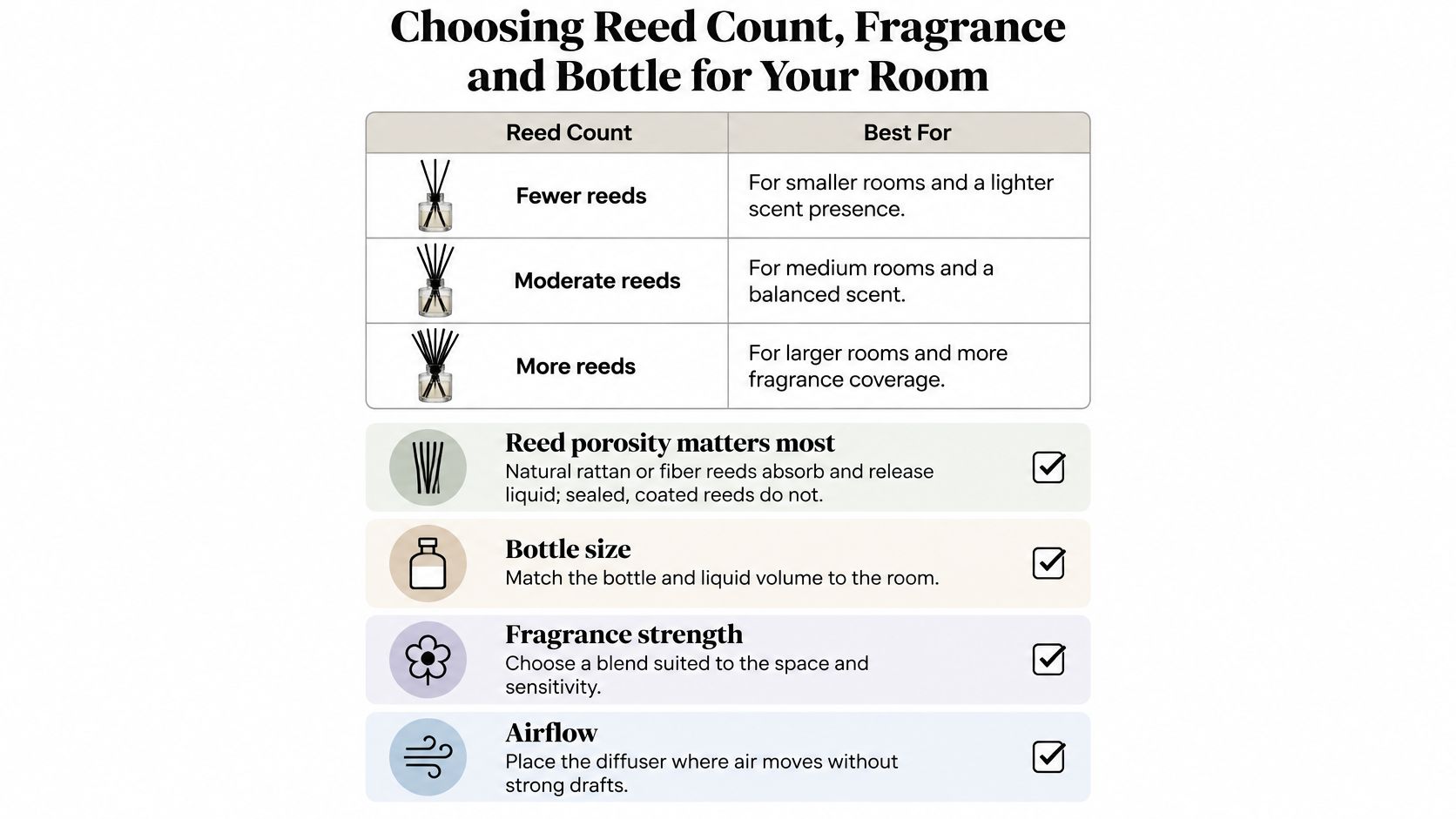
Start with fewer reeds than you think you need. The ranges below are a starting grid, not a target to hit on minute one. Always follow the product label when it names a count.
Room size | Reeds to start | Setup note |
|---|---|---|
Small room or bathroom (under 100 sq ft) | 3-5 reeds | Start with 3 and add one at a time |
Bedroom or office (100-200 sq ft) | 5-8 reeds | Start with 5 and check after 24 hours |
Living room or open plan (200-400 sq ft) | 8-12 reeds | Use a wide-neck bottle |
Apply the low end first. A 150 square foot bedroom starts at five reeds. If the scent is still faint after 24 hours, move to six. A 300 square foot living room with the same mild blend can open near the bottom of the 8–12 band, then add one reed at a time. A small bath starts at three.
What actually carries the liquid
Porosity comes before looks. Natural rattan or fiber reeds have open channels, so they drink and release. Sealed, painted, or purely decorative sticks look tidy and wick almost nothing. If the tips stay dry after a day in liquid, those reeds aren't doing the job.
Length and thickness change the drink rate. A longer reed gives more dry surface above the neck, which means more evaporation. A very thick reed can move more liquid, but only if the pores are open. Match the neck to the count you might need later. A narrow mouth fights an eight-reed bundle. A wide neck lets you add reeds without crowding them into a plug.
Liquid, strength, and who shares the room
Fragrance oil and an essential-oil blend are not interchangeable pours. Some formulas use a solvent such as dipropylene glycol so the scent stays thin enough to climb. Our notes on fragrance oil uses help you match a pour to the job instead of treating every bottle as the same liquid.
Strength should fit the space and the people in it. A light lavender suits a small bedroom. The same bold resinous blend in a compact bath can feel like a wall. A stronger smell is not a stronger benefit. Choose the scent you enjoy at a level you can ignore while you work.
Keep a fragrance-free option on the shelf for asthma, allergies, migraines, or sensitive pets. Wellness studios and gift shops serve those customers every week. One unscented hour is a product decision, not a failure of the display.
A five-point check before you fill
Room size: Use the table's low count, then wait a full day.
Reed type: Natural rattan or fiber, not a coated stick.
Liquid base: Know whether you are pouring fragrance oil, an essential-oil blend, or a solvent-cut formula.
Bottle opening: Wide enough for the highest count you might use.
Sensitivity: Name who sleeps, works, or treats clients in that room, and start lower if anyone is reactive.
Fixing Weak or Overpowering Scent Through Placement
Put the bottle where air moves a little, then leaves. A stagnant corner keeps the scent in a bubble around the glass. A blast from a vent, a sunny sill, or a hallway draft pulls vapor off the reeds so fast that the room smells sharp for an hour and thin by evening.
A 2024 chamber study of reed diffusers found linalool acetate, linalool, and alpha-pinene as the three dominant volatile organic compounds, with linalool acetate about 31.4–43.6% of total measured VOCs at 25°C. The same work showed that placement changes how those compounds spread. Near an air-current path, scent travels across the room. In a dead corner, the field stays local.
Porous reeds only work while their lower ends sit in liquid. Sealed sticks won't wick no matter where you park the bottle. Flip the bundle when output fades, and replace reeds that have gone dark and clogged. Top up before the level falls below the reed bottoms, or the capillary path breaks and you're smelling leftover vapor, not a fresh draw.
Keep the bottle upright on a small tray. The mix can mark finished wood and painted surfaces. A bedroom arranged as a quiet retreat, the way Slone Brothers Furniture bedroom spa ideas describe, still needs that tray. Soft linens don't protect the nightstand.
Symptom lookup
Symptom | Likely cause | Fix |
|---|---|---|
Scent fades within days | Saturated reeds or low liquid | Flip reeds, replace them when dark, and top up the liquid |
Weak scent from the start | Sealed reeds, too few reeds, or a cold still room | Use porous natural reeds, add reeds one at a time, and move to a warmer spot away from vents |
Scent too strong | Too many reeds for the room | Remove reeds and place the bottle in a larger room |
Liquid spilling or staining wood | Bottle tipped or on a finished surface | Keep the bottle upright on a protected tray |
Scent drifts to one corner only | Placed in a still corner | Move it near gentle airflow, not a draft |
Move the bottle to a second room for two days. If the scent behaves there and failed in the first spot, placement was the problem. If it fails in both rooms, change the reed type or the blend, not the furniture.
Don't "fix" a strong scent by cracking every window and leaving all the reeds in. Pull reeds first. Ventilation is for dose control, not for correcting an overfilled neck.
How Much Scent Is Too Much for Sensitive People
A strong smell is not proof of a stronger effect. Exposure depends on the formula, the room's volume, how air moves, and how long the bottle stays open. Intensity is what your nose reports. Dose is what stays in the air.

A household simulation of tea-tree-oil diffusion found total volatile-organic-compound concentrations rose from a background of roughly 200–300 parts per billion by one to two orders of magnitude during ultrasonic and heat-diffuser tests. Several terpene concentrations in the heat-diffuser survey exceeded long-term derived no-effect levels, and alpha-pinene exceeded a European long-term exposure limit. That work did not test every reed diffuser, and it does not show that ordinary consumer use causes illness. Read it as a warning about powered diffusion, not as a ban.
Passive reeds are the lower-exposure case in that comparison. They are not an exposure-free case. France's agency ANSES states that essential-oil diffusers emit airborne VOCs, some of which can irritate or sensitize even when naturally sourced, with effects that include eye, nose, and throat irritation and respiratory symptoms. In homes with the lowest air-exchange rates, operating a fragrance diffuser increased median alpha-pinene from 9 to 15 micrograms per cubic meter (p < 0.02).
Dose rules that actually change the air
Fewer reeds: Drop to the low end of the room-size range, especially in bedrooms and treatment rooms.
Shorter time: Lift the reeds out and cap the bottle between sessions instead of running all night.
A real air change: Open a window or a door for a few minutes. A closed spa room with no exchange will accumulate whatever you emit.
Distance from faces: Keep the bottle off the nightstand and off the desk where someone sits for hours.
Clinical advice: Check with a clinician before use around anyone with asthma.
Stop when you notice headache, coughing, throat irritation, breathing discomfort, or stinging eyes. Those signs outrank any "relaxing blend" claim on the label.
If you can smell the scent clearly from the doorway of a closed room, the dose is probably high for that space. Step the reed count down until the scent is obvious beside the bottle and faint at the door.
A short visual on air and scent helps staff explain this without a chemistry lecture.
Spas, yoga studios, and gift counters should keep a fragrance-free block on the schedule. Our piece on a safer approach to air freshening is the handout to pair with that policy. If you are designing a calming bedroom escape, build the calm with textiles, light, and one modest scent source, not a bottle parked beside the pillow.
Safe Storage and Your First Week
The reeds aren't the main hazard. The liquid is. Among 754 U.K. reed-diffuser exposures recorded from 2010–2014, 706 involved ingestion, according to a poison-center review. 570 involved liquid alone, 31 involved sucking the reeds, and 21 involved both liquid and water beads. Of 702 cases with a known severity score, 81.3% were asymptomatic, 16.6% produced minor toxicity, and 1.6% produced moderate toxicity. Reported symptoms included vomiting, nausea, coughing, and central-nervous-system depression.
Most recorded cases were not severe. That still isn't a reason to leave an open bottle on a low shelf. "Natural" essential-oil blends are not automatically safe for a child, a pet, or an older adult who might mistake the bottle for a drink.
Where the bottle lives
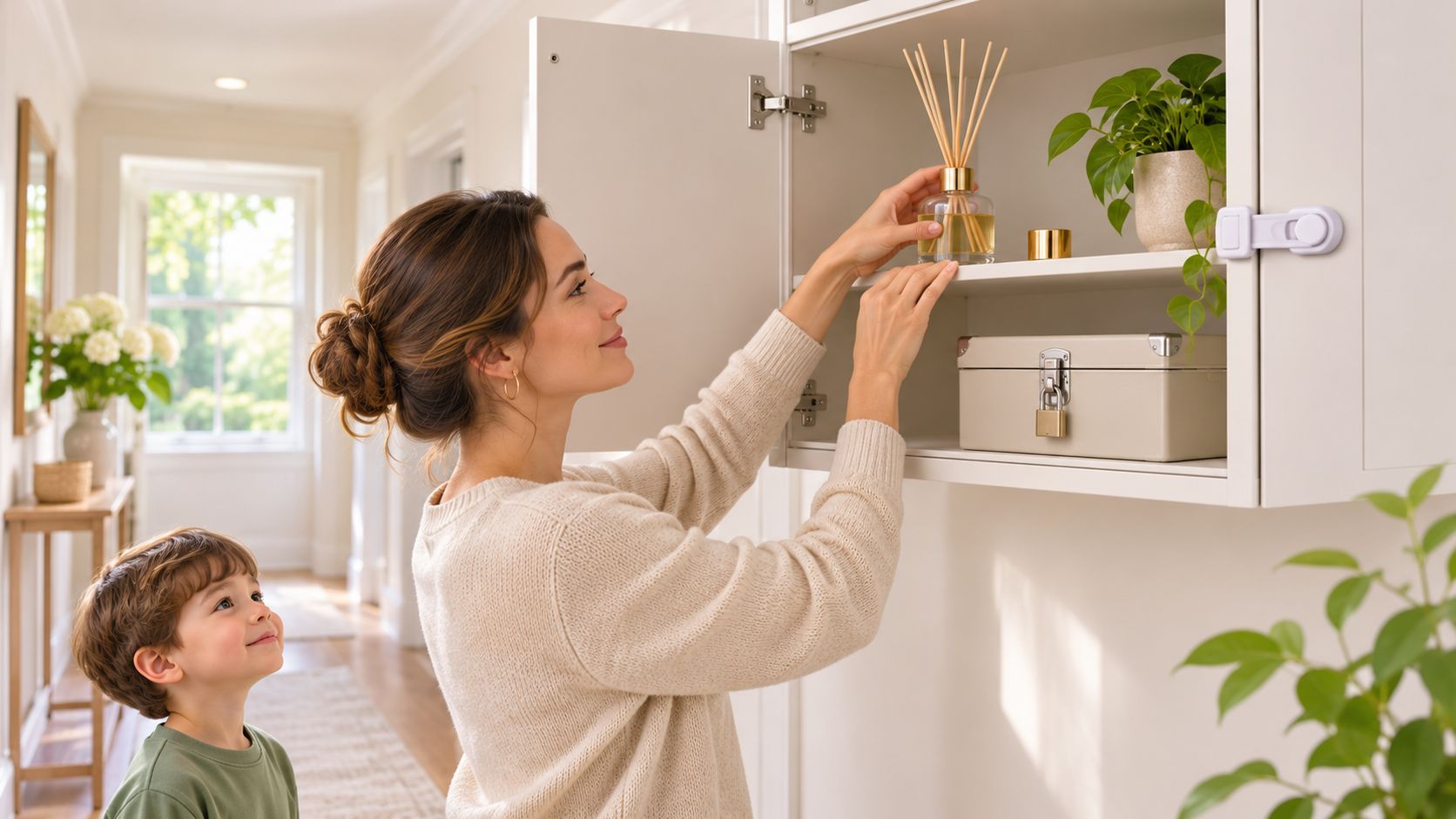
Cap it. Stand it upright. Put it inside a closed cupboard, and lock that cupboard in any home with toddlers. A high open shelf fails the moment a chair appears. Use stricter habits in elder-care rooms and in wellness studios where clients, including children at family classes, can reach a side table. Pets will lick a spill. Wipe it before they can.
If oil gets on skin or in an eye, or if someone swallows any amount, don't wait to see how the afternoon goes.
Rinse eyes or skin with water for several minutes.
Take the saturated reeds and the bottle out of reach, and keep the label for the ingredients.
Call your local poison control center, or get medical care, after any ingestion or if symptoms show up.
Don't flush spent reeds. Bag them and follow your local household-waste rules. A soaked reed still holds liquid.
Refill bottles belong in that same cupboard, not on the craft table. We sell amber glass bottles along with eye droppers and dipropylene glycol for people who refill at home, and those supplies need the same locked storage as a finished diffuser.
The first seven days
Set the reed count from the room-size grid and start at the low number.
Place the bottle where air moves gently, off vents and out of direct sun, on a tray.
On day three, sniff at the doorway. Flip the reeds if the scent has faded and the liquid is still covering the ends.
Whenever children or pets are in the room unsupervised, the working bottle goes back in the closed cupboard. A pretty display isn't worth an ingestion call.
Top up with the same blend before the level slips under the reed bottoms. Replace reeds when they darken or the scent stops traveling even after a flip. Different oils in the same reeds muddy both the smell and your sense of how strong the dose is.
These sticks fragrance a room. They don't clean the air, and they don't replace ventilation.
Frequently Asked Questions
FAQ 1: Can You Use Bamboo Skewers Instead of Reed Diffuser Sticks?
Bamboo skewers are not an ideal replacement for diffuser reeds. Purpose-made rattan or fiber reeds are designed with porous channels that help fragrance liquid travel upward and evaporate consistently. Ordinary bamboo skewers may not provide the same reliable fragrance distribution.
FAQ 2: Can You Use Reed Diffuser Oil in an Ultrasonic Diffuser?
No. Reed diffuser liquids and ultrasonic diffuser solutions are formulated for different delivery systems. Reed diffuser liquids may contain solvents or other ingredients that are not intended for ultrasonic misting. Always use a fragrance solution specifically approved for your diffuser model.
FAQ 3: How Do You Clean a Reed Diffuser Bottle Before Changing Scents?
Empty the remaining fragrance liquid and follow the bottle manufacturer's cleaning recommendations. For compatible glass bottles, warm water and mild dish soap can help remove residue. Rinse thoroughly and allow the bottle to dry completely before adding a different fragrance.
FAQ 4: Can You Use the Same Reed Diffuser in Multiple Rooms?
Yes. A reed diffuser can be moved between rooms as long as the bottle remains upright and the liquid is not disturbed. However, fragrance performance will vary depending on room size, temperature, and airflow. Allow time for the scent to adjust after relocating it.
FAQ 5: What Is the Difference Between Rattan and Fiber Reed Diffuser Sticks?
Rattan reeds are made from natural plant material with internal channels that transport fragrance liquid. Fiber reeds are manufactured from specialized porous fibers designed to absorb and release fragrance. Both can work effectively, although their absorption rates and fragrance output may vary depending on the material and liquid formulation.
Aroma Warehouse carries fragrance oils poured fresh to order, plus the glass bottles, droppers, and dipropylene glycol you need if you build or refill your own sticks, with retail and wholesale pricing for home users, studios, and shops. Pair that with a reed count that suits you, a capped bottle, and a room you can air out. Visit Aroma Fragrance Warehouse to choose a blend and the supplies that match the room you're scenting.


