

Fragrance Oils Uses: The Complete Practical Guide 2026

You've chosen a fragrance oil for a candle, diffuser, soap, or personal scent, and then noticed that the label doesn't quite answer the question you have: how should this oil be used safely in this specific product? A scent that performs beautifully in wax may behave very differently in a room spray or leave-on lotion.
That's why understanding fragrance oils uses requires more than a list of products. The finished product, exposure route, concentration, ventilation, heat, and customer contact all matter. This guide separates those variables so you can choose oils more confidently, whether you're making products at home, running a wellness space, or buying stock for resale.
Table of Contents
Why Fragrance Oils Are Everywhere - Two foundational roles for aromatic oils
The Core Difference Between Fragrance and Essential Oils - Start with the identity of the oil
Top Applications for Fragrance Oils - Candles and wax melts - Soap and bath products - Lotions, body oils, and personal fragrance - Reed and electric diffusers
Safety and Indoor Air Quality Considerations - How ultrasonic diffusion changes the picture
Understanding IFRA Standards and Allergen Labeling - A simple decision matrix - What small businesses should keep on file
Best Practices for Blending and Sourcing - Buy documentation before buying volume
Why Fragrance Oils Are Everywhere

A candle shop may greet you with vanilla, cedar, clean linen, citrus, incense, and rose
before you reach the counter. In a spa, the same goal may appear as a softer diffuser aroma or a scented massage product. That variety can make aromatic liquids seem interchangeable, even though their ingredients, performance, and safety requirements may differ.
Fragrance oils are generally crafted combinations of aromatic materials, including naturally derived and synthetically created compounds. A formula may recreate a familiar botanical note or build an aroma that does not exist as a simple plant extract, such as fresh laundry, rain, or powder. Essential oils are botanical extracts obtained from plant material, and their composition can change with the plant, harvest, and extraction method.

A pleasant scent is only the starting point for choosing an oil. The formula must match the base material, the finished product's exposure route, and the supplier's usage documentation. Wax, reeds, soap, perfume, and body lotion place different demands on the same aromatic blend. Heat, evaporation, skin contact, rinsing, and indoor ventilation can all change the practical risk and performance.
Two foundational roles for aromatic oils
Fragrance oils and related aromatic products usually serve two broad roles:
Consumer product scenting: They add aroma to candles, wax melts, soaps, bath products, personal fragrances, home fragrance products, incense, and other goods.
Aromatherapy practices: Aromatic oils may support routines involving inhalation or topical application. The National Cancer Institute's aromatherapy overview describes aromatherapy as using volatile plant oils to promote physical, emotional, and spiritual well-being, while distinguishing traditional use from proven medical effectiveness.
Aromatic oils, infused plant materials, and unguents have appeared across cultures, including ancient Egypt, biblical traditions, the Middle Ages, and the Renaissance. Modern aromatherapy took shape in the early twentieth century, when French chemist and perfumer René-Maurice Gattefossé introduced the term and later published Aromatherapy in 1937.
The commercial field extends well beyond candles and diffusers. A U.S. Department of Agriculture review of essential oils and derivatives describes uses across food and beverages, cosmetics, household products, pharmaceuticals, fragrances, and aromatherapy. Retailers and craft makers therefore need to treat each application as its own exposure and compliance question, rather than relying on the oil's scent name alone.
The Core Difference Between Fragrance and Essential Oils
Think of an essential oil as a complex botanical extract and a fragrance oil as a designed scent formula. The first begins with plant material. The second is assembled to deliver a particular aroma and performance in a chosen product.
That doesn't make one automatically better. It makes them different tools.
Start with the identity of the oil
Before using any aromatic oil, work through these questions:
What is the product? A wax melt, soap, perfume, diffuser blend, and lotion have different requirements.
How will someone encounter it? The route may involve inhalation, direct skin contact, rinse-off skin contact, or incidental contact.
Will heat be involved? Candles and oil warmers expose the formula to heat, while passive reed diffusion does not.
What does the supplier document? Look for intended applications, maximum usage guidance, safety information, and regulatory documentation.
Is the finished product leave-on or rinse-off? A lotion remains on skin, while a soap is normally washed away.
Essential oils are often valued for their recognizable botanical character and layered aroma. Fragrance oils can offer greater consistency and a broader creative palette, including accords such as ocean air, baked goods, clean cotton, or non-botanical cosmetic scents. The important point is that “oil” doesn't tell you enough about suitability.
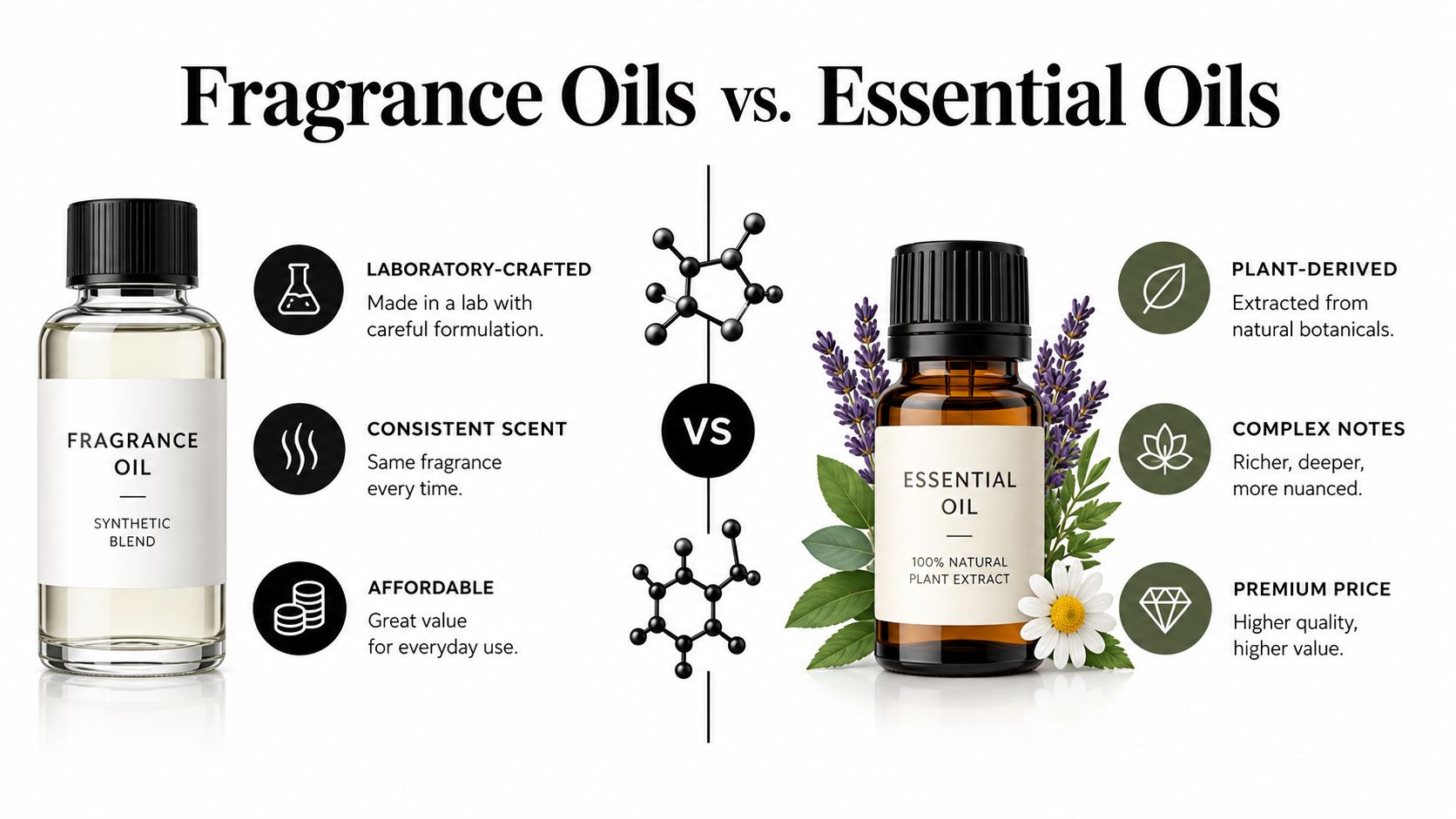
A common mistake is to transfer advice from one category to the other. An essential oil blend may have botanical-specific considerations, while a fragrance oil may have a supplier-defined application profile. Neither “natural” nor “synthetic” is a complete safety assessment.
For a clear side-by-side overview before choosing a formula, consult this guide to fragrance oils and essential oils. Then read the documentation for the exact product you're buying, not just the marketing description for a similar scent.
Practical rule: Choose the oil for the finished product, not merely for the name of the aroma.
Consistency also affects customer experience. A retailer who sells a “lavender” candle expects the scent to remain recognizable from batch to batch. A maker creating a perfume may want complexity and evolution on skin. The right choice depends on whether the priority is scent identity, botanical character, product stability, or a specific exposure route.
Top Applications for Fragrance Oils
The same fragrance oil can appear in several product categories, but that doesn't mean it belongs at the same concentration in each one. Compare the material, exposure, and performance test before you scale a formula.
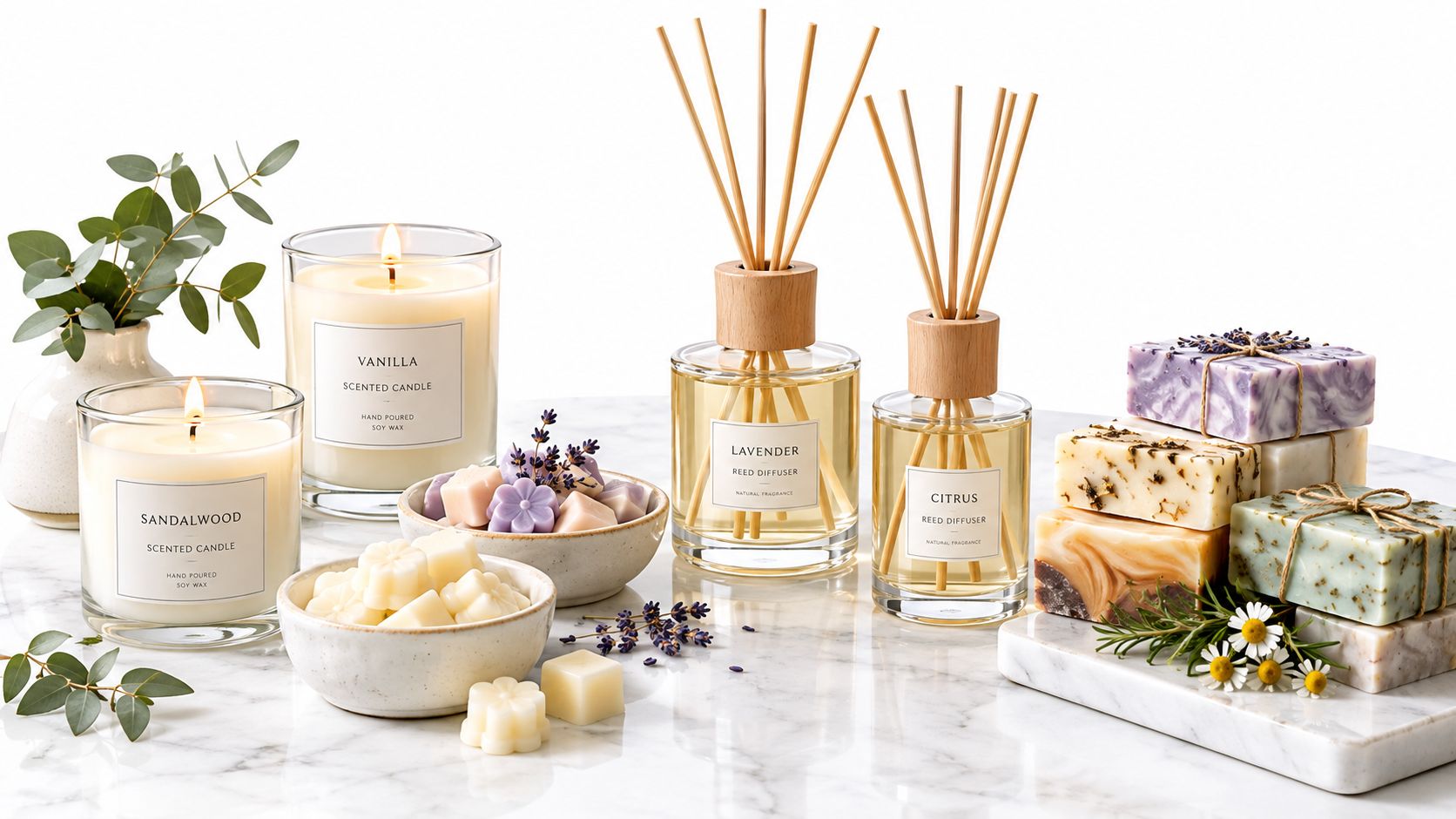
Wax products need an oil that disperses properly through the wax and produces an appealing scent before lighting and during use. Makers often evaluate cold throw, the aroma from an unlit candle or wax melt, and hot throw, the aroma released as the product warms or burns.
Don't choose an oil based only on how strong it smells in the bottle. Test the finished wax, wick, vessel, cure behavior, and burn performance together. Supplier guidance about candle compatibility and heat behavior is more useful than a generic claim that an oil is “strong.”
Wax melts and candles are also different from skin products. They're primarily scenting products, so a seller shouldn't treat a candle-use statement as permission for topical application.
Soap and bath products
Soap makers need to consider whether the fragrance blends well into the base, changes the appearance, or affects the working time of the mixture. A scent that behaves calmly in melt-and-pour soap may need different handling in cold-process soap.
Bath salts, bath bombs, and similar products create another question: will the fragrance contact skin directly, and is it dispersed appropriately in the finished product? “Bath-safe” should be supported by supplier documentation for that application. It shouldn't be inferred from “candle-safe.”
Lotions, body oils, and personal fragrance
Leave-on products deserve the most careful attention because the finished formula remains against skin. A fragrance oil intended for body use still needs to be used within the supplier's permitted level for the specific product category.
Solubility matters as well. A fragrance oil may not disperse evenly in a water-based formula without an appropriate solubilizing system, and uneven distribution can create concentrated pockets. Test the completed product rather than judging only the neat oil.
For shoppers who are exploring personal scent formats rather than manufacturing a formula, curated options such as Nemat perfume oils can help illustrate how fragrance is presented as a wearable product. That's a different use case from adding an undiluted fragrance oil to skin.
Reed and electric diffusers
Reed diffusers are passive scenting systems. Their performance depends on the liquid base, reed material, room conditions, and evaporation rate. Electric and plug-in devices actively release volatile materials into indoor air, so runtime, output, room size, and ventilation become central considerations.
Room sprays need their own formulation approach because the oil must be distributed through the spray vehicle and applied into the air or onto suitable surfaces. For a practical formulation starting point, see this guide to making room sprays with fragrance oils.
This short video provides a visual introduction to common fragrance applications:
A useful comparison looks like this:
Application | Main question | What to verify |
|---|---|---|
Candle or wax melt | Does the scent perform in heated wax? | Wax compatibility, finished-product testing, supplier guidance |
Soap | Does the scent remain suitable during production and use? | Product category, appearance, working behavior, rinse-off suitability |
Lotion or perfume | Is it appropriate for leave-on skin contact? | Skin-use documentation, permitted level, even dispersion |
Reed diffuser | Does it evaporate predictably? | Base compatibility, reed performance, room ventilation |
Electric diffuser | How much volatile material enters the room? | Output, runtime, oil type, room volume, outdoor-air exchange |
Safety and Indoor Air Quality Considerations
A pleasant room can become over-scented without anyone intending it. Fragrance intensity isn't a reliable measure of exposure because concentration also depends on room volume, air exchange, formulation volatility, and diffuser output.
A controlled study of 60 homes in the United Kingdom found that switching on a commercial plug-in diffuser produced statistically significant increases in 20 measured species, including alpha-pinene, eucalyptol, ethanol, benzaldehyde, and total volatile organic compounds. In homes with low air-exchange rates, median alpha-pinene rose from 9 to 15 micrograms per cubic meter, while total measured VOC concentrations across the homes ranged from 30 to more than 5,000 micrograms per cubic meter over 72 hours, according to the Royal Society of Chemistry study.
The practical lesson isn't that every diffuser is unsafe. It's that operating conditions change exposure.
How ultrasonic diffusion changes the picture
Ultrasonic devices can release primary VOCs, and those compounds may react in indoor air to form secondary particulate matter. In a chamber experiment, a 15-minute ultrasonic-diffuser run released approximately 2.6 ± 0.7 milligrams of d-limonene from lemon oil, 3.5 ± 0.4 milligrams of eucalyptol from eucalyptus oil, 1.0 ± 0.1 milligrams of linalyl acetate from lavender oil, and 0.2 ± 0.02 milligrams of linalyl acetate from grapeseed oil, as reported in the indoor-air diffusion research.
Those results don't mean every fragrance oil will behave identically. They show why oil selection, water quality, dose, and device design matter.
For homes, studios, spas, and shops, use a cautious operating policy:
Ventilate deliberately: Allow outdoor air into the room where practical, especially during extended scenting.
Use intermittent operation: Avoid assuming that continuous diffusion provides a better customer experience.
Lower the output in small rooms: A setting that works in a large retail floor may be excessive in a treatment room.
Clean the reservoir: Residue buildup can affect performance and contaminate later batches.
Consider sensitive occupants: Ask about scent sensitivity and avoid imposing strong fragrance in shared spaces.
Document the routine: Businesses should record the device, oil, setting, and operating schedule used in each space.
For broader practical guidance on indoor scenting, see safe air freshener use. Responsible use is about managing dose and airflow, not making unsupported promises about health benefits.
Understanding IFRA Standards and Allergen Labeling
A fragrance oil can be suitable for one product and unsuitable at the same concentration in another. That's because the finished product changes the exposure route. A wax melt, incense product, soap, perfume, and body lotion don't place the same demands on a fragrance formula.
The International Fragrance Association, commonly known as IFRA, establishes different maximum-use levels across 12 product categories, as explained in its regulatory FAQ. These standards are designed to distinguish applications rather than provide one universal “safe percentage” for every use.
A simple decision matrix
Finished product | Primary exposure concern | Documentation to request |
|---|---|---|
Candle or wax melt | Heated scent release and incidental contact | Candle or burning-use guidance |
Reed or electric diffuser | Indoor-air release | Diffusion suitability and operating guidance |
Incense | Heated or burned aromatic materials | Intended-use documentation and warnings |
Rinse-off soap | Skin contact followed by washing | Rinse-off category guidance |
Lotion or perfume | Prolonged skin contact | Leave-on category guidance and allergen information |
Bath product | Skin contact in water | Bath-product category guidance and labeling information |
“Skin-safe” and “candle-safe” aren't interchangeable claims. A supplier's certificate or product page should identify the relevant application category, and a maker should retain the documentation used to develop the formula.
Allergen labeling adds another layer. The underserved question isn't whether a fragrance is natural. Recognized fragrance allergens can occur in consumer products regardless of whether the marketing language emphasizes botanical or synthetic origins. Businesses serving European customers should monitor the expanded European Union fragrance-allergen labeling regime, which covers more than 80 substances and has transition deadlines extending through 2026 to 2028, according to the IFRA regulatory material.
What small businesses should keep on file
A responsible sourcing folder should include:
Supplier documentation: Keep the current IFRA certificate or application guidance for each fragrance.
Safety information: Request the applicable safety data sheet and retain the version used during production.
Formula records: Note the fragrance identity, batch, concentration, product type, and date of manufacture.
Label review: Check ingredient and allergen requirements for the market where the product will be sold.
Claim control: Don't describe a product as therapeutic, hypoallergenic, or universally safe without appropriate substantiation.
For a practical introduction to packaging and disclosure obligations, review these fragrance labeling requirements. Documentation isn't paperwork for its own sake. It helps a maker answer customer questions accurately and trace a product decision later.
Best Practices for Blending and Sourcing
Good fragrance work starts with restraint. Blend small test batches, change one variable at a time, and write down the oil names, ratios, base material, date, and result. Your notes turn personal impressions into a repeatable process.
A simple blend may include a bright opening note, a fuller middle note, and a lasting base note. You don't need to force every fragrance into that structure, but the framework helps explain why a scent can smell fresh at first and warmer later. Evaluate the finished product after it has rested, not only immediately after mixing.
Buy documentation before buying volume
Before ordering a large quantity, ask the supplier for:
Application guidance for candles, diffusers, soap, or body products.
IFRA documentation that matches the intended product category.
Safety data and relevant allergen information.
Batch consistency details and storage recommendations.
Packaging options if you're creating private-label or resale products.
If your work involves laboratory or formulation handling, a specialist resource such as this reconstitution diluent for Frag 176 191 may be relevant to controlled preparation workflows. Use only materials that match your actual formulation process and supplier instructions.
For candle makers, the guide to blending fragrance oils for candles can help organize testing around wax compatibility and scent performance. Buying in bulk can make sense for established makers and resellers, but only after a smaller trial confirms that the fragrance, documentation, packaging, and customer demand align.
The strongest fragrance oils uses strategy combines creativity with traceability. Choose the scent, confirm the application, control the exposure, and teach customers how the finished product should be used.
FAQ
1. Can fragrance oils be mixed together to create custom scents? Yes. Fragrance oils can be blended to create custom scent profiles, but small test batches are recommended. Change one variable at a time and record the oils, ratios, base material, and results so successful blends can be reproduced consistently.
2. How should fragrance oils be stored to maintain their quality? Fragrance oils should be stored according to the supplier's recommendations. Keeping batch information and storage guidance on file is especially important when purchasing larger quantities for production or resale.
3. Does fragrance oil expire or lose its scent over time? Fragrance oils can change over time, so storage conditions and supplier recommendations matter. For production use, keeping batch information and evaluating the finished fragrance during testing can help identify changes before a larger batch is made.
4. Why can the same fragrance oil smell different in different products? The finished base, concentration, temperature, evaporation rate, and exposure route can all influence how a fragrance is perceived. An oil that performs strongly in one product therefore should not automatically be expected to smell the same in another.
5. Should I test a fragrance oil before buying it in bulk? Yes. Testing a smaller quantity first can help confirm fragrance performance, compatibility, documentation, packaging needs, and customer demand before committing to a larger order.
Aroma Warehouse offers fragrance oils, incense, diffusers, burners, bottles, droppers, DPG solvent, and bath products for home users, makers, wellness spaces, and resellers. Visit Aroma Incense Warehouse to explore supplies that support more informed fragrance products and scenting routines.


