Scent of the Ocean: Notes, History, and How to Recreate It

You're standing at the shoreline after a wave has broken. Wet sand cools your feet, the air carries a fine briny mist, and somewhere nearby, broken seaweed adds a darker, greener note. It feels like one smell, but your nose is sorting through many layers created by water, marine life, decay, wind, and sunlight.
That complexity explains why a bottle labeled “ocean” may smell clean, airy, or cucumber-fresh while the actual coast can also smell like kelp, shells, mud, fish, or warm driftwood. The scent of the ocean has two identities: the living shoreline smell, driven by biological chemistry, and the commercial aquatic accord, designed in a laboratory to suggest the sea.
Understanding that difference makes home scenting much easier. You can choose a bright marine fragrance for a diffuser, add seaweed and wood for realism, or build a bath ritual that feels coastal without trying to make plain salt water smell like surf.
Table of Contents
What the Scent of the Ocean Really Is
At the beach, the first impression often arrives as freshness. A wave breaks, air moves across the foam, and your nose catches something cool, mineral, and slightly green. The next breath may reveal wet stones, drying rope, seaweed, shellfish, or mud exposed by the tide. The smell changes because the shoreline is not a single ingredient. It's a moving mixture produced by water, organisms, weather, and decay.
The literal shoreline smell is the first layer. Marine microorganisms, algae, seaweed, fish, shellfish, and tidal sediment all contribute volatile compounds to the air. Some feel clean and briny. Others smell earthy, iodine-like, fishy, or sulfurous. Independent coverage of coastal smellscapes emphasizes that there's no single ocean smell, because local biology and environmental conditions change what reaches the nose. This explanation of shoreline odor is useful if you want to distinguish fresh surf from seaweed, tidal mud, or decaying marine matter.
The second layer is the commercial ocean accord. Perfumers don't collect seawater and pour it into a bottle. They combine aroma materials that suggest cold water, sea air, salt crystals, sun-warmed wood, clean skin, and marine vegetation. A cucumber-melon fragrance can help illustrate the bright, watery side of that design language, especially when you compare its freshness with a darker seaweed note. The cucumber melon fragrance oil guide offers useful context for that fresh, watery direction.

Practical rule: Treat the real coast as an ecosystem and the bottled ocean accord as an illustration of that ecosystem.
That distinction also helps with interiors. A marine candle may create the feeling of open windows and cool air, while a seaweed-heavy blend can evoke the tide line itself. If you're decorating around that mood, coastal art for home can reinforce the visual story without forcing every object in the room to smell aquatic.
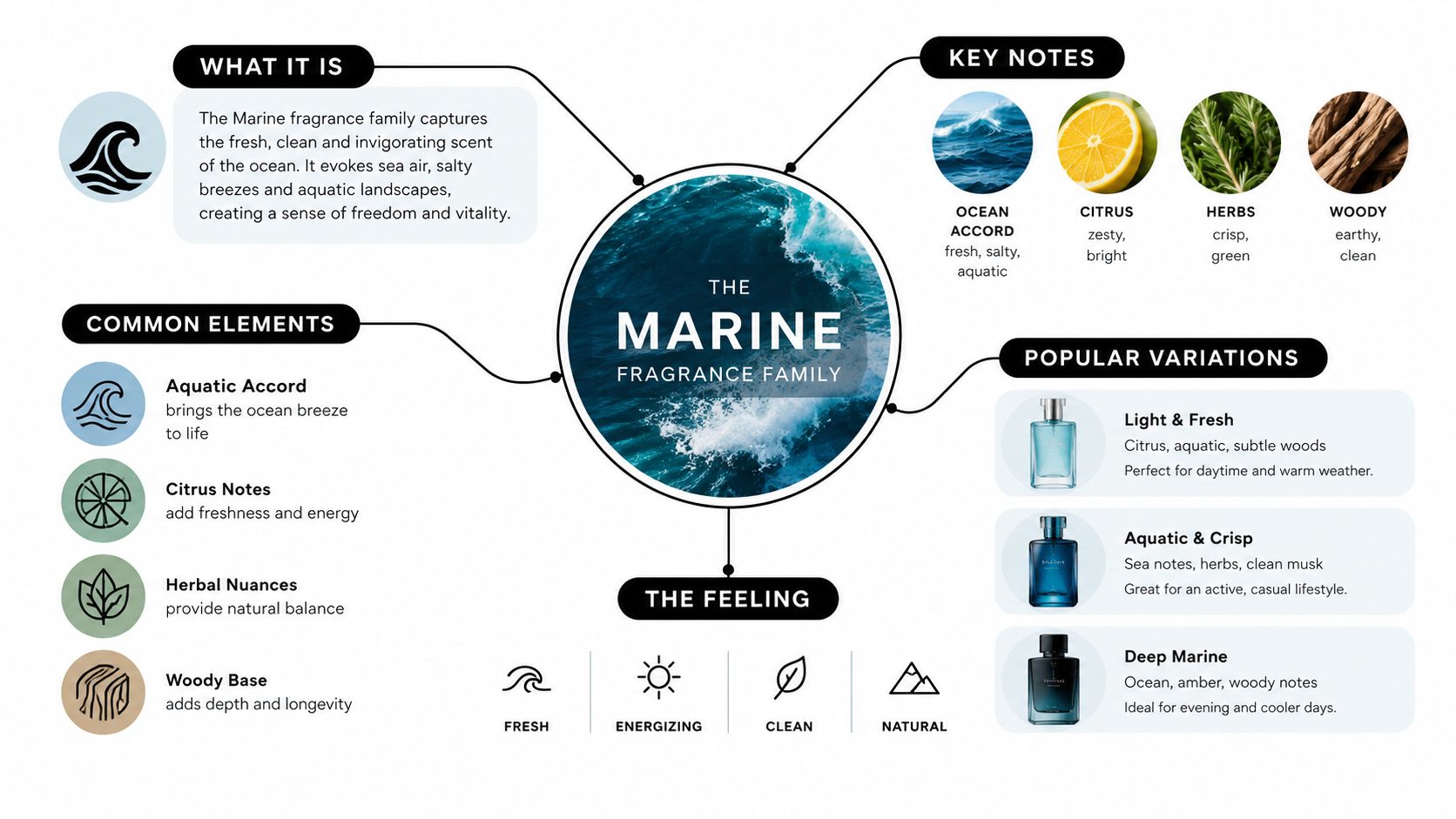
Breaking Down the Marine Fragrance Family
An ocean accord becomes easier to understand when you stop thinking of it as one note. Think of it as a shoreline scene built in layers, from the first cool breeze to the warm material left on the sand after sunset.
Marine freshness
The marine facet is the splash of cold water. It can feel melon-like, cucumber-fresh, transparent, or slightly watery. Calone is the classic reference point in this family, although perfumers can use other synthetic materials to create related effects. This facet usually appears early, making a blend feel crisp before deeper notes arrive.
Ozonic air
The ozonic facet is less like water in a glass and more like air moving over a wave. It can suggest clean laundry, rain-filled skies, or the cool metallic lift of a storm. Use it carefully. Too much can make a fragrance feel sharp, abstract, or chemically clean rather than coastal.
Saline texture
Saline notes don't smell like a spoonful of table salt. They suggest dry crystals, mineral skin, shells, and sea spray. Ambergris-type materials and certain musks can give an accord this dry, slightly salty impression. They also help connect the airy opening to the body of the fragrance.
Driftwood warmth
Without a base, a marine blend may disappear into a cold, watery impression. Driftwood, amber, cedar, and soft musk add the feeling of rope, sun-bleached timber, skin, and warm sand. This is what keeps the accord from smelling like a glass of chilled water.
A practical blending sequence looks like this:
Start with marine freshness to establish the watery identity.
Add ozonic lift until the opening feels like moving air, not detergent.
Build saline texture with dry, mineral, musky materials.
Anchor the base with driftwood, amber, or clean musk.
Introduce seaweed sparingly if you want the result to feel more like a real shore than a polished aquatic perfume.
A bathroom spray can tolerate a brighter, simpler opening. A personal fragrance usually benefits from a more balanced base. A candle or reed diffuser may need extra wood and musk because heat and air movement can emphasize the top notes while leaving a flat drydown.
The Chemistry Behind the Real Shoreline Smell
The most important correction is simple: salt itself isn't the smell of the ocean. Sodium chloride has no meaningful odor in ordinary seawater. What people call “salt air” is a sensory impression created by dissolved minerals, moisture, marine organisms, and volatile compounds carried in the breeze.
One central contributor is dimethyl sulfide, usually abbreviated as DMS. Marine microorganisms produce it when they break down dimethylsulfoniopropionate associated with phytoplankton. DMS escapes from the surface of the sea into the atmosphere, where oxidation creates sulfur dioxide and sulfate aerosols. Those particles can help form cloud droplets and influence how sunlight interacts with the atmosphere. Research on DMS and Southern Ocean emissions connects the odor molecule to a much larger biological and atmospheric cycle.
DMS is only one member of the shoreline's aromatic cast. Seaweed and marine organisms contribute other compounds that can read as green, briny, iodine-like, fishy, or sulfurous. Chemistry coverage describes marine plankton as releasing more than 20 million tons of sulfur into the air every year, mostly as DMS, showing that ocean odor is part of a large biogeochemical process rather than a tiny trace event. This overview of the sulfur cycle explains why marine emissions matter beyond their smell.
A tidal beach also changes with location and condition. Fresh surf may feel clean and airy, while exposed seaweed can add a dark green tone. Fishy trimethylamine, bromophenols, and hydrogen sulfide from tidal mud can push the experience toward shellfish, iodine, or decay. That variation is why a convincing coastal accord often needs contrast. A bright aquatic top alone captures the idea of water, not the full smell of a living shore.
For home use, don't try to recreate DMS directly. Use a reputable fragrance material or finished accord designed to evoke marine air, then soften it with woods, musks, or a controlled seaweed facet. If you're learning about solvents for dilution and fragrance work, this guide to what DPG is used for provides helpful background.
How the Ocean Scent Became a Fragrance Category
Modern ocean-style perfumery began with a laboratory idea rather than a bottle of seawater. Chemists at Pfizer discovered calone in 1951, and the material was first marketed in 1966 and patented in 1970. It later became a defining ingredient in aquatic fragrances, especially during the late 1980s and 1990s. This history of sea notes in perfumery shows how a synthetic material became a shorthand for marine freshness.
The mainstream turning point arrived with Davidoff Cool Water in 1988. The fragrance helped make the sea-breeze effect familiar to a broad audience, presenting marine freshness through a polished, energetic style. Issey Miyake L'Eau d'Issey followed in 1992, and Giorgio Armani Acqua di Giò launched in 1996, helping establish aquatic fragrance as a global commercial family rather than a niche experiment.
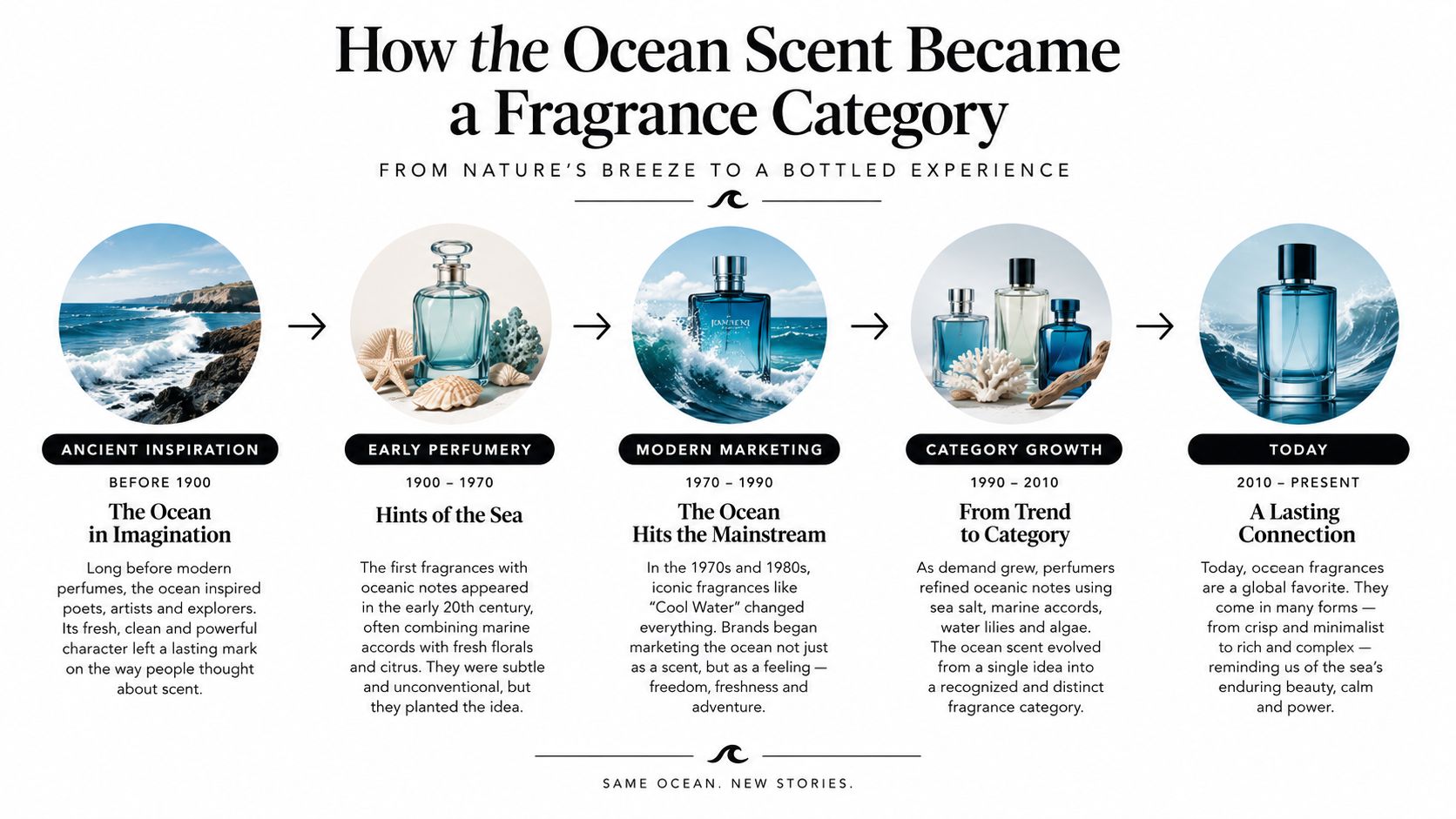
The commercial response was substantial. One industry source describes Acqua di Giò as moving over 20 million bottles, a scale that illustrates how strongly consumers responded to watery, clean, modern profiles. This account of salty notes and sea spray places that success within the wider rise of marine perfumery.
Early aquatic marketing often connected ocean notes with clean masculinity, sport, and energetic grooming. Today, the same materials can support a more gender-neutral mood, including coastal interiors, spa rituals, and quiet freshness. The ingredients haven't stopped being synthetic, but the story around them has broadened. Calone and related marine materials still create the recognizable watery lift, while musks, woods, salt effects, and algae notes make the accord more nuanced.
Building Your Own Ocean Accord with Fragrance Oils
A useful home accord starts with a decision. Do you want commercially clean ocean air, or do you want a more naturalistic shoreline with algae, wet wood, and mineral depth? Trying to maximize every facet at once usually produces a loud blend with no clear center.
Choose materials by role:
Marine core: Select a calone-style or comparable aquatic fragrance oil for the cold, watery opening.
Ozonic lift: Add a clean air or rain-like material to create movement above the core.
Seaweed facet: Use a restrained algae or seaweed note for realism. It should create texture, not dominate the room.
Floral water note: A soft watery floral can round sharp edges and make the blend feel more wearable.
Dry base: Driftwood, amber, and clean musk give the accord persistence and warmth.
Diluent: Use DPG for a home fragrance dilution or a suitable carrier for skin products, following the supplier's safety documentation.
A flexible sample structure
The table below uses qualitative loading rather than a universal recipe. Fragrance oils vary in strength, and a material that feels gentle in one supplier's line may be powerful in another. For skin contact, follow the product's current IFRA guidance and the supplier's stated usage limits.
Ingredient | Wearable Dilution (10 ml DPG) | Reed Diffuser Concentrate | Roll-On Oil |
|---|---|---|---|
Marine accord | Moderate | High | Moderate |
Ozonic material | Low to moderate | Moderate | Low |
Seaweed or algae note | Trace to low | Low to moderate | Trace |
Watery floral | Low | Low | Low |
Driftwood or cedar | Low | Moderate | Low |
Amber or clean musk | Low | Moderate | Moderate |
DPG or suitable carrier | Fill remainder | Use diffuser base as directed | Fill remainder |
Blend the marine and ozonic materials first, then add the watery floral. Let that opening settle before introducing seaweed. Finish with driftwood and musk, because the base tells your nose whether the result feels like open water, a tide pool, or synthetic cleaner.
For a home project, pre-diluted fragrance oils are simpler than handling concentrated aroma chemicals. Aroma Warehouse's Aromar fragrance oil guide can help you understand the format before choosing a material.
Give the mixture time to marry before judging it. Smell it on a strip at the opening, after the first drydown, and again when the base is fully apparent. If it smells plasticky, reduce the marine core and add wood. If it smells soapy, lower the ozonic portion and introduce a softer musk. If it feels flat, add contrast through a small seaweed facet or a drier base rather than just adding more fragrance.
Diffusers, Incense, and Sea-Salt Baths Compared
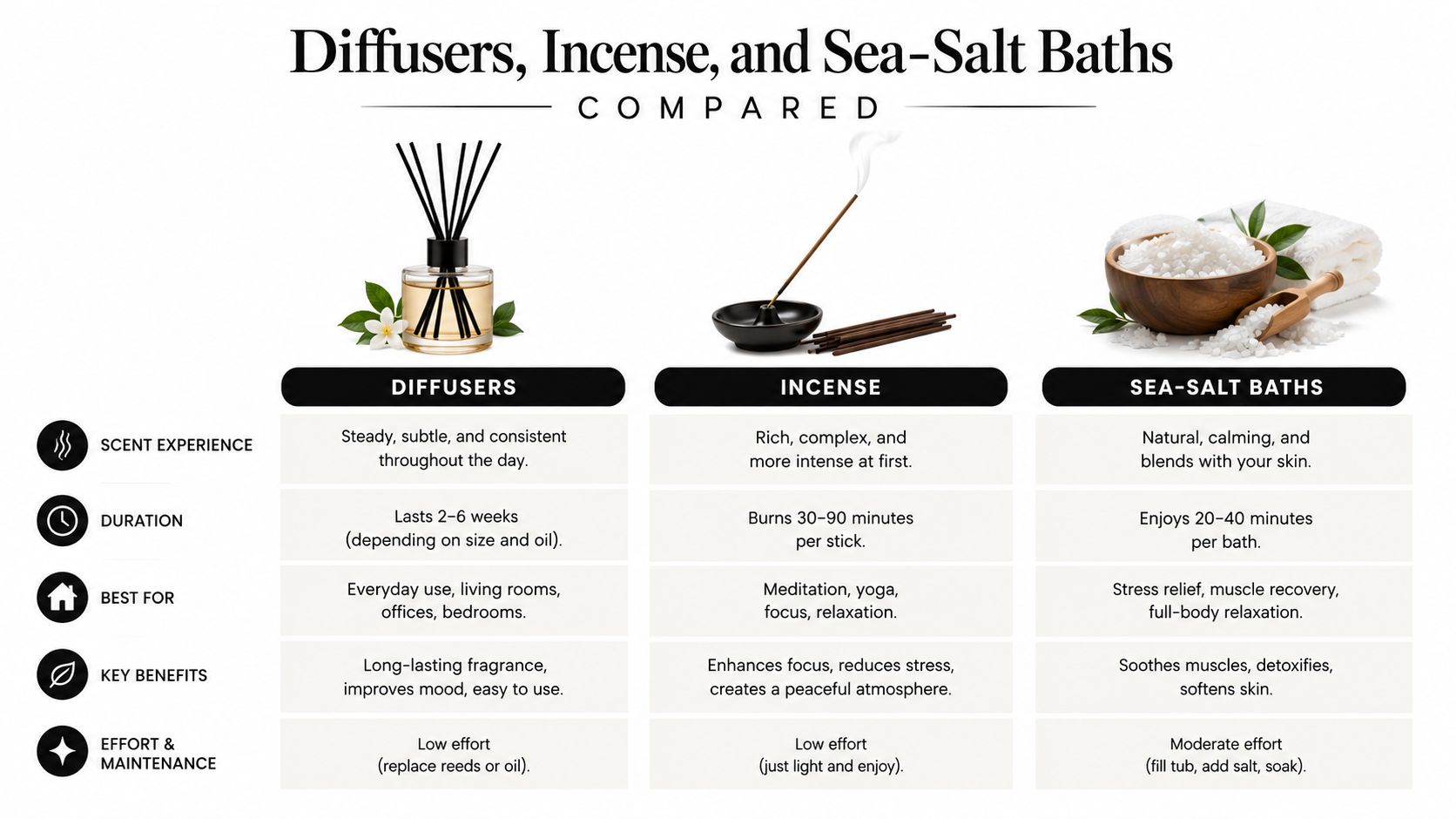
The same ocean accord behaves differently depending on how you release it. A reed diffuser provides a steady background presence, making it a natural choice for an entryway, hallway, or small sitting area. It works slowly and continuously, so the blend should be balanced and not overly sharp. Keep the vessel on a stable, protected surface because fragrance oils can mark wood, stone, or finished furniture.
An ultrasonic diffuser creates a softer, intermittent atmosphere when used with a compatible water-based product. A nebulizing diffuser delivers a more concentrated fragrance effect without the same water mist, but it can make a powerful marine accord feel overwhelming more quickly. Follow the device manufacturer's instructions instead of assuming that every fragrance oil belongs in every diffuser.
Incense changes the ocean theme into a ritual. A marine incense may begin with an airy, ozonic impression, then reveal wood, musk, or resin as it burns. Use it for a short, intentional session in a well-ventilated room, with the burner placed on a heat-resistant surface away from fabric and drafts.
A sea-salt bath offers the most personal interpretation. The salt contributes texture and bathing ritual, while the fragrance creates the coastal association. Oils don't automatically disperse safely through bathwater, so use a properly prepared bath product or a formulation designed for bathing. The guidance on sea-salt bath benefits can help you think about the format separately from the fragrance itself.
Use this quick decision rule:
Choose reeds for quiet, continuous scent in a passageway or compact room.
Choose an electric diffuser when you want adjustable intensity and a faster change of mood.
Choose incense for a defined evening ritual rather than all-day fragrance.
Choose a bath when you want the ocean theme to stay close to the body.
If coastal freshness is part of a bedtime routine, compare the marine profile with softer options through resources that help you discover sleep-friendly scents. Keep ventilation in mind, and check fragrance safety around children, pets, and anyone sensitive to smoke or strong aroma.
Pairing and Merchandising the Ocean Theme
An ocean accord works better as the anchor of a collection than as a single isolated product. Retailers can give the scent several personalities by pairing it with neighboring fragrance families, then naming each combination according to a clear mood.
For an airy display, combine marine notes with white tea or bamboo. For a softer vacation direction, pair them with coconut milk and frangipani. Driftwood and cedar create a drier, wood-forward interpretation, while eucalyptus and mint shift the same coastal idea toward a spa environment. These pairings help shoppers understand that “ocean” can mean fresh air, tropical water, weathered timber, or wellness.
A practical display might group candles, reed diffusers, incense, and bath salts in graduated blue and sand tones. Place testing strips at counter height, where customers can reach them without leaning over merchandise. Each strip should name the dominant facet, such as marine air, saline wood, or seaweed shore, rather than relying on the broad word “ocean.”
Small bundles make the story easier to buy:
Coastal Morning: Bright marine fragrance, white tea, and a reed diffuser.
Tide Ritual: Saline bath soak, incense, and driftwood fragrance.
Quiet Shore: Soft musk, cedar, and a low-intensity room scent.
A QR code can lead to a short scent story that explains the difference between real shoreline chemistry and a commercial aquatic accord. Seasonal timing also helps. A spring reset can emphasize clean air and pale woods, while a summer display can add bath salts, travel-friendly formats, and brighter marine notes.
Wellness spaces should use restraint. A lighter ocean accord in a waiting area can establish a recognizable identity, while a softer saline or wood note in treatment rooms reduces the risk of scent fatigue. Retailers planning a broader assortment can review wholesale supplies for gift shops when choosing compatible formats and accessories.
FAQs
Can you make a room smell like the ocean without using a diffuser?
Yes. Marine incense, room sprays, scented candles, and other compatible home-fragrance formats can create a coastal atmosphere without using a diffuser. Choose the format based on how strong and how long you want the scent to last.
Why does ocean-inspired fragrance smell different from one product to another?
Ocean fragrances are accords rather than a single ingredient. One formula may emphasize watery freshness, while another may lean toward citrus, woods, musk, seaweed, or clean air. The balance of these facets determines the final character.
What scents pair well with an ocean fragrance?
Ocean-inspired fragrances pair especially well with clean woods, white tea, bamboo, eucalyptus, mint, coconut, and soft musk. The best pairing depends on whether you want a fresh, tropical, spa-like, or woodsy coastal effect.
How do you make an ocean scent smell less artificial?
Give the blend more depth instead of simply adding more marine fragrance. A small amount of woody, musky, mineral, or carefully controlled green notes can create a more rounded impression and reduce an overly sharp aquatic character.
What should you look for when buying an ocean fragrance oil?
Look beyond the name and check the scent description, intended application, dilution or usage guidance, and whether the profile emphasizes watery, ozonic, salty, green, or woody characteristics. This makes it easier to choose an oil that fits your intended project.
Quick Reference Checklist for Ocean Scenting
Use this checklist before blending, buying, or merchandising an ocean-themed scent.
Separate the two realities: The natural shoreline smell is a biological mixture centered in part on DMS, while the commercial aquatic accord uses synthetic materials such as calone to suggest marine freshness.
Name the dominant facet: Decide whether the product leads with marine freshness, ozonic air, saline mineral texture, driftwood warmth, or seaweed.
Build contrast: Pair a bright watery opening with a dry or warm base so the result doesn't feel flat.
Treat seaweed as texture: Add it carefully when you want realism. Too much can shift a clean aquatic blend toward decay or tidal mud.
Check the format: Use a skin-suitable dilution and follow current supplier and IFRA guidance for roll-ons, perfumes, and bath products.
Match the delivery method: Reeds suit steady background scent, electric diffusers offer adjustable room fragrance, incense supports brief rituals, and bath salts create close-to-body immersion.
Protect surfaces: Keep oil-based products away from unfinished wood, delicate stone, painted finishes, and fabrics.
Test in neutral air: Smell the blend away from cooking, cleaning products, candles, and other fragrances.
Label by facet: Write “ozonic marine,” “saline driftwood,” or “green seaweed” on test strips so you can compare formulas accurately.
Refresh the collection: Rotate the emphasis among clean air, mineral salt, seaweed, and wood to keep an ocean-themed assortment interesting.
The most convincing result won't necessarily be the strongest one. It will be the blend that gives the nose a clear path from cool air to water, from water to mineral texture, and from the shore to warm wood.
Aroma Warehouse offers fragrance oils, incense, DPG, diffusers, burners, bottles, and scented sea salts for building ocean-inspired home and retail rituals. Visit Aroma Incense Warehouse to explore materials and formats for your own marine accord.