Tower Incense Burners Explained and How to Use Them

A customer lifts the lid off a tower burner for the first time, lights a cone, and waits for something dramatic to happen. Sometimes it does. Smoke curls through little windows, drifts from the top, or in a backflow model, pours downward like a tiny foggy waterfall. Sometimes nothing much happens except a faint ribbon of smoke and a puzzled look.
That moment tells you almost everything about tower incense burners. They're not just holders. They're shaped tools. The design changes how smoke moves, how ash stays contained, how the piece fits a room, and even how easy it is to sell to someone who's never used incense before.
For home users, that means a tower burner can turn a simple cone or stick into a calmer, tidier ritual. For retailers, it means the wrong burner can create returns, confusion, or disappointed buyers if it's merchandised like decor alone. The right one, paired with clear guidance, becomes much easier to recommend.
Table of Contents
Introduction to Tower Incense Burners and Why They Stand Out - What people usually notice first - Why they feel special
How Tower Burners Evolved From Ancient Censers - From vessel to designed smoke object - Why East Asian refinement matters to modern buyers - What that history means for buying and selling now
Tower Incense Burner Types Materials and Styles Explained - Standard towers and backflow towers - Materials and what they change - Matching style to the customer
How to Use a Tower Incense Burner Safely and Get the Best Effect - A calm setup routine - Ventilation without ruining the effect - Safety habits worth keeping
Cleaning Maintenance and Troubleshooting Common Issues - A simple care routine - What common problems usually mean - Think like airflow, not mystery
Buying Guide for Retailers Resellers and Gift Shops - Bundle for the real use case - Tower Burner Assortment Planner for Retailers - Don't ignore the air-quality question
Choosing Styling and Enjoying Your Tower Burner With Confidence - Match the burner to the space - Don't confuse containment with safety
Introduction to Tower Incense Burners and Why They Stand Out
A flat ash catcher does one main job. It catches ash. A tower burner does more than that.
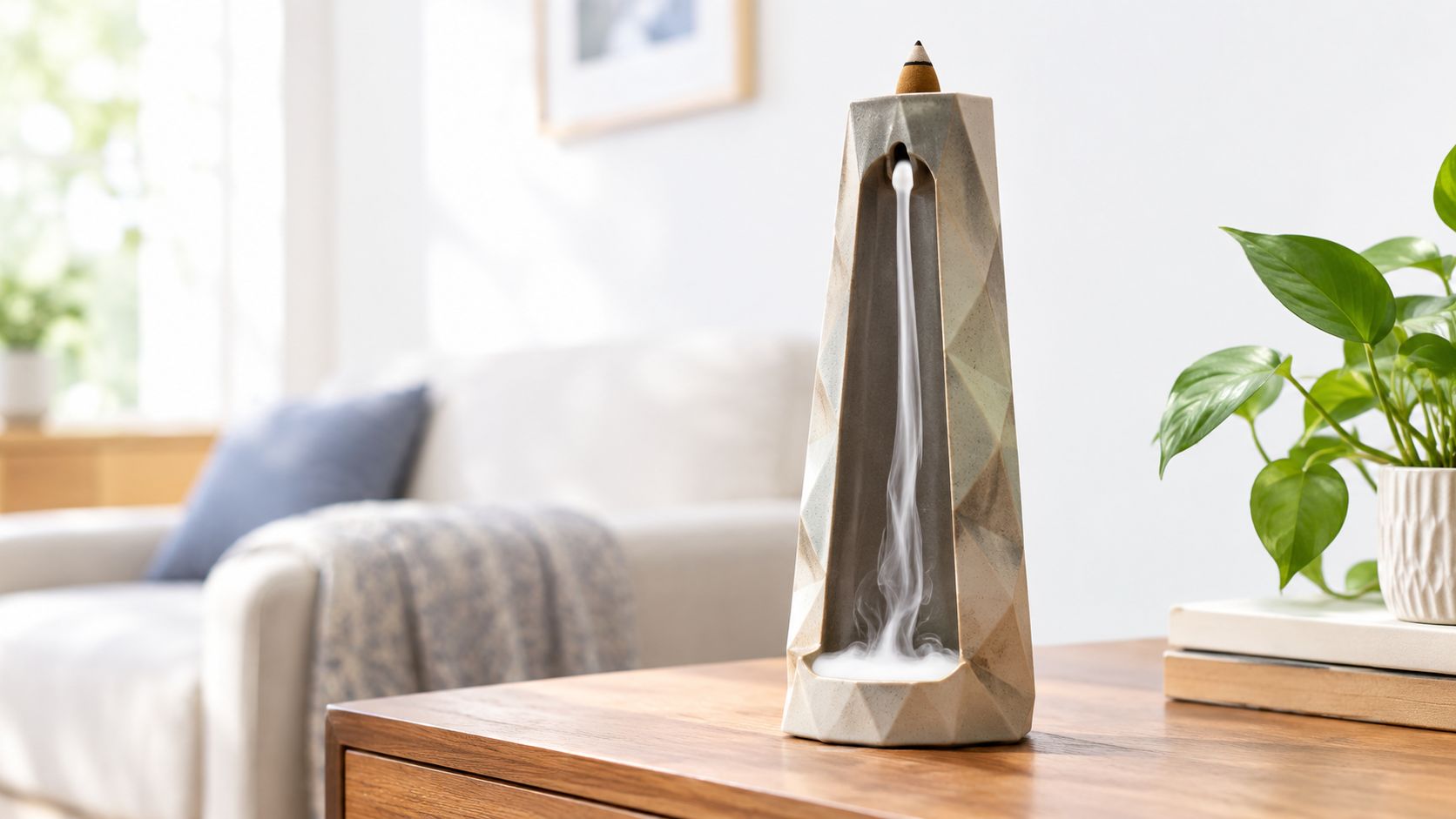
It usually has a vertical, enclosed, or partially enclosed form that shapes the path of smoke while also helping contain falling ash. That's why it feels different on a shelf and in use. It looks like an object, not just an accessory.
What people usually notice first
Most shoppers respond to one of three things right away:
The shape: It resembles a lantern, temple, chimney, or small sculpture.
The smoke behavior: Standard towers let smoke drift out through cutouts. Backflow towers guide it downward through a designed path.
The mess control: Ash stays more contained than it does with many open holders.

That combination makes tower burners appealing to two very different customers. One wants a quiet evening ritual on a bookshelf or meditation corner. The other needs products that display well, gift well, and make sense to explain in a shop.
Why they feel special
A tower burner changes the experience the way a lampshade changes light. The flame
or ember may be simple, but the structure around it shapes what you see and feel.
That's also where confusion starts. Buyers often assume all tower burners work the same way. They don't. Some are made for sticks. Some are made for cones. Some are meant for backflow cones and won't perform correctly with standard cones.
A tower burner isn't automatically better than a simpler holder. It's better for certain spaces, certain smoke effects, and certain customer expectations.
If you sell incense, this matters at the display table. If you burn incense at home, it matters the first evening you try one in a small room and wonder whether the smoke is supposed to pool, rise, or pour.
How Tower Burners Evolved From Ancient Censers
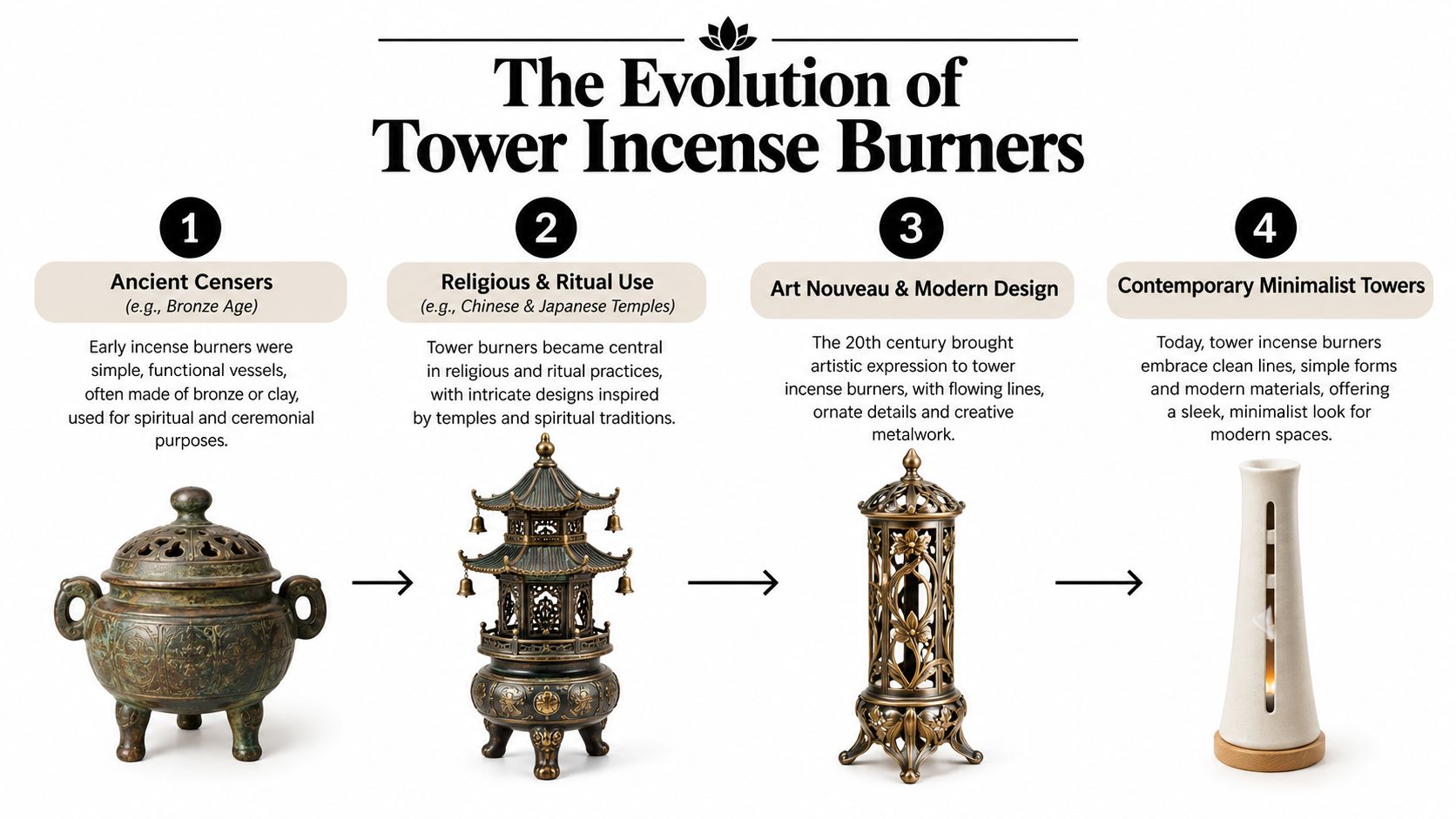
A customer picks up a tower burner, turns it over, and asks two smart questions. Why is it enclosed, and why does the smoke leave through cutouts instead of burning in the open? The answer starts far earlier than modern home decor. Tower-style burners come from a long line of covered censers built to contain heat, guide smoke, and make aromatic materials easier to use indoors.
Historical records place incense-burner traditions in several regions. Early censers appear in the ancient Near East, including the Levant and Arabia, from the late 5th century BCE to the 1st century CE, while Chinese examples go back to the Shang and Western Zhou periods, according to Britannica's overview of incense and smoke devices. So the basic idea behind a tower burner is ancient: hold the burning material inside a vessel, let air in where needed, and release smoke in a controlled way.
From vessel to designed smoke object

The earliest covered burners had a practical job. They contained embers, reduced stray ash, and moderated how smoke entered a room. A covered censer works a bit like a lantern for fragrance. The structure around the burning material changes how the experience feels, how much smoke escapes at once, and how safely the object can sit near other furnishings.
Over time, the container became expressive too. In China, a distinctive hill-censer form developed by the Han dynasty, and later covered forms with pierced lids became well established. That design choice still matters today. A pierced top is not only decorative. It affects airflow, smoke spread, and how visible the smoke becomes in a small room versus a larger one.
If you want more context on those forms, this overview of the Chinese incense burner tradition gives useful background.
Why East Asian refinement matters to modern buyers
East Asian incense culture shaped more than appearance. It also pushed burner design toward precision. During the Song dynasty, incense became part of cultivated daily life and scholar culture, as discussed in a study published through David Publisher. That shift matters because objects used regularly at home tend to get refined for comfort, control, and repeatable results.
The same study describes a Tang-dynasty spherical burner with a level inner chamber held by gimbals and nested rings. That sounds specialized, but the lesson is simple. Burner makers were solving practical problems, such as keeping burning material stable while the outer body moved. In modern retail terms, that is the difference between an object that only looks interesting and one that performs predictably.
Covered incense burners developed as tools for handling heat, airflow, and smoke, not just as decorative containers.
What that history means for buying and selling now
This history helps explain why tower burners still appeal to both home users and retailers. The enclosed form is part tradition and part function. It can contain ash better than an open holder, soften the visual intensity of the ember, and shape how smoke behaves in tighter spaces.
That has real buying consequences. A taller enclosed burner may suit a medium room with some air circulation, while a heavily enclosed piece with small vents can feel too concentrated in a compact bedroom if the incense itself is strong. For a gift shop or reseller, the story also helps with bundling. A tower burner often sells better when paired with the right incense format, a simple cleaning tool, and a clear note about ventilation and placement.
So when a tower burner feels old and modern at the same time, that is not an accident. The form survived because it solves the same problems people still have now. How to burn incense more neatly, more safely, and with more control over how smoke fills a space.
Tower Incense Burner Types Materials and Styles Explained
Buyers often mix up form and function. A burner can look like a tower and still behave very differently depending on what it's made for.
The easiest way to understand the category is to separate format, material, and style. Format tells you what kind of incense it accepts. Material affects heat handling, cleaning, and weight. Style affects who buys it and where they place it.
Standard towers and backflow towers
A standard tower burner works a bit like a small chimney around a smoldering incense source. Smoke rises naturally and escapes through cutouts or vents. Ash usually stays contained inside the body.
A backflow tower burner is different. It's designed so smoke moves through a narrow internal channel and outlet. The visible waterfall effect depends on a stable pressure path, not just on smoke being heavier than air. A level burner, a centered backflow cone, and a clear channel all matter because drafts, residue, or misalignment can interrupt the cascade, as explained in this guide to how backflow incense works.
If that sounds technical, think of it this way. A standard tower is like a lantern with openings. A backflow tower is like a tiny indoor fountain for smoke. The shape isn't decorative fluff. It's part of the mechanism.
For buyers comparing these with simpler holders, this guide to the cone incense burner format helps clarify what changes when the burner encloses the cone instead of leaving it exposed.
Materials and what they change
Different materials create different selling points.
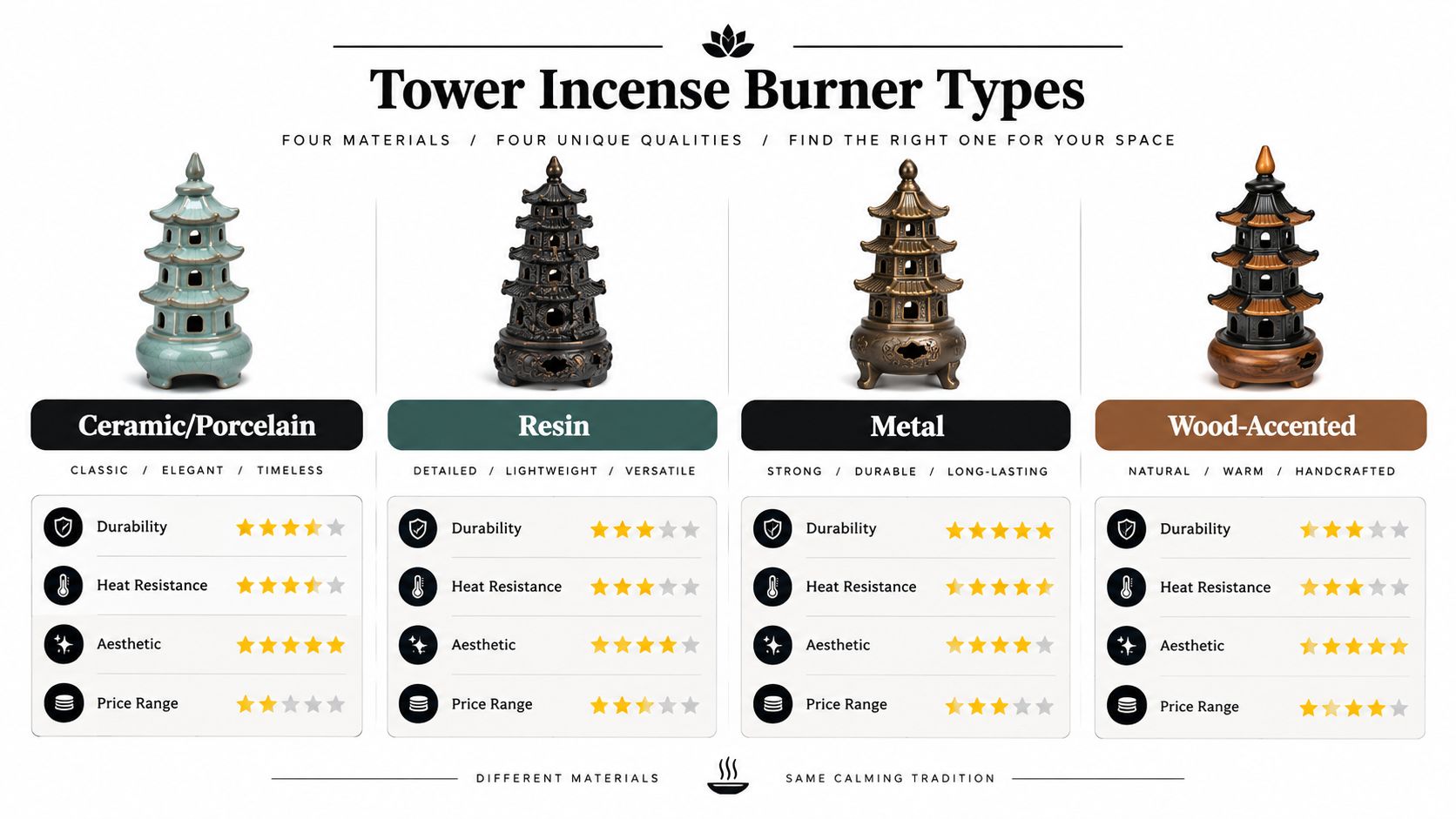
Ceramic and porcelain: These are popular because they handle heat well, clean fairly easily, and suit both minimalist and traditional styles.
Resin: Resin can carry ornate detail and sculptural shapes, which makes it useful for gift shops and themed displays. Buyers should still check where the actual heat contact sits.
Metal: Metal towers often feel sturdy and traditional. They can suit temple-inspired or old-world styling.
Wood-accented designs: These soften the look and fit natural or bohemian decor, but the heat-facing parts still need proper construction.
Matching style to the customer
Here's a simple retailer lens.
Customer type | What they usually respond to | Good fit |
|---|---|---|
Modern home user | Clean lines, neutral colors, easy cleanup | Ceramic or porcelain tower |
Gift buyer | Drama, detail, display impact | Resin or ornate metal tower |
Meditation space | Calm visual presence, contained ash | Simple enclosed cone tower |
Backflow enthusiast | Waterfall smoke effect | Dedicated backflow tower with matching cones |
Don't sell a backflow burner as a general cone holder without explanation. That's one of the fastest ways to create confusion.
The best tower incense burners aren't the most decorative by default. They're the ones whose material, opening pattern, and incense format match the use case.
How to Use a Tower Incense Burner Safely and Get the Best Effect
Most frustration with tower burners comes from setup, not from the burner itself. A crooked surface, the wrong cone, or air moving across the opening can spoil the whole experience.
That's especially true for backflow designs, where smoke movement depends on geometry. Good performance starts before you ever light the cone.
A calm setup routine
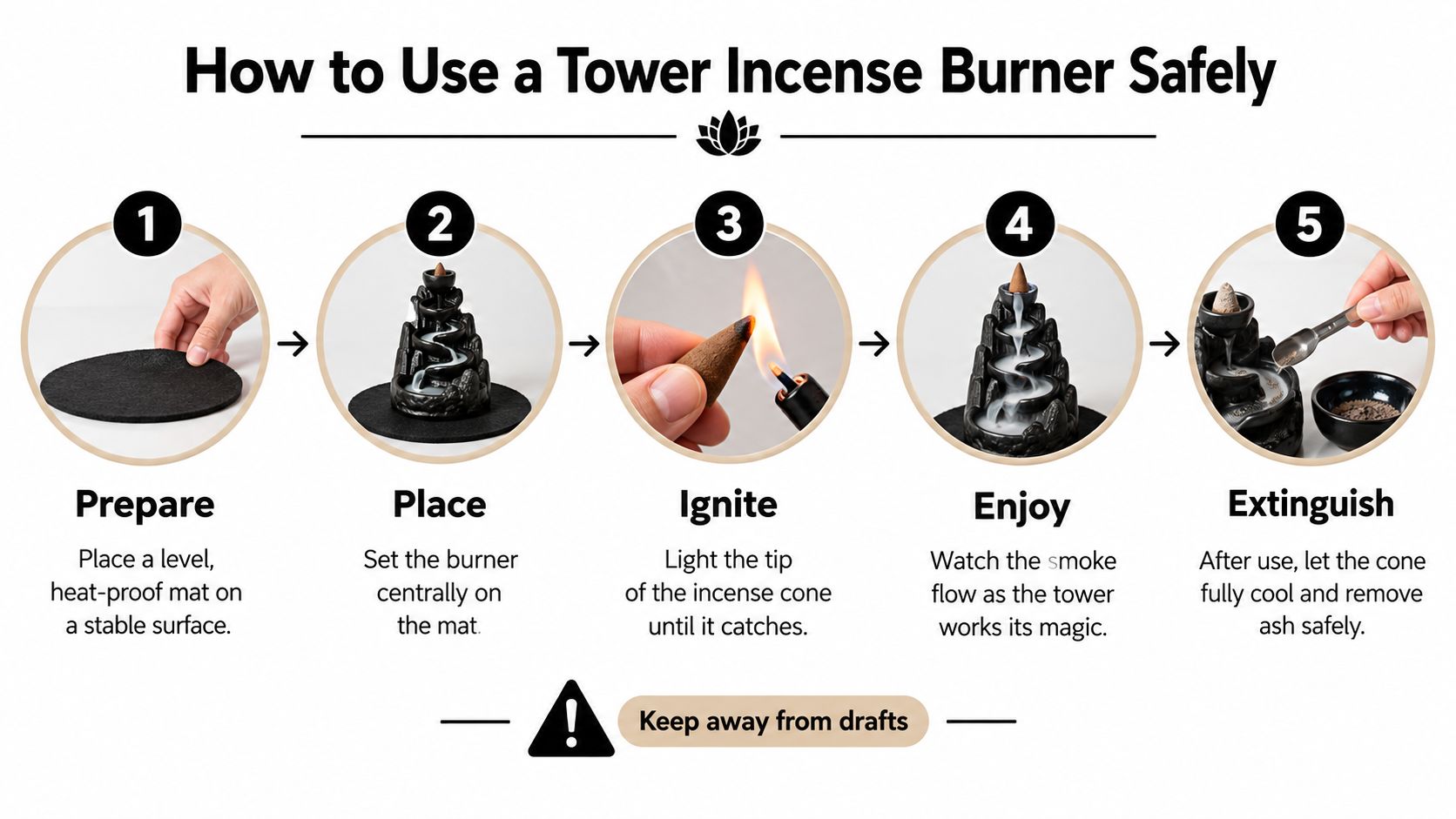
Use this sequence every time:
Choose the spot first. Place the burner on a level, heat-safe surface. Side tables with a wobble, soft fabric, or slanted shelves make smoke behavior less predictable.
Match the incense to the burner. Standard towers need the format they were designed for. Backflow towers need backflow cones, centered correctly over the opening.
Light the cone and let the tip catch. Once it's glowing, gently blow out the flame so it smolders.
Close or position the burner as intended. If the piece has a lid or chamber, fit it properly rather than leaving it ajar.
Watch the air in the room. If smoke whips sideways, the room is too drafty for the intended effect.
A practical companion for people who also use open formats is this overview of incense sticks and how they're used, because many customers switch between formats depending on the room and mood.
Ventilation without ruining the effect
This is the balancing act most guides skip.
Independent combustion studies show incense emissions are strongly ventilation-dependent. In controlled testing, emissions increased with airflow from 2–28 L/min, and one residential study found higher ventilation produced higher emission factors for PM2.5. Laboratory measurements also reported PM2.5 emission rates of 154–255 mg/h and CO emission rates of 378–790 mg/h in one study, according to Aerosol and Air Quality Research.
For everyday use, that doesn't mean “seal the room.” It means use steady background air exchange instead of a direct draft blowing across the burner.
Practical rule: Open air in the room is helpful. Air blasting straight at the burner is not.
Safety habits worth keeping
A few habits solve most problems before they happen.
Keep sessions modest: Smaller rooms hold smoke longer, so use shorter burns and give the room time to clear.
Stay nearby while it burns: A tower contains ash better than many open holders, but it still contains a live ember.
Mind the surface underneath: Ceramic trays, stone coasters, or heat-safe mats are simple insurance.
Let ash cool fully: Don't empty the chamber while the ember may still be active.
If you're trying to create a calm ritual, the safest setup often looks unexciting. Stable surface, matched cone, still air, and enough room ventilation.
That's what gives you the best visual effect and the least guesswork.
Cleaning Maintenance and Troubleshooting Common Issues
Tower burners reward consistency. If the smoke path worked beautifully on day one and looks weak a week later, the burner usually isn't defective. It's dirty, off-level, or being used with a small mismatch in setup.
Residue matters more than many people expect. In enclosed or channeled designs, even a thin layer of soot or cone residue can change airflow enough to weaken the smoke effect.
A simple care routine
After each use, let the burner cool completely. Then tap out loose ash and wipe the interior gently with a dry cloth or soft brush.
For deeper cleaning, focus on the channel, cone seat, and vent openings. A cotton swab, soft brush, or cloth-wrapped tool works better than anything sharp, especially on glazed ceramic. If your assortment includes resin-burning tools too, this guide on an incense burner for resin helps clarify why cleanup needs differ across burner types.
What common problems usually mean
Use this quick checklist when performance changes:
Weak or broken backflow effect: Check for residue in the smoke channel, an off-center cone, or a tilted surface.
Smoke escaping from odd places: Make sure the lid, chamber, or cone placement lines up with the design.
Lingering odor after the session: Empty old ash promptly and don't let spent cones sit inside overnight.
Soot marks near openings: The cone may be producing residue that's collecting where smoke exits. Clean before the next use so buildup doesn't narrow the path.
Think like airflow, not mystery
A lot of burner troubleshooting sounds mystical online. Most of it is mechanical.
Smoke follows the path the burner gives it. If that path is blocked, angled, or interrupted by air movement, the effect changes. That's why maintenance isn't only about keeping the piece pretty. It keeps the intended geometry working.
A tower burner performs best when it's clean enough for the smoke path to stay predictable.
Retailers can use that point in product cards or staff training. Home users can use it to avoid blaming the incense when the issue is residue under the cone seat.
Buying Guide for Retailers Resellers and Gift Shops
If you stock tower incense burners, don't treat them like a single product category. They sell differently depending on who walks in the door and how much explanation the shopper needs.
A wellness studio customer often wants calm visuals, tidy ash control, and something that won't dominate a small room. A gift-shop customer may want drama and shelf appeal first. An online buyer needs photos and descriptions that clearly separate standard towers from backflow towers.
Bundle for the real use case
The strongest bundles answer a practical question.
A starter set might pair a tower burner with matching cones and a short care note. A gift-oriented bundle might lean into visual style. A shop serving repeat burners may want to stock replacement cones and cleaning tools nearby rather than treating the burner as a one-time purchase.
Aroma Warehouse offers tower-style options including the Natural Tower Burner Box and the Cone/Charcoal Temple Burner, which are examples of how a tower product can be sold as part of a broader incense setup rather than as a stand-alone decor piece.
For retailers building cone and stick assortments together, this guide to wholesale incense sticks is useful because many customers won't commit to one format only.
Tower Burner Assortment Planner for Retailers
Buyer Type | Best Tower Style | Bundle Pairing | Merchandising Tip |
|---|---|---|---|
Wellness studio | Simple ceramic tower | Mild cones, care card, heat-safe tray | Show it in a meditation corner scene |
Metaphysical shop | Ornate tower or temple style | Cones plus complementary ritual items | Use signage that explains incense format clearly |
Gift shop | Decorative resin or metal-look tower | Gift-ready cone pack | Emphasize enclosed ash and visual appeal |
Online reseller | Clearly labeled standard or backflow tower | Matching refill cones | Use product photos that show the burner in use and at rest |
Don't ignore the air-quality question
This is the underused sales conversation. Existing content often focuses on style and scent, but independent research shows incense smoke is a meaningful indoor pollutant source. EPA material and NIH-reviewed research note that incense can be a major indoor particulate source, and a 2024 ACS study found incense burning in a California residence produced PM2.5 emissions similar to cigarette smoke, with poor ventilation pushing concentrations beyond health guidelines, as summarized in this EPA archive document.
That doesn't make tower burners unsellable. It makes honest merchandising more important.
The broader incense burner market is still projected to grow, with one estimate placing global value at USD 881.2 million in 2026 and projecting USD 1.13 billion by 2033 at a 3.6% CAGR, while another projects USD 942.9 million in 2026 rising to USD 1.29 billion by 2034 at a 4% CAGR, according to Coherent Market Insights. The opportunity may be strongest where retailers explain room size, session length, and ventilation instead of selling smoke-heavy use without context.
Choosing Styling and Enjoying Your Tower Burner With Confidence
The right burner is the one that suits your real room, not the one that looked dramatic in a photo.
If you live in a small apartment, a large smoke-heavy setup may be more trouble than pleasure. A compact ceramic tower used for shorter sessions usually makes more sense. If you're styling a meditation corner, choose a burner that feels calm when it isn't lit, because most of its life will be spent sitting on a shelf or table.
Match the burner to the space
A few simple pairings work well:
Small rooms: Choose a modest tower and burn for shorter periods.
Open living areas: You have more flexibility with taller or more sculptural pieces.
Retail displays: Pick one style that demonstrates clearly and one that gifts well.
Shared homes or offices: Use extra caution about lingering smoke and nearby people.
Don't confuse containment with safety
This is one of the biggest misconceptions in the category. A tower design may contain ash better and shape smoke more beautifully, but it doesn't remove the basic combustion exposure issue. Room size, ventilation, and how long you burn matter more than whether the burner looks enclosed.
That's why confident use starts with honesty. Use the burner because you enjoy the ritual, the scent, and the object itself. Then support that choice with sensible airflow, a matched incense format, and cleaning habits that keep the burner performing the way it was designed to perform.
A good tower burner should feel easy to live with. It should suit the room, fit the ritual, and ask for only a little care in return.
If you're buying for a shop, stock with explanation in mind. If you're buying for home, start with one versatile piece and learn how your room behaves. That approach usually leads to fewer disappointments and much more enjoyment.
Frequently Asked Questions
Can you use a tower incense burner with incense sticks?
Most tower burners are designed around a specific incense format, so incense sticks should only be used when the burner has a suitable holder or opening designed for sticks. A cone-only tower should not be modified to hold a stick because the burning position and airflow may not be appropriate.
How long does incense typically burn in a tower burner?
Burn time depends primarily on the incense cone or other incense format being used rather than the tower itself. Check the product's recommended burn time, and avoid assuming that a larger tower means the incense will burn longer.
Can a tower incense burner be used outdoors?
It can be used outdoors when the burner is placed on a stable, heat-safe surface and protected from strong wind. However, moving air can interfere with smoke patterns, especially with enclosed or backflow designs, so outdoor conditions may produce less predictable results.
Why does a tower incense burner get hot during use?
A tower burner surrounds a smoldering incense source, so heat naturally transfers into the surrounding structure. The exterior temperature depends on the burner material, construction, incense being burned, and length of the session. Always allow the burner to cool before handling or cleaning it.
Can you leave an incense cone inside a tower burner after it stops smoking?
It is better to remove spent incense and cooled ash rather than leaving them inside for extended periods. Clearing the chamber helps prevent residue buildup and keeps the burner ready for the next use.
If you're ready to compare incense formats, refill cones, and burner accessories in one place, Save on Scents Incense carries incense supplies for home users, retailers, and resellers. It's a practical place to browse tower-style options alongside cones, sticks, oils, and the everyday extras that make setup and merchandising easier.