

Amber Glass Bottles: A Guide for Oil Sellers

A clear bottle in a shop window looks honest. Your customer can see the oil, check the color, and judge the fill at a glance. The problem is that the light doing the showing is also doing damage, and an amber bottle that leaks at the cap can lose scent just as fast as a clear one. Color matters, but it's only one part of a closed system that includes glass, air, heat, and the seal.
Table of Contents
How Much Light Each Bottle Color Lets Through - Light Transmission and Protection by Bottle Color - Why Two Amber Bottles Don't Protect Equally
What Amber Glass Is and Which Glass Holds Oils - Color Is Not the Same as Glass Grade - Which Glass Suits Retail Oils
Bottle Sizes and Closures for Oils and Blends - Common Amber Bottle Sizes for Aromatherapy Resale - The Two Sizes That Carry Most Lines - Bigger Bottles and the Shape Question
How to Store Oils After the Bottle Is Opened - A Five Step Storage Routine - Signs an Oil Is Going Off Anyway
Cleaning Labels and What to Do After Use - Washing a Bottle for Another Fill - Labels That Stay Readable - Three End of Life Paths
Regulatory and Safety Points for Amber Packaging - A Benchmark You Can Ask a Supplier About - Safety and Label Basics
Choose Amber Bottles for Your Shop Shelf - A Short Buying Checklist - A Practical First Order
How Much Light Each Bottle Color Lets Through

Dark amber blocks far more UV-violet light than clear glass. Clear flint lets most of it straight through to the oil. Dark amber cuts that exposure down to a small fraction.
Clear glass works like bare eyes on a bright counter. Dark amber works like a deep tint. You can still read the fill level through it, but much less of the short wavelength light that speeds oxidation, fading, and scent drift reaches fragrance oils and essential oils.
Light Transmission and Protection by Bottle Color
Bottle color | Harmful UV-violet transmitted | Protection pattern | What it means for oils |
|---|---|---|---|
Clear flint | Highest transmission | Weakest light barrier | Poor choice for display or slow sellers |
Bluish-green | High transmission | Better than clear, still passes substantial light | Helps a little, not enough for photosensitive scents |
Light amber | Moderate transmission | Mid level barrier | Workable for fast turning stock kept off bright light |
Dark amber | Lowest transmission | Strongest glass color here | Best choice for window side stock and slow movers |
Read the table as a ranking, not a shelf life promise. Wine tests and shop tests measure the glass, not your lavender oil or a DPG blend. The order holds for any light sensitive liquid behind the same wall of glass.
Why Two Amber Bottles Don't Protect Equally
New retailers often treat amber as one thing. Glass does not work that way.
Wall thickness matters. A thick wall forces light to travel through more tinted glass. A heavy bottle in the same shade often screens better than a thin one.
Shade depth matters too. Pale honey and deep brown sit far apart, so never count a light tint as full protection. Formula differences add another variable. Two bottles that look close in the hand can still transmit differently because makers vary the colorants.
Then add shelf brightness. A dim back shelf and a south facing window ask different work from the same bottle.
Practical rule: Use color as a ranking for window facing retail. For a very photosensitive formula, put the amber bottle inside a carton or an opaque sleeve instead of asking the tint to work alone.
Beginners line up amber glass bottles under bright display lights and call the job done. Choose light amber only for fast turning stock on an interior shelf. Choose dark amber for testers near a window, slow moving scents, or anything a customer will keep for months. Add the carton when light is strong. Color starts the protection. The closed system of glass, air space, heat control, and a tight cap finishes it.
What Amber Glass Is and Which Glass Holds Oils
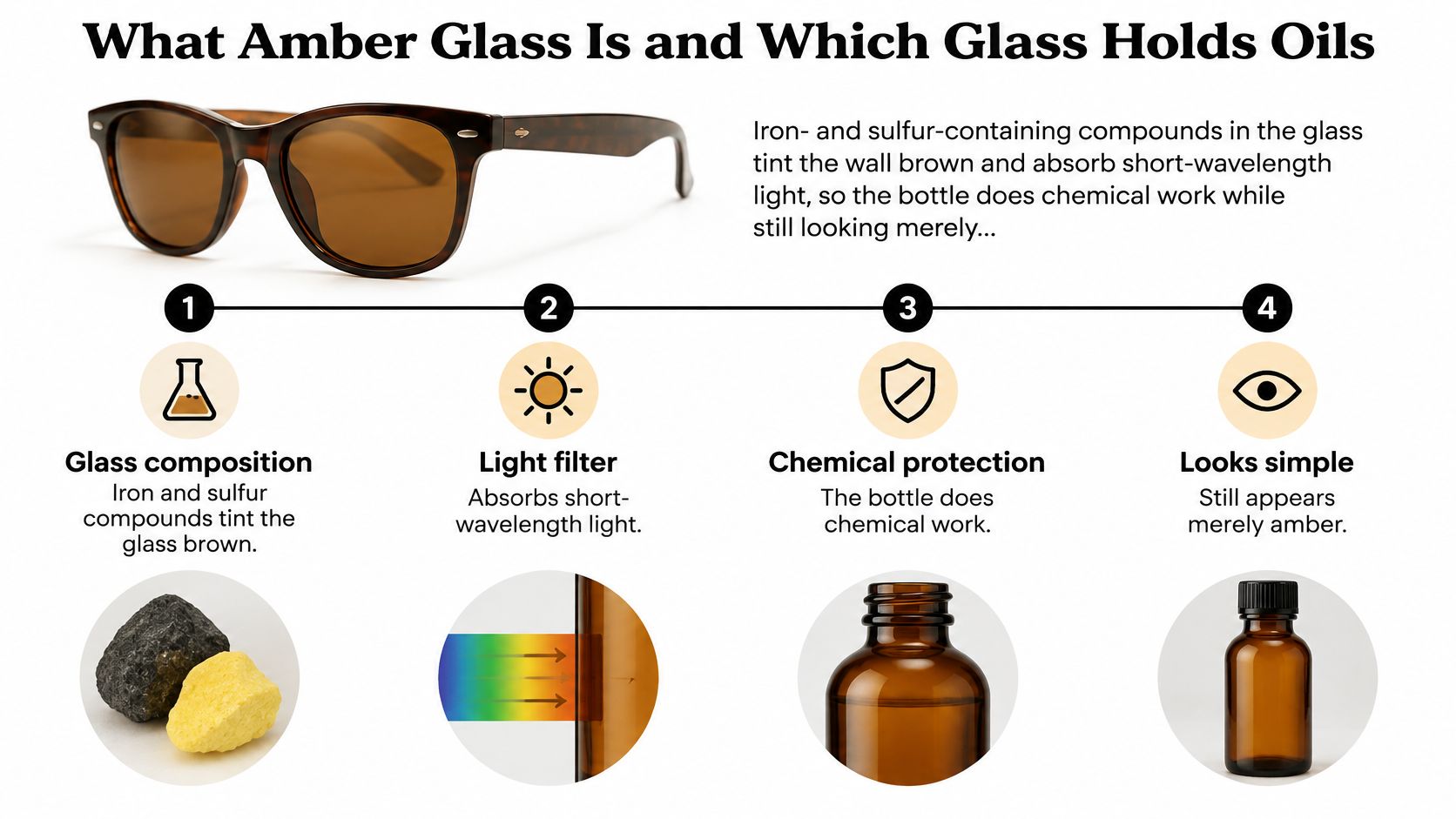
Picture a pair of brown sunglasses. The tint isn't paint on the surface. It's built into the material, so light gets absorbed as it tries to pass through. Amber glass works the same way, and that's why a bottle that looks merely brown is doing chemical work without anyone noticing.
The brown color comes from glass chemistry, typically iron and sulfur containing compounds, which absorb substantially more short wavelength light than clear glass. The historical record of pharmaceutical bottles shows specialized medicinal containers already being produced in the early 20th century, with earlier American pharmaceutical bottles dating back to the colonial period. Amber became a working package for light sensitive medicines, chemicals, and botanicals because the bottle itself helped reduce photochemical deterioration during storage.
The visual below breaks that simple idea into its parts, from what's in the glass to what the tint does.
Color Is Not the Same as Glass Grade
This is the confusion to clear up early. A very dark bottle can still be ordinary glass, and a pale bottle isn't automatically poor glass. Color tells you about light. It doesn't tell you how the glass surface behaves against water or what's dissolved in your blend.
Soda lime silica glass is generally classified as USP Type III because it has moderate hydrolytic resistance, meaning water contacting the glass can extract limited alkaline constituents from the surface. The USP glass characterization guidance separates the two jobs. Hydrolytic resistance is evaluated through controlled extraction tests, while light resistance is evaluated through spectral transmission measurements.
In plain shop terms, one test asks what the liquid pulls out of the glass. The other asks how much light gets in. A bottle can pass one conversation and still deserve questions on the other.
Which Glass Suits Retail Oils
For most fragrance oils, essential oils, and DPG diluted blends sold at retail, Type III amber soda lime glass is the common, appropriate choice. It's the same general class used for many oral liquids, powders, and general purpose products. You don't need laboratory drama for a half ounce bottle of sandalwood blend.
Highly water sensitive, injectable, or exceptionally demanding formulations are a different category. Those may require higher resistance glass or compatibility testing, and they sit outside a typical aromatherapy line. If a supplier can't tell you the declared glass type, that silence is useful information.
Glass also helps in a quieter way. Amber glass is chemically inert compared with many plastics, so it's slow to lend its own smell to an oil or pick up the last scent it held. It can be reused or recycled, which matters when you're filling hundreds of small bottles.
A dark color is a clue, not a certificate. Ask for the glass type before you trust the tint.
Before you commit to a case, fill a few bottles and watch them. Check closure liner compatibility, dimensional fit, leakage, and stress cracking under your real storage conditions. Inspect for odor transfer, color change, sediment, and closure deformation, because a suitable bottle can still fail through a bad cap.
If you're weighing formats, our guide to glass dropper bottles covers the dropper side of that fit. Treat the glass, the cap, and the fill level as separate questions, and you'll avoid blaming the tint for a sealing problem.
Bottle Sizes and Closures for Oils and Blends
Buyers usually ask which size looks best. Ask a better question first. What job does this bottle have to do, and how fast will the customer use what's inside?
Common Amber Bottle Sizes for Aromatherapy Resale
Size | Usual retail name | Best job | Typical closure |
|---|---|---|---|
5 ml | Dram tester | Paid or free scent samples | Plug or orifice reducer |
10 ml | About one-third ounce | Travel and single oils | Orifice reducer |
Half ounce | Standard essential oil retail bottle | Reducer or glass dropper | |
30 ml | One ounce | Fragrance blends and counter bottles | Dropper or polycone screw cap |
60 ml | Two ounces | Carriers and larger blends | Phenolic or plastic cap with liner |
120 ml | Four ounces | Shop decant and carrier size | Screw cap with compatible liner |
A 5 ml dram is a tester, not a storage bottle. It costs little to sample, leaves little air space once filled, and usually takes a plug or orifice reducer rather than a customer dropper. Use it when you want someone to smell twenty scents without opening your retail stock.
The 10 ml bottle suits travel oils and single scents a customer carries in a bag. An orifice reducer slows spills and gives some control without a separate pipette. It's also a good size for a scent you're testing in the market before you commit shelf space.
The Two Sizes That Carry Most Lines
A 15 ml, or half ounce, bottle is the familiar single oil retail size. Fit a reducer for neat oils a customer shakes out drop by drop. Fit a glass dropper for blends people measure more deliberately, such as a beard oil or a diffuser blend.
A 30 ml, or one ounce, bottle fits fragrance oil blends and counter displays where a half ounce looks skimpy. It gives you label room, which you'll appreciate once ingredients and cautions enter the picture. It also suits a blend a regular customer buys repeatedly.
Say a shop sells a citrus heavy essential oil and a stable sandalwood fragrance blend. Put the citrus in 10 ml or 15 ml so each opening uses a larger share of the bottle and the liquid doesn't sit half empty for months. Put the sandalwood blend in 30 ml if your buyers use it for burners and come back for the same scent.
Bigger Bottles and the Shape Question
A 60 ml bottle suits carriers and larger blends, but it gets heavy and breakable in a mailer. A 120 ml bottle is a shop decant or carrier size, and it wants a screw cap with a compatible liner, not a tiny reducer. Don't force a closure made for drops onto a bottle meant for pouring.
Boston round shoulders are the usual shape for a reason. The rounded shoulder pours cleanly, the straight side takes a label without wrinkles, and the neck accepts common droppers and caps. Our overview of bottle cap types helps if you're sorting polycone, phenolic, and lined caps by job rather than by name.
Pick two or three sizes for the whole line. Caps, labels, and cartons then stay interchangeable, and a replacement shipment doesn't leave you with droppers that fit nothing. A tidy size system looks professional to customers and saves you money in small, boring ways that add up.
How to Store Oils After the Bottle Is Opened
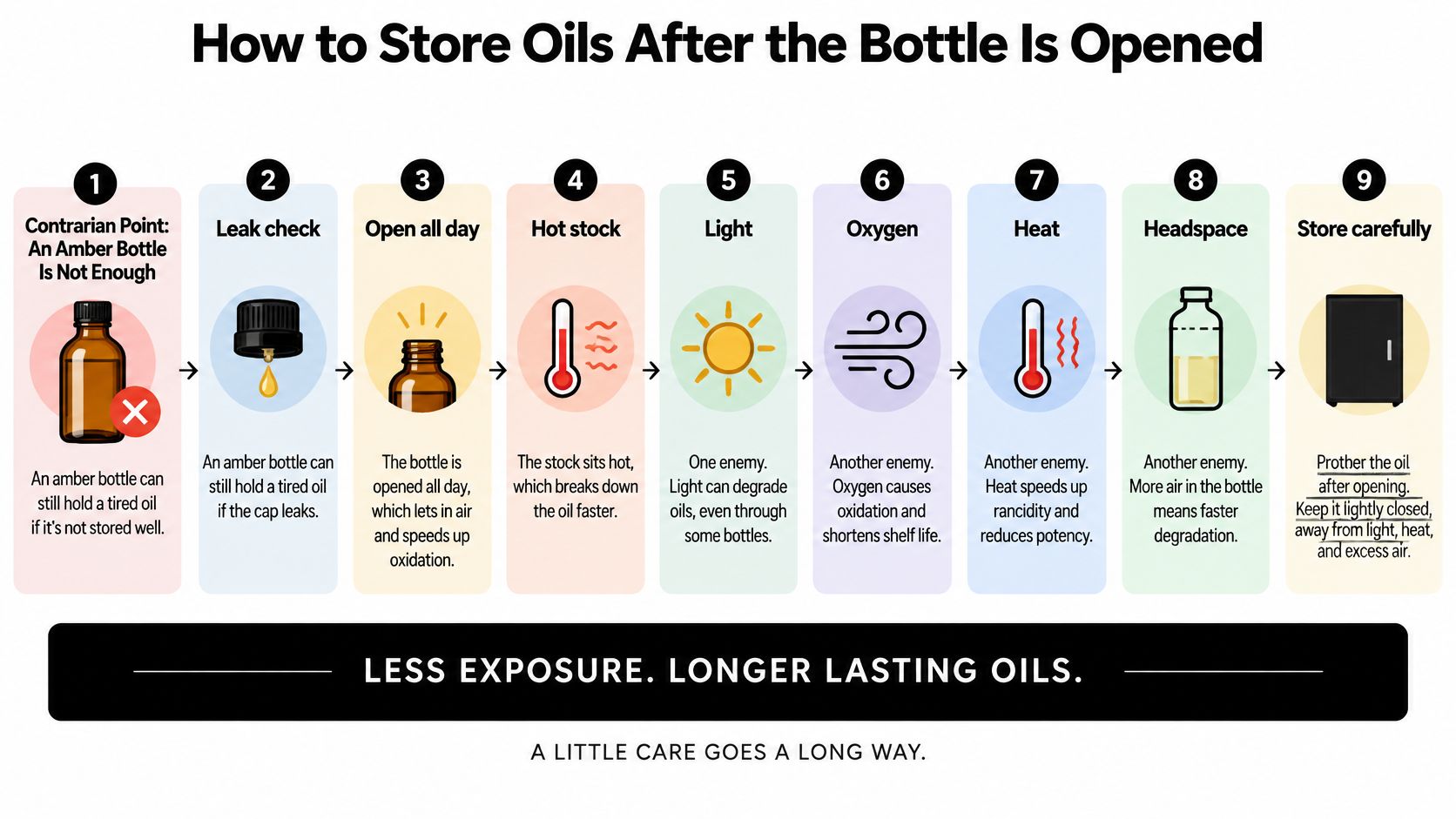
A small citrus bottle that is half empty and opened daily will tire faster than a full sandalwood blend opened once a week. The tint is the same. The handling is different.
That is the closed system at work. Amber glass filters harmful light, but oxygen, heat, headspace and the cap decide whether the scent survives. Headspace is the air sitting above the liquid. Each opening trades oil vapor for fresh air, and that air keeps working on what is left.
Research on household storage points to the same fix. Keep oils airtight, cool, and protected from light, because oxygen, heat, and repeated opening age oils even in amber glass.
A Five Step Storage Routine
Fill small and fill high: Choose a bottle size that leaves a small air gap, and decant a half empty bulk bottle into smaller amber glass bottles as the level drops.
Cap immediately: Close the bottle as soon as you have poured. Do not leave a dropper on the counter gathering dust and air.
Keep it cool: Store opened stock away from windows, heaters, sunny shelves, and car trunks, where heat swings speed every bad reaction.
Add a carton for sensitive formulas: Keep retail bottles in a carton or drawer when the formula is very light sensitive or meant to last a long time.
Sort by lifespan: Treat citrus essential oils as the short lived group. Do not promise one shelf life for citrus, resinous oils, carriers, and fragrance oils.
Watch this short demonstration with those steps in mind, and notice how much of good storage is handling rather than hardware.
Signs an Oil Is Going Off Anyway
Smell first. A flatter top note, a sharper or sour edge, or a scent that seems thinner than your fresh sample all point the same way. A darker color than the lot started with is another clue.
Then check the cap. If the outside of a closed bottle smells strongly of oil, vapor is escaping. That sign points to the seal, not the glass color. Swapping the cap or liner matters more than buying a darker bottle.
Keep one small, fresh, tightly capped reference sample for each scent. Your nose can compare against it long before a customer complains.
Our guide on whether essential oils expire and how to tell goes deeper on those checks. When a bottle fails the smell test, pull it from sale. A discounted stale oil costs you more in trust than it earns at the register.
Cleaning Labels and What to Do After Use
Start with reuse. A sound, empty bottle you can clean and refill is often worth more to a small shop than the recycling credit, and it keeps a matched cap and bottle together.
Washing a Bottle for Another Fill
Wash out residue with hot water and a small amount of unscented dish soap. A narrow bottle brush helps with oily films that a rinse alone won't move. Rinse until no film or fragrance remains, because leftover soap will perfume the next fill as surely as leftover oil will.
Air dry the bottle upside down with the cap off until no moisture is left. For oils, bone dry and odor free matters more than a clinical sterilizing claim. Water droplets left inside can cloud a blend and shorten its useful life.
Inspect before you refill. Hold the bottle to the light and look for chips at the lip, haze you can't wash away, and cracks around the shoulder. Then smell it empty.
Lingering citrus: Don't move a bottle that held lemon or orange into a delicate floral without that empty smell test.
Chipped lip: Retire it, because a chip breaks the seal and can cut a liner.
Cloudy residue: Wash once more, and retire the bottle if the film stays.
Labels That Stay Readable
Put the product name, volume, and lot where a thumb won't smear them. On 10 ml and 15 ml bottles, keep ingredient and caution text readable by using a wrap label or a small hang tag rather than cramming tiny type onto curved glass. A carton protects both the label and the light barrier, and it gives you flat space for the words that matter.
If you're building a small product line from a kitchen table or market stall, a craft startup guide for makers from Raccoon Transfers can help you think through the business side of turning filled bottles into a repeatable product. Keep the label system as simple as your size system, so a new scent doesn't require a new printing setup.
Three End of Life Paths
Refill when the bottle is intact, clean, and matched to a compatible product. Recycle through a local program that accepts colored glass, after removing droppers and checking whether labels must come off. Discard glass that held a contaminated or unknown liquid rather than guessing.
Customers care about this choice more than many sellers expect. The McKinsey sustainability in packaging report found 44% of surveyed consumers in 2025 said environmental impact was extremely or very important when making packaging related judgments. The same body of life cycle evidence reports every 10% increase in recycled glass cullet can reduce carbon dioxide emissions by roughly 3 to 3.5%.
Still, recyclable doesn't mean superior in every market. Glass is inert and highly recyclable, but it's heavier than plastic, so shipping weight and breakage matter for online sellers. Prefer durable reuse where practical, then local closed loop recycling, and don't assume every curbside bin takes amber.
Regulatory and Safety Points for Amber Packaging
Keep the scope straight first. The strictest light benchmarks come from pharmaceutical packaging, so a fragrance or essential oil seller uses them as a reference point, not as a legal standard for aromatherapy products. That distinction protects you from making claims your bottle was never certified to carry.
A Benchmark You Can Ask a Supplier About
The U.S. FDA container closure guidance identifies opaque or amber colored packaging as a standard method of providing light protection and recognizes USP <661> light transmission testing for evaluating container performance. The pharmacopoeial acceptance criterion is no more than 10% transmission across approximately 290 to 450 nm, the spectral region associated with many photochemical degradation reactions. In one comparative packaging study, an amber glass oral liquid bottle recorded a maximum transmission of only 1.121% across that range.
You don't need to run that test yourself. You do need a better question than asking whether a bottle is amber. Try these.
Spectral data: Can the supplier quote transmission across that 290 to 450 nm band?
Declared glass type: Is the bottle Type III soda lime, or something else?
Closure specification: What's the liner material, and has it been tested with oils or DPG based liquids?
Amber glass is not complete light exclusion. Transmission can rise at longer visible wavelengths, and performance depends on wall thickness, bottle geometry, color intensity, and the liquid itself. For an exceptionally photosensitive formula or a long shelf life target, add a carton or opaque sleeve.
Safety and Label Basics
Keep every filled bottle out of children's reach. Where a product falls under poison prevention packaging rules, use the required closure rather than the prettiest dropper. A child resistant cap that looks plain beats an elegant cap that fails the rule that applies to your product.
Label each bottle or carton with the product name, volume, ingredients, and caution text that stays readable. Essential oils can irritate skin and sensitize some users, so include dilution and patch test cautions in plain words. Our notes on fragrance labeling requirements are a useful starting point for laying that text out.
Never sell a bottle that held an unknown or contaminated liquid. Glass can be cleaned. Uncertainty can't.
Labeling and product safety rules differ by product type and by state. Confirm the requirements with the agency or adviser that covers your product before you print a full run of labels. A short check before printing costs far less than relabeling a case of filled amber glass bottles.
Choose Amber Bottles for Your Shop Shelf
Turn the lessons into a buying rule you can repeat. Choose dark amber over clear or pale glass for anything light sensitive. Then judge the whole closed system, glass, cap, liner, fill level, and shelf, instead of judging the bottle by its color.
A Short Buying Checklist
Standardize sizes: Two or three sizes, commonly 5 ml testers, 15 ml single oils, and 30 ml blends, keep caps and labels matching across the line.
Test filled, not empty: Order a small filled test before a large case, and reject a lot if the liner smells, the cap loosens, or the glass chips in a mailer.
Pad for shipping: Wholesale cartons need dividers or padding, because breakage costs more than the bottle and can soak a whole case in oil.
Price the filled unit: Compare cost per filled bottle once droppers, caps, labels, and freight are added, not the empty bottle price alone.
Ask about breakage: Confirm whether damaged stock is replaced and how quickly, and buy caps and droppers from the same supplier so replacements match the neck finish.
Our reference on the 1 oz bottle is handy when you're deciding whether that size earns a permanent place in your set. Buy the quantity you can sell within your storage window, because light and air age even good stock sitting in a back room.
A Practical First Order
We're based in Buckeye, Arizona, and we sell glass bottles and eye droppers alongside fragrance oils poured fresh to order, with both retail and bulk pricing. One concrete starting set is Starter Package #6 at $129.99, with two 16 oz bottles of DPG cutting solvent, 100 half ounce empty amber bottles, and ten 4 oz bottles of oils in a choice of scents.
That pack lets a new reseller fill the half ounce size instead of guessing a first quantity. Fill a few samples first, store them cool and capped, and smell them against a fresh reference after a week or two on your shelf. Scale the size and scent that sell best, and keep a fresh sample lot for any reorder so you notice drift early.
If you're unsure about fit, send us your question through the contact form on our Contact Us page before you order a case. Report a damaged package within a day of delivery so a broken carton doesn't become dead stock.
The habit to build is simple. Buy dark amber, seal it well, keep the air gap small, and store it cool. Do those four things and the bottle stops being packaging and starts being part of the product your customer trusts.
Frequently Asked Questions
FAQ 1: How can sellers maintain consistent bottle quality when ordering amber glass bottles in bulk?
Request samples from the actual production lot before placing a large order. Compare bottle dimensions, neck finishes, wall consistency, color uniformity, and closure fit. Establishing an incoming inspection process also helps identify manufacturing variations before bottles reach your filling station.
FAQ 2: Do amber glass bottles work with both oil-based and alcohol-based fragrance products?
Amber glass can be suitable for both oil-based and alcohol-based formulations, but the complete packaging system must be compatible with the specific product. Pay particular attention to cap liners, seals, and dispensing components. Test the finished package with the actual formulation before committing to bulk production.
FAQ 3: What is the difference between tamper-evident and child-resistant bottle closures?
Tamper-evident closures provide a visible indication that a package may have been opened or interfered with. Child-resistant closures are specifically designed to make access difficult for young children while remaining usable by adults. They serve different purposes and are not interchangeable. Product-specific packaging regulations determine when either type is required.
FAQ 4: How should oil sellers calculate the number of empty bottles needed for a production run?
Start with the total finished product volume and divide it by the capacity of each bottle. Then account for filling losses, quality-control samples, damaged containers, and expected reorder demand. Ordering a modest reserve of matching bottles and closures helps prevent production interruptions when a particular size sells faster than expected.
FAQ 5: Can amber glass bottles be used with automated bottle-filling equipment?
Yes. Amber glass bottles can work with automated and semi-automated filling equipment when their dimensions, neck finishes, and shapes match the machine specifications. Check bottle diameter, height, opening size, and stability on the filling line before purchasing a large quantity.
Order your amber glass bottles, matching droppers, DPG, and fresh poured fragrance oils together so your first filled samples use the same caps and neck finishes you'll sell. Visit Aroma Fragrance Warehouse to start with a tester set or a half ounce case, fill a few bottles, and store them cool, capped, and out of window light before you scale up.


