

Benefits of Grapefruit Oil with Honest Limits
You already know the smell of a cut grapefruit. It's sharp, a little bitter, and bright enough to wake a dull room. So why do so many benefit lists treat that scent as a disinfectant, a fat burner, and a skin treatment all at once?
They skip the part that decides the result. Benefits of grapefruit oil change with the exposure. A short inhale, a diluted skin blend, and a swallowed dose are three different experiments. The first has early human data on mood. The second is mostly chemistry plus anecdote, with a real sun limit if the oil was pressed from the peel. The third is the one to refuse. Grapefruit juice can change how some medicines are absorbed. Ordinary room diffusion is not that exposure.
This guide sorts each popular claim by what was measured and how people use the oil. You'll leave with a scorecard, a label check, and a dilution you can measure in a 30 mL bottle.
Table of Contents
Grapefruit Oil Benefits That Evidence Supports - The scorecard
How Peel Oil Gets Its Bright Character - A test-tube score, not a facial promise
Why Lab Germ Tests Do Not Clean a Room - Biofilm is a different job from killing cells
Weight Loss Claims That Outrun the Science - Walk the outcomes one by one
Topical Skin Claims Without Overpromising - What was actually measured - How to put it on skin anyway
Sunlight and Medication Safety Rules - Format decides the sun rule - Juice and pills are not the same as a diffuser
Diffuse, Dilute, or Buy Fragrance Oil - Pick one product for one job
Dilution Amounts at a Glance - Why the face stays lower - A bath is not a neat pour - What to do when a bottle smells off
Grapefruit Oil Benefits That Evidence Supports
The strongest human result is a mood score, not a medical cure. A 2025 randomized study in BMC Complementary Medicine and Therapies enrolled 90 women with premenstrual syndrome, 30 each in grapefruit essential oil, bergamot essential oil, and placebo. During the luteal phase they inhaled the assigned material for 30 minutes, three times a day, for four days. Total premenstrual-syndrome scores in the grapefruit group fell at p = 0.010.
The same trial reported gains for depressive affect, anxiety, fatigue, depressive thoughts, appetite changes, sleep changes, and bloating, generally at p < 0.001. Irritability reached p = 0.024 and pain p = 0.047. That's a short, scheduled sniff in one group of women. It isn't a prescription for depression, cramps, or a bad week at work.
A 2020 physiological report cited in that review found grapefruit fragrance changed muscle sympathetic nerve activity and raised diastolic blood pressure. Broader aromatherapy work has also tracked cortisol and related stress markers. The scent can nudge the body in more than one direction. It isn't automatically a calm-down oil, and it isn't a stimulant you can count on either.
The scorecard
Claim | What was measured | Typical use | Conclusion |
|---|---|---|---|
Mood during PMS | 2025 trial of 90 women; inhale 30 minutes, 3 times daily, 4 days; total score p = 0.010 | Short inhalation | Early human support, not a treatment |
Stress and energy | Fragrance changed sympathetic nerve activity and raised diastolic blood pressure | Inhalation | Measurable and mixed, not guaranteed calm |
Household germs | Species-dependent lab inhibition only | Diffusion or surface dab | Does not disinfect a room or skin |
Antioxidant or brighter skin | Test-tube radical-scavenging scores; little clinical skin data | Diluted topical use | Lab chemistry, not an anti-aging proof |
Oily or dull complexion | Mostly user reports | Diluted massage or toner | Anecdote, with sun limits if expressed |
Appetite, waist, or weight | Reviews find no established change in weight, insulin, or lipids | Often marketed as slimming | Not supported |
Practical rule: If the only measurement is a plate or a test tube, keep it in the chemistry column. Don't promote it as a room result or a body result.
The same habit helps when you compare other shop staples, including how people use tea tree and lavender. Name the job, then the exposure, before you write a blend card. For finished leave-on formulas that already feature the fruit, grapefruit skincare from Skin Perfection shows the scent inside a product, which is a different job from dabbing neat oil on a cheek.
How Peel Oil Gets Its Bright Character
Think of orange juice next to orange soda. Both smell citrusy. Only the juice carries the fruit's messier chemistry. Grapefruit essential oil works the same way. It is peel perfume from the rind of Citrus paradisi, not liquid vitamin C in a dropper.
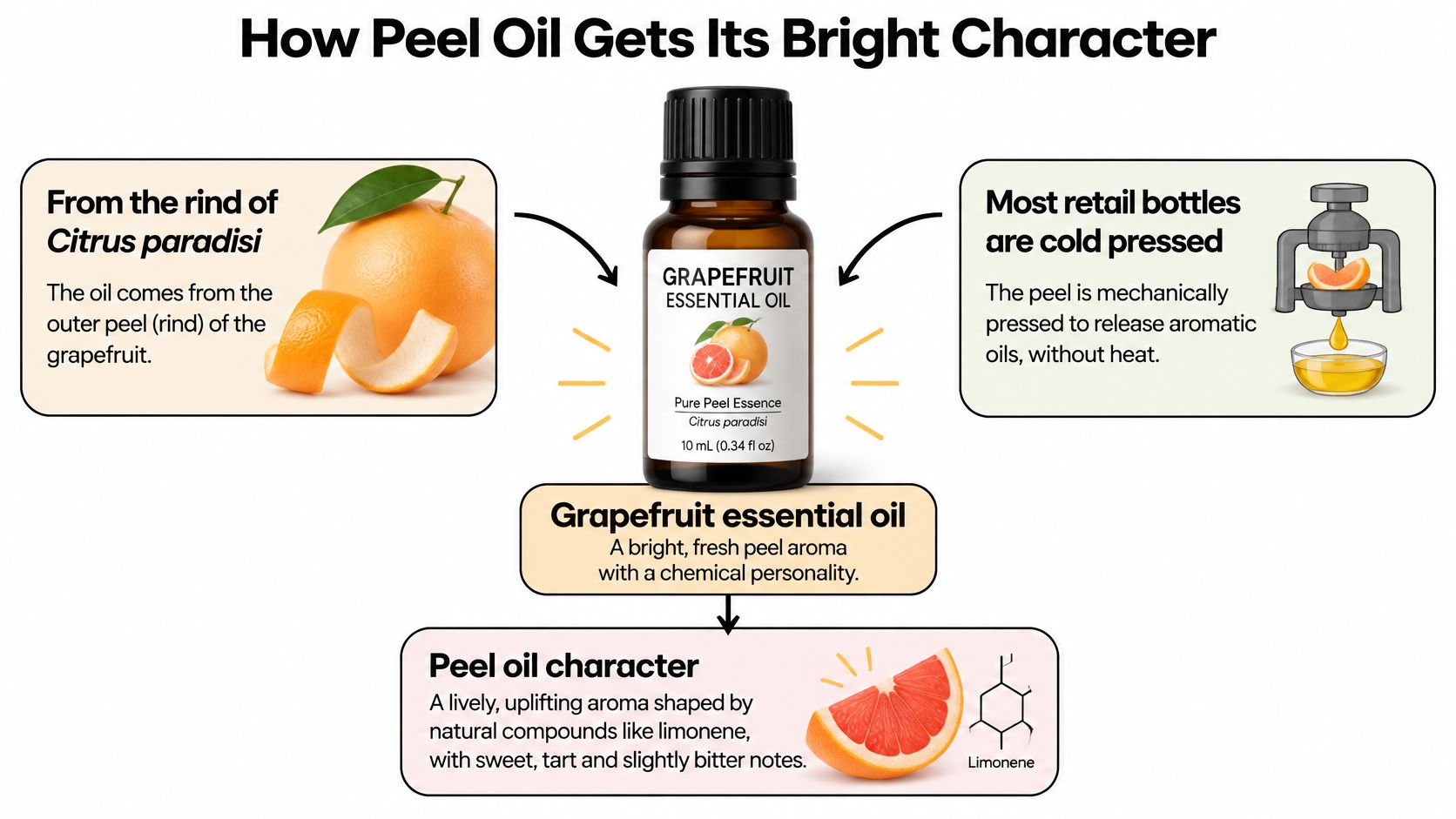
Most retail bottles are cold pressed, also called expressed. Pressure ruptures oil glands in the rind and keeps more of the peel's heavier molecules. Steam-distilled grapefruit smells related, but heat and steam change what stays in the bottle. That format is the one usually treated as the lower sun-risk option. The word on the label, expressed or distilled, matters before you put oil on skin that might see daylight.
The bright note you recognize is largely limonene, with smaller terpenes that shift both aroma and lab behavior. A pink bottle and a white bottle can both smell like the fruit and still differ in those minor pieces.
A test-tube score, not a facial promise
A 2026 study in Scientific Reports found grapefruit peel essential oil reached 95.98% DPPH free-radical-scavenging activity under optimized extraction. That's measurable antioxidant potential in a lab extract. It doesn't mean a drop on the cheek fades a spot.
Citrus oils also age faster than woods and resins. If an opened bottle smells flat, harsh, or like paint after about one to two years, it's past its best for aroma work. Store it cool, dark, and tightly capped.
If you're unsure whether you even want a concentrated oil, the contrast in hydrosol versus essential oil is the right next read. A hydrosol is the lighter aromatic water. The essential oil is the concentrated peel fraction, and it needs the label check above.
Why Lab Germ Tests Do Not Clean a Room
A petri dish is a closed, measured world. A cutting board is not.

A 2011 study in the International Journal of Food Science & Technology tested grapefruit-peel essential oil against Staphylococcus aureus, Enterococcus faecalis, Staphylococcus epidermidis, Escherichia coli, Salmonella typhimurium, Serratia marcescens, and Proteus vulgaris. Reported inhibition zones ran from 11 to 53 millimeters. The strongest zone reached 53 millimeters against S. aureus, while activity against E. faecalis stayed near 12 to 16 millimeters depending on how the oil was extracted. Oils from two extraction methods inhibited most of those organisms. Pseudomonas aeruginosa was the exception.
Read those zones like a score from a single match. A wide halo in agar means the organism was susceptible under those exact conditions: that oil, that extraction, that concentration, that dish. An oil that slows a bacterium's growth around a drop is doing a different job than wiping out a population on a countertop, and the result says nothing about what a diffuser pushes into a room.
Biofilm is a different job from killing cells
A separate laboratory look at P. aeruginosa used grapefruit essential oils at 0.1 mg/mL. Growth didn't change. Biofilm production fell by 52–55%, sessile-cell viability by 45–48%, and signaling outputs such as autoinducer production and elastase activity by about 30–56%, as reported in a quorum-sensing study in Food Science and Technology International. Whole oil beat isolated limonene, which points to teamwork among minor constituents.
A biofilm is the slimy scaffold bacteria build to protect a colony, so weakening it in a flask is real information for chemists designing tested formulas.
A fragrance that weakens a biofilm in a flask is a candidate ingredient inside a tested formula. It is not a substitute for soap, a sanitizer, or a wiped surface.
Diffusing grapefruit, or dabbing it on a counter or a cut, does not disinfect a room, a board, or skin. Dose, extraction, and the microbe decide the lab result, and none of those transfer automatically to a kitchen. For actual home cleaning, start with a method built for surfaces, the way a tea tree oil home-cleaning routine frames scent as an add-on rather than the cleaner itself.
Weight Loss Claims That Outrun the Science
The slimming promise is the claim this oil attracts, and the one the clinical record doesn't support. A bright morning scent gets rewritten as fat burning, appetite control, or detox. That rewrite skips what was measured.
A scientific review summarized by Soin et Nature says grapefruit essential oil may influence sympathetic-nerve activity and fat-tissue metabolism in experimental models. The same review notes that appetite reduction and weight control are not established clinical outcomes. A 2025 review of essential oils for metabolic disease reached a similar limit. Human trials stay few, and they usually track emotional symptoms rather than body weight, insulin resistance, or lipid levels.
Walk the outcomes one by one
Mood has an early inhalation trial in a defined group. Perceived energy is mostly how a sharp scent feels in the moment. Appetite showed up as a premenstrual symptom score, not as counted calories at the table. Waist circumference, blood glucose, and body fat don't have a solid human grapefruit-oil trial behind them.
Test-tube antimicrobial papers and anticancer papers don't become weight-loss proof in people. A cell dish can't stand in for a food log.
Inhaling peel oil, rubbing a diluted blend, and swallowing oil are different exposures. Oral use is the riskiest of the three, and it isn't a shortcut around meals, sleep, or movement. For home users and anyone selling blends, the line is the same. Use the oil as a bright scent inside a routine that already includes food and activity. Don't use it, and don't market it, as a fat-burning treatment, an appetite suppressant, or a stand-in for medical care.
Topical Skin Claims Without Overpromising
Searchers usually want three skin jobs: a brighter or more even tone, an anti-aging effect, and help with an oily or dull complexion. Each one needs its own evidence grade.
What was actually measured
The antioxidant story is laboratory chemistry. A 2024 report in Nutrition and Food Sciences Research found grapefruit essential oil contained 92.75 mg of gallic-acid equivalents per gram of total phenolic compounds. That's a phenolic tally in the oil, not a before-and-after on a face. Clinical skin data for fading spots or slowing visible aging is thin, so an anti-aging claim doesn't earn a pass.
The oily-complexion claim rests mostly on user reports. Call it anecdote. People like the fresh smell in a toner and then credit the oil for less shine. That isn't a measured sebum study.
How to put it on skin anyway
If you still want the scent in a routine, keep it dilute. For the face or sensitive skin, 0.5% is about 3 drops in 30 mL of jojoba or fractionated coconut. That's a pleasant scent during skincare, not a documented acne treatment or spot fader.
Choose the carrier for the skin in front of you. Our notes on carrier oils for skin walk through jojoba, fractionated coconut, and richer oils so the base matches dry, oily, or easily reactive skin. Expressed grapefruit on skin that may see sun needs the phototoxicity rules in the next section. Don't apply it neat as a blemish dab.
Sunlight and Medication Safety Rules
Expressed citrus oils can contain furanocoumarins. On skin, then ultraviolet light, those compounds can trigger phototoxicity: redness, burning, or discoloration after sun, a tanning bed, or a strong UV lamp. A citrus-oil review discussed by the Journal of Nutrition and Food Security treats phototoxicity and drug-interaction risks as dependent on the formula and the exposure, not as a blanket ban on the scent.
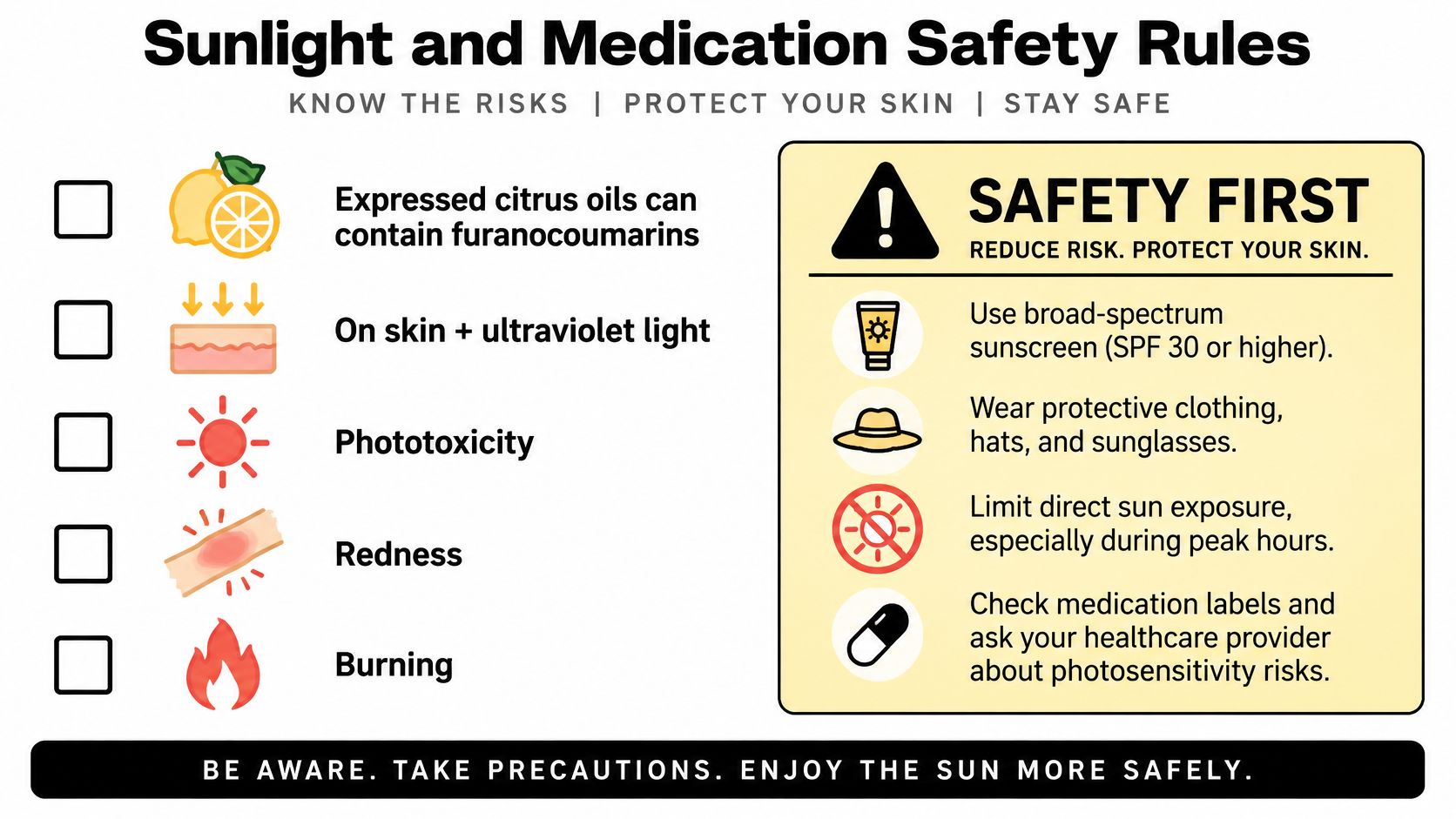
Format decides the sun rule
Format | Sun risk | Skin use | Oral use |
|---|---|---|---|
Expressed (cold pressed) | Contains furanocoumarins; phototoxicity possible after UV | Dilute; cover or avoid UV for at least 12 hours | Never swallow |
Steam-distilled | Generally lower phototoxicity; sensitive skin can still react | Dilute and patch test | Never swallow |
Room diffusion (either format) | Not a skin exposure | Not applicable | Not applicable |
Check the supplier's safety sheet. Avoid undiluted application. Follow that product's phototoxicity note. Steam-distilled grapefruit is generally the lower-phototoxicity option, yet sensitive skin can still react. Pregnancy, young children, and a known citrus allergy need personal advice before skin use.
Juice and pills are not the same as a diffuser
Grapefruit products can inhibit intestinal CYP3A4 and change concentrations of some medicines. That list includes some statins, some calcium-channel blockers, immunosuppressants, and other CYP3A4-sensitive drugs. Evidence for ordinary inhalation is much less direct. Swallowing concentrated oil is a different risk category from a 30-minute diffuse.
Don't ingest grapefruit essential oil. If you take a prescription medicine, ask a pharmacist before oral use or heavy topical use. You don't have to assume a short room diffuse is forbidden.
Diffuse for aroma, dilute for skin, never swallow, and read expressed or distilled on the label before you go outside.
Diffuse, Dilute, or Buy Fragrance Oil
Start with the job, then read the bottle. The three paths below keep aroma, skin, and craft scent from getting mixed up.
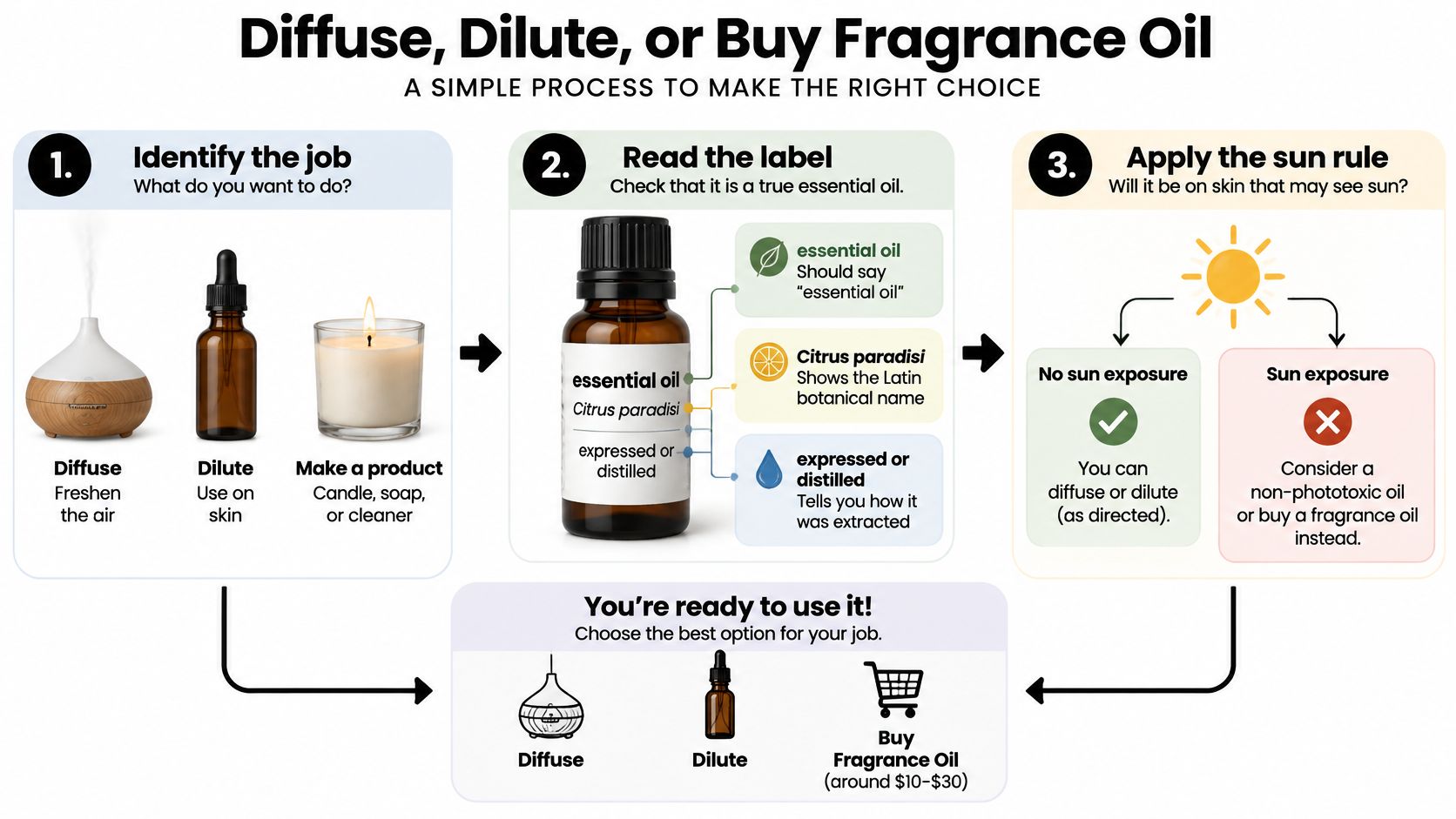
Read the label. It should say essential oil, Citrus paradisi, and expressed or distilled. Use that last word with the sun rule. If the bottle doesn't name the fruit and the method, don't guess.
Set a short room session. Add 3 to 5 drops to a water diffuser, run it 30 to 60 minutes, crack a window, and stop if anyone gets a headache. Match the mood-trial length. Don't run citrus all day in a closed shop or studio.
Dilute before skin. 0.5% for face or sensitive skin is about 3 drops in 30 mL of jojoba or fractionated coconut. 1% for arms and legs is about 6 drops in the same 30 mL, only when sun guidance allows.
Patch test. Put the blend on the inner forearm and wait 24 hours. Redness or itch means that blend stays off the body.
Keep the neat oil contained. Stay off eyes and broken skin. Don't use undiluted oil as a spot treatment, don't drip it on a hot lamp, and store it away from children and pets.
A morning diffuser might be 3 drops grapefruit with 2 drops lavender. A body oil for arms and legs might be 6 drops grapefruit in 30 mL jojoba, used when sun exposure fits the label.
The video below shows a simple inhale setup so the drop count stays visual.
Pick one product for one job
Diffuse essential oil for a mood-oriented routine. Dilute essential oil for skin. Buy a fragrance oil for soap, incense, or room spray. Fragrance oil is a different product. It isn't measured in essential-oil drops, and it shouldn't be described as clinical. The difference is laid out in fragrance oils and essential oils.
We pour fragrance oils fresh upon order, so a grapefruit-style room scent for soap or spray starts from a fresh fill rather than a bottle that has sat open on a shelf. Skip any product that promises fat loss from the scent alone, and never swallow grapefruit essential oil.
Dilution Amounts at a Glance
Percentages feel abstract until you tie them to one bottle size. Use 30 mL, about one fluid ounce, as the home unit. Count drops into the carrier, cap the bottle, and roll it between your palms. Don't stir with a finger.
Where it goes | Strength | Drops in 30 mL | Carrier example |
|---|---|---|---|
Face or easily reactive skin | 0.5% | 3 | Jojoba or fractionated coconut |
Arms, legs, general body | 1% | 6 | Jojoba |
A short bath, pre-diluted | 1% blend, then a spoon of that blend in the water | 6 in the 30 mL bottle first | Any light carrier |
Diffuser water | Not a skin percent | 3 to 5 drops in the reservoir | Water only, no carrier |
Why the face stays lower
Facial skin is thinner, and you're more likely to go outside afterward. A 0.5% blend still smells clearly of grapefruit in jojoba. Jumping to a body strength on the face doesn't make the scent "work better." It raises the chance of sting, and with expressed oil it raises the sun issue.
Body skin on arms and legs can usually take the 1% blend if the patch test was quiet. That's the bottle for a post-shower scent, not a slimming massage. If the label says expressed, cover the area or keep it out of UV for the window in the format table. Steam-distilled still gets a patch test.
A bath is not a neat pour
Never tip essential oil straight into a tub. Oil floats, and it can sit on skin undiluted. Mix the drops into the 30 mL carrier first, then add a spoon of that finished blend to the water. Skip baths entirely for young children unless a clinician has already set a plan.
What to do when a bottle smells off
If the oil smells like solvent or the blend irritates on the patch, stop. Citrus that's oxidized is a poor candidate for skin even at 0.5%. Keep the diffuser path, or switch to a fragrance oil for candles, soap, and spray, where you follow that product's own usage rate instead of essential-oil drop math.
Label the finished bottle with the date, the percent, and "expressed" or "distilled." Future you shouldn't have to guess before a sunny errand.
Frequently Asked Questions
1. What essential oils blend well with grapefruit essential oil?
Grapefruit essential oil blends well with lavender, bergamot, sweet orange, lemon, peppermint, rosemary, and cedarwood. Floral oils create a softer fragrance, while woody oils add depth to grapefruit's bright citrus character. Experiment with small quantities to find a balanced aroma that suits your preferences.
2. Can grapefruit essential oil be used in a reed diffuser?
Grapefruit essential oil can contribute a fresh citrus aroma to certain diffuser formulations, but it should not automatically be added directly to a reed diffuser. Reed diffusers require a compatible diffuser base that allows the fragrance to travel through the reeds. Check the oil and base manufacturer's compatibility recommendations before preparing a blend.
3. What is the difference between pink grapefruit and white grapefruit essential oil?
Pink and white grapefruit essential oils both come from the peel of Citrus paradisi. Their aroma profiles can differ slightly because of variations in their natural aromatic constituents. Pink grapefruit is commonly associated with a sweeter, fruitier citrus impression, while white grapefruit often has a sharper, more tart character. The actual scent depends on the fruit, extraction method, and oil composition.
4. How can grapefruit oil be incorporated into homemade potpourri?
Grapefruit fragrance can add a bright citrus note to homemade potpourri made with dried flowers, botanicals, wood pieces, and other decorative materials. Add fragrance sparingly to an absorbent material rather than pouring concentrated oil directly over delicate botanicals. Allow the fragrance to distribute before placing the potpourri in a decorative bowl. Keep scented materials away from children and pets.
5. What fragrance notes complement grapefruit in homemade room sprays?
Grapefruit pairs nicely with complementary citrus, herbal, floral, and woody fragrance notes. Lavender creates a softer aromatic profile, peppermint adds a crisp character, and sandalwood provides a warmer foundation. For homemade room sprays, choose fragrance ingredients specifically suitable for spray formulations and follow the manufacturer's recommended usage rates and compatibility instructions.
If you want the bright peel note in a diffuser ritual, a diluted body oil, or a fresh fragrance oil for soap and room spray, Aroma Warehouse carries the bottles, carriers, and diffuser gear to match the job. We pour fragrance oils to order and ship incense, oils, and aromatherapy supplies from Buckeye, Arizona, to customers across the United States. Visit Aroma Warehouse to pick a grapefruit-style scent for the exposure you plan to use.


