

Glass Bottles for Oils: The Complete Buyer's Guide

You're staring at a cart full of pretty amber bottles, a bulk jug of fragrance oil on the counter, and a first order due out Friday. That's exactly when most sellers discover the droppers don't fit, the labels slide off, or a citrus blend smells flat before it reaches the customer. Choosing glass bottles for oils isn't hard, but it isn't one decision either.
Glass became a trust signal long before it was a boutique look. During the 1890s, concern about adulterated food and cooking oil pushed the California olive-oil industry toward clear glass bottles that let buyers inspect the contents, tying transparent packaging to purity and origin according to Hagley's history of old bottles and packaging. That history still matters because your bottle sells confidence before anyone opens it. It also has to protect, seal, dispense, and survive shipping.
Table of Contents
Why Glass Bottles for Oils Are a Chain of Decisions - The Five Links You Have to Match
Amber, Cobalt, and Clear Glass and What Each One Protects - What Each Color Is Really For
Sizes and Neck Finishes That Actually Match - Pick Capacity by How the Oil Gets Used - Read the Neck Finish Like a Lock and Key
Chemical Compatibility and Storage That Protects the Oil - What the USP Glass Types Actually Tell You - Test Before You Commit
Cleaning, Sterilizing, and Labeling for Resale - A Routine Small Sellers Can Repeat - Labels That Survive Oil and Humidity
How to Choose a Bottle Supplier and Buy in Bulk - Three Realistic Buying Paths - Size the First Order Honestly
Why Glass Bottles for Oils Are a Chain of Decisions
A small seller orders a hundred bottles for a citrus-heavy fragrance oil, fills them on a Saturday, and ships Monday. By the time boxes land, two have leaked into the mailers and the bright top notes smell dull. The oil didn't fail. One weak link did, and it dragged the rest down with it.
Maybe the bottles sat in a sunny studio window. Maybe the dropper bulb softened in the fragrance, or the cap liner never sealed against the neck. On a product page, each part looked fine alone.
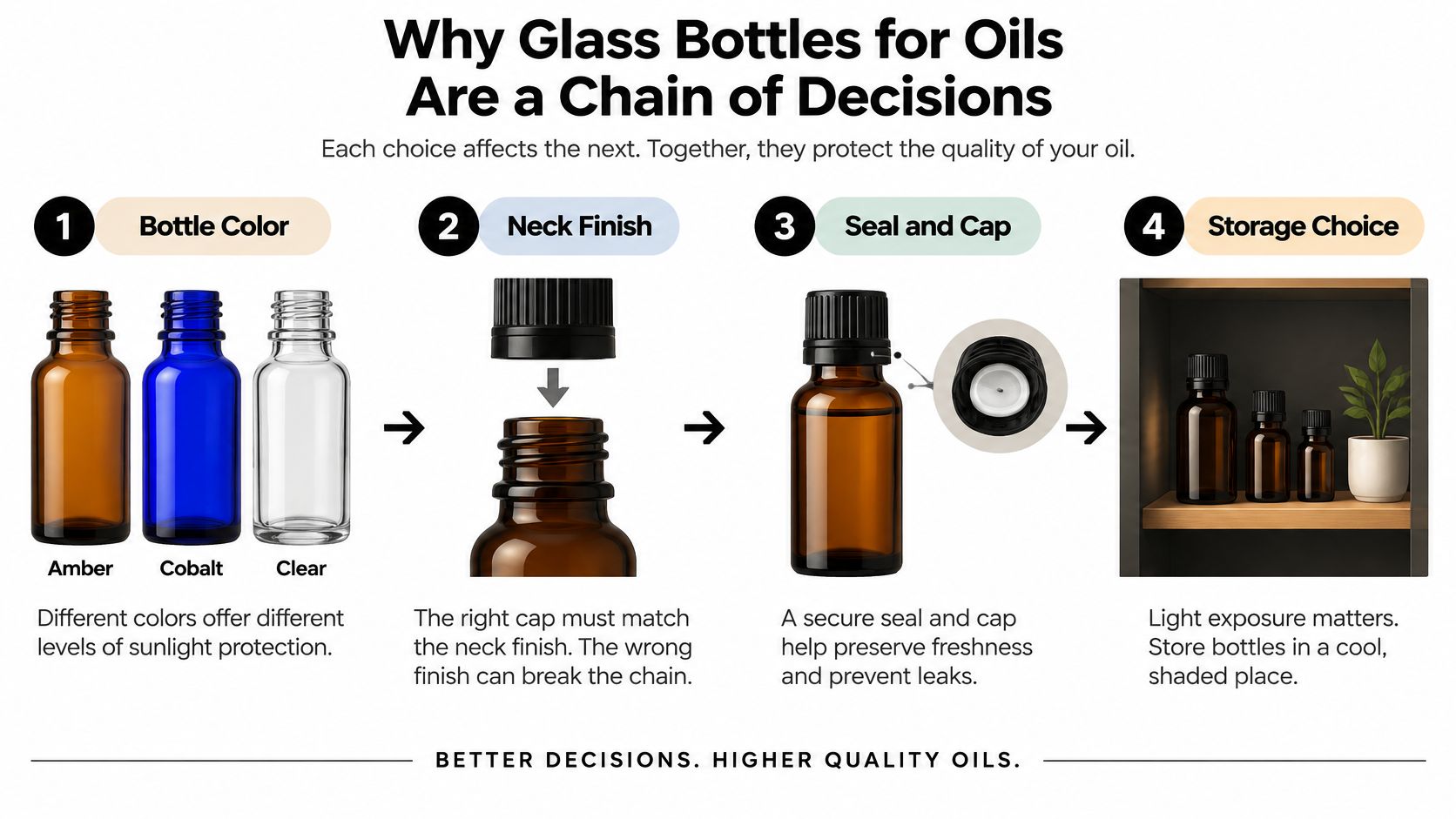
The Five Links You Have to Match
Think in sequence, not in singles. If you change one link, recheck the ones after it.
Glass color and type: Does the oil need light protection, and will the formula touch water or alcohol?
Size and neck finish: Does the capacity fit the use, and does the closure thread match exactly?
Closure and dispensing: Dropper, pump, orifice reducer, or sprayer, picked for viscosity and dose, not looks.
Compatibility and storage: Will the liner, bulb, and oil get along for months in a warm stockroom?
Cleaning, labeling, and shipping: Can you wash it, label it so the label stays, and pack it so it arrives intact?
Practical rule: don't buy a case of bottles and a case of closures from two listings on the same hopeful guess. Fill, cap, label, and ship one test unit first.

That test costs almost nothing. A mismatch costs a batch, a refund, and a review that says the bottle leaked everywhere, which customers read as a product problem even when it's a packaging problem.
Order parts as a system. When the glass, neck, closure, liner, label, and box all agree, you'll stop troubleshooting shipments and start scaling them. When they don't, no single upgrade, not even a pricier bottle, will save the run.
Amber, Cobalt, and Clear Glass and What Each One Protects
Light doesn't just fade a label. Ultraviolet and visible radiation trigger photo-oxidation, which increases peroxide formation and alters aroma, color, and flavor compounds in oils. Bottle color slows that process. It doesn't stop it outright.
A five-week sunlight study of extra-virgin olive oil makes the difference concrete. Samples in clear glass showed significantly higher free-fatty-acid values, peroxide values, and K270 absorbance than samples in amber or foil-covered glass, and they lost more chlorophyll, carotenoids, and phenolics while producing more acrolein, as reported in the Food Science and Technology Research study on sunlight exposure. Covered glass prevented detectable deterioration. Amber glass gave only partial protection under direct sunlight.
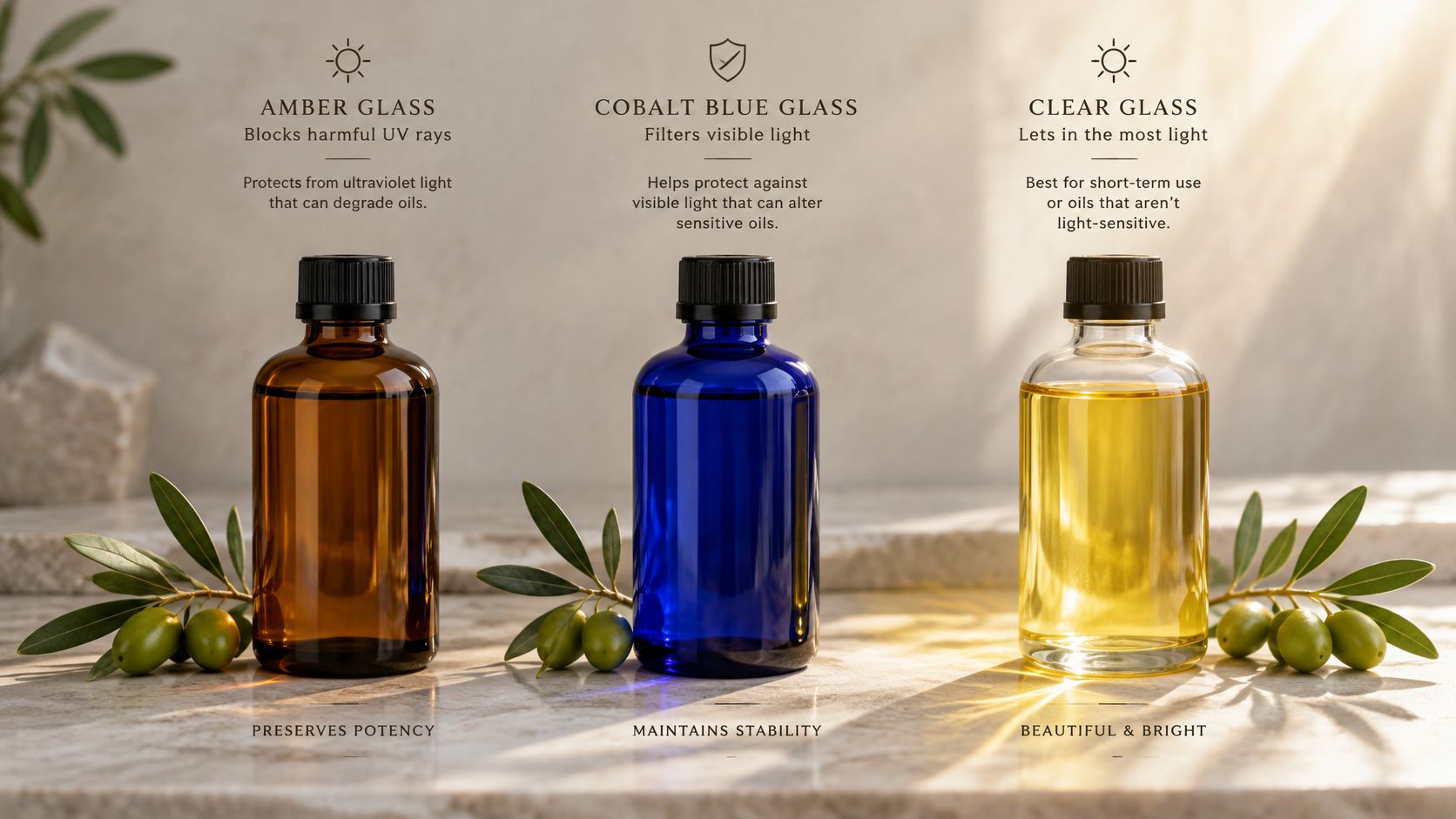
What Each Color Is Really For
Amber is the sensible default for light-sensitive fragrance, essential, and carrier oils. It cuts a useful share of incoming light, reads as professional on a shelf, and pairs with almost every closure family. Treat it as a strong filter, not a vault.
Cobalt blue stands out in photos and on crowded shelves, and it does reduce light compared with clear glass. It still transmits some light, so don't assign it the same job as a closed carton. Use it when branding matters and the oil won't live on a bright counter for months.
Clear glass is a presentation choice, and there's nothing wrong with admitting that. It shows color beautifully, which helps for gifts, samples, and oils you'll sell and use quickly. The trade-off is exposure, so clear bottles belong in boxes, cabinets, or fast-moving retail, not in a shop window.
Amber in direct sun is still oil in direct sun. Move the bottle, box it, or accept a shorter-quality life.
For long shelf life, pair low-transparency glass with opaque secondary packaging. A simple outer carton often protects better than arguing over shades of tint. Keep filled stock away from display windows, use smaller sizes when customers will take months to finish a bottle, and rotate older stock forward. Color helps, but your storage habits decide whether that help is enough.
Sizes and Neck Finishes That Actually Match
Most ordering mistakes happen in two fields on a listing, capacity and neck finish. Get those right and most of your returns disappear. Get one wrong and nothing else about the bottle matters.
Pick Capacity by How the Oil Gets Used
Small formats around 5 ml, 10 ml, and 15 ml suit samples, discovery sets, travel sizes, and potent essential oils that customers use drop by drop. A 30 ml or 1 oz bottle is the workhorse retail single for fragrance oils, blends, and facial oils. Larger 2 oz and 4 oz bottles suit carrier oils, massage blends, refills, and back-bar use in spas and studios.
Bigger isn't automatically better value. A large bottle a customer opens daily for months holds more air as it empties and sits around longer. If your oil is delicate, a smaller Glass Bottles for Oils format they finish sooner often delivers a better experience than a bargain size.
Read the Neck Finish Like a Lock and Key
A neck finish such as 18-400 isn't decoration. The first number is the neck diameter in millimeters. The second number describes the thread style.
Match both numbers: An 18-400 bottle needs an 18-400 closure, dropper, or pump.
Don't eyeball it: A 15 ml bottle with a 13-415 neck won't take a standard 18-400 dropper, however close it looks.
Check pipette length separately: Even with the right thread, a dropper cut for a short bottle won't reach oil in a tall one.
Shop habit: buy the bottle and closure together, from the same supplier, in the same order, until you've proven that pairing.
Shape and wall thickness matter after fit. A straight-sided Boston round gives you a generous, flat label panel and fills quickly on a small funnel setup. Slim or tapered bottles look elegant but can slow filling, shrink your label area, and concentrate stress in transit. Thicker walls feel premium and resist bumps, yet they add shipping weight. Choose the shape that serves your fill line, label, and mailer first, then worry about shelf drama.
Droppers, Pumps, and Orifice Reducers Compared
Customers remember the closure every time they use your oil. They forget the bottle shape. Pick dispensing for viscosity and dose control first, appearance second.
Droppers suit essential oils and precise blending, where a customer counts drops into a diffuser or carrier. The parts that fail are the rubber bulb, which can swell or crack with aggressive fragrances, and a pipette that's too short for the bottle. Squeeze-test the bulb after it has sat in your actual oil, not just in water.
Pumps suit carrier oils, massage blends, and lotions. They give a measured dose without fingers touching the product, which spas and studios appreciate. Thin fragrance oils can dribble or mist unpredictably through a pump meant for something thicker, so test your exact viscosity.
Orifice reducers are the quiet bargain. The small insert in the neck lets thin liquids out drop by drop and costs little. They're ideal for fragrance oils poured by the drop and for bottles shipped under a sealed cap. They frustrate customers who want a faster pour, so say so on the listing.
Sprayers suit room and linen sprays, which are usually alcohol- or water-based. That changes the conversation about glass, liners, and testing because you're no longer packaging a neat oil. Don't borrow a sprayer setup from an oil product without retesting.
Closure | Best for | Typical bottle size | Main risk |
|---|---|---|---|
Essential oils, counted-drop blending | 15 ml, 30 ml | Bulb swelling, short pipette | |
Carrier oils, massage blends | 2 oz, 4 oz | Dribbling with thin liquids | |
Fragrance oils, thin liquids | 10 ml, 15 ml, 30 ml | Slow pour for impatient users | |
Room and linen sprays | 2 oz, 4 oz | Wrong liner for alcohol or water bases |
The liner, the thin disc inside a cap, is where leaks are born. If it swells, softens, or doesn't seat against the neck, oil will find the threads during a warm truck ride. Reviewing the main bottle cap types and how they seal before you order closures separately will save you from mixing a pretty cap with the wrong seal.
Usage questions also shape dispensing choices. A customer asking about oregano oil drops during pregnancy is really asking about dose control and safety context, which is a useful reminder that droppers imply precision. Don't sell that implication unless your closure actually delivers consistent drops.
Chemical Compatibility and Storage That Protects the Oil
Glass looks inert, and for neat oils it mostly behaves that way. The failures usually start at the closure, the liner, or in a formula that isn't purely oil anymore.
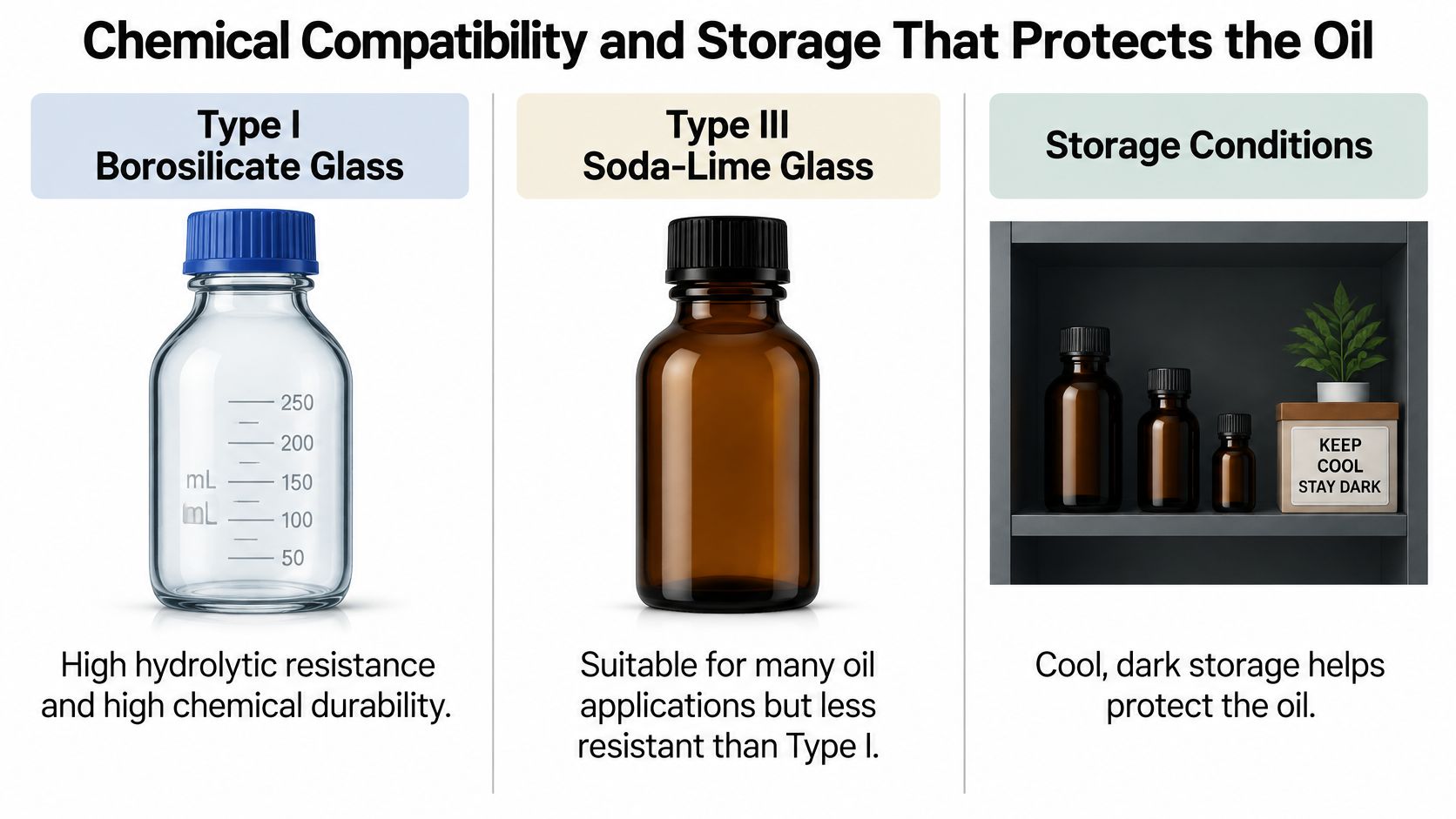
What the USP Glass Types Actually Tell You
USP classifications distinguish Type I borosilicate glass, with high hydrolytic resistance and high thermal-shock resistance, from Type III soda-lime-silica glass, which has moderate hydrolytic resistance that an appropriate inner-surface treatment can raise to high, as defined in USP glass container classifications. Hydrolytic resistance measures how strongly glass resists releasing alkaline constituents into an aqueous test medium.
That's most directly relevant to water-containing or pharmaceutical formulations, not neat hydrophobic oils. Any seller handling aqueous lab liquids should understand separate materials such as bacteriostatic water on their own terms and not treat them like oil. For routine fragrance and carrier oils, a clean, defect-free interior and a compatible closure matter more than chasing a lab-grade specification.
Pay for Type I when you've got thermal cycling, aggressive formulations, water, alcohol, salts, or other polar ingredients in the mix. Room sprays are a good example, which is why the packaging thinking behind making room sprays with fragrance oils differs from a neat oil fill. Type III is practical for ordinary oil packaging when your formula and closure system have proven compatible.
Don't upgrade the glass and ignore the liner. In daily packing, the liner loses more batches.
Test Before You Commit
Storage is part of the packaging system, not an afterthought. Direct sunlight can degrade oil even in amber glass, so cartons, closed cabinets, and cool stockrooms do real protective work. Keep filled bottles away from heat vents and delivery-truck hot spots in summer.
Before a large order, run three checks on your actual formulation. Do a leak test with bottles on their sides, an odor check after the filled bottle sits closed, and a short stability check in the warmest place your stock will realistically sit. If scent, color, or the bulb changes, change a part now while it's cheap.
Cleaning, Sterilizing, and Labeling for Resale
New bottles aren't automatically ready to fill. They carry dust from manufacturing and packing, and reused bottles carry whatever your last blend left behind. A repeatable routine beats a heroic one you skip when orders pile up.
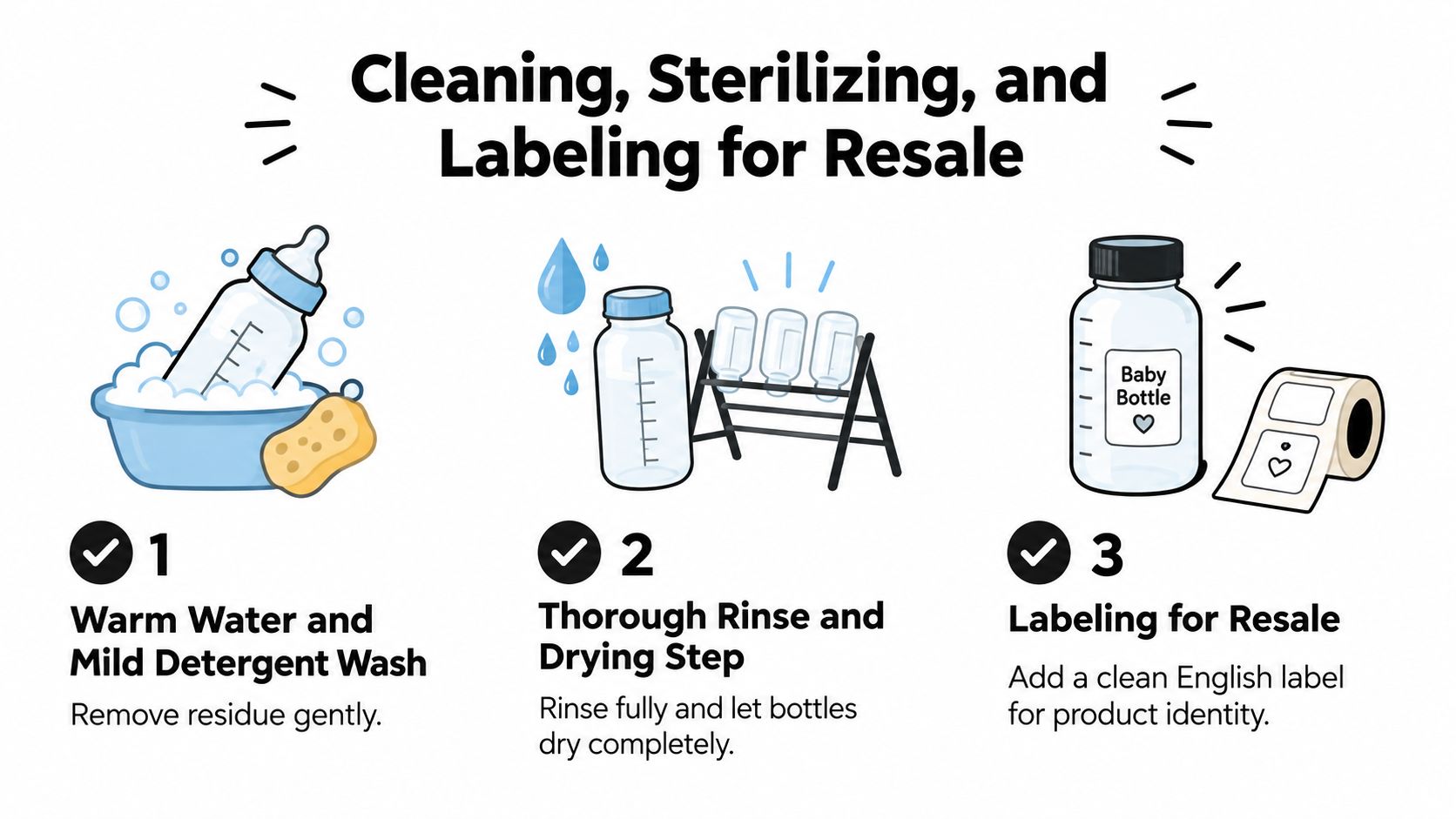
A Routine Small Sellers Can Repeat
Wash warm, rinse thoroughly: Use warm water and mild detergent, then rinse until no residue remains.
Dry completely: Air-dry upside down on a clean rack. Trapped moisture is the fastest way to cloud a neat oil.
Inspect before filling: Reject chips, cracks, and bottles that still smell of the previous product.
Most fragrance and aromatherapy products don't need pharmaceutical-grade sterilization. Be more careful with water-based or skin-contact products, and respect the glass type before using heat methods. Thermal shock cracks the wrong bottle faster than any customer will.
Labels That Survive Oil and Humidity
Oil finds label edges. It always does. Choose a label material and adhesive that tolerate oil contact and a humid bathroom or stockroom, and confirm your bottle's flat panel fits the text you've got to print. Review fragrance labeling requirements before you print a full run so a design reprint doesn't eat your margin.
Add a batch or fill date, even if you're small. When a customer reports a dull scent, that date tells you which production day, oil lot, and storage shelf to check. Without it, you're guessing across every bottle you've ever sold.
At end of life, tell customers to remove droppers and caps before recycling. Small oil bottles enter the broader container-glass system, and practical recyclability depends on collection access, color sorting, closures, labels, and contamination. A clean bottle with the closure off has a far better chance than a sealed one tossed in whole.
How to Choose a Bottle Supplier and Buy in Bulk
Unit price is the easiest number to compare and the least useful one. A cheap bottle that arrives with the wrong neck, late, or packed so poorly that a corner of the case is chipped costs more than the quote you turned down.
Three Realistic Buying Paths
A general packaging distributor gives you range. You'll find dozens of shapes and closures, but you're often on your own matching neck finishes and minimums across separate lines. That works once you know your exact specification and don't need guidance.
A specialty aromatherapy supplier narrows the range to what oil sellers actually use. Bottles, droppers, and reducers are more likely to be stocked as working pairs. For related stocking decisions, browsing wholesale supplies planned for gift shops shows how packaging sits alongside the finished goods it supports.
A direct import order can lower unit cost at real volume. It also brings longer lead times, larger minimums, and expensive corrections when a thread or tint arrives off-spec. Most small sellers aren't ready for that risk on their first bulk buy.
One concrete option in the specialty category is Aroma Warehouse, a Buckeye, Arizona based online retailer and wholesaler supplying glass bottles, droppers, DPG solvent, unscented incense sticks, and other repackaging supplies. It offers retail and wholesale pricing with no business license required and ships throughout the domestic U.S. and territories. Those details matter if you're a new reseller who can't meet a distributor's account requirements yet.
Size the First Order Honestly
Compare landed cost, not shelf price. Add freight, expected breakage, closures, labels, and the outer box to every quote. Heavy glass makes freight a real line item, and shipping distance can erase a unit-price win.
Order samples first: Fill, cap, label, and mail one to yourself before buying a case.
Buy one selling cycle, not a fantasy year: Tie quantity to proven sales, plus a modest buffer.
Keep closures matched in stock: Running out of the right dropper while bottles sit full helps nobody.
A sample that fails is a bargain. A case that fails is inventory you'll look at for months.
Glass's environmental story also belongs in a bulk decision. Container glass is about 48% of roughly 130 million metric tons of annual global glass production, yet only about 32% of container glass is recycled globally, with the U.S. at a 31.3% rate in 2018, according to the Environmental Engineering Research review of glass recycling. Recyclable doesn't mean recovered. Buy formats your customers will reuse or recycle, not just the heaviest bottle in the catalog.
Your Pre-Order Checklist for Glass Oil Bottles
Run this list before money moves. It takes minutes and prevents the expensive kind of learning.
Oil and light: Is it light-sensitive, and did you pick amber or another low-transparency glass plus a carton?
Capacity and neck: Does the size fit the use, and does the closure match the exact neck finish?
Closure and liner: Did you test the dropper, pump, or reducer and liner in the actual oil?
Glass type: Is the formula a neat oil, or does water, alcohol, or heat justify a higher specification?
Storage and shipping: Have you planned dark, cool storage and a mailer you've drop-tested?
Cleaning and labeling: Are the wash routine, label stock, and batch date decided before bottles arrive?
Be honest on sustainability. A heavier glass bottle shipped empty and discarded after one use may not deliver the benefit buyers assume, a trade-off the EU Packaging and Packaging Waste Regulation 2025/40, in force since February 11, 2025, pushes brands to consider across recyclability and reuse, as summarized in the European Commission packaging waste overview. A durable bottle refilled many times is a different story. For sourcing discipline beyond bottles, review a structured approach to product sourcing, then order a small sample set and test the full chain before bulk.
Frequently Asked Questions About Glass Bottles for Oils
1. How many glass oil bottles should a small business order for its first inventory purchase?
Start with enough bottles for one proven sales cycle, plus a modest reserve for replacements and unexpected orders. Estimate your average monthly sales, consider supplier lead times, and test a small batch before committing to a large quantity.
2. Can the same glass bottle be used for different fragrance oil scents?
Yes, provided the bottle is thoroughly cleaned, completely dried, and inspected before reuse. Residual fragrance can contaminate a new scent, so use dedicated bottles for different formulas when cross-contamination could affect product quality.
3. What should sellers include on glass fragrance oil bottles for retail customers?
Depending on the product and applicable regulations, labels may need the product identity, net contents, business information, ingredient details, directions, and relevant safety warnings. Check the requirements for your specific formulation and intended use before printing labels.
4. How can online sellers reduce breakage when shipping glass oil bottles?
Use a secure closure, protect each bottle with suitable cushioning, separate glass items so they cannot collide, and choose a sturdy shipping carton. Test a fully packed order before shipping at scale, and assess whether additional leak protection is needed.
5. Is glass packaging a good choice for fragrance oil sample sets?
Glass can work well for sample sets because it presents the fragrance professionally and allows customers to try several scents in smaller quantities. Choose a suitable capacity, compatible closures, and protective packaging, and consider amber glass for formulas that need additional light protection.
Browse glass bottles, matching droppers, and repackaging supplies, then order a small sample set to fill, cap, label, and ship-test with your own oil before you commit to a case. When that test unit arrives intact and smells right, scale the same exact pairing with confidence at Aroma Incense Warehouse.


