

Sea Salt in Bulk: A Buyer's Guide for Spas and Retailers

A spa owner comparing two sea salt quotes usually starts with price per pound. One supplier offers a finer crystal in a compact bag; another quotes a lower price for a coarser product shipped in a larger container. Then the practical questions surface: Is it suitable for bath use? Can it be repackaged? Does “unscented” mean food-safe? And what paperwork will arrive with the order?
Those aren't side issues. Sea salt in bulk is a purchasing decision about grade, intended use, documentation, packaging, and storage, not just a way to lower ingredient costs. Before you send payment, make sure the supplier can identify what the salt is, which uses it's intended for, and how the lot is documented.
Table of Contents
Why Buyers Are Stocking Up on Sea Salt in Bulk - Treat a bulk quote as a specification
Understanding Sea Salt Grades, Grain Size, and Composition - Match the crystal to the product - Read the numbers that affect handling
Matching Salt Grade to Intended Use - Compare the use case before ordering
Packaging Formats and Minimum Order Quantities - Choose a format your operation can manage
Reading a Certificate of Analysis and Asking the Right Questions - Check the product data, not just the headline purity - Ask directly about microplastics
Pricing Structures and the True Cost of a Quote - Compare equivalent orders
Storage, Humidity Control, and Stock Rotation - Set up storage before delivery
Labeling, Compliance, and Final Buyer Checklist - Buyer questions answered
Why Buyers Are Stocking Up on Sea Salt in Bulk

A small spa might use salt in back-bar treatments and retail bath soaks. A gift shop may
want a simple, giftable product under its own label. An online seller might be comparing bulk bags and wondering whether a product described as “natural sea salt” can be offered as edible salt. Each buyer has a different use, and the wrong grade can create a costly problem after the shipment arrives.
Buying a larger quantity can make sense when you already know how the salt will be used and how quickly you can move it. But the order changes the work. You're no longer choosing a finished retail bag with a consumer-facing label. You're responsible for checking specifications, arranging storage, planning any repackaging, and confirming that the supplier can maintain the same product characteristics when you reorder.
The market is large, but that doesn't mean every salt product is interchangeable. The U.S. Geological Survey's salt summary estimates that global salt production reached about 270 million metric tons in 2023. That total includes salt made through several methods, not just seawater evaporation. It's a useful reminder that sea salt is one category in an established commodity market, while a buyer's needs may be specific to grain size, moisture, processing, and intended use.
Treat a bulk quote as a specification
When you move from small retail quantities to larger commercial orders, compare more than the unit price. Ask what the quote includes, how the product is packed, whether the salt is sold for bath or food use, and what batch-specific documentation comes with it. A quote that leaves those questions unanswered isn't ready for approval.
Start by writing down the product's job. Will staff scoop it into a treatment bowl? Will customers pour it into bathwater? Will you package it for sale? Each answer affects the grade and documents you need. Don't buy a bulk product first and decide its use later.
Understanding Sea Salt Grades, Grain Size, and Composition
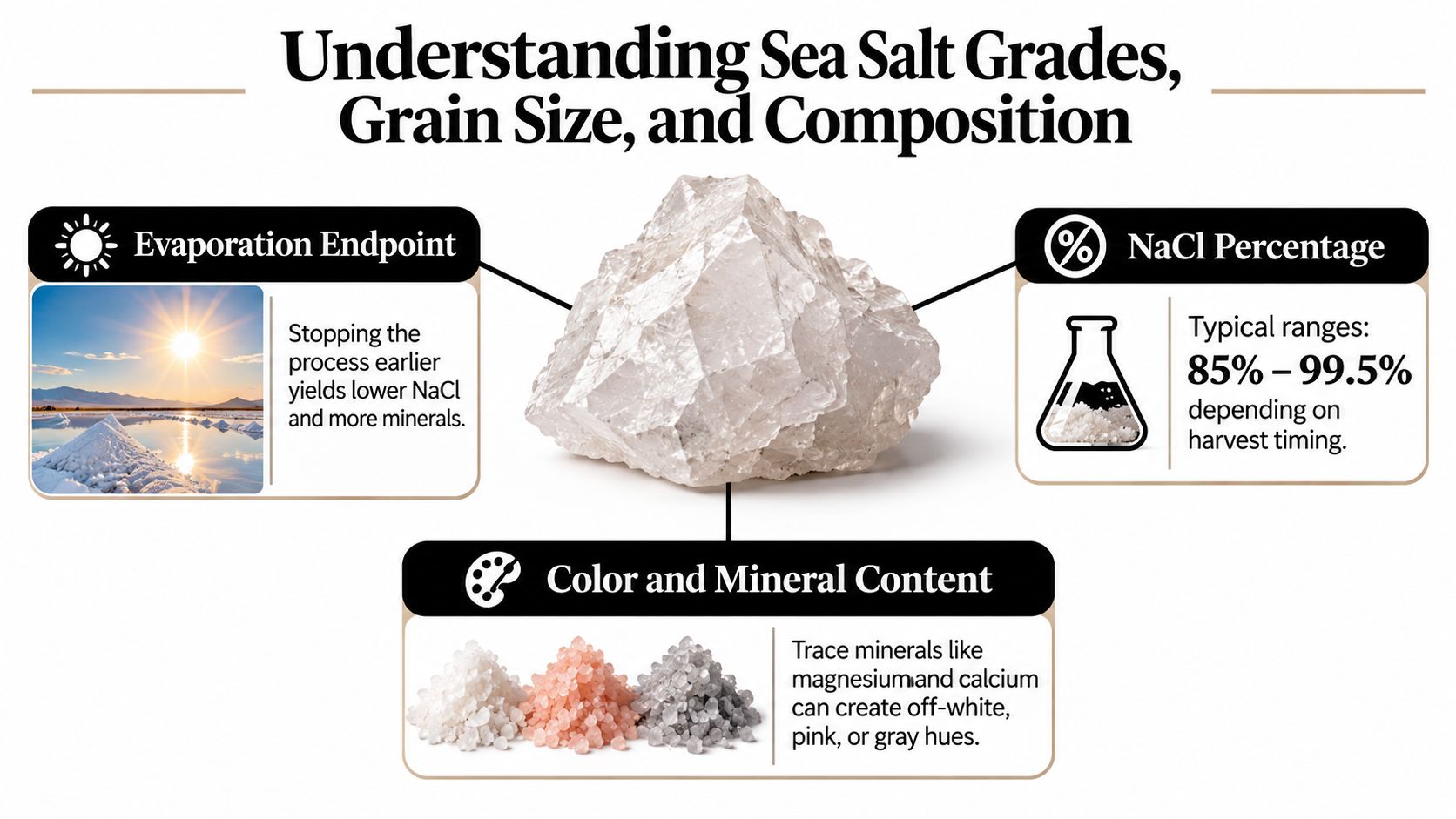
Two products labeled “sea salt” can look similar in a listing but behave differently in a bath or package. The evaporation endpoint, processing, and grain size influence the salt's sodium chloride content, moisture, mineral composition, and handling. That's why a generic product name isn't a purchasing specification.
Salt produced through staged evaporation typically reaches at least 94.7% sodium chloride, while the balance consists largely of minerals such as magnesium, calcium, sulfate, and potassium, along with residual moisture. The technical research on evaporated sea salt explains why a buyer should request the actual composition rather than assume that all sea salt has the same purity.
Match the crystal to the product
Fine grains dissolve quickly and can suit products where a smooth appearance and easy mixing matter. Medium grains are a common practical choice for bath soaks because they're straightforward to scoop and package. Coarse crystals can work in grinder-style products or decorative layers, but they take up more space and dissolve differently. Flake salt has a distinct shape and texture, so don't assume it will substitute cleanly for a conventional granule.
Request the supplier's particle-size distribution, not just a description such as “fine” or “coarse.” Grain consistency affects appearance, scoopability, dissolution, and how much product fits into a container by volume. If you're comparing sources, use samples in the exact jar, pouch, or treatment setup you plan to use.
Read the numbers that affect handling
Moisture and insoluble matter tell you something about how the salt may perform in packaging and in water. Residual magnesium and calcium salts attract moisture from the air, which can increase caking risk. Bulk density also matters when you package by volume: the same container can hold different weights if the product's density varies.
A technical specification for a particular sea salt reports 0.05% surface or interstitial moisture, 0.02% water-insoluble matter, and a bulk density of 1,060–1,120 g/L. Those figures describe that product, not a universal standard. Use them as examples of the measurable information a supplier can provide, not as automatic pass-or-fail limits for every application. For a broader comparison of seawater-derived salts, see this guide to Dead Sea salt and evaporated sea salt.
Matching Salt Grade to Intended Use
The word “unscented” only tells you that a product isn't scented. It doesn't establish that the salt is suitable for food, approved for a particular cosmetic use, or ready to be repackaged under your own label. Grade follows intended use. Confirm the supplier's intended-use statement before you place an order.
For bath or cosmetic products, ask for specifications and documentation appropriate to that use, and don't describe the salt as edible unless the supplier has established it as suitable for food resale. Culinary resale needs food-grade documentation and labeling that fits the jurisdiction where you'll sell. Private-label culinary products need even more coordination: confirm the product identity, ingredient declaration, iodine status, lot traceability, and who is responsible for reviewing the finished label.
Repackaging for crafts, rituals, or decorative products still needs accurate product claims. A salt sold for bath use shouldn't become a food product because it's clean-looking or has no added fragrance. Likewise, premium origin or mineral language doesn't replace proof of grade.
Compare the use case before ordering
Use Case | Acceptable Grade | Key Documentation | Label Notes |
|---|---|---|---|
Bath or spa use | Supplier-designated bath or cosmetic grade | Lot identification, composition, moisture, and relevant contaminant information | State the actual intended use; don't imply food suitability |
Food resale | Supplier-designated food grade | Food-use documentation, lot traceability, and applicable safety records | Check iodine disclosure and local labeling requirements |
Private-label culinary product | Food grade approved for the planned product | Lot-specific documents and label information from the supplier | Confirm ingredient wording, iodine status, and jurisdictional rules |
Craft or ritual repackaging | Grade appropriate to the product and claims | Product identity and lot records | Avoid edible, cosmetic, or purity claims you can't substantiate |
Label terminology matters. The Canadian Food Inspection Agency's salt-labeling guidance distinguishes “sea salt” from “sea salts”; the latter can refer to a mixture of sodium chloride and other mineral salts and doesn't have to meet the same standard or be iodized. The verified U.S. guidance also distinguishes iodine disclosures for salt sold for human food use, so check the rules that apply to your product and market rather than borrowing a label from another seller.
For products used on skin, the salt grade is only one part of the finished product decision. This exfoliator guide from Spa Black offers context on choosing exfoliation products for facial use. For bath-specific product ideas, review sea salt bath benefits and uses. If you plan to put the salt in a jar and call it a product, know the grade, the intended use, and the label requirements first.
Packaging Formats and Minimum Order Quantities
Packaging changes the economics and the work involved in a bulk order. A small pail is easier to handle and store than a large drum, but it may cost more per pound. A poly bag can be a practical supply format for repackaging, while a lined drum or larger container may suit a buyer with suitable storage and filling equipment. Don't confuse the supplier's shipping container with the package your customer will buy.
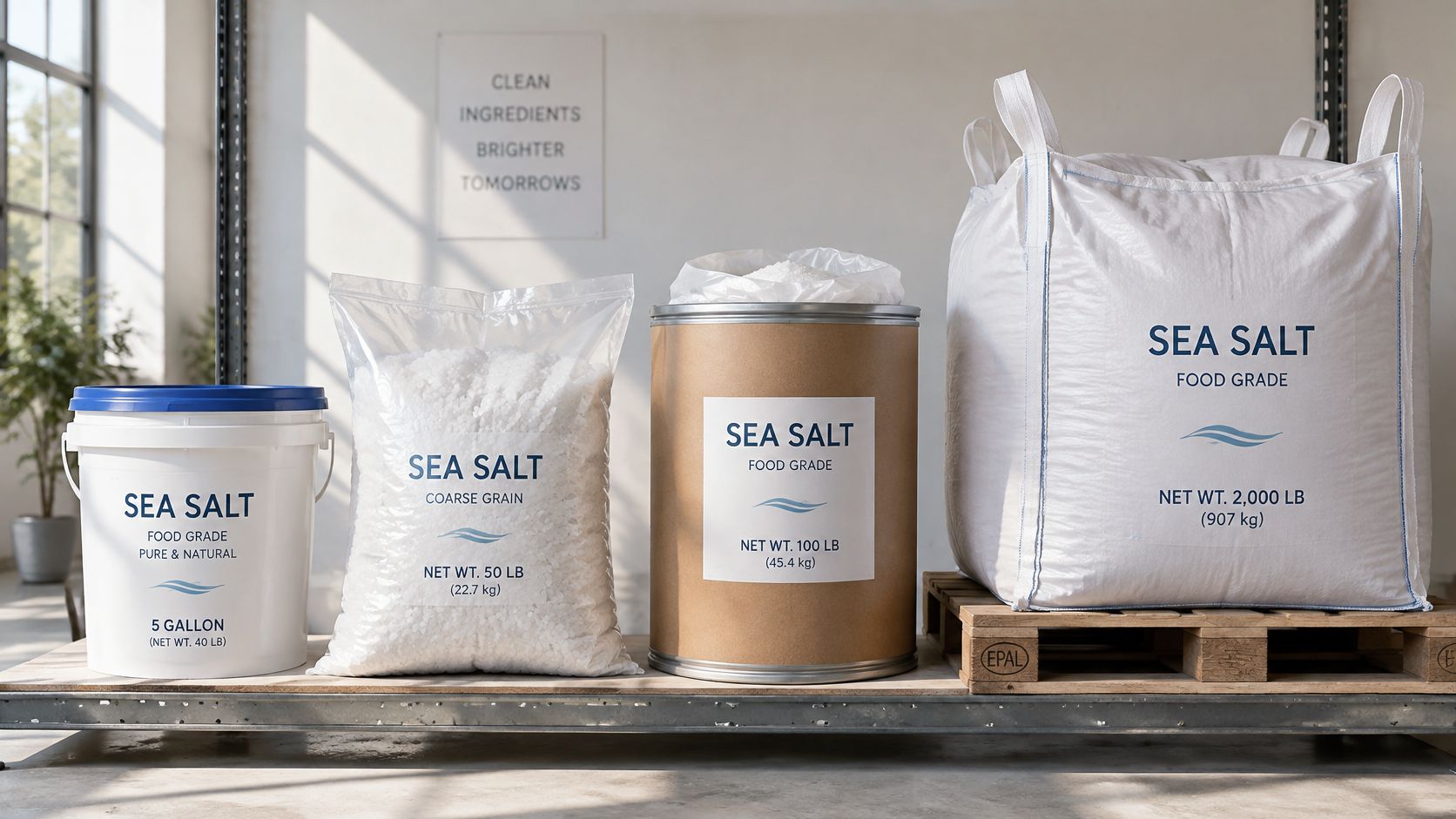
A jar or stand-up pouch may look right on a retail shelf, but it doesn't necessarily make sense as the inbound bulk format. First decide whether you need ready-to-sell packaging or raw material that your team will portion. Then check closure quality, liner compatibility, ease of filling, and how well the container protects the salt from humidity after opening.
Choose a format your operation can manage
A small pail can be convenient for a spa that needs a manageable back-bar container. Bags can be simple to store and portion, but they need a reliable resealing process once opened. Fiber drums with appropriate liners offer a more substantial container, while palletized loads or supersacks require adequate receiving space and equipment. Ask the supplier how each option affects freight, packaging charges, and the condition in which the product is shipped.
Minimum order quantities vary by supplier and product. Don't accept a number as a universal rule. Instead, estimate how much you can use or sell before the salt's condition becomes a concern, then compare that amount with the supplier's minimum and the delivered cost. For a first order, a smaller quantity can be worth paying more per pound if it lets you test the grain, handling, customer response, and repackaging workflow.
Aroma Warehouse offers retail and wholesale purchasing for bath products, including unscented sea salts, without requiring a business license. Treat that as one purchasing option, and still confirm the specific product's grade, available packaging, and supporting documents for your use. If you're filling retail pouches, this overview of resealable stand-up bags for wholesale bath salts can help you think through the customer-facing package separately from the bulk container.
Use this video as a prompt to review how your own receiving and repackaging workflow will handle bulk material.
Reading a Certificate of Analysis and Asking the Right Questions
A product page describes what a supplier wants to sell. A certificate of analysis (COA) gives you measurable information about a specific product or lot. Ask for the COA before payment, and check whether it identifies the material you're buying rather than presenting a generic sheet with no clear connection to the order.
Check the product data, not just the headline purity
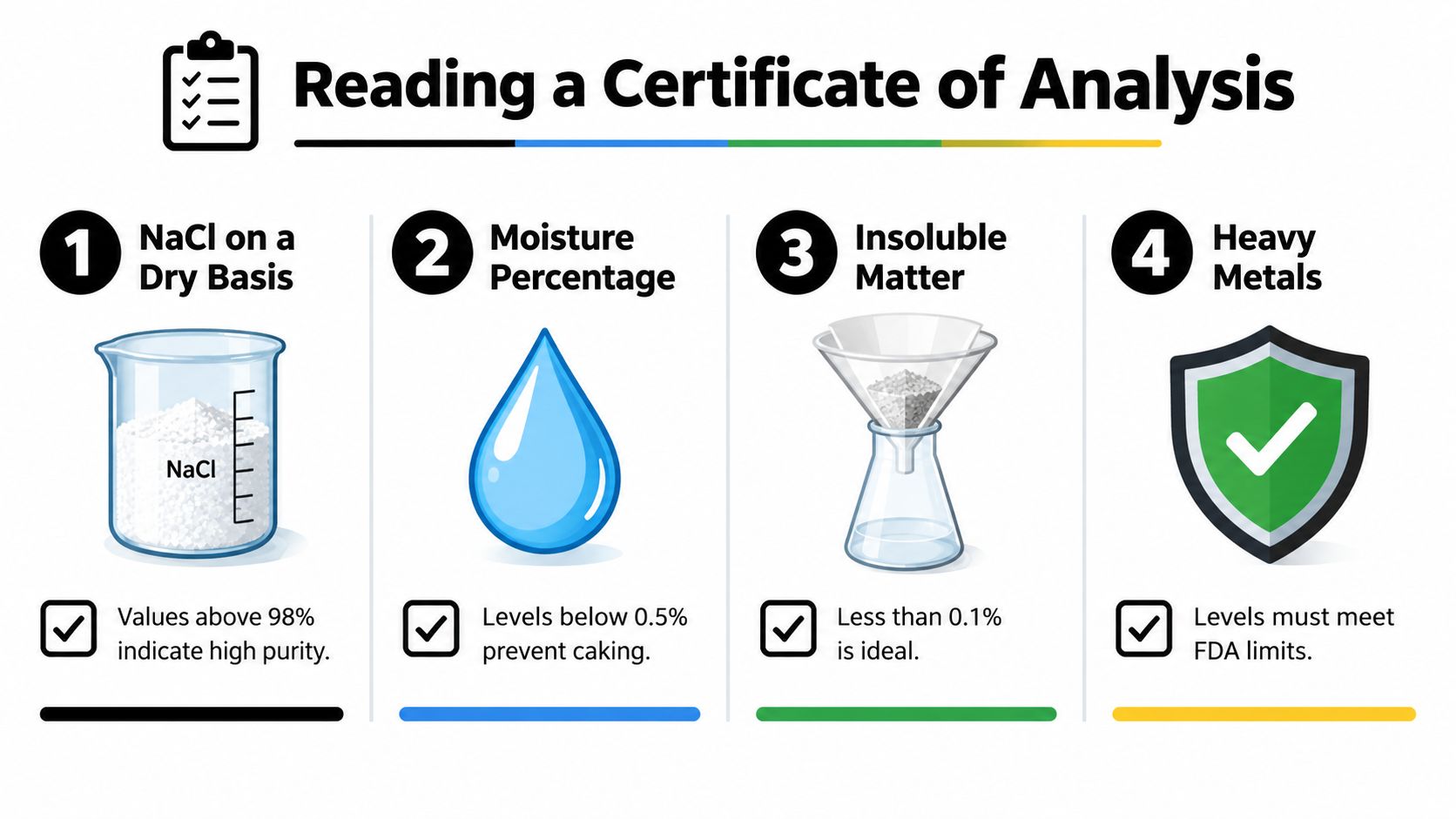
Request NaCl on a dry basis, moisture, water-insoluble matter, and bulk density. Dry-basis NaCl helps distinguish salt content from the effect of moisture. Moisture and insoluble matter help you assess handling and appearance, while density helps you forecast fill weight when you package by volume.
Don't treat a sample specification as a universal threshold. One technical document reports approximately 99.6% NaCl, 0.05% surface or interstitial moisture, and 0.02% water-insoluble matter for a particular product. It also lists arsenic at or below 1 ppm. These are examples of information to request, not blanket requirements for every grade or use. The sea salt technical data sheet shows the kind of defined specification a buyer can review.
For cosmetic and food applications, ask for lot-specific heavy-metal and microbiological documentation, and confirm that the testing suits the intended use. Ask who conducted the tests, what lot they cover, and whether the supplier can provide the underlying results. For help building a sourcing process, use this practical guide to product sourcing.
Frequently Asked Questions about Sea Salt 1. How can I compare bulk sea salt suppliers before placing a wholesale order?
Compare suppliers by product specifications, intended-use documentation, lot traceability, packaging options, minimum order quantities, and total delivered cost. Request a written quote and product-specific certificate of analysis (COA) so you can evaluate equivalent products rather than comparing price per pound alone.
2. What grain size of sea salt works best for retail bath soak packaging?
The best grain size depends on your packaging, product appearance, and customer preferences. Fine grains dissolve quickly, while medium grains are practical for scooping and filling many bath soak containers. Test a sample in your intended packaging before committing to a large order.
3. How can retailers keep bulk sea salt from hardening during storage?
Store sea salt in sealed, moisture-resistant containers away from damp areas, sinks, and open doors. Keep containers off the floor, reseal opened packaging promptly, and use first-in, first-out inventory rotation. Follow the supplier’s storage recommendations for the specific product.
4. What information should a wholesale sea salt supplier provide for product traceability?
Ask for the product identity, lot or batch number, composition specifications, intended-use designation, and a certificate of analysis tied to the relevant product or lot. For cosmetic or food applications, request appropriate contaminant and microbiological documentation based on the intended use.
5. Can retailers sell bulk bath sea salt in smaller customer-ready packages?
Retailers may be able to repackage suitable bulk bath salt into smaller containers, but they should confirm the product’s intended use, applicable labeling requirements, and any relevant handling or packaging obligations first. Bath-grade salt should not be marketed as edible salt without documentation supporting food suitability.
Ask directly about microplastics
A 2025 peer-reviewed study tested 20 salt brands in Bali and found microplastics in every sample, with an average of 173 ± 119 particles per kilogram. The study also reported different averages for local and non-local salts. Those findings describe the tested products in that regional study; they don't establish the contamination level of every bulk salt lot worldwide or prove a specific health effect. Review the 2025 study on microplastics in salt with that scope in mind.
Ask suppliers whether recent microplastic testing exists, what sampling method and detection limits were used, where the material was sourced, and what washing or filtration controls are in place. If they can't provide the requested data, don't fill the gap with a “pure” or “contaminant-free” claim. If a supplier can't connect a document to the product and lot being quoted, treat the document as incomplete.
Pricing Structures and the True Cost of a Quote
The lowest price per pound can still produce the more expensive order. Compare the full landed cost, including the salt, packaging, palletization, freight, fuel charges, and any labeling or kitting labor. Then divide that total by the amount of usable product you'll receive.
Consider two quotes with the same listed unit price. One ships in poly bags and the other in fiber drums. The drum option may suit longer storage or cleaner handling, while the bags may be easier to portion into your own containers. But if one format adds freight, handling, or repackaging work, the material price alone won't tell you which quote costs less to operate.
Compare equivalent orders
Ask each supplier to quote the same grade, grain size, quantity, and destination. Request separate line items for packaging and freight so you can see where the difference comes from. If a supplier bundles everything into a single number, ask for an itemized quote before comparing it with another offer.
For a hypothetical order of the same weight, list the extra work each format creates. A bag may require more careful resealing and handling after opening. A drum may take more storage space or require different equipment for access. Include your labor and packaging supplies in the comparison, not just the shipping invoice.
A buyer should also avoid assuming the raw-material market guarantees a fixed price. The USGS 2025 salt summary estimated U.S. production at 42 million metric tons in 2023 and 40 million metric tons in 2024, a decline of about 4.8%. Those totals cover salt production broadly, not sea salt alone. They're useful market context, but they don't tell you whether a particular grade or package will be available at the quoted price.
Practical rule: Compare the cost to receive, store, portion, and sell the product, not just the amount printed beside “per pound.”
For a useful model of evaluating commodity pricing beyond the sticker figure, see this buyer's guide to cocoa powder pricing. Then apply the same discipline to salt by calculating the per-unit cost of your finished product with your own packaging and labor. This guide to calculating product costs can help you organize that math.
Storage, Humidity Control, and Stock Rotation
Salt can pull moisture from the surrounding air. Residual magnesium and calcium salts can make that tendency more troublesome, so don't leave an opened bag exposed in a humid stockroom and expect the contents to stay free-flowing. Caking affects more than appearance: it can make scooping harder and interfere with consistent filling.
Set up storage before delivery
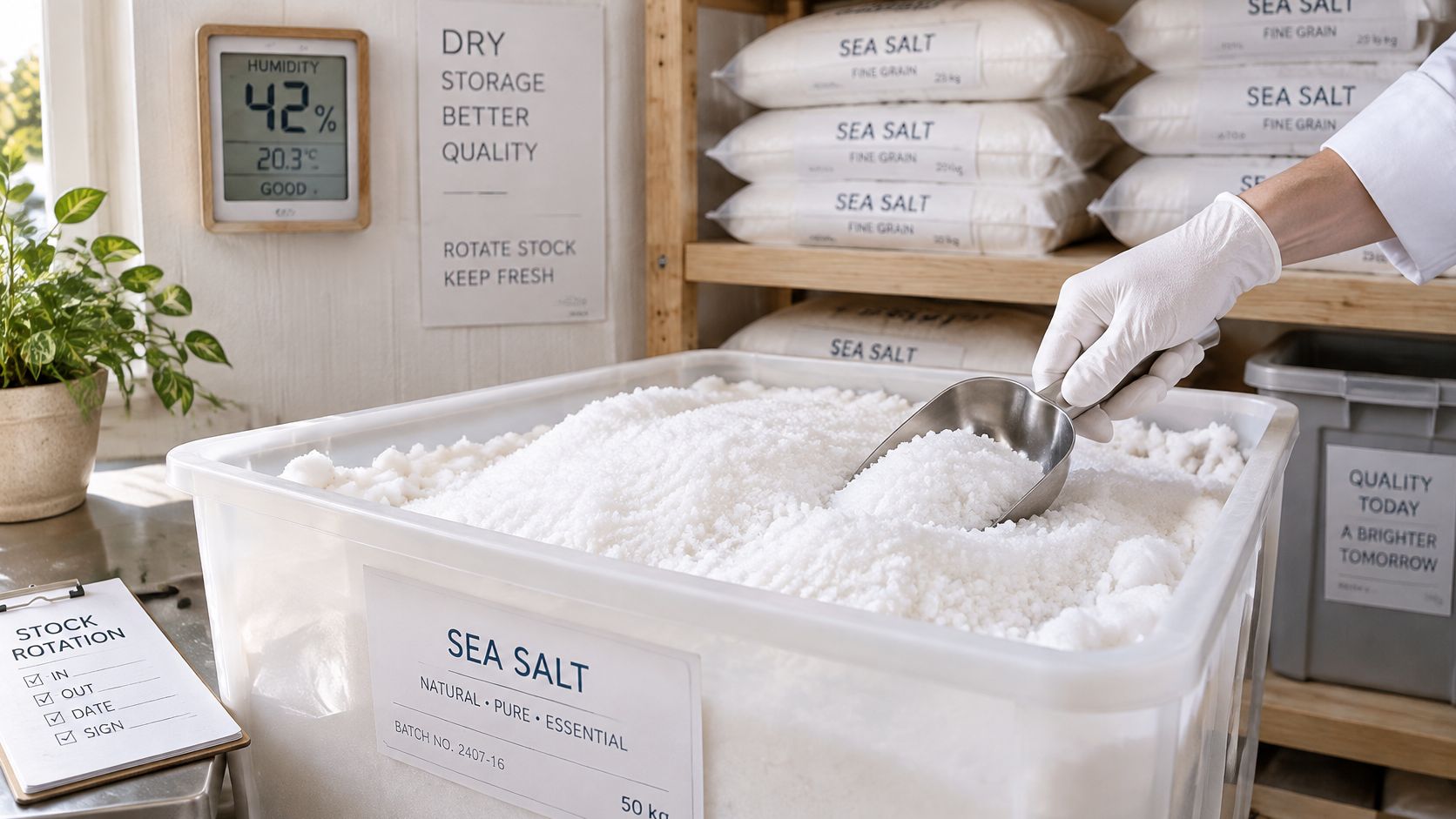
Keep salt sealed in its original packaging or transfer it to a clean, moisture-resistant container with a secure lid. Store containers off the floor, away from open doors, sinks, and other damp areas. In a humid space, use appropriate environmental controls and inspect packaging for tears or loose closures as soon as the order arrives.
Mark each container with the lot identification and the date it was received. Use first-in, first-out rotation, and follow the supplier's storage and shelf-life guidance rather than relying on a generic time limit. Ask how long the product is expected to remain suitable under the stated storage conditions, and get that guidance in writing.
If a shipment arrives clumped, photograph the sealed package and affected material before you open or rework it. Record the lot information, contact the supplier promptly, and ask whether the condition is consistent with the product specification. Don't assume that breaking up clumps restores the product's original quality, especially if you can't tell whether moisture entered during transit or storage.
Labeling, Compliance, and Final Buyer Checklist
Before you pay, confirm the intended use, grade, documentation, lot traceability, packaging, and label responsibility. A supplier's description is not a substitute for the records you need to support your own claims. Check the rules for the market where you'll sell, particularly if the product is intended for human food use.
Avoid calling bath-grade salt “food grade” without supplier documentation that supports that designation. Don't claim “chemical-free” or “contaminant-free” unless you can substantiate the wording with appropriate evidence. If you sell food salt, verify the relevant iodine disclosure and product-name rules. The distinction between “sea salt” and “sea salts” can also matter under Canadian labeling guidance, so don't assume one jurisdiction's wording works everywhere.
Buyer questions answered
How much should I order for a first spa line? Start with the smallest amount that lets you test the product in your actual service and packaging workflow. Confirm the supplier's minimum, then estimate how quickly you can use the order without compromising storage.
Do I need a food-safety license? Requirements depend on what you sell, how you handle or repackage it, and where you operate. Check with the relevant local and national authorities before offering salt as food; a supplier's product description doesn't settle your obligations.
What if a shipment arrives clumped? Document the condition and lot details, then contact the supplier before you repackage or alter the material. Ask how the shipment compares with the agreed specification and what remedy applies.
Is private label worthwhile at a small volume? It can be, if your customers value a distinct product and you can handle label review, packaging, and reorders. If you're still testing demand, first confirm the grade and packaging process with a smaller purchase rather than committing to a format you can't support.
Before wiring money, get a written quote, a product-specific COA, lot-traceability details, intended-use confirmation, and clear label guidance. If the supplier won't answer basic questions about grade or documentation, choose a supplier who will.
Aroma Warehouse offers unscented sea salts for bath, spa, aromatherapy, crafting, and resale, with retail and wholesale purchasing options. Review the product details and confirm that the grade and documentation fit your intended use before ordering from Aroma Bath Salt Warehouse.


