

Bamboo Incense Sticks: What They Are and How to Buy

You've lit a stick at the edge of the room, watched a thin thread of smoke rise, and wondered what's burning. Or you're holding a wholesale catalog, trying to decide whether the sandalwood sticks belong on your shop's shelves. Either way, understanding bamboo incense sticks starts with separating the fragrance you're buying from the structure that carries it.
Table of Contents
Why Bamboo Incense Sticks Still Matter - Tradition with a practical buying lesson
What a Bamboo Incense Stick Actually Is - Separate structure from scent
How Bamboo Incense Sticks Are Made - From bamboo to coated stick - Drying, inspection, and packing
Bamboo-Core vs Unscented and Alternative Sticks - Choosing the Right Stick Format - Compare performance, not assumptions
Fragrance, Raw Materials, and What the Nose Tells You - Read the label without filling in the gaps - A sample checklist that earns its place
Lighting, Burning, and Basic Safety Tips - Light the coating and supervise the ember - Match the routine to the room
Storage, Shelf Life, and Packaging That Protects Quality - Choose protection before decoration - Set shelf-life expectations you can defend
Buying Considerations for Retailers, Spas, and Resellers - Ask questions before comparing prices - Keep private label manageable
Why Bamboo Incense Sticks Still Matter
A home buyer might choose incense for an evening reading corner. A gift-shop owner needs a fragrance customers can understand without a long explanation. A studio owner has another question: will using it suit everyone sharing the room? The same product can serve different purposes, but buying it well means looking beyond the scent name.
Bamboo incense sits at the intersection of cultural practice and everyday commerce. Agarbatti, incense paste rolled around a bamboo core, has roots in India's religious and household traditions, including worship, ceremonies, air freshening, and insect-deterrent applications. Commercial agarbatti-making is traced to the Thanjavur region, with an organized cottage industry developing in southern India, according to INBAR's account of India's agarbatti industry.
Tradition with a practical buying lesson
That history matters because incense isn't a decorative accessory with an old-fashioned story attached. Craftspeople developed a product that people could handle, package, transport, and use in familiar settings. Today's buyer still needs those practical qualities, whether the destination is a bedside drawer or a retail display.
A retailer should respect that cultural background without turning it into an unsupported sales promise. Incense can accompany prayer or meditation, but a fragrance name doesn't establish a spiritual effect. Likewise, traditional use for insect deterrence isn't proof that a particular retail packet works as a repellent.
Buying perspective: Treat cultural history as context, not as evidence for health, spiritual, or performance claims.
For curious buyers, the useful questions are straightforward: what's in the stick, what does it smell like when burning, and how should it be handled? For small businesses, add packaging condition, repeat-order consistency, and clear product information.
That's why bamboo incense remains a worthwhile category to understand. Its appeal involves craft and personal preference, but a good purchase also depends on ordinary decisions about materials, testing, storage, and honest descriptions.
What a Bamboo Incense Stick Actually Is
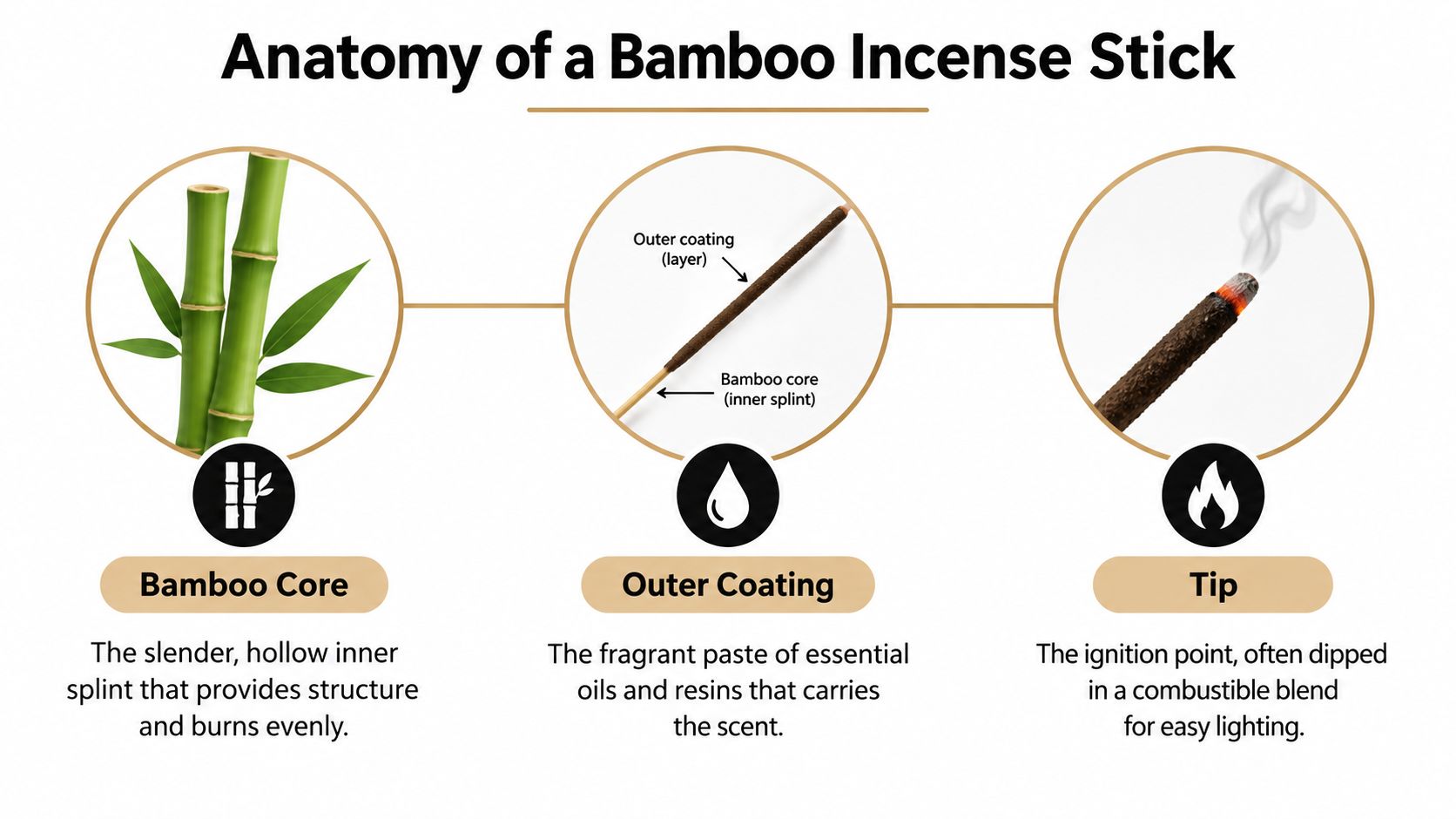
Look at an unlit stick where the exposed handle meets the coated portion. The bamboo core provides the structure. Around it sits a combustible coating, which carries the aromatic ingredients that create the scent.
Think of it loosely as a scented candle with a built-in handle, although the comparison has limits. A candle wick draws fuel from surrounding wax; an incense stick's coating smolders along its length. The analogy helps explain the supporting structure, not identical combustion.
Separate structure from scent
The illustration is a simplified guide, not a specification for every product. Don't assume the inner splint is hollow, that every fragrance comes from essential oils, or that every tip receives a separate ignition treatment. Ask the supplier about the actual construction.
Core: The slender bamboo support gives the coated stick its shape and leaves an exposed portion for handling.
Coating: The combustible mixture surrounds the core. Its formulation matters independently of the bamboo.
Aromatic ingredients: These give the product its fragrance identity. A scent name alone doesn't disclose the recipe.
Tip: This is where you begin lighting the coated portion, rather than a separate fragrance component.
Earlier incense traditions used aromatic materials in forms other than bamboo-supported sticks. A historical review of incense practices and materials describes loose, rolled, and shaped incense alongside the later bamboo-centered format, whose structural core supports consistent handling, drying, and packaging.
This distinction clears up a common misunderstanding: bamboo incense doesn't necessarily smell like bamboo. The term usually describes construction. Sandalwood, lavender, or a blended fragrance describes the intended scent.
It also explains why matching stick shapes don't guarantee matching experiences. You can recognize the format by sight, but you still need product information and a burning sample to assess what's around that core.
How Bamboo Incense Sticks Are Made
Making a bamboo-core stick involves several decisions, not a single universal recipe. A supplier might sell a finished scented product or an unscented coated blank intended for later fragrance application. Ask which production route applies before comparing products.
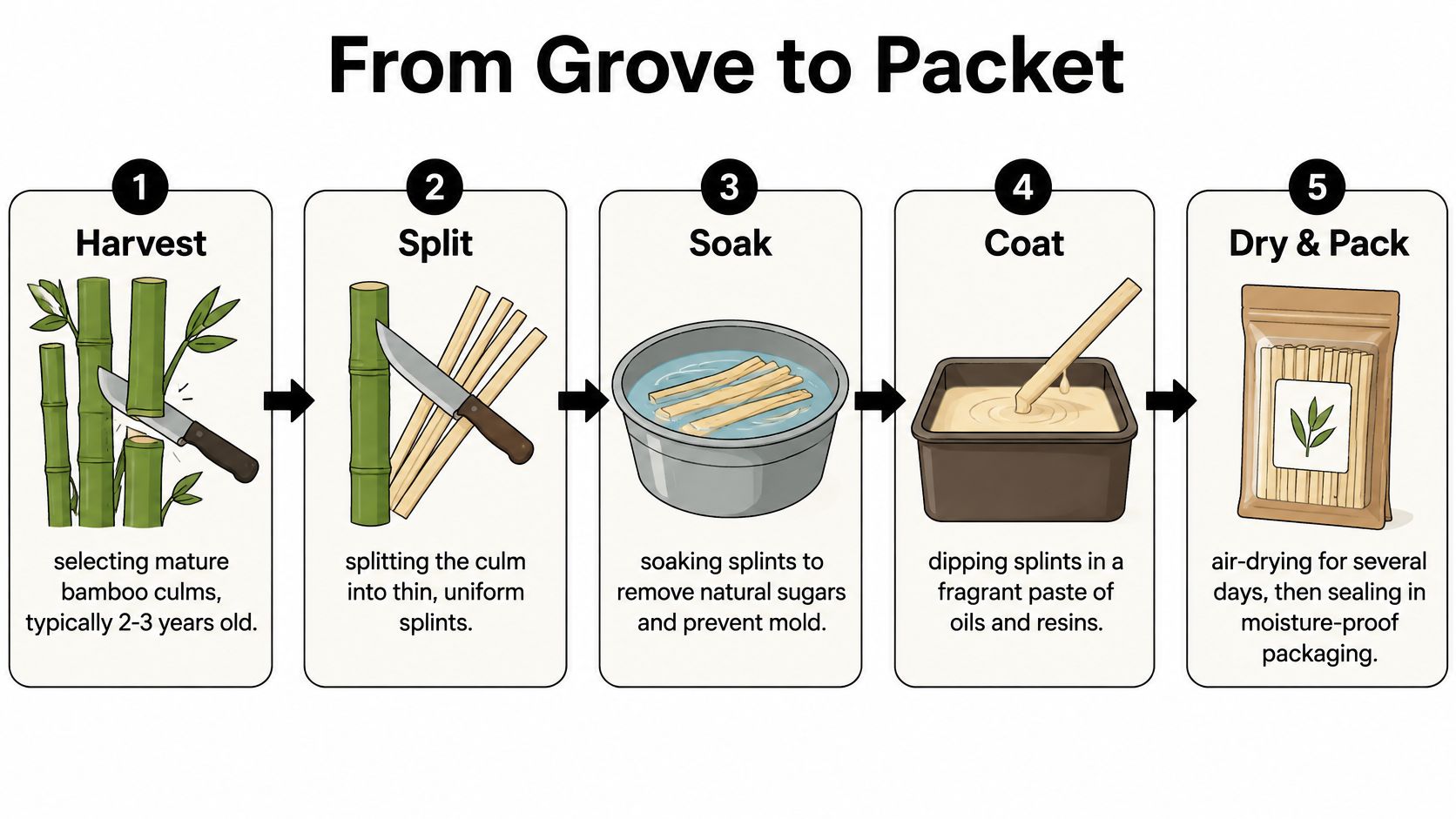
The broad production flow is easy to recognize, but preparation treatments and drying schedules should be confirmed with the manufacturer.
From bamboo to coated stick
Manufacturers select bamboo and split it into slender supports. For a buyer, the practical questions concern straightness, consistent dimensions, and whether the supports survive normal handling. Don't use appearance alone to infer bamboo age or a particular preparation method.
The coating stage brings together combustible powders and a binder. Depending on the product, a formulation may include wood or charcoal powder and aromatic materials. Paste can be applied by rolling or machinery, while some products receive fragrance through a later dipping process.
These methods aren't automatic quality grades. Hand-rolled, machine-rolled, and hand-dipped describe production choices, not a reliable ranking from poor to premium. A neatly finished stick still needs a burn test, and a handmade appearance doesn't excuse excessive breakage.
Drying, inspection, and packing
Before accepting a production sample, ask the supplier to explain how it's dried and checked. Useful inspection points include:
Coating condition: Look for cracks, loose material, and exposed patches where coverage should be continuous.
Handling quality: Remove sticks from the packet as a customer would. Note breakage or heavy shedding.
Burn consistency: Compare samples from the same batch using a consistent setup.
Packing condition: Check whether the finished sticks arrive protected rather than compressed or loosely bundled.
The guide to how incense sticks are made offers additional manufacturing context for buyers who want to discuss these stages with suppliers.
The important purchasing lesson is that a fragrance label leaves much unanswered. Ask whether the scented sample represents the production batch you'll receive, whether the manufacturing method can change between orders, and how the supplier handles defects. Those answers are more useful than an attractive process photograph.
Bamboo-Core vs Unscented and Alternative Sticks
A finished bamboo-core stick and an unscented blank aren't necessarily competing constructions. Unscented describes fragrance status; bamboo-core describes structure. A blank intended for hand-dipping may already have a bamboo support and combustible coating.
That distinction matters when ordering. If you want stock customers can take home and use, finished incense is the straightforward option. If you want to develop a private-label fragrance, blanks may fit your workflow, but you're taking responsibility for evaluating the completed product.
Choosing the Right Stick Format
Stick Type | Best For | Fragrance Control | Typical Buyer |
|---|---|---|---|
Finished bamboo-core incense | Resale in its supplied fragrance | Selection from the supplier's finished scents | Gift shops, home buyers, studios |
Unscented coated blanks | Developing and testing a scented product | Buyer chooses a compatible fragrance process | Craft sellers, private-label businesses |
Finished bambooless sticks | Offering a different stick construction | Usually limited to the finished formulation | Specialty retailers, curious buyers |
Other support materials or formats | A clearly defined product requirement | Depends on formulation and supplier | Buyers comparing specific alternatives |
Compare performance, not assumptions
Fragrance strength needs a burning comparison, not just a sniff through the packet. Burn duration needs testing under comparable conditions. Smoke level needs its own assessment rather than an assumption based on whether bamboo is present.
A finished stick gives you less control over the recipe but removes a production task. A blank gives you more involvement, along with more opportunities for inconsistency. For a small shop, the added labor, testing, and packing may matter more than the blank's purchase price.
The overview of bambooless incense sticks is useful when customers ask about alternatives. Present that option as a construction choice, not an automatic guarantee of gentler fragrance or cleaner combustion.
A different core isn't a substitute for testing the finished product.
For a spa or shared studio, deciding not to burn incense may be the better choice when clients don't welcome fragranced smoke. Don't promise that an alternative stick solves sensitivity concerns.
Likewise, don't treat an already scented product as an unscented blank for rebatching. Start with materials intended for your process and obtain the supplier's compatibility guidance before developing a resale product.
Fragrance, Raw Materials, and What the Nose Tells You
A customer asking for sandalwood may mean a woody fragrance impression, not a demand for a particular ingredient. Another customer may specifically want incense containing sandalwood material. Those are different requests, and a responsible seller shouldn't answer both from the scent name alone.
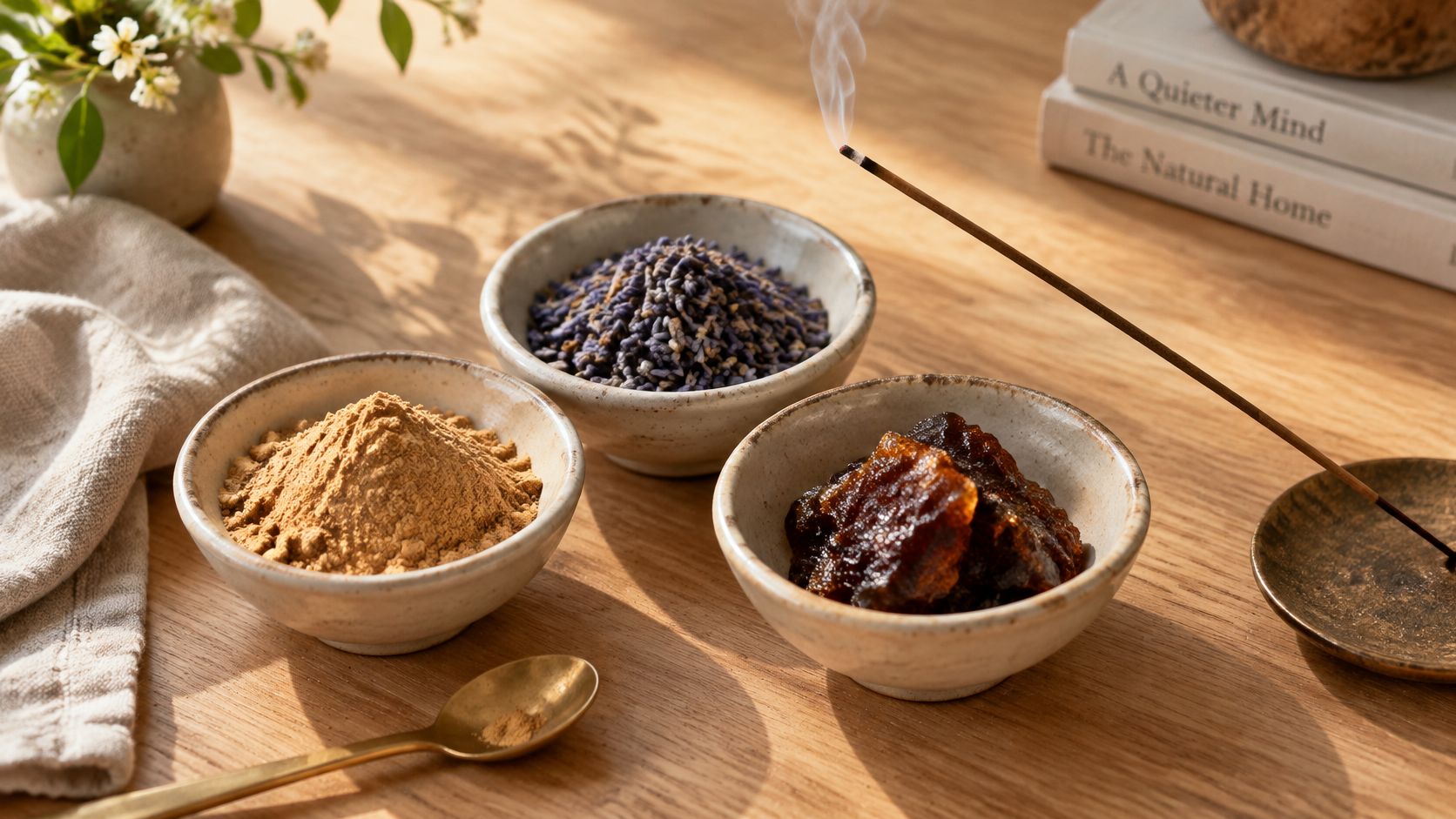
Use familiar descriptions as shopping aids. You might present sandalwood as a woody option, lavender as a floral direction, nag champa as a blended incense profile, and resin-based products as a separate comparison. Describe the sample you've evaluated rather than assigning every product the same character.
Read the label without filling in the gaps
Hand-dipped doesn't mean essential-oil-only. Sandalwood fragrance doesn't establish how much sandalwood is present. Ask for ingredient information where available, and distinguish a fragrance description from a material declaration.
Don't assume a particular scent family burns more evenly on bamboo, either. Evaluate the actual product. A retailer can organize a display by woody, floral, and blended profiles without claiming those categories predict combustion quality.
For gift shoppers, plain descriptions are more useful than perfumery jargon. For customers choosing incense for a personal relaxation routine, describe scent preferences without promising therapeutic effects.
A sample checklist that earns its place
Smell it unlit: Record your first impression, including anything sharp or unexpected.
Evaluate it burning: Note whether the fragrance remains recognizable and whether you find it comfortable in the test setting.
Watch the stick: Record uneven progress, shedding, or repeated extinguishing rather than overlooking defects because you like the scent.
Compare with the label: Check whether the product description matches your experience.
Keep a reference sample: Retain the packaging and batch details so you can compare a future delivery.
For a retail assortment, I'd favor clearly distinguishable scents over a large collection of near-duplicates. That gives customers a more understandable choice and gives you more useful feedback about what they want to buy again.
Lighting, Burning, and Basic Safety Tips
Set up the holder before striking a match. Choose a stable, heat-resistant incense holder on a noncombustible surface, with an ash-catching area beneath the burning portion. Keep the setup away from curtains, papers, merchandise, and places where someone could knock it over.
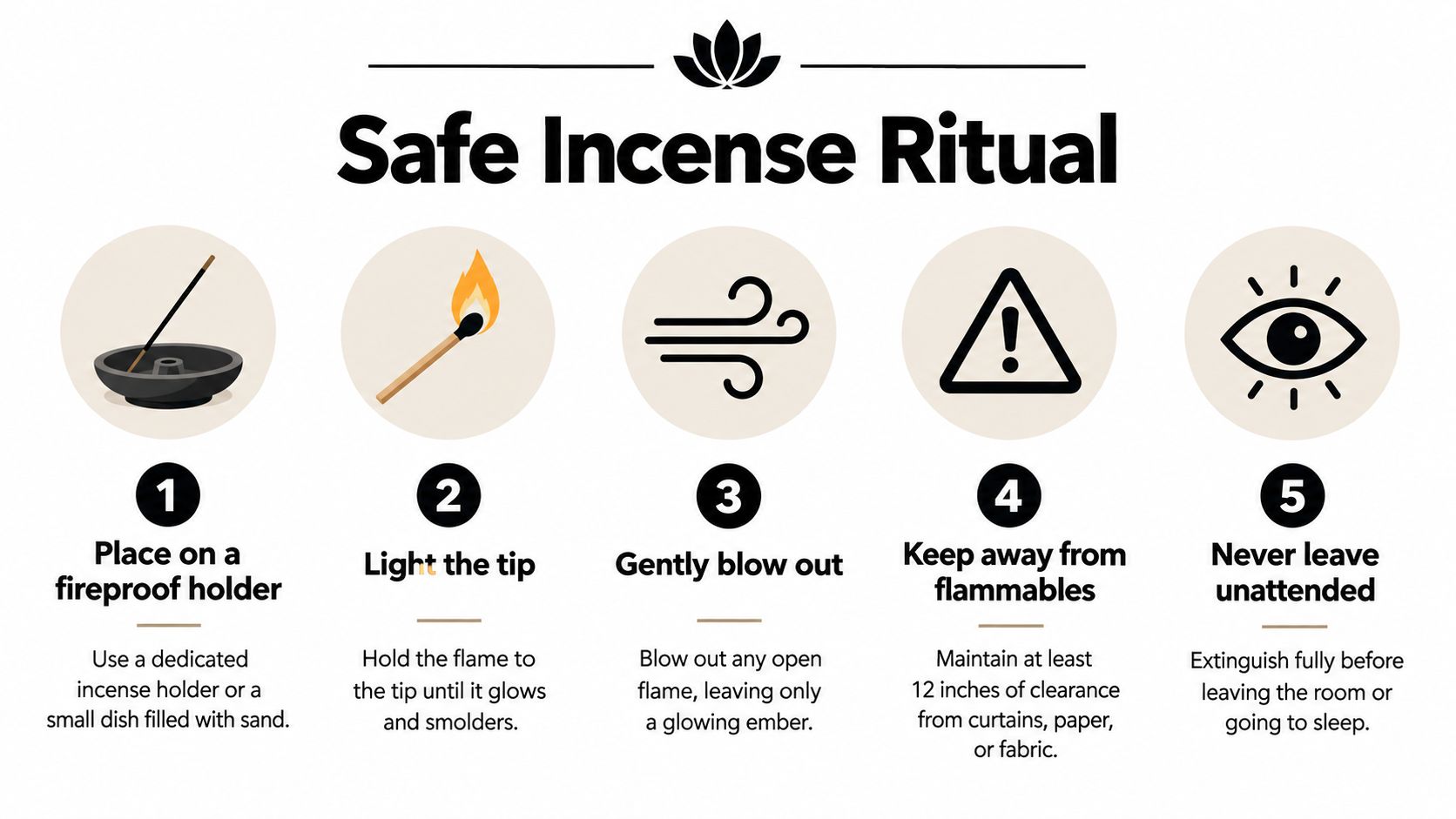
Use this visual as a reminder, while following the product and holder instructions for your particular setup.
FAQ 1. What is the difference between agarbatti and other types of incense?
Agarbatti commonly refers to incense sticks made by applying a combustible aromatic mixture around a thin support, often bamboo. Other incense formats include cones, loose incense blends, and sticks made without a bamboo core. The main differences involve construction, preparation, and how the incense is used.
2. Can bamboo incense sticks be used for making custom fragrance blends?
Bamboo-core incense sticks can be part of a custom fragrance-making process when the base materials and fragrance ingredients are compatible with the intended application. Before producing a batch for resale, test the finished sticks for scent, burning performance, and consistency. Not every fragrance oil is suitable for incense combustion.
3. How can retailers determine whether bamboo incense sticks are suitable for their target customers?
Retailers can begin by identifying customer preferences for fragrance families, package sizes, and price points. Request samples, evaluate the finished product, and gather feedback before placing a large order. Clear product descriptions and consistent replenishment also help retailers build a dependable incense selection.
4. What information should an incense supplier provide before a wholesale purchase?
A supplier should clarify minimum order quantities, available fragrances, bundle contents, shipping costs, product specifications, and policies for damaged merchandise. Buyers developing their own products should also request relevant material information and compatibility guidance. These details help businesses compare suppliers beyond the advertised unit price.
5. How should online sellers describe bamboo incense sticks without making misleading claims?
Online sellers should describe the stick construction, fragrance profile, quantity, dimensions when verified, and appropriate usage instructions. Avoid unsupported claims that incense treats medical conditions, guarantees spiritual outcomes, or eliminates airborne pollutants. Accurate descriptions help customers understand what they are purchasing and make more informed choices.
Light the coating and supervise the ember
Apply a flame to the coated tip until it catches, then gently blow out the open flame so the tip smolders. Secure the exposed handle in the holder and check that falling ash will land on the protected surface.
Never leave burning incense unattended. Extinguish it fully before leaving the room or going to sleep.
Keep children and pets away from the holder and hot ash. Don't empty the ash catcher until its contents are completely cool, and don't assume a faint ember is harmless.
Ventilation matters. Controlled incense-combustion research documented airborne pollutants during burning and showed that changing a bamboo-supported incense formulation affected emissions and burning behavior. A bamboo core doesn't make incense smoke-free.
Match the routine to the room
At home, choose a ventilated space and stop if the smoke causes discomfort. If someone has asthma, fragrance sensitivity, or concerns about exposure, consider a no-burn alternative rather than treating incense as universally suitable.
In a shop or studio, ask whether customers or participants welcome a demonstration. Keep the holder out of walkways and away from treatment linens, display packaging, and other combustible materials. Consult the incense safety guidance before establishing a routine.
For a visual demonstration to accompany the written instructions:
A calm, supervised setup is the objective. More smoke isn't evidence of better fragrance, and a room doesn't need continuous burning to demonstrate what a product smells like.
Storage, Shelf Life, and Packaging That Protects Quality
A packet that looks attractive on a counter still needs to protect its contents. Home buyers should close the original packaging after use. Retailers should separate display samples from saleable inventory rather than leaving all their stock exposed.
Bamboo is hygroscopic, meaning it exchanges moisture with the surrounding environment. Research on bamboo moisture, density, and physical properties supports treating moisture control and dimensional stability as practical quality concerns. Inspect incoming incense for warping, swelling, and unusual fragility before repackaging it.
Choose protection before decoration
A cool, dry storage location away from direct sunlight, heating vents, and damp areas is a sensible starting point. Keep fragrance varieties separately enclosed, and retain the supplier's packaging information.
For business inventory, evaluate the complete package:
Inner protection: Ask whether a sealed pouch provides an appropriate moisture barrier for the product.
Outer support: Check whether the carton prevents crushing during ordinary handling and shipping.
Closure: Make sure customers can close the pack after removing a stick.
Identification: Preserve fragrance, supplier, and batch information when transferring stock into retail packaging.
Glassine sleeves, tins, and printed boxes are packaging options, not interchangeable protection guarantees. Check the actual material, closure, and fit rather than assuming a decorative tin is airtight or a paper sleeve provides a moisture barrier. The custom incense packaging guide can help frame those choices.
Set shelf-life expectations you can defend
Don't assign a universal shelf life to sandalwood, citrus, or floral incense based on the fragrance family alone. Request the manufacturer's recommended storage conditions and product-specific quality period.
For private-label stock, keep dated retained samples in the packaging you intend to sell. Recheck their scent, handling condition, and burn performance before making a shelf-life promise.
Stockroom rule: Buy quantities you can manage and verify, not quantities that merely qualify for a lower unit price.
Use older acceptable stock first, record quality complaints, and investigate changes instead of assuming every weak or damaged stick is old. Clear records help you distinguish a storage problem from a production or shipping issue.
Buying Considerations for Retailers, Spas, and Resellers
A sensible wholesale order starts with the customer and the intended use. A gift shop may want finished packets with readable scent descriptions. A craft seller may need unscented blanks and compatible fragrance materials. A studio may need a small sampling order before deciding whether burning incense suits its space at all.
For online sellers, think about what arrives at the customer's door. Protective packaging, accurate photographs, and clear descriptions deserve as much attention as fragrance selection. Don't copy unsupported health or spiritual claims into an Etsy, eBay, or Amazon listing because they appear in a product name.
Ask questions before comparing prices
Order requirements: Confirm minimum quantities, whether fragrances can be mixed, and the contents of each bundle.
Delivered cost: Include shipping, packaging, damaged-stock allowances, and any preparation labor in your comparison.
Reordering: Ask about availability, batch identification, and notice of formulation or packaging changes.
Stock condition: Ask how inventory is stored and how the supplier handles slow-moving fragrances.
Product information: Request supported ingredient descriptions, usage directions, and a clear defect policy.
The wholesale incense buying guide provides a starting point for organizing those conversations. Compare finished branded products, hand-dipped options, and private-label inputs according to the work you want to perform.
Keep private label manageable
A starter workflow may involve unscented sticks, fragrance materials approved for that use, measuring tools, droppers, and suitable packaging. Don't assume an oil is appropriate for combustion because it smells pleasant or is sold for another fragrance application.
Before ordering printed sleeves or blank tins in volume, validate the finished stick and package together. Keep records of materials, preparation, and sample results so repeat orders don't depend on memory.
The practical recap is simple: identify the format, test the finished product, protect the inventory, and describe it clearly. A focused opening assortment with reliable replenishment is a more manageable starting point than an ambitious catalog you haven't evaluated.
Aroma Incense Warehouse offers finished incense, unscented sticks, fragrance oils, burners, and supplies for retail and private-label projects. Visit to compare options for your home or business, then confirm material compatibility and sample your chosen bamboo incense sticks before committing to a larger order.


