

Vanilla Musk Fragrance Oil: A Practical Guide for Makers

A maker is checking two supplier samples in the back room of a candle shop. Both bottles say “vanilla musk,” but one smells like syrupy vanilla sugar while the other is soft, warm, and close to clean skin. The name gives a direction, not a formula.
That distinction matters when you're choosing an oil for candles, soap, diffusers, or a retail shelf. Vanilla musk fragrance oil is a formulated accord, and the blend behind the label can vary in aroma materials, concentration, solvent, and recommended use. Before you buy or batch, you need to know what the scent is doing, what the supplier's documents allow, and which customer you're selling it to.
Table of Contents
What Vanilla Musk Fragrance Oil Actually Is - Why modern musk is usually reconstructed - Why vanilla notes are often aroma materials
The Scent Profile and Common Variations - Read the layers, then choose the variation
Blending Recipes and Usage Rates by Application - Build a scent blend before scaling
Safety, Skin Contact, and IFRA by Category - What the certificate can and can't tell you - A practical check before you formulate
Storage, Shelf Life, and Documentation to Keep on File - Keep the paperwork tied to the product
A Shop, Two Bottles, and a Label That Means Too Much
Smell the first bottle on a blotter. Its vanilla arrives immediately, sweet and almost edible, with a gentle powdery finish. The second has less sugar up front. Its musk feels warm and quiet, like a soft sweater that's been worn all day. Both can be sold as vanilla musk, yet they may behave differently in wax, soap, and room fragrance.
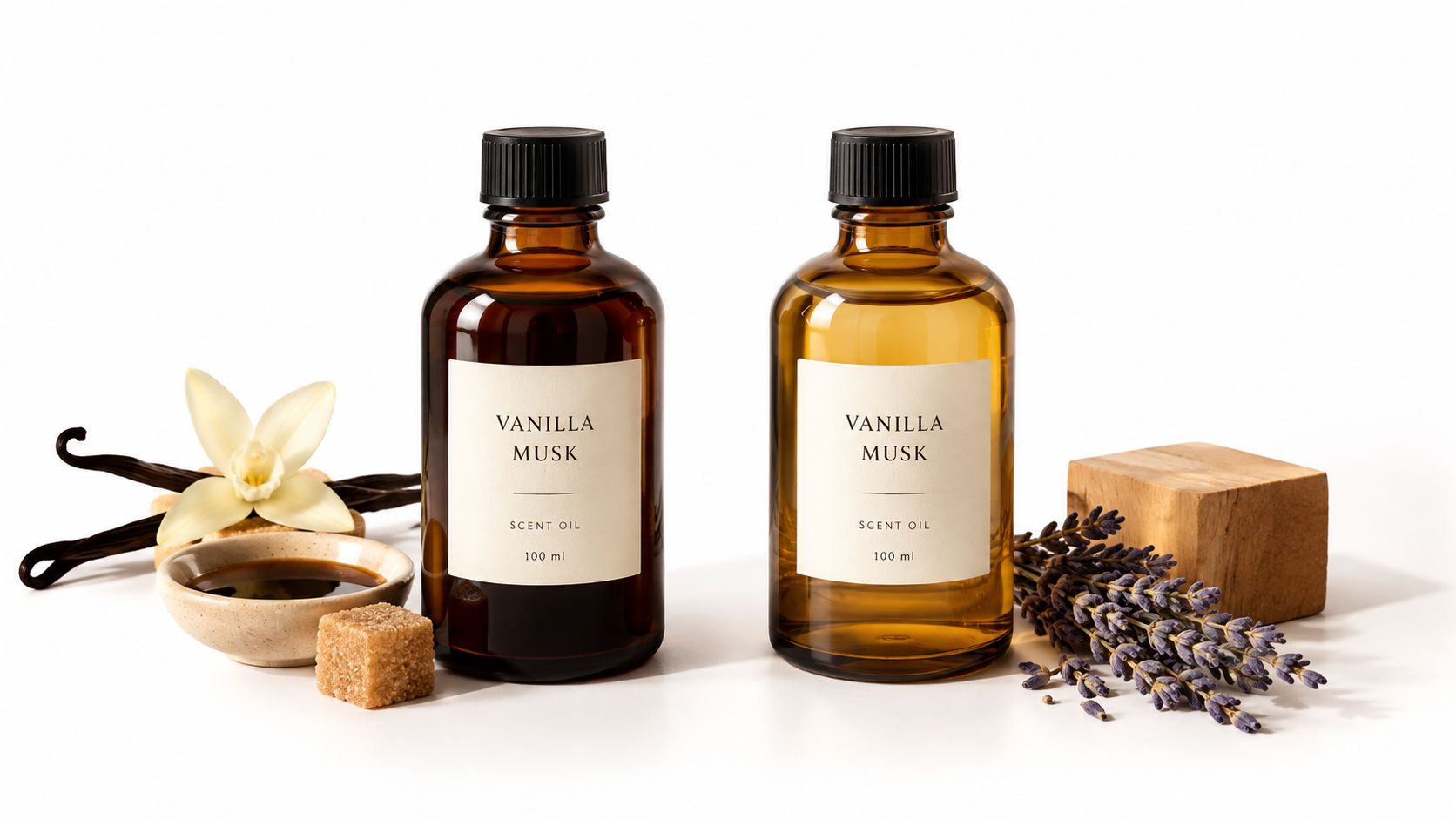
The reason is straightforward: “vanilla musk” describes a scent idea, not a standardized ingredient. One supplier may build a creamy gourmand profile around vanillin and supporting notes. Another may use a restrained vanilla effect over a clean, skin-like musk. The product name alone won't tell you the exact materials, strength, or suitability for a particular finished product.
That's why the label should be the start of your buying conversation, not its conclusion. Ask for the current Safety Data Sheet (SDS), the IFRA certificate for your intended product category, and an allergen declaration. Then smell a sample in the base you plan to use. A fragrance that seems balanced on a blotter can shift once it's dispersed in wax, soap, or a diffuser blend.
For a useful reminder of how product-page wording shapes customer expectations, see this Product Page Readability Study. Clear product copy can explain the scent character without implying that the oil contains natural vanilla or animal-derived musk.
The practical questions are simple: What's in the bottle? What does the supplier permit for my product category? What scent variation will my customer expect? The sections ahead answer those questions without treating one product name as a complete specification.
What Vanilla Musk Fragrance Oil Actually Is
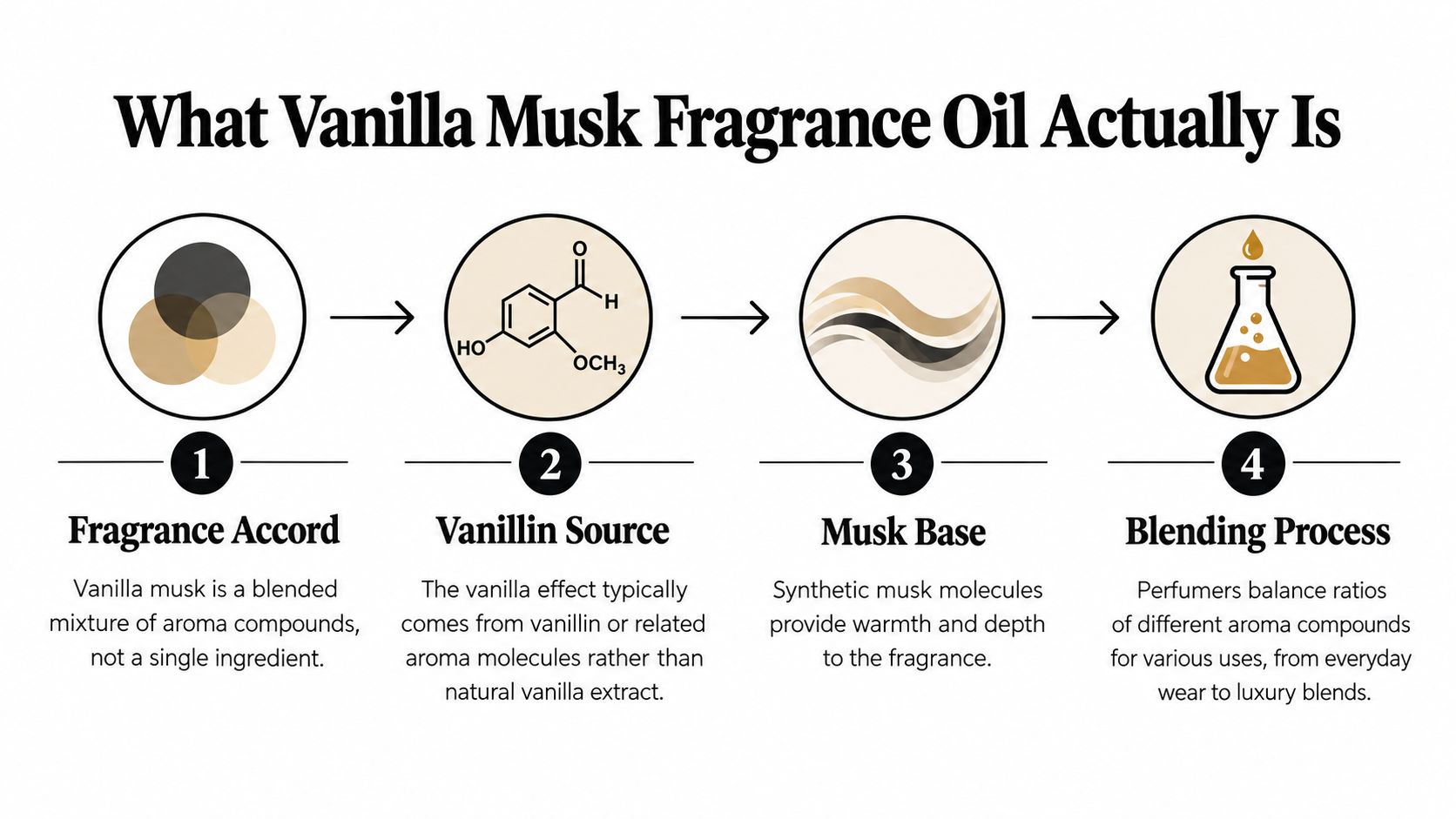
A fragrance accord is a designed blend of aromatic materials that creates a recognizable scent impression. In vanilla musk, the vanilla character often comes from vanillin or related aroma materials, while musk supplies a soft, lingering base-note effect. That doesn't mean every oil uses the same ingredients or proportions.
Why modern musk is usually reconstructed
The history of synthetic musk helps explain what “musk” means on a contemporary fragrance label. In 1888, chemist Albert Baur accidentally discovered the first synthetic musk while working on research connected to explosive compounds. His discovery began the development of musk odorants that could be manufactured at commercial scale, reducing reliance on musk deer, whose natural secretion traditionally required killing the animal. McGill's account of the history of musk chemistry describes this shift and the later development of synthetic musk materials.
During the 1920s, chemist Leopold Ruzicka identified muscone, the principal odor-active compound associated with natural deer musk. In 1935, Wallace Carothers and DuPont developed Astrotone, described as the first macrocyclic musk. Polycyclic musks later became important because manufacturers could produce them economically for consumer products. From 1987 to 2000, global use of polycyclic musks rose from about 4,300 metric tons to 10,000 metric tons, an increase of roughly 133%. These milestones help explain why modern vanilla musk oils typically rely on synthetic aroma molecules or accords, not material from deer.
Why vanilla notes are often aroma materials
Natural vanilla production is geographically concentrated. FAOSTAT-based figures report 7,433 metric tons of raw vanilla production worldwide in 2023, with Madagascar producing 3,113 tons, or about 42% of the total. Indonesia supplied another 1,833 tons, roughly 25%. Vanilla production figures show why natural vanilla can be vulnerable to weather, crop disease, labor disruption, and price swings.
Most vanilla-like fragrance effects don't require large quantities of vanilla beans. A U.S. International Trade Commission working paper states that, as of 2020, industry estimates put natural-vanilla-derived vanillin at 1% or less of global vanillin demand, with synthetic vanillin less expensive because of its broad availability. For buyers, the distinction is useful: a vanilla-inspired accord isn't automatically a product containing botanical vanilla extract or absolute. Ask the supplier what the formula contains, then describe it accurately.
The Scent Profile and Common Variations
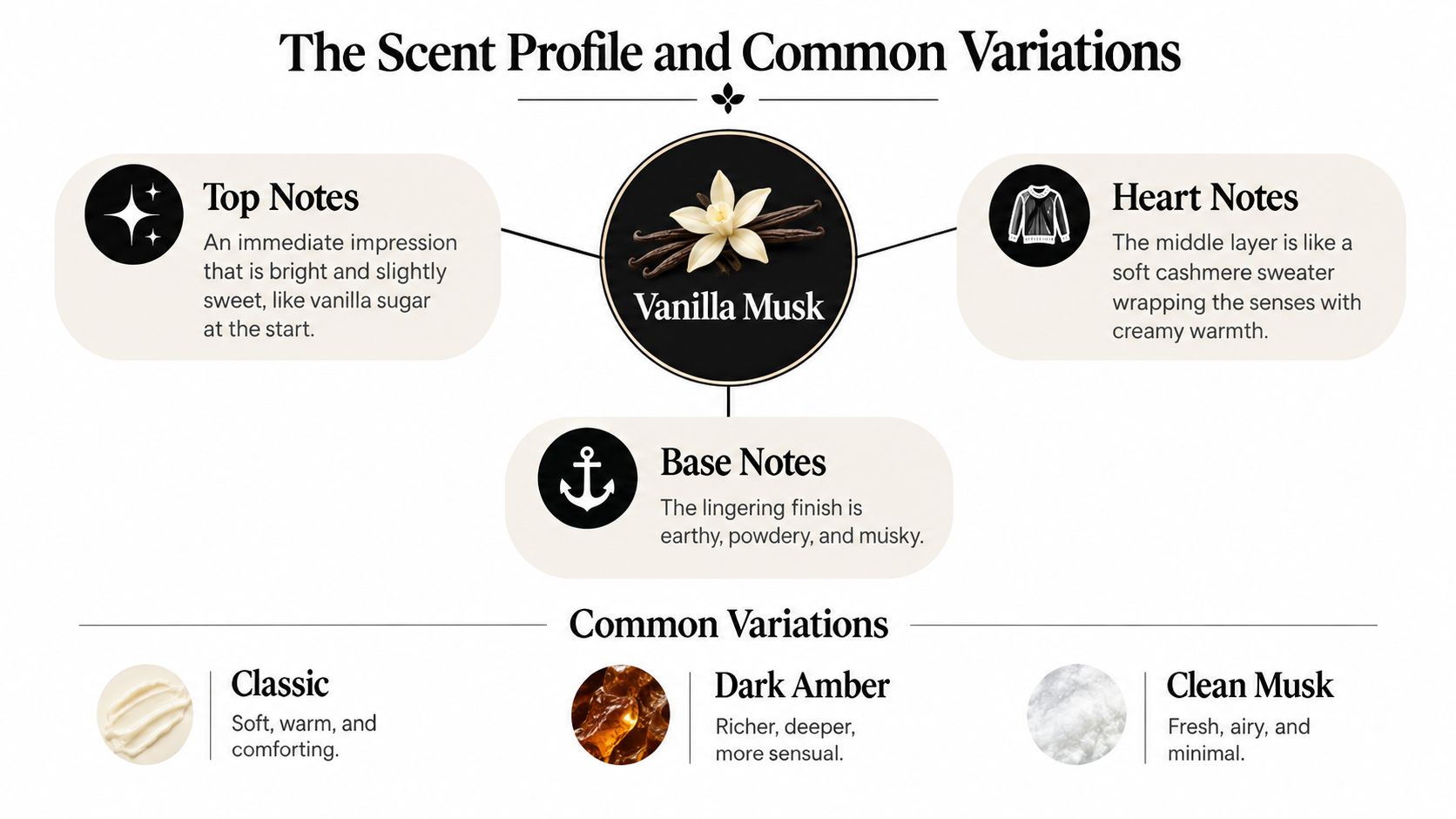
Vanilla musk isn't one fixed smell. Think of it as a structure that a perfumer can tilt toward sweetness, woods, or a cleaner skin-like finish. The opening may be bright and lightly sweet, like vanilla sugar at the edge of a flame. The heart often feels creamy and warm, while the base lingers with a soft, powdery musk.
Read the layers, then choose the variation
A creamy gourmand version puts vanilla forward. It can feel rich, rounded, and dessert-like, which suits shoppers seeking a cozy home scent. If the sweetness dominates on a blotter, it may read as bakery fragrance rather than a restrained everyday musk.
A woody ambered version folds in dry woods and resinous warmth. Sandalwood or amber-like effects can make the vanilla feel deeper and less sugary, a direction that often works well for seasonal gift displays. The label still doesn't tell you how strong those supporting notes are, so sample before committing to a larger order.
A clean, intimate skin musk version keeps sweetness in the background and lets the soft base do more of the work. It may suit wellness studios, customers who dislike candy-like fragrances, and gift buyers looking for an easy-to-layer scent. For another example of how a musk profile can be softened with vanilla, compare it with white musk fragrance oil.
Blotter test: Smell the sample at first application, then revisit it after the brighter notes fade. The drydown often tells you more about the musk character than the first impression does.
Treat “classic,” “dark amber,” and “clean musk” as useful merchandising descriptions, not fixed industry definitions. One supplier's clean musk may be another's powdery vanilla, so test each specific oil and write your own sensory notes before preparing a product page.
Blending Recipes and Usage Rates by Application
There's no dependable universal usage rate for vanilla musk. A candle, a rinse-off soap, a leave-on product, and a diffuser expose people to fragrance in different ways and use different bases. Your supplier's current documentation for the complete fragrance blend and the product category should take precedence over any general starting point.
Product category | Typical usage range | Key notes |
|---|---|---|
Candles and wax melts | No universal rate | Check the supplier's candle guidance and test in the specific wax. |
Reed and electric diffusers | No universal rate | Use only within the supplier's directions for the diffuser base and product. |
Cold-process soap | No universal rate | Check the relevant IFRA category and test for scent changes during processing. |
Bath products | No universal rate | Distinguish rinse-off from leave-on use and follow category-specific limits. |
Fine-fragrance or linen sprays | No universal rate | Confirm product suitability, dilution, and labeling requirements before batching. |
Build a scent blend before scaling
For a warm, ambered direction, start with vanilla musk as the main accord, add a sandalwood note for dry warmth, then use bergamot sparingly as a brighter accent. For a clean, skin-like direction, keep the vanilla musk restrained and combine it with a light floral and a softer musk layer. These are olfactory starting points, not percentages or ready-to-sell formulas. Confirm that every component is appropriate for the intended application and that the finished blend complies with the supplier's documentation.
A fragrance may smell rounded in soy wax but turn faint, sharp, or unbalanced in a surfactant base. Make a small test batch, record the formula and base, and evaluate the result after it has settled or cured as appropriate for that product. Don't assume that a rate that works in one base will carry over unchanged to another.
For a broader overview of formats and applications, review this guide to fragrance oil uses. When you're buying for multiple product lines, ask the supplier for usage guidance by category rather than one figure presented as suitable for everything.
Safety, Skin Contact, and IFRA by Category
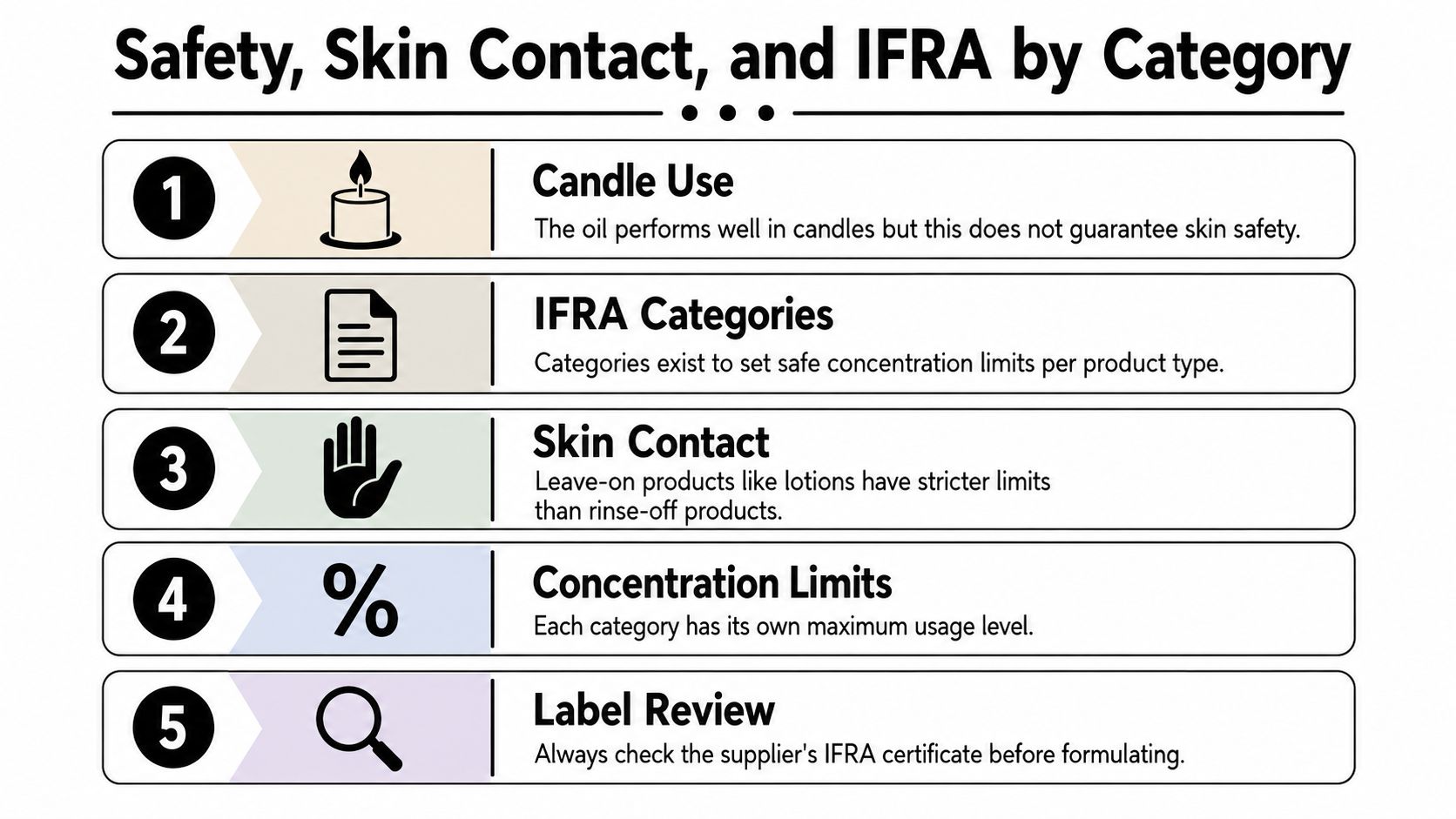
An oil that performs well in a candle isn't automatically appropriate for skin. Safety depends on the finished product, the exposure route, the concentration, and the complete formula. A raw-material document doesn't answer every question about a blended fragrance oil, and a candle-use recommendation doesn't establish a skin-use limit.
What the certificate can and can't tell you
The International Fragrance Association describes its standards as a voluntary, globally recognized risk-management system. They are a useful formulation reference, but they do not replace a thorough safety assessment. A vanilla-musk certificate reports different maximum concentrations for different applications, including 4.00% for one category, 3.07% for another, and 35.98% for another. Those figures are specific to that certificate and its categories, not universal recommendations for every vanilla musk oil. IFRA's regulatory FAQ explains the role and limits of this framework.
Vanillin-containing formulas can also require allergen declarations. A technical fragrance document identifies vanillin at 100% and flags declaration thresholds above 0.01% for rinse-off products and above 0.001% for leave-on products. The relevant question is the vanillin concentration in the finished fragrance formula, not what the product name suggests. The technical IFRA document illustrates why you should check product-specific paperwork instead of guessing from an ingredient name.
A practical check before you formulate
Keep the current SDS on file. Use the document for the exact product you bought, and review its handling and hazard information before production.
Request the IFRA certificate for the finished blend. Match it to your intended category rather than relying on a certificate for a single raw material.
Check allergen disclosure and labeling needs. Requirements depend on the product and market, so confirm what applies to your finished formulation.
Test skin products cautiously. Follow the supplier's limits, and don't market a neat fragrance oil as a topical product without product-specific authorization and directions.
Ventilate while handling fragrance. Keep your work area ventilated and follow the SDS.
For soap makers, this guide to soap-making fragrance oil can help frame the application, but the exact oil's certificate and SDS remain the working documents.
Storage, Shelf Life, and Documentation to Keep on File
Store vanilla musk oil in a tightly capped container, away from heat and direct light. Amber glass helps limit light exposure, and a cool, dark storage area makes it easier to protect the material from avoidable changes. Don't leave the cap open on a busy workbench, where repeated exposure to air and handling can compromise consistency.
Vanillin can darken an oil over time, shifting a clear liquid toward amber without necessarily making the scent unusable. Don't judge the product by color alone. Compare the aroma with a retained sample, check the supplier's shelf-life guidance, and record the lot or batch information so you can trace any change.
Keep the paperwork tied to the product
Maintain three current documents for each fragrance oil:
Safety Data Sheet: Covers hazards, handling, storage, and first-aid information.
IFRA certificate: Gives application-category guidance for the specific fragrance formula.
Allergen declaration: Supports ingredient review and labeling for the markets where you sell.
When reordering, ask the supplier for the lot number, whether the scent profile is expected to remain consistent, the maximum recommended use by category, and the current allergen content. If you repackage or private-label the oil, keep the paperwork connected to the correct product and batch.
Buyer's check: If the supplier can't provide category-specific guidance, don't fill the gap with a percentage copied from another oil. Hold the formula until you have the right documentation.
Clear customer-facing language matters too. Review this guide to fragrance labeling requirements when preparing product descriptions and labels. A good label should set expectations without claiming natural content, skin suitability, or a specific concentration that the supplier hasn't verified.
Buying, Merchandising, and Positioning for Retailers
Don't automatically place every vanilla musk oil on a bakery-themed shelf. A creamy gourmand version belongs with cozy candles and home fragrance. A clean, intimate musk may suit wellness studios or gift sets, while a woody ambered profile can complement a seasonal display. Merchandise the actual scent character, not just the product name.
Samples make that distinction easier for both staff and customers. Use blotter strips or small testers, and label them with your own plain-language notes: creamy, resinous, dry, powdery, or softly sweet. Retailers planning their displays can also explore these merchandising insights for retailers for ideas on connecting product presentation to how shoppers browse.
Wholesale buyers should confirm the container size and closure, whether the oil is poured fresh to order, what repackaging options are available, and whether the supplier can support private-label needs. Keep your sourcing criteria in writing so that reorders don't rely on memory or an old sample alone. This guide to product sourcing can help you organize those supplier questions.
Avoid unsupported claims such as “natural,” “skin-safe,” or a precise concentration unless you have documentation for that specific formula and use. Aroma Warehouse offers fragrance oils alongside bottles, droppers, diffusers, and other supplies for makers and retailers, so buyers can evaluate products and packaging needs together.
Putting It All Together
Keep this decision card beside the next batch or reorder:
Treat the name as a scent direction. Vanilla musk is an accord, not a standardized ingredient.
Match the oil to the application. Candle performance doesn't establish skin suitability.
Work from current documents. Use the product-specific SDS, category-relevant IFRA certificate, and allergen declaration.
Merchandise the variation. Match a creamy, ambered, or clean profile to the shopper's expectations.
Before you scale a formula, sample the oil in its intended base and record what you used. Before you restock, confirm the batch documentation and describe the scent without implying natural ingredients or universal safety.
FAQs on Vanilla Musk Fragrance Oil
Does vanilla musk fragrance oil smell more sweet or powdery?
Vanilla musk fragrance oil can smell sweet, creamy, powdery, or softly warm, depending on the formula. Some blends emphasize a dessert-like vanilla aroma, while others feature a subtle musk finish. Testing a sample is the best way to determine which scent profile fits your intended product.
What fragrances pair well with vanilla musk for a signature scent?
Vanilla musk pairs well with sandalwood, lavender, bergamot, jasmine, amber, and soft floral fragrances. Woody notes create a warmer profile, citrus adds brightness, and florals can produce a softer, more balanced aroma. Test small combinations before choosing a final blend.
Is vanilla musk fragrance oil suitable for fragrance layering?
Vanilla musk can work as a base for fragrance layering because its warm, rounded character can complement floral, woody, fruity, and amber scents. The result depends on the specific formula and the products being combined. Test compatible fragrances in small amounts to find a balanced combination.
How can retailers describe vanilla musk fragrance oil to customers who dislike overly sweet scents?
Retailers can highlight the softer side of the fragrance by describing it as warm, smooth, powdery, or subtly creamy when those characteristics match the actual product. Emphasize the musk finish rather than dessert-like sweetness, and offer a tester so customers can evaluate the aroma themselves.
What should I compare when choosing between vanilla musk fragrance oil suppliers?
Compare scent consistency between samples and reorders, available container sizes, pricing at different order quantities, product documentation, and application-specific guidance. Ask whether the supplier can provide current SDS, IFRA, and allergen documentation for the exact formula. These details help makers select a product that suits their production requirements.
Aroma Warehouse carries fragrance oils and maker supplies, including bottles, droppers, oil warmers, and diffusers, for home users, studios, and resellers. If you're sourcing vanilla musk for a product line or display, visit Aroma Fragrance Warehouse to explore the available oils and supplies.


