

Soap Making Fragrance Oil: A Complete Guide for Makers
You've chosen a fragrance oil that smells wonderful in the bottle, poured a promising batch, and unmolded bars that look exactly as planned. Then the problems appear. The batter may have thickened before you finished the swirl, the pale soap may turn brown, or the scent may seem much weaker after curing than it did on pour day.
That's why a soap making fragrance oil shouldn't be chosen by scent description alone. The useful question isn't only “What does this smell like?” It's also “How will it behave in my process, is it permitted at my intended rate, and will the cured bar still smell right to a customer?”
Table of Contents
Why Fragrance Oil Choice Makes or Breaks Your Soap - Start with the finished bar - Why this matters commercially
Fragrance Oil vs Essential Oil in Soap - Choose according to your product promise - A simple decision test
How Fragrance Oils Behave in Cold Process, Hot Process, and Melt & Pour - Match the fragrance to the process
Usage Rates and the Category 9 Calculation - Find the number on the certificate - Apply the formula - Don't confuse “strong” with “permitted”
Troubleshooting Ricing, Acceleration, Discoloration, and Scent Fade - Ricing - Acceleration - Discoloration - Scent fade
A Repeatable Micro-Batch Test for New Fragrance Oils - Record the conditions first - Use the same decision language
Storage, Labeling, and Sourcing for Hobbyists and Small Businesses
Why Fragrance Oil Choice Makes or Breaks Your Soap
A first batch often teaches this lesson the expensive way. A fragrance can smell rich and distinctive from the bottle, yet behave poorly in cold-process batter. It may cause rapid trace, create grainy lumps, darken the bar, or fade during cure. None of those outcomes means the fragrance is unusable, but each one changes how you need to formulate and sell the finished soap.
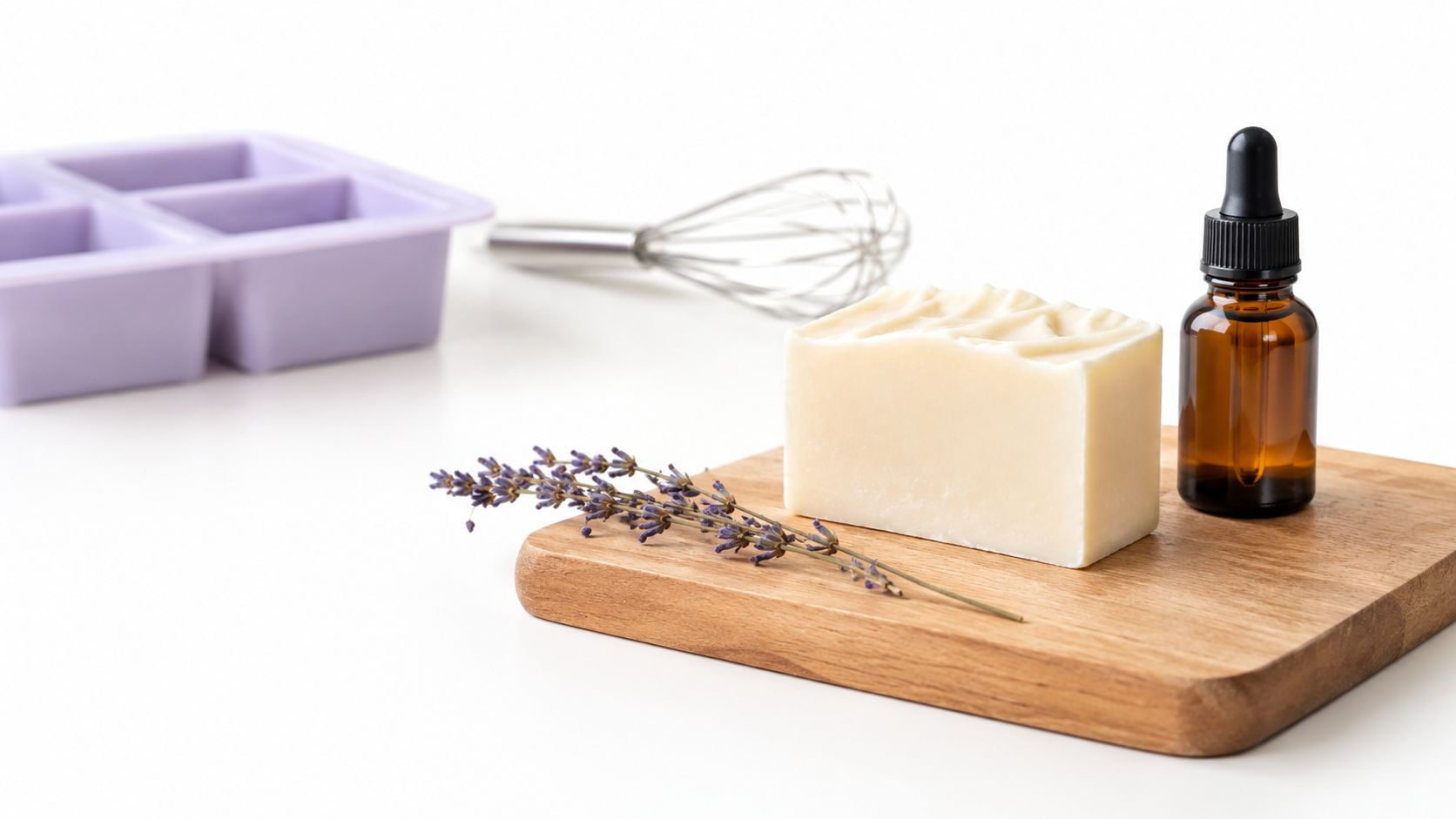
A better buying decision rests on three practical tests:
Process behavior: Does the oil accelerate trace, cause ricing, separate, or discolor the batter?
Safety documentation: Does the supplier provide a current IFRA Certificate of Conformity for the soap category?
Cured performance: Does the fragrance remain recognizable after the soap has finished curing, rather than only smelling strong in the bottle?
Start with the finished bar
Think of fragrance oil as an ingredient that has to complete a journey. It begins in the bottle, enters alkaline soap batter, passes through heat and curing, and ends in a bar that someone uses in the shower. The scent description only tells you about the starting point.
A vanilla fragrance is a useful example. Vanilla notes can create warmth and familiarity, but some vanilla-containing fragrances also discolor soap. The vanilla fragrance oil guide can help you think about that scent as a formulation choice, not merely a pleasant aroma.
Practical rule: Buy for the behavior you can repeat, not for the first impression you get from the bottle.
Why this matters commercially
A bar that changes color may still be attractive if the design allows for it. A fragrance that accelerates trace may still work in a one-color loaf. But an oil that produces inconsistent batches, loses its identity during cure, or conflicts with your label claims creates avoidable inventory and customer-service problems.
Your first test should therefore be small. Record what happened, repeat the test in the same process, and judge the fragrance after cure. That simple habit turns fragrance selection from guesswork into quality control.
Fragrance Oil vs Essential Oil in Soap
Fragrance oils are blended aroma materials formulated to create a particular scent. They may combine synthetic aroma chemicals, natural materials, or both. Essential oils are concentrated plant extracts obtained from plant material, and their scent reflects the characteristics of that source.
The difference affects what you can make. A fragrance oil can reproduce a complex concept such as vanilla, cucumber melon, freshly washed linen, or a seasonal bakery blend. Essential oils are better suited to plant-derived profiles such as lavender, peppermint, or eucalyptus, although their behavior and scent can still vary between materials and batches.
Choose according to your product promise
If your label emphasizes a consistent fragrance profile, fragrance oils often give you more options and predictable repeatability. They can also make a complex scent practical when no single essential oil provides the desired aroma.
Essential oils may suit a product line built around plant-derived ingredients. But “natural” doesn't automatically mean safer. Essential oils can contain regulated fragrance allergens, and the finished product still needs appropriate safety review and labeling.
The opposite assumption is just as misleading. A synthetic ingredient isn't automatically unsafe. What matters is the specific material, its concentration in the finished soap, the product category, and the documentation supporting its intended use.
A simple decision test
Before ordering, write the claim you want the finished soap to communicate:
Plant-derived scent: Consider an essential oil or a documented essential-oil blend.
A specific abstract or food-inspired scent: Consider a fragrance oil designed for that profile.
Sensitive-skin positioning: Avoid assuming either format is automatically suitable. Review the supplier's documentation and avoid unsupported medical or hypoallergenic claims.
Consistent wholesale production: Favor the material that performs consistently in your process and remains stable after cure.
A fragrance oil is also different from an oil-based perfume, which is made for personal scent application rather than automatically for soap. For a clear explanation of that broader fragrance format, consult this oil based perfume guide, then return to the product-specific documentation for soap.
For a deeper comparison of the two scent formats, see fragrance oils and essential oils. The important takeaway is practical: choose the aroma format that matches your formula, your intended claims, and your customer's expectations.
How Fragrance Oils Behave in Cold Process, Hot Process, and Melt & Pour
The same fragrance oil can behave differently in different soap processes. Temperature, water content, mixing speed, and the amount of time the batter remains fluid all affect your result.
Cold process usually exposes fragrance problems most clearly because the oil enters a reactive batter that must remain workable while you design the soap. A fast-moving fragrance can turn a pourable mixture into a thick paste before you finish a swirl. Ricing may appear as small lumps, while separation creates a more serious blending problem.
Hot process gives you less design time but cooks the soap batter, so acceleration is often easier to manage. You still need to watch fragrance choice, heat, and scent retention. Adding fragrance at an appropriate stage can help protect the working process, but you should follow the supplier's guidance for the specific product.
Melt and pour starts with a prepared soap base. Because you aren't creating the lye reaction yourself, many fragrances that are difficult in cold process are easier to use here. Discoloration can still occur, and too much fragrance can affect the bar's texture or sweating behavior.
Reaction | Cold Process | Hot Process | Melt & Pour |
|---|---|---|---|
Acceleration | Can sharply reduce design time | Usually less disruptive during the cooking stage | Often less relevant, but work quickly before the base sets |
Ricing | May create lumps in fresh batter | Can be worked through during cooking | Less common, but compatibility still needs testing |
Separation | Can ruin the emulsion if not corrected | Cooking may help combine the mixture | Usually appears as poor dispersion or oil pooling |
Discoloration | May become visible during cure | Can appear as the soap cooks or cures | Often easier to observe in a clear or light base |
Scent retention | Judge after cure, not immediately | Evaluate after the finished soap cools and settles | Test the set bar, not only the liquid base |
Match the fragrance to the process
If you make cold-process soap, ask the supplier about acceleration, ricing, discoloration, and recommended handling. A floral fragrance may require a simple mold and one color, while a slower fragrance may suit a layered design.
If you make melt and pour, test clarity, color change, and scent distribution. A fragrance that performs well in a loaf may not look attractive in a transparent bar.
For a specific example of evaluating a fragrance profile before committing to a design, review this honeysuckle fragrance oil resource. The product name is only the beginning. Your own process test is the final decision-maker.
A supplier's performance note is a starting point. Your mold, recipe, temperature, and mixing method determine the result you'll actually sell.
Usage Rates and the Category 9 Calculation
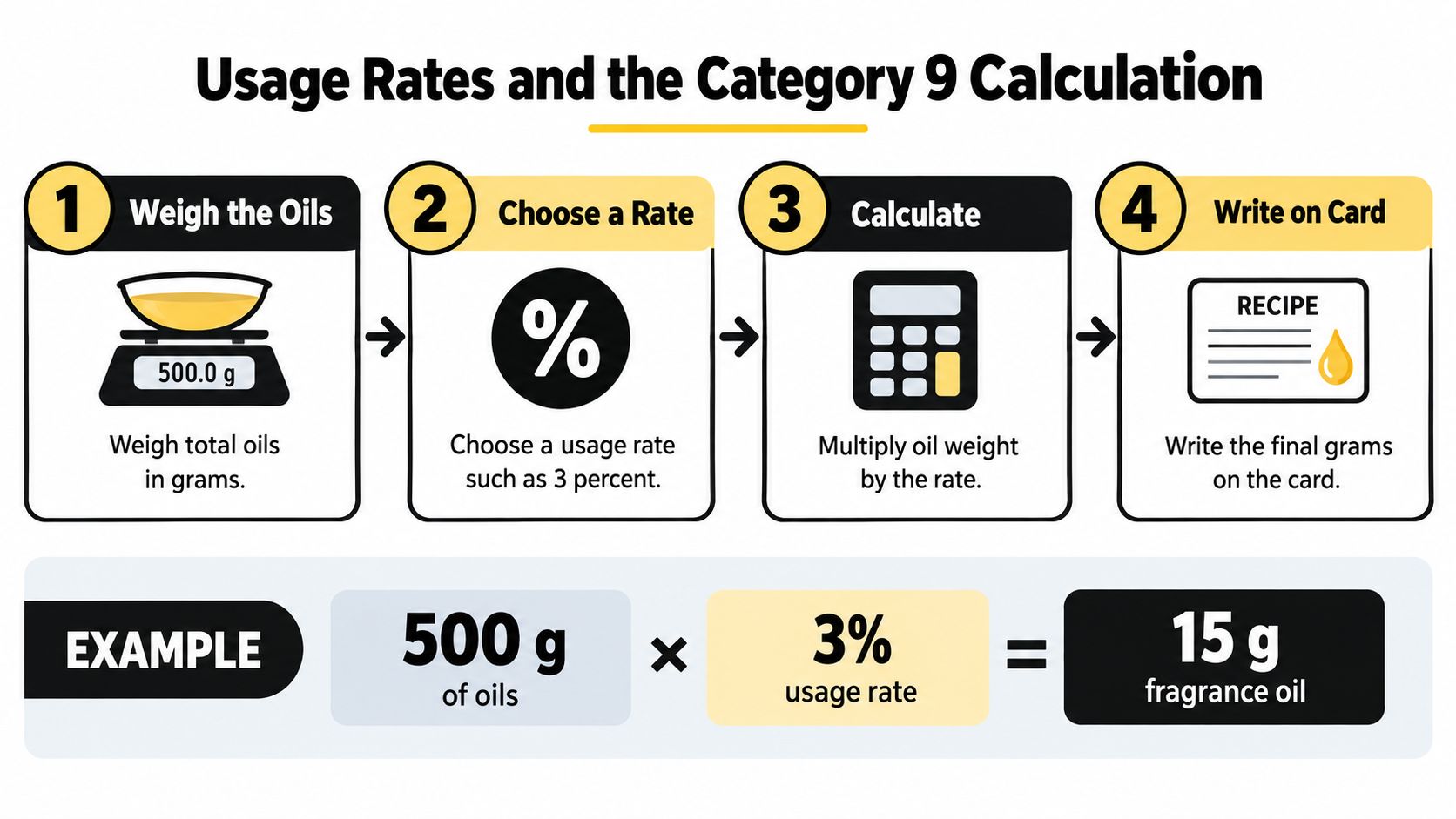
A fragrance oil's permitted soap rate isn't universal. For rinse-off products such as bar soap, the relevant IFRA classification is Category 9. The maximum concentration depends on the most restrictive ingredient in the fragrance formulation and applies to the finished product rather than just the fragrance concentrate.
That distinction prevents a common mistake: copying a percentage from a lotion, perfume, shampoo, or another fragrance oil. Those products can belong to different exposure categories, with different limits.
Find the number on the certificate
Before calculating your recipe, obtain the supplier's current IFRA Certificate of Conformity. Find the row for Category 9 and note the maximum permitted concentration for that specific oil.
The International Fragrance Association's standards distinguish rinse-off from leave-on exposure. Its guidance identifies Category 9 as covering relevant rinse-off applications such as soap and similar bath products. You can review the IFRA standards guidance and the organization's explanation of how the standards are used.
Apply the formula
Use this calculation:
Finished batch mass × Category 9 limit ÷ 100 = maximum fragrance mass
For example, a 1,000 g finished soap batch with a 4% Category 9 limit allows:
1,000 g × 4 ÷ 100 = 40 g of fragrance oil
That 40 g maximum is an example based on the stated certificate limit. It doesn't mean every fragrance oil can be used at 4%.
If the certificate gives a lower limit, use the lower limit. If your normal recipe rate exceeds the certificate limit, the certificate controls the formulation. Scale the calculation whenever the batch size changes, and record the certificate version, oil identification, batch size, and fragrance mass on your recipe sheet.
Don't confuse “strong” with “permitted”
A fragrance that smells weak in the bottle isn't automatically safe at a higher rate. Increasing the amount can create safety, performance, labeling, and compliance problems. Adjust the design, blend, cure expectations, or fragrance choice instead of overriding the Category 9 limit.
Troubleshooting Ricing, Acceleration, Discoloration, and Scent Fade
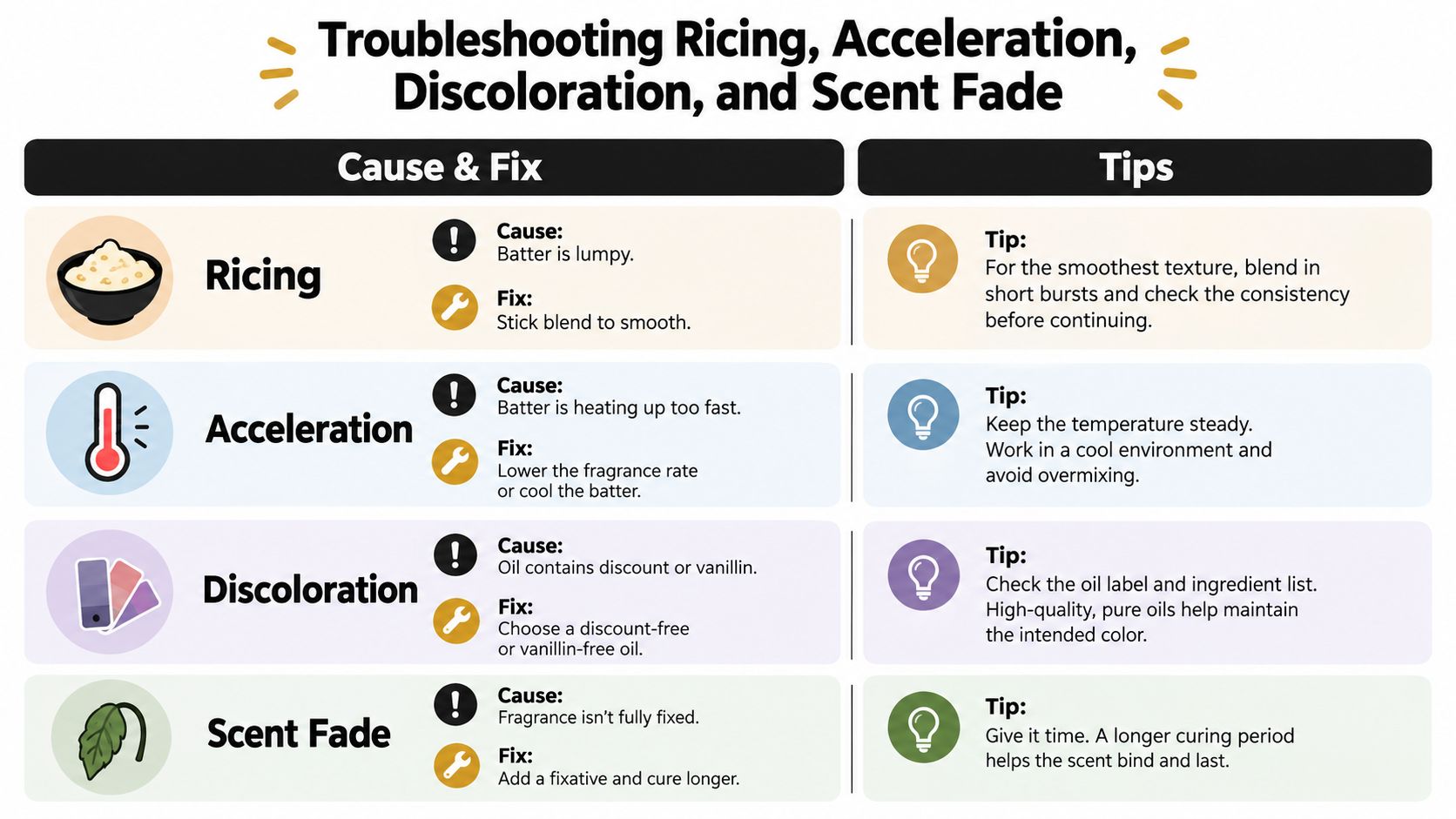
Fragrance problems become easier to solve when you diagnose the reaction instead of treating every failed batch as the same issue. Keep a sample of the fragrance, your recipe notes, and the batter temperature together so you can compare results.
Ricing
What you see: Small grains or soft lumps appear after adding the fragrance.
Likely cause: The fragrance isn't dispersing smoothly in the soap batter, or one of its components is reacting with the mixture.
What to do: Stop adding decorative details and work the batter gently with a stick blender if the mixture remains stable. If the lumps smooth out, pour a simpler design. If the batter continues to separate, don't force a retail-quality bar from a visibly unstable batch.
Acceleration
What you see: The batter thickens almost immediately after fragrance addition.
Likely cause: The fragrance and your process conditions are combining in an unfavorable way. Temperature, water level, blending intensity, and fragrance composition can all influence available working time.
What to do: Use a simpler design, reduce unnecessary stick blending, and test the fragrance at a cooler process temperature if your recipe allows it. Never lower the fragrance rate below a safe, documented formulation merely to slow trace without considering the finished scent and product requirements.
Discoloration
What you see: A cream or pale bar turns tan, brown, orange, or another unexpected shade.
Likely cause: Certain fragrance components, especially vanilla-related materials, can darken the finished soap.
What to do: Embrace the color when it suits the design, or use a different fragrance when you need a pale bar. You can also design around the change with darker colorants, layered tones, or a clearly described finished appearance. Calling a discolored bar defective may be unfair if the color shift is a known property of the fragrance.
Scent fade
What you see: The bottle smells strong, but the cured bar smells faint or loses its recognizable character.
Likely cause: Some aromatic materials don't survive the soap environment or cure as well as others. Early testing can also mislead you because fresh soap hasn't settled.
What to do: Judge the bar after cure and record the scent at multiple points. Choose a fragrance with better retention, adjust the blend only within documented safety limits, and avoid promising a scent experience you haven't confirmed in the finished product.
The fragrance oils and their uses guide can help you think beyond scent families and consider how the material fits the intended application. Your own cured samples still matter more than a bottle description.
A Repeatable Micro-Batch Test for New Fragrance Oils
A small test protects you from making a large amount of soap with an unproven fragrance. Use the same base recipe, mold style, mixing method, and fragrance scale each time so the results are comparable.
Record the conditions first
Create a one-page log with these fields:
Fragrance name, supplier, lot or batch identifier, and date received
Soap process and base recipe
Oil and lye solution temperatures at fragrance addition
Fragrance percentage and total batch mass
Time from fragrance addition to visible acceleration
Whether ricing, separation, or unusual thickening occurred
Color at pour, unmolding, and after cure
Lather appearance and any noticeable effect on the bar's feel
Scent character at unmolding and after cure
Scent retention at 30 and 60 days
The time checkpoints are useful because the bottle's first impression doesn't tell you how the bar will develop. A scent may soften into a pleasant final profile, or it may lose the note that made you choose it.
Use the same decision language
Score each category with simple terms such as acceptable, needs adjustment, or reject for this product. Don't compare a fragrance tested in a hot process batch with one tested in cold process and assume the result applies equally.
Write a short conclusion: “Suitable for one-color cold process,” “discolors too much for a pale bar,” or “retention is insufficient for this product line.” That sentence becomes more useful than a vague note such as “smells good.”
If you sell across borders, include label planning in the test. In the United States, fragrance ingredients may generally be declared collectively as “Fragrance,” but the EU requires specified fragrance allergens to be listed individually above 0.01% in rinse-off products, including soap, compared with 0.001% in leave-on products. Review the European Commission's fragrance-allergen labeling information before preparing EU-facing packaging.
Storage, Labeling, and Sourcing for Hobbyists and Small Businesses
Store fragrance oils with their caps tightly closed, away from direct light and excessive heat. Keep the original container and supplier identification so you can connect the finished batch to the exact material used.
Your paperwork should include the IFRA Certificate of Conformity, safety data, supplier lot information, and the final formula. For U.S. cosmetics, FDA explains that products must comply with the Federal Food, Drug, and Cosmetic Act and the Fair Packaging and Labeling Act. Products that meet the narrow legal definition of soap are treated differently, so your formula, claims, and presentation matter. The fragrance labeling requirements guide is a useful practical reference, but it shouldn't replace checking the rules for every market where you sell.
Use this checklist beside your mixing station:
Confirm Category 9: Check the current certificate for the exact oil.
Calculate the batch amount: Apply the limit to the finished product.
Run a micro-batch: Test process behavior and cured scent.
Plan the label: Match ingredient declarations and claims to the destination market.
Store and log: Keep the container, documents, and batch record together.
Aroma Warehouse offers fragrance oils for soap and bath-and-body use, with fresh-to-order pouring, retail and wholesale purchasing, and supplies such as bottles, droppers, and packaging materials. Those options can support a hobby formulation or a small resale workflow, provided you still verify the documentation and test each fragrance in your own process.
FAQ about Fragrance Oils for Soap Making
1. How can you tell if a fragrance oil is compatible with a particular soap recipe?
Check the supplier's usage documentation and performance notes, then test a small batch using your actual soap base, mixing method, and processing temperatures. Observe how the fragrance disperses, how quickly the mixture thickens, and whether the finished soap develops unwanted changes. A fragrance that works well in one recipe may behave differently in another.
2. Can you combine two fragrance oils when making homemade soap?
Yes, you can blend fragrance oils to create a custom scent profile, provided each material is suitable for your intended soap application. Test the combined blend in a small batch because mixing fragrances can change the aroma and how the soap behaves. Confirm that the finished blend meets applicable usage limits before making a larger batch.
3. What fragrance oil packaging is best for small-scale soap makers?
Leak-resistant bottles with secure caps are practical for storing and measuring fragrance oils in small production spaces. Choose a container size that suits your expected usage, and keep supplier identification and safety documentation with each oil. Smaller quantities can also help makers test new fragrances without committing to more inventory than they need.
4. How should soap makers compare fragrance oil costs when buying wholesale?
Compare the cost per usable unit rather than looking at the bottle price alone. Consider the fragrance's documented maximum usage rate, the amount required per batch, shipping costs, and how consistently the scent performs in your finished soap. Testing before purchasing larger quantities can help reduce waste and avoid spending money on fragrances that do not suit your product line.
5. Should soap makers keep separate fragrance oil inventory for different product types?
Keeping fragrance oils organized by approved application can simplify production and reduce the risk of using a material outside its documented intended use. Label containers clearly, retain the relevant supplier paperwork, and track lot numbers when available. Before using an oil in another product, verify its documentation and permitted concentration for that specific application rather than assuming soap approval covers every product type.
Order a small quantity of your next fragrance oil from Aroma Incense Warehouse, then test it in a documented batch before committing to larger production. Use the supplier information, Category 9 certificate, and cured-scent log together so your next soap is chosen for repeatable performance, not just a good first impression.


