

Honeysuckle Fragrance Oil: A Practical Guide for Makers
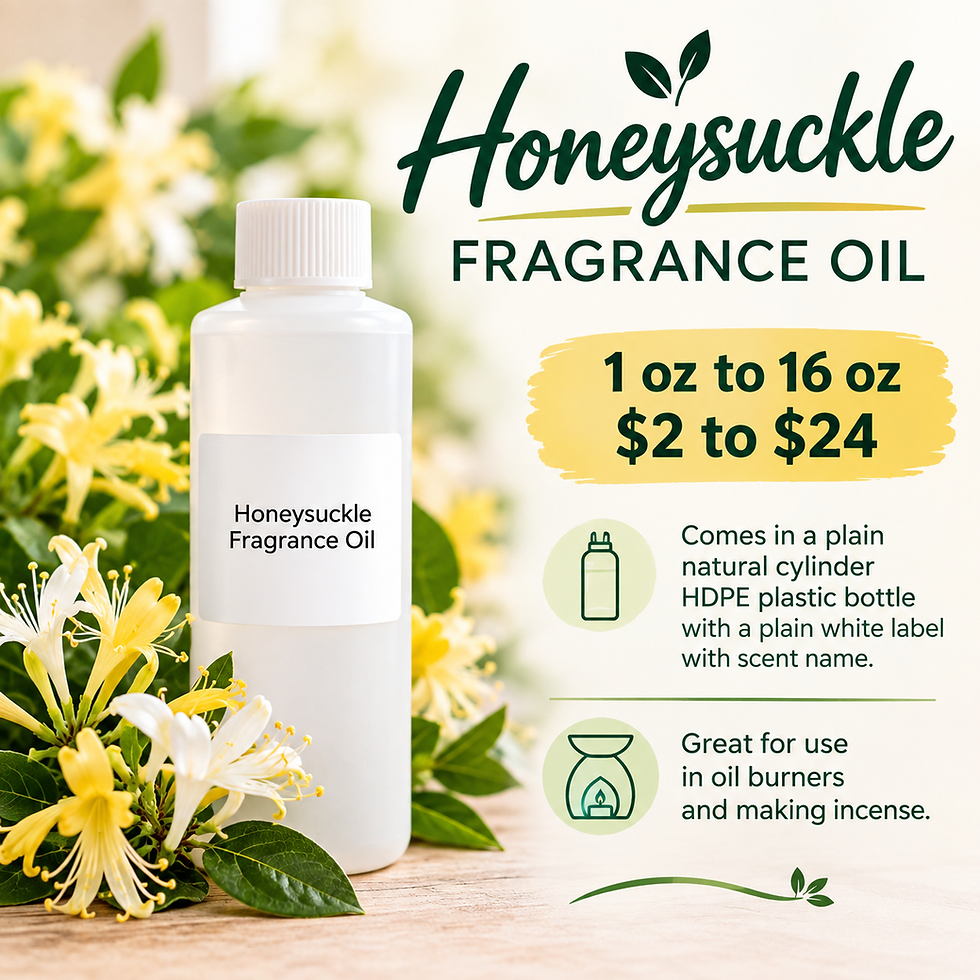
You've got the sample vial open, and the first thing you notice isn't “flower” in the abstract. It's a warm, sweet, green floral that feels familiar enough to sell, but specific enough to make you stop and sniff again. That's the moment many makers realize honeysuckle fragrance oil is less about a single plant extract and more about a carefully built scent idea.
That matters because the bottle on your desk isn't usually a straightforward flower distillation. True honeysuckle materials were historically scarce and low-yielding, which is why perfumers relied on synthetics for this floral family, and one early extraction example from Lonicera gigantea showed just how limited the material could be in practice, with tiny yields at each stage of processing, from concrete to absolute to steam distillation (Perfumer & Flavorist article). In other words, the bottle is built to be usable, repeatable, and affordable, not to behave like a fresh vine in a garden.
That's good news for makers. A well-made honeysuckle accord can be consistent from batch to batch, easier to dose, and much more practical for candles, soaps, and diffuser bases than a rare natural extraction. The questions are safer and more useful ones, like how to read IFRA paperwork, how to dilute it, what allergens may be inside, and why it performs differently in wax, surfactants, and reed diffuser blends.
Table of Contents
What Honeysuckle Fragrance Oil Is - Rebuilt, not just picked from a flower
The Scent Profile in Plain Language - The note progression buyers actually notice
What's Inside a Typical Honeysuckle Accord - The building blocks and what they do
Using Honeysuckle Oil in Candles, Soaps, and Diffusers - Candles and wax blends - Soap, sprays, and diffuser bases
Dilution, Safety, and IFRA Essentials - What to check before you pour - Keep the math simple
Blending Honeysuckle with Other Notes - Four practical blend directions
Sourcing, Storage, and Wholesale Considerations - What to verify before you place a larger order
What Honeysuckle Fragrance Oil Is
A buyer opens a sample vial expecting a simple floral and finds something fuller. The first breath usually lands as sweet flower, soft green notes, and a touch of nectar warmth, which is why honeysuckle fragrance oil often feels more like a finished perfume note than a raw botanical. That is the point of the material.
Rebuilt, not just picked from a flower
In commercial perfumery, honeysuckle is usually a reconstructed accord, not a steam-distilled essential oil. True honeysuckle materials have been hard to obtain in usable quantity, so perfumers have long relied on synthetics to represent floral notes like this one. Modern formulas often combine aroma chemicals such as phenethyl alcohol, linalool, linalyl acetate, methyl dihydrojasmonate, and benzyl salicylate to build the sweet-floral impression.
That structure matters. A reconstructed fragrance oil is easier to reproduce, easier to scale, and far more predictable in wax, soap, and diffuser bases than a one-off natural extract. Some supplies may include natural material, but the scent is still usually stabilized and shaped with synthetics so the aroma stays consistent from batch to batch.
Practical rule: if a honeysuckle bottle smells polished and consistent, that means the formula is doing its job, not that it is “fake.”
A good way to frame it for buyers is simple. The accord is built to capture honeysuckle's best-known facets, not to behave like a living vine. That is why makers can use it in candles, soaps, lotions, and room scents with much more confidence than they would have with a delicate natural extract.
For wholesalers and makers, the useful questions are practical ones. Is the oil IFRA-compliant for your product type, which allergens need to be declared, how much should you dilute, and how will the scent act in wax, surfactants, or diffuser base? A general floral fragrance guide can help with that wider context, including how flower oils are handled in bath and body products, such as the discussion at Aroma Warehouse's flower fragrance oil guide.
The Scent Profile in Plain Language
Honeysuckle fragrance oil usually reads as sweet floral first, but that's only the opening. If you've smelled jasmine, you already have part of the map. The two share a lush, creamy floral character, but honeysuckle often leans a little greener and nectar-like, with a cleaner lift that keeps it from feeling heavy.
The note progression buyers actually notice
At the top, the scent often feels bright and airy, with a citrusy-green sparkle. That opening matters most when you first warm a candle or open a diffuser bottle, because it gives the impression of freshness before the deeper floral body takes over. In the heart, the recognizable honeysuckle impression shows up, sweet, honeyed, and floral in a way that feels close to a garden bloom at dusk. The drydown tends to soften into musk, a faint woody trace, or a powdery floral residue that lingers after the brighter notes fade.
Here's the easiest way to describe it to customers without getting too technical. It starts fresh, turns creamy and floral, and settles into a soft sweet finish. That wording works because it matches how the accord is built and how it's usually experienced across product formats.
Phase | Dominant Notes | What It Smells Like | Typical Duration |
|---|---|---|---|
Top | Citrus, green lift | Bright, fresh, slightly leafy opening | First few minutes |
Heart | Honeysuckle, jasmine-like floral, honeyed nectar | The main floral body, sweet and blooming | Middle of the burn or wear |
Base | Musk, soft woods, powdery floral residue | Smooth finish, round and lingering | Hours in finished products |
The same bottle won't smell identical in every format. In candles, the sweeter part usually comes forward more strongly. In soaps, the green and clean floral edges can feel sharper. In diffusers, the floral heart often stays the clearest because it's released slowly from the base.
A simple customer-facing description works well. Say sweet floral with honeyed nectar, green freshness, and a soft clean finish. That tells buyers what they'll smell without overpromising a real botanical extraction.
What's Inside a Typical Honeysuckle Accord
A typical honeysuckle fragrance oil contains a small set of aroma chemicals, each chosen to shape one part of the scent or make the blend work in a finished product. The bottle may smell like one flower, but the structure is usually a layered mix of floral, green, honeyed, and musky materials.
The building blocks and what they do
Linalool often contributes fresh floral lift, and it also matters because it can appear on allergen declarations. Benzyl acetate supports a jasmine-like sweetness, while hydroxycitronellal helps create the classic soft floral body and can trigger labeling attention in cosmetic contexts. Hedione brings diffusion, the airy radiance that helps a scent feel open instead of flat.
Methyl anthranilate is useful because it gives a sweet, fruity, nectar-like undertone that many people read as “honeysuckle” even when no natural honeysuckle extract is present. A small green accent such as cis-3-hexenol can keep the accord from becoming too syrupy. On the base, soft musks such as galaxolide or habanolide help the fragrance last without making it feel heavy.
Formulation note: the materials that make the fragrance smell beautiful are sometimes the same ones that make compliance more complicated.
A commercial honeysuckle oil may also include phenethyl alcohol, linalool, alpha-amylcinnamaldehyde, eugenol, and isoeugenol in specific proportions, which shows that the accord is built from multiple aroma chemicals rather than a single natural source. One composition sheet from Madar Corporation shows that kind of blended structure in practice (Madar honeysuckle fragrance composition). That matters because the ingredient mix affects allergen disclosure, IFRA category limits, and how the oil behaves in paraffin, soy, and soap.
Aroma Chemical | Sensory Contribution | Why It Matters |
|---|---|---|
Linalool | Fresh floral lift | Often part of allergen labeling and scent brightness |
Benzyl acetate | Sweet jasmine-like floral tone | Helps build the floral heart |
Hydroxycitronellal | Soft classic floral body | Can affect declaration and safe-use review |
Hedione | Airy diffusion | Helps the scent project in finished products |
Methyl anthranilate | Honeyed, fruity nectar nuance | Makes the accord feel recognizably honeysuckle |
Cis-3-hexenol | Green leaf effect | Keeps the blend fresh instead of syrupy |
Galaxolide or habanolide | Soft musk base | Supports lasting power in candles and room scents |
The practical takeaway is straightforward. When you see honeysuckle on a spec sheet, you are really buying a designed scent structure. That structure decides what to declare, how much to use, and how strong the result will feel in your actual product.
Using Honeysuckle Oil in Candles, Soaps, and Diffusers
A good honeysuckle bottle can behave nicely across several formats, but it won't behave the same way in each one. Makers often expect one fragrance to act like a universal ingredient, then get confused when a candle smells round and sweet while soap smells sharper and a diffuser seems lighter. That's normal. The carrier and curing method change what comes forward.
Candles and wax blends
For candles, the practical first question is how the scent throws in your wax system. Makers commonly test around 6 to 10 percent fragrance load in soy or coconut wax, then adjust by scent strength, wax type, and wick performance. Cure time matters too, because cold throw often changes after the candle has rested, and hot throw only reveals itself after the wax has fully set and stabilized.
The safest workflow is simple. Start with a small test pour, record the weight of fragrance used, burn the candle after the recommended cure period for your wax, and compare the first burn with later burns. A floral accord like honeysuckle usually shows more sweetness in wax than it does from the bottle, so don't judge it too quickly.
Soap, sprays, and diffuser bases
In cold-process soap, honeysuckle-style blends can speed trace, so a cooler lye temperature and a more deliberate mixing pace help. Some makers split the fragrance, adding part at emulsion and part later, to keep the batter workable. Melt-and-pour soap is gentler, but even there the scent can shift once the base cools and sets.
For reed diffusers, a recent DIY formulation used honeysuckle fragrance oil with fractionated coconut oil and rubbing alcohol, and emphasized narrow-mouthed jars and reed flipping for better throw; a related guide on diffuser bases is available at Aroma Warehouse's DPG diffuser base article. Room sprays need more testing because clarity, stability, and skin contact all matter at once. If the fragrance includes opaque or heavy components, it may cloud a spray base, so test before you commit to a large batch.
A helpful way to compare formats is this:
Candles: sweeter, fuller, and warmer, with the honeyed side pushed forward.
Soaps: cleaner, brighter, and sometimes sharper because the base washes away quickly.
Diffusers: more linear and floral, with the heart note staying visible for longer.
Room sprays: fast impression, but they need clarity and stability checks before sale.
Use the product, not just the bottle, as your test surface. A fragrance that smells beautiful on a blotter can still misbehave in wax or turn cloudy in a spray base.
If you make leave-on body products, you need a skin-safe version and the right documentation before you scale. For that reason, a honeysuckle oil that works in candles may still be the wrong choice for lotion unless the certificate and category limits support it.
Dilution, Safety, and IFRA Essentials
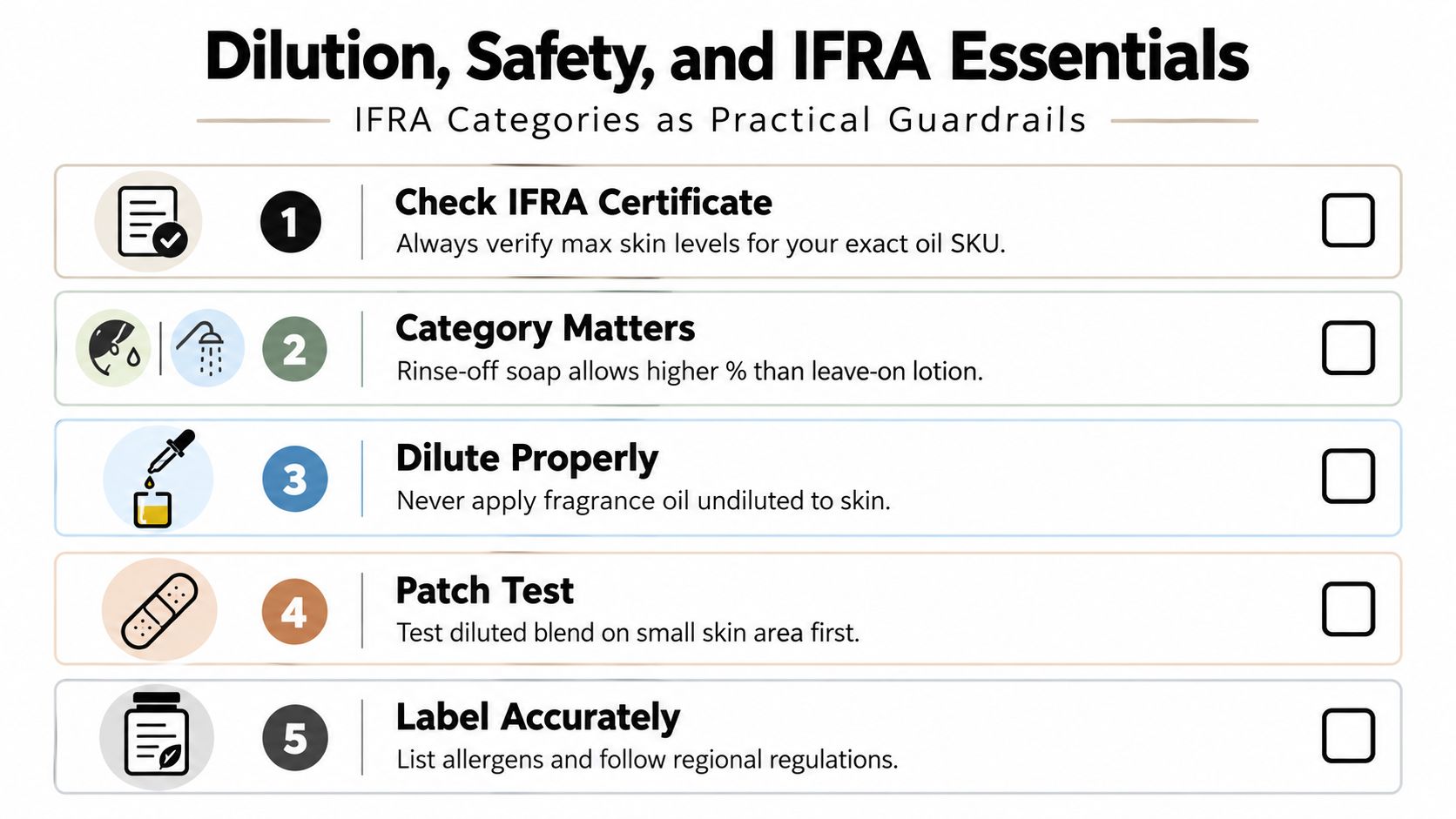
Safety sheets can feel dry, but they're the part that protects your product line. IFRA categories are best treated as practical guardrails, not bureaucratic clutter. They tell you how much of a specific fragrance oil can be used in a finished product depending on whether it's a candle, a rinse-off soap, or a leave-on lotion.
What to check before you pour
A honeysuckle oil can contain regulated sensitizers and allergen-relevant ingredients that affect labeling and safe use. One IFRA-related certificate lists benzyl benzoate at 35.8127%, hydroxycitronellal at 4.7393%, hexyl salicylate at 4.0%, and eugenol at 0.4568%, while another safety sheet lists methyl dihydrojasmonate at 10 to 20%, benzyl benzoate and linalool at 1 to 5%, and hexyl cinnamal at 1 to 5% (IFRA-related honeysuckle documents). Those numbers matter because they show why the same fragrance can be fine in one product and too concentrated in another.
Allergen declaration also matters. Floral accords often involve ingredients such as linalool, geraniol, citronellol, and hydroxycitronellal, so buyers need to check both the safety sheet and their regional labeling rules. If you sell wholesale, the SDS belongs in your vendor file, and the IFRA certificate should match the exact SKU you're buying.
Practical rule: never assume “fragrance oil” means “safe at any dose.” Safety comes from the exact formula, the product type, and the final concentration.
Keep the math simple
Dilution is easier when you stay methodical. Start with the finished product, check the fragrance certificate for the right category, and calculate from the total batch weight, not from a vague estimate. That approach helps whether you're making soap, lotion, or a candle blend.
For skin products, patch testing is still worth doing even when the paperwork looks good. For burners, candles, and reed diffusers, the main concern shifts toward correct loading, ventilation, and user instructions. If you need a solvent for diffuser work or fragrance handling, a product guide such as Aroma Warehouse's DPG overview can help you compare base choices with your formula.
Blending Honeysuckle with Other Notes
Honeysuckle already brings its own mix of floral, green, and sweet nectar tones, so the easiest blends don't fight that character. They reinforce it. If you pair it with the wrong partner, the scent can turn muddy or too sugary. If you pair it well, the accord gets clearer and more usable.
Four practical blend directions
A bright citrus-floral blend works when you want the opening to feel lively. Bergamot and sweet orange can sharpen the top, while honeysuckle keeps the heart floral and soft. That mix is useful for spring candles and cheerful room sprays.
A green garden blend leans into leafier notes. Violet leaf and fresh cut grass style accents help the honeysuckle feel like a living vine instead of a dessert floral. That direction is especially useful when you want the scent to feel airy rather than romantic.
A soft woody base gives the fragrance more structure. Sandalwood and a touch of musk can steady the sweetness, which helps in candles that need a smoother drydown and in body products that shouldn't smell overly bright. A romantic version uses rose with a hint of vanilla, which pushes the perfume side of honeysuckle and gives it a softer, more intimate finish.
The basic pairing rule is simple. Match like with like, then use the base to keep the blend from drifting. If the honeysuckle smells too syrupy, add green or wood. If it feels too sharp, add a creamy floral or a soft musk.
Recipe Name | Top Notes | Middle Notes | Base Notes |
|---|---|---|---|
Citrus Floral Lift | Bergamot, sweet orange | Honeysuckle | Soft musk |
Green Garden Blend | Fresh cut grass style notes | Honeysuckle, violet leaf | Light woods |
Soft Woody Balance | Bright citrus touch | Honeysuckle | Sandalwood, musk |
Romantic Bloom | Bright floral lift | Honeysuckle, rose | Vanilla, soft musk |
A blending guide for candle makers can be helpful when you're testing proportions and deciding how much support a floral needs in wax, such as the practical notes in Aroma Warehouse's fragrance blending article. Still, the biggest mistake is easy to avoid. Don't bury honeysuckle under too many notes. It already carries a lot of scent identity, so one or two smart partners usually work better than a crowded recipe.
Sourcing, Storage, and Wholesale Considerations
Buying honeysuckle fragrance oil in bulk is a quality-control task, not a guess. The bottle may look the same from supplier to supplier, but the paperwork, batch behavior, and storage needs decide whether the oil is fit for resale. A pretty scent only helps if it still performs well in the finished product.
What to verify before you place a larger order
Start with the documents. Ask for the SDS and the current IFRA certificate for the exact SKU, then check that the CAS or product identifier on the certificate matches the bottle you plan to buy. If the supplier shares allergen declarations, read those before you commit. That is the quickest way to catch a mismatch before production starts.
For first tests, order a small sample, let it rest, then evaluate it in the product you want to sell. Smell it straight from the bottle, then test it in a candle, soap base, or diffuser base, because the scent can shift after dilution. If you are comparing suppliers, smell several lots side by side so you can judge consistency instead of assuming every honeysuckle oil will act the same.
Good sourcing means checking the same fragrance in more than one setting, not trusting the bottle alone.
A supplier's technical sheet can also show whether a batch is likely to stay consistent. COA details such as specific gravity, refractive index, and flash point help you spot a stable fragrance profile. Wholesale terms matter too, including minimum order quantities, lead times, return policies for defective fragrance, and whether bulk drums or private-label packaging are available. For a broader look at sourcing options, see our guide on where to buy fragrance oils for candles.
For storage, keep the bottle sealed in amber glass or HDPE, away from heat and light, in a cool room. Floral accords usually last longer when you protect them from air and UV exposure, and labels should include the proper INCI naming and batch number for resale. Keep a simple scorecard with your own test notes, batch dates, and finished-product results. Over time, that record shows which supplier stays consistent and which one only smells good in the sample vial.
Frequently Asked Questions
1. How should honeysuckle fragrance oil be stored between uses?
Store honeysuckle fragrance oil tightly sealed in a cool, dark location away from direct sunlight and excessive heat. Limiting exposure to air, UV light, and temperature swings can help preserve the fragrance between uses.
2. Can honeysuckle fragrance oil be mixed with other fragrance oils?
Yes. Honeysuckle can be combined with complementary floral, citrus, green, woody, and musky fragrance notes to create custom scent profiles. Small test batches are recommended before making a larger quantity.
3. How can you tell if a honeysuckle fragrance oil has changed over time?
Compare the current oil with a retained sample or previous batch. Changes in odor, appearance, clarity, or performance in a finished product can indicate that the fragrance has changed or degraded during storage.
4. Should makers test a new honeysuckle fragrance oil before buying it in bulk?
Yes. A small sample lets you evaluate the fragrance in the actual product you intend to make rather than relying only on how it smells directly from the bottle. This can reveal differences in scent character and performance after formulation.
5. What information should wholesale buyers keep for each fragrance oil?
Keep the supplier's SDS, IFRA documentation, product or SKU identification, batch information, test notes, and finished-product observations. Maintaining these records makes it easier to track consistency between purchases and production batches.


