

Neroli Essential Oil: A 2026 Guide for Retailers

Buyers ask why neroli costs so much, others question its safety during pregnancy, and your team is left trying to explain a premium oil that seems simple until you touch the buying side. That is the core neroli problem for retailers. The bottle looks elegant on the shelf, but the questions behind it are about identity, scarcity, authentication, and responsible counsel, not just scent.
Table of Contents
What Makes Neroli Essential Oil Distinct - Why the name is tied to the blossom oil
How Neroli Oil Is Extracted and Why Yield Matters - What the extraction process really involves
Aroma Profile and Chemical Composition Explained - Turning chemistry into sales language
Historical Positioning and Modern Perfumery Use - Why perfumers still reach for it
Practical Applications Across Diffusion, Topical Blends, Bath, and Perfumery - Matching format to customer intent
Safety Guidance and the Pregnancy Use Question - How to talk about exposure without overpromising
Authentication Standards and Wholesale Sourcing Decisions - What to ask for before you buy
Storage Practices and Inventory Turnover for Retailers - Simple rules that protect margin
What Makes Neroli Essential Oil Distinct
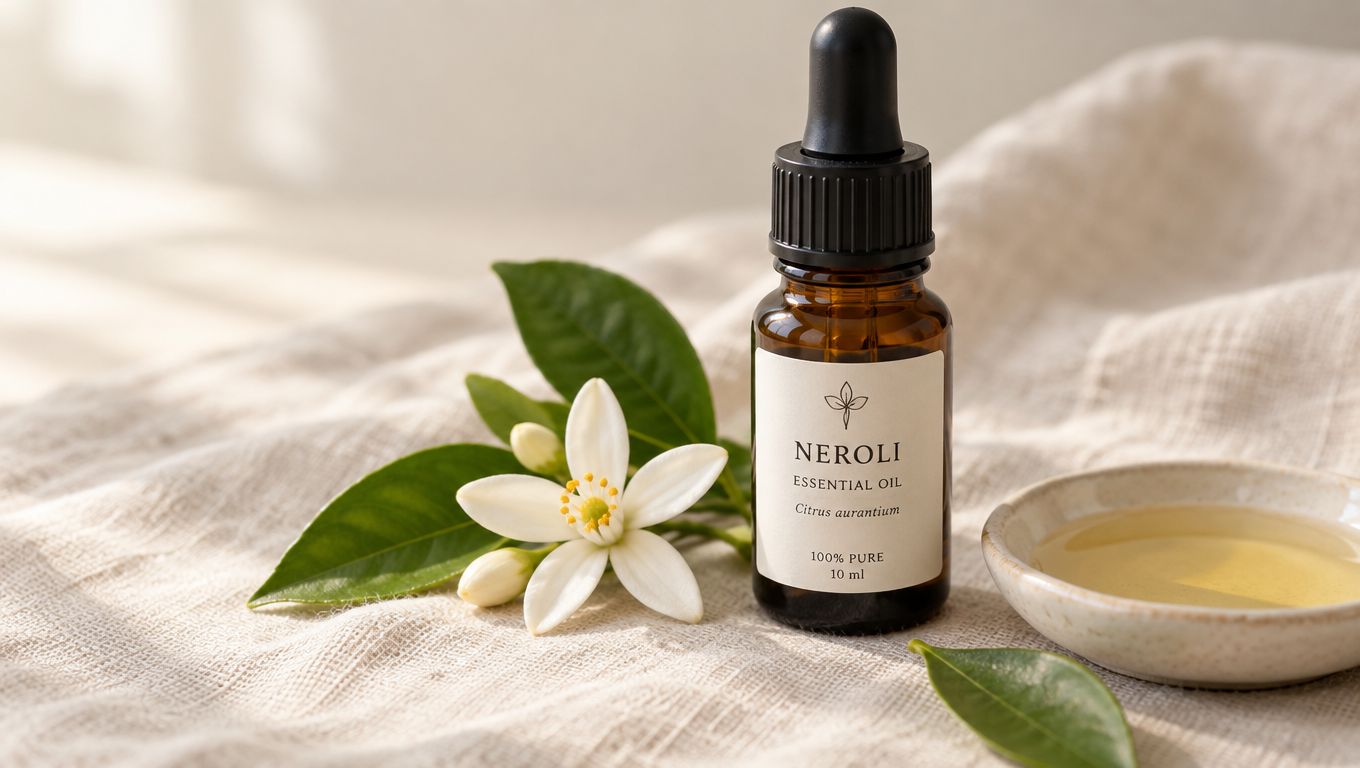
A customer once held two bottles up at the counter and asked why one said neroli, another said petitgrain, and both came from orange blossom material. That's a common retail moment, and it's where confusion starts. Neroli essential oil is the steam-distilled oil from bitter orange blossoms, not from the leaves or twigs, and not from the fruit peel. That distinction matters because petitgrain and bitter-orange peel oils are different products, even though they come from the same species.
Why the name is tied to the blossom oil
The name is linked to Anne-Marie Orsini de La Trémoille, Princess of Nerola, who helped popularize bitter-orange blossom oil by using it on gloves, bath water, and writing paper. By 1709, neroli had already entered mainstream fragrance culture through Aqua Mirabilis, the Cologne tonic made by Giovanni Maria Farina, later known as Eau de Cologne. That historical path is why the name still carries weight in perfumery and retail today. The product has always been treated as a premium material, not a casual citrus note.
For staff training, the simplest rule is this, neroli = blossom oil, petitgrain = leaf and
twig oil, and peel oil = fruit rind oil. That's also the best way to prevent returns and mislabeling. If a buyer wants a floral top note for a signature blend, neroli fits one brief. If they want a greener, more herbal citrus profile, that's a different product entirely.
Practical rule: if the supplier description can't clearly state blossom origin, treat the lot carefully until the documentation is clear.

The botanic name you're really dealing with is Citrus aurantium L. var. amara, also called Bigaradia. That precision helps when you're buying for resale, because it keeps marketing copy, shelf labeling, and customer expectations aligned.
For a quick refresher on oil families and flower waters, this comparison of hydrosol vs essential oil is a useful reference point for staff.
How Neroli Oil Is Extracted and Why Yield Matters
Neroli stays in a premium bracket for a simple reason, the blossoms give up very little oil. A hydrodistillation study reported a yield of 0.12% from bitter-orange material under its test conditions, and real-world output shifts with flower quality, geography, harvest timing, and extraction method (TandF study). That kind of return hits wholesale margins fast, especially when demand is steady but supply is narrow.
What the extraction process really involves
Neroli blossoms are handled gently, then steam or hydro distillation draws the volatile aromatic compounds out of the plant material. That is why it is an essential oil, not a cold-pressed citrus oil. Cold pressing fits citrus peel, where the rind carries expressed oil glands. Blossom material is different, and solvent extraction would produce an absolute instead of a true essential oil.
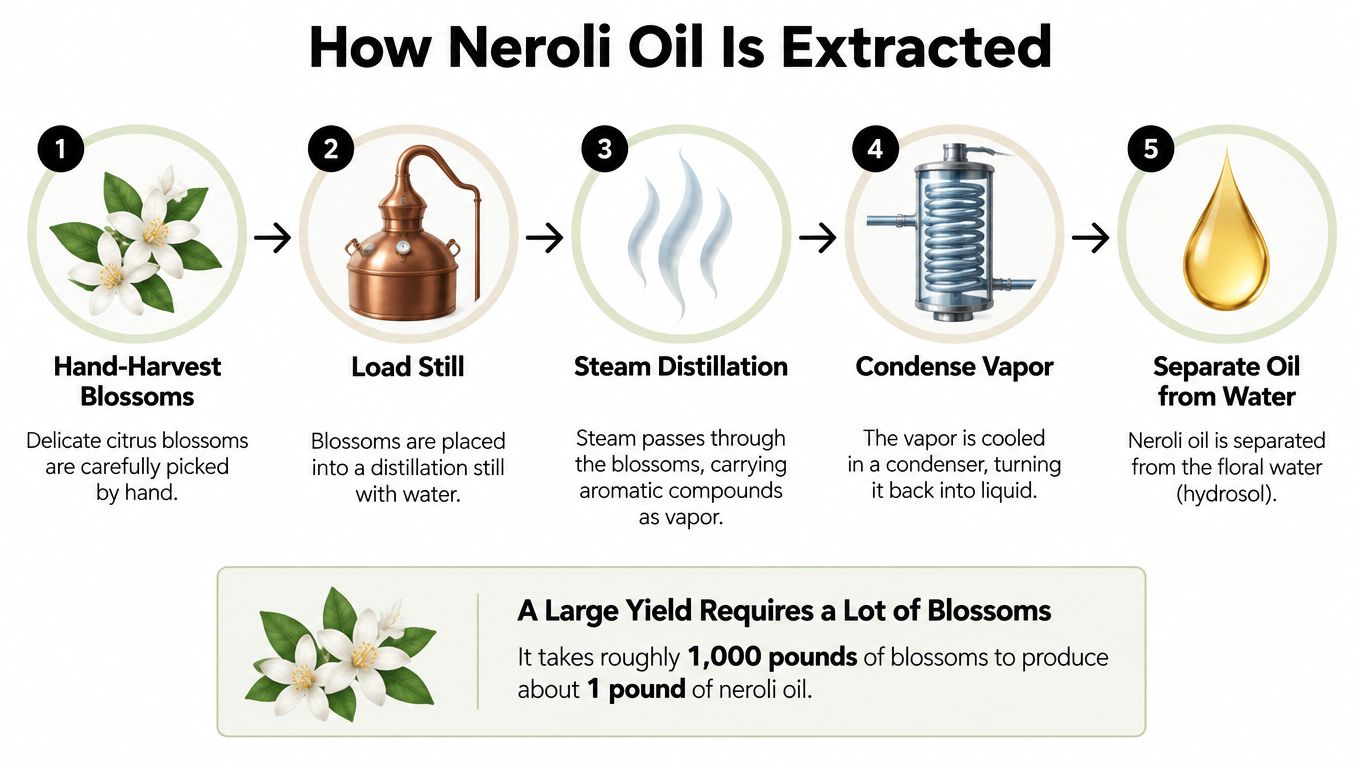
Supply concentration follows from that low yield. Production in Tunisia and Morocco is described as approximately 1,500 kilograms, which accounts for more than 90% of worldwide output, while total global production is said to be less than 2,000 kilograms per year. Egypt, Spain, and the Comoros together contribute no more than about 150 kilograms (TandF study). In practice, that means a seller cannot pretend the material is common and stay credible for long.
The trade-off is clear. Authentic neroli costs more because it takes a large amount of blossom material, and the supply chain is narrow. A price that looks unusually low deserves paperwork review before a purchase order, not after the stock arrives.
Retailers face the same verification mindset with other aroma products, such as the identity and handling checks discussed in mango essential oil, where documentation and storage details shape the customer experience just as much as scent.
Aroma Profile and Chemical Composition Explained
Open a bottle of neroli and the first impression is rarely just floral. The scent usually reads as blossom, citrus, and a faint green freshness, which is why it feels refined rather than flat. A chemical study of Tunisian Citrus aurantium var. amara identified linalool, linalyl acetate, and limonene as the main constituents, and those compounds help explain the oil's bright but not harsh character.
Turning chemistry into sales language
Linalool contributes floral softness. Linalyl acetate supports the smooth, sweet, lightly

fruity side that buyers often associate with higher quality. Limonene brings the citrus lift customers notice first. On the sales floor, describe neroli as a soft blossom-citrus oil so staff can explain it clearly without drifting into vague floral language.
That profile also helps when one lot smells different from another. Neroli can shift with origin, harvest conditions, and extraction method, so one batch may lean more floral while another feels more sparkling or green. That variation does not automatically point to a problem. It often reflects how the material expresses itself.
For retailers, that distinction matters. It gives your team a way to compare incoming stock against the aroma customers expect, and it gives you a practical check when a sample smells thin, harsh, or oddly sweet. In those cases, the question is not just whether the oil smells pleasant. The central question is whether the lot matches the profile you can stand behind on the shelf.
The chemistry also supports later authentication checks. In wholesale buying, you are not only purchasing a fragrance, you are buying a scent profile that has to stay consistent enough for blending, labeling, and repeat sales.
Historical Positioning and Modern Perfumery Use
Neroli has long carried luxury weight because it entered fragrance culture as a prized material rather than a mass-market scent. Its historical production spread across Italy, southern France, North Africa, and Spain, and that same Mediterranean and Maghreb corridor still influences how buyers source it today. (Osmetheca)

Why perfumers still reach for it
Perfumers still use neroli for the way it opens a formula with brightness and restraint. In finished work, it gives a polished floral-citrus lift that can sit above citrus, spice, and wood accords without turning heavy. Orange blossom absolute sits differently in that same formula, so the two materials are useful for different effects rather than interchangeable.
That distinction matters on the retail side too. If a customer expects the richer, denser texture of an absolute, neroli can seem lighter and more transparent. If they want a cleaner floral-citrus profile, neroli usually fits better.
Retailers also need to price and explain it with care. Neroli's reputation comes from both aroma and supply economics, because authentic material depends on a limited production chain and careful handling from blossom to bottle. That makes provenance a practical selling point, not just a heritage story.
For finished fragrance education, the oil-based perfume angle helps staff explain how neroli performs once it is blended into a wearable scent. It also gives retailers a useful framework for discussing texture, longevity, and the trade-offs between a delicate floral oil and a denser perfume material.
Practical Applications Across Diffusion, Topical Blends, Bath, and Perfumery
Different customers buy neroli for different outcomes, and your recommendation should match the use case. In a wellness studio, diffusion is usually the easiest entry point because it lets the aroma do the work without skin contact. For body care or facial blends, topical use demands more caution and a smarter carrier choice. Bath use sits in the middle, pleasant but easy to misuse if the oil is dumped straight into water.
Matching format to customer intent
Diffusion suits meditation spaces, reception areas, and retail gift sets because it gives the customer the scent experience quickly. Topical blends fit cosmetic formulators and self-care buyers who want a personal ritual, but they need proper dilution and a compatible carrier oil. Baths can work well for spa-style retail baskets, but the oil needs emulsification guidance so it doesn't sit as a slick on the water surface.
Perfumery is the most technical route. Neroli functions well as a heart note, especially where a formula needs floral polish without losing brightness. It can sit comfortably with woody and spicy bases, but it's not the same as blending fragrance oils by volume. A good formula respects evaporation behavior, not just scent preference.
For wellness centers, digital reminder systems can help staff keep treatment notes and product recommendations organized, and BonusQR for wellness centers is one tool some operators use to manage that side of the customer experience.
Retail takeaway: don't recommend one neroli format for every buyer, recommend the format that matches how they'll actually use it.
If someone wants a home diffuser oil, sell the diffuser oil. If they want a bath ritual, explain how to disperse it properly. If they want a fragrance base, talk about the way neroli behaves in a composition rather than just naming other oils it “blends well with.” That keeps the conversation practical and prevents the kind of disappointment that comes from giving elegant advice that doesn't work in practice.
Safety Guidance and the Pregnancy Use Question
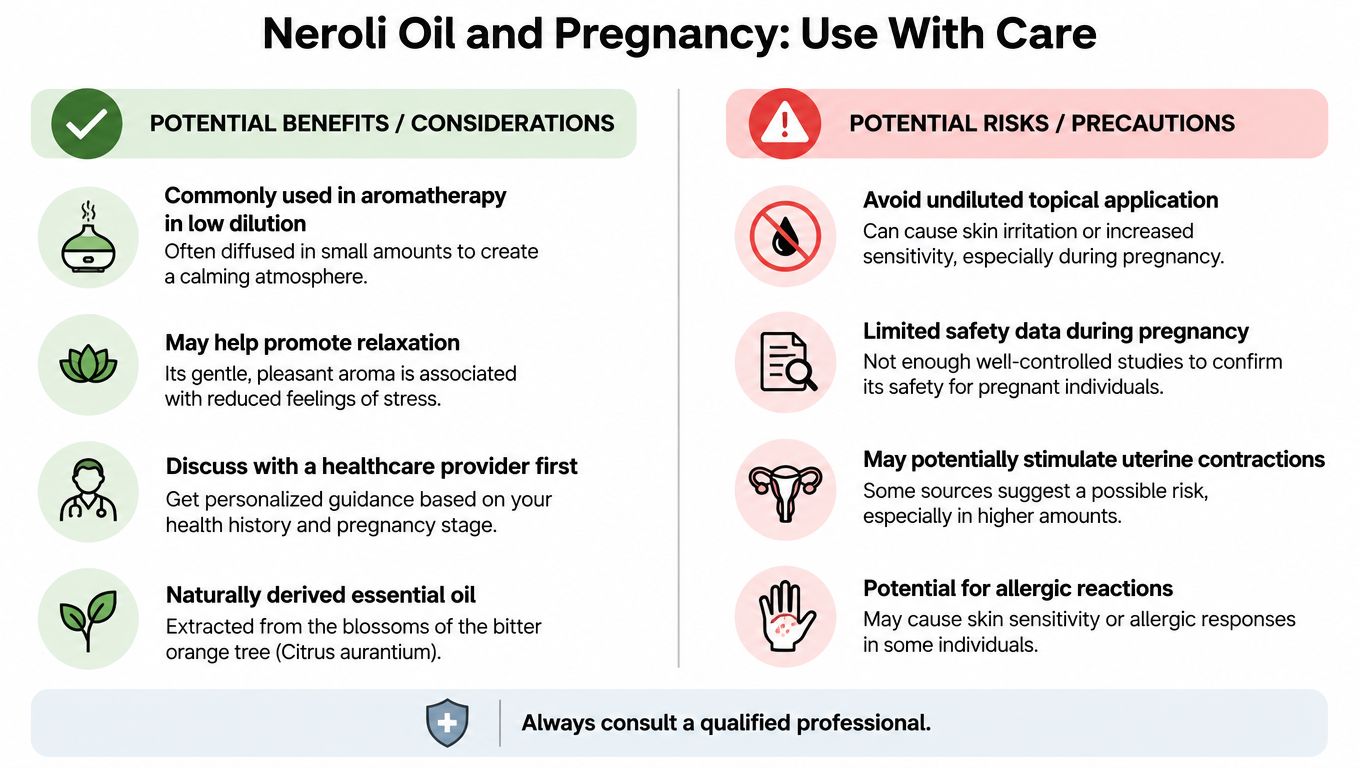
Retailers get pressed for a simple yes or no on pregnancy safety, but that answer is not supported by the evidence. UK Teratology Information Services says there are no epidemiological or evidence-based studies establishing essential-oil safety during pregnancy, and the evidence base is mainly anecdotal case reports and historical opinion. It also notes that ordinary toiletry products usually contain very low essential-oil concentrations, typically below 0.01%, while higher-concentration exposure such as massage has not been systematically studied (UKTIS).
How to talk about exposure without overpromising
Exposure route changes the conversation. Diffusion is one thing, topical application is another, and accidental undiluted contact creates a separate risk. A diluted skin blend is not equivalent to massage-level exposure, so the buyer asking about pregnancy needs product-specific guidance, not a blanket reassurance.
General medical guidance advises against applying essential oils directly to skin, and people with atopic dermatitis or previous topical-product reactions face a higher chance of irritation. That means “sensitive skin” deserves a proper explanation of dilution, patch testing, and when to stop using the product and speak to a clinician.
An absence of evidence is not the same as evidence of safety, and your counter language should reflect that gap. Avoid telling customers that neroli is “safe in pregnancy,” because that goes further than the evidence allows. Keep the guidance narrower: follow product directions, do not ingest it, be cautious with skin exposure, and advise a qualified clinician if the buyer is pregnant, manages asthma or eczema, or has a history of reactions. That is the level of caution retailers can stand behind.
Authentication Standards and Wholesale Sourcing Decisions
A premium neroli lot should be judged against ISO 3517 first, not against price tags or sales talk. The standard looks at a set of marker compounds, including alpha- and beta-pinene, sabinene, limonene, (E)-beta-ocimene, linalool, alpha-terpineol, linalyl acetate, neryl and geranyl acetate, (E)-nerolidol, and (E,E)-farnesol (Scientific Reports). That gives buyers a practical reference point for whether a sample behaves like genuine neroli.
What to ask for before you buy
The most useful paperwork starts with a lot-specific GC-FID or GC-MS report. In one online-market study, some samples went beyond the ISO linalyl-acetate range of 3 to 15%, reaching 16.19% and 21.42%, which is a clear reason to question compositional fit (Scientific Reports).
For higher-risk or higher-value lots, more advanced testing has its place. Enantioselective multidimensional gas chromatography and compound-specific stable-isotope-ratio mass spectrometry have been used to separate Egyptian geographic origin and to detect the addition of as little as 10% petitgrain oil, so they matter when a supplier's story and the sample do not line up (Scientific Reports).
For wholesale decisions, a workable checklist keeps emotion out of the process:
Request a lot-specific GC-FID or GC-MS report. A generic spec sheet is not enough for a premium lot.
Check the ISO marker ranges. The report should show the full marker profile, not just one headline compound.
Watch for unusual linalyl acetate or terpene ratios. Outliers deserve questions before they reach the shelf.
Escalate disputed or high-value lots to isotope or enantiomer testing. The lab cost is easier to justify than a batch of mislabeled stock.
If a supplier cannot show clean documentation, the burden shifts to you. The aim is not to prove fraud in every case, it is to keep diluted or mislabeled oil out of customer hands under a premium name. For a broader supplier-facing reference on product sourcing guidance, Aroma Warehouse offers a practical starting point.
Storage Practices and Inventory Turnover for Retailers
Neroli loses value fast when it's stored carelessly. Light, heat, and air are all working against a delicate aromatic material, and retailers often discover that after the fragrance has already shifted in the bottle. The fix is boring but effective, keep it protected, keep it stable, and keep it moving.
Simple rules that protect margin
Amber glass matters because clear packaging invites unnecessary degradation. Temperature stability matters because swings accelerate quality loss. Larger containers need minimal fill space once opened, since extra headspace means more oxygen exposure over time. None of that is glamorous, but it protects the scent profile that justifies the price.
Rotation should follow older lots first, while still tracking which bottles have packaging integrity issues or uncertain harvest and distillation dates. That documentation matters because it helps you predict shelf longevity and decide whether a bottle should go into immediate sale stock or slower-moving back inventory. If the supplier can't clearly show dates and condition, the lot deserves closer scrutiny.
Operational rule: don't let premium oils sit as dead stock. Neroli sells on trust, and trust erodes when the aroma drifts before the bottle moves.
For retailers carrying multiple oils, a routine expiry check pays off. How to tell if your oils have gone bad is a useful companion read if you want a simple internal reference for training or stock review.
A lean turnover system protects more than product quality. It protects customer confidence, and that matters with neroli because buyers expect the bottle to smell expensive from the first opening to the last drop. If you preserve that experience, you preserve the premium story too.
Frequently Asked Questions
1. Can Neroli Essential Oil Be Used in Candle Making?
Neroli essential oil may be considered for candle fragrance formulations, but its suitability depends on the specific oil, wax system, fragrance performance, and applicable safety limits. Before using it in a finished candle, review supplier documentation, confirm the relevant usage restrictions, and conduct small-scale testing for scent performance and stability.
2. Is Neroli Essential Oil Suitable for Homemade Soap?
Neroli essential oil may be used in some soap formulations when the supplier's documentation supports the intended application. The amount permitted depends on the specific material and the finished product category. Soap makers should verify applicable usage limits and test the formulation for scent retention, compatibility, and stability rather than assuming that a concentration suitable for one product is suitable for another.
3. What Is the Difference Between Neroli Essential Oil and Orange Blossom Water?
Neroli essential oil is the concentrated aromatic oil obtained from bitter orange blossoms through distillation. Orange blossom water, often called orange blossom hydrosol, is the water-based aromatic product associated with the distillation process. They differ in composition, concentration, and intended applications, so they should not be treated as interchangeable ingredients in cosmetic or fragrance formulations.
4. Can Neroli Essential Oil Be Used in a Reed Diffuser?
Neroli essential oil may be evaluated for reed diffuser applications, but it should not automatically be added to a commercial diffuser base without checking compatibility. Reed diffusers rely on the interaction between the aromatic material, base liquid, and reeds. Follow the base manufacturer's instructions and test evaporation, fragrance throw, clarity, and stability before preparing a larger batch.
5. What Is the Difference Between Neroli Essential Oil and Neroli Fragrance Oil?
Neroli essential oil is a botanical product distilled from bitter orange blossoms, while neroli fragrance oil is a formulated fragrance product designed to reproduce or interpret the neroli scent profile. Fragrance oils can differ in composition, performance, and application restrictions. Buyers should check the product description and technical documentation to confirm whether an ingredient is a natural essential oil, a fragrance formulation, or a blend.
If you source neroli for retail, spa use, or private-label blending, Aroma Warehouse can help you build a practical inventory around the category, from aroma education to supply-ready packaging. Visit Aroma Incense Warehouse to review the current selection and choose the format that fits your shelf, your clients, and your compliance needs.


