

Bergamot Fragrance Oil: Aroma, Uses, and Buying Guide

Have you ever bought “bergamot fragrance oil” expecting one familiar ingredient, only to discover that the bottle might contain a natural essential oil, a modified essential oil, or a constructed fragrance blend? Those products can share a name and a similar scent while differing significantly in chemistry, handling, skin suitability, and supply consistency.
The easiest way to choose correctly is to stop treating bergamot as a single material. Bergamot essential oil, bergapten-reduced essential oil, and compounded bergamot fragrance oil are three distinct products. Once you know which one you're holding, the right application and safety questions become much clearer.
Table of Contents
The Aroma Profile and Where It Comes From - What each aroma family contributes
Practical Uses in Candles, Diffusers, Soap, and Bath - Candles - Reed and ultrasonic diffusers - Cold-process soap - Bath products and skin-contact formulas
Simple Blending Recipes Anyone Can Try - A bright cologne-style direction - A tea-inspired candle direction - A citrus-herb bath direction - How to test without wasting materials
Storage, Shelf Life, and Batch Variation - Why batches can smell different
Buying and Wholesale Tips for Retailers and Resellers - Request the technical basics - Choose the right purchasing format
What Bergamot Fragrance Oil Actually Is
A buyer may select a bottle marked “bergamot” for a candle, soap, diffuser, or perfume without knowing whether it came from expressed citrus peel or a perfumer's formula. In most supplier catalogs, bergamot fragrance oil means a compounded aroma designed to reproduce the scent of Citrus bergamia. It may contain aroma chemicals, natural extracts, or both, blended into a carrier such as DPG, ethanol, or MCT oil.
That's different from conventional cold-pressed bergamot essential oil. Expressed oil contains the natural volatile and non-volatile components of the peel, including bergapten, also called 5-methoxypsoralen or 5-MOP. A bergapten-reduced or furanocoumarin-free bergamot oil has been processed to remove or reduce the components associated with phototoxicity. A compounded fragrance oil is formulated to create an odor profile and doesn't necessarily contain genuine expressed bergamot oil.
For a plain-language comparison, use this guide:
Expressed bergamot essential oil: A natural citrus oil obtained from the fruit peel. It can contain bergapten and requires careful attention to skin-use restrictions.
Bergapten-reduced or FCF bergamot oil: A modified essential oil with phototoxic furocoumarins reduced or removed. The supplier still needs to provide documentation for the intended use.
Compounded bergamot fragrance oil: A designed fragrance composition that recreates some or all of the bergamot character. Its composition and safety profile depend on the specific formula.
Perfumers can build the recognizable effect with materials associated with bergamot's aroma, including limonene, linalool, and linalyl acetate, then adjust the blend for brightness, softness, persistence, or compatibility with wax and other bases. A manufacturer may choose this route because a formulated oil can offer more predictable supply and batch behavior than a raw agricultural material.
Practical rule: Never identify an oil by scent alone. Read the product description, SDS, intended-use guidance, and any available IFRA documentation.
For a broader explanation of why these categories shouldn't be treated as interchangeable, see the differences between fragrance oils and essential oils. The label should make the product type clear so a candle maker doesn't assume a fragrance composition is an essential oil, or a skincare maker doesn't assume a candle fragrance is suitable for leave-on use.
The Aroma Profile and Where It Comes From
Why does bergamot smell both sparkling and soft? Its character moves through several scent families. The opening brings bright citrus, the middle becomes floral and tea-like, and the drydown can feel clean, slightly green, or mineral. A compounded fragrance oil can recreate this progression without copying the exact chemistry of expressed bergamot oil.
The natural reference is bergamot fruit from southern Italy, especially Calabria. A historical bergamot industry profile reports that Calabria supplied more than 90% of global bergamot production. It also records approximately 70 metric tons of bergamot oil during the 2008–2009 growing season, an estimated 125 metric tons annually by 2011, and about 19,000 metric tons of fruit processed in the 2010–2011 production year, yielding approximately 100 metric tons of essence.
The natural oil's chemistry helps explain its scent. A peer-reviewed review of bergamot oil composition describes approximately 93–96% volatile material and 4–7% non-volatile material. Within the volatile portion, limonene appears at roughly 25–53%, linalool at 2–20%, and linalyl acetate at 15–40%. These broad ranges are one reason natural batches can vary in brightness, sweetness, and floral softness.
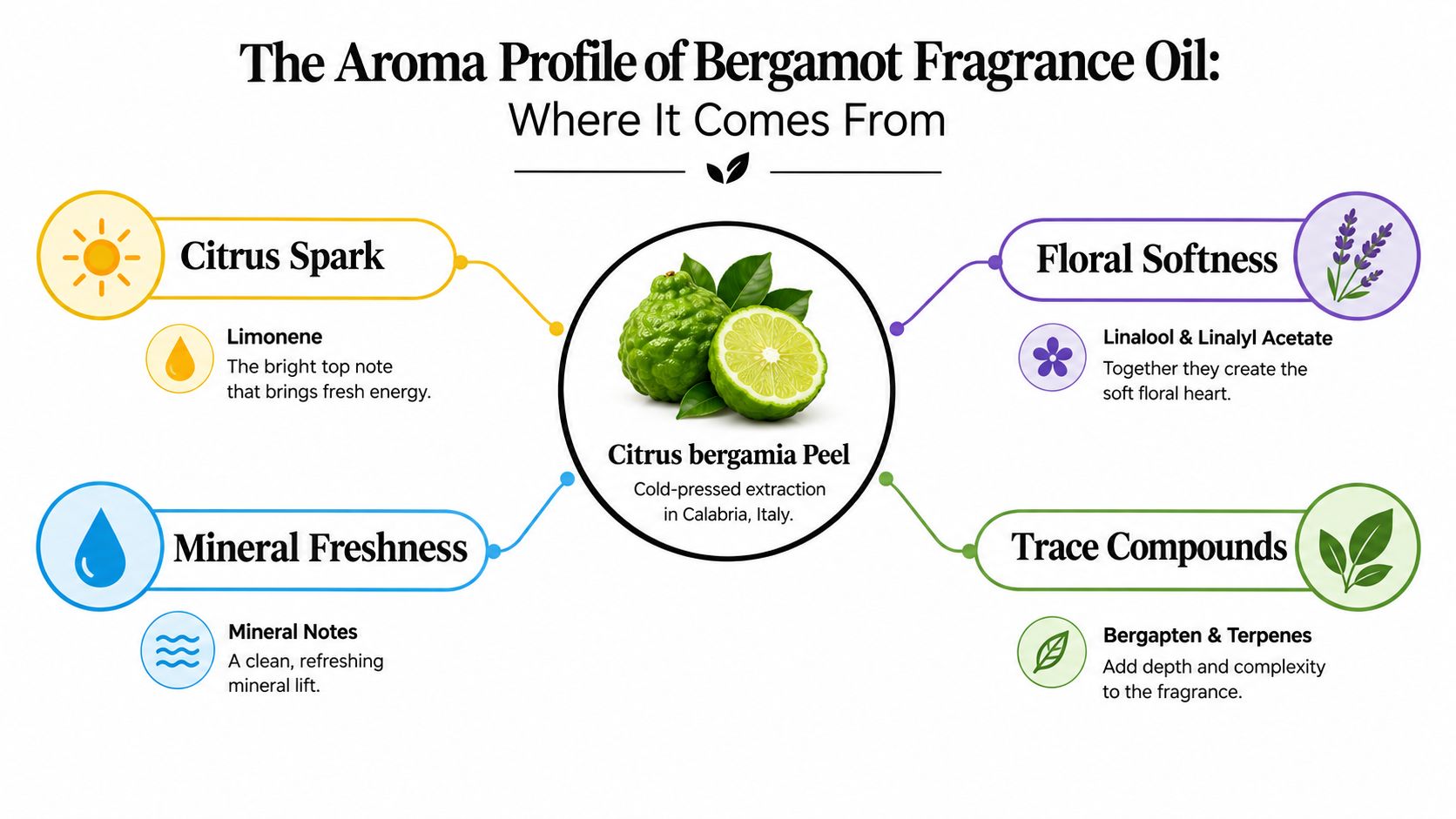
What each aroma family contributes
Limonene supplies the peel-like citrus lift.
Linalool brings a soft floral note.
Linalyl acetate creates a smooth, sweet, tea-like impression.
Gamma-terpinene and beta-pinene add terpene brightness and depth.
A published chromatographic research study found approximately 37.2% limonene, 30.1% linalyl acetate, 8.8% linalool, 6.8% gamma-terpinene, and 6.2% beta-pinene in one bergamot profile. Other origins showed different ratios, so “bergamot” describes an aromatic direction rather than one fixed chemical specification.
Product type matters when you interpret that aroma. Natural bergamot essential oil follows the fruit's chemistry, bergapten-reduced oil changes the phototoxic furocoumarin content, and compounded fragrance oil is built to achieve a selected scent effect. For a simple buying guide, choose the natural or reduced product when botanical identity matters, and choose a compounded fragrance oil when consistent performance in a specified base matters. Wax can soften the opening, alcohol can make top notes feel quicker, and soap surfactants can alter how the scent blooms. For more botanical context, see this guide to bergamot essential oil.
Practical Uses in Candles, Diffusers, Soap, and Bath
The correct bergamot fragrance oil depends on the finished product, not just the scent you want. A candle, reed diffuser, rinse-off soap, and body oil all expose people to fragrance differently, so a single “bergamot safe rate” isn't reliable.
Candles
Candle makers usually begin with the supplier's tested wax and fragrance guidance, then evaluate cold throw, hot throw, cure behavior, wick performance, and color. Citrus accords can feel very bright in a fresh pour and more rounded after the wax has settled. Test the finished candle rather than judging the fragrance oil from the bottle.
Use a scale for every batch. Measuring by drops makes it difficult to reproduce a formula because drop size changes with viscosity, bottle opening, and temperature. Record the wax, wick, vessel, fragrance identity, batch number, and tested load so you can compare results when a new shipment arrives.
Reed and ultrasonic diffusers
For passive diffusion, check that the carrier and fragrance are compatible with the reed material. The supplier should state whether the oil is ready to use or requires dilution. For ultrasonic equipment, follow the diffuser manufacturer's instructions and avoid assuming that a fragrance oil designed for wax belongs in a water reservoir.
A clean citrus opening can become harsh if the formula is overdosed. Start with the supplier's recommended range, assess the scent in the actual room, and allow time for the fragrance to disperse before adding more.
Cold-process soap
Soapmakers need to evaluate scent retention, trace behavior, discoloration, and the finished aroma after cure. Some fragrance compositions can accelerate trace, but that behavior depends on the complete formula, oils, temperature, and process. A small test batch protects a larger production run.
Bath products and skin-contact formulas
Bath salts, bath bombs, scrubs, lotions, and body oils need separate documentation. A candle-grade fragrance oil must not be transferred into a leave-on formula just because it smells pleasant. Confirm that the SDS and supplier guidance support the intended skin-contact category, then follow the applicable usage limit.
Application | Recommended rate | Key note |
|---|---|---|
Candles | Use the supplier's tested wax rate | Test throw, wick behavior, cure, and color |
Reed diffusers | Follow the fragrance and carrier guidance | Confirm compatibility with reeds and the base |
Ultrasonic diffusers | Follow the device and supplier instructions | Don't assume candle oil belongs in water |
Cold-process soap | Use the documented rinse-off limit | Test trace acceleration and cured scent |
Bath and body products | Use only a documented skin-suitable material | Check leave-on or rinse-off category before formulating |
Safety, Photosensitivity, and IFRA Dilution Basics
Bergamot needs extra attention because expressed oil can contain furocoumarins. These compounds, especially bergapten, can participate in photochemical reactions under ultraviolet exposure and increase the risk of skin phototoxicity. The concern applies to the material's chemistry, not to the word “bergamot” printed on a label.
A review reports bergapten at about 0.2% in bergamot oil, while IFRA guidance states that, when bergapten is analytically determined, the total bergapten level in consumer products applied to sun-exposed skin shouldn't exceed 0.0015%, equivalent to 15 ppm. The same guidance distinguishes situations where the bergapten level is known from those where it isn't.
That distinction makes the product identity essential:
Expressed essential oil may contain phototoxic furocoumarins.
Bergapten-reduced or FCF oil has had relevant components reduced or removed, but still requires supplier documentation.
Compounded fragrance oil may be built without natural furocoumarins, but its formula and allowed uses remain supplier-specific.
The often-repeated 0.4% figure applies to bergamot oil in certain sun-exposed leave-on applications. It isn't a universal limit for every bergamot fragrance oil, every perfume, or every product category. The European Medicines Agency assessment of bergamot oil provides useful context for why material identity and exposure route matter.
Product type | Candle | Soap or rinse-off | Leave-on lotion |
|---|---|---|---|
Decision basis | Use the supplier's candle-tested rate | Use the documented rinse-off limit | Use the documented leave-on limit |
Main concern | Combustion, scent throw, and wick performance | Skin exposure during washing | Extended skin contact and possible sunlight exposure |
Documentation to request | SDS and candle usage guidance | SDS and IFRA category guidance | SDS, IFRA certificate, allergen information, and material identity |
In the EU, bergamot-related allergens must be declared above 0.001% in leave-on products and 0.01% in rinse-off products, according to the supplier-compliance guidance summarized by Scentree's bergamot reference.html). If you're selling across borders, calculate the finished-product concentration and check the destination market rather than relying on a generic “skin-safe” claim.
For full-spectrum expressed bergamot, take particular care with body oils, balms, perfumes intended for exposed skin, and other leave-on products. A bergapten-reduced material or a documented compounded fragrance may be more suitable, but only the supplier's current technical documents can confirm that choice.
For practical label wording and documentation habits, see fragrance labeling requirements.
Simple Blending Recipes Anyone Can Try
Blending bergamot is easier when each companion note has a job. Citrus notes create lift, florals soften the middle, woods add structure, and musks or ambers can extend the dry-down. Work in parts for the concentrate, then test that concentrate in the finished product using the supplier's permitted rate.
A bright cologne-style direction
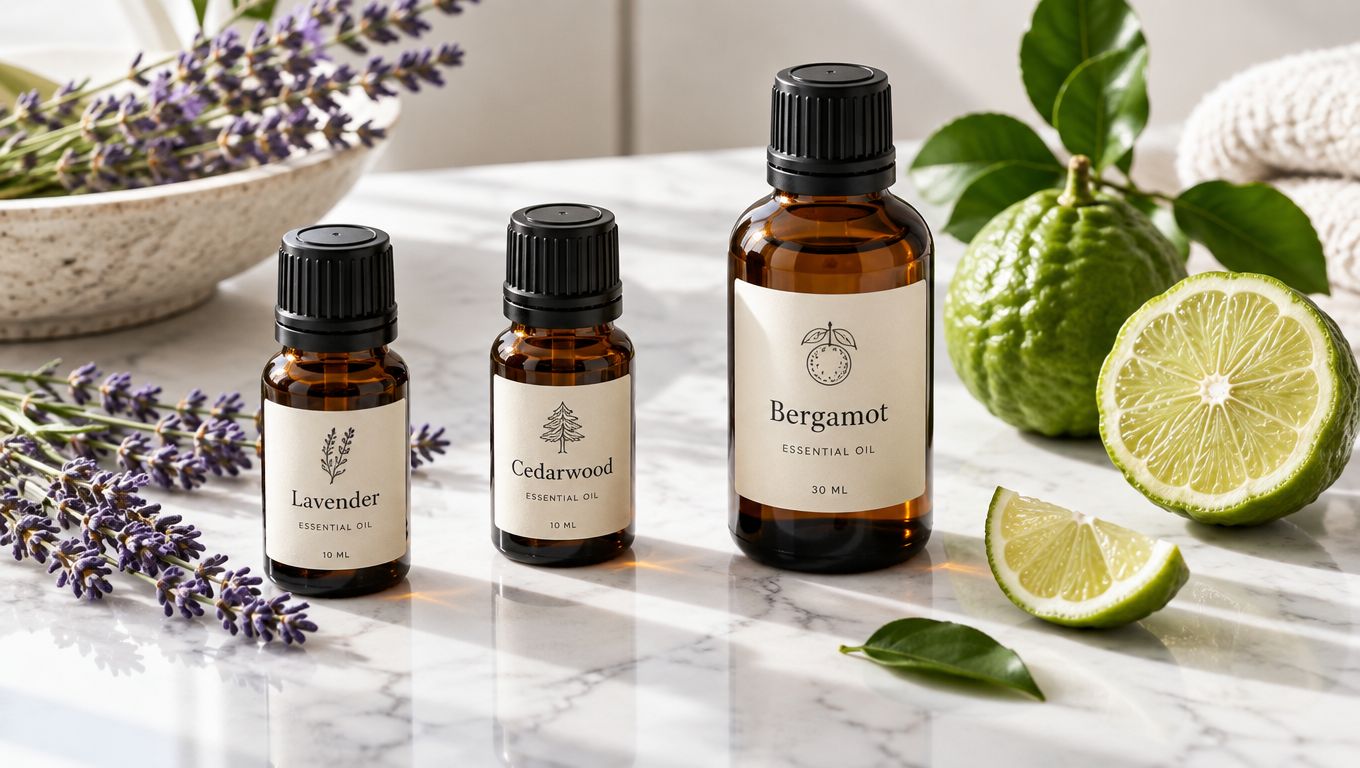
Try a bergamot, lavender, and cedarwood accord in a 3:2:1 ratio by parts. Bergamot supplies the opening, lavender bridges the citrus and floral facets, and cedarwood gives the blend a dry, grounded base. This direction suits candles and passive diffusion when each component is approved for the intended application.
A tea-inspired candle direction
For a warmer profile, combine bergamot, black-tea absolute, and vanilla in a 4:2:1 ratio by parts. Bergamot creates the familiar citrus lift, black tea adds dryness and depth, and vanilla rounds the edges. Because absolute materials and vanilla compositions can affect color and viscosity, test the blend in the actual wax before committing to a product line.
A citrus-herb bath direction
A sparkling accord can use bergamot, lemon, rosemary, and white musk base in a 3:2:1:1 ratio by parts. Lemon sharpens the opening, rosemary adds a green herbal edge, and the musk base gives the blend a clean finish. For bath salts or shower steamers, verify that every ingredient is approved for the intended exposure route.
How to test without wasting materials
Make a small concentrate: Weigh each ingredient rather than counting drops.
Label the formula: Record parts, supplier, batch numbers, and date.
Test the finished product: A blend that smells balanced in glass may behave differently in wax, soap, alcohol, or a carrier oil.
Compare after resting: Evaluate the opening and dry-down, not just the first impression.
Check documentation: Each ingredient needs approval for the final application.
For a deeper look at the weighing and testing process, use this guide to blending fragrance oils for candles. Compounded bergamot accords can also integrate smoothly with modern woody, amber, and musk materials, but compatibility still depends on the individual formula.
Storage, Shelf Life, and Batch Variation
Bergamot fragrance oil can lose its clean top-note character when stored carelessly. Oxygen, light, heat, and repeated temperature changes can alter volatile terpenes, so a bottle that was once crisp and sparkling may develop a flatter or less precise aroma.
Keep containers tightly closed in a cool, dark storage area. Amber glass or suitable HDPE packaging can help limit light exposure, while smaller working containers reduce the amount of air repeatedly introduced into the main stock. Don't leave caps open during production, and wipe the bottle neck before resealing it.
Why batches can smell different
Natural bergamot material varies because the proportions of limonene, linalool, and linalyl acetate are ranges rather than fixed values. A compounded oil can also change if a supplier adjusts the formula, carrier, or raw-material source. That doesn't automatically mean the new batch is defective, but it does mean comparison matters.
A simple quality-control record should include:
Product identity: Expressed, distilled, bergapten-reduced, FCF, or compounded.
Supplier batch number: Keep it with the purchase record.
Technical documents: Save the current SDS and IFRA information.
Retained sample: Store a small reference from each approved batch.
Production test: Run a small candle, diffuser, soap, or bath test after a supplier change.
Volatile terpenes are susceptible to oxidation, so storage affects both scent quality and consistency. The research on bergamot oil composition and variation supports the need to treat natural and formulated materials as batch-controlled ingredients rather than permanent scent constants.
Buying and Wholesale Tips for Retailers and Resellers
A good purchasing decision starts with documentation, not the color of the bottle or the strength of the first sniff. Ask the supplier to identify exactly what the product is and what the supplier has tested it for.
Request the technical basics
A serious wholesale inquiry should cover:
SDS: Check handling, hazards, and product identity.
IFRA information: Confirm the intended application category and maximum use guidance.
Allergen declaration: Essential for finished-product labeling in markets with disclosure rules.
Batch number and manufacturing information: Useful for traceability and repeat orders.
Material description: Ask whether it is synthetic, essential-oil based, bergapten-reduced, FCF, or compounded.
Carrier information: Important for dilution, equipment compatibility, and labeling.
Flash point data: Relevant to storage and certain production environments.
Vague origin claims, missing safety documents, absent CAS information where applicable, or a price that seems inconsistent with the stated material should prompt more questions. A low price doesn't prove poor quality, but a buyer should understand whether the product has been diluted, reformulated, or supplied in a different carrier.
Choose the right purchasing format
Retail bottles are useful for sampling and early testing. Regular candle, soap, diffuser, or bath production may justify a larger format once the supplier, formula, and batch behavior are approved. The right size depends on your production schedule, storage conditions, cash flow, and ability to protect the material from heat and light.
Before scaling, request a sample or trial quantity and compare at least the documentation, scent profile, finished-product behavior, and replenishment lead time. Premium natural-material claims may also justify requesting a current GC-MS report, but the report should correspond to the actual batch or material being sold.
For small-batch supplies, where to buy fragrance oils for candles can help buyers think through sourcing and product format. Whether you choose a local supplier, a specialist wholesaler, or an overseas manufacturer, keep a retained reference sample of every approved batch.
Match the oil to the product. A fragrance tested for candles isn't automatically suitable for soap, and a soap-approved material isn't automatically suitable for perfume or body oil.
Common Misconceptions and Quick Answers
How does bergamot fragrance oil smell in different products?
Bergamot fragrance oil can change character depending on the finished product. In wax, the citrus opening may become softer and more rounded, while alcohol can make top notes appear faster. Soap surfactants and other bases can also change how the fragrance develops.
What should you compare when testing bergamot fragrance oils from different suppliers?
Compare more than the scent from the bottle. Evaluate the product identity, technical documentation, batch information, carrier, finished-product performance, and replenishment consistency. Testing each sample in the same finished-product formula gives a more useful comparison than smelling the oils side by side.
Should you test a new bergamot fragrance oil before buying it in bulk?
Yes. A small trial helps confirm that the fragrance performs as expected in the intended product before a larger purchase is made. Compare the sample's scent profile, documentation, finished-product behavior, and supplier replenishment information before scaling up.
Why can a new batch of bergamot fragrance oil smell different from an older batch?
Differences can come from natural variation in bergamot materials or changes to a compounded fragrance formula, carrier, or raw-material source. Keeping the supplier batch number and a retained sample from an approved batch makes it easier to identify and evaluate changes.
How should businesses keep records for bergamot fragrance oil?
A useful record should identify the material, supplier batch number, current SDS and IFRA information, retained reference sample, and results from a production test. Recording these details makes future purchasing and quality comparisons easier, particularly when changing suppliers or receiving a new batch.
Is fragrance oil fake or inferior to essential oil? No. They are different products. Bergamot essential oil is distilled or expressed from the fruit, bergapten-reduced or FCF essential oil has certain furocoumarins reduced or removed, and compounded fragrance oil combines aroma materials to produce a controlled scent. Judge each by its intended use, composition, documentation, and performance.
Are all bergamot products phototoxic? No. The main concern is expressed bergamot essential oil when relevant furocoumarins remain. Bergapten-reduced materials lower that concern, while a compounded fragrance may be formulated without those components. Check the product identity rather than relying on the word “bergamot.”
Can bergamot fragrance oil go on skin? Only if the supplier documents that application and provides the applicable leave-on or rinse-off guidance. A candle fragrance should not be applied to skin. “Skin-safe” alone does not replace current SDS, IFRA, and allergen information.
Which product fits each use?
Use | What to confirm |
|---|---|
Candle | Candle performance, wax compatibility, wick testing, and the supplier's tested usage guidance |
Diffuser | Diffuser compatibility, ventilation, and exposure guidance |
Soap | Rinse-off suitability and the relevant IFRA category |
Bath or body product | Leave-on or rinse-off approval, dilution guidance, and allergen details |
Skin or perfume | Explicit skin-use documentation, not a candle-use approval |
The same safety limit does not automatically apply across these products. Match the material and its documentation to the finished product.
Is it safe around cats and dogs? Use caution with diffusers and undiluted fragrance materials. Prevent direct animal exposure, provide suitable ventilation, and ask a veterinarian about species-specific concerns.
Can it be used during pregnancy in a diffuser? Pregnancy can change the safety questions around fragrance exposure. Consult a qualified healthcare professional, follow diffuser and supplier guidance, and stop use if irritation or discomfort occurs.
Do more drops make a candle stronger? Not reliably. Fragrance load, wax compatibility, wick choice, curing, and the formula affect performance. Weigh the fragrance, follow tested supplier guidance, and test the finished candle.
For formulation decisions, review the safety and IFRA guidance and beginner blending methods. Aroma Warehouse supplies fragrance oils, incense, diffusers, bottles, droppers, and DPG for small-batch testing and packaging. Visit Aroma Incense Warehouse to compare supplies for your intended use.


