

French Lavender Perfume: What Makes It Distinctive
You're probably looking at two bottles right now. One says French Lavender and carries all the romance of Provence. The other just says Lavender, costs less, and on a tester strip it smells louder, sharper, and oddly less natural.
That gap is where most buyers get misled.
In perfume, French lavender can be beautiful. It can also be a label doing far more work than the oil inside. If you stock fragrance, blend private-label products, or want a lavender scent that smells refined instead of soapy or medicinal, you need to judge the material by chemistry, not the field printed on the box.
Table of Contents
What French Lavender Perfume Really Means - What the term can mean in trade - Where the romance stops
The Botanical Source Behind the Scent - Two plants sold under one idea - What each material contributes - Why Provence on a label isn't enough
How the Chemistry Shapes the Aroma - The two molecules doing most of the work - What I look for on a lab sheet - What works in formulation
French Lavender Versus Other Lavender Types - What buyers actually notice - The comparison worth keeping near your sample tray - What doesn't work
Building Sprays and Oils From the Note - Alcohol sprays keep the note brighter - Oil perfumes wear closer - The mistakes that keep showing up
Where the Note Fits in Modern Fragrance - Why it feels current again - The styles that actually feel modern
Safety, IFRA Limits, and Storage Practices - The working checklist - Storage matters more than most small brands think - Questions customers ask constantly
Wholesale Sourcing and Reseller Strategy - What to ask for before you buy - The stock plan that usually works - What actually converts at retail
What French Lavender Perfume Really Means
At a market stall, the difference is obvious before anyone says a word. You smell one amber bottle and get an herbaceous, dry-floral note with a soft sweetness under it. You smell the other and get a brighter, harsher lavender that veers candy-like, then turns camphorous on skin.
Both may be sold as French lavender perfume.
What the term can mean in trade
In actual use, French lavender perfume usually points to one of three things:
A finished perfume built around true lavender grown in France
A fragrance that uses French-sourced lavender oil or absolute somewhere in the heart
A marketing description for a lavender-style blend with no strict origin standard
That last category is common. The phrase sounds premium, and consumers often assume it guarantees a certain plant species, region, or distillation quality. It doesn't.
French lavender does have real history behind it. Lavender became a major perfumery ingredient in the 19th century as the Grasse perfume industry expanded, and southern France turned cultivated lavender into an economic pillar. Historical records place regional lavender output at about 100 metric tons in 1914, with essential oil prices rising from 30 francs per kilogram in 1914 to 100 francs per kilogram in 1918 during wartime demand, before output fell to under 60 tons per year by 1920. Production later recovered and reached over 150 metric tons of essential oils in 1960 according to APAL's lavender history.
Where the romance stops
That heritage matters. Packaging alone doesn't.
What gives French origin weight for perfumers is the expectation of a certain profile: cleaner floral lift, less medicinal bite, and a more polished drydown. Buyers often connect that profile to altitude, cultivation choices, and traditional distillation practices. But two bottles carrying the same French language cues can contain very different oils, or no natural lavender oil at all.
Practical rule: If you're paying a premium for French lavender perfume, ask for the oil type and the GC or GC-MS profile before you get distracted by Provençal branding.
A good starting point is understanding the difference between essential oils and fragrance oils, because many retail products blur that line on purpose. This guide on fragrance oils and essential oils is worth reading before you buy bulk or build your own blend.
The Botanical Source Behind the Scent
If you want to evaluate French lavender perfume properly, start with the plant name. Not the color of the label. Not the illustration of a field.
Two plants sold under one idea
The botanical split that matters most is this:
Lavandula angustifolia. True lavender. This is the species perfumers usually want for a softer, finer result.
Lavandula × intermedia. Lavandin. A hybrid. Useful, powerful, and often much less elegant in fine fragrance.
In bulk buying, these two get mixed up constantly at the consumer level because both smell recognizably “lavender.” In the bottle, though, they behave differently. True lavender usually smells more floral, airy, and smooth. Lavandin pushes harder. It can feel cooler, greener, and more medicinal.
What each material contributes
Here's the fast comparison I use when evaluating a lavender-led formula:
Attribute | Lavandula angustifolia | Lavandula × intermedia (lavandin) |
|---|---|---|
Core impression | Fine, floral, soft, slightly sweet | Sharper, stronger, more camphorous |
Fine fragrance use | Excellent for parfum, EDT, skin scent blends | Better in functional fragrance, soap, home scent |
Typical feel on strip | Polished and rounded | Penetrating and more utilitarian |
Consumer reaction | Usually reads premium and wearable | Can read medicinal if overused |
Best role in formula | Main note or heart accent | Support note where lift and throw matter |
Why Provence on a label isn't enough
France remains a central lavender market, but the commercial sector is dominated by both lavender and lavandin. In 2023, France had 33,500 hectares of plants used for perfumery, and more than 90% of that area was devoted to lavender and lavandin. CPPARM also reports that up to 90% of global lavandin production is French. Annual production is about 1,500 tonnes of lavandin essential oil versus about 100 tonnes of fine lavender essential oil, which shows how much scarcer true fine lavender is in the supply chain as outlined by CPPARM.
That's why a “French lavender” claim can still hide a lavandin-heavy reality.
Provence is a place name. It isn't a quality verdict.
For a shop owner, this matters because customers often expect French lavender perfume to smell soft and expensive. If the formula leans on lavandin instead, they get a sharper profile than the name suggests.
How the Chemistry Shapes the Aroma
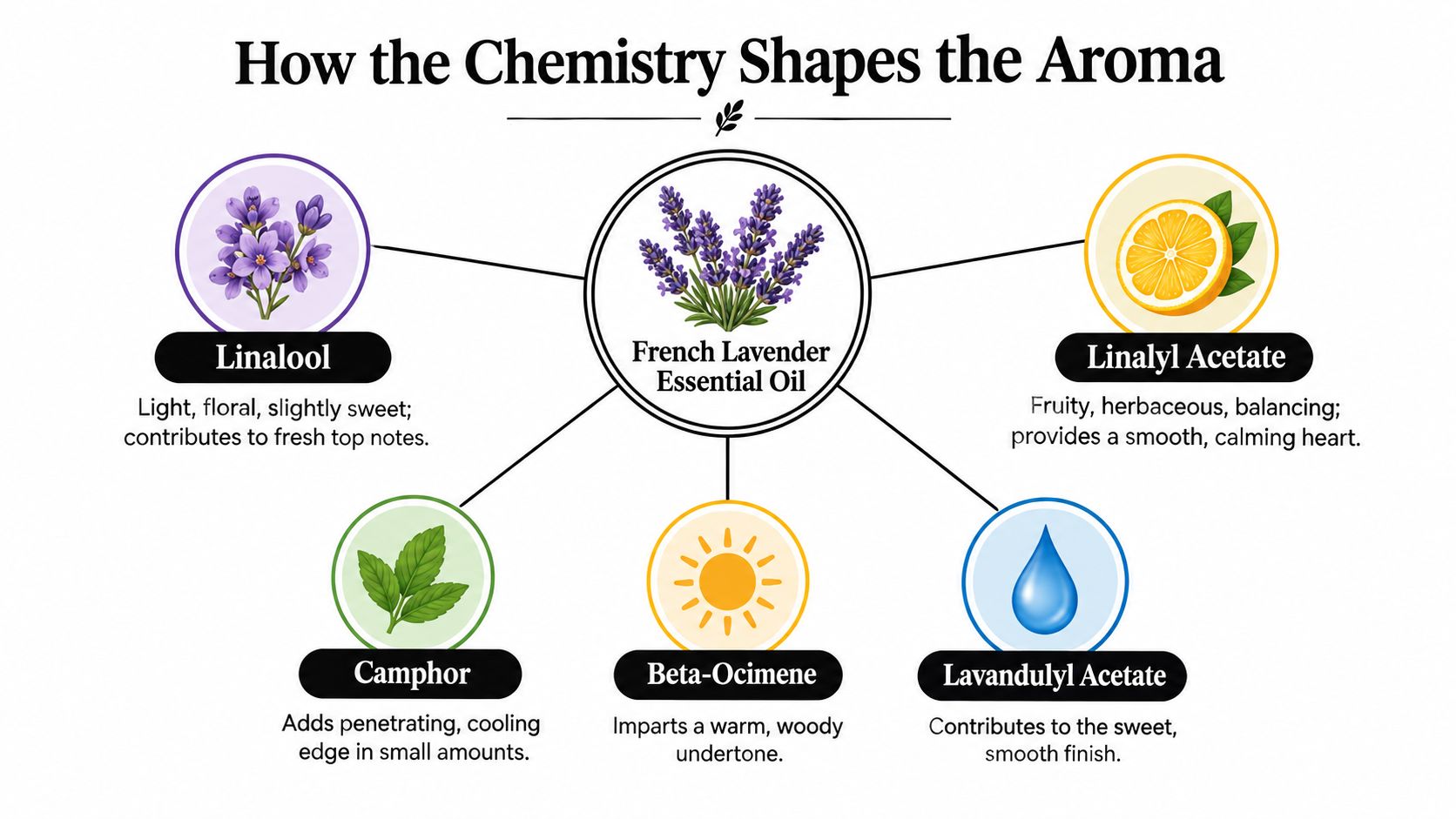
You don't smell “lavender” as a single thing. You smell a balance of molecules, and that balance decides whether the perfume reads clean, floral, medicinal, barbershop, or powdery.
The two molecules doing most of the work
In French lavender oil used for perfumery, linalool and linalyl acetate usually carry the scent. Technical reviews report that these two molecules often account for about 60% to 65% of the oil, and in some high-grade samples, as much as 75%. Linalyl acetate gives a sweeter, softer floral effect, while linalool adds fresher aromatic lift as noted in Perfumer & Flavorist's technical review.
That's why some lavender perfumes feel silky and airy, while others feel stern and herbal.
What I look for on a lab sheet
The practical benchmark is less about patriotic branding and more about the ratio on paper.
Published GC-MS data show that fine lavender from Haute-Provence can contain 35% to 45% linalyl acetate and under 1% camphor, while lavandin may reach 5% to 10% camphor. In perfumery terms, low camphor usually means softer and more premium. Higher camphor pushes the scent into a sharper, more medicinal direction that many fine-fragrance buyers reject based on published GC-MS comparisons.
Here's how that plays out on a smelling strip:
Higher linalyl acetate gives a smoother, more “true lavender” impression
Healthy linalool presence keeps the note fresh and aromatic
Low camphor prevents the medicinal edge
Low cineole feel helps the perfume stay cosmetic rather than functional
What works in formulation
If I'm choosing lots for a lavender-forward perfume, I care more about profile than romance. A softer French-style result usually comes from oils with restrained camphor and a good floral-to-fresh balance, not from a dramatic story about mountain fields.
The calming reputation of lavender often gets discussed in broad terms, but the more useful angle for perfumers is how chemistry changes perception in the finished scent. If you want a quick consumer-facing explanation, this article on the science behind lavender oil and its calming effects gives a helpful overview without losing the point.
French Lavender Versus Other Lavender Types
A shop shelf doesn't need four poetic descriptions of lavender. It needs a clear reason why one bottle costs more and smells better.
What buyers actually notice
Most customers won't ask for linalyl acetate. They'll ask why one lavender smells refined and the other smells like drawer sachets, floor cleaner, or soap.
That's a fair question.
French lavender, especially when the fragrance is built around true lavender rather than lavandin, usually wins on softness and polish. English lavender can overlap in style and can work well for customers who lean more herbal and less perfumey. Bulgarian material often works as a practical production oil for soaps, candles, and home scent, where a slightly rougher edge isn't a problem. “Generic lavender” is where trust gets eroded. That label often hides undisclosed origin, hybrid-heavy composition, or a heavily reconstructed fragrance accord.
The comparison worth keeping near your sample tray
Lavender Type | Aroma Character | Price Tier | Best-Fit Product Use |
|---|---|---|---|
French lavender | Soft, floral, herbaceous, low-camphor feel | Premium | Fine fragrance, giftable personal scent, upscale body oil |
English lavender | Clean, herbal, familiar, slightly drier | Mid-range | Aromatherapy-led products, simple EDTs, linen and body use |
Bulgarian lavender | Stronger, more direct, less nuanced | Value to mid-range | Soap, candles, room products, broader bath lines |
Generic supermarket lavender | Loud, flat, often candy-like or harsh | Budget | Entry-level products where price matters more than distinction |
What doesn't work
Don't oversell cheap lavender as French-style if it isn't. Customers may not know why it smells off, but they notice when the strip opens sweet and closes medicinal.
The fastest way to lose repeat fragrance buyers is to ask them to pay niche language for commodity oil.
What does work is matching the oil to the product. Save the more refined profile for wear-on-skin formats. Use stronger, less nuanced lavender where diffusion and cost matter more than elegance.
Building Sprays and Oils From the Note
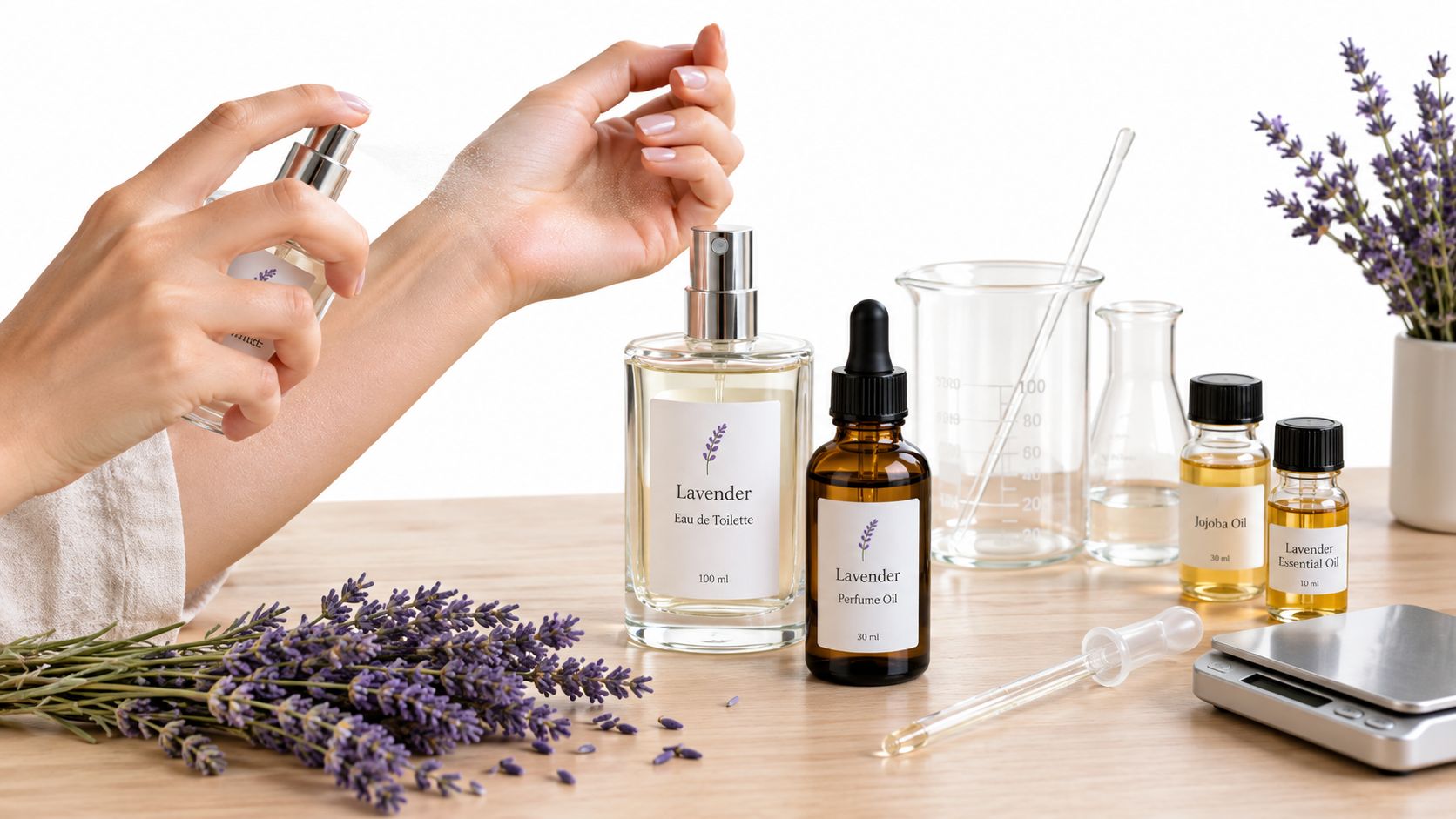
French lavender perfume behaves differently in alcohol than it does in oil. That's where a lot of beginner formulas go sideways.
Alcohol sprays keep the note brighter
In an alcohol-based spray, lavender gets more lift. The opening feels clearer, cleaner, and more recognizably perfumey. For small-batch work, I usually treat lavender as a note that benefits from restraint and support rather than brute force.
For a simple 100 ml eau de toilette, the practical framework looks like this:
Fragrance load in the light EDT range
Perfumers alcohol as the main solvent
A small amount of distilled water if the formula stays clear
Optional DPG when the blend needs help smoothing or stabilizing
Vodka is a bad shortcut. It doesn't give the same clarity, evaporation profile, or shelf stability as proper high-proof perfumers alcohol. If the goal is a clean French-lavender effect, cloudy dilution and blunt diffusion work against you.
Oil perfumes wear closer
A 30 ml perfume oil in jojoba or fractionated coconut oil can smell beautiful, but the profile shifts. Fixed oils mute sparkle. Lavender turns more herbal and less airy, which can be pleasant if that's the point, but it won't smell like an EDT version of the same blend.
Common carrier choices include:
Jojoba for a more substantial skin feel
Fractionated coconut oil for a lighter feel and easier roll-on use
DPG in certain fragrance applications when a thinner, more even performance is needed
One practical consumer angle is how lavender behaves beyond perfume, especially in body and home products. This guide on lavender essential oil for skin care, hair, and home is useful if you're expanding a scent line across categories instead of only making perfume.
After you blend, let the formula rest before you judge it.
The mistakes that keep showing up
The most common problems aren't subtle:
Too much lavender oil: The formula turns medicinal fast.
No rest period: Fresh blends can smell disjointed and thinner than they will after settling.
Clear packaging: Light exposure starts stealing freshness.
No supporting notes: Lavender alone can feel flat unless that starkness is intentional.
For modern wearability, lavender usually needs company. Bergamot, tonka-style sweetness, soft musks, sage, or a dry wood note can stop it from smelling like a single-note functional product.
Where the Note Fits in Modern Fragrance
Lavender spent years trapped between two stereotypes. It was either old-fashioned powder or basic barbershop.
That isn't the whole story anymore.
Why it feels current again
Independent fragrance coverage says lavender is “breaking free of its sleepy-time reputation” and showing up in unisex and gourmand blends, while a French beauty article notes that the note is returning to favor after a long stretch of being seen as old-fashioned. The same coverage gap matters in retail because buyers still ask whether lavender smells dated, while current release tracking shows the note continuing to appear through 2026, with Parfumo listing French lavender across releases over a long span as discussed in Grazia's coverage of lavender's return.
The key is composition.
The styles that actually feel modern
French lavender perfume reads current when it falls into one of these lanes:
Clean aromatic with bergamot, musks, and a dry herbal backbone
Leathered or woody where lavender lifts darker materials instead of dominating them
Citrus-lavender that feels bright and crisp
Creamy lavender paired with vanilla, tonka-style warmth, or skin-scent musks
What tends to feel dated is a powdery, overly soapy lavender with obvious camphorous edges and no contrast.
If you want lavender to read unisex in 2026, keep it clean, keep it smooth, and don't let the medicinal side take over.
For a small reseller, the strongest sellers tend to be wearable rather than thematic. “Sleepy pillow” language can help in home scent, but on-body fragrance usually moves better when lavender is presented as fresh, grounded, and modern.
Safety, IFRA Limits, and Storage Practices
Pretty lavender perfume can still be badly handled. Most quality issues I see aren't dramatic safety failures. They're oxidation, sloppy labeling, and storage that cooks the life out of the oil.
The working checklist
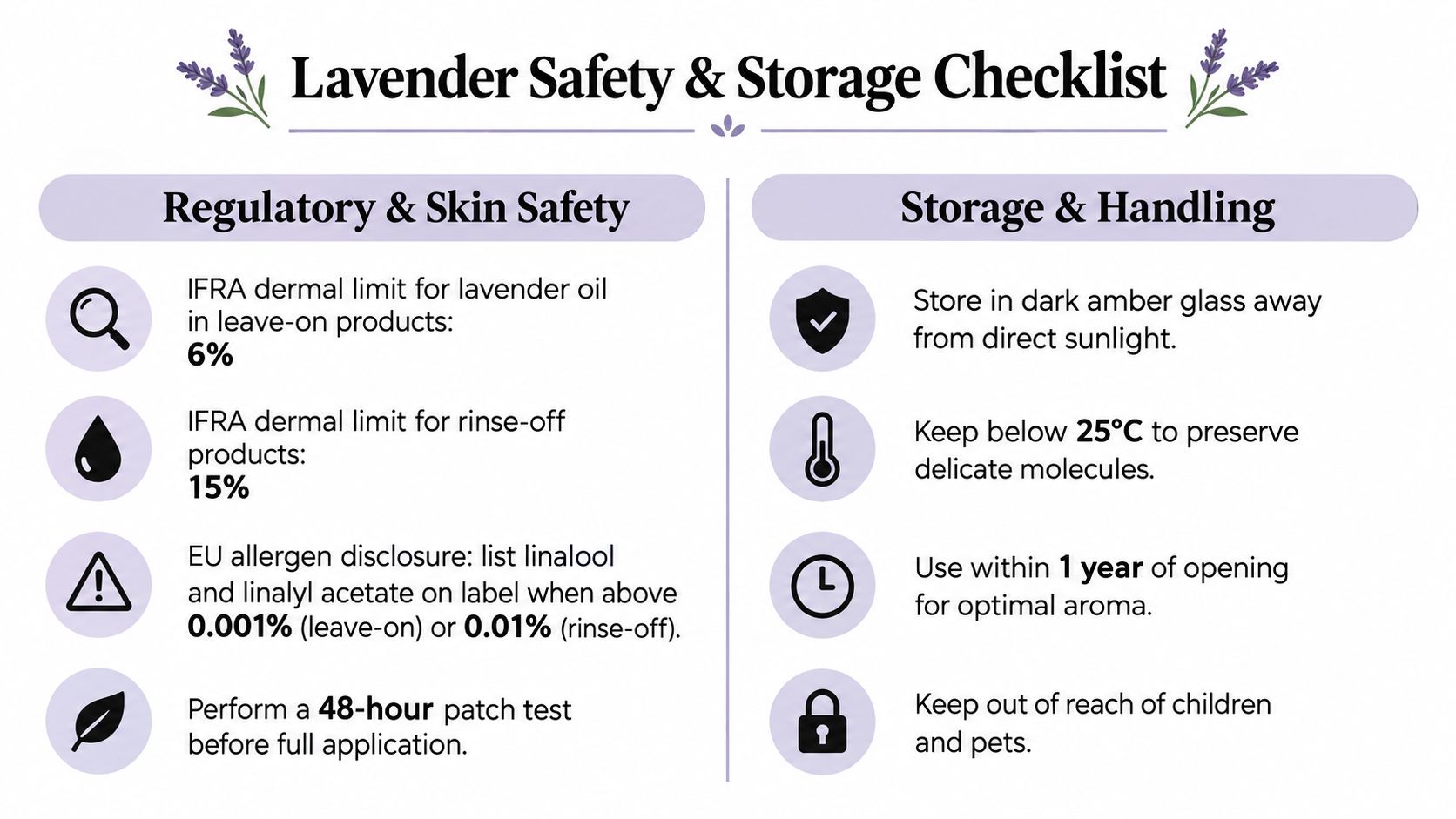
Treat lavender like any other active aromatic ingredient. Check your supplier paperwork, match usage to product type, and label allergens correctly.
The infographic above includes specific limits and thresholds, but in day-to-day practice I'd frame the essentials this way:
Check the current IFRA documentation for your exact material and application category before production
Review allergen disclosure requirements for the market where you sell
Patch test consumer-facing leave-on products during development
Keep usage moderate if the fragrance is intended for sensitive users
Steam-distilled true lavender is generally a different phototoxicity conversation than expressed citrus oils, but “low concern” doesn't mean “ignore the paperwork.”
Storage matters more than most small brands think
Lavender loses charm when it oxidizes. Freshness drops first. Then the oil starts smelling flatter, dustier, or slightly harsh.
Use these habits:
Amber glass only: It gives the oil a better chance than clear display bottles.
Cool storage: Keep stock away from heat and direct light.
Tight closures: Oxygen is part of the degradation problem.
Date every decant: Don't rely on memory.
If you're updating packaging across a fragrance line, it's worth looking at practical ideas for eco friendly packaging for your brand, especially if you want sustainable presentation without switching to packaging that exposes oils to too much light.
Questions customers ask constantly
Pregnancy and pets come up in retail all the time. The only sensible answer is a careful one. Encourage buyers to keep concentrated oils diluted, avoid casual overapplication, and check with an appropriate professional if they're buying for pregnancy, infants, or animals.
For broader consumer education around cautious essential-oil use, this safe-use guide on eucalyptus and lavender oil benefits is a practical resource to keep on hand.
Wholesale Sourcing and Reseller Strategy
When a reseller asks me what to stock, the answer usually starts with a blunt question. Are you selling a scent story, or are you selling repeat purchases?
If it's repeat purchases, your sourcing sheet matters more than your label copy.
What to ask for before you buy
A lavender oil meant for French-lavender-style perfumery should come with a Certificate of Analysis or a GC-style profile you can read. I want to know the species, the country of origin, the country of distillation if different, and whether the profile fits the softer style customers expect.
For finished fragrance oils, I also want clarity on whether the product is:
Natural lavender essential oil
A natural isolate blend
A fragrance oil built to smell like French lavender
A hybrid composition using both
That distinction affects pricing, labeling, and customer expectations.
One practical source for private-label and resale supply browsing is Aroma Warehouse wholesale fragrance oils, especially if you're comparing ready-to-sell scented stock against the cost and complexity of blending from scratch.
The stock plan that usually works
I'd carry lavender in tiers instead of pretending one SKU fits everybody.
Volume | Grade | Indicative Price per kg (USD) | Best Use |
|---|---|---|---|
Small trial lot | Fragrance oil or entry perfumery grade | Varies by supplier and composition | Testing demand, gift shop sampling, seasonal launches |
Mid-volume stock | Better perfumery grade lavender profile | Varies by supplier and documentation | Core body products, EDTs, boutique resale |
Bulk drum purchase | Documented fine grade or specialized French-style profile | Varies widely by species, origin, and paperwork | Established private label lines and repeat bestsellers |
I'm leaving those prices qualitative on purpose. Real numbers swing hard depending on species, harvest quality, natural versus reconstructed composition, and order size. Anyone giving you a single “standard market price” for lavender is usually skipping important details.
What actually converts at retail
These angles tend to move:
Giftable lavender sets with body, room, and personal scent options
Unisex positioning for customers who want clean fragrance without sweetness
Sleep and unwind language for home fragrance, linen, and bath
Origin-led storytelling only when the formula supports it
What doesn't convert for long is fake specificity. If the formula smells generic, calling it “French Lavender de Provence Reserve” won't save the second sale.
Sell the note for what it is. If it's soft, elegant, and skin-friendly in character, say that. If it's stronger and better for soap or room use, say that instead.
Lavender is still a broad commercial category. One retail guide notes that lavender now appears across feminine, masculine, and unisex compositions, including gourmand and oriental styles, while another catalog lists 60 lavender-note perfumes across a price range of £26 to £96. The same source also notes that the broader lavender products market is projected to reach $1.4 billion by 2030, with North America already the largest region in 2025 according to Perfume Wheel's market overview. That tells me demand is broad, but the brands that win are the ones that explain the differences clearly.
Frequently Asked Questions
1. Does French lavender perfume smell sweet or floral?
French lavender perfume is usually more aromatic and herbal than conventionally sweet. Depending on the formula, it can have fresh, slightly green, floral, woody, or softly powdery characteristics.
2. Is French lavender perfume suitable for men?
Yes. Lavender can work well in men's fragrances, particularly when combined with citrus, woods, musk, leather, or other dry aromatic notes. The overall character depends more on the complete fragrance composition than the lavender note alone.
3. Can French lavender perfume be worn year-round?
Yes. A lighter lavender fragrance can work particularly well in warmer weather, while blends with woods, vanilla, tonka-style notes, or musk can give the scent more presence for cooler seasons.
4. How long does French lavender perfume last on skin?
Wear time varies considerably depending on the fragrance concentration, carrier or alcohol base, supporting ingredients, skin chemistry, and application amount. Lavender itself does not determine the total longevity of a finished perfume.
5. What fragrance notes pair well with French lavender?
French lavender can pair with a wide range of notes, including citrus, woods, musk, vanilla, tonka-style accords, leather, herbs, and soft florals. The supporting notes can shift lavender from crisp and aromatic to creamy, woody, or more sophisticated.
If you're building or stocking lavender-led products, Aroma Warehouse offers fragrance oils, lavender essential oil, bottles, droppers, DPG, and other practical supplies that fit small-batch perfume work and resale. If you want to compare formats, test a French-lavender-style profile, or source components for your own line, visit Save on Scents Aroma.


