

Quality Fragrance Oils Reviews: How to Judge Them Well

Stop chasing the highest star rating. That's the most popular advice for finding quality fragrance oils, and it's the advice most likely to mislead you. A 4.8-star average tells you buyers left satisfied, but it doesn't tell you what they used the oil for, how they diluted it, whether the next batch will match, or whether the product belongs on skin at all.
Read quality fragrance oils reviews as evidence instead. Grade each claim by the detail behind it, pair performance claims with documentation, and keep three judgments separate: how it smells, whether it's suitable for skin, and whether it's suitable for the room. An oil can pass one test and fail the other two.
Table of Contents
A Scorecard for Judging Fragrance Oil Quality - What Good Evidence Looks Like
Translating Review Language Into Evidence - Reading Common Phrases Critically - A Reliability Check Before You Believe Anything
Safety Signals and Label Limits - Why Natural Does Not Settle the Question - Two Identical Labels, Two Different Risks
How to Verify a Batch Before Bulk Buying - Six Steps Before You Scale Up
Indoor Air, Ventilation and Sensitive Users - What a Room-Level Review Reports
Confirm the Oil Fits Your Use Before You Buy - The Verdict Checklist
A Scorecard for Judging Fragrance Oil Quality
Stars measure satisfaction, not quality. A buyer who wanted a loud room scent and got one will rate an oil highly even if the formula drifts between batches, the allergens aren't declared, or the listing implies a use the oil was never tested for. You need a way to sort mixed comments into categories you can compare.
Use six rows for every listing you're considering. Score scent accuracy, longevity and throw, batch consistency, ingredient and allergen disclosure, intended-use fit, and documentation before you look at the average rating. If a row has no evidence, treat it as a gap. A blank isn't neutral when you're buying for resale, soap, or a spa treatment room.
What Good Evidence Looks Like
Criterion | Good evidence | Red flag | Question to ask the seller |
|---|---|---|---|
Scent accuracy | Reviews describe the stated profile in specific terms | Vague comparisons to famous perfumes only | Which notes are dominant and how is the profile tested? |
Longevity and throw | Hours of performance in a named application and room size | Only 'lasts all day' with no setting | What dosage and application produced the stated longevity? |
Batch consistency | Reviewers report similar results across reorders | Scent or strength changes between orders | How do you check that each batch matches the last one? |
Ingredient and allergen disclosure | Full list or allergen declaration is available | Only the word 'Fragrance' with no detail | Which allergens are declared and at what level? |
Intended-use fit | Product is labeled for the application the reviewer used | Skin use claimed with diffuser-only guidance | Is this oil approved for topical or only for diffusion and crafts? |
Documentation | SDS and batch certificate of analysis are available | No SDS and no test method given | Can you send the SDS and the certificate for this batch? |
Say a listing carries a 4.8-star average and claims it's suitable for body products. You read twenty reviews and every detailed one describes an electric diffuser. Nobody names a dilution, nobody reports skin contact, and the seller offers no allergen declaration. On the scorecard, throw scores well and intended-use fit fails. The average hid that failure because happy diffuser buyers outnumbered the question you needed answered.
Practical rule: Score three listings on the same six rows before you compare their ratings. The oil with fewer blanks is usually the safer buy, even if its stars are lower.
That sorting also rescues mixed reviews. A one-star complaint about weak throw in cold-process soap and a five-star rave about a wax melt aren't contradicting each other. They're reporting different applications, and each belongs in its own row. Once you separate them, disagreement becomes information about where the oil works and where it doesn't.
I'd start with intended-use fit and documentation, because those two rows decide whether the other four even apply to you. A beautifully accurate scent that isn't labeled for your product is the wrong oil, however strong the reviews are.
Translating Review Language Into Evidence
"Smells good" is the phrase readers trust most and the one that tells you least. It records a first sniff, usually from the bottle, with no application, no dilution, and no duration. In a Pew Research Center survey published in 2016, 82% of U.S. adults said they read online customer ratings or reviews at least sometimes before purchasing something for the first time, while 40% said they did so always or almost always. That habit is mainstream, which makes the quality of what you're reading worth checking rather than assuming.
A review is a user experience, not a laboratory measurement. Dosage, formulation, equipment, storage, and individual sensitivity all shape the result, so a comment proves performance in one setting. That setting has to be named before the comment helps you.
Reading Common Phrases Critically
Review says | What it proves | Detail to look for instead |
|---|---|---|
'Smells good' | A first impression only | Application, dilution rate and how long the scent held |
'Lasts all day' | Persistence in one setting | Hours of throw, room size and the carrier or wax used |
'Very strong' | High perceived intensity, which may reflect concentration rather than quality | Recommended dosage and whether the reviewer diluted it |
'Smells just like' a famous perfume | Resemblance in one reviewer's judgment | Composition or batch documentation |
'Five stars, no detail' | Overall satisfaction | Equipment, duration and the reviewer's use case |
'Hypoallergenic' | A marketing term without a federal standard | Stated ingredients and patch-test guidance |
Compare two reviews of the same oil. The first says "amazing, smells just like the original, five stars." The second says the reviewer ran it in a diffuser for six hours in a 300 square foot room, diluted it with a carrier, and found the top notes faded after two hours while the base held. If you're learning what DPG does as a carrier and diluent, that second review gives you a dosage to test and a limit to expect. The first gives you enthusiasm.
Weight patterns over standouts. One exceptional review can reflect a fresh batch, a powerful diffuser, or a reviewer who likes heavy scent. Several reviewers describing similar results in the same application, soap, wax, or diffusion, carry more weight than a single glowing outlier.
A Reliability Check Before You Believe Anything
Count and date them: Note how many reviews exist and when they were posted. A handful of recent, detailed reviews outweighs a large batch of old one-line ratings.
Watch for bunching: Discount reviews that are unverified, clustered in a short window, or written in near-identical wording.
Treat solicited praise carefully: Count incentivized or seller-requested reviews as uncertain unless they name an application and a setting.
Read the most detailed one- and two-star reviews first. Satisfied buyers often stop at praise, while unhappy buyers explain the conditions. Those explanations reveal where an oil fails, which is exactly what you need before you commit money.
Safety Signals and Label Limits
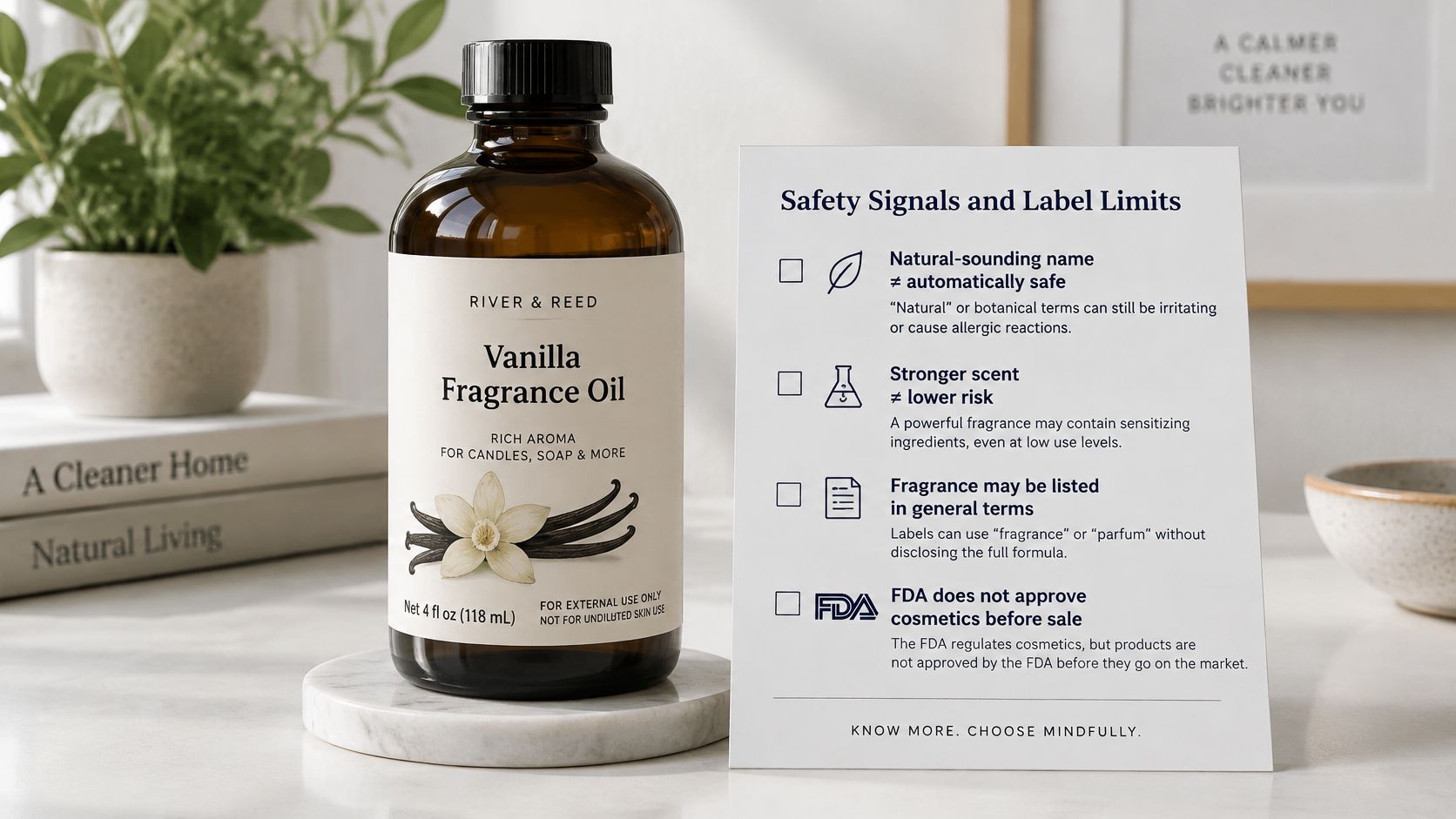
A polished label and a high star rating can tell you very little about skin safety. In the United States, the FDA guidance on fragrances in cosmetics explains that the FDA does not preapprove cosmetics before sale and that fragrance formulas may be listed collectively as “Fragrance” or “Flavor” instead of naming each component. The FDA also warns that some fragrance ingredients can cause sensitivity or allergic reactions. A review that calls an oil “hypoallergenic” repeats a marketing claim, not a test result.
Why Natural Does Not Settle the Question
The European Commission summary on perfume allergies reports that the Scientific Committee on Consumer Safety identified fragrance substances and natural extracts, including essential oils, as established contact allergens in humans. Natural origin does not establish skin safety, and synthetic origin does not establish harm. The relevant evidence is which substances are present, their concentration, and how the finished product contacts skin.
Use category changes the evidence a review needs. Rinse-off products and leave-on products involve different exposure patterns, so a concentration suitable for one cannot automatically be treated as suitable for the other. A review that omits whether a product was rinsed off or left on skin gives too little information to judge tolerability.
Use category | What a review should note |
|---|---|
Rinse-off products (shower gels, baths) | Dilution rate and contact time |
Leave-on products (body oils, massage oils, creams) | Skin contact, patch-test result and any irritation |
Analytical screening level (IFRA method, 57 allergenic substances) | Whether the certificate covers those 57 substances |
Diffusers and candles | Dosage, room size, ventilation and operating time |
Soap and wax products | Final concentration after processing and labeling for the intended use |
Two Identical Labels, Two Different Risks
Two oils labeled only “Fragrance” may come with very different supporting documents. One seller might provide an SDS, an allergen declaration, and usage guidance that distinguishes diffusion from topical use; another might provide only a scent name. Compare what each document covers. The guide to fragrance labeling requirements and seller disclosures can help you identify what a label may leave unspecified.
Potency is not a safety score. A strong oil may perform well in a diffuser yet be unsuitable for a topical application, especially when used undiluted or above the seller's guidance. A review praising throw does not establish that the oil is appropriate for skin or for a treatment room.
The video below walks through label reading in practice.
A spa reviewer who reports a rash after using an oil in a leave-on massage blend provides more relevant safety evidence than a reviewer who says only that the scent is incredible. The first account identifies the application, contact type, and outcome. It still does not establish the cause, but it gives a specific claim that can be weighed against the product's documentation.
A review that rates only intensity is silent on safety. Keep scent quality separate from skin safety, and do not treat a strong scent score as evidence of suitability.
Grade each safety claim by what would support it: application type, dilution, patch-test details, and any reported irritation. Record what the label and documents do not disclose as unknown, rather than treating missing information as proof of safety.
How to Verify a Batch Before Bulk Buying
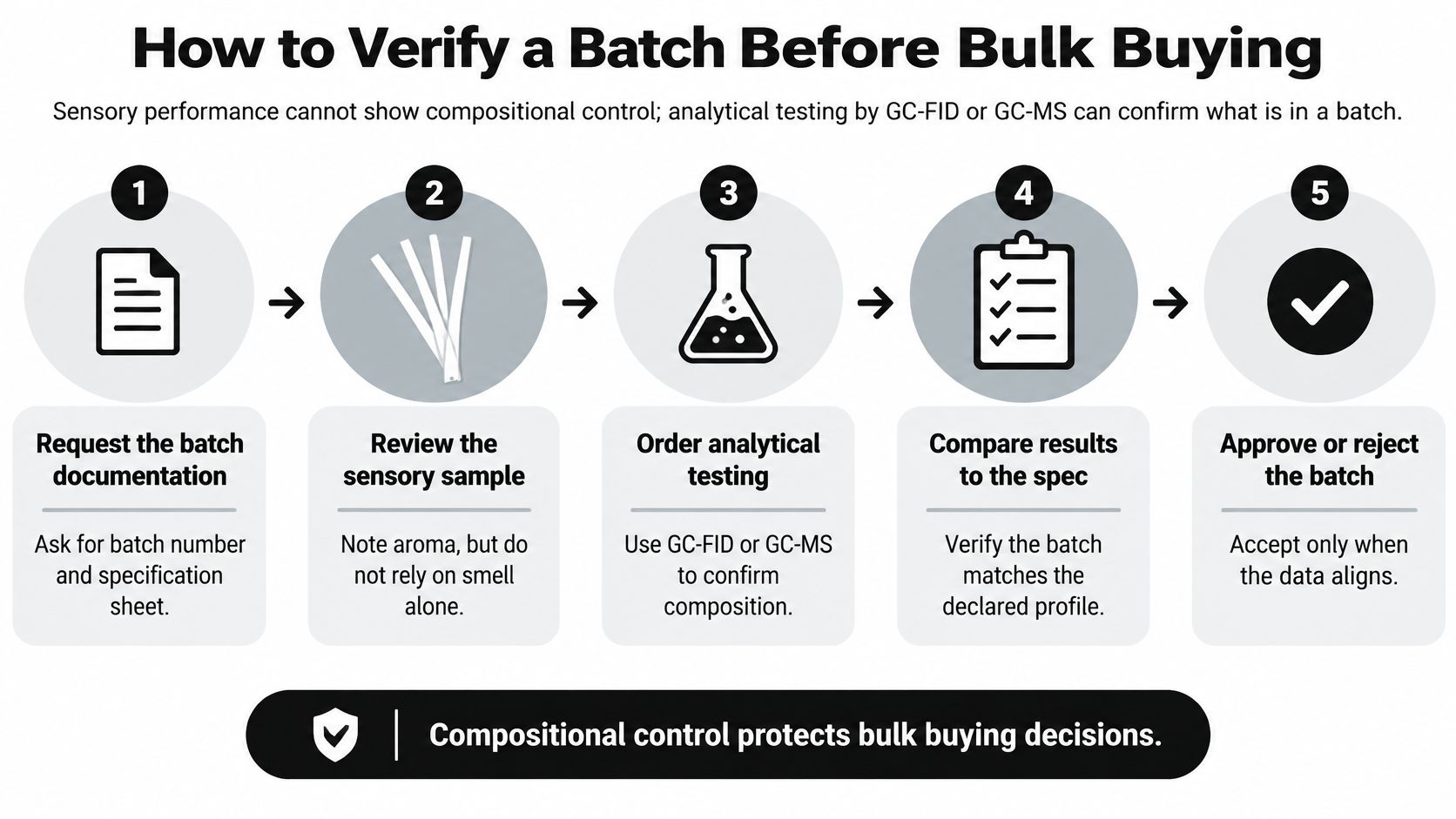
A sample can smell right and still tell you little about what is in the full batch. It cannot confirm concentration, identify an unexpected ingredient, or show whether a similar-smelling component has been substituted. Analytical testing can help answer those questions. The Sigma-Aldrich protocol on allergenic fragrance testing describes using gas chromatography with flame-ionization detection or mass spectrometry (GC-FID/GC-MS) to identify and quantify fragrance constituents, including potentially allergenic compounds. The protocol notes an IFRA Analytical Working Group method targeting 57 allergenic fragrance substances and relevant isomers above 0.002% (20 mg/kg) in fragrance materials and oils.
Whether you are buying for candles after reviewing where to buy fragrance oils for candles, soap, or resale, ask for evidence tied to the batch and your intended use.
Six Steps Before You Scale Up
Request a batch-specific certificate of analysis. Match its batch number and date to the stock you expect to receive. A generic certificate shows that some batch was tested, not necessarily yours.
Confirm the allergen declaration. Ask whether it covers the 57 substances in the IFRA method and what concentration basis it uses. Without that basis, the figures may not be comparable.
Check the test method and application. Confirm what the results establish for your intended use, such as candles, diffusers, soap, or leave-on products. Evidence for one use does not automatically establish suitability for another.
Order a sample from the same batch. A sample tied to the shipment helps assess the stock you are considering. A sample from different stock only represents that other batch.
Compare it with the previous batch. Test the sample on a paper strip and in the finished product alongside retained stock. Keep dosage consistent, then record changes in scent character and strength.
Record the result and decide. Log batch numbers, dates, dosage, and observations. If composition or scent falls outside the stated profile, document the specific mismatch before deciding whether to accept the batch.
The infographic summarizes the six checks.
A pour date and a manufacture date may describe different points in a product's history. Aroma Warehouse pours its fragrance oils fresh upon order. Ask any supplier how it tracks stock from bulk supply to the bottle you receive, and request the answer in writing.
GC-MS results can support claims about composition, unexpected contaminants, concentration drift, or a mismatch with the stated profile. They do not, by themselves, establish that an oil smells better or performs well in your finished product. Treat the documentation and the sensory comparison as separate evidence: one addresses contents, the other checks performance at your chosen dosage.
Indoor Air, Ventilation and Sensitive Users
"Clean-smelling" doesn't mean low-impact. Reviews usually treat strong projection as pure benefit, and they rarely describe what happens in an occupied room after hour three. A scent that delights you in the first ten minutes can become the reason a customer leaves a studio early.
The Purdue University newsroom report on indoor air and everyday chemical products describes research indicating scented products emit volatile organic compounds (VOCs), while fragrance terpenes can react with ozone to form secondary pollutants, and Purdue researchers reported these reactions can generate high concentrations of airborne nanoparticles indoors. A 2025 indoor-exposure study measured emissions from liquid electrical fragrance diffusers in 60 homes and found homes with the lowest air-change rates had the highest exposure to diffuser-origin VOCs. Ventilation, not scent profile, drove that result.
What a Room-Level Review Reports
Say a yoga studio runs a diffuser all day in a small room with closed windows. A responsible review of that setup wouldn't just praise the throw. It would state room size, diffuser type, operating duration, dilution, and whether windows or HVAC moved air through the space. It would also say whether the scent stayed tolerable after several hours of classes, which is the condition clients experience.
Room size and diffuser type: Ultrasonic, reed, and electric units release scent at different rates, so throw claims need the device named.
Operating duration and dilution: Continuous all-day diffusion is a different exposure from intermittent use between sessions.
Ventilation and tolerability: Note air change and whether anyone reported headache, irritation, or scent fatigue.
This matters most for asthma sufferers, fragrance-sensitive customers, and gift-shop buyers who'll pass usage guidance to someone else. If you're choosing products for shared spaces, guidance on a safe air freshener approach for occupied rooms is a useful companion to any review you read. "Natural" and "oil-based" don't answer the ventilation question, and neither does a pleasant first impression.
Rate sensory quality and indoor-air suitability as two separate scores. An oil can smell beautiful and still be wrong for a small, sealed room.
I'd favor intermittent diffusion, lower dilution, and open air exchange in any space where people can't easily leave. That trade gives up some projection. It keeps the room usable for the people in it.
Confirm the Oil Fits Your Use Before You Buy
Match the oil to the application first, then score it on the six rows. Reversing that order is how buyers end up with a well-reviewed oil that fails in their product.
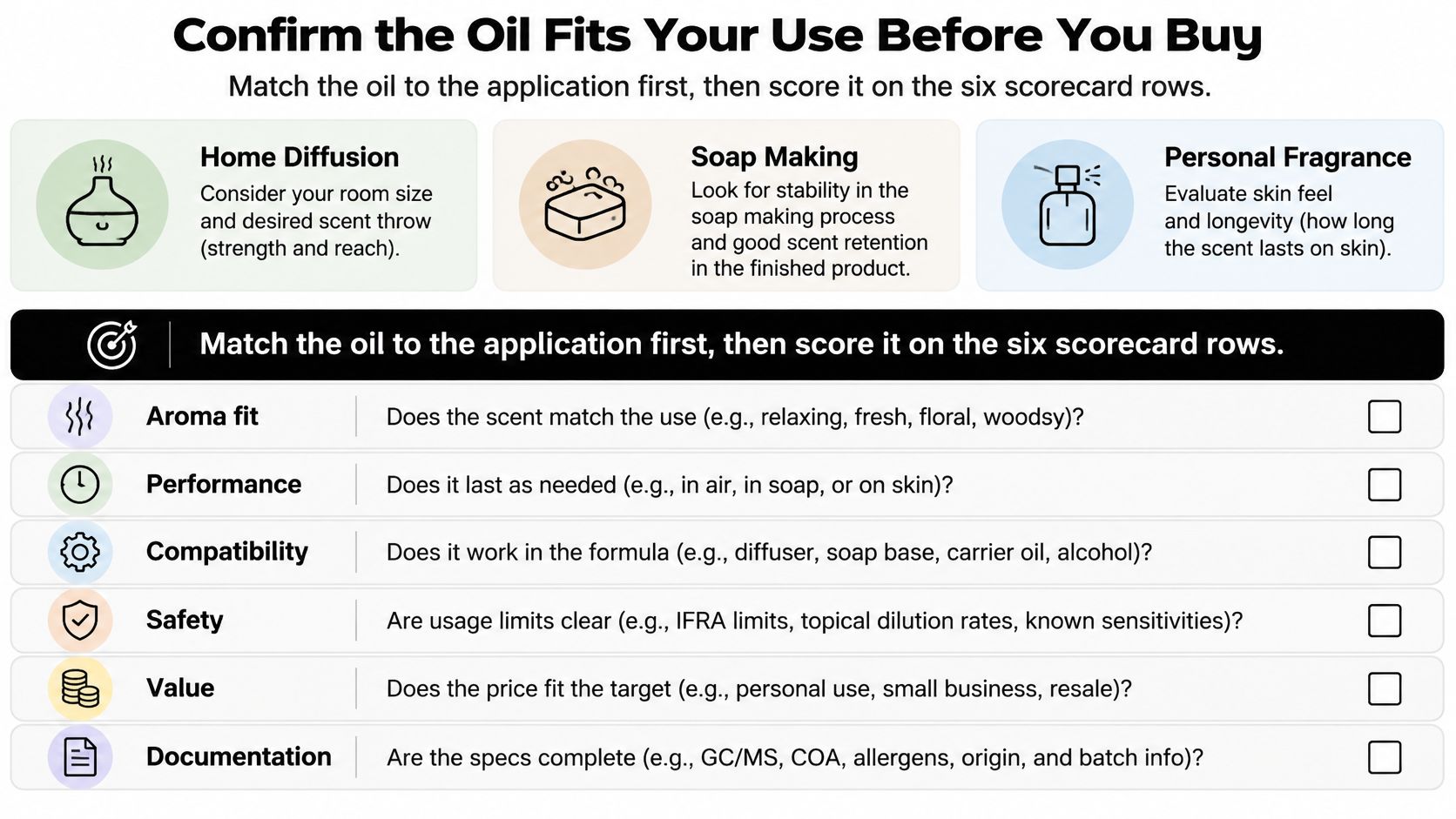
Home diffusion buyers should prioritize room size, ventilation, and a sensory test in the actual room with the actual device. If you're comparing hardware too, a Bluetooth humidifier from EcoQuest Purifiers is one example of equipment where output settings change how strong any oil seems, so test the pairing rather than the oil alone. Browsing common fragrance oils uses across home and craft applications helps you confirm you're shopping in the right category.
Wellness studios and spas need the allergen declaration, intended-use labeling, and patch-test guidance before scent preference enters the discussion. Your clients can't consent to ingredients nobody disclosed.
Resellers should weight batch consistency, batch documentation, and claims their own customers can verify. You'll be reordering, relabeling, and answering questions, so a fragrance with a paper trail protects your reputation better than a stronger one without it.
Test before you commit. We sell 1/8 ounce tester drams for $1.10 each, in over 100 different fragrances, which makes same-batch sampling cheap. That matters because we don't accept returns on fragrance, incense or perfume oils because of the possibility of contamination. Ask any seller about samples and returns before ordering, since fragrance returns are commonly restricted and a bulk mistake may be yours to keep.
The Verdict Checklist
Scorecard pass: The oil scores acceptably on all six rows for your specific use.
Batch documentation: You hold paperwork tied to the batch you'll receive.
Real-setting test: You've tested scent and strength in the finished product or room, against your previous batch where relevant.
If any one of those three fails, treat the oil as unproven and don't scale up. That's not a rejection of the fragrance. It's a recognition that reviews, however glowing, haven't yet answered your question.
frequently asked questions
How long do fragrance oils last when stored properly?
Fragrance oils can remain usable for an extended period when stored in tightly sealed containers away from direct sunlight, heat, and excessive temperature changes. Shelf life varies depending on the ingredients and formulation. Check the supplier's recommended storage conditions and expiration guidance before purchasing large quantities.
Can you mix different fragrance oils together to create custom scents?
Yes. Many fragrance oils can be blended to create custom scent combinations for candles, incense, room fragrances, and other applications. Start with small test quantities, record your blending ratios, and evaluate the finished scent before preparing larger batches. Always verify that each fragrance is suitable for your intended application.
What is the difference between fragrance oil concentrates and ready-to-use fragrance products?
Fragrance oil concentrates are designed to be incorporated into another product or carrier at an appropriate usage level. Ready-to-use fragrance products are formulated for a particular application and may already contain dilution ingredients. Always check the supplier's product description because concentration and intended use vary between products.
How much fragrance oil should you purchase when testing a new supplier?
Start with small samples rather than committing to a wholesale quantity. A tester allows you to evaluate the fragrance profile, compatibility with your intended application, and overall performance before investing in larger containers. Once you've confirmed the results, you can determine the quantity needed for regular production.
What should wholesale buyers look for when comparing fragrance oil suppliers?
Wholesale buyers should consider product selection, consistent availability, transparent pricing, sample options, minimum order requirements, and customer support. Reliable communication about product specifications and intended applications is also important. Comparing these factors helps businesses identify suppliers that can support repeat purchasing and long-term inventory needs.
Start with tester drams, score each fragrance against your actual application, and build your bulk orders only on oils that pass. At Aroma Fragrance Warehouse, you'll find fragrance oils poured fresh upon order, classic scents like sandalwood, lavender, and nag champa, plus retail and bulk pricing for studios, gift shops, and resellers. Visit us to order samples and put your scorecard to work.


