

Tea Tree and Lavender: Benefits, Uses, and Simple Blends

You're standing at the kitchen counter with two small bottles in front of you. Tea tree smells sharp and herbaceous. Lavender feels softer and more familiar. You're wondering whether they belong in the same diffuser, whether a few drops can go on skin, and whether mixing them automatically makes a stronger product.
The useful answer is more measured. Tea tree and lavender are related but distinct tools, and their value depends on how you use them. Together, they can shape a room's atmosphere, contribute to a properly diluted topical formula, or add a fresh aromatic note to household cleaning. They aren't interchangeable, and a blend shouldn't carry medical claims just because both oils have a long history of interest.
That distinction matters to home users, gift shops, spas, wellness studios, and resellers. Aroma Warehouse supplies essential oils, fragrance oils, incense, diffusers, bottles, droppers, and related materials for people building aromatic products or routines. If you're comparing this pair with other calming combinations, this guide to stress-relief scents offers useful context.
By the end, you'll know what each oil contributes, how to combine them without overcomplicating the formula, and what responsible labels should leave out.
Table of Contents
Why These Two Oils End Up in the Same Bottle - Three different jobs for one blend
What Tea Tree Oil Actually Is and Does - A complex oil, not a single ingredient - What that means in practice
What Lavender Oil Brings to the Table - Why the bottle can smell different over time
Tea Tree and Lavender Side by Side at a Glance - Why pairing isn't automatic synergy
Three Reliable Ways to Use the Blend at Home - Diffusion for a balanced room aroma - A diluted chest-and-shoulders body oil - A household fragrance spray
Does the Blend Actually Work Better Than Either Oil Alone - Translate the finding into honest product language
A Safety and Storage Checklist You Can Actually Use - Use this decision checklist
Sourcing, Storage, and Smart Buying for Shops and Studios - Build a practical shop inventory
Why These Two Oils End Up in the Same Bottle
Tea tree and lavender meet at the blending table because they create contrast. Tea tree brings a clean, green, medicinal-leaning aroma. Lavender softens that edge with a floral, familiar scent. In a diffuser, the result can feel fresher and rounder than either oil by itself, which explains why the pairing appears in personal-care, fragrance, and home products.
That pleasant balance doesn't prove that the oils work better together for every purpose. A scent can be harmonious without producing a stronger antimicrobial effect, and a laboratory result doesn't automatically become a reliable skin or household treatment. Keeping those ideas separate protects both the user and the retailer.
Three different jobs for one blend
Think about the intended use before counting drops:
Atmosphere: Diffusion and fragrance use focus on how the blend smells and how it changes the feel of a room.
Topical formulation: A carrier oil or finished cosmetic base reduces the concentration before skin contact. The finished product needs appropriate labeling and a patch-test instruction.
Household scent: A cleaning spray or aromatic surface product can smell fresh, but it shouldn't be marketed as a disinfectant or medical treatment without evidence and regulatory support.
A boutique owner might use the blend in a gift set with a diffuser. A spa might prefer lavender-forward room fragrance with only a small tea tree note. A home user might want a counter spray that smells cleaner without expecting it to replace a formulated cleaning product.
Practical rule: Choose the use first, then choose the ratio. Don't start with a bottle and invent a purpose afterward.
The same principle applies to wholesale buying. Ask whether you need an essential oil, a fragrance oil, a carrier, a diffuser accessory, or packaging for resale. Those materials may share a scent direction, but they aren't automatically interchangeable in a formula.
What Tea Tree Oil Actually Is and Does
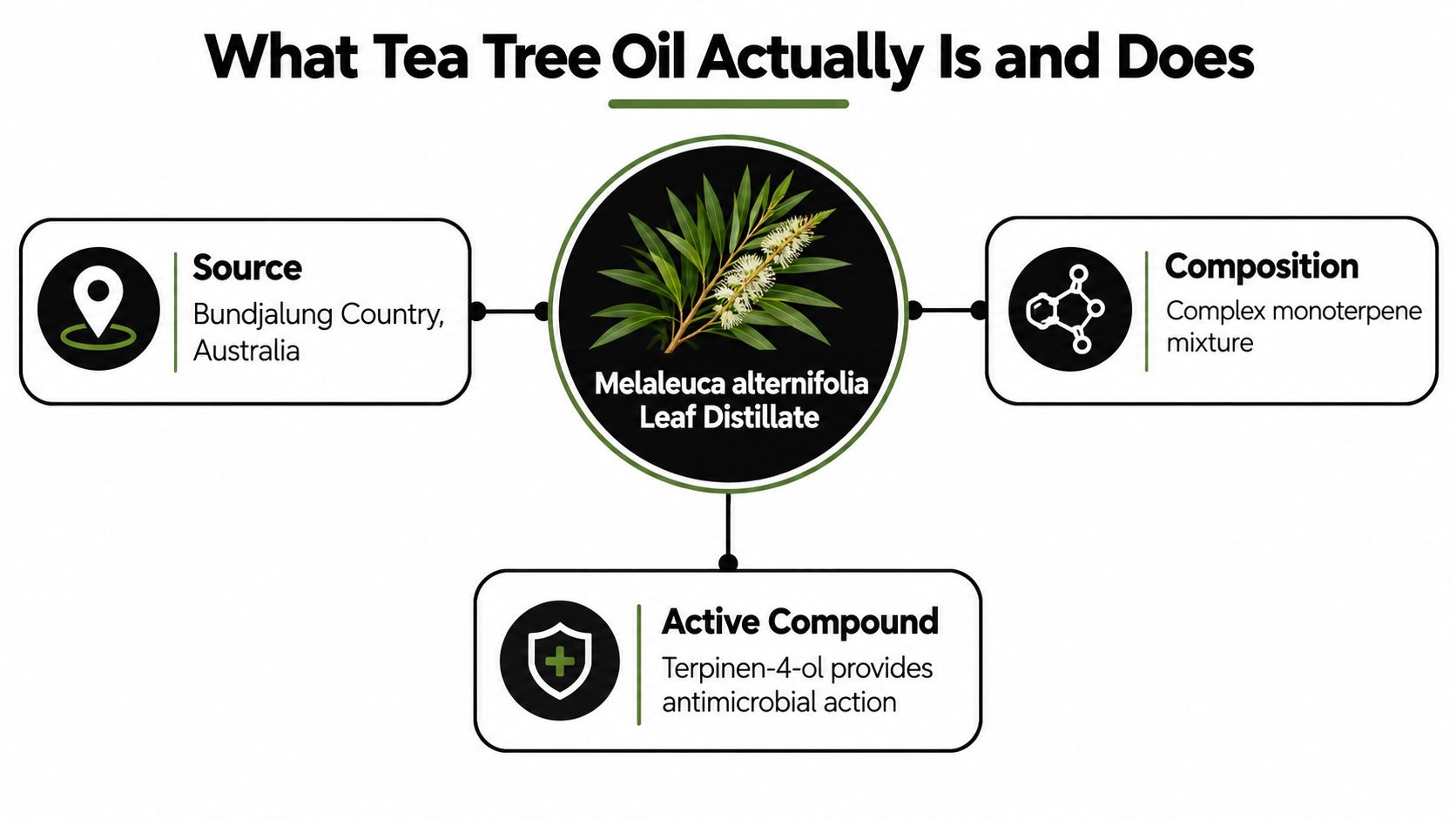
Tea tree oil is distilled from the leaves and terminal branches of Melaleuca alternifolia, an Australian plant. Its history includes the traditional practices of the Bundjalung people of eastern Australia, who used the leaves on wounds and insect bites. Modern interest grew around its antimicrobial properties and dermatological applications, but that history doesn't make every tea tree product suitable for every condition.
A complex oil, not a single ingredient

Tea tree is a chemically complex monoterpene mixture. Terpinen-4-ol drives much of
its antimicrobial performance, while alpha-terpineol also contributes, as described in this review of tea tree oil chemistry and applications. Historical gas-chromatographic analysis of more than 800 samples identified about 100 constituents, which helps explain why botanical identity, batch records, and constituent profiles matter to professional buyers.
A useful analogy is a musical chord. You may recognize the overall sound as tea tree, but the individual notes can vary between batches. Storage, source, and handling influence the aromatic profile, so a shop buying for repeatable products should track the lot rather than relying only on the words “tea tree.”
At the microbial membrane level, tea tree can weaken the structure that keeps a cell intact. Laboratory work has described potassium-ion leakage and reduced cellular respiration in E. coli, effects consistent with damaged membrane integrity. That helps explain why results can look compelling in a test environment, while real skin, surfaces, concentration, contact time, and formulation create a much more complicated picture.
What that means in practice
Tea tree belongs in a diluted formula for topical use, not casually on bare skin. It shouldn't be ingested, and concentrated exposure can be toxic. Mouthwash and gel research uses specific concentrations that shouldn't be copied into undiluted household or personal-care recipes.
For readers managing oily or blemish-prone skin, Mina Beauty Cosmetics' resource on oily skin can provide broader skincare context, but tea tree still shouldn't be treated as a guaranteed acne treatment. Aroma Warehouse's tea tree essential oil is best considered a raw aromatic ingredient whose use depends on the finished formula and label language.
What Lavender Oil Brings to the Table
Lavender earns its place beside tea tree for a different reason. Its main contribution is usually sensory. The scent is floral, herbaceous, and familiar, so many people use it to create a calmer-feeling room, support an evening routine, or soften sharper notes in a fragrance blend. Those are experiential uses, not promises to diagnose, treat, or cure a medical condition.
The word “lavender” also hides useful complexity. Lavender essential oil is a variable botanical mixture rather than one fixed active ingredient. Cultivar, geography, extraction method, storage, and oxidation can change the relative amounts of volatile constituents, which can affect odor, tolerability, and biological activity, as explained in this review of lavender's reported wound-healing literature.
Why the bottle can smell different over time
A fresh lavender oil may smell bright, clean, and gently floral. A poorly stored bottle can become flatter, harsher, or less pleasant. Light, heat, oxygen, and a loose cap all work against consistency, especially when a retailer opens the same container repeatedly.
That's why a sunny windowsill is a poor storage location. Light-resistant packaging and a tightly closed cap help preserve the character buyers expect. A shop selling lavender incense, fragrance oils, or diffuser blends also benefits from documenting the botanical identity and lot, rather than treating every lavender-scented material as the same thing.
For a home routine, lavender pairs naturally with sandalwood, patchouli, and other grounding fragrance directions. In a tea tree and lavender blend, it can round off tea tree's sharper profile without proving that the two oils have a universal therapeutic partnership. Aroma Warehouse's lavender essential oil can serve as a starting material, but the finished product still needs a clear purpose and appropriate instructions.
Label language should describe the experience you can support, such as “floral herbal room aroma,” rather than promise medical results you haven't established.
Tea Tree and Lavender Side by Side at a Glance
The quickest way to understand the pairing is to compare the decisions a user has to make. Neither oil is “the stronger one.” Each suits a different part of an aromatic routine.
Attribute | Tea Tree | Lavender |
|---|---|---|
Dominant scent impression | Green, sharp, herbaceous, cleansing-leaning | Floral, soft, herbaceous, familiar |
Most common uses | Fresh fragrance blends, aromatic household products, diluted personal-care formulas | Diffusion, relaxation-oriented fragrance, evening atmosphere, cosmetic scent |
Typical dilution range for skin | Use a properly diluted finished formula and begin conservatively, especially on sensitive skin | Use a properly diluted finished formula and begin conservatively, especially on sensitive skin |
Household versatility | Works well in fresh, green, and cleansing-style scent profiles | Works well in floral, soft, woody, and calming-style scent profiles |
Main cautions | Don't ingest it, don't use it neat, and don't present laboratory activity as a treatment claim | Allergic skin reactions, headache, or coughing are possible for some people, and natural doesn't mean premarket safety-tested |
Tea tree often gives a blend definition. Even a small amount can pull a fragrance toward green leaves, clean surfaces, or an herbal cabinet. Lavender adds approachability and helps the aroma feel less austere. That division of labor makes the oils useful to retailers selling incense, room fragrance, diffuser supplies, and personal-care ingredients.
The table's skin row is intentionally cautious. There isn't one universal dilution for every person, body area, product base, or regulatory market. A face product, a body oil, and a rinse-off formula require different formulation decisions, and the total amount of essential oil includes every essential oil in the bottle.
Why pairing isn't automatic synergy
“Stronger together” can be a reasonable shorthand for a diffusion experience. The aroma may feel fuller because the two profiles balance one another. It isn't a reliable scientific conclusion for every topical, cleaning, or antimicrobial use.
A retailer can accurately describe the blend as tea tree's fresh herbal character softened by lavender's floral note. That statement tells the customer what to expect without turning a scent pairing into a medical promise.
Three Reliable Ways to Use the Blend at Home
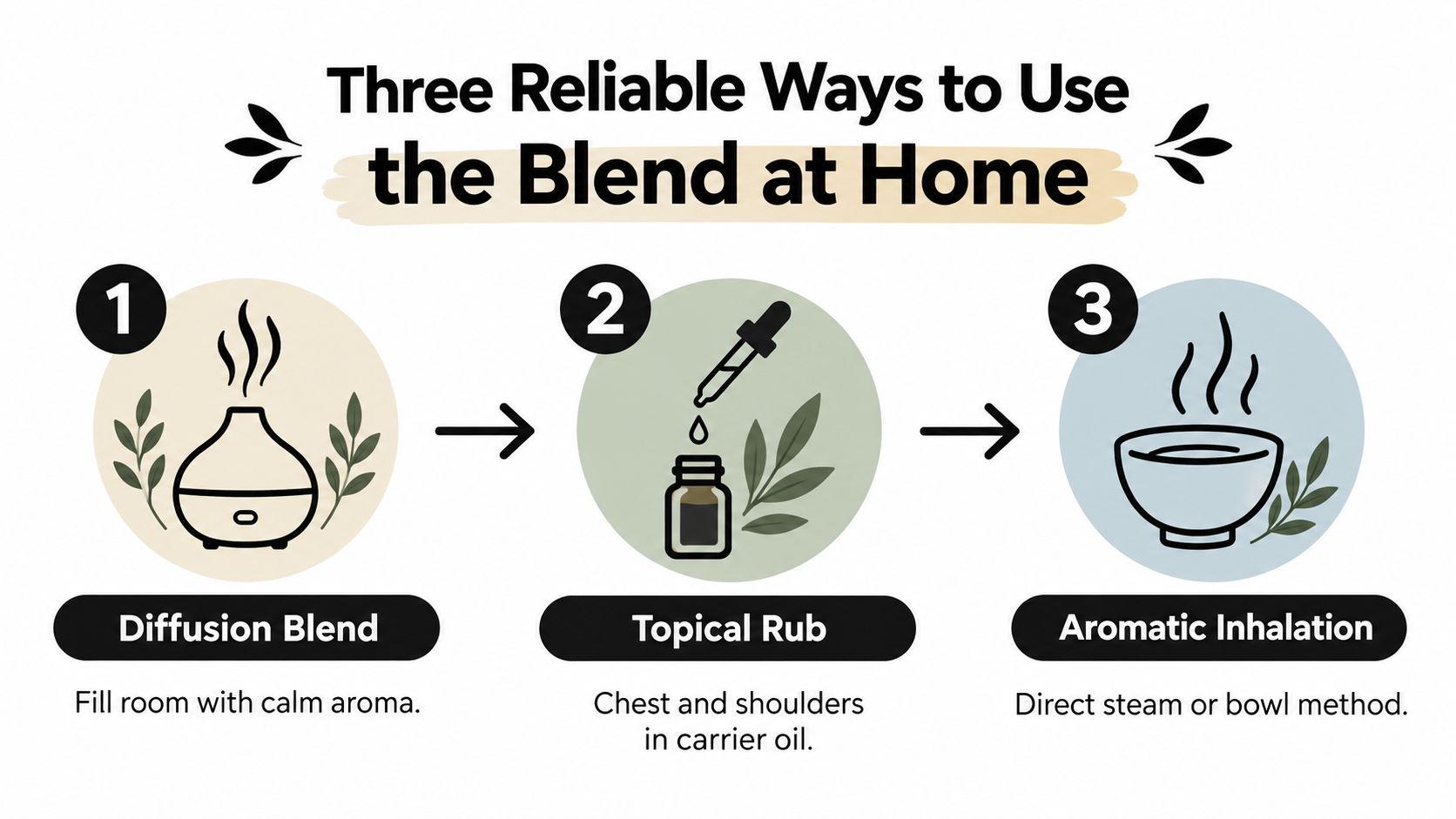
Start with the job, not the claim. The same two oils can create a room aroma, a diluted body product, or a household scent, but each route has different safety considerations.
Diffusion for a balanced room aroma
For a small diffuser, try a 2:3 ratio of tea tree to lavender, such as two drops of tea tree and three drops of lavender, while following the diffuser manufacturer's fill and operating instructions. This is a scent recipe, not an antimicrobial treatment. Use ventilation and stop if anyone develops headache, coughing, eye discomfort, or breathing symptoms.
This is the easiest place to begin because there's no carrier oil or water-based formula to preserve. If you're comparing diffuser styles, this guide to essential oils for diffusers can help you match the scent idea to the equipment.
A diluted chest-and-shoulders body oil
For a simple adult body oil, combine three drops of tea tree and three drops of lavender with one fluid ounce of carrier oil. That provides six drops of essential oil per fluid ounce, a commonly used example of a 1% dilution, as outlined in this practical dilution guide. Apply a small amount to the shoulders or upper chest, avoiding the eyes, broken skin, and mucous membranes.
Who should skip it? Children, people with known sensitivities, anyone who reacts during a patch test, and anyone who hasn't checked whether the ingredients suit their personal circumstances should avoid improvising a topical blend. A healthcare professional can advise people who are pregnant, nursing, taking medication, or managing a health condition.
A household fragrance spray
For a non-ingestible aromatic spray, combine ten drops total, split evenly between tea tree and lavender, with a suitable water-compatible base or a properly formulated cleaning product according to its instructions. Essential oils don't remain evenly dispersed in plain water, so don't assume that shaking a water-only bottle makes a stable or reliably safe cleaner. Label the bottle “aromatic household spray,” keep it away from food and children, and test the surface in an inconspicuous area.
A practical shopping list might include a carrier oil, glass bottles with droppers, an electric diffuser, DPG solvent for compatible fragrance applications, and suitable packaging. Fragrance oils and essential oils aren't the same material, so follow the supplier's intended-use guidance rather than substituting one for the other.
Does the Blend Actually Work Better Than Either Oil Alone
The short answer is sometimes in a specific formulation, but not as a universal rule. A 2025 study of tea tree and lavender emulgels found that lavender increased antibacterial activity against Cutibacterium acnes. It didn't improve tea tree's activity against Staphylococcus aureus or S. epidermidis, and the tested preparation produced mild irritation, according to the published emulgel study.
That finding matters because “synergy” is often used too loosely. In a laboratory formula, changing the ingredients can alter how the product spreads, how compounds interact, and how organisms respond. A result against one organism doesn't predict the same result against another organism, and a test preparation isn't identical to a consumer's homemade bottle.
Translate the finding into honest product language
A reseller could write:
“Tea tree and lavender aromatic blend”
“Fresh herbal-floral scent for diffusion”
“For use in a properly diluted personal-care formula”
A reseller shouldn't write:
“Treats acne”
“Kills all bacteria”
“Clinically proven to disinfect your home”
Those stronger statements require evidence, appropriate testing, and attention to the rules governing cosmetic, household, and therapeutic claims. A pleasing aroma is enough reason to sell a fragrance product. It doesn't need a medical story attached to it.
This distinction also helps Aroma Warehouse customers who stock incense and fragrance oils. In those categories, the customer usually wants an appealing atmosphere, consistent scent, and usable accessories. Tea tree can add a crisp herbal direction, while lavender can make the overall profile softer. That is a valuable blend rationale without claiming that the bottle treats a condition.
Frequent Asked Questions
1. What is the difference between tea tree essential oil and tea tree fragrance oil?
Tea tree essential oil is distilled from the leaves and branches of the Melaleuca alternifolia plant. Tea tree fragrance oil is a formulated aromatic product designed to provide a particular scent profile. Their ingredients, intended applications, and compatibility with product bases may differ, so always check the supplier's usage instructions.
2. Can tea tree and lavender oils be used to make scented incense?
Tea tree and lavender scents can be incorporated into incense-making projects when the selected ingredients are compatible with the incense base and intended burning application. Follow supplier recommendations for fragrance compatibility, dilution, and use, and test small batches to evaluate the finished scent and burning characteristics.
3. How can you tell if tea tree or lavender essential oil is authentic?
Check the botanical name, ingredient information, supplier documentation, batch or lot number, and relevant quality records. A reputable supplier should provide clear product identification and intended-use guidance. Scent alone cannot reliably confirm authenticity or purity.
4. Why do tea tree and lavender blends smell different between brands?
Differences in botanical source, growing conditions, extraction methods, ingredient composition, storage, and formulation can change a blend's aroma. Fragrance oils may also contain additional aromatic ingredients. Comparing ingredient information and testing samples can help you find a scent profile that suits your needs.
5. What supplies are useful for starting a small essential oil blending project?
Useful supplies include suitable essential oils, an appropriate carrier or compatible product base, calibrated droppers or measuring tools, compatible containers, labels, and a notebook for recording formulas and batch details. Choose materials according to the intended application, and follow relevant safety and labeling requirements.
A Safety and Storage Checklist You Can Actually Use
Safety starts with exposure route. Diffusion, topical application, surface use, and accidental ingestion create different concerns, so a decision that makes sense for a room aroma may be inappropriate for skin.
Use this decision checklist
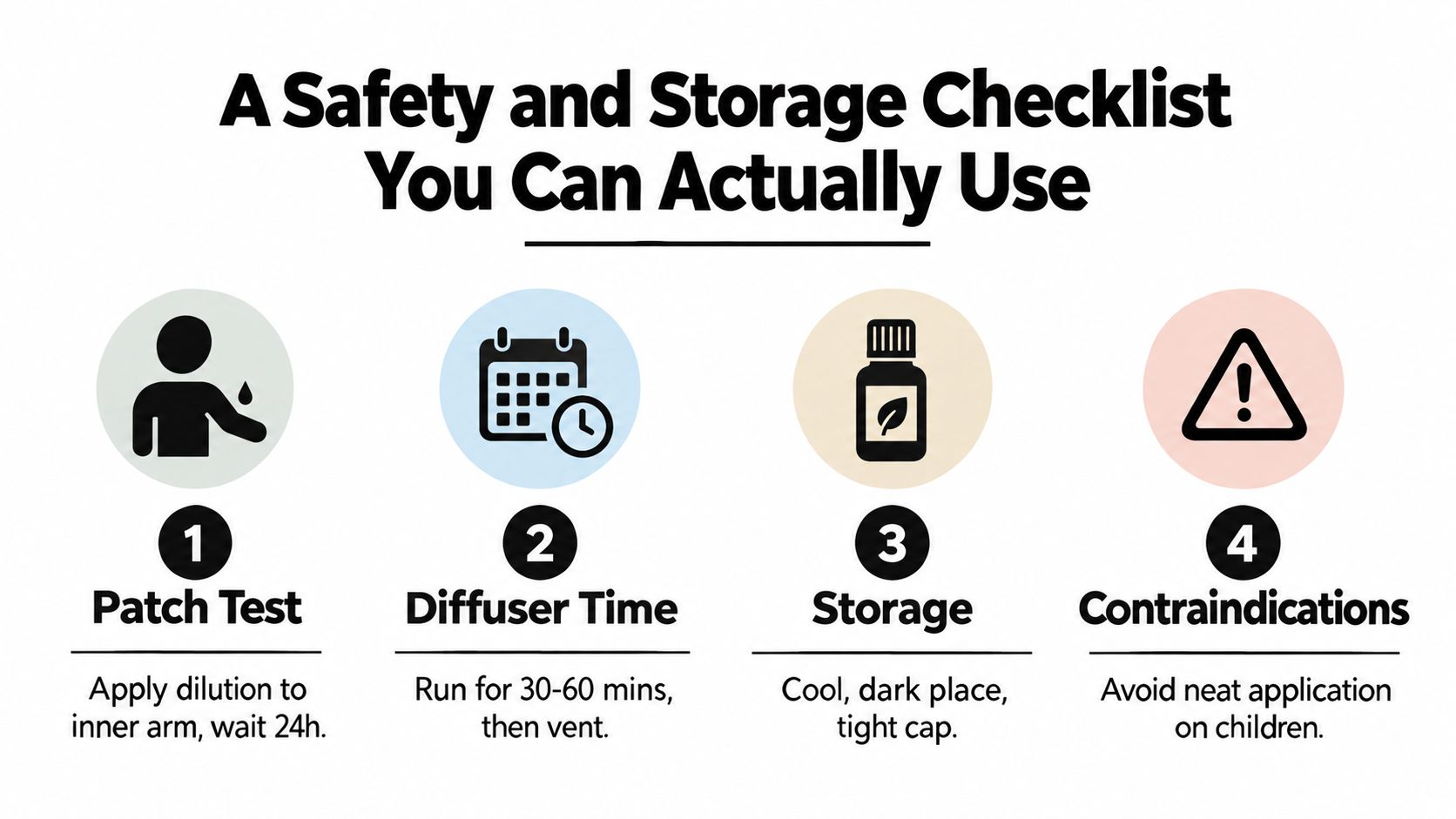
Children and pets: Keep concentrated oils out of reach, don't apply them neat to children, and avoid assuming that a pet can tolerate a human aromatic routine. Seek species-specific veterinary guidance before using essential oils around animals.
Sensitive skin: Dilute the complete blend in a suitable carrier. Patch test a small amount on the inner arm, then discontinue if redness, itching, burning, or swelling appears.
Diffusion: Use the equipment as directed, ventilate the room, and stop if anyone experiences headache, coughing, or discomfort. The National Center for Complementary and Integrative Health's lavender information notes that lavender aromatherapy may cause headache or coughing, while topical lavender products can trigger allergic skin reactions.
Ingestion: Don't swallow tea tree oil or treat either oil as an internal supplement. Keep bottles away from food preparation areas and label decanted materials immediately.
Storage: Cap every bottle tightly and store it somewhere cool and dark. Don't leave clear bottles beside a sunny window or near a heat source.
Labeling: Record the contents, intended use, date blended, and any dilution information. A reseller's customer shouldn't have to guess whether a bottle contains essential oil, fragrance oil, carrier oil, or a water-based product.
“Natural” doesn't mean automatically safe or premarket tested. That warning matters especially when a shop pours products to order or sells samples in gift sets. Clear instructions protect the customer and reduce the chance that someone uses an aromatic ingredient in an unintended way.
For a deeper look at aroma changes, oxidation, and bottle condition, see how to tell whether essential oils have gone bad. If the scent has changed sharply, the product looks unusual, or the packaging is compromised, don't put it into a new topical or resale formula to avoid waste.
Sourcing, Storage, and Smart Buying for Shops and Studios
A good tea tree and lavender kit begins with traceability. Ask for the botanical identity, lot information, intended application, and constituent profile when consistency matters. Tea tree's complex composition makes batch documentation useful, while lavender's changing chemistry makes storage and sourcing equally important.
Retailers should also distinguish essential oils from fragrance oils before ordering. An essential oil is a botanical distillate. A fragrance oil is a formulated aromatic material that may be designed for a particular application, such as incense, oil warmers, or personal fragrance. The name on the scent label doesn't tell you how the material behaves in every base.
Build a practical shop inventory
Fresh aromatic materials: Choose containers and quantities that suit your sales pace, especially if products are poured or blended to order.
Light-resistant bottles: Glass bottles with suitable closures help protect aroma and make decanted products easier to identify.
Application tools: Droppers, electric diffusers, oil warmers, and compatible DPG solvent support different fragrance formats.
Packaging records: Keep the lot, contents, blend date, and intended use with every private-label or repackaged product.
Customer instructions: State whether the item is for diffusion, fragrance, topical formulation, or household scent. Include dilution and ventilation guidance where relevant.
Studios and gift shops can also learn from hospitality purchasing, where packaging, consistent presentation, and clear amenity information influence the customer experience. Avistar's hospitality amenity guide offers useful context for businesses thinking about how aromatic products fit into guest-facing kits.
The best use of tea tree and lavender doesn't depend on calling the blend a cure. Use tea tree for a crisp herbal direction, lavender for a softer floral atmosphere, and both only in properly designed formulas. Store them well, label them clearly, and choose between atmosphere, topical use, and household scent before you start blending.
Aroma Warehouse offers tea tree and lavender oils alongside fresh-to-order fragrance oils, incense, diffusers, glass bottles, droppers, oil warmers, and DPG solvent for home users, studios, and resellers. Visit Aroma Incense Warehouse to choose the materials and accessories that fit your next clearly labeled aromatic blend.


