Stress Relief Scents That Actually Work, and How to Use Them
You know the moment. You've had a long day, your shoulders are up around your ears, and the room still feels too loud even after you shut the door. That's when stress relief scents earn their keep, not as decoration, but as a practical way to change the air you're breathing and the mood you're carrying.
Some scents help you settle. Others help you stay clear-headed enough to keep working. A few are better left for quiet spaces because they're too heavy for a desk, too smoky for a shared room, or just too much when you're already overloaded. The useful question isn't “what smells nice?” It's “what fits this room, this time of day, and this kind of stress?”
Table of Contents
The Scent Families That Move Stress - Citrus for quick lift and daytime clarity - Floral for emotional settling - Woody and resinous for grounding - Herbal and green for clearing the head
Incense, Oils, and Diffusers Compared - Incense for presence and ritual - Oils for control and repeat use - Passive diffusion for tight or shared spaces
Three Stress Relief Blend Recipes to Try Tonight - Evening wind-down blend - Midday reset blend - Grounding meditation blend
Matching Scent to Setting and Time of Day - Bedroom and evening spaces - Open office and shared work areas - Yoga studios and massage rooms - Retail floors and reception areas
Building a Stress Relief Line for Your Shop or Studio - A lean shelf mix that sells - What moves in practice - Brand voice still matters
Why Your Nose Knows How to Calm You Down
You walk into a spa, a yoga room, or even your own bedroom after a rough commute, and one scent can change the whole temperature of the moment. That's not just mood and memory doing a bit of theater. The nose feeds odor signals into the brain's emotional circuitry fast, which is why stress relief scents can feel immediate compared with slower comforts like tea, music, or a shower.
That speed matters in real life. If a room smells soft and familiar, people often unclench before they've consciously decided to relax. If the scent is too sharp, smoky, or synthetic, the opposite can happen. The body notices before the mind rationalizes it, which is why scent choice has to match the setting instead of chasing a single “calming” label.
Practical rule: the best scent for stress is the one your space can actually tolerate for more than a few minutes.
The useful split is simple. In a bedroom, you can lean into slower, deeper notes because sleep is the goal. In a busy shop or open office, a lighter profile usually works better because nobody wants to feel like they've been trapped inside a perfume counter. That's also why format matters as much as the oil itself, something I'd pair with a quick read on hydrosol versus essential oil choices if you're deciding what to stock or use at home.
Stress relief is never just “add scent and relax.” It's scent, strength, room size, and timing working together.
The Scent Families That Move Stress

The strongest aromatherapy choices usually fall into families, not random one-off favorites. That matters because a customer who likes lavender in a bedroom may hate it in a retail aisle, while someone who wants a clean citrus scent at noon may find floral notes too soft for work. I see the same pattern on the shelf and in the room, scent choice has to match the setting, the strength, and the time of day, or it misses the mark.
The research signal points in the same direction. A systematic review and meta-analysis found essential-oil interventions reduced state anxiety by −6.63 points and trait anxiety by −4.97 points, and it identified Citrus aurantium L. as the most recommended oil overall because it affected both anxiety measures systematic review on essential oils and anxiety. For a shop owner or studio buyer, that does not mean one oil solves everything. It means some families are more dependable starting points than others.
Citrus for quick lift and daytime clarity
Citrus scents like sweet orange, bergamot, lemon, and mandarin feel brighter, cleaner, and less demanding than heavier oils. They are usually the first thing I reach for when the issue is mental drag rather than full-body tension. In practice, they suit desks, morning routines, and any space where you need a calmer edge without tipping into sleepiness.
Citrus also behaves well in shared spaces. It opens a room without crowding it, which is why it sells easily for office use, front desks, and retail floors. If you want a practical way to compare relaxing blends before buying in volume, the relaxation oil guide is a useful reference point The relaxation oil guide.
Floral for emotional settling
Lavender, jasmine, and rose are the classic softeners. Lavender still earns its place because it feels familiar and rounded, while jasmine can feel more alive and less sedating. The same review found the strongest state-anxiety results for jasmine interventions lasting 30 to 100 minutes, which is a useful reminder that exposure length matters as much as the note itself.
Florals are where room context really matters. In a bedroom or treatment room, they can feel comforting and restorative. In a busy shop or open office, the same oils can read as heavy if the dose is too high or the air circulation is poor.
Woody and resinous for grounding
Sandalwood, cedar, patchouli, frankincense, myrrh, and copal read as deeper and steadier. These are the scents people reach for when they want a room to feel anchored, not airy. They suit meditation corners, evening routines, and buyers who dislike sweet fragrances.
They also hold up well in spaces that need presence without sweetness. A yoga studio can carry a woody base much more easily than a small bedroom can, and a retail floor often benefits from that slower, quieter profile. The trade-off is simple, these notes can feel dense if the room is already warm or crowded.
Herbal and green for clearing the head
Eucalyptus, peppermint, tea tree, and rosemary are sharper and more functional. They do not always feel relaxing in the softest sense, but they can cut through the mental fog that comes with a busy day. For many people, that sense of clarity is what stress relief feels like.
These scents are useful in work zones, entryways, and studios where people want to feel reset rather than sleepy. They are less forgiving in enclosed bedrooms because the finish can seem brisk or medicinal if the blend is pushed too far. Used lightly, they give a clean lift without turning the space harsh.
A randomized study also showed that not every pleasant scent reliably changes task outcomes after stress exposure, since lavender, coconut, and water conditions produced similar poststress performance, with go correct scores near 99.3% to 99.6% and no-go correct scores from 81.5% to 87.5% across conditions ambient scent and stress study. That is useful because it keeps the buying decision honest, pleasant does not automatically mean powerful. A scent still has to fit the room, the task, and the people using it.
Incense, Oils, and Diffusers Compared

The same scent behaves differently depending on how you release it. That's why one buyer swears by incense while another prefers a diffuser, even if they both like the same note. For a shop floor or treatment room, the delivery method often matters more than the fragrance family.
Incense for presence and ritual
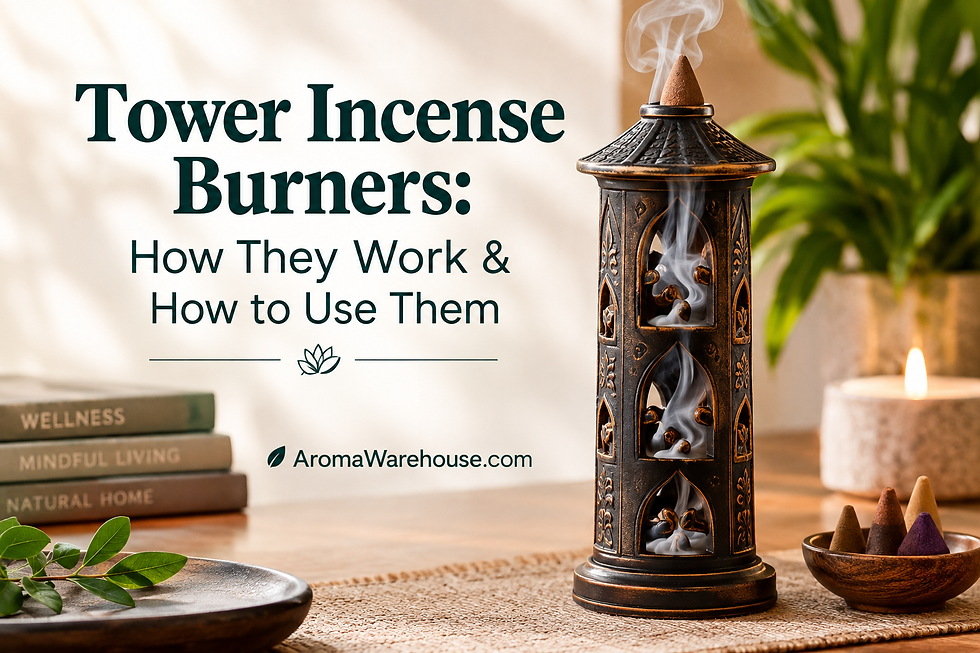
Stick incense, cones, and resins like frankincense or nag champa give a room a full, ceremonial character. That's a strong fit for meditation spaces and homes where smoke isn't a problem. It's a poor fit for shared offices, small bedrooms, or anywhere ventilation is weak, because the room doesn't just smell scented, it smells occupied.
Oils for control and repeat use
Fragrance oils in electric diffusers or oil warmers give you a more controlled release. That's useful in offices, waiting rooms, and studio spaces where the goal is consistency rather than a dramatic opening note. Aroma Warehouse also keeps fresh-poured fragrance oils and related accessories like warmers, bottles, droppers, and DPG solvent for buyers who need to build larger batches or private-label stock, and that kind of setup usually suits resellers and treatment-room operators rather than casual users.
Passive diffusion for tight or shared spaces
Sachets, lava beads, and light-bulb rings are the quietest option. They work when smoke and mist aren't welcome, which makes them practical for lockers, drawers, small retail displays, and shared rooms. They're also the easiest way to keep scent present without asking everyone in the room to agree on intensity.
Safety note: incense needs air flow, oils need sensible dosing, and passive diffusion still needs restraint if pets, kids, or sensitive noses are in the space.
This comparison of oil burners and reed diffusers is worth a look if you're deciding between sustained throw and a lighter, hands-off setup.
Three Stress Relief Blend Recipes to Try Tonight
Theory helps, but a working blend is what changes someone's night. These are the kinds of blends that make sense in a real home or a real counter display, because they don't ask for obscure ingredients or a perfume lab. They also respect the fact that a bedroom and a midday desk need very different energy.
Evening wind-down blend
Use lavender, chamomile, and sweet orange in a 4:3:1 ratio for a diffuser blend that feels soft without turning sugary. For a standard room, start with a small total amount in water, then stop there if the air already feels full. This is the blend I'd point someone toward when the day is over and the goal is to lower the volume on everything.
Midday reset blend
Mix peppermint, lemon, and rosemary in a sharper, shorter profile. It's the one to use when the room feels stale and you still need to keep moving. I'd keep this one away from bedtime, because it works by clearing the head rather than smoothing it down.
Grounding meditation blend
For a heavier, more anchored feel, combine sandalwood, frankincense, and a touch of patchouli. This suits slower work, breath practice, and quiet evening rituals. The patchouli should stay in the background, not take over the whole room.
A small batch behind the counter usually performs better when the blend is tested in plain proportions before you scale it. If you're preparing sprays or larger fragrance runs, a guide like this body spray mixing reference can help you think in terms of balance instead of overload.
Mixing note: unscented sticks and empty bottles matter if you're building a private label line, because they let you control the scent identity instead of fighting a pre-existing smell.
Matching Scent to Setting and Time of Day
The same bottle can feel perfect in one room and wrong in another. A citrus note that keeps a workspace alert may feel too busy in a bedroom, while sandalwood that grounds a meditation space can feel heavy at a front counter. The best stress relief scents are chosen by use case first, then by personal preference.

Bedroom and evening spaces
Bedrooms usually benefit from quieter, rounder notes. Lavender, chamomile, sandalwood, and rose sit well here because they don't fight the purpose of the room. If the scent competes with sleep, it's too much.
Open office and shared work areas
Shared desks need lighter fragrance and less throw. Citrus and herbal notes help keep the air from feeling stale without turning the space into a scented showroom. Start low, wait a few minutes, then add more only if the room still feels flat.
Yoga studios and massage rooms
These spaces can handle more character because people enter them expecting a sensory experience. Jasmine, frankincense, sandalwood, and gentle lavender all work well here, depending on whether the room should feel more uplifting or more meditative. The key is consistency, not intensity.
Retail floors and reception areas
Retail spaces need restraint. A scent that seems luxurious to one person can feel suffocating to the next, especially if the air doesn't move well. In those rooms, lighter diffusion often works better than smoke, and the old rule still holds, if customers notice the fragrance immediately, it may already be too strong.
Start with fewer drops than you think, give it a few minutes, and only then decide whether to add more.
That's the practical difference between a scent that calms a room and a scent that takes over a room.
Building a Stress Relief Line for Your Shop or Studio
A solid stress-relief shelf doesn't need twenty choices. It needs a tight mix that addresses the most common buying reasons, calm, grounding, sleep, and daytime reset. For wholesalers, gift shops, smoke shops, botanicas, and wellness studios, the right assortment makes customers feel seen without creating dead stock.
A lean shelf mix that sells
Start with a sandalwood or nag champa staple, one lavender or jasmine anchor, one bright citrus, and one resinous option such as frankincense or palo santo for ritual buyers. That gives you coverage without clutter. Add a small diffuser or oil warmer display, because once someone likes a single-stick incense, they often trade up to fragrance oil or a room-based format.
For sourcing and replenishment, this product sourcing guide helps frame what to look for when you're buying in bulk or pairing accessories with consumables.
What moves in practice
Fresh-poured fragrance oils are easier to position as repeat purchases than one-off novelty items, because customers return for refills once they find a room scent they trust. Bath salts and sea salts extend the category into gift sets and self-care bundles, which matters for seasonal merchandising and bundled checkouts. Custom labeling also gives resellers a cleaner way to turn a commodity fragrance into a branded line.
Brand voice still matters
If you're writing product cards, bundles, or gift tags, a practical guide to brand voice is useful because scent buyers respond to language that sounds calm, specific, and consistent. A stress-relief line should feel steady on the shelf, not noisy.
Aroma Warehouse also fits naturally into this kind of setup, since it stocks incense, fragrance oils, accessories, and bulk-friendly supplies that support both retail display and private-label work. For a small business, that's the difference between a pretty shelf and a shelf that turns.
Common Questions About Stress Relief Scents
What are the best stress relief scents for daytime use?
Citrus and herbal scents such as sweet orange, lemon, bergamot, rosemary, and peppermint are useful daytime choices when you want a fresh, clear feeling without making the space feel overly heavy.
Which stress relief scents work well in a bedroom?
Lavender, chamomile, sandalwood, and rose are good choices for bedrooms because they offer softer, quieter scent profiles that fit evening routines and relaxation.
Are incense or fragrance oils better for stress relief?
Neither format is automatically better. Incense creates a stronger, more noticeable presence, while fragrance oils used in diffusers or warmers provide greater control over scent intensity and are often better suited to shared spaces.
How do I choose a stress relief scent for my workspace?
Choose lighter scents with less throw, particularly citrus or herbal profiles. Start with a small amount and allow the fragrance to develop before adding more, especially in an enclosed or shared office.
Can I combine different scents to create a stress relief blend?
Yes. Combining complementary scent families can create a more balanced profile. For example, lavender, chamomile, and sweet orange can create a softer evening blend, while peppermint, lemon, and rosemary provide a brighter daytime profile. The article provides additional blend recipes and guidance on balancing fragrance intensity.
How long do they last? It depends on the format. Incense gives a faster, louder burst, while diffusers and passive formats hold closer to the pace of the room.
Are they safe around cats and dogs? Keep heavy smoke out of shared animal spaces and use ventilation. Lighter, well-managed diffusion is usually the more conservative option.
Can fragrance oils go on skin? Only if they're made and diluted for that use. Room fragrance and skin-safe body fragrance aren't the same thing.
What if one scent stops working? Rotate by family, not just by bottle. A citrus for daytime, a floral for evening, and a woody note for grounding gives you more range than repeating the same smell until your nose tunes it out.
Stress Relief Scents Quick Reference | Best Time of Day | Best Setting | Recommended Format |
|---|---|---|---|
Citrus | Morning, midday | Office, retail, kitchen | Diffuser, passive diffusion |
Floral | Evening, transition time | Bedroom, studio, treatment room | Diffuser, light incense |
Woody | Evening | Bedroom, meditation space | Incense, oil warmer |
Resinous | Quiet hours | Ritual space, yoga room | Incense, warmer |
Herbal and green | Daytime | Desk, shared work area | Diffuser, passive diffusion |
If you're building a room scent routine or a retail lineup, start with a few reliable families and match them to the space instead of chasing every trendy note. Explore Incense Warehouse for incense, fragrance oils, diffusers, and bulk-friendly accessories that fit real bedrooms, studios, and storefronts, then build a stress-relief selection your customers can live with.