

Sandalwood Musk Fragrance: Notes, Scent and How to Choose

You open a bottle marked sandalwood musk, expecting something woody, but the first sniff seems bright, sweet, or almost soapy. Is that the fragrance you wanted, or will it smell different once it settles?
The name describes a scent direction, not a complete recipe. Knowing what to smell for, which materials might create it, and how to test the finished product makes choosing much easier.
Table of Contents
What Sandalwood Musk Fragrance Smells Like - Follow the scent as it settles
Notes Behind a Sandalwood Musk Scent - Recognize the supporting roles
Why Sandalwood and Musk Pair So Well - What the molecules contribute - Balance matters more than strength
Natural, Synthetic and Blended Materials - Understand the trade-offs - Ask about sourcing, not just naturalness
Using Sandalwood Musk Safely and Making It Last - Make a small-area trial meaningful - Preserve the fragrance without increasing exposure
Choosing and Testing Your Sandalwood Musk - Check the finished experience - Sample under repeatable conditions
What Sandalwood Musk Fragrance Smells Like
A sandalwood musk fragrance usually smells warm, creamy, and soft, closer to a worn cashmere sweater than to a forest. Sandalwood supplies the milky wood character. Musk adds a clean, skin-like softness that can make the fragrance feel close and rounded rather than sharp.
Think of sandalwood as the frame of a wooden chair and musk as its comfortable padding. You can still recognize the wood, but you experience it through a softer texture. Creamy here doesn't necessarily mean sugary: a fragrance can suggest polished wood and warm milk without smelling like dessert.
The bottle's name gives you a starting point, not the whole sensory experience.
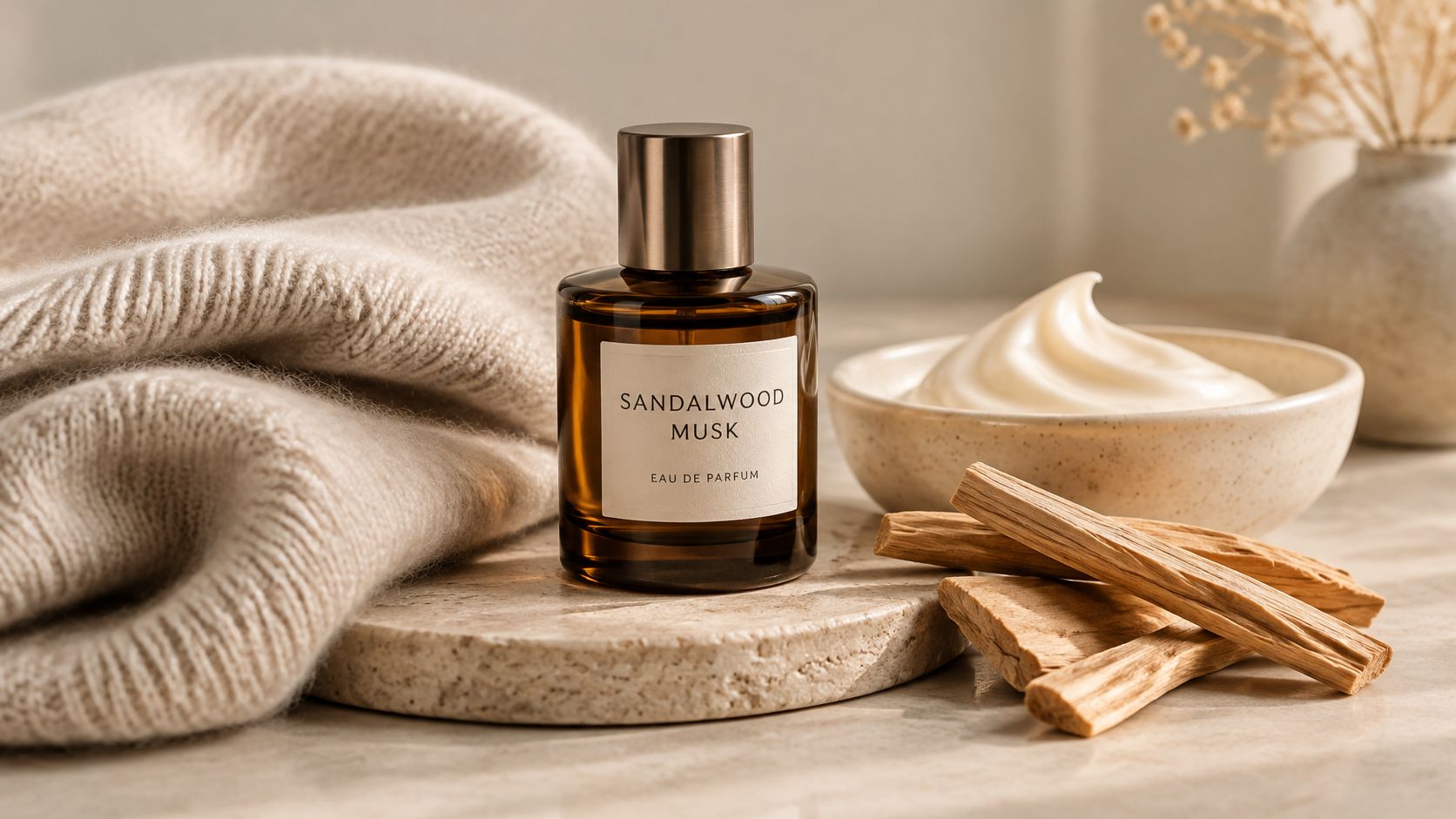
Follow the scent as it settles
At first, you might notice citrus zest, pepper, or a bright floral impression. As the opening softens, the wood becomes easier to distinguish, sometimes alongside gentle flowers. The final dry-down, meaning the scent left after the more volatile materials fade, is where warm woods and musk become clearest.
Sandalwood itself isn't the sharp resinous smell of pine, the smoke of burning incense, or the green freshness associated with some cedar fragrances. A finished blend can contain those effects, but they're additions rather than defining sandalwood characteristics.
If you prefer a sweeter softness, the vanilla musk fragrance guide offers a useful comparison. The same sandalwood-musk bottle can seem creamy to one person and dry to another, so judge the settled scent rather than deciding from the cap alone.
Notes Behind a Sandalwood Musk Scent
Read this scent-family map by role: base notes provide the lasting foundation, heart notes shape the middle, and top notes give the opening its brightness.
Common notes in sandalwood musk fragrances
Note | Scent Character | Typical Position | Common Partners |
|---|---|---|---|
Sandalwood | Creamy, soft, warm woody | Heart and base | Cedarwood, vanilla |
Synthetic musk | Soft, clean, skin-like | Base | Sandalwood, iris |
Amber or benzoin | Resinous, balsamic, deep | Base | Vanilla, patchouli |
Patchouli | Earthy, damp, grounding | Base | Vetiver, amber |
Cedarwood | Dry, pencil-like, structured | Heart | Bergamot, vetiver |
Vanilla | Sweet, creamy, rounded | Heart and base | Tonka, amber |
Iris | Powdery, root-like, elegant | Heart | Musk, violet |
Bergamot | Bright, citrus, fresh | Top | Lavender, cedarwood |
Recognize the supporting roles
Sandalwood and synthetic musk establish the central woody-soft effect. Amber or benzoin can make that foundation feel resinous and enveloping, while patchouli gives it an earthy underside. Neither addition automatically makes the perfume smoky.
Cedarwood supplies a drier, pencil-like structure. Say you enjoy sandalwood but dislike rich sweetness: cedarwood and vetiver are useful clues when browsing descriptions. Vanilla, tonka, and amber point toward a more rounded, comforting interpretation, although vanilla doesn't always turn a fragrance into a gourmand.
Bergamot creates a brighter entrance, while iris can lend a powdery, root-like elegance beside musk or violet. The sandalwood fragrance oil guide provides another way to identify the central wood note before comparing its partners.
A note list describes recognizable smells. It isn't an ingredient list or a formula.
Brands may highlight only the notes they consider most memorable. A label naming sandalwood, iris, and musk doesn't tell you their proportions, whether natural sandalwood oil is present, or which musk materials the perfumer used.
For comparison-shopping ideas, Finding Favourites' guide to luxury-inspired woody scents for budget shoppers can help you explore different interpretations of woody perfume. Use such descriptions to build a sampling shortlist, not to assume equivalent ingredients or performance.
Start with the dominant impression in a fragrance you already like. Match it to the table, then look for its likely partners: powdery preferences suggest iris and musk, while a taste for earthy woods suggests patchouli and vetiver.
Why Sandalwood and Musk Pair So Well
The pairing works because the materials can contribute different sensory qualities: sandalwood provides recognizable wood character, while musk can soften transitions and influence how the blend spreads around the wearer.
This concept map summarizes their complementary roles.
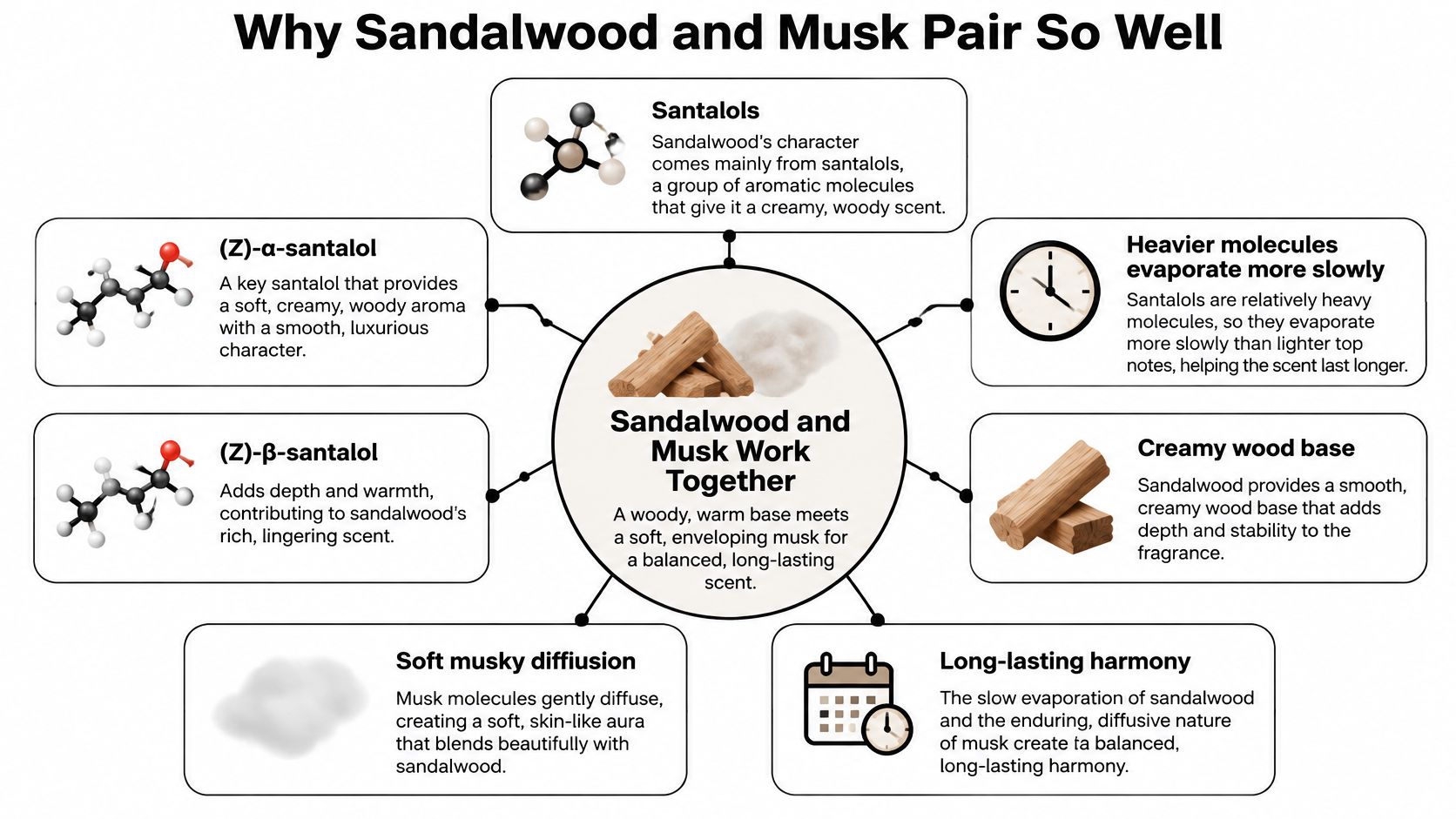
What the molecules contribute
Sandalwood's characteristic odor comes mainly from santalols, including the sesquiterpene alcohols (Z)-α-santalol and (Z)-β-santalol; the peer-reviewed sandalwood review hosted by PubMed Central reports α-santalol commonly at about 40–60% and β-santalol at about 20–25% in typical sandalwood oil, while identifying natural (-)-(Z)-β-santalol with the strongest characteristic sandalwood impression.
These relatively heavy, oil-loving molecules evaporate more slowly than many lighter citrus or floral materials. That helps explain the wood's persistence on skin, textiles, and scent strips. The technical term substantivity means a material's ability to remain perceptible on a surface.
Composition alone doesn't establish quality. Molecular shape matters too: related isomers can smell weaker or even lack the expected sandalwood odor. A high total santalol claim therefore isn't a substitute for smelling the finished product.
Balance matters more than strength
Think of sandalwood as the blend's spine. Musk supports a smooth, coherent impression around that central structure, but different musk materials can produce clean, powdery, airy, or more animalic effects. Adding more musk doesn't necessarily produce a better sandalwood fragrance.
Natural oils also aren't interchangeable. A Natural Product Communications paper on sandalwood odor chemistry describes how structural changes affect sandalwood odor and how minor constituents contribute cedarwood, balsamic, nutty, or animalic nuances.
A vanilla sandalwood fragrance comparison can help distinguish added sweetness from the wood's own creamy character.
Practical rule: Evaluate a diluted blotter after several hours. The woody core should remain recognizable without an overwhelming musky haze.
For an additional visual accompaniment to the pairing, use the video below.
Natural, Synthetic and Blended Materials
A sandalwood musk label can describe very different formulas: natural sandalwood oil paired with musk materials, a reconstructed woody accord, or a blend of natural and synthetic ingredients. The name describes a scent direction, not a guaranteed ingredient list.
An accord combines materials to create a recognizable scent impression. It can suggest sandalwood without containing sandalwood essential oil, much like a painted woodgrain can resemble a surface without being made of wood.
Sandalwood musk materials compared
Material | Source | What It Adds | Watch Out For |
|---|---|---|---|
Natural sandalwood oil | Steam-distilled heartwood of Santalum album | Woody character with subtle secondary nuances | Cost, sourcing documentation, and batch differences |
Synthetic sandalwood odorants | Aroma chemicals such as Sandalore, Ebanol, Radjanol, and Javanol | Repeatable woody effects and formulation flexibility | A simple reconstruction can lack depth |
Synthetic musk accords | Aroma chemicals rather than animal-derived musk | Skin-like softness, diffusion, and persistence | The specific musk materials may not be named |
Blended accords | Natural and synthetic materials combined | Wood character with less dependence on natural oil | The natural-to-synthetic ratio may be undisclosed |
Understand the trade-offs
Natural sandalwood has a long history in perfumery. A Chemical Senses article on sandalwood odorants describes steam-distilled heartwood oil, approximately 6–10% oil in dry Santalum album heartwood, and the 1970s shortage that encouraged synthetic alternatives.
Natural oil can bring layered nuances, while its agricultural origin and batch composition can affect the scent. Synthetic woods are often more consistent and can reduce material costs. They are not automatically inferior: a perfumer can use them to shape a particular woody texture or add depth and lift.
Synthetic musk is a separate category from synthetic sandalwood. The guide to musk essential oil and fragrance terminology helps clarify why the word “musk” does not identify one specific material.
Blended accords combine natural and synthetic materials. Price alone cannot reveal the formula, since concentration, packaging, and product positioning also affect cost. A higher price does not necessarily mean a higher proportion of natural oil.
Ask about sourcing, not just naturalness
Sandalwood conservation is a sourcing concern, so ask what documentation is available for any natural oil. “Natural” by itself does not explain where an ingredient came from or how it was obtained.
For sensory context, read about sandalwood's soft woody scent. Then ask whether the product uses sandalwood essential oil or a reconstructed accord, what ingredient or allergen information is available, and which applications the finished product is intended for.
Using Sandalwood Musk Safely and Making It Last
The intended use decides the safety question. A fragrance suitable for an oil warmer or diffuser isn't automatically suitable for skin, and adding carrier oil doesn't make an ambient-only fragrance a cosmetic product.
The FDA's guide to allergens in cosmetics identifies fragrances as a major class of cosmetic allergens and notes that susceptible people can experience contact dermatitis or respiratory symptoms, particularly those with asthma or allergic rhinitis. A pleasant smell isn't evidence that an exposure is harmless.
Application guidance by use
Use | Application Guidance | Patch Test | Ventilation |
|---|---|---|---|
Personal wear on skin | Only when topical use is explicitly permitted; use the documented dilution | Small-area trial on the inner forearm; monitor for delayed irritation | Avoid spraying near the face or breathing concentrated mist |
Oil warmer or diffuser | Follow the supplier's dilution and device instructions; begin with brief use | No skin test for an ambient-only product | Provide fresh-air exchange; stop if symptoms occur |
Incense or smouldering form | Use a stable, heat-resistant holder away from fabrics | Not applicable | Well-ventilated indoor space |
Room or linen spray | Use only on label-approved surfaces, away from the face | Test fabric for staining, not skin unless topical use is permitted | Ventilate during and after use |
Make a small-area trial meaningful
For a skin-permitted product, apply a small amount at its approved dilution to the inner forearm. Leave the area uncovered and watch for redness, itching, swelling, or a delayed rash. Don't apply undiluted fragrance concentrate to test whether it's safe.
A home trial can reveal irritation, but it can't rule out allergy. People with known fragrance allergies or previous significant reactions should seek clinical guidance rather than experiment with new products. Stop use if symptoms develop; breathing difficulty requires prompt medical attention.
Comfortable wear means more than liking the smell. Your skin and the people sharing your space need to tolerate it too.
Preserve the fragrance without increasing exposure
Apply a skin-approved perfume to moisturized skin, preferably over an unscented moisturizer. Use a light application rather than repeatedly topping up because you've stopped noticing it. Avoid rubbing freshly applied perfume, which spreads it and changes the initial evaporation.
The oil-based perfume guide provides context for that application format. Keep bottles tightly closed, away from heat and direct light, and test any fabric application on an inconspicuous area before broader use.
Choosing and Testing Your Sandalwood Musk
Buy the sandalwood musk that suits your intended use and remains comfortable after it settles, not the one with the most appealing name. If sampling is available, test before committing to a full bottle.
Use this checklist as a sensory prompt, while keeping your own preferences separate from defects. A deliberately dry woody fragrance isn't poor quality just because you prefer a milky one.
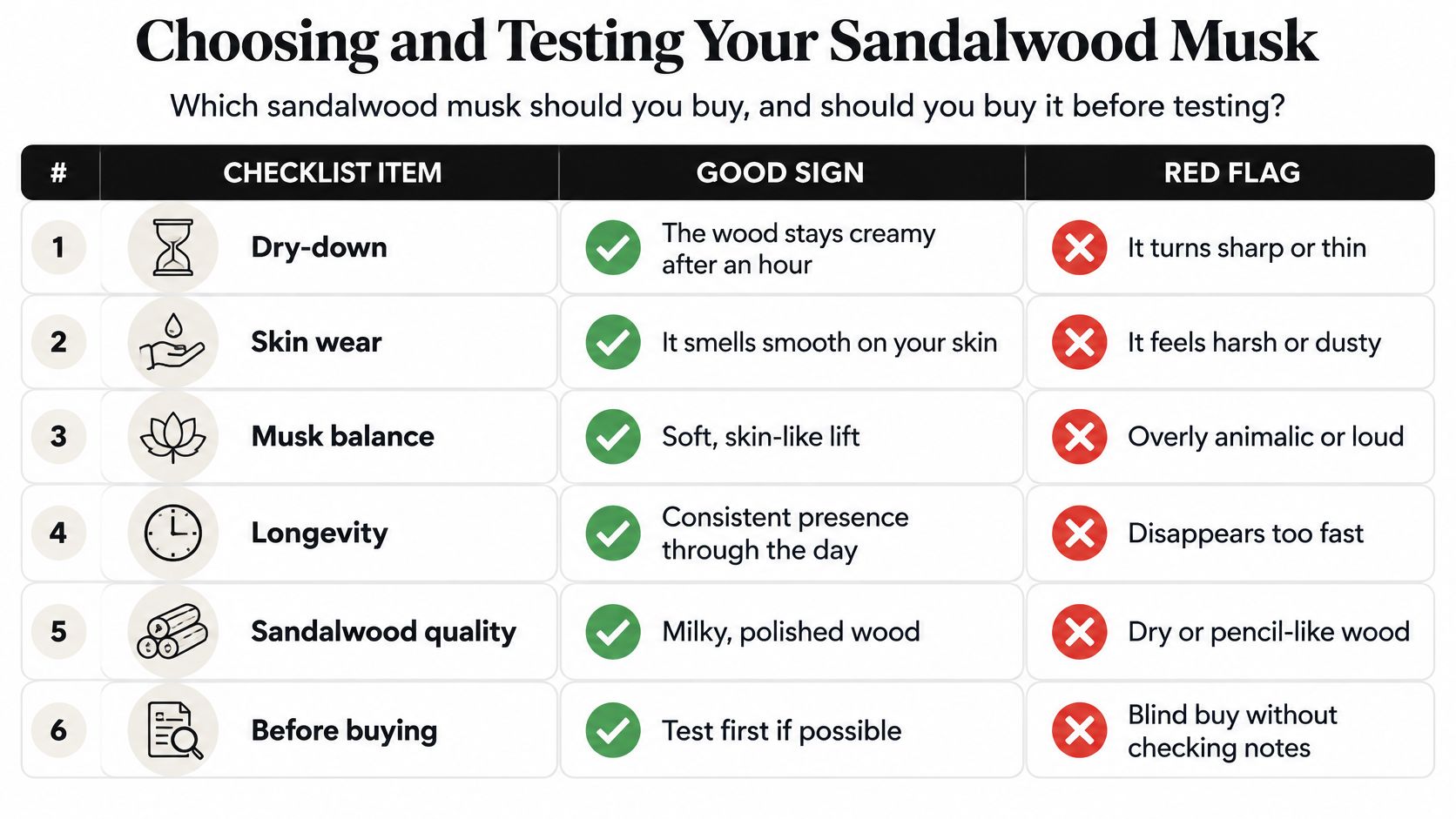
Check the finished experience
Check | Good Sign | Red Flag |
|---|---|---|
Dry-down | The settled wood matches the character you wanted | An unpleasant sharp, sour, or cloying finish |
Sweetness | Vanilla or resin enriches the blend without dominating your preference | Sweetness masks the woody character you bought it for |
Projection | The scent is appropriate for your room or wearing situation | It overwhelms a shared office, treatment room, or studio |
Longevity | It remains perceptible for the period you need | You need frequent reapplication to enjoy it |
Batch consistency | A replacement resembles your retained reference sample | A marked unexplained difference in odor or strength |
Unit price | You compare the same format, concentration, and intended use | A large bottle seems cheaper but isn't a comparable product |
Vanilla-forward versions may suit someone seeking evening warmth; cedar-led versions may appeal to someone who wants a less sweet daytime scent. Those are preferences, not rules about who should wear what.
For retailers, consistency deserves particular attention. Keep a clearly labeled reference sample away from heat and light, then compare replacement stock under the same conditions. Record the dilution medium and application method so a strength difference doesn't masquerade as a formula change.
Sample under repeatable conditions
Build a focused shortlist. We sell 1/8 ounce tester drams for $1.10 each, in over 100 different fragrances, including classics such as sandalwood, lavender, and nag champa alongside exclusive blends. Use familiar scents as sensory reference points, and confirm that samples of your preferred candidates are available.
Label before applying. Write each candidate's name and dilution on a separate perfume blotter. Use the same application method for every sample and keep the strips apart so the smells don't mingle.
Record changes, not just strength. Smell at application, after the opening settles, later in the day, and at the end of your intended wear period. Note creaminess, dryness, sweetness, musky character, and comfort in plain words.
Test the actual application. For a skin-approved candidate, complete a cautious small-area trial before normal wear. For an ambient product, evaluate it in the intended device and space instead of putting it on skin.
Choose the base you want to live with. Buy the full size only when the final impression feels right and the product performs acceptably for its intended use.
We don't accept returns on fragrance, incense, or perfume oils because of the possibility of contamination. Sampling reduces the risk of committing to a scent that looks right on a label but doesn't suit you.
Frequently Asked Questions
1: Can sandalwood musk fragrance be mixed with other fragrance oils?
Yes. Sandalwood musk can be combined with complementary fragrance oils to create custom scent blends. Popular combinations include vanilla, amber, patchouli, lavender, and cedarwood. Start with small test batches to find a balance that preserves the woody musk character.
2: Is sandalwood musk a good fragrance for making homemade candles?
Sandalwood musk can be used in candle making when the fragrance oil is specifically approved for candle applications. Check the supplier's usage guidelines and recommended fragrance load, and verify compatibility with your chosen wax before producing larger batches.
3: What fragrances pair well with sandalwood musk for soap making?
Vanilla, amber, lavender, bergamot, patchouli, and cedarwood can complement sandalwood musk in handmade soap. Always check the fragrance oil's soap-making suitability, applicable usage limits, and compatibility with your soap base.
4: Does sandalwood musk fragrance work well in homemade room sprays?
Sandalwood musk can create a warm, inviting fragrance for homemade room sprays when the fragrance oil is suitable for that application. The correct spray base and formulation are important because fragrance oils do not automatically mix evenly with water. Follow supplier recommendations for the intended product.
5: How can small businesses use sandalwood musk fragrance oil in products for resale?
Small businesses can explore sandalwood musk fragrance oil for compatible products such as candles, wax melts, room sprays, and other scented goods. Before selling finished products, verify application-specific usage limits, labeling requirements, ingredient documentation, and applicable product safety regulations.
We offer fragrance oils, incense, and accessories for exploring woody and musky scents at home or for resale. Visit Aroma Fragrance Warehouse to compare fragrance options and available testers, then choose according to the settled scent and the product's intended use.


