

2 Oz Spray Bottles: Size, Material and Sprayer Guide

A 2 oz spray bottle holds about 59.15 mL, which suppliers usually label as 60 mL. Choose it by matching the bottle, sprayer and formula, not by capacity or appearance alone.
You've found a bottle that looks right, the sprayer screws on, and the first few sprays seem fine. Then a filled sample leaves an oily ring on the bench, or the mist turns into a weak stream after storage. Before replacing the bottle, check the closure and the liquid together. A good-looking package isn't necessarily a compatible dispensing system.
Table of Contents
2 oz Spray Bottle Sizes and Capacity at a Glance - Comparing bottle sizes
Glass or PET Bottles and Which Material Fits Your Product - Decide with filled samples
Fine Mist, Lotion Pump or Crimp-On Sprayer and How to Match Them - Check the attachment before blaming the pump
Matching Fragrance Oils and DPG to the Closure - Run a storage screen
How to Fill and Test a 2 oz Bottle - Follow a repeatable trial procedure
Labeling and Recycling Rules for Resellers - Build the label around the actual product - Keep environmental claims separate
Bulk Ordering, Shipping and Unit Cost Per Bottle - Find the costs you can control - Ship the trial before scaling
2 oz Spray Bottle Sizes and Capacity at a Glance

One U.S. fluid ounce equals 29.5735 mL, so a 2 oz bottle works out to 59.147 mL.
Suppliers round that to 59.15 mL and print 60 mL on the spec sheet, which makes 2 oz a packaging category rather than an exact metric fill. Keep that rounding in mind when you write label claims or set a fill target on the line, because a 60 mL fill in a bottle that holds 59.15 mL nominal will overflow.
Comparing bottle sizes
The calculated capacities below use that conversion factor. The use column is a purchasing guide, not a restriction on what each size can contain.
Size | Fluid oz | Exact mL | Typical use |
|---|---|---|---|
1 | 29.5735 | Testers and small samples | |
2 | 59.147, commonly rounded to 59.15 and labeled 60 mL | Fragrance oils, room sprays, travel mists and trial sizes | |
3.5 | 88.7205 | Linen mists and larger samples | |
4 | 118.294 | Home room sprays and gift sets | |
8 | 236.588 | Full-size room sprays and linen sprays |
For a retailer, the appeal of 2 oz spray bottles is the balance between repeated use and compact presentation. Consider them for personal-care liquids, gift sets, fragrance samples and small room sprays when a tiny tester would feel insufficient but a full-size package would be unnecessary.
Matching capacities do not guarantee matching dimensions. Ask for a dimensional drawing, usable label area and the supplier's intended fill specification before ordering labels or cartons. A tall, narrow bottle and a short, broad bottle can sit in the same capacity category while needing different cartons, different label sizes and different case counts. I've seen label orders arrive sized for a bottle the buyer never sampled.
Capacity is only half the spec. A basic atomizer uses a pump and internal dip tube to move liquid toward a nozzle that breaks it into a mist, and whether your formula travels through that system cleanly depends on viscosity, surface tension and the sprayer's output per stroke, not on how much the bottle holds. Two 60 mL bottles with different closures can deliver very different doses of the same liquid.
For travel products, check the destination's current liquid and dangerous-goods requirements separately. Small size alone isn't a complete travel-compliance claim.
Glass or PET Bottles and Which Material Fits Your Product
Choose glass when presentation and the proposed formula justify it. Consider PET when handling weight and breakage are bigger concerns, but don't treat either material as an automatic compatibility pass.
The useful comparison isn't just premium versus inexpensive. It's the complete package, including protection in transit, the wetted pump components and what the customer can recycle.
Factor | Glass | PET plastic |
|---|---|---|
Empty weight | Plan for a heavier package and compare packed freight quotes | Consider for weight-sensitive mailing |
Breakage in transit | Specify protective inserts and separation | Evaluate drop performance in the finished shipping pack |
Fragrance and solvent resistance | Still requires testing of the complete closure system | Test the actual formula against the specified resin and closure |
Finish options | Ask about clear, amber, frosted and decorated options | Ask about clear, colored and decorated options |
Recycling | Confirm local acceptance and component-separation instructions | Identify the resin and verify local acceptance; assess the pump separately |
Decide with filled samples
Request samples in the actual material and finish you intend to buy. A clear sample bottle doesn't establish how a decorated production bottle will look after filling, and testing an empty bottle won't reveal formula-related changes.
For an oil-and-DPG product, don't approve PET from a material name alone. Likewise, don't assume a glass body resolves concerns about plastic valves, seals or the dip tube. Ask the supplier to identify the components that contact the liquid.
Practical rule: Compare filled, packed samples, not loose empty bottles photographed on a shelf.
Recycling deserves the same specificity. The EPA reports that U.S. PET bottles and jars had a 29.1% recycling rate in 2018, while natural HDPE bottles had an estimated 29.3% rate, according to its containers and packaging material data. Those figures describe broad material categories, not the recyclability or actual recovery of your assembled spray bottle.
A resin identification mark is useful, but it isn't permission to describe the entire package as recyclable. Check the sprayer, label and cap independently, then write disposal instructions for the market where you sell.
Fine Mist, Lotion Pump or Crimp-On Sprayer and How to Match Them
A fine-mist atomizer turns liquid into a plume. A lotion-style pump delivers a dose or stream. If the customer expects a room mist, a pump that merely moves the liquid out of the bottle hasn't done the right job.
Also separate attachment style from dispensing style. Screw-on and crimp-on describe how the closure attaches; they don't, by themselves, establish the quality of the spray.
Sprayer type | Spray pattern | Best for | Watch for |
|---|---|---|---|
Fine-mist atomizer with pump and tube | Conical mist | Room, linen and aromatherapy mists | Poor atomization or clogging with unsuitable thick blends |
Lotion-style pump | Dose or thicker stream | Blends intended for direct dispensing | Doesn't provide the plume expected from a mist |
Crimp-on fine-mist sprayer | Fine mist | Perfume-style sampling and compatible alcohol-based blends | Requires the correct neck finish and suitable crimping equipment |
Screw-on sprayer with dip tube | Depends on the pump selected | Refillable products and repacking | Thread mismatch or unsuitable dip-tube length |
Check the attachment before blaming the pump
A closure that catches the threads isn't necessarily the right closure. The neck diameter, finish and sealing arrangement must match, as the crimp-on perfume sprayer compatibility discussion emphasizes. Don't use extra tightening as a substitute for confirming the specification.
Use a bottle cap types guide to distinguish closure formats, then ask the supplier for the exact bottle-and-pump pairing. Keep the part references in your purchasing records.
Run this fit check on a physical sample:
Neck finish: Match the supplier's drawing and closure specification, not just the apparent opening width.
Attachment style: Confirm whether the package needs a threaded closure or a crimped assembly.
Dip-tube reach: Check the installed tube against the internal bottle geometry and the supplier's measurement datum.
A tube may need trimming for a short bottle. Don't cut it by eye across an entire delivery. Approve the sample length first, then verify that the pump draws properly as the bottle empties.
Matching Fragrance Oils and DPG to the Closure
The formula and closure fit together like a lock and key. A well-made bottle can still leak or stop dispensing when the liquid and the wetted components aren't compatible.
Treat the bottle, closure, pump, actuator and protective components as one container-closure system. FDA packaging guidance identifies protection, compatibility and safety as central requirements, and discusses formulation properties that affect dispensing in its container-closure systems guidance. That pharmaceutical framework is useful for organizing a packaging assessment, not for implying that every room spray is regulated as a drug.
Formula type | Main risk to investigate | Test before filling |
|---|---|---|
Pure fragrance oil | Seal swelling, staining or component softening | Compare filled units stored upright, inverted and horizontally |
Fragrance oil in DPG | Changes in plastic or elastomer components | Inspect for swelling, cloudiness and cracking after storage |
Alcohol-water room spray | Leakage, mass loss or changed nozzle performance | Record mass and compare the spray before and after storage |
High-concentration essential-oil blend | Changes in seals, valves or odor transfer | Check component condition and actuation force |
Thick aromatherapy blend with carrier oil | Failure to prime or atomize | Evaluate dry-start priming and repeated dispensing |
These aren't universal risk rankings. A formula's viscosity, solvent composition and concentration matter more than its marketing category. The explanation of DPG and its uses provides formulation context, but dilution doesn't establish packaging compatibility.
Run a storage screen
Fill samples with the finished formula, assemble them consistently and record their starting condition. Store separate units upright, inverted and on their sides, using a multi-week screening period agreed with the supplier rather than treating an arbitrary waiting period as proof of shelf life.
Inspect for swelling, softening, stress cracking, discoloration, odor transfer and leakage. Compare spray behavior too. A package can remain visibly dry while the valve or seal changes enough to affect dispensing.
Request material information for the wetted components and seals. Keep a retained sample linked to the formula revision, bottle lot and sprayer lot so a later complaint can be investigated without guessing which parts were used.
How to Fill and Test a 2 oz Bottle
A useful trial documents what happened, not just whether the sample sprayed once. Prepare a worksheet, a suitable balance, clean collection surfaces and a consistent actuation method before filling.
Use the preparation sequence below only where it agrees with the component supplier's cleaning instructions.
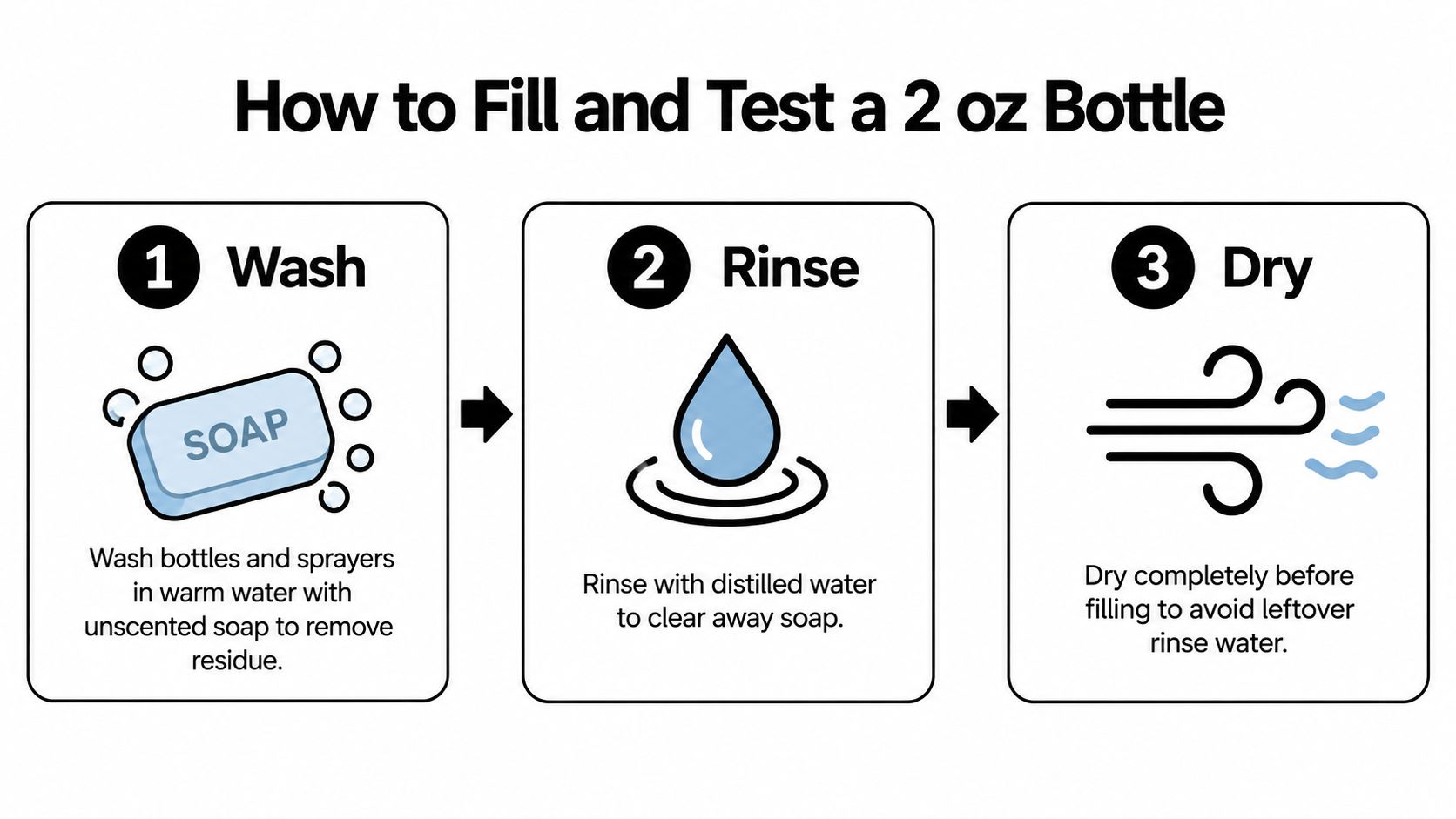
Follow a repeatable trial procedure
Confirm the preparation method. Ask whether the bottles and pumps arrive ready for filling or require cleaning. Don't assume washing an assembled pump is permitted, and don't describe a rinse as validated sanitation.
Record the empty package mass. Weigh the dry bottle and its assigned closure components. Keep the same components together throughout the trial.
Establish the fill line. Use the intended production fill and leave the headspace specified for the package. Check the assembled unit rather than filling an open bottle to its brim.
Close and prime consistently. Follow the supplier's assembly instructions. Record how the pump primes from a dry start instead of forcing every candidate through an assumed universal priming count.
Measure delivery. Weigh the bottle before and after a defined sequence of actuations. Divide the mass lost by the number of sprays to calculate average delivered mass; use individually measured deliveries to assess variation.
Check performance through use. Compare the first, middle and final stages of the filled unit's dispensing life. Record actuation effort, failed strokes, spray direction and remaining liquid.
Assess the plume on the intended surface. For a suitable linen product, inspect visible wetness on representative fabric. Packaging performance doesn't establish that a formula is safe for skin, inhalation or every textile.
The FDA spray-product guidance provides an engineering framework for evaluating spray weight, pattern, droplet distribution and actuation force. Set acceptance limits for your product and method. Pharmaceutical benchmarks aren't automatically cosmetic or household-product requirements, and container fill weight shouldn't be confused with the intended mass of an individual spray.
For formulation preparation alongside package testing, consult the room spray guide using fragrance oils.
The accompanying video can be viewed separately from the written test record.
A passing trial has documented closure integrity, acceptable delivery consistency and no unexplained deterioration after storage. Save the results with batch codes and retained units; a verbal approval won't help much when a later shipment behaves differently.
Labeling and Recycling Rules for Resellers
The catalog capacity isn't a finished label specification. Confirm the applicable net-quantity rules, actual declared fill and required units for your product category and sales destination before printing. A nominal metric capacity used to compare empty bottles shouldn't automatically become the quantity claim on a filled product.
The illustration below shows a dual-unit layout concept. Have the final quantity statement and its placement checked against the requirements that apply to your product.
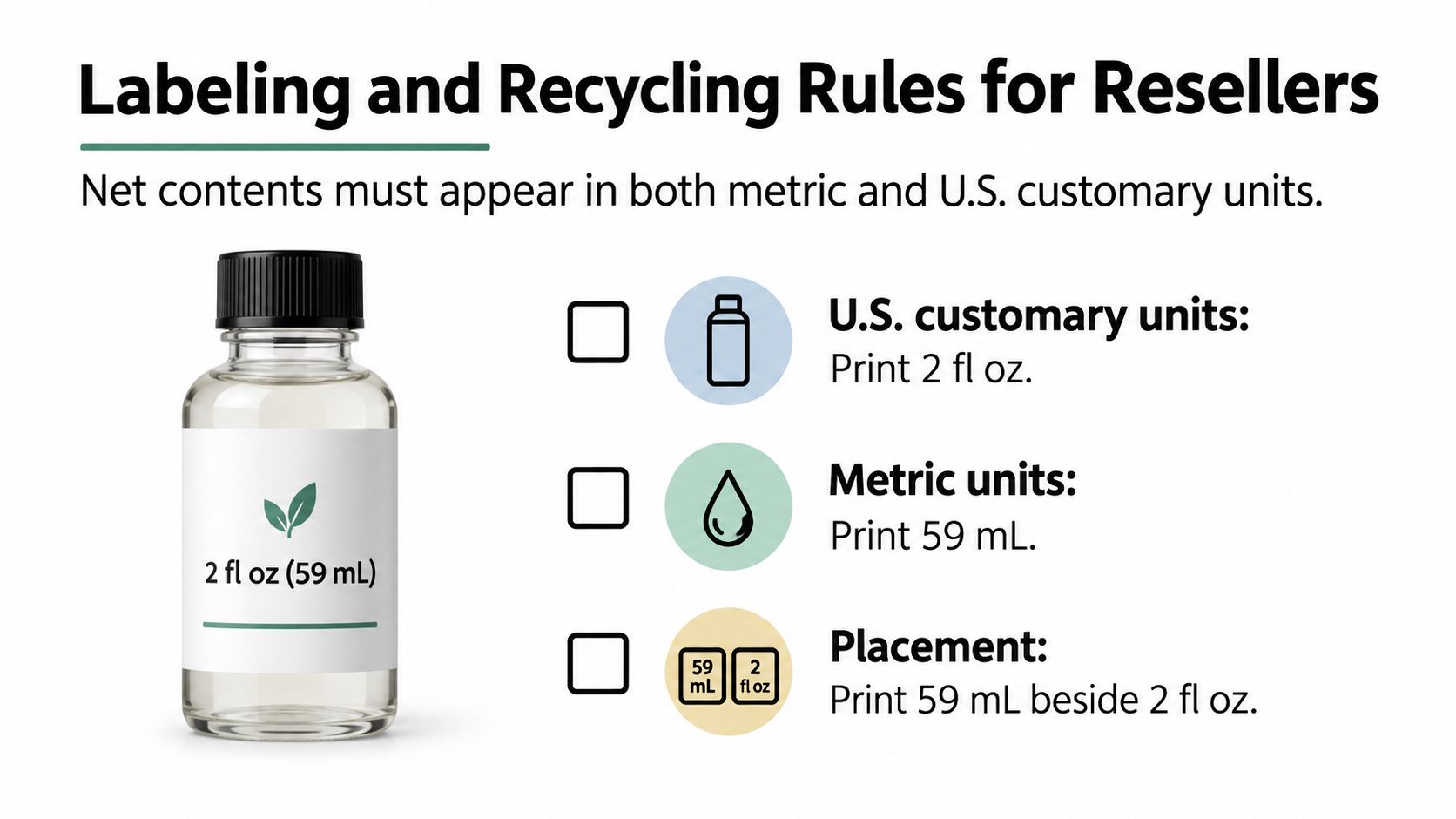
Build the label around the actual product
Use this as an artwork review checklist, not a universal statement that every item is legally mandatory everywhere:
Product identity: Make the intended use clear, especially when similar bottles contain different formulas.
Net quantity: Verify the declaration, units and placement.
Ingredient information: Check what the category and destination require.
Directions and warnings: Match them to the formulation and exposure assessment, including relevant precautions around children and pets.
Traceability: Include a usable batch reference and appropriate business details.
Origin information: Confirm whether a country-of-origin statement is required.
The fragrance labeling requirements guide is a useful starting point for assembling questions before artwork approval.
Keep environmental claims separate
Don't print fully recyclable or zero waste just because the bottle body has a familiar material designation. Give component-specific disposal instructions that local programs can support.
The EU's Packaging and Packaging Waste Regulation, published in January 2025, emphasizes packaging minimization, lifecycle sustainability and reuse or refill considerations, with restrictions affecting certain small single-use hospitality packaging, as described in Baker McKenzie's PPWR overview. That doesn't mean every small retail spray bottle is prohibited.
Distinguish refillable retail bottles from disposable hospitality minis in listings and compliance reviews. A reusable design also needs a credible refill process; a removable cap alone doesn't establish a successful reuse program.
Bulk Ordering, Shipping and Unit Cost Per Bottle
Calculate landed cost per saleable bottle, not just the empty-bottle price:
Total bottle, sprayer, protective cap, label, filling labor, shipping carton, inserts, freight and expected handling costs ÷ saleable units received.
Use totals consistently. Don't add per-unit component prices to a full shipment's freight bill and divide the mixed result again. Compare suppliers on the same package specification and delivery basis.
Find the costs you can control
Cost line | Purchasing decision |
|---|---|
Bottle | Compare material, finish, dimensions and neck specification |
Sprayer and cap | Quote the approved matched assembly |
Labels | Compare stock and custom printing with setup and unused inventory included |
Filling labor | Include preparation, assembly, testing and changeovers |
Cartons and inserts | Specify protection for the actual filled package |
Freight | Compare packed carton weight, dimensions and destination |
Standardizing a neck finish can simplify purchasing, but don't substitute an untested pump merely because it fits that standard. An apparently cheaper closure can create extra inspection work or leave you with components you can't use.
For early runs, avoid buying custom labels far ahead of package approval. A change in bottle shape or usable label area can make the artwork obsolete even when the nominal capacity stays unchanged.
A lower bottle quote isn't a saving if you have to replace the sprayer, rework the labels or reship leaking orders.
Ship the trial before scaling
Order a trial quantity large enough to cover filling, storage testing, shipping evaluation and retained samples. There's no universal sample count that proves a package reliable, so agree on the scope before purchasing the bulk lot.
Pack filled glass with suitable separation and protection. Check that pump heads are secured against accidental actuation, and send a representative shipment through the route you expect customers to use. Inspect it on arrival, then operate the sprayers rather than checking only for visible leaks.
If a smaller tester might serve the same merchandising purpose, compare the packaging approach in the 1 oz bottle guide. Finish the cost review by requesting stock-label and custom-label quotes at your realistic purchasing volumes, including setup charges and leftover stock.
Pick the Right 2 oz Spec for Your Use Case Before You Order
Choose the specification by use, not size alone. The customer's intended action, misting a room, testing a fragrance or carrying a travel product, should determine which package you shortlist.
The bottles below illustrate a presentation direction, not proof that a particular formula and sprayer have passed testing.
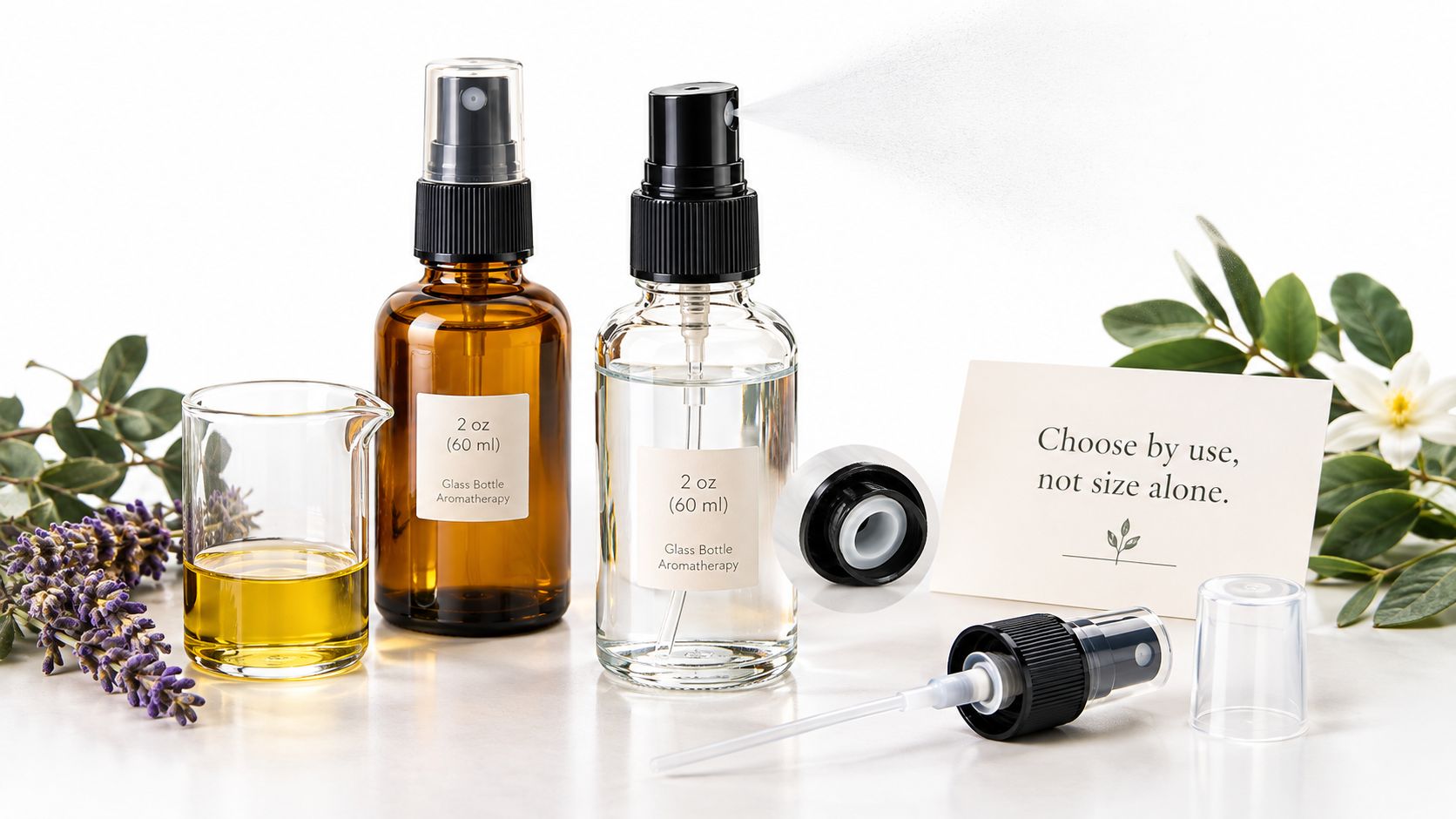
Home aromatherapy. Consider glass with a fine-mist atomizer when it suits the setting and formula. Use the compatibility screen to approve the oil load and closure rather than assuming an aromatherapy label establishes suitability.
Samples and trial kits. Consider PET where mailing weight and handling influence the decision. Approve the label fit and the customer's opening, spraying and reclosing experience on a shipped set.
Travel mists. Prioritize a secure protective cap and an assembly that performs after transport. Confirm travel eligibility separately for the contents and destination.
Retail display. Choose the finish that supports the range, then inspect consistency across filled units. Attractive glass doesn't compensate for crooked labels, erratic dispensing or a closure customers struggle to operate.
Before issuing the purchase order, obtain the supplier's component references and dimensional information. Complete the fit check, formula screen and shipped trial, then keep the approved sample as the reference for incoming deliveries.
Don't accept an undocumented component substitution during reordering. If the supplier changes the seal, pump or bottle material, review whether the existing approval still applies.
Frequently Asked Questions
1. How many sprays can you get from a 2 oz spray bottle?
The number of sprays depends on the sprayer's output per stroke. To estimate it accurately, measure how much liquid the selected pump dispenses with each actuation and divide the usable fill volume by that amount. Different atomizers can deliver different quantities, even when paired with bottles of the same capacity.
2. Are 2 oz spray bottles suitable for selling fragrance samples?
Yes. A 2 oz bottle provides approximately 59.15 mL of capacity, making it an option for larger fragrance samples, discovery kits, and small retail products. Choose a sprayer that delivers the intended application and ensure the packaging, labeling, and formula are suitable for the product being sold.
3. What is the difference between a 2 oz spray bottle and a 2 oz dropper bottle?
A spray bottle uses a pump and nozzle to dispense liquid as a mist or stream, depending on the sprayer design. A dropper bottle dispenses liquid in drops for more controlled application. The better option depends on how customers need to use the product and whether the formula is compatible with the selected dispensing components.
4. How should 2 oz spray bottles be stored to help prevent leaks?
Store filled bottles according to the formula and packaging supplier's recommendations. Keep closures properly secured, protect bottles from excessive heat, and avoid conditions that could damage seals or other components. Before selling a filled product, test the assembled package under realistic storage and transport conditions to check for leakage and dispensing problems.
5. What should businesses ask a supplier before ordering 2 oz spray bottles in bulk?
Ask for the bottle dimensions, neck-finish specifications, material details, compatible sprayer options, case quantities, sample availability, and shipping costs. Request samples of the exact bottle-and-closure combination before placing a large order. If the bottles will hold fragrance oils or other formulated liquids, confirm component compatibility through testing with the finished product.
Aroma Warehouse offers glass bottles, droppers, fragrance oils and DPG solvent for small formulation and packaging trials. Visit Aroma Fragrance Warehouse to source test-batch supplies, then confirm the closure specification and run your filled-package checks before committing to a bulk order.


