How to Make Room Sprays with Fragrance Oils

You've mixed a fragrance oil with water, shaken the bottle, and watched it turn cloudy before the first spray even lands. Or perhaps the batch looked perfect on the counter, then separated after storage and left an oily ring on the surface below. That's the point where room-spray making stops being a simple scent project and starts behaving like formulation work.
Learning how to make room sprays with fragrance oils means controlling three things at once: fragrance concentration, the carrier system, and the finished product's safety documentation. The most reliable workflow is to choose the base before measuring the oil, check the applicable IFRA certificate, premix the fragrance correctly, then give the batch time to settle before filling bottles.
Table of Contents
Why a Room Spray Formula Needs More Than Scent - What the base is actually doing
Choosing Your Base System - Three workable approaches - Choose by the product you want
Dilution Ratios and IFRA Category 9 - How to calculate a batch - Premix before you dilute
Blending Fragrance Oils for a Balanced Throw - Build the fragrance pyramid - Give the blend time
Safety, Allergens, and Labeling - Documentation before production
Packaging, Bottling, and Quality Checks - Bottle the batch only after it passes inspection
Why a Room Spray Formula Needs More Than Scent

A first batch often begins with good intentions. You choose a fragrance oil, add it to distilled water, shake the bottle, and get a strong burst of scent. The problem appears later. The oil rises, the water turns hazy, and the spray pattern deposits uneven droplets instead of a consistent mist.
Fragrance oils don't naturally mix with water. A water-and-oil bottle can separate quickly, leaving the fragrance unevenly distributed and making every spray different from the last. The technical foundation is either a strong alcohol carrier or a compatible solubilizer system.
This guide to safe air freshener formulation is useful background because the carrier affects both dispersion and how the product behaves around people and surfaces.
What the base is actually doing
The base carries fragrance compounds through the pump and helps disperse them into the room. Alcohol-rich systems usually dissolve oils more directly and evaporate quickly, which creates fast scent lift. Water-containing systems can produce a softer-feeling mist, but they require more attention to solubilization, preservation, and clarity.
A stable formula also needs to remain uniform during storage. Temperature changes can expose incompatible materials, waxy components, or an insufficient amount of solubilizer. A spray that looks clear immediately after mixing may still develop haze when it rests.
Practical rule: Never judge a room spray only by how it smells in the mixing beaker. Judge its clarity, spray pattern, surface residue, and scent performance after it has rested.
The foundational alcohol-led example in a neutral technical guide uses 80% ethyl alcohol, 12% fragrance oil, and 6% deionised water per 100 mL. Its water-based example uses 62% water, 25% PEG-40 hydrogenated castor oil, and 10% fragrance oil. The same room-spray formulation guide recommends beginning with solubilizer at roughly 2 to 4 times the weight of the fragrance oil, then increasing it until the blend clears.
A weak throw isn't always a sign that you need more fragrance. Adding more oil to a poorly designed base can worsen separation, increase surface residue, and create a sharper exposure profile. Start with a clear, compatible system instead.
Choosing Your Base System
A small batch can smell promising in the beaker, then turn cloudy, separate, or spray unevenly after resting. The base controls that outcome as much as the fragrance. Alcohol-led formulas usually dissolve compatible oils directly and give fast scent lift. Solubilizer-led systems can feel softer, but keeping water, oil, and solubilizer in one phase takes more testing. A hybrid sits between those choices.
Three workable approaches
Alcohol-led: Perfumer's alcohol or suitable denatured ethanol is often the clearest starting point for a room spray with little or no water. It evaporates quickly and fills a room promptly. The trade-off is a sharper opening alcohol note and faster drying on some surfaces. Compatibility still matters, because not every fragrance oil stays clear in the same alcohol system.
Solubilizer-led: A non-ionic solubilizer, such as Polysorbate 20 or PEG-40 hydrogenated castor oil, disperses fragrance oil through a water phase. The mist can feel less dry, but water brings preservation, compatibility, and clarity work. Give the blend time to settle before deciding whether it is ready.
Hybrid: Alcohol supplies lift while water and solubilizer soften delivery. This suits makers who want a less aggressively fast-drying spray without committing to a fully water-based formula. It also creates more variables to check, especially clarity and phase stability.
Property | Alcohol-led | Solubilizer-led | Hybrid |
|---|---|---|---|
Main carrier | Alcohol | Water plus solubilizer | Alcohol, water, and solubilizer |
Scent release | Fast and immediate | Softer and slower | Balanced |
Clarity risk | Usually lower with compatible oils | Higher if solubilization is incomplete | Depends on water and oil compatibility |
Preservation | Most relevant when water is present | Important because water is central | Required when the water phase supports microbial growth |
User feel | Dry, sometimes sharp | Lighter and less drying | Between the two |
Best use | Clear, quick-diffusing room sprays | Water-forward formulas | Softer alcohol-containing sprays |
The body mist base guide offers a useful comparison for how carrier selection changes spray feel. A room spray still needs its own intended-use review, compatibility checks, and IFRA Category 9 assessment.
Choose by the product you want
Start with an alcohol-led system when clear appearance and quick room fill matter most. Choose a water-forward system only with a tested solubilizer and preservation approach. Mixing water and fragrance oil first, then hoping the blend clears, commonly creates haze, separation, or residue.
For water-containing formulas, published technical guidance places alcohol around 60% to 80%, solubilizer around 2% to 10%, water around 10% to 30%, preservative around 0.3% to 1%, and fragrance oil around 3% to 10%. These are starting ranges from technical room-spray guidance, not a substitute for supplier documentation or small-batch testing. Check clarity, spray pattern, surface residue, and scent throw after the blend has rested before filling bottles.
Dilution Ratios and IFRA Category 9
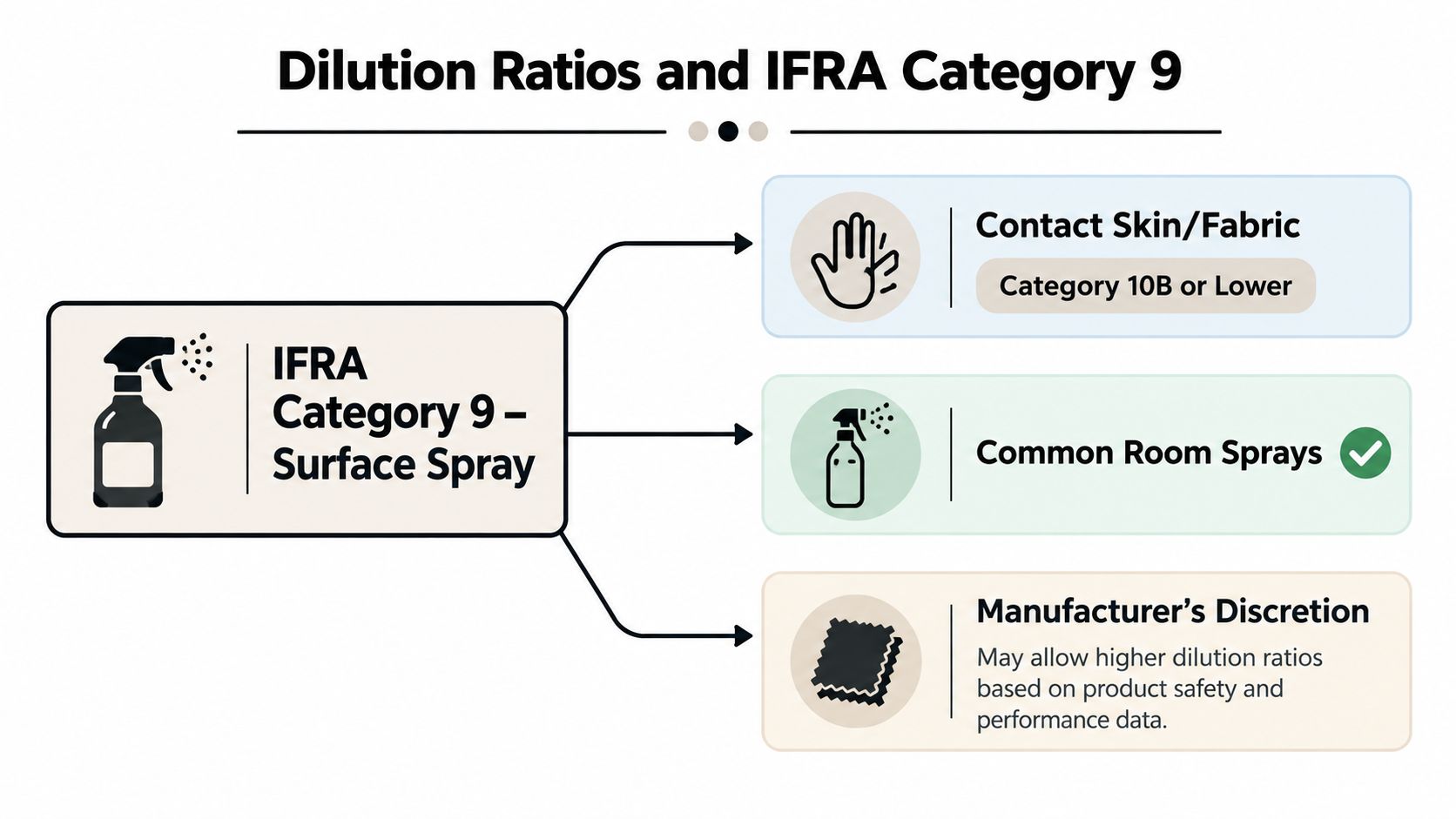
Fragrance load must be treated as a compliance decision, not a strength control. Industry guidance commonly places room sprays under IFRA Category 9, but the allowable fragrance level depends on the specific oil's IFRA certificate. The certificate for one fragrance may permit a different maximum than the certificate for another.
Many commercial-style room sprays target a final fragrance loading around 3% to 5% for Category 10B-style air fresheners, with a commonly cited upper limit near 8% depending on the material and product type. The relevant room-spray ratio guidance makes the important point that a benchmark formula is only a starting point. The certificate remains the controlling document.
How to calculate a batch
Work by weight whenever possible. Convert the intended fragrance percentage into the required fragrance weight, then subtract that amount from the total batch and allocate the remaining material among alcohol, water, solubilizer, and preservative.
A practical water-containing starting framework is:
Fragrance oil: about 3% to 10%, subject to the oil's IFRA limit.
Alcohol: about 60% to 80%.
Solubilizer: about 2% to 10%, adjusted until the blend clears.
Water: about 10% to 30%.
Preservative: around 0.3% to 1% when water is present.
For a 100 mL alcohol-led example, the technical guide cited earlier gives 80% ethyl alcohol, 12% fragrance oil, and 6% deionised water. Don't copy that formula blindly. Check whether the selected fragrance is permitted at that load and account for the full formula, including any solubilizer or preservative your system requires.
Premix before you dilute
Solubilizer compatibility varies by oil and material. Published ratios include approximately 3:1 solubilizer to fragrance for Polysorbate 20, 1:1 for PEG-40 hydrogenated castor oil with lighter oils, and about 2:1 for caprylyl/capryl glucoside. The DPG overview from Aroma Warehouse can also help clarify the role of solvents in fragrance work, although DPG isn't automatically the correct solution for every room-spray formula.
Use the lowest fragrance concentration that delivers the result you need while staying below the applicable IFRA limit. More oil isn't a shortcut around weak solubilization.
Mixing the Batch Step by Step
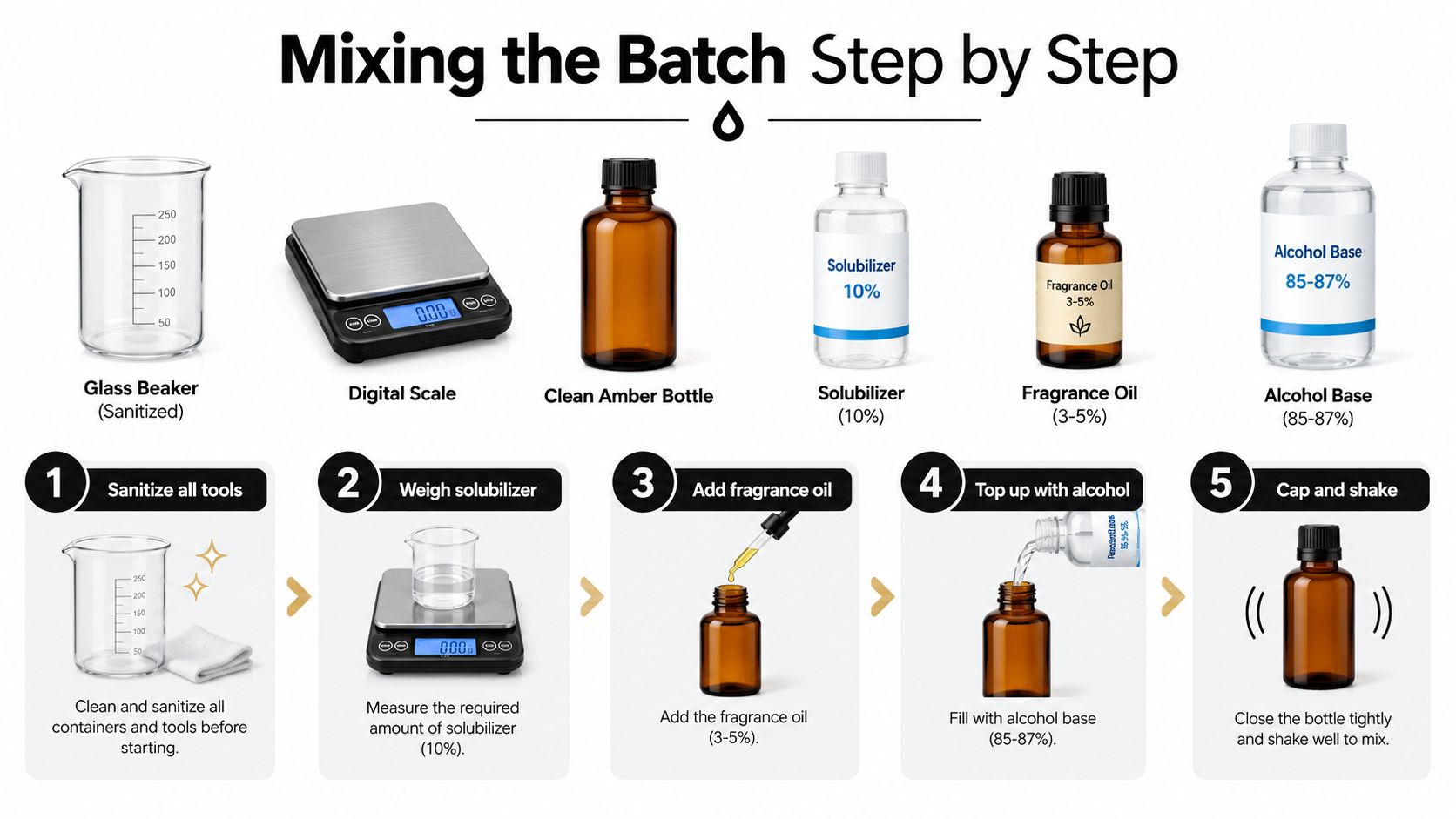
A small batch is easier to troubleshoot when each ingredient is weighed and added in order. Use sanitized glass beakers, a digital scale, clean stirring tools, and compatible amber or PET packaging. Keep the workspace well ventilated, particularly while handling alcohol.
Assembly order matters
Prepare and sanitize. Clean the beaker, stirrer, scale area, funnel, and bottle, then let every item dry completely. Residual water can shift the intended formula balance.
Weigh the solubilizer. In a hybrid or water-containing system, add the planned solubilizer first. The correct amount depends on the fragrance oil. Aim for a uniform concentrate rather than applying one fixed percentage to every oil.
Add fragrance oil. Weigh the fragrance into the solubilizer and stir gently until the concentrate looks even. Streaks, oily patches, or visible layers mean the mixture needs adjustment before water enters the batch.
Introduce alcohol. Add perfumer's alcohol or suitable denatured ethanol gradually. Stir steadily without whipping air into the liquid. Excessive agitation can create foam and may reduce some volatile top notes.
Add water last. Use distilled or deionised water, adding it in small portions. Observe the mixture after each addition. Sudden haze indicates that the solubilization limit may have been reached or that the materials are incompatible.
Mix gently for 3 to 5 minutes, then let the batch rest for 12 to 24 hours for an initial clarity and compatibility check. A longer maceration of 1 to 2 weeks can help the finished scent profile settle. The short rest supports early QC, while the longer rest shows how the formula performs before filling. The published room-spray mixing method covers a comparable premix sequence and resting approach.
Keep the covered beaker in a cool, dark place. After resting, filter visible particles through a compatible fine filter before bottling. Do not fill a cloudy batch to move it along. Check clarity, separation, and scent throw first.
A visual demonstration can help compare the addition order and handling technique:
Blending Fragrance Oils for a Balanced Throw
A room spray has to work in the air, not just on a blotter. Alcohol carries volatile top notes quickly, so citrus, green, and herbal materials can make the opening feel bright but brief. Woods, resins, musks, and vanillas evaporate more slowly and can remain noticeable on soft surfaces, giving the spray a longer tail.
Build the fragrance pyramid
A workable starting structure for a room-spray blend is:
Top notes, 20% to 30%: Bergamot, citrus, green accords, and herbs create the first impression.
Middle notes, 40% to 50%: Rose, floral, fruit, and spice materials provide the main character.
Base notes, 25% to 35%: Sandalwood, woods, resins, musks, and vanilla add depth and persistence.
These proportions describe the fragrance concentrate, not the entire bottle. Keep the finished room-spray load within the chosen oil's permitted use level. The fragrance blending guidance for candle oils offers useful blending logic, but always test the finished spray because a carrier can change how the same concentrate opens.
For a simple example, combine bergamot for lift, rose geranium for the heart, and sandalwood for the base. If the result smells thin after spraying, the issue may be the balance of the concentrate. If it smells oily or cloudy, the issue is more likely the carrier system.
A room spray often benefits from a little more base structure than a perfume designed for close skin wear. The room needs an opening, a recognizable middle, and something that survives after the alcohol has flashed off.
Give the blend time
Single-note sprays can work well when the fragrance itself has enough character. A layered blend usually feels more dimensional, but it may smell disjointed immediately after mixing. The technical guide recommends macerating the finished spray for 1 to 2 weeks, allowing the materials to settle into a more integrated profile.
Evaluate the concentrate before diluting a full batch. Smell it immediately, after the initial alcohol note fades, and after resting. If the bergamot dominates at first and the sandalwood takes over later, that may be exactly the progression you want. If the rose geranium disappears completely, adjust the concentrate rather than increasing the total fragrance load.
Safety, Allergens, and Labeling
A room spray may be used in shared indoor air, around furniture, and near people who didn't choose the scent. That makes disclosure and exposure assessment part of the formulation, not an afterthought. IFRA guidance commonly frames room sprays under Category 9, but the applicable limit still comes from the specific fragrance oil's certificate and intended product use.
Natural origin doesn't automatically mean low risk. Essential oils and synthetic fragrance oils can both contain sensitizing or irritating materials, and the relevant question is how the finished product is formulated and used. Households with pets, asthma, fragrance sensitivity, or poor ventilation need clear instructions rather than broad claims about one ingredient category being universally safer.
Documentation before production
Keep the IFRA certificate and Safety Data Sheet for every fragrance oil and solvent. Record the intended use, formula version, batch number, and any restrictions attached to the selected material.
Allergen awareness deserves particular attention. Linalool may appear in lavender and bergamot materials, limonene in citrus profiles, citral in lemongrass, and geraniol in rose geranium. Don't guess from the fragrance name. Use the supplier's allergen declaration and the rules that apply in your market.
Label field | Why it matters | Example |
|---|---|---|
Product name | Identifies intended use | Room Spray, Bergamot and Sandalwood |
Ingredient information | Supports informed use | Alcohol, fragrance, water, solubilizer |
Net volume | States the amount supplied | Net contents shown in the chosen unit |
Batch or lot number | Enables traceability | Internal batch identifier |
Responsible person contact | Gives users a route for questions | Business name and contact details |
Safety directions | Reduces foreseeable misuse | Avoid eyes, flames, children, and pets |
Allergen disclosure | Identifies relevant sensitizers | Supplier-supported allergen information |
For makers shipping alcohol-based products, transport rules can matter as much as label design. This resource on shipping hazardous goods from Australia provides useful context on hazardous-goods labeling, though local requirements must be checked for the destination and carrier.
Work in ventilation, keep alcohol away from ignition sources, and use suitable gloves and eye protection when handling concentrated materials. The fragrance labeling requirements guide can help organize the information you need before a product reaches customers.
Packaging, Bottling, and Quality Checks
Packaging protects the formula and controls how the customer experiences it. Amber glass offers better protection from light, while clear PET is lighter and more resistant to breakage. The choice depends on the fragrance, shipping conditions, cost, and the setting where the bottle will be stored.
A fine-mist sprayer should produce an even cloud rather than a wet stream. Test the actual pump with the finished formula because viscosity and solubilizer content can change spray performance. Makers sourcing small-format packaging may find this guide useful for deciding where to find quality 1 oz spray bottles.
Bottle the batch only after it passes inspection
Run a small quality-control sequence before filling the entire run:
Clarity: Hold the sample against a light background and look for haze, sediment, rings, or separation.
Surface check: Spray onto white paper or another compatible test surface and inspect for oily residue as the droplets dry.
Scent check: Evaluate the room immediately after spraying and again at later checkpoints, including one hour and four hours, as specified in the supplied testing plan.
Water-phase check: If the formula contains water, confirm its pH with a calibrated meter and verify that the preservative system is appropriate.
Sprayer check: Confirm that the pump produces a consistent fine mist and doesn't drip around the collar.
Traceability: Log the date, ingredient lots, fragrance load, base system, IFRA category, and any filtration or conditioning performed.
Cold conditioning can expose problems that remain hidden at room temperature. One technical guide recommends cooling a sample to around 0 to 4 °C for about 24 hours so waxy components can precipitate before filtration. Another practical approach uses 4 °C for 48 hours, followed by filtration through a 1-micron mesh if needed. Treat these as development tests, not guarantees of long-term stability.
Fill in a cool environment, leave practical headspace, and cap the bottle promptly to limit evaporation. Don't scale a formula until the small batch has passed clarity, compatibility, scent, and packaging checks.
Frequently Asked Questions
Can you use fragrance oil in a room spray without alcohol?
Yes, but a water-based room spray needs a compatible solubilizer to help disperse the fragrance oil. Because water-based formulas also introduce preservation concerns, the finished product should be tested for clarity, separation, and microbial stability before regular use.
Why does my homemade room spray leave spots on furniture?
Spots or oily marks can occur when fragrance oil has not been adequately dispersed or when the formula produces droplets that do not evaporate cleanly. Test the spray on compatible surfaces before selling or using it throughout a room.
How long does homemade room spray last in the bottle?
Shelf life depends on the formula, especially whether it contains water, the preservative system, packaging, storage conditions, and fragrance materials. A maker should establish shelf life through stability and preservation testing rather than assuming a fixed expiration period.
What type of spray bottle is best for homemade room spray?
A bottle paired with a fine-mist sprayer is generally preferable because it distributes the formula more evenly through the air. The bottle material should also be compatible with the alcohol, fragrance, and other ingredients used in the formula.
Can you mix different fragrance oils together to make room spray?
Yes. Different fragrance oils can be blended into a custom fragrance concentrate, provided the individual materials are compatible and the final fragrance concentration remains within the applicable usage limits. Small test batches make it easier to evaluate the finished scent before scaling up.
Aroma Warehouse supplies fragrance oils for home-fragrance applications along with glass bottles, droppers, DPG solvent, and other accessories that can support small-batch testing and packaging decisions. Visit Aroma Warehouse to compare fragrance oils and room-spray supplies, then start with a documented test batch before committing to a larger run.