

Strawberry Fragrance Oil Guide: Aroma, Uses and Safety

You've lined up strawberry fragrance oils on the counter, expecting an easy choice. One smells like a freshly cut berry, another like strawberry jam, and another like candy from a sweet shop. They share a name, but they won't necessarily give you the same candle, soap, or room fragrance.
The useful question isn't just which bottle smells best. It's which strawberry profile suits your product, performs in its base, and comes with documentation for that use. Think of the scent as a musical chord: the ingredients need to work together, and the finished product changes how you hear them.
Table of Contents
What Strawberry Fragrance Oil Smells Like and Why - The ingredients behind the impression - Why sweetness alone can feel flat
Where Strawberry Fragrance Oil Gets Used - Match the oil to the delivery system - Test the behavior that matters
Comparing Bottle Sizes and Prices Per Ounce - Budget from batches, not bottle appeal
Safe Concentration Limits by Product Category - Read the category before the percentage - Calculate and assess the finished product
Natural, Sustainable and Non-Toxic Claims Explained - Separate origin from safety and environmental impact - Ask for claims you can verify
Confirm Documents and Samples Before You Buy - Build a usable supplier file - Make the sample earn the bulk order
What Strawberry Fragrance Oil Smells Like and Why
Strawberry fragrance oil is usually a constructed accord, a blend designed to recreate a recognizable smell. It isn't one ingredient that smells exactly like every ripe strawberry. A perfumer selects materials that suggest juicy fruit, green leaves, cooked sugar, cream, or flowers, then balances them toward a particular result.
Even actual strawberries don't have a universal aroma formula. A 2018 review in the Journal of Agricultural and Food Chemistry examined 25 analytical studies and found 979 reported volatile organic compounds, with no individual compound appearing consistently across every study. Cultivar, ripeness, growing conditions, harvest timing, and analytical methods all help explain those differences.
That doesn't mean a fragrance maker must reproduce every compound. The task is to select the notes that make your nose recognize strawberry, then give them enough support to feel convincing.
The ingredients behind the impression
Esters provide much of the fruity character. A review in Horticulture Research reports that methyl and ethyl esters account for approximately 25%–90% of total strawberry volatile abundance. That's a measurement of the fruit's volatile fraction, not a recipe percentage for commercial fragrance oil.
Other aroma families supply contrast. Aldehydes can suggest a freshly cut, green edge. Sweet furanones, including furaneol and mesifurane, help create ripe, caramel-like impressions, while lactone notes can soften an accord toward creamy strawberry.
A Plant Physiology study of wild strawberry aroma identifies methyl anthranilate with grape and wood-strawberry character, alongside other fruity and floral volatiles. This helps explain why a strawberry fragrance can lean perfumed or grape-like without being mislabeled.
Think about making jam. The berries establish the identity, but sweetness, acidity, and cooking change the result. In fragrance, supporting notes play a similar balancing role, although the materials and proportions aren't the same as food ingredients.
Strawberry aroma profiles and what builds them
Aroma profile | What it smells like | Formula emphasis |
|---|---|---|
Fresh ripe berry | Bright, sweet, slightly green | Fruity esters with light green aldehydes |
Jammy or cooked | Thick, sugary, stewed fruit | Sweet furanones such as furaneol and mesifurane |
Candy or confection | Sweet, playful, bubblegum-like | Esters balanced with sweet furanones |
Creamy strawberry | Soft, milky, dairy-like sweetness | Ester-rich base with lactone notes |
Floral or grape-leaning | Perfumed, grape-like, wood strawberry | Methyl anthranilate with floral terpenes |
These are sensory directions, not ingredient disclosures. You can't identify a commercial oil's full composition by smelling it, and a supplier may reach a similar impression through different materials.
Why sweetness alone can feel flat
A candy-forward strawberry isn't inferior by default. It may be exactly right for a playful gift collection or dessert-inspired wax melt. The problem comes when you want fresh fruit but buy an accord that gives you sweetness without the green, tart impression you associate with a berry.
Too much sugary emphasis can make it harder to distinguish strawberry from generic fruit candy. Conversely, a sharply green fragrance may feel less familiar to someone expecting strawberries and cream. Accuracy depends partly on the strawberry experience you're trying to evoke.
Judge the fragrance against your intended product, not against an imaginary single correct strawberry.
For a useful comparison, apply each sample to a separate labeled paper fragrance strip. Smell briefly, set the strips aside, then return after they've had time to develop. Don't touch undiluted oil to your skin.
Write down concrete impressions rather than merely good or bad. Does it open green and sharp? Does it become sugary, creamy, or floral? Does the berry remain recognizable as the opening fades?
Keep the strips apart and compare them away from the open bottles. This won't predict every aspect of product performance, but it gives you a more useful starting point than repeatedly sniffing concentrated oil from the cap. The profile you want should decide the purchase, not the name alone.
Where Strawberry Fragrance Oil Gets Used
A strawberry fragrance that works beautifully in wax may disappoint in a reed diffuser. The surrounding material changes how the fragrance releases, so choose the application before choosing the oil. The practical distinctions in our guide to fragrance oil uses can help you separate home-fragrance projects from skin-contact products.
Match the oil to the delivery system
Candles and wax melts require wax compatibility and testing under heat. Cold throw, the scent from unheated wax, isn't the same as hot throw during use. Evaluate the finished candle with its actual wax, wick, container, and fragrance load rather than assuming a strong bottle scent guarantees a strong candle.
For reed diffusers, the fragrance must work with the diffuser base and travel through the reeds. Look for an even blend without separation, then check whether it continues to diffuse instead of producing an impressive opening that quickly becomes faint. Don't assume an oil intended for an electric warmer is suitable for reeds.
Soap and bath salts introduce skin exposure. Soap also brings process-specific challenges, including changes in scent, batter behavior, and appearance. Bath salts need a suitable fragrance-dispersing system; mixing oil into dry salt doesn't establish that it will disperse safely in bathwater.
Test the behavior that matters
Incense requires evaluation during burning, not just after dipping. Check ignition, smoldering, smoke character, ash, and the scent released by the finished stick or cone. Don't add fragrance oil to sage bundles or other smudging materials unless the formulation is expressly intended for that application.
Room sprays require a compatible spray base. Oil doesn't dissolve in water on its own, and a mixture that looks blended immediately after shaking may separate later. For linen products, test on an inconspicuous area of the intended fabric for staining and residue.
Use a straightforward selection order:
Choose the end use. Specify the actual product, such as a reed diffuser rather than general home fragrance.
Choose the sensory direction. A sweet candy profile may suit a dessert candle but feel heavy in a fresh bath blend.
Check suitability and restrictions. Confirm both the documentation and the performance in your chosen base.
Practical rule: Buy for the conditions the fragrance will meet, not just the moment you open the bottle.
Comparing Bottle Sizes and Prices Per Ounce
The lowest unit price can tempt you into buying more oil than you need. In the 2025 NorthStar3C strawberry fragrance oil listing, the 16-ounce bottle cost $30.46, equivalent to approximately $1.90 per ounce. The table shows that listing's prices and calculated unit costs, rounded to the nearest cent.
Price per ounce by bottle size (2025 listing)
Bottle size | Listed price |
|---|---|
1 oz | $3.89, equivalent to $3.89 per oz |
2 oz | $6.78, equivalent to $3.39 per oz |
4 oz | $11.48, equivalent to $2.87 per oz |
8 oz | $19.26, equivalent to $2.41 per oz |
16 oz | $30.46, equivalent to $1.90 per oz |
Those are historical prices from a particular supplier, not current market-wide rates. They illustrate how bottle size can change unit cost, but they don't establish that the largest bottle is your best purchase.
Budget from batches, not bottle appeal
Start with your production schedule. Estimate the finished product you expect to make, then calculate the fragrance required using the dosing basis specified for that application. Add the fragrance requirements across your planned batches before choosing a bottle size.
Use a digital scale for formulation. Don't treat fluid volume and weight as interchangeable, and check whether a supplier's ounce designation refers to weight or volume before comparing it with your batch calculations.
A practical buying routine is:
Forecast production. Base the estimate on realistic batches rather than hoped-for sales.
Calculate fragrance demand. Apply each product's tested fragrance load using the correct denominator.
Match stock to turnover. Buy an amount you can use within the supplier's storage guidance.
Sample unfamiliar scents. Confirm performance before committing to a larger bottle.
Oxygen, light, and heat can change fragrance during storage. Keep bottles tightly closed, away from sunlight and heat, and label them with receipt and opening dates. Don't assign every oil the same shelf life.
Our explanation of retail versus wholesale pricing provides useful context for comparing purchase quantities. Include shipping and other order costs in your comparison: a lower price per ounce doesn't save money if the fragrance sits unused or fails your product test.
Safe Concentration Limits by Product Category
A stronger strawberry smell isn't automatically a better formulation. Adding fragrance beyond the permitted level can create a safety and compliance problem even when the result smells pleasant. Your working concentration must satisfy the relevant restrictions and still perform properly in the finished product.
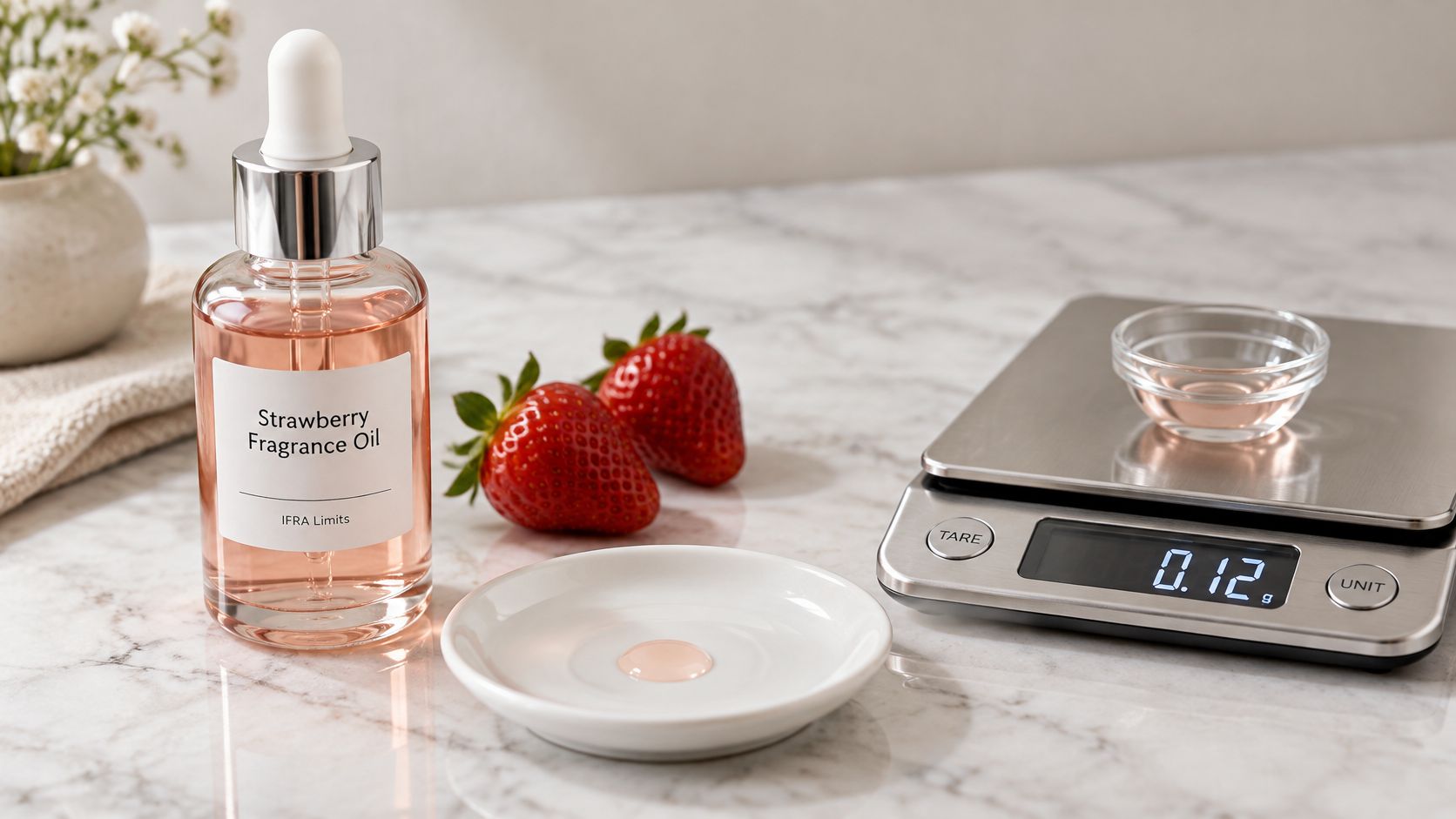
The following example comes from a strawberry fragrance oil conformity certificate, which lists limits including 0.77%, 1.50%, and 3.67%, with categories 1 and 6 not approved. These limits belong to that formula and certificate, not to every oil sold as strawberry.
IFRA limits on a strawberry fragrance oil certificate
Limit on certificate | What it tells the buyer | Action |
|---|---|---|
0.77% | Strict limit for one IFRA category | Apply this ceiling only to the category identified on that certificate |
1.50% | Different limit for another category | Confirm the exact product category before dosing |
3.67% | Limit for several leave-on categories | Verify that your specific leave-on application is included |
Not approved | Categories 1 and 6 | Don't use this oil in products within these categories |
Read the category before the percentage
A certificate isn't a menu from which you select the highest number. Find the category matching the intended exposure, then read its limit. If the product description is ambiguous, have the supplier confirm the classification before you formulate.
A home candle maker still needs the relevant candle-use information. A retailer selling the same concentrate for lotion or soap needs separate confirmation for those uses. Neither a pleasant scent nor a skin-safe description establishes suitability for every person or product.
Fragrance-allergen labeling requirements distinguish leave-on from rinse-off cosmetics, and finished products may also require regional chemical-hazard labeling. Treat these as separate checks rather than assuming the fragrance certificate completes your labeling obligations.
Calculate and assess the finished product
Use this sequence before making a saleable batch:
Identify the category. Match the finished product to the current certificate for the exact fragrance.
Establish the working ceiling. Account for the category limit, base compatibility, and any additional formulation restrictions.
Calculate by the specified basis. Use mass and confirm whether the percentage applies to the finished product rather than the base alone.
For skin products, test only a properly formulated finished sample, never the concentrate. A small-area tolerance test can reveal a reaction, but it doesn't prove universal safety or replace cosmetic safety assessment. Anyone with a known fragrance allergy should avoid leave-on fragrance unless their clinician advises otherwise.
The same product-specific caution applies to comforting scent names, including those discussed in our baby powder fragrance oil guide. A familiar smell is not a safety classification.
Natural, Sustainable and Non-Toxic Claims Explained
Natural doesn't tell you whether a strawberry fragrance is suitable for your product. It describes an origin claim, and even that needs clarification. A fragrance oil, a botanical extract, and a product marketed as strawberry essential oil shouldn't be treated as interchangeable materials.
Ask what the product really contains and how it was made. A strawberry seed oil, for example, should not be assumed to reproduce the aroma of ripe fruit just because strawberry appears in its name.
Separate origin from safety and environmental impact
A Royal Society of Chemistry sustainability article provides context on biological and synthetic chemicals in fragrance and flavor production. The important distinction for buyers is that natural origin, environmental impact, and toxicological safety are different questions. Evidence supporting one claim doesn't automatically support the others.
Synthetic aroma materials can help formulators produce a consistent strawberry impression without depending entirely on scarce natural materials. That can be a practical advantage, but it doesn't establish that every synthetic ingredient is environmentally preferable or suitable at any concentration.
For background on how terpene ingredients fit into blends, the Gold Coast Terpenes formulation guide offers an additional formulation perspective. Ingredient-focused guidance should inform your questions, not replace the assessment of the complete product.
Frequently Asked Questions
1. Can you blend strawberry fragrance oil with other fragrance oils?
Yes. Strawberry fragrance oil can be blended with complementary scents to create custom fragrance profiles. Vanilla, coconut, cream, citrus, and floral fragrances can add depth or change the overall character. Start with small test batches and adjust the ratios until you achieve the desired scent.
2. Can strawberry fragrance oil be used in car air fresheners?
It may be suitable for certain car air freshener applications, depending on the fragrance formulation and delivery system. Check the supplier's documentation for the intended application, compatibility with the freshener base, and applicable usage restrictions before production.
3. Can strawberry fragrance oil be used in an ultrasonic diffuser?
Not all fragrance oils are compatible with ultrasonic diffusers. These devices are generally designed around water-based operation or products specifically approved by the manufacturer. Never add fragrance oil directly to a water reservoir unless the diffuser manufacturer expressly permits it.
4. How can I keep the strawberry scent consistent between production batches?
Purchase the same fragrance formula from the same supplier and keep records of product codes, batch numbers, fragrance weights, and formulation percentages. Use consistent production materials and procedures and compare test batches before beginning larger production runs.
5. How long does strawberry fragrance oil last in storage?
Shelf life varies depending on the fragrance formulation, packaging, and storage conditions. Keep bottles tightly sealed in a cool, dry location away from direct sunlight and heat. Ask your supplier for product-specific shelf-life guidance rather than assuming all fragrance oils have the same expiration period.
Ask for claims you can verify
Use a focused checklist when evaluating sustainability language:
Feedstock origin. Ask whether the materials are petroleum-derived, renewable, or a mixture, and what supports that description.
Packaging composition. Ask which packaging components contain recycled material and how the claim is documented.
Environmental evidence. Request specific support before repeating biodegradability or indoor-air claims.
Marketing wording. Avoid unsupported clean or non-toxic promises that don't define the conditions of use.
Our discussion of clean beauty fragrance claims can help you recognize where attractive wording becomes too broad.
A narrow claim you can substantiate is more useful than a reassuring claim you can't explain.
For a retailer, stating that a supplier provides category-specific conformity documentation is more defensible than declaring an oil universally natural and non-toxic. Use the document checklist below to turn that distinction into a buying decision.
Confirm Documents and Samples Before You Buy
A strawberry oil can smell ripe and complete in the bottle, then behave very differently once it hits hot wax, cold-process soap, or a bath salt base. That is because the scent is a constructed chord: bright top notes, a fruity middle, and softer base materials that keep it from smelling thin. The paperwork is how you learn whether that chord is allowed, stable, and sensible for the exact product you plan to sell.
Match every document to the exact fragrance name, product code, supplier, and version. A certificate for a different strawberry blend does not establish the limits for the bottle on your bench. The IFRA Standards framework uses product-category exposure assessment and quantitative risk assessment for dermal sensitization, with restrictions or prohibitions on materials where necessary. A conformity certificate supports formulation decisions, while your finished candle, cosmetic, or diffuser still has to meet the rules for its own category.
Build a usable supplier file
Request and retain these documents before production:
Current IFRA conformity certificate. Use it to identify restrictions for the intended application and the exact fragrance formula.
Safety data sheet. Consult the SDS for concentrate handling, protective measures, spill response, and storage information.
Allergen disclosure. Use the relevant information when preparing compliant finished-product labeling.
Recommended maximum concentration by application. Distinguish the supplier's formulation guidance from regulatory or category-based ceilings.
Flash-point information. Use it alongside the SDS and applicable transport requirements, not as a candle mixing-temperature instruction.
For private-label sales, check the rules governing your finished product and market before printing labels. Keep your formula, supplier documents, batch records, and test results together. Copying a blog recipe does not transfer responsibility for what you sell.
Document literacy matters in other product categories, too. A guide to understanding a CBD certificate of analysis offers a useful comparison for reading product-specific paperwork, although a CBD analysis is not a substitute for fragrance documentation.
Make the sample earn the bulk order
Buy a test size and use it in the intended base. Burn-test the candle through its planned use, assess the cured soap, or evaluate properly formulated bath salts after dissolution. Record scent, appearance, separation, residue, and any process problems rather than relying on memory.
Judge the sample against the job, not the first sniff. A strawberry chord that smells candy-bright on a blotter may read jammy in soap, thin in a diffuser, or muted in wax if the base notes cannot carry it. For sourcing questions specific to wax products, our guide to where to buy fragrance oils for candles helps frame the purchase around application suitability.
At Aroma Warehouse, we pour fragrance oils fresh upon order. We offer 1/8-ounce tester drams for $1.10 each in over 100 different fragrances, and we don't accept returns on fragrance, incense, or perfume oils because of the possibility of contamination. Sampling before a larger purchase is therefore a practical way to reduce avoidable waste.
Choose a test size for one clearly defined application, obtain the matching documentation, and evaluate it in the actual product before ordering in bulk.
We offer fragrance oils in tester sizes, along with retail and bulk purchasing options, so you can explore a strawberry profile before committing to a larger project. Visit Aroma Fragrance Warehouse to browse the fragrance selection and choose a sample for your intended use.


