

Clean Beauty Fragrance: A Complete Guide

Clean beauty fragrance means transparent, lower-risk scenting, not fragrance that is automatically risk-free. The EU expanded mandatory disclosure from 24 listed fragrance allergens to more than 80 in 2023, with labeling transitions extending to July 2026 for new products and July 2028 for existing stock.
So why can a perfume labeled “clean” still surprise someone with eczema, rosacea, or fragrance sensitivity? The answer sits between marketing language, botanical chemistry, product performance, and the practical labeling work that retailers and wellness studios now need to manage.
Table of Contents
What Clean Beauty Fragrance Actually Means Today - Four questions make the claim useful
The Real Difference Between Clean, Natural, and Fragrance-Free - What shoppers should compare
Why Natural Fragrance Is Not Automatically Safer for Sensitive Skin - What responsible formulation controls look like
How EU Fragrance Allergen Rules Are Reshaping Clean Scent - Why retailers feel the change
Natural versus Synthetic Fragrance in Clean Beauty - Match the material to the use case
How Retailers and Wellness Businesses Can Choose Safer Fragrances - Build a supplier review routine
How to Talk About Clean Fragrance with Customers - Product descriptions should be equally precise
What Clean Beauty Fragrance Actually Means Today
You pick up a perfume, read “clean,” “non-toxic,” or “plant-powered,” and expect the label to tell you exactly what you need to know. Sometimes it does. Often, the word “clean” tells you more about a brand's philosophy than about the product's measurable safety profile.
Clean beauty fragrance isn't a regulated legal category. There's no single official formula, ingredient blacklist, or universal certification that makes a scent clean. One brand may focus on avoiding certain solvents, another may emphasize vegan or plant-derived materials, and a third may define clean fragrance through ingredient disclosure and allergen awareness.
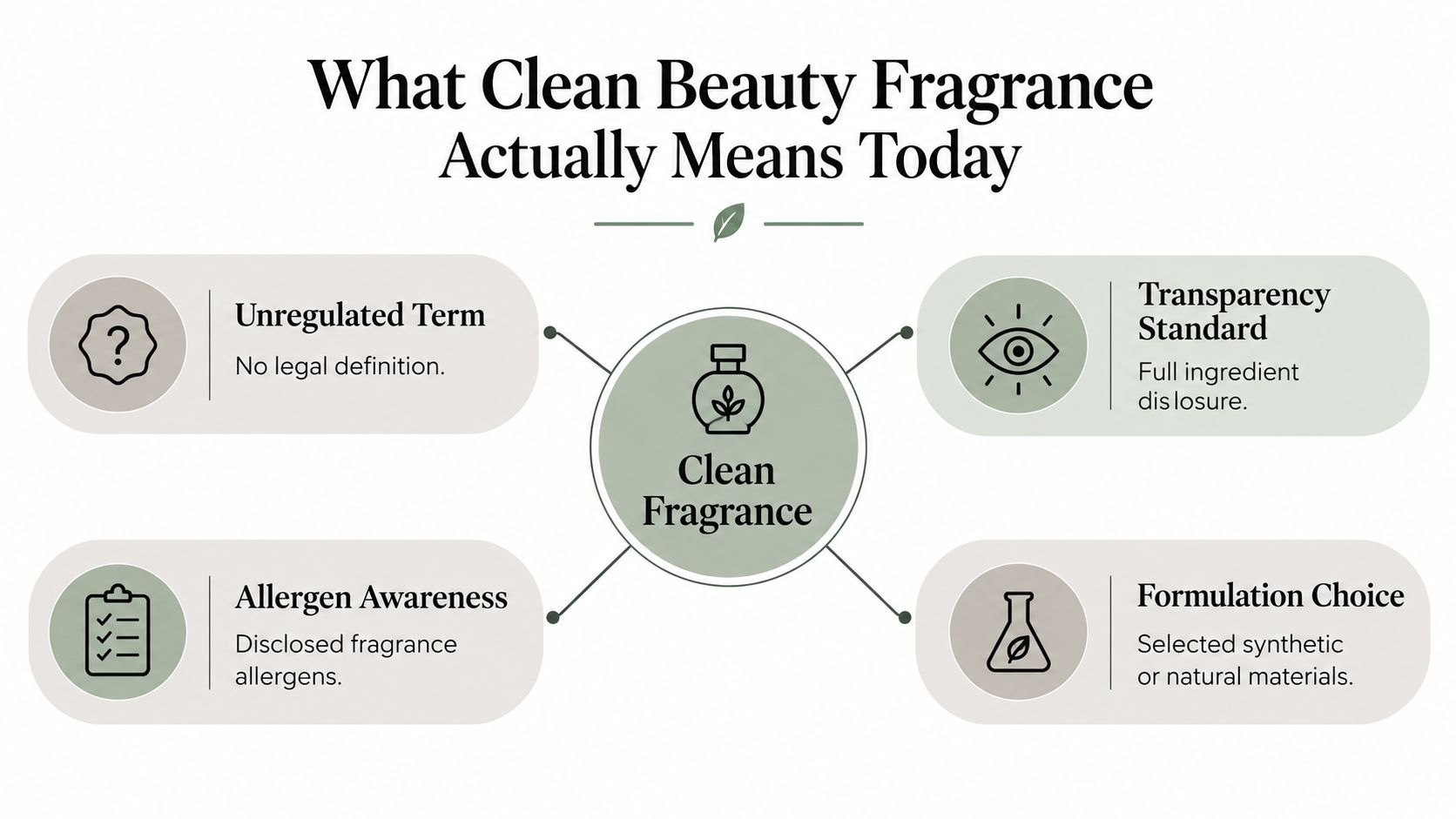
A useful working definition is transparent, intentionally selected scenting designed to reduce avoidable concerns while clearly communicating limitations. That can include natural materials, synthetic aroma molecules, or a blend of both. “Clean” doesn't automatically mean natural, fragrance-free, hypoallergenic, or suitable for every sensitive customer.
Four questions make the claim useful
When evaluating a product, ask:
What materials create the scent? Look for a clear ingredient list or fragrance disclosure.
Which allergens may be present? A botanical source can still contain declared fragrance allergens.
What does the product claim to do? A light body mist, oil perfume, and room fragrance have different performance and safety requirements.
Who is the product for? A scent designed for occasional personal use shouldn't be presented as universally suitable for reactive skin.

Retailers can also broaden their ingredient literacy beyond perfume. A practical resource on plant-based ingredients for yeast infections illustrates why “plant-based” needs context, especially when customers associate natural sourcing with automatic gentleness.
For packaging and product education, use specific language such as “contains disclosed fragrance allergens,” “made with selected botanical extracts,” or “formulated without added alcohol,” where those statements are accurate. Keep a copy of your supplier's current documentation, and use this guide to fragrance labeling requirements as a practical reference when reviewing claims.
The Real Difference Between Clean, Natural, and Fragrance-Free
These three terms answer different questions.
Clean usually describes a brand's formulation philosophy. It may involve ingredient exclusions, sourcing preferences, transparency, or a lower-irritant positioning, but the term itself has no standardized legal definition.
Natural describes the origin or perceived origin of ingredients. Essential oils, absolutes, botanical extracts, and naturally derived materials can all contribute to a scent. Natural origin says nothing by itself about allergen concentration, oxidation behavior, or whether a sensitive customer will tolerate the finished product.
Fragrance-free is the narrowest consumer-facing claim, but it still deserves careful reading. A product may contain odor-controlling or masking ingredients, and customers shouldn't rely on the front label alone. For personal-care products, check the complete ingredient declaration and ask the supplier what “fragrance-free” means in that specific formula.
Practical rule: Treat “clean” as a prompt to investigate, not as a safety verdict.
The compliance history explains why confidence in these claims needs evidence. A 2024 EU-commissioned review found that 7.7% of 932 cosmetic samples failed fragrance-allergen compliance checks, including 3.1% of products labeled perfume-free, as summarized by the Health Products Regulatory Authority's fragrance-allergen guidance. That finding doesn't prove that every clean or perfume-free product is problematic. It does show that labels and formulas can fall out of alignment.
What shoppers should compare
A retailer can make the distinction simple:
Label language | What it may tell you | What it doesn't guarantee |
|---|---|---|
Clean | A brand's chosen formulation standards | Universal safety or allergen absence |
Natural | Some materials come from natural sources | Low sensitization risk |
Fragrance-free | No intentionally added fragrance may be present | That every customer will tolerate the product |
Allergen-aware | The brand discusses known fragrance allergens | Complete suitability for reactive skin |
For a deeper sourcing discussion, explain the difference between fragrance oils and essential oils. Customers often assume one category is safer, but the finished formula, exposure route, concentration, labeling, and individual sensitivity matter more than a simple natural-versus-synthetic label.
Why Natural Fragrance Is Not Automatically Safer for Sensitive Skin
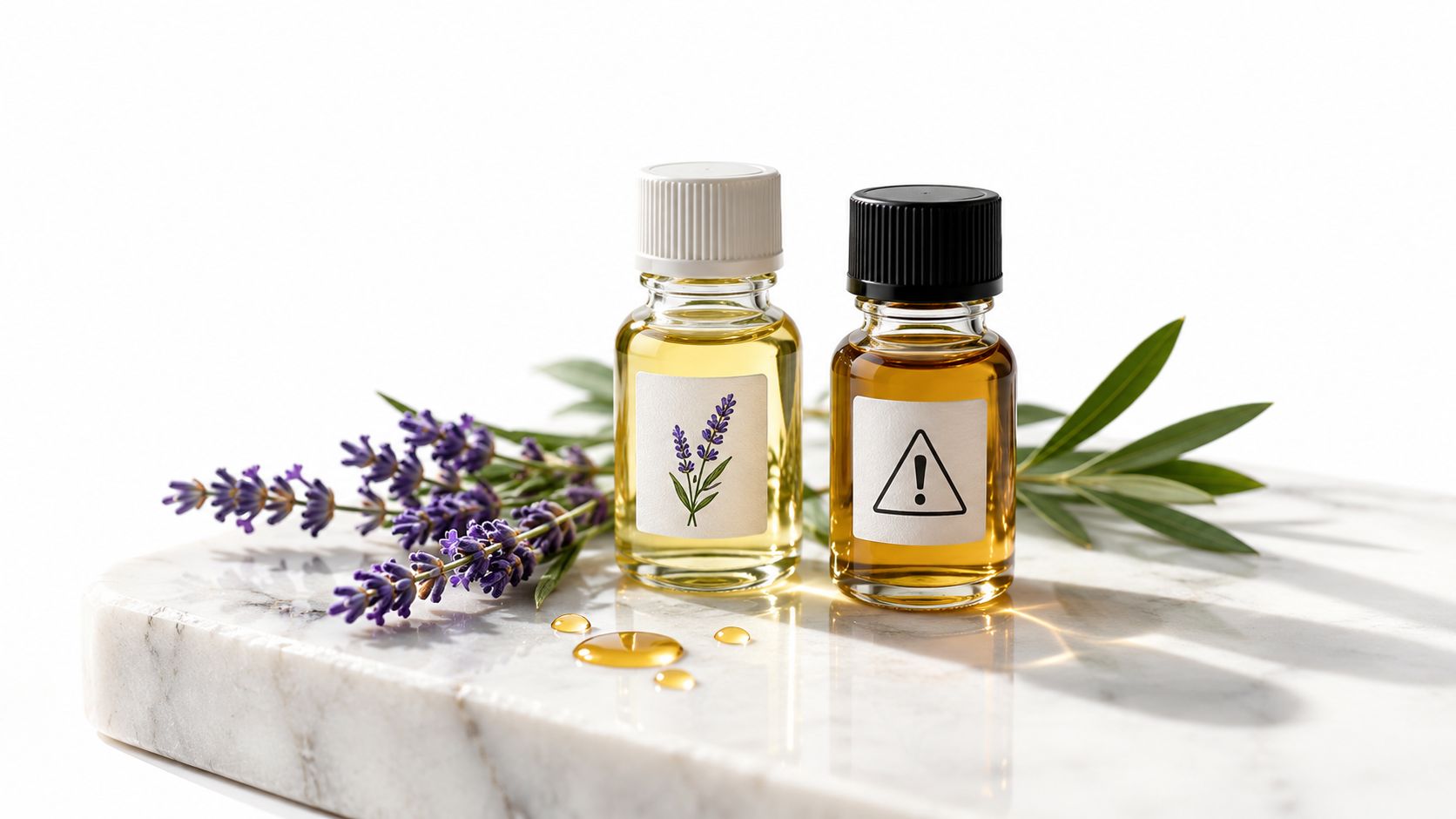
A lavender sprig looks gentler than a laboratory ingredient list. The skin doesn't evaluate appearance, though. It responds to molecules, dose, exposure, and the way those molecules change over time.
Essential oils and botanical extracts contain complex mixtures of naturally occurring compounds. Some of those compounds can contribute to sensitization, especially after oxidation. Hydroperoxides of linalool and limonene are common causes of contact allergy, and fragrances and essential oils remain among the main contact allergens in cosmetics, as described in this peer-reviewed review of fragrance allergy and oxidation.
That creates a formulation problem. A raw material may meet a brand's natural or clean sourcing preference when it enters production, yet oxygen, light, heat, and storage time can alter vulnerable constituents. The resulting oxidation products may create a different skin-sensitization profile from the material the formulator originally evaluated.
What responsible formulation controls look like
A formulator working with botanical fragrance should assess more than the oil's marketing description.
Raw-material identity: Confirm the botanical name, plant part, extraction method, origin where relevant, and current supplier specification.
Allergen profile: Review naturally occurring fragrance allergens in the supplied material, not just the name of the oil.
Oxidation control: Consider antioxidants, air exposure, light protection, and container selection.
Stability: Test the finished product across its intended shelf life and storage conditions.
Finished-product labeling: Calculate whether allergens require individual disclosure in the final formula.
The same approach helps retailers communicate responsibly. A customer with fragrance sensitivity may benefit from a lower-intensity format, but “natural” alone isn't enough evidence to recommend a product. A plain-language essential-oil skin-safety guide from ArtNaturals can support basic customer education, but it shouldn't replace a product-specific safety assessment.
Cinnamon and cassia materials are useful examples. They can provide a warm, recognizable profile, yet their presence makes documentation and intended use especially important. Retail teams handling these materials can consult guidance on cassia essential oil while keeping personal-care, diffuser, and other use cases clearly separated.
Natural origin can shape a brand story. It cannot replace allergen review, stability testing, or accurate use instructions.
How EU Fragrance Allergen Rules Are Reshaping Clean Scent
The EU's updated allergen rules turn transparency from a brand preference into an operational requirement. In 2023, the EU adopted Regulation (EU) 2023/1545, expanding mandatory on-pack disclosure from 24 listed fragrance allergens to more than 80. The European Commission describes a transition period until 31 July 2026 for placing new products on the market and until 31 July 2028 for withdrawing existing products, as detailed in its fragrance-allergen labeling guidance.
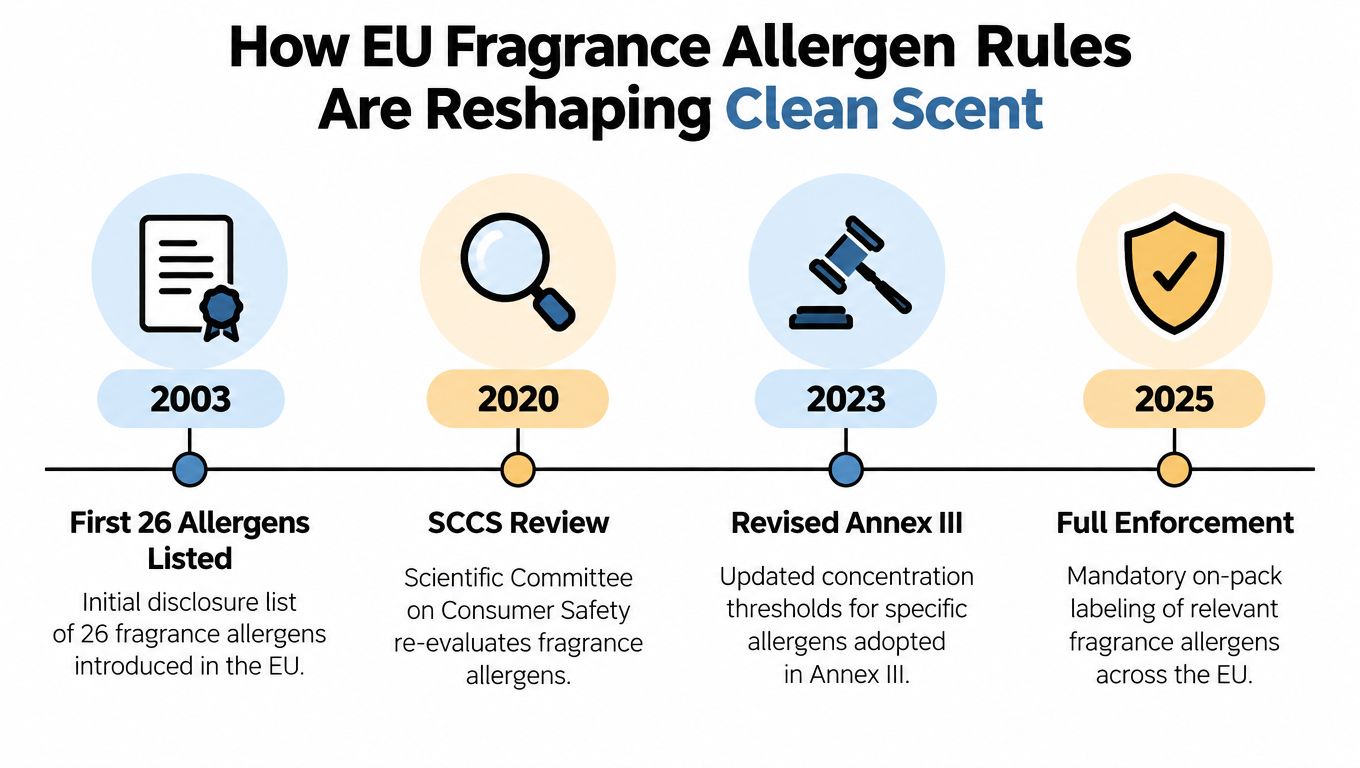
The rule preserves the established disclosure thresholds of 0.001% in leave-on products and 0.01% in rinse-off products, according to the same European Commission source. Those thresholds apply to the relevant allergen in the finished product, whether it comes from an essential oil, botanical extract, fragrance oil, or synthetic aroma material.
Why retailers feel the change
A small retailer may not manufacture a perfume, but the retailer still carries the consequences of incomplete information. Packaging, online listings, wholesale descriptions, customer advice, and inventory timing all need to match the formula and the market where the product is sold.
A wellness studio faces a related challenge. It may use scented oils in a treatment environment, sell personal-care products, or recommend fragrances for home use. Each use case needs clear instructions, and a label designed for a room diffuser shouldn't be treated as evidence that the same material is appropriate for direct skin application.
The regulatory shift also explains why brands are moving toward simpler scent systems and more detailed supplier files. A fragrance formula that once appeared straightforward may now require a broader allergen review before the label is approved. Documentation is no longer just a formulator's concern. It supports purchasing decisions, retailer confidence, customer conversations, and inventory planning.
Watch the accompanying explanation before reviewing a product range:
For a retailer, the practical response is to identify products sold into the EU, confirm which labels are changing, and ask suppliers for current allergen information. A familiar scent profile, such as a soft powder accord, still needs the same documentation discipline. Teams reviewing that category can use this guide to baby powder fragrance oil as a product-specific educational reference.
Natural versus Synthetic Fragrance in Clean Beauty
Natural and synthetic materials aren't moral opposites. They're formulation tools with different strengths, limitations, and customer perceptions.
Natural materials can bring complexity and a recognizable botanical identity. They may vary with harvest, origin, processing, and storage. Synthetic aroma materials can offer consistency, targeted performance, and access to scent profiles that are difficult to obtain from plants alone. They can also include allergens, so “synthetic” doesn't mean risk-free.
Aspect | Natural Fragrance | Synthetic Fragrance |
|---|---|---|
Source story | Botanical, agricultural, or naturally derived origin | Designed or produced aroma materials |
Consistency | May vary by crop, origin, extraction, and batch | Often easier to standardize across batches |
Allergen profile | Can contain multiple naturally occurring allergens | Requires review of the specific materials used |
Oxidation | Some constituents can form sensitizing oxidation products | Stability depends on the selected molecules and formula |
Performance | Can offer depth and natural variation | Can provide controlled diffusion, persistence, or clarity |
Brand positioning | Supports botanical and plant-focused storytelling | Supports precision, consistency, and ingredient flexibility |
Match the material to the use case
A botanical-rich skin scent may suit a brand whose customers value a recognizable essential-oil story and accept a more nuanced wear profile. A synthetic-supported formula may make more sense when the retailer needs consistent batches, a specific projection level, or a stable low-alcohol or alcohol-free format.
Format changes performance, too. Oil perfumes, body mists, solid fragrances, and alcohol-based sprays distribute scent differently. A softer skin scent may feel discreet and intimate, while a spray can create more immediate diffusion. Alcohol-free formats can appeal to customers seeking a different sensory experience, but they still need appropriate preservation, packaging, stability, and use guidance.
The carrier also matters. Formulators evaluating dipropylene glycol, often abbreviated DPG, can review this DPG guide to understand why carrier selection affects how a fragrance oil behaves in a finished product. The right choice depends on the intended format, not on whether the marketing label says clean.
For customers, the honest promise is simple: clean beauty fragrance can offer transparency and thoughtful material selection, but no single ingredient origin guarantees identical longevity, projection, or skin tolerance. Retailers should describe what the formula does rather than promise what it cannot prove.
How Retailers and Wellness Businesses Can Choose Safer Fragrances
A safer sourcing process starts before the product reaches the shelf. Retailers, spas, studios, and resellers should treat each fragrance as a documented material with a defined use, not as a decorative scent name.
Build a supplier review routine
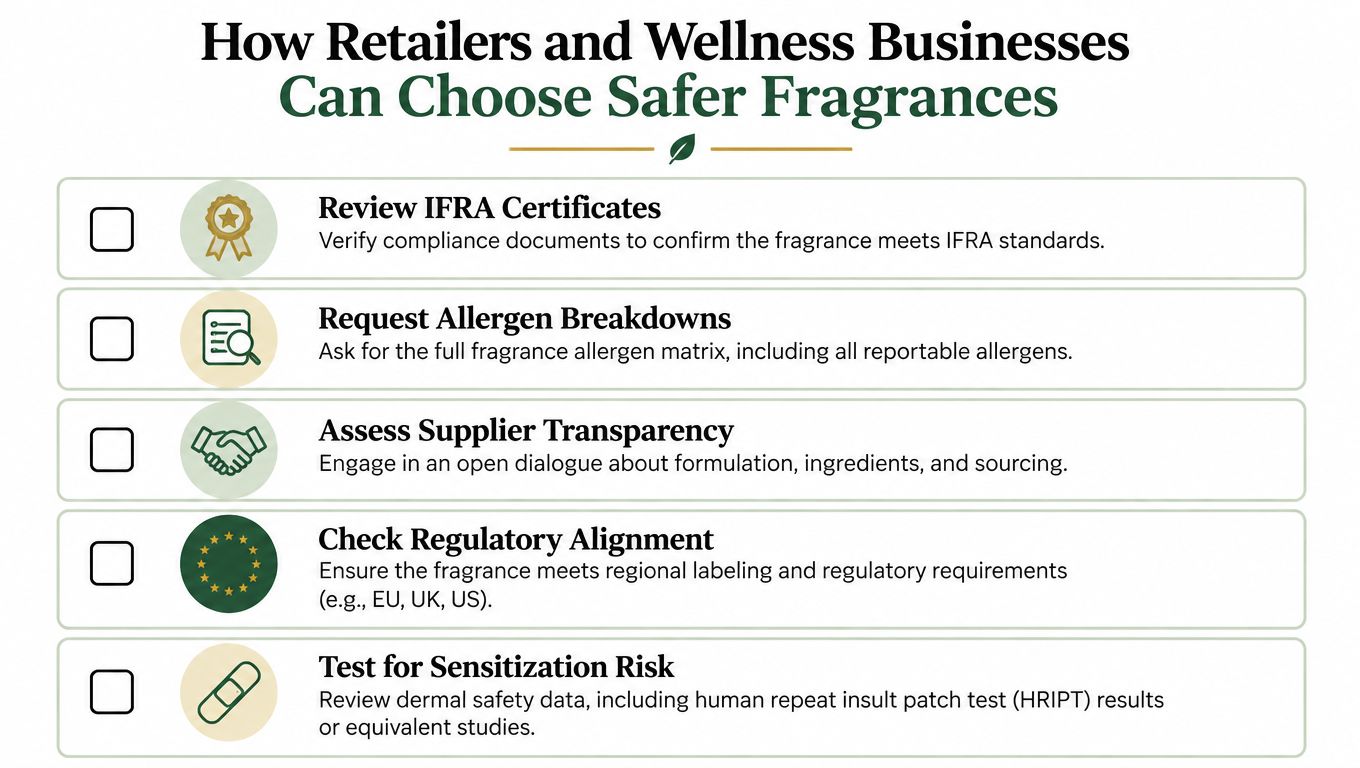
Request the relevant documents. Ask for an up-to-date ingredient or allergen breakdown, intended-use guidance, safety information, and any applicable conformity or IFRA documentation. An IFRA certificate can support a review, but it doesn't replace finished-product labeling work.
Define the use before buying. Separate room fragrance, candle, soap, bath, body oil, and leave-on personal-care applications. Don't assume a fragrance sold for home use is automatically cleared for direct skin application.
Check the target market. If products may enter the EU, review the expanded disclosure requirements before printing packaging or committing to a large batch. Keep market-specific label versions organized.
Review storage conditions. Protect fragrance materials from excess heat, direct light, and unnecessary air exposure. Rotate inventory and record batch information so older stock doesn't sit unnoticed in circulation.
Test the customer experience. For personal-care products, assess scent strength, dry-down, skin feel, stability, and irritation risk through an appropriate professional process. A patch-test instruction can help customers proceed cautiously, but it isn't a guarantee of individual tolerance.
A small retailer can also ask a supplier five direct questions:
Which product uses are supported?
What allergens are present in the supplied fragrance?
Has the formula or documentation changed?
Which markets can the product legally enter?
What label language is approved?
For businesses sourcing oils, incense, accessories, and packaging together, Aroma Warehouse offers fragrance oils, wholesale supplies, DPG, bottles, droppers, diffusers, and related aromatic products for retailers, wellness studios, and resellers. Evaluate any supplier by matching its documentation and product guidance to your exact application.
Keep the supplier file, the approved label, and the actual inventory record connected. That simple habit prevents many avoidable mistakes.
How to Talk About Clean Fragrance with Customers
A customer asks, “Is this clean fragrance safe for sensitive skin?” A confident but responsible answer doesn't promise certainty. It explains what the retailer knows, what the label discloses, and what the customer should consider personally.
Try: “This product uses a transparent fragrance approach, but clean isn't a regulated safety category. Let's review the ingredients and any listed allergens together.” That phrasing builds trust because it answers the concern without turning a marketing term into a medical claim.
For a customer who prefers natural products, say: “This scent contains botanical materials. Natural ingredients can still contain fragrance allergens, so the ingredient list and your own sensitivity history matter.” For someone seeking a lighter experience, explain the format: “This is designed as a softer skin scent, so it may sit closer to the body than a stronger spray. Lighter projection doesn't mean allergen-free.”
Product descriptions should be equally precise
Use language that describes verifiable characteristics:
“Contains disclosed fragrance allergens.”
“Made with selected botanical and aroma materials.”
“Designed for a soft, close-to-skin scent.”
“Review the ingredient list before use if you have known fragrance sensitivity.”
“For external use only,” when appropriate for the product.
Avoid claims such as “non-toxic,” “safe for everyone,” or “hypoallergenic” unless you have a defensible basis and the claim meets the rules for your market. Don't imply that a plant icon, essential-oil ingredient, or alcohol-free format removes the need for allergen awareness.
The strongest clean beauty fragrance conversation gives customers three things: clear ingredients, realistic performance expectations, and permission to choose cautiously. That approach serves sensitive shoppers while helping retailers stay aligned with the direction of fragrance labeling.
FAQs
1. Can clean fragrance be used in homemade perfume? Yes, but the fragrance material must be appropriate for the intended application and used at a suitable concentration. Check supplier documentation, usage restrictions, allergen information, and labeling requirements before making a perfume for personal use or sale.
2. How should clean fragrance oils be stored? Store fragrance oils tightly closed in a cool, dry location away from direct sunlight and excessive heat. Limiting unnecessary air exposure can also help protect fragrance quality during storage.
3. Does clean fragrance last as long as traditional perfume? Longevity depends more on the fragrance composition, concentration, carrier, and product format than on whether a fragrance is marketed as clean. Some clean-positioned fragrances can have excellent staying power, while lighter formulas may wear more quickly.
4. Can clean fragrance oils be used in candles or wax melts? Some fragrance oils are formulated for candle and wax applications, but not every fragrance is suitable for every product type. Always follow the supplier's intended-use guidance and recommended usage limits for the specific fragrance.
5. What should small businesses ask before buying clean fragrance oils wholesale? Ask for current product documentation, supported applications, allergen information, recommended usage levels, applicable safety documentation, and any market-specific restrictions. This gives the business information needed to evaluate the fragrance before purchasing in bulk.
Aroma Warehouse supplies fragrance oils, incense, aromatherapy accessories, bottles, diffusers, DPG, and wholesale materials for retailers, wellness studios, and resellers. Visit Aroma Incense Warehouse to review products and sourcing options for more transparent aromatic experiences.


