

Lemongrass Incense Sticks: Aroma, Uses and Buying Guide

You open a fresh bundle of lemongrass incense sticks and catch a sharp lemon note before you've even found the matches. It's the scent you wanted for a morning routine or a shop display, but the label leaves questions unanswered: Is it essential oil or fragrance? Will it smell the same when lit? And does natural mean less smoke?
A useful choice starts with separating aroma, construction, and combustion. The lemon character has a chemical explanation, the stick's quality needs a practical test, and the smoke deserves attention regardless of how fresh the fragrance smells.
Table of Contents
What Lemongrass Incense Sticks Are - A familiar plant, not a new fragrance invention
Why Lemongrass Incense Smells Like Fresh Lemon - Think of the compounds as scent controls - What chemistry can and can't tell a buyer
Choosing Quality Lemongrass Incense Sticks - Checks before you buy - Checks during and after a sample burn
How to Light and Burn Lemongrass Incense Sticks - A controlled lighting sequence - Fix the setup before adding more incense
Smoke Exposure and Safety Misconceptions - Low-smoke needs evidence - Fragrance sensitivity isn't the same as smoke sensitivity
Matching Lemongrass Incense to the Moment - Make the ritual work for the people present - Enjoy the evening scent without a pest-control promise
Buying Lemongrass Incense for Home or Wholesale - For wholesale buyers, compare the finished result - Match the order to the purpose
What Lemongrass Incense Sticks Are

Cracking open a fresh bundle releases sharp lemon before the stick is lit. Lemongrass incense sticks are commonly bamboo-core sticks coated with combustible charcoal or wood powder, binders, and lemongrass essential oil or fragrance, although coreless versions also exist. When smoldering, they combine a citrus fragrance with the odor of the burning base.
The intended aroma resembles fresh-cut lemon, green citrus peel, and crushed grass, sometimes with a slightly soapy finish. It's usually drier and more herbal than dessert-lemon fragrances, without their vanilla-like sweetness. Compared with dense resinous incense, a lemon-led blend can feel brisk and airy, though that sensory impression says nothing about its emissions.
Lemongrass incense stick profile at a glance
Attribute | What to expect |
|---|---|
Aroma family | Fresh citrus with green, grassy undertones |
Signature note | Lemon peel brightness with a citronella-like edge, not sweet dessert lemon |
Dominant compounds | Citral, comprising geranial and neral, with beta-myrcene and geraniol among the oil's accompanying compounds |
Scent character | Bright and clean-smelling, often perceived as awakening rather than heavy |
Typical burn time | Use the product's stated duration and confirm it with a supervised sample burn |
Common uses | Morning routines, meditation and yoga, room fragrancing, festive settings |
Best placement | Heat-safe holder in a ventilated room, away from fabrics, children, and pets |
Blends well with | Sandalwood, lavender, citronella, palo santo |
A familiar plant, not a new fragrance invention
The botanical foundation is Cymbopogon citratus, a tropical aromatic grass. The CABI species account documents systematic cultivation and essential-oil distillation in Kerala, India, beginning in the 1880s, followed by wider international cultivation.
That history establishes the plant as a longstanding fragrance material. It doesn't establish that every modern stick follows a traditional recipe or contains genuine plant oil.
Say you're choosing between lemongrass and sandalwood for a living room. Choose lemongrass if you want a citrus-forward impression; choose sandalwood if you prefer a warmer woody character. For a small retailer, the same distinction helps customers shop by scent rather than vague promises of wellness.
Verdict: Lemongrass is a versatile everyday incense choice for people who enjoy a crisp, green citrus room scent.
Why Lemongrass Incense Smells Like Fresh Lemon
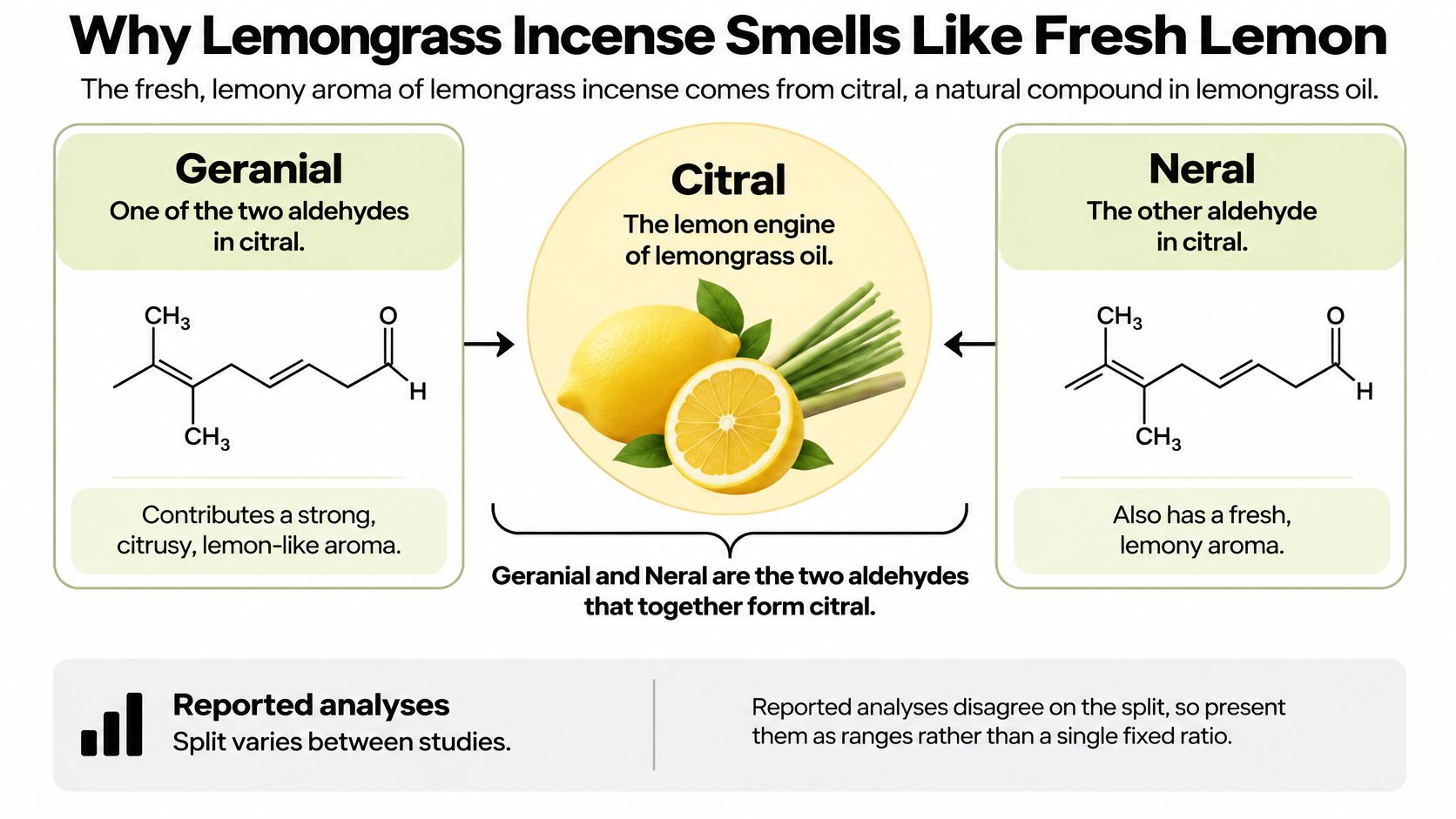
Citral is the main reason lemongrass smells lemony. Rather than being a single ingredient in the everyday sense, citral is a mixture of closely related aldehydes called geranial and neral. An aldehyde is a chemical category, not a synonym for artificial fragrance.
A scientific review of lemongrass essential oil describes an analysis identifying 28 compounds, with geranial and neral together contributing as much as 72% of the oil. That's a measurement of an essential-oil sample, not a guaranteed composition for incense smoke.
The diagram separates the lemon-driving compounds from the broader fragrance.
Think of the compounds as scent controls
As a sensory analogy, citral turns up the lemon dial. Beta-myrcene contributes to the green, grassy, faintly resinous impression, while geraniol can soften the blend with a floral suggestion. You don't need to identify each component separately to recognize the overall profile.
The plant, growing conditions, extraction, and formulation can change the balance. Different analyses shouldn't be forced into a universal recipe, especially when their compound labels or methods differ. A measured result belongs to the sample tested.
For shoppers comparing citrus names, the guide to lemongrass versus lemon essential oil helps distinguish a grassy botanical profile from a more fruit-peel-led scent.
What chemistry can and can't tell a buyer
An essential-oil label tells you something about the fragrance's origin. It doesn't tell you how much oil the manufacturer used, what the base contributes, or whether you'll like the finished smoke.
Botanical identity: Look for Cymbopogon citratus when genuine lemongrass oil is claimed.
Formulation clarity: Distinguish essential oil from a fragrance blend, which may combine natural and synthetic materials.
Scent preference: Decide whether you want herbal citrus, softer perfumery, or a pronounced lemon note.
Practical rule: Use chemistry to understand the aroma, not to predict safety or performance from the fragrance name alone.
A fragrance blend isn't automatically inferior, and essential oil isn't automatically pleasant when burned. The useful question is whether the manufacturer describes the scent source clearly and whether the finished stick suits your room.
Choosing Quality Lemongrass Incense Sticks
A strong scent through the wrapper can make a weak product seem convincing. Quality is easier to judge when you separate what you can inspect in a shop from what only a supervised burn will reveal.
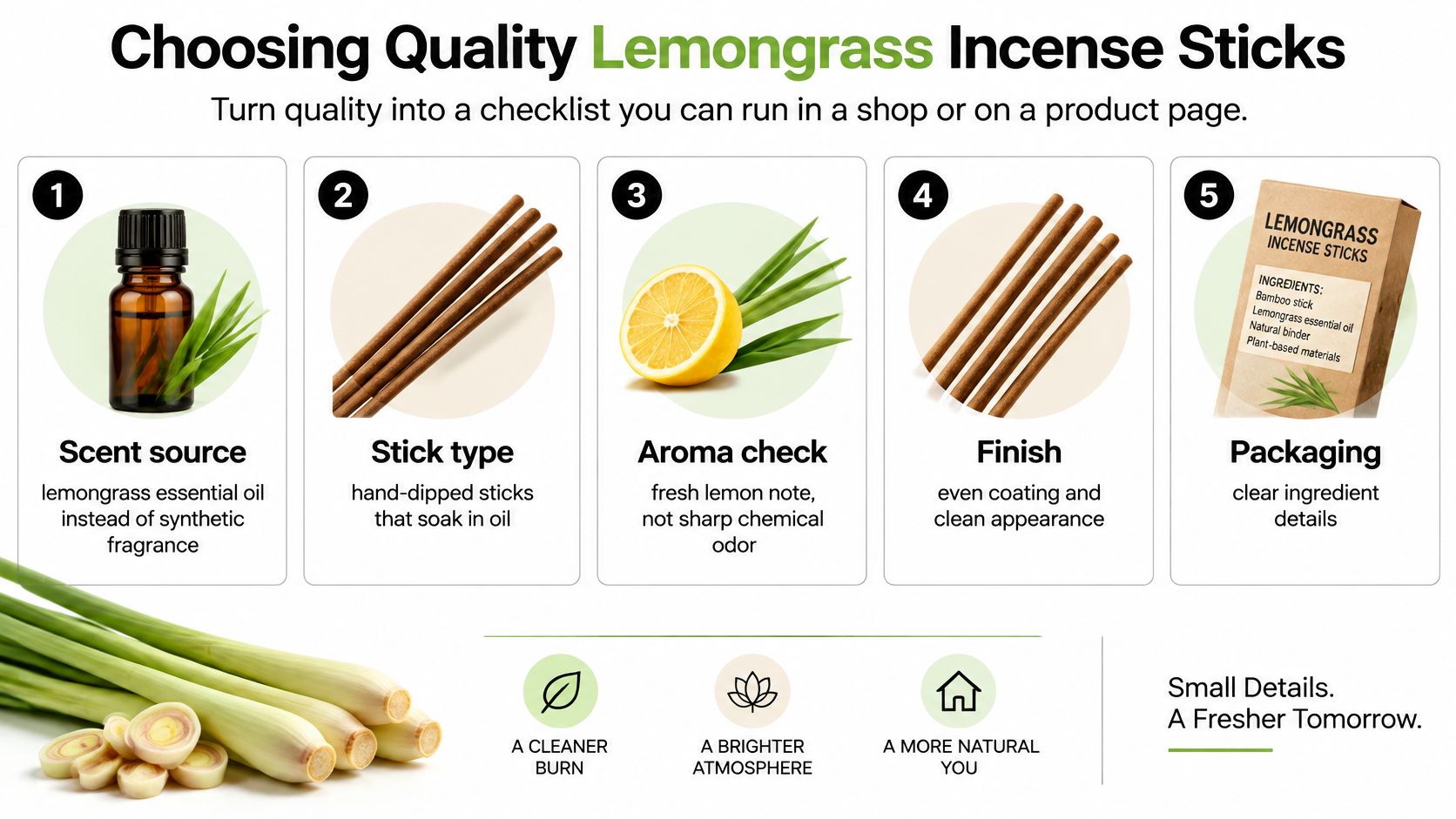
Use this shopping visual as a starting point, while remembering that hand-dipping and natural ingredients don't independently prove better performance.
Checks before you buy
Scent source: Find out whether the product contains lemongrass essential oil, a fragrance blend, or both. Hand-dipped describes a manufacturing method, not botanical purity.
Appearance: Look for an even coating, intact sticks, and a straight core where one is used. Cracks, loose powder, and damaged packaging can make handling and burning less predictable.
Labeling: Prefer clear ingredient descriptions, origin information, storage directions, and ventilation cautions. Bright coloring isn't proof of poor quality, but unexplained dyes add another ingredient to consider.
Our hand-dipping process includes soaking sticks in pure incense oil for no less than 24 hours. Incense oil describes the scenting material used in that process; it shouldn't be read as a claim that every fragrance is a pure botanical essential oil.
For a broader comparison of construction and labeling, consult our guide to choosing good incense sticks.
Checks during and after a sample burn
Aroma: Notice whether the lemon character remains recognizable or becomes unpleasantly acrid. A clean-smelling result is a preference judgment, not an emissions test.
Burn behavior: Watch for a stable ember and secure ash collection. Neither pale ash nor a thin smoke ribbon proves low pollutant output.
Freshness: Compare samples from sealed stock and keep purchases tightly closed, cool, and out of direct sunlight. Don't buy more than you can store properly.
Record your impression from the normal seating area rather than leaning over the smoke. Compare lemongrass and citronella on separate occasions so the room doesn't become a confusing mixture of fragrances.
The video offers a visual companion to these buying checks.
For a retail sample log, use plain descriptions such as lemon-forward, grassy, smoky, or overly perfumed. Those notes help you describe the product accurately without turning personal preference into a universal quality claim.
How to Light and Burn Lemongrass Incense Sticks
Prepare the holder and extinguishing material before you strike a match. A ceramic incense holder or a sand-filled heatproof bowl on a noncombustible surface gives you a straightforward setup without relying on decorative furniture to catch hot ash.
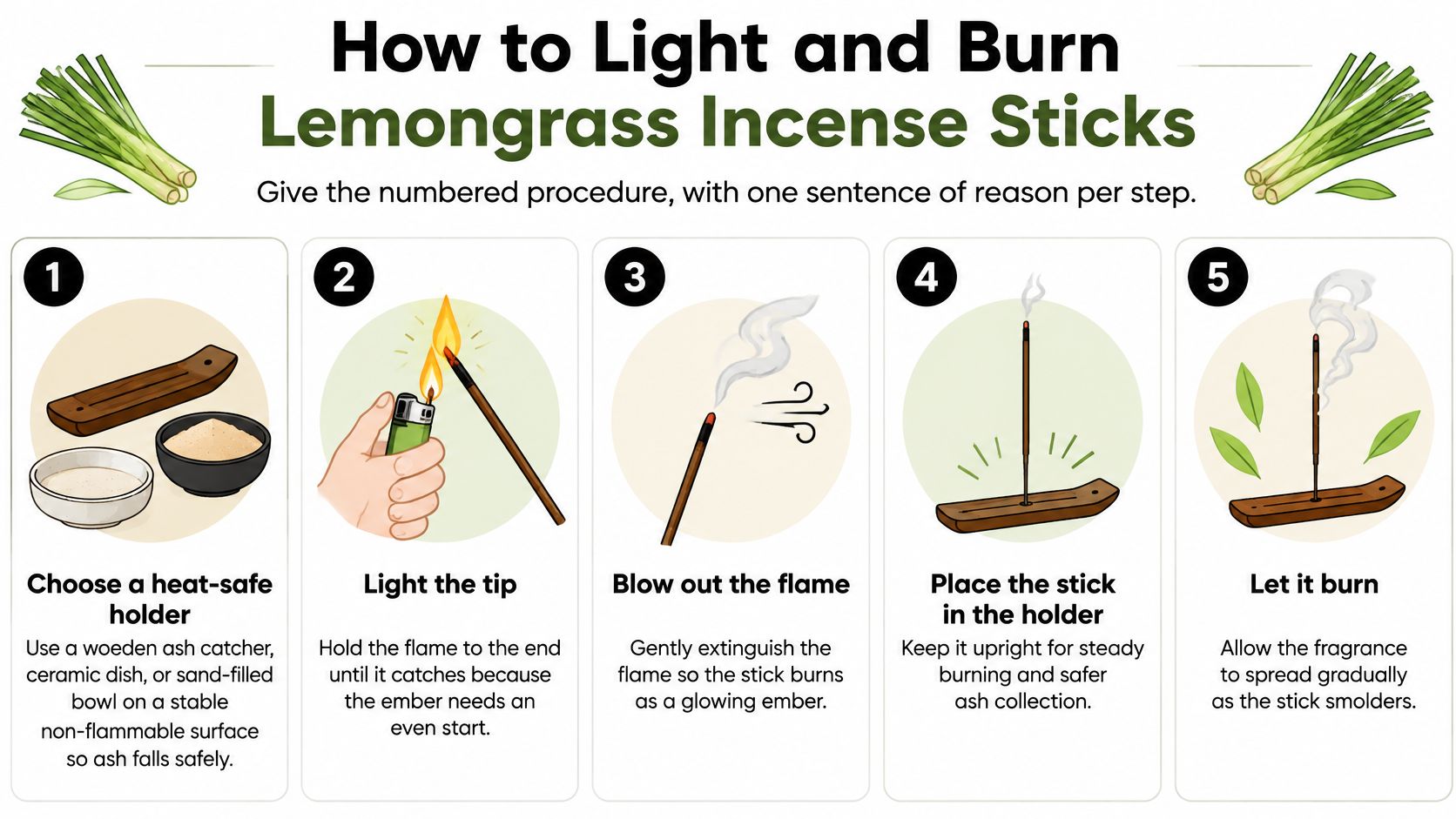
The visual shows the basic lighting sequence; secure the stick before ignition whenever your holder allows it.
A controlled lighting sequence
Choose a heat-safe holder. Set a ceramic holder or sand-filled heatproof bowl on a stable, nonflammable surface so falling embers can't contact furniture.
Secure the stick. Position the coated portion over the ash-catching area, because an attractive holder is only useful if it catches the ash.
Light the coated tip. Apply a match or lighter until the end catches, allowing the burning material to establish an ember.
Gently extinguish the flame. Confirm a glowing tip and a small stream of smoke, since incense should smolder rather than continue flaming.
Keep the session brief and ventilated. Open a window or exterior door where practical and extinguish once you've assessed the fragrance instead of treating a full-stick burn as the goal.
Stay nearby. Keep the burner away from curtains, bedding, paper, children, pets, and strong drafts, because movement or contact can scatter ash or overturn it.
Extinguish completely. Press the glowing end into sand in a heatproof container and check that it no longer glows or emits smoke before leaving.
Fix the setup before adding more incense
If the stick goes out, inspect whether the tip developed a proper ember and whether damp storage or direct airflow could be interfering. Don't repeatedly add flame to a damaged stick or leave it balanced in an unsuitable holder.
Our incense-burning troubleshooting guide offers further help with sticks that won't stay lit or burn unevenly.
Judge fragrance from where you'll actually sit, not with your face above the burner.
Start with a single stick rather than lighting several to force a stronger effect. If you stop noticing the aroma, step into fresh air before deciding it needs reinforcement. Alternating fragrances on different occasions can also make comparison easier without adding simultaneous smoke sources.
Never relight incense to cover cooking odors or a stuffy room. Remove the odor source and ventilate first; fragrance doesn't replace fresh air.
Smoke Exposure and Safety Misconceptions
Natural describes an ingredient's origin, not the safety of its smoke. A bright citrus scent can coexist with combustion pollutants, and a product that smells gentle may still release fine particles.
An incense health-effects review describes emissions including fine particulate matter, carbon monoxide, volatile organic compounds, aldehydes, and polycyclic aromatic hydrocarbons, citing average particulate emissions of approximately 45 mg per gram burned. That finding concerns incense combustion generally, not a measured result for every lemongrass product.
Low-smoke needs evidence
A review of residential incense emissions reports chamber measurements spanning 0.4 mg/g for a smokeless product to 44.5 mg/g across tested incense products. Such differences make smoke output a formulation and construction question, not something a buyer can determine from the fragrance name.
Retailers should request product-specific test documentation before using low-smoke claims. A photograph of a faint smoke ribbon, a natural label, or a pleasant smell isn't equivalent to emissions testing.
Shorten exposure: Extinguish when you've obtained the scent you want rather than finishing the stick automatically.
Ventilate actively: Use outdoor-air exchange where practical, but don't assume an open window removes every pollutant.
Choose the setting carefully: Avoid bedrooms, enclosed rooms, and spaces where smoke can drift directly toward someone.
Protect sensitive occupants: Be especially cautious around children, pets, and people with asthma or cardiovascular conditions.
There isn't a universal burn duration that makes incense safe. For household handling and placement guidance, consult our incense safety guidance.
Fragrance sensitivity isn't the same as smoke sensitivity
The Drugs.com lemongrass monograph notes limited human evidence for aromatherapy uses, rare hypersensitivity reports, and toxic alveolitis associated with inhalation of lemongrass oil. These reports don't establish how frequently a reaction occurs from lemongrass incense sticks, but they do undermine blanket therapeutic or harmlessness claims.
Someone who tolerates lemongrass tea may still react to incense. The exposure includes smoke, the scenting material, and other formulation ingredients, so a reaction doesn't identify the responsible component by itself.
Stop burning and move to fresh air after coughing, wheezing, rash, or eye irritation. Seek medical advice for persistent symptoms and urgent medical help for significant breathing difficulty. Don't keep testing different formulas to push through a reaction.
Matching Lemongrass Incense to the Moment
Choose the occasion before choosing how much fragrance to introduce. A citrus note might feel appropriate while opening the house for the day, yet become distracting during a close breathing exercise or in a crowded gathering.
Treat these uses as preferences and routine cues, not demonstrated treatments for fatigue, stress, or poor concentration. A familiar scent can mark the start of an activity without guaranteeing a physiological benefit.
Matching lemongrass incense to the moment
Use case | Why lemongrass fits | How to burn it |
|---|---|---|
Morning energy | Crisp citrus can feel like a bright start | Use a brief supervised burn in a ventilated living space |
Meditation and yoga | A restrained herbal-citrus note may suit a simple setting | Fragrance the room lightly, then extinguish before breath-focused practice |
Focus and study | A familiar scent can serve as a personal work cue | Keep the holder away from the desk and skip burning in windowless rooms |
Festive rituals | Green citrus offers an alternative to sweet or resinous fragrances | Use a secure holder away from decorations and guest traffic |
Warm evenings | The grassy citrus character suits an outdoor setting | Place on a sheltered, stable surface and don't rely on it for pest control |
Make the ritual work for the people present
For morning use, finish ventilation and basic tidying before introducing fragrance. Lemongrass should complement a comfortable room, not disguise stale air.
During yoga or meditation, keep the holder outside your immediate breathing zone. If you're arranging a dedicated practice space, HD Asian Art on altar styling offers ideas for organizing the setting; keep incense physically separated from textiles, flowers, and other combustible decorations.
A studio has different responsibilities from a private home. Give participants a chance to decline fragrance, and choose a fragrance-free session when someone reports sensitivity. Customers shouldn't have to accept smoke exposure to use a wellness service.
Enjoy the evening scent without a pest-control promise
A 2024 study by Neelamma and colleagues reported better mosquito-repellent activity for its F2 polyherbal incense formulation than F1, without stating a numerical efficacy percentage. That comparison doesn't establish protection from a lemongrass-only stick.
Choose incense for its fragrance. Choose a purpose-made mosquito-control method for protection.
Outdoors, watch for gusts and keep ash contained. An open setting doesn't eliminate fire risk, and a stronger breeze isn't a reason to light additional sticks.
Buying Lemongrass Incense for Home or Wholesale
Buy a sample before buying a supply. Home users need to discover whether they enjoy the finished fragrance, while retailers need a product they can describe, store, and reorder consistently.
For a first home purchase, choose the smallest available pack rather than assuming a bulk bundle offers better value. Check the format carefully: rope incense, cones, and conventional sticks require different holders and shouldn't be treated as interchangeable.
Buying priorities by situation
Buying situation | Priority checks | Sensible first order |
|---|---|---|
First-time home burner | Scent fidelity, acceptable burn behavior, freshness | The smallest available stick pack |
Daily home user | Cost per usable stick and practical storage | A modest bundle plus a tightly closing storage container |
Spa or yoga studio | Participant tolerance, repeatable scent, ventilation | Samples before any case order |
Gift or smoke shop | Margin, labeling, companion fragrances | A mixed starter assortment with suitable holders |
Private label or reseller | Formulation records, packaging, batch consistency | Prototype quantities of sticks, scenting materials, and bags |
For wholesale buyers, compare the finished result
A physicochemical analysis of steam-distilled lemongrass oil measured 73.17% citral in the tested oil. That supports the importance of citrus-rich raw material, but it isn't a composition guarantee for a finished incense stick.
Request documentation distinguishing genuine essential oil from lemongrass fragrance, along with fragrance load, carrier system, and batch identification. Evaluate both the unlit aroma and hot throw, the scent perceived during burning. Keep packaging claims proportionate to what the manufacturer can substantiate.
Compare landed cost, breakage, packaging labor, and consistency rather than unit price alone. For context, an Accio marketplace listing reported $1.58–$1.68 per pack for citronella-lemongrass sticks with a 1,000-pack minimum; that's a specific listing, not a like-for-like market benchmark.
Before committing to bags and labels, compare wholesale packaging supply options with attention to closure, scent containment, and labeling space. Our wholesale incense buying guide provides additional purchasing context.
Match the order to the purpose
Our sticks are sold by weight, with approximately 85–100 sticks per bundle. For shops exploring a broader assortment, our 1000 Stick Starter #7 costs $39.99 and contains approximately 1,000 sticks across 10 bundles of popular scents selected at random; it isn't a guaranteed lemongrass order.
This week, test a small lemongrass purchase in an appropriate ventilated space, write down your scent impression, and extinguish rather than automatically finishing it. Buy the next quantity according to actual use, not the strongest discount.
Frequently Asked Questions
1: How should you store lemongrass incense sticks to preserve their fragrance?
Store lemongrass incense sticks in an airtight container or tightly sealed package in a cool, dry location away from direct sunlight. Limiting exposure to air, heat, and moisture helps preserve the fragrance and prevents the sticks from becoming damp or damaged.
2: Can lemongrass incense sticks lose their fragrance over time?
Yes. Exposure to air, heat, and sunlight can gradually weaken the fragrance of incense sticks. Proper storage helps maintain their scent, but older products may eventually develop a noticeably weaker or altered aroma.
3: Do lemongrass incense sticks come in different stick lengths and thicknesses?
Yes. Incense sticks are manufactured in different lengths, thicknesses, and core styles depending on the manufacturer. These differences can affect how the sticks fit into holders and how they perform when burned. Check product dimensions before purchasing to ensure compatibility with your incense holder.
4: Does the color of lemongrass incense sticks indicate their fragrance strength?
No. The color of an incense stick is not a reliable indicator of fragrance strength or quality. Coloring can come from the base materials, dyes, or manufacturing process. Fragrance concentration, formulation, and the quality of the scenting materials are more relevant factors.
5: Are lemongrass incense sticks a good gift for someone who enjoys citrus fragrances?
Yes. Lemongrass incense can make a thoughtful gift for someone who enjoys fresh, herbal, and citrus-inspired fragrances. Consider pairing a bundle with a decorative incense holder or other complementary fragrance varieties to create a practical gift set.
Aroma Warehouse offers hand-dipped incense sticks and cones, fragrance oils, and holders for home users and small retailers. Visit Aroma Fragrance Warehouse to compare formats and starter options, and confirm the available lemongrass format before choosing the holder and quantity for your routine.


