

Amber Incense Sticks: Scent, Choice and Safe Burning

A bundle of amber incense sticks arrives, you slit the plastic, and the unlit sticks smell sweet, resinous, a bit like vanilla and warm wood. Then you light one. Within a minute the smoke is drier than the wrapper promised, closer to melted resin than to perfume, and you're standing there wondering whether that's what amber is supposed to do, whether the stick contains any actual amber at all, and whether it's fine to leave burning in a bedroom with the window shut.
Those are three separate questions, and they don't share an answer. Scent is a blend of notes. Contents are a manufacturing choice the word amber tells you nothing about. Smoke is a measurable thing that goes into your air along with the fragrance. Keep the three apart and the buying decision gets much simpler.
Table of Contents
What Amber Incense Smells Like and Where It Comes From

Amber incense smells warm, sweet and resinous. Where resins carry the blend, that sweetness picks up a dry, faintly smoky edge, like hardened tree sap warming over a flame. Where vanilla and sandalwood carry it, the same name turns creamy and soft. Most sticks open sweet in the first minute and settle into resin after five or ten, which is why two people smelling the same stick reach for completely different words.
The confusion almost always starts with the label.
Amber Names a Scent Family, Not an Ingredient

A stick sold as amber may contain no fossil amber at all. In fragrance work, amber is an accord: a built blend of balsamic, resinous and sweet materials aiming at a warm golden impression. The word points at a direction, not a recipe. Real gum resins sit at one end of that range, and this guide to amber resin incense explains how resin products differ from dipped sticks.
Four note families show up again and again under the same label.
Scent type | Typical notes | Character | Best for |
|---|---|---|---|
Benzoin, labdanum, vanilla | Warm, sweet, balsamic | Evenings and relaxation | |
Frankincense, myrrh, labdanum | Dry, smoky, earthy | Meditation and ritual | |
Vanilla, tonka, sandalwood | Creamy, soft, rounded | Bedrooms and gifting | |
Cinnamon, clove, cardamom | Warm, spicy, lively | Cool-season living rooms |
The menu test: treat amber the way you treat the word spicy on a restaurant menu. It gives you the direction, and the listed notes tell you whether you're ordering chili or cinnamon.
A Three-Minute Self-Test Before You Commit
Smell the unlit stick. You should get sweet resin and wood, not alcohol. A sharp solvent smell usually means the dip hasn't fully cured, so let the bundle air for a day before you judge it.
Smell the first minute of smoke. Sweetness arrives first. A harsh or ashy opening usually means the tip caught too much flame or the room is drafty.
Wait ten minutes. Good amber turns drier and more resinous as it burns. If it stays sugary the whole way through, you're in the sweet amber family and should look for a resin-forward stick next time.
Why Amber Gets Burned at All
The practice is old. The J. Paul Getty Museum's publication on amber identifies amber burning as significant in rituals connected with solar deities before and during the Classical era. Incense was a regular part of Babylonian religious ceremonies, and thousands of incense burners found in sanctuaries and graves across Greece and Etruria show how much value fragrant smoke carried in ritual life. A nineteenth-century account from China records carving chippings and amber dust being reused for varnish or incense.
Ancient sources describe burned amber as loose pieces, dust or mixed aromatic material, not shaped sticks. Modern amber incense sticks are a standardized format built on an older practice, not a replica of an ancient product. The trade history explains why no single country owns the scent: the Getty's introduction to amber traces a defined long-distance amber trade from around the mid-second millennium B.C., with material moving through European river corridors toward the Mediterranean and turning up in the Iberian Peninsula, Mesopotamia, Anatolia, Ugarit and Egypt, used for incense, perfume, pharmaceuticals and varnish.
Before you shop, name the family you enjoy. It's the single decision that makes everything after it easier.
How Amber Incense Is Used Today
Most amber sticks get burned for something smaller than a ceremony. A living room at nine at night after the dishes are done. A desk cleared for twenty minutes of quiet before the workday starts. The last stretch of a yoga class, lights down, everyone still. A guest room made to feel lived in before a friend arrives.
Each of those settings has a set-up that works better than the others.
Wind-down at home. One stick in a heatproof holder on a side table, window cracked a couple of fingers wide, and let the stick finish on its own rather than stubbing it out early.
Short meditation. Light it two minutes before you sit so the room has scent when you close your eyes, and place the holder behind you rather than in front of your face.
Yoga studio closing rest. Time it so the stick is lit before students settle into stillness, and keep it near a vent or door rather than beside a mat.
Gifting. Pair a sweet or spiced amber with a simple ceramic holder, since those who enjoy warm woods often do not yet own a decent holder.
Guest rooms and short stays. A single stick burned an hour before anyone sleeps leaves a faint trace without leaving a room smelling of smoke in the morning.
Many people burn amber inside a religious or cultural practice, and the scent carries different weight in different traditions. Follow your own tradition's conventions rather than treating amber as a fixed ritual ingredient.
One distinction worth holding onto: scent changes how a room feels and how you feel in it, and that's real. Claims that a particular stick treats anxiety, clears sinuses or improves sleep aren't something a fragrance name can support. If you want the broader picture of where sticks fit into daily routines, this piece on incense stick uses covers the practical end.
Pick the scene you'd use. That decision shapes the next one.
How to Choose Amber Incense Sticks
The label gives you one word. A complete product page gives you five pieces of information, and any seller who can't supply them is asking you to buy on atmosphere alone.
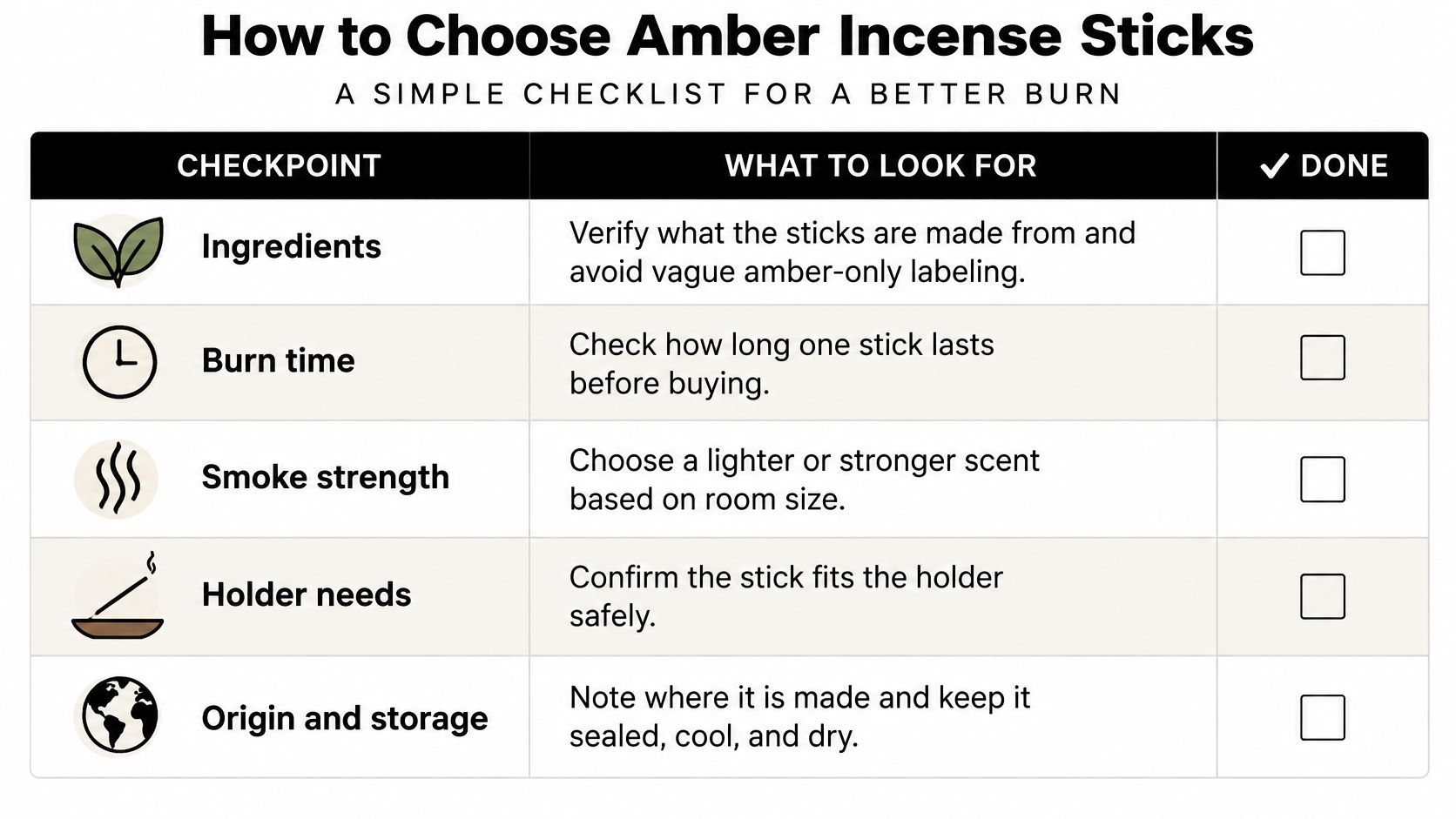
Criterion | What to check | Red flag |
|---|---|---|
Ingredients | Base material (charcoal or masala) and any synthetic fragrance named | No ingredient information at all |
Burn time | Approximate burn time per stick stated | Only "long lasting" with no figure |
Smoke strength | Light, medium or strong rating given | Strong scent claims with no strength rating |
Holder needs | Holder or ash catcher recommended in the listing | No burning instructions |
Origin and storage | Country of manufacture, batch consistency and storage advice | Only "exotic" or "all-natural" wording |
Read the ingredients row first, because it settles the question the word amber can't. Charcoal-based sticks coat a blank core in a fragrance paste, while masala-style sticks carry a paste of ground aromatic materials on the core itself. Neither category is automatically safer. They differ in how the fragrance is carried, not in whether smoke is produced, so treat a "charcoal-free" badge as a description rather than a guarantee.
That distinction matters because scent and perceived quality don't predict emissions. A home-use study published in Atmospheric Chemistry and Physics measured toluene as the most abundant identified compound at 70.8 ± 35.7 micrograms per gram of incense burned, followed by benzene, furfural and phenol. Those figures come from specific products in a specific setting, so they don't transfer to every amber stick on a shelf. The narrower lesson does transfer: a resinous name and a premium feel tell you nothing about what a stick emits, which is exactly why disclosure is worth demanding.
Buyer's rule: match strength to room size, buy a small pack before committing to a bundle, and treat "exotic" or "healing" as decoration on the label until the page backs it with specifics.
Run three questions before you pay. What is the stick made of, and does the page say so? How long does one stick burn, and how strong is it rated? Where was it made, and how should it be stored? For a wider view of what separates a well-made stick from a cheap one, see this guide to good incense sticks.
Safety Limits for Kids, Pets and Asthma
Sweet smoke reads as gentle smoke, and that misreading is where most indoor incense trouble starts. The measurement points the other way. Burning incense in a California residence produced more than 45 mg of particulate matter per gram burned, against roughly 10 mg per gram reported for cigarettes, and that work identifies incense as a substantial indoor PM2.5 source, as published in Environmental Science & Technology. The practical response is simple: give the smoke somewhere to go, and put distance between the burning tip and the people sharing the room.
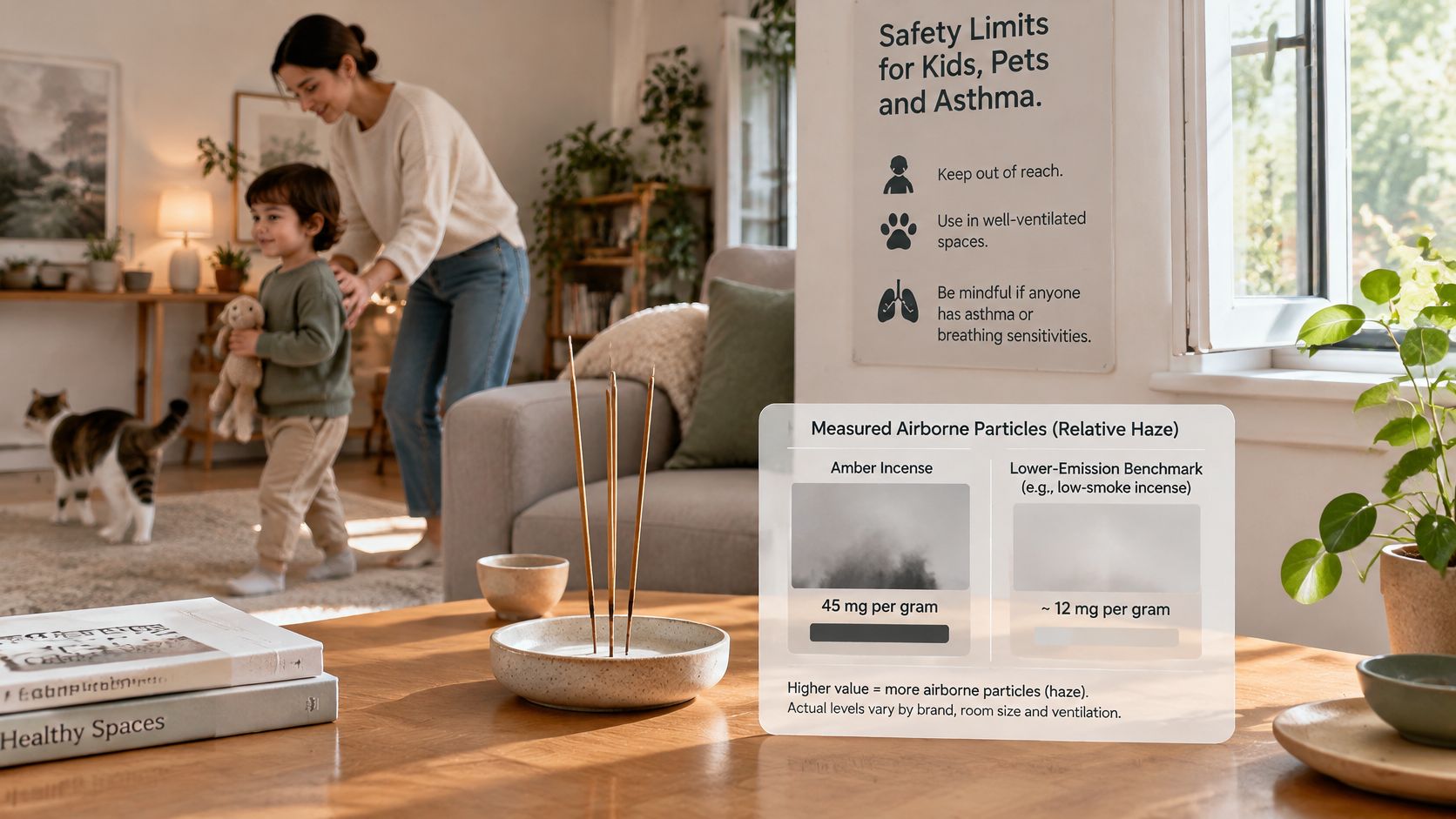
A darker stick or a richer fragrance does not mean less smoke. Colour and scent names describe smell, not emissions, and a resin-like aroma is not automatically gentler on lungs than a synthetic one. What changes your exposure is how much smoke enters the room and how quickly that room can clear it. Ventilation and distance do more for safety than anything printed on the label.
Match your situation to the action.
Setting or person | Main concern | What to do |
|---|---|---|
Asthma or allergies | Smoke irritates airways | Avoid indoor burning or keep it very brief with windows open; ask a doctor if unsure |
Children and infants | Close-range smoke exposure | Burn only in another room, out of reach, or not at all |
Pets, especially birds | Sensitive airways | Keep them out of the room and ventilate fully |
Small bedroom or studio | Smoke builds up quickly | Burn one stick at a time with a window open |
Poor or closed ventilation | Particulates accumulate | Do not burn until the room can be aired |
Birds deserve their own mention, because a parrot in the corner of a living room is the household member least likely to be considered before someone lights a stick. If you keep companion animals, this guide to whether incense sticks are safe for pets goes further than this section can.
The stop rule: if your throat, eyes or chest start to complain, put the stick out, open the windows and leave the room for a while. A headache or a smell you can taste is not a sign the incense is working.
On air purifiers, the honest answer is that no published work establishes that a purifier makes incense safe for someone with asthma or a small child. Treat ventilation and distance as the controls you rely on, and do not use a machine to justify burning more.
How to Light and Burn Amber Incense Step by Step
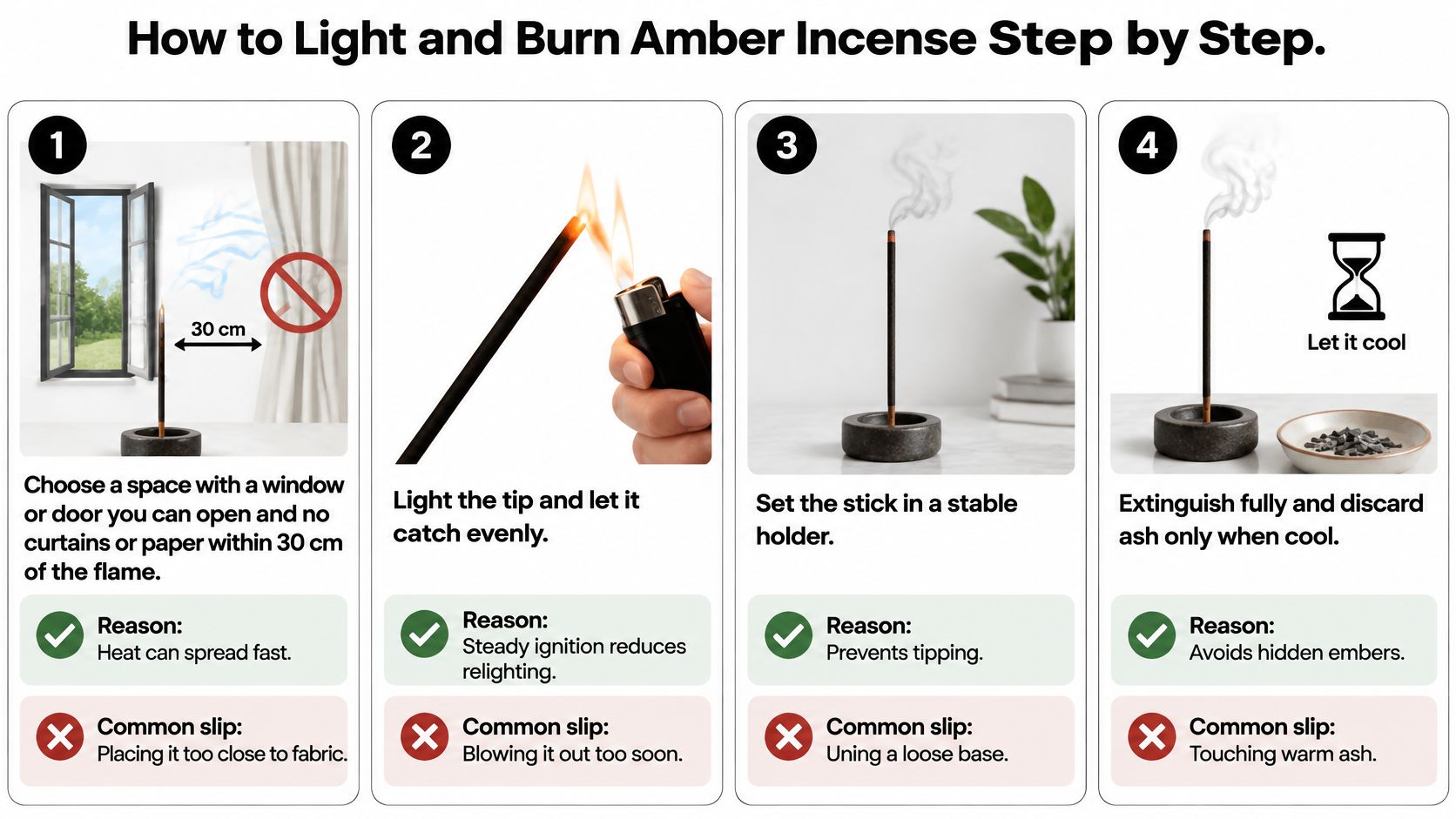
The difference between a clean amber burn and a smoking, eye-stinging one comes down to setup and the first thirty seconds.
Choose a space you can air out. A window or door you can open matters more than the holder does. Keep curtains, paper and dry plants at least 30 cm from the flame, because heat and smoke collect fast in a corner. The common slip is setting up on a shelf under a cabinet, where smoke pools and leaves a film.
Set a heatproof holder on a flat, stable surface. A ceramic holder or a sand-filled bowl catches ash and stops a tipped stick from dropping embers onto a table. The slip here is a light wooden base on a soft surface, which rocks once the stick shortens.
Hold the tip in the flame for five to ten seconds, until it glows. You want an ember, not a torch. Leaving it in longer chars the tip and buys you soot plus a harsh opening minute; pulling it out early means relighting almost immediately.
Blow the flame out gently. A soft puff leaves a steady ember. A hard blow can unbalance the tip or scatter ash across the table.
Stand the stick upright and stay in the room. Incense isn't a leave-the-house fragrance. Keep it in sight until it's finished.
Check at the five-minute mark. Thin, steady smoke is what you're after. Dense grey smoke or a sting in the eyes means put it out and open the window wider.
Extinguish in sand or ash, then wait. Press the tip into sand or let the stick finish in the holder, and leave the ash alone until it's cold to the touch.
A good burn looks unremarkable. An even ember, a thin line of smoke, and a scent that reaches the far side of a normal room within about ten minutes without making anyone's eyes water. If the stick is shopping for a home before you burn the next one, this guide to choosing a ceramic incense stick holder covers weight, ash depth and the shapes that don't tip.
Pick Your First Amber Stick and Burn It Safely
Start with the scene, then the label. Pick the amber-style note family that fits the room you pictured, run the five label checks, and choose a small pack before a bundle. Judge three things separately: how it smells, what the listing says is in it, and how much smoke it puts into your air. Aroma Warehouse incense sticks are hand dipped and soaked in pure incense oil for no less than 24 hours; any complete product page should state that kind of detail plainly, along with base material, synthetic fragrance if used, approximate burn time per stick, strength, holder guidance and ventilation instructions. Use that list against any listing, including the retailer's.
Then give the stick a week. One per evening, in a ventilated room, with the safe setup already covered. After each burn, write two lines: scent strength in that room, and smoke behavior. Thin, steady smoke with easy breathing can still mean fine particulates in the air, so the window rule stays even when the fragrance feels gentle.
If the stick smells right, burns with a thin stream of smoke and suits the room, keep it. If it doesn't, change the note family or the strength rating, and never change the ventilation rule. Adjust the fragrance. Hold the air quality line.
Aroma Warehouse stocks hand-dipped incense sticks, cones, fragrance oils and the incense holders, burners and ash catchers that support a tidy setup, shipped from Buckeye, Arizona. Browse Aroma Fragrance Warehouse, apply the same checklist, and start with one scent family in a size you can finish.


