

Patchouli and Lavender: How to Blend and Use Them
You have two bottles on the counter, lavender and patchouli, and a diffuser that has been running the same single note for weeks. Lavender on its own is bright and a little sharp. Patchouli on its own is rich, then heavy if the drop count creeps up. Together they can read as one scent, floral first and earthy underneath, but only when the ratio matches the job.
This is a scent-design problem before it is anything else. A starting ratio belongs to a use, and that use has a safety limit. A room blend is not a massage oil. A pleasant smell is not a treatment. You'll get a ratio for each common format, a small-batch method, and plain language for what patchouli and lavender can and cannot claim.
Table of Contents
Why Patchouli and Lavender Balance Each Other - What each oil contributes
Starting Ratios for Each Common Use - Walk the uses in the order you'll actually try them
Safety Limits for Skin, Diffusers and Incense - Match the limit to the route
How Batch Quality Changes the Final Scent - What to do when the next bottle arrives
Why Patchouli and Lavender Balance Each Other
Patchouli and lavender balance each other because lavender lifts the top of the scent while patchouli holds the base. Lavender is the melody. Patchouli is the bass line. You notice the tune first. The low note is what makes the phrase feel finished instead of thin.
Lavender is floral, herbaceous, and fresh. In one chemical analysis, linalool and linalyl acetate together comprise approximately 75% of the oil, as reported in Medical Mycology. Those lighter constituents come forward quickly on a blotter, then step back. Patchouli is earthy, woody, and sweet. It behaves as a base note. Heavier sesquiterpene compounds, including patchouli alcohol and caryophyllene, cling to skin and fabric longer than lavender's brighter fraction. A single drop of patchouli is often still obvious half an hour after the lavender has softened.
The earthiness takes the edge off lavender's herbal sharpness. Lavender keeps patchouli from sitting in the room like damp wood. If you want a heavier, warmer base than lavender can provide, the same anchoring idea shows up in patchouli and amber.
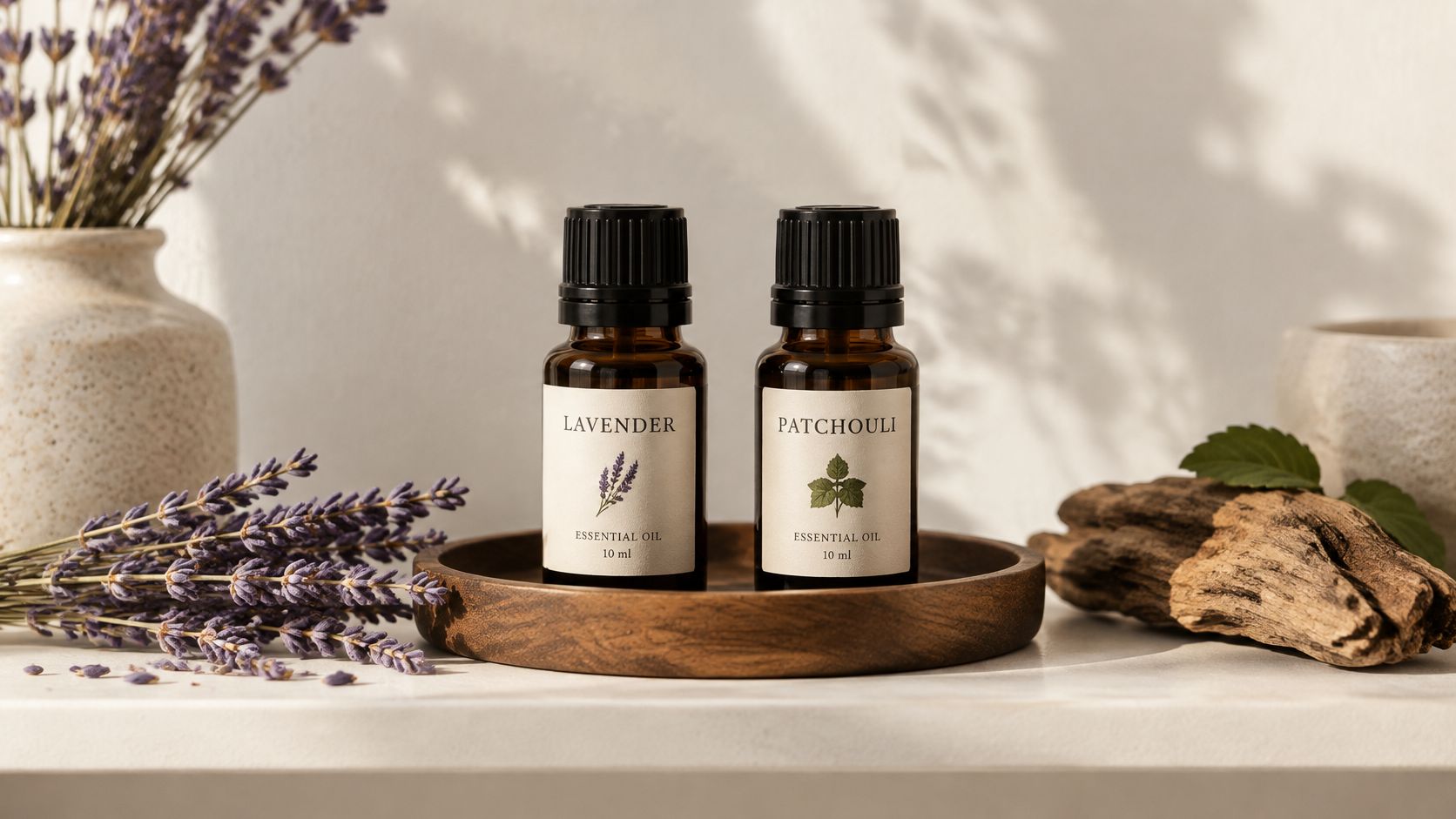
What each oil contributes
Put one drop of each oil on separate blotter strips. Smell lavender, then patchouli, then both strips held together. Come back after thirty minutes. The first impression should still be floral. The dry down should be earthy, without a harsh or medicinal edge.
If the dry down smells only like patchouli, the bass is already too loud. If it smells only like lavender, the blend will feel unfinished once the top note leaves the room. That thirty-minute check is the whole point of pairing them. You're judging a timeline, not a single sniff.
Starting Ratios for Each Common Use
Write every ratio as parts lavender to parts patchouli, counted in drops. Start lighter than feels necessary. Patchouli announces itself late, so a blend that smells shy in the first minute often smells heavy by the end of the hour. Total strength changes with the volume of water, alcohol, or carrier, so scale the drop count with the container instead of guessing.
Use | Starting Ratio (Lavender:Patchouli) | Total Strength | Why It Works |
|---|---|---|---|
Room diffuser, 100 mL water | 3:1 | 3-5 drops | Lavender leads; patchouli stays in the background |
Room spray, 30 mL alcohol base | 2:1 | 10-15 drops | Patchouli stays audible; alcohol carries the scent |
Massage or body oil, 30 mL carrier | 2:1 | About 2% (roughly 12 drops) | Patchouli adds depth without overpowering skin |
Bath blend, 1% in carrier first | 1:1 | 1% or less | Blend in carrier first; oils float if added directly |
Incense or candle | 1:1 | Check the product label before lighting | Scent is pre-blended; test smoke in a ventilated space |
Walk the uses in the order you'll actually try them
Room diffuser. In 100 mL of water, a 3:1 ratio at 3 to 5 total drops lets lavender lead. Patchouli stays in the background, which is what you want when the scent has to fill a room rather than sit on skin. For more single-oil ideas in the same format, see essential oils that behave well in a diffuser.
Room spray. A 30 mL perfumers alcohol base at 2:1, using 10 to 15 drops, keeps patchouli audible. Alcohol carries both oils into the air more evenly than water alone, so the earthy note doesn't sink to the bottom of the bottle.
Massage or body oil. In 30 mL of carrier, stay near 2% total, roughly 12 drops, still at 2:1. Patchouli adds depth on skin without covering the floral opening. Jojoba or fractionated coconut oil are straightforward carriers because they have little scent of their own.
Bath. Move to 1:1, and keep the blend at 1% or less. Stir it into the carrier before it touches the water. Neat oils float, and floating droplets sit on skin in a much higher local concentration than the bottle math suggests.
Incense or candle. A finished stick or candle is already blended, often near equal parts in character if both notes are listed. You don't control the drop count, so read the maker's dosing and test the smoke in a ventilated space before you commit a whole box to a studio.
Change the ratio by a small step only after a real test. If the blend feels heavy or lingers past the point you wanted, drop back toward more lavender rather than adding more of both.
Safety Limits for Skin, Diffusers and Incense
A bottle that sits harmlessly on a diffuser shelf can still irritate the inside of a wrist. Safety depends on the route, the concentration, the freshness of the oil, and the person using it. Calling patchouli and lavender "natural" settles none of those questions.
Lavender contains recognized contact allergens, including linalool, linalyl acetate, and geraniol. Oxidation can make some fragrance constituents more sensitizing, so a bottle that spent a year on a sunny windowsill is a different product from a fresh one. In a clinical review on PubMed Central, 2.2% of lavender-exposed patients had positive patch tests, personal-care products and essential oils were common exposure sources, and European patient groups ranged from 0.6% to 1.4%. Patchouli reactions are documented but appear less common. Outside the clinic, consumers do sometimes report contact dermatitis or allergic reactions after using essential oils, so the careful approach treats even a gentle-smelling blend as a potential sensitizer until a patch test says otherwise.
Match the limit to the route
Exposure Route | Main Concern | Practical Guidance |
|---|---|---|
Skin contact | Contact allergens such as linalool, linalyl acetate and geraniol; oxidized oils can sensitize | Dilute to 2% or less and patch test a small area, waiting 24 hours |
Room diffusion | Airway irritation, especially for people with asthma | Use short cycles in a ventilated room; get medical advice first if asthma applies |
Incense or candle smoke | Smoke and combustion particulates | Burn in a well-ventilated space, away from children and pets |
Bath water | Undiluted oils float and irritate skin | Disperse in a carrier before adding, at 1% or less |
Ingestion | Not appropriate for any blend | Never take internally |
Pregnancy, children, medication | Individual risk varies | Get medical advice before use |
One pattern runs through the table: the limit tightens as contact gets closer and lasts longer. A diffuser spreads the blend through a roomful of air, while skin and bath keep the oil pressed against the body, which is why those routes carry the lowest percentages. The patch test itself is a small rehearsal. Apply a drop of the diluted blend to the inner forearm, cover it, and wait a full day. Redness, itching, or a rash means that blend stays off skin entirely.
Storage controls one variable in every row. Keep both oils tightly closed, away from heat and light, and retire any bottle that starts to smell sharp, paint-like, or off. Anyone with a known fragrance allergy, asthma, a pregnancy, young children at home, or medication in the picture should get medical advice before regular use. If you are building skin or hair products around lavender alone, the practical limits in lavender essential oil for skin, hair, and home pair well with the table above.
How to Blend a Test Batch Step by Step
A test batch is three tiny samples, not one heroic bottle. You are looking for the first ratio that smells floral up front and earthy later, without a harsh edge.
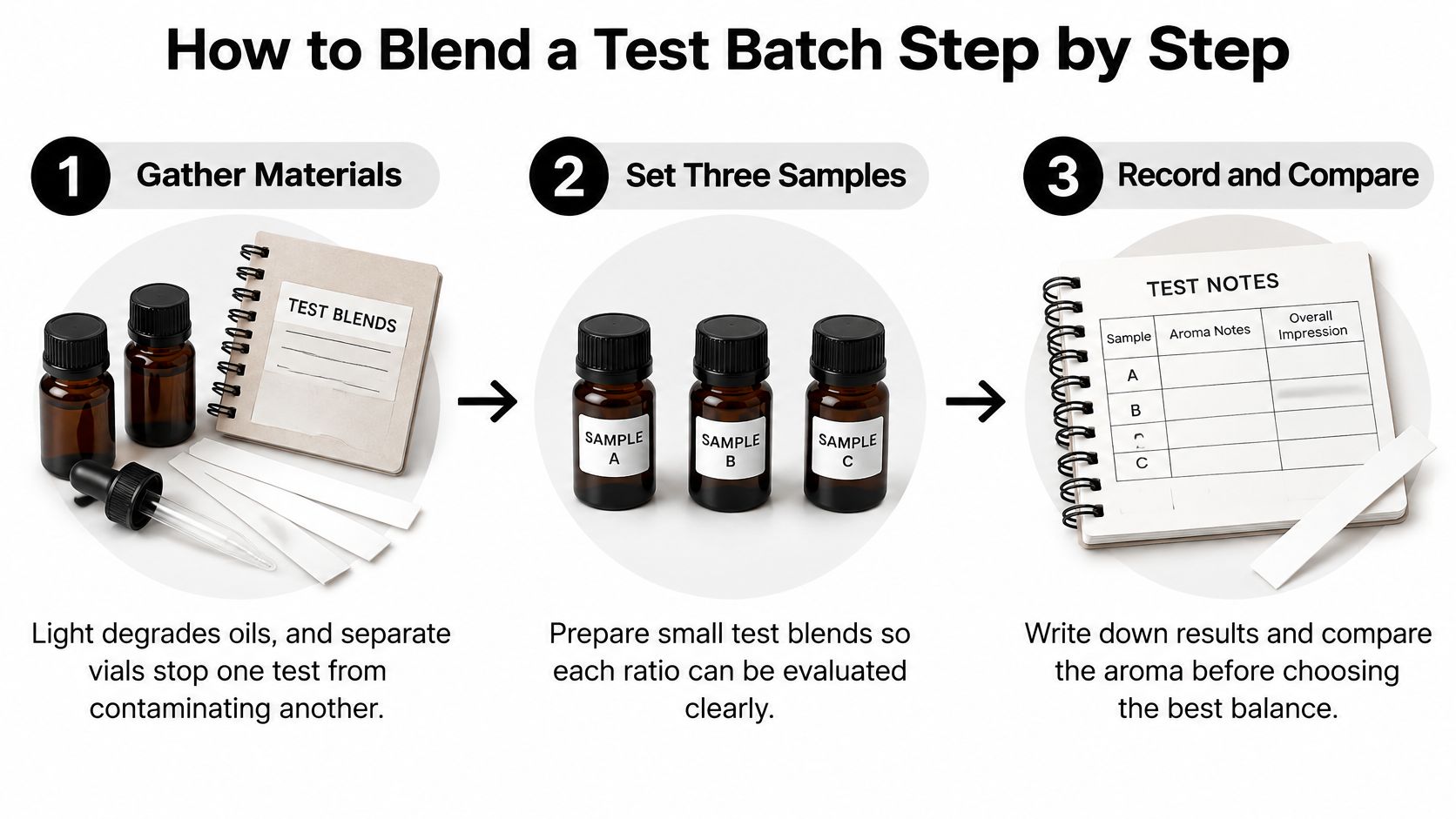
Gather the tools. Set out two or three dark glass vials, a glass dropper, blotter strips, and a labeled notebook. Light degrades oils, and separate vials stop one test from contaminating the next. Amber glass beats a clear sample jar on a sunny counter.
Set three ratios. Prepare 3:1, 2:1, and 1:1, lavender to patchouli, on separate blotters or in separate vials. Three samples side by side beat one sample you keep "fixing," because you can still smell the version you almost chose.
Add lavender first. It sets the top and keeps the blend from starting heavy. Count the drops out loud and write them down before the second oil goes in.
Add patchouli one drop at a time. Swirl, then sniff, after every drop. The common slip is pouring patchouli quickly because the first drop smells weak. It dominates a minute later.
Stop at the first balanced ratio. You want floral first, then an earthy base after about an hour. If you are building toward a personal perfume rather than a room scent, the same counting habit is what makes essential oil perfume recipes repeatable.
Rest the chosen blend. Leave it 24 to 48 hours in a closed, dark container. The scent settles as it ages, and a judgment made in the first five minutes is often wrong.
Re-smell a fresh blotter. Compare it with the earlier notes. Record the ratio, the date, and the supplier batch number.
A good result is lavender-forward at the open, with an earthy depth afterward, and no harsh or medicinal edge. If the rested sample smells muddier than the fresh blotter, the patchouli share is too high for that bottle. Don't "correct" it by adding a third oil until this pair is clean.
How Batch Quality Changes the Final Scent
Two bottles both labeled patchouli can smell like different materials. The cause is chemistry, not a bad nose.
Patchouli essential oil is dominated by sesquiterpenes, but the mix shifts with the plant part, the origin, and the processing. In a comparative GC–MS study published in the Journal of Essential Oil Bearing Plants, patchouli alcohol represented 27.52% of flower oil and 44.52% of leaf oil, while caryophyllene accounted for 18.23% and 12.86%. A richer sesquiterpene and patchouli-alcohol content generally supports a deeper, longer-lasting odor. A composition heavier in volatile monoterpenes feels brighter and fades sooner.
What to do when the next bottle arrives
That gap is large enough to move a blend. A ratio that felt balanced on a high-alcohol leaf oil can feel thin, or suddenly heavy, on the next lot.
Request paperwork: Ask for GC–MS data or a certificate of analysis when consistency matters, especially for private label.
Keep a benchmark: Hold back a small retained sample of the lot you already like, stored dark and closed.
Retest on a blotter: Any time the batch number changes, smell the new oil against that retained sample before you scale the blend.
The same study reported antimicrobial activity ranging from weak to strong across tested organisms. Don't present patchouli as a proven disinfectant. Organism-specific testing on the finished product is the only basis for that kind of claim, and a nicer-smelling lot is not evidence of it.
What the Blend Can and Cannot Claim
A label test sorts most of this out. If a sentence about your blend would sit comfortably on a soap wrapper, it is probably fine. If it would sit comfortably on a pharmacy shelf, it is not.
What holds up is modest. Many people find the aroma pleasant. The blend can mark a ritual, such as the start of a class or a few quiet minutes, and some people report a short-term sense of relaxation. That is a sensory report, not a clinical result. A scent claim describes what the nose notices, a health claim describes what the body does, and only the first is yours to make.
What does not hold up is the usual product language. Anxiety relief, sleep support, mood improvement, and skin healing are not established outcomes for this pair. Blending the two oils has not been shown to produce additive or synergistic effects, and no optimal ratio for health has been determined. The National Center for Complementary and Integrative Health notes that evidence for lavender remains limited by small samples, limited participant diversity, and other study-design problems. Evidence for the two-oil combination is thinner still, and reviews of essential-oil use in skin care land in the same place: small, short studies leave dermatology claims unproven.
Ratio choices sit on the scent-design side of this line. A richer, earthier patchouli note may smell better to some people, and picking it is a legitimate preference. More oil does not mean more benefit. A stronger scent is still just a stronger scent, and pushing past the dilution limit for your use adds exposure rather than effect.
Describe the blend as a sensory experience, not a treatment. "Earthy floral for a meditation room" is accurate. "Relieves anxiety" is not.
Studios and retailers can still say plenty: meditation ambience, scent layering in a room, which format fits the space. A diffuser, a room spray, and a pre-blended incense stick are format choices, not therapy choices. For wording that stays on the sensory side of relaxation, stress-relief scents shows how similar products phrase it before anything lands on a label.
FAQs
FAQ 1: What fragrances pair well with patchouli and lavender?
Patchouli and lavender pair well with complementary fragrance notes such as vanilla, bergamot, sandalwood, cedarwood, and frankincense. Vanilla adds sweetness, bergamot introduces a bright citrus character, and sandalwood creates a warmer woody foundation. These combinations allow you to customize the floral and earthy character of the original blend.
FAQ 2: Is patchouli and lavender a good combination for homemade soap?
Yes. Patchouli and lavender can create an appealing floral and earthy fragrance combination for homemade soap. However, always select oils approved for soapmaking and check their applicable usage limits. Fragrance suitability and maximum concentrations vary depending on the specific oil and formulation.
FAQ 3: What is the difference between patchouli and lavender essential oils and fragrance oils?
Patchouli and lavender essential oils are obtained from botanical materials through extraction or distillation. Fragrance oils are formulated scent products that may contain natural ingredients, synthetic aroma compounds, or a combination of both. Essential oils and fragrance oils are not automatically interchangeable, particularly when formulating products for skin contact.
FAQ 4: Can patchouli and lavender be combined to create a signature fragrance?
Absolutely. The combination provides a versatile foundation for creating a recognizable fragrance profile. Lavender contributes a fresh floral character, while patchouli adds an earthy, woody dimension. Adjusting the proportions and introducing complementary fragrance notes can help create a distinctive scent for personal fragrance products, home fragrance, or incense.
FAQ 5: What should I look for when purchasing patchouli and lavender oils for blending?
Look for clearly identified ingredients, consistent fragrance descriptions, appropriate product documentation, and reliable supplier information. If you are purchasing oils for commercial production, ask about batch consistency and request applicable safety documentation. For repeatable results, compare new batches against a previously approved sample before making larger quantities.
Choose Your Ratio and Test a Small Batch
Decide the use before you touch a dropper. Diffuser, room spray, body oil, bath, or incense: each one pairs a starting ratio with a safety limit, so the use comes first and the drops come second. Take the starting ratio for that use and confirm the exposure route before anything touches skin. Then blend three versions, rest the one that wins, and let the rested blotter make the final call. A test costs a few millilitres, which is far cheaper than a 30 mL bottle you will never finish.
Three details make the next batch repeatable: the ratio, the date, and the supplier batch number on each bottle you used. Skip that last one, and a later bottle that smells different will read as a blending error when the cause is a lot change. Wholesalers and private-label sellers should keep the benchmark sample and retest against it whenever a supplier lot changes, before committing to a full production run.
Aroma Warehouse sells fragrance oils that include classic lavender and exclusive blends, poured fresh to order, plus hand-dipped incense sticks and the glass bottles, droppers, and electric diffusers needed for a small test batch. Visit Aroma Fragrance Warehouse to choose a format and test the pair before you scale it.
Today, pick one use, set its starting ratio, blend the three versions, and write down the result. Scaling comes after the rested sample still smells like the blend you meant.


