

Twilight Woods Fragrance Guide for Notes, Uses and Blends

If you pick a Twilight Woods fragrance by the name alone, you'll expect a dark forest from the first breath. That's the gap. The name points at woods, but the scent opens bright and fruity, turns floral, and only later settles into vanilla, musk, and warm wood. People who love the opening often dislike the drydown, and people who wanted a pure woody oil think the bottle is wrong. Neither group is smelling a mistake. They're smelling a layered formula that changes with time and with the format you put it in.
A diffuser in a living room shows the berries first. A slow candle leans on the base. Incense either supports the woods or covers them, depending on the stick. Skin, soap, and bath use are a separate question, and the answer lives on the supplier sheet, not in the note list.
This guide walks the layers, matches each one to a home setting, then shows how to test an oil, blend it, and judge a dupe by overlap and timing rather than by the words on the label.
Table of Contents
Twilight Woods Notes From Top to Base - Why it reads fruity and woody
Where Twilight Woods Works Best in Your Home - Electric diffuser and oil warmer - Candle, incense, and a light spray
Test Store and Check the Safety Sheet - Blotter timing, then the sheet - Patch test, labeling, and the cabinet
Blending Twilight Woods Into Custom Recipes - Mix in this order
Sample Twilight Woods Before You Buy in Bulk - What the small size was for - A buying sequence that respects the oil
Twilight Woods Notes From Top to Base
Twilight Woods is a woody-fruity fragrance Bath & Body Works launched in 2009, created by perfumers Harry Fremont, Jane Konnyu, and Honorine Blanc, as recorded on Fragrantica's Twilight Woods page. Contemporary coverage placed it in the brand's Signature Collection, with a planned launch in November 2009. It was built as a three-stage scent, not a single-material woody perfume.
Say you start a warm electric diffuser at 6 p.m. For the first stretch you mostly get fruit. The florals show once the room has warmed. An hour later the berries have stepped back, and vanilla, musk, and wood are what you still notice from the hall. That timing is why the pyramid matters more than the name on the cap.
Layer | Notes | What You Smell |
|---|---|---|
Top | Juicy berries, sparkling mandarin, coconut | Bright, fruity opening |
Heart | Frangipani, mimosa, honeysuckle, freesia, apricot nectar | Soft floral-fruity middle |
Base | Oud wood, vanilla, musk, warm woods | Warm, lingering woods |
Why it reads fruity and woody
The top notes of juicy berries, sparkling mandarin, and coconut are the light materials. They reach your nose first and make a counter sniff feel like a fruit mist. The heart of frangipani, mimosa, honeysuckle, freesia, and apricot nectar carries the middle. Those florals keep the fruit from turning candy-sweet and give the wear a soft, slightly powdery stretch.
The base of oud wood, vanilla, musk, and warm woods sits on fabric and in a closed room after the citrus is gone. If you want a drier wood to compare against, a cedarwood fragrance oil is a useful contrast. Cedar reads cleaner and drier. Twilight Woods keeps a sweeter, muskier finish.
Practical rule: Match the note you already recognize to its layer, then predict the evening. Love the berry, and expect it early and brief. Love the musk, and give the oil time.
Older published pyramids and later product copy don't list every material the same way. Use the three rows above as the historical structure, then confirm the bottle in your hand by smelling it across an evening rather than trusting the label alone.
Where Twilight Woods Works Best in Your Home
Slow formats favor the base. Quick formats favor the top. Pick the tool for the layer you want in the room, not for the mood the name suggests.
Home setups change which part of the oil you notice first.
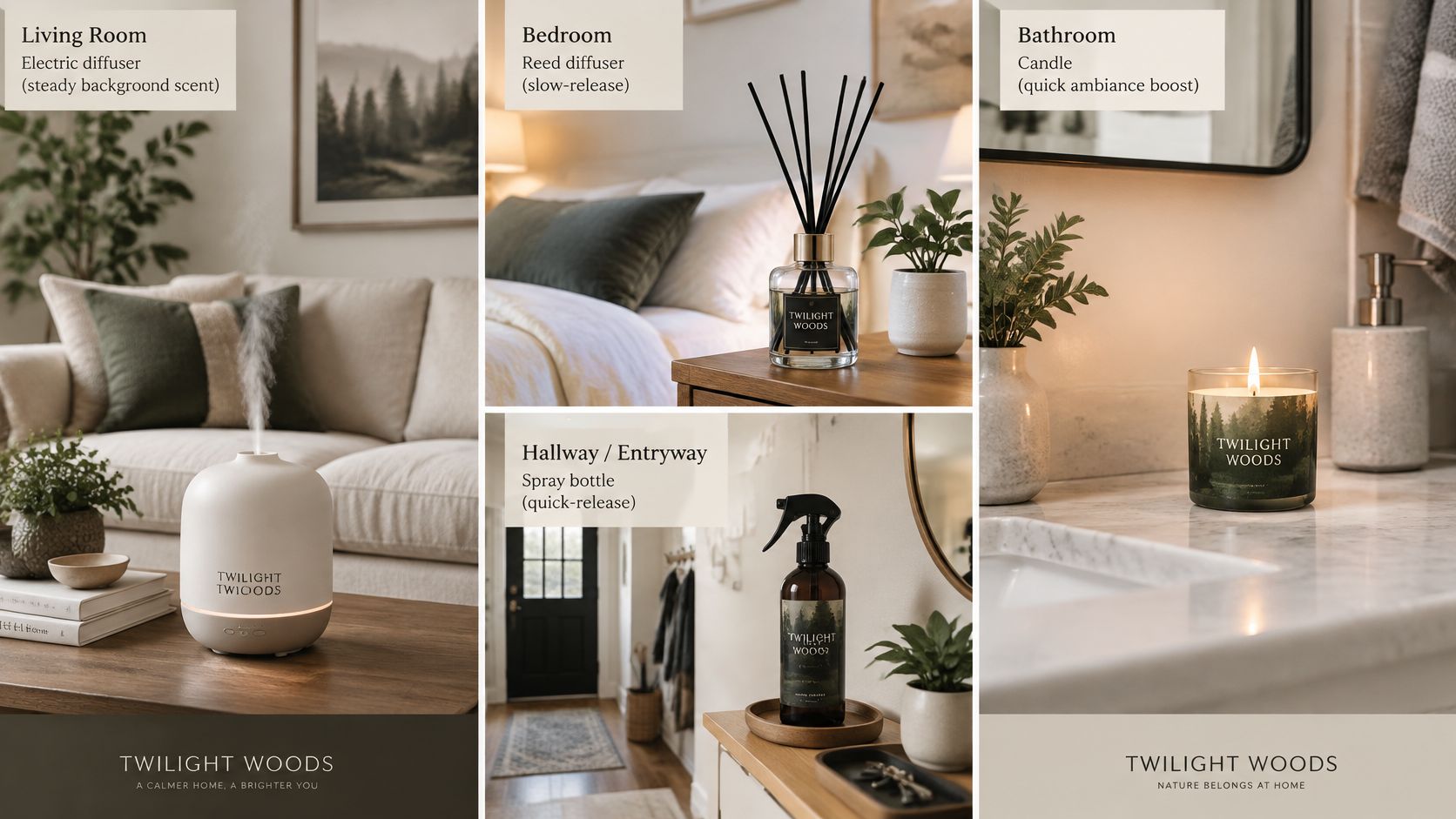
Electric diffuser and oil warmer
Electric diffuser: A steady background for a living room. Fill only to the manufacturer's line so the mist stays fine. Fruit leads for the first stretch, and the vanilla-musk base carries best after the first hour. Crack the door if the room is small, or the musk will stack.
Oil burner or warmer: Better for a bathroom or a reading nook, where you want scent fast and can shut it off. Keep water in the dish so the oil doesn't scorch. Scorched oil smells sharp and loses the fruit. You'll get the berry opening first, then a shorter woody tail than a diffuser gives you.
Candle, incense, and a light spray
Candle: Evening use in a larger room. Woody bases suit a slow burn, so check fragrance load and wick size before you pour. A wick that's too large throws soot and cooks the vanilla. A wick that's too small never warms the wax enough for the woods to leave the jar.
Incense pairing: A sandalwood or cedar stick sits with the oud-style woods and musk. A light floral stick sits better beside the fruity heart. A heavy resin stick in the same small room will cover the berries. Burn one format at a time until you know which layer you came for.
Room spray: A light mist on curtains or a throw, after you test a hidden spot. Fabric holds the base. Over-misting makes the opening feel sharp for the first minutes, then leaves a sweet film on the cloth.
Skin, soap, and bath use depend on the supplier's intended-use notes. Those formats aren't automatic just because the smell is familiar.
Stand in the doorway. You should notice the scent without it filling the space, and it should be gone by morning. If it's still heavy at breakfast, you used too much or the room was too closed.
A short look at how a layered home scent behaves once it's in the air helps before you commit a whole evening to one format.
Test Store and Check the Safety Sheet
Check the oil, the supplier sheet, and the storage before you blend or put anything on skin. Smell and safety are separate jobs. A familiar forest character doesn't make a concentrate gentle.
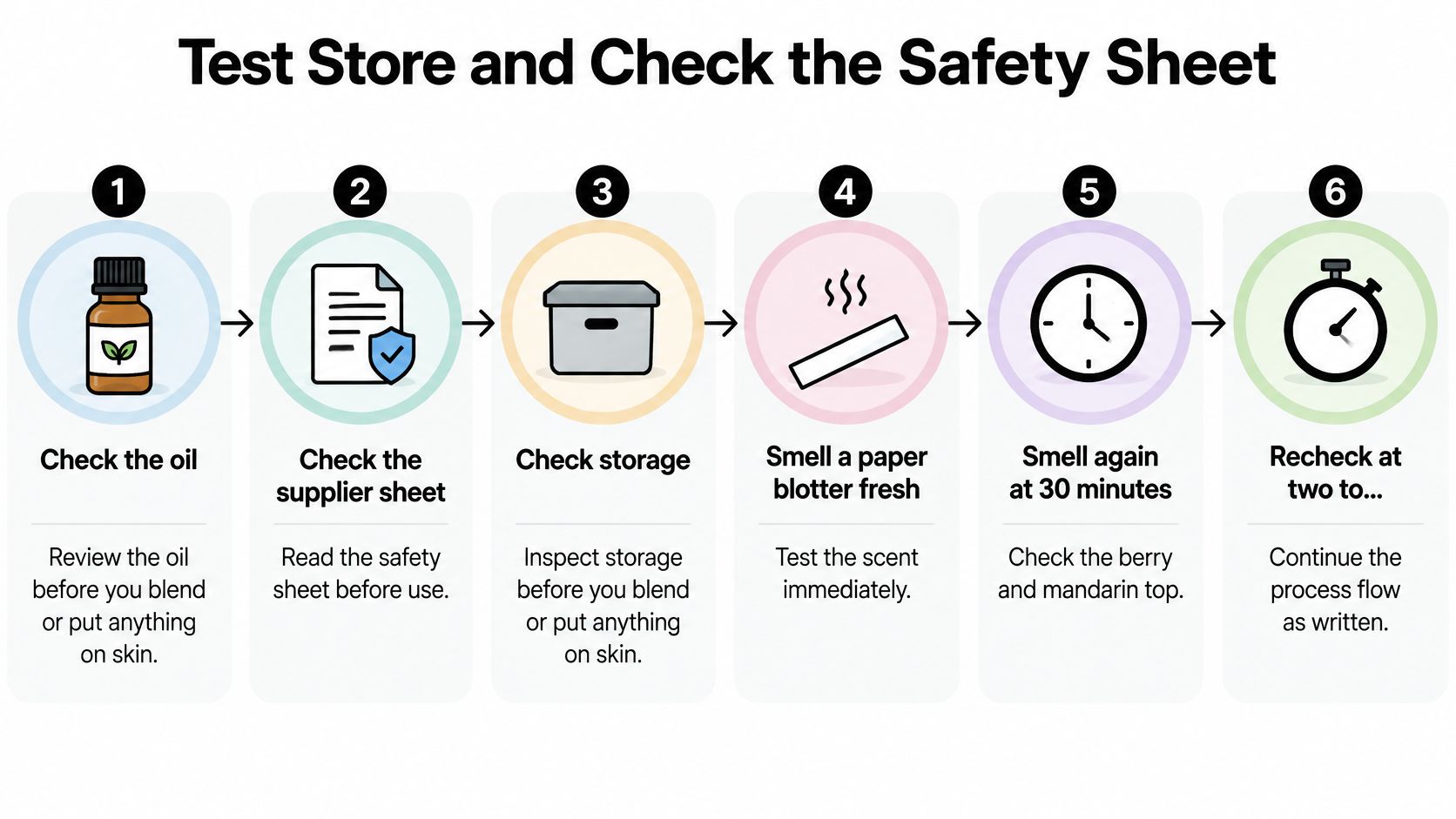
Blotter timing, then the sheet
Smell a paper blotter fresh. Dip it, wave it, and note the first impression within a minute. You're checking whether the opening is bright or already flat.
Smell again at 30 minutes. The berry and mandarin should still read clearly. If the blotter is only sweet musk at this point, the top has faded or the bottle is old.
Recheck at two to four hours. Vanilla, musk, and woods should still hold. If the strip is blank, the base won't carry a candle or a closed room.
Read the SDS for that exact oil. One Twilight Woods safety data sheet lists Iso E Super, Vertofix, hexyl cinnamal, cypress wood oil, Majantol, lavandin oil, linalyl acetate, copaiba balsam, coumarin, Vertenex, eugenol, and thyme oil, and it classifies the mix as H315 skin irritation and H317 allergic skin reaction. Don't copy that classification onto a different supplier's bottle. Composition changes by maker, concentration, and end use.
Patch test, labeling, and the cabinet
Patch test before any skin use. Place a small amount on a limited area of inner arm and watch it for 24 to 48 hours. Redness, itching, or a delayed rash means stop. A 2025 report citing dermatology evidence estimates fragrance allergy affects roughly 2% to 11% of people globally and notes fragrance as a leading cause of cosmetic contact dermatitis, while IFRA estimates fewer than 3% develop fragrance allergy. Those are population figures, not your personal risk, and a woody or "natural" story doesn't lower them.
Confirm the job before you pour. For a candle, diffuser, incense, or room spray, match the oil to the supplier's intended use, concentration limit, and hazard labeling. Keep the current sheet with the stock. The same oil is not automatically fine in a diffuser and on skin.
Store it like a perishable. Use amber or other dark glass, cap it tightly, and keep it in a cool cabinet away from sun, heat, and bathroom humidity. Date the bottle and smell it every few months. Flat top notes, a darker color, or a sharp smell mean it has oxidized.
Side-by-side notes on how to judge fragrance oil quality help when two bottles share a name and don't share a drydown. Buy the documentation with the oil, and don't market a concentrate as skin-safe because the odor feels familiar.
Blending Twilight Woods Into Custom Recipes
Make Twilight Woods the largest share, then add one partner. Strong add-ons past about one third of the blend bury the woods and flatten the fruit. Count parts, not casual drops, so a tester can scale to a candle batch without changing the balance.
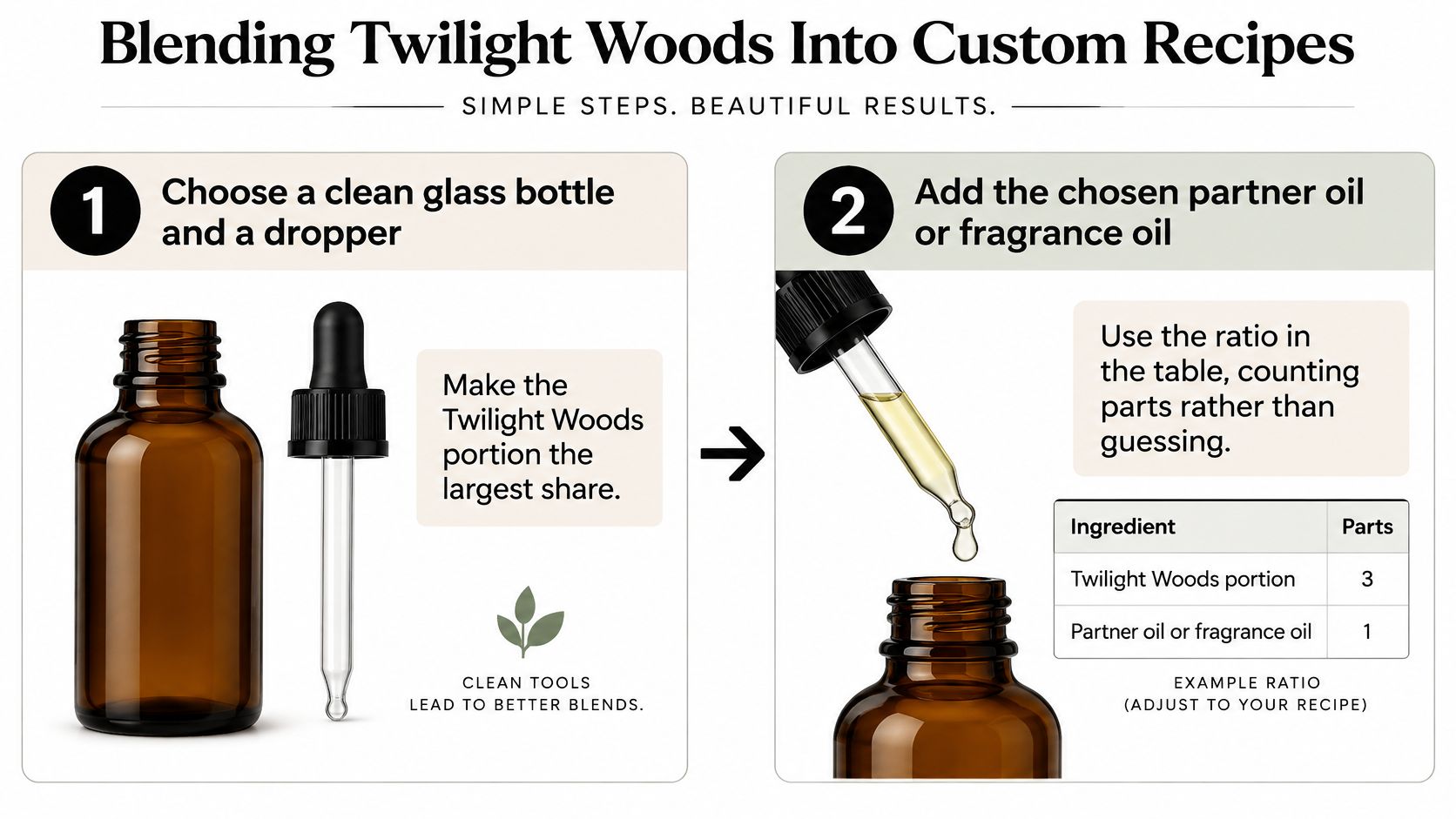
Mix in this order
Start with clean glass and a dropper. Choose a bottle you can cap tightly. Pour the Twilight Woods portion first so you can see that it is the biggest share before anything else goes in.
Add one partner at the ratio below. Sandalwood, cypress, vanilla, or freesia, not all four. Parts keep the math honest when you move from a dram to a pound.
Keep the add-on under one third. A sweet or woody partner that's equal to the main oil will take over. The woods should still be recognizable after the rest.
Cap, shake gently, and rest 24 to 48 hours. The notes need time to marry. Smelling the bottle in the first hour mostly shows you the lighter partner.
Blotter it, then recheck at two hours. The opening should still have some brightness, and the base should feel round rather than sharp. If the two-hour strip is only sugar, the vanilla was too high.
The same counting habit shows up in essential oil blending basics from ArtNaturals, which is worth reading for dilution habits even when you're working with fragrance oil rather than a single botanical. Fragrance oils and essential oils aren't interchangeable on skin, so keep each supplier's limits with its own bottle.
Blend | Ratio (parts) | Add-on | Mood |
|---|---|---|---|
Warm Woods | 3 Twilight Woods : 1 sandalwood | Sandalwood oil | Grounding, evening |
Bright Forest | 2 Twilight Woods : 1 cypress | Cypress oil | Fresh, morning |
Sweet Amber | 2 Twilight Woods : 1 vanilla | Vanilla fragrance oil | Cozy, dessert-like |
Light Floral | 3 Twilight Woods : 1 freesia | Freesia fragrance oil | Soft, airy |
Warm Woods deepens the base for a closed evening room. Bright Forest uses cypress to sharpen the opening, which suits a morning diffuser. Sweet Amber softens the musk into something dessert-like, easy to overdo. Light Floral lets freesia lift the heart without adding more sugar.
The common miss is pouring the sweet partner before you've blottered the plain oil. Vanilla on top of an already sweet drydown erases the berry and leaves a flat amber. For wax, keep the same part ratios and follow a candle fragrance oil blending method so the load and the wick still match the jar.
Twilight Woods Dupes and Close Alternatives
A dupe is a match of notes and timing, not a match of names. No alternative copies every layer. Decide which gap you can live with for the job in front of you, then prove it on paper strips.
Woody-amber candles: These share the base of oud-style woods, vanilla, and musk, so an evening jar can feel close once the wax is warm. They usually lack the berry top, which means the first ten minutes of a Twilight Woods room won't be there. Choose this when the drydown is the part you missed.
Fruity-floral woods incense: A stick that pairs mandarin and berry sparkle with a light wood can stand in during meditation, when you want the opening and a soft trail of smoke. It won't hold vanilla and musk the way a base-heavy oil does after the stick is out. The gap shows up in the quiet after the burn, not during it.
Vanilla-musk fragrance oils: These capture the lingering base and work in a diffuser you plan to run for hours. They lose the frangipani and mimosa heart, so the middle of the evening smells simpler and sweeter. If your original love was the floral stretch, this substitute will feel incomplete.
Berry-mandarin body mists: These match the top and feel right in the first minute on fabric or in a quick spray. They fade before the woods arrive. That's fine for a hallway refresh and wrong for a scent you wanted still present at bedtime.
Put the alternative on one blotter and Twilight Woods on another. Mark which layer differs at the start, at 30 minutes, and at two hours. Keep the substitute only if the missing layer doesn't matter for that use.
A musk-and-wood reference such as a sandalwood musk fragrance is a clean way to hear the base without the fruit in the way. Price per milliliter belongs with the buying decision, after you know which gap you're paying to avoid.
Sample Twilight Woods Before You Buy in Bulk
Would you rather pay a little extra per milliliter, or own a full jug of a drydown you never wanted? Bulk looks cheaper on the label. It only is cheaper if the scent still works after the first hour in the format you use.
A simple sizing example shows the split. At $29.50 for 75 ml versus $7.50 for 8.5 ml, the roll-on costs about 2.2 times more per milliliter. The larger bottle lands near $0.39 per milliliter. The small one lands near $0.88. Same idea as a single espresso versus a bag of beans: the small pour costs more per sip, and it keeps you from stocking a flavor you will not finish.
Format | Volume | Price | Cost per Milliliter |
|---|---|---|---|
Eau de toilette | 75 ml | $29.50 | about $0.39 |
Roll-on | 8.5 ml | $7.50 | about $0.88 |
What the small size was for
The roll-on costs more per milliliter and less at the register. That premium buys a trial, not a better formula. You smell the opening, the floral middle, and the wood-musk drydown on a blotter or in one diffuser run before any large pour. If the base is what you wanted in a long candle burn, and the fruit drops off too fast, you stop there. If the top is all you needed for a quick room refresh, you also stop there. Either way, the small size answered the question the jug cannot undo.
Retail versions of this style of scent have long spread the same fruit, floral, vanilla, musk, and wood idea across spray, wash, and lotion. Those formats do not tell you how an oil will behave in wax, a warmer, or a stick. Judge the oil by which layer shows up in your setup, and by when that layer arrives, not by the name on a finished product.
A buying sequence that respects the oil
Aroma Warehouse pours fragrance oils fresh upon order, so a new dram is a cleaner start than a bottle that has sat open. Tester drams are 1/8 ounce at $1.10 each, in more than 100 fragrances. Use that dram for one timed blotter, one small blend, and a read of the safety sheet. Returns are not accepted on fragrance, incense, or perfume oils because of the possibility of contamination, so the sample is the decision, not a spare you can send back.
For a studio or a resale shelf, size the order to the evenings you scent. A guide to buying fragrance oils for candles is the right next read when wax is the end use. Order one tester, run those checks, and only then choose the full size.
FAQs
1. Is Twilight Woods considered a unisex fragrance?
Twilight Woods has a combination of fruity, floral, vanilla, musk, and woody notes. Although fragrance preferences are personal, its warm woody base and fruity opening can appeal to people who enjoy both traditionally masculine and feminine scent profiles.
2. Is Twilight Woods a good fragrance for fall and winter?
Yes. Its warm vanilla, musk, and woody base make it particularly appealing for fall and winter. However, the bright berry, mandarin, and floral opening also gives it enough freshness to enjoy throughout the year.
3. Does Twilight Woods contain real oud wood?
Not necessarily. Oud listed in a fragrance's scent profile may describe an aromatic impression rather than confirm the presence of natural oud oil. Check the manufacturer's ingredient disclosure or safety documentation for the specific product.
4. Is Twilight Woods an essential oil or a fragrance oil?
Twilight Woods is a fragrance profile rather than a single botanical essential oil. Its layered scent can be created using a combination of aromatic ingredients. Always check the supplier's documentation to understand the composition of the particular fragrance oil you purchase.
5. Will Twilight Woods smell the same when purchased from different suppliers?
Not necessarily. Different manufacturers may use different fragrance ingredients, concentrations, and formulations to recreate a similar scent profile. Even products sharing the Twilight Woods name can have noticeable differences in their opening notes, floral middle, and woody dry down.
Aroma Warehouse pours fragrance oils to order and carries incense, warmers, and bottles for the diffuser, candle, and incense setups this Twilight Woods fragrance guide covers. Start with a tester dram, match the layer you want to the format you will use, and keep the safety sheet with the stock. Visit Aroma Fragrance Warehouse when you are ready to sample before you buy in bulk.


