

Pine and Eucalyptus: Scent Profile, Uses and Safety
There's a familiar moment with these two oils. You uncap a bottle of eucalyptus and the smell reaches the back of your nose before you've lifted it properly. Then the pine goes onto the strip, and the room shifts again, drier and warmer, like stepping into a stand of conifers on a hot afternoon. Both read as clean, both read as natural, and that's usually where the assumption creeps in: that a scent this sharp must be doing something good for the air.
It isn't, at least not automatically. Aroma is chemistry you can smell, and chemistry has opinions about dose, ventilation and time. The same molecules that make the pairing so recognizable in a candle or an incense stick behave very differently in a sealed bathroom, a small office or a bowl of steaming water. Understand what's in the bottle and how the materials move through a room, and the choices stop being guesswork.
Table of Contents
The Scent Profile Pine and Eucalyptus Share
Pine and eucalyptus is a sharp forest accord, not a soft floral one. Pine lands first in most blends, fresh and resinous with a dry, bark-like edge. Eucalyptus slides in beneath it, cooling and camphorous, and pushes the whole accord toward something that reads as clean and almost medicinal. That clean impression is worth treating carefully. It is a smell, not a measurement. Sharpness tells you what your nose detects, nothing about what the air contains, and how much of the blend you breathe depends on the room, the method and the airflow.
Ingredient | Main aroma compounds | Scent character | Typical form |
|---|---|---|---|
alpha-pinene, beta-pinene, delta-3-carene | Fresh, resinous, coniferous | Essential oil, resin or wood-derived fragrance | |
1,8-cineole (eucalyptol), with alpha-pinene, limonene, alpha-terpineol | Cool, camphorous, penetrating | Essential oil | |
Pine and eucalyptus blend | Shared monoterpenes plus 1,8-cineole | Sharp, cooling forest note | Blended oil, candle or incense accord |
That eucalyptus row hides the biggest variable in the pairing. Eucalyptus oil is dominated by 1,8-cineole, also called eucalyptol, but the concentration varies materially by species, genotype, plant age and extraction process. The European Medicines Agency assessment report on eucalyptus oil reports approximately 70 to 85 percent 1,8-cineole for some Eucalyptus globulus oils. Oils distilled from other species or from younger plant material can sit well outside that band, which is why two bottles carrying the same word on the front can behave like different ingredients.
The spread matters for blending, and so does the speed. 1,8-cineole is one of the more volatile components in the bottle, so it evaporates off a paper strip quickly and owns the first minute of the experience, while the heavier, woodier pine notes arrive more slowly and linger longer.
Ask three questions before you buy eucalyptus. Which species, which chemotype, and what percentage of 1,8-cineole? A supplier who can answer all three is selling you a material, not a mood.
If you lean toward the softer, sweeter side of the conifer family, these balsam fir scent notes show how a fir profile can sit beside eucalyptus without fighting it.
Then run a five-minute self-test. Put a drop of each oil on its own paper strip, smell them separately, wait two minutes, then hold both strips together under your nose. Note which one leads, whether the eucalyptus flattens the pine or the pine cuts through the camphor, and how the pairing changes after five minutes. Perfumery has leaned on this accord for decades, and you can explore Pino Silvestre's modern appeal to see how far a pine-forward composition built from these same materials can travel.
Why Pine and Eucalyptus Smell the Way They Do
Leave a sprig of pine on a sunny windowsill for an afternoon and it goes quiet and dry. Leave another in a cool drawer and it still smells like a forest a week later. Nothing about the wood changed. What changed is how fast the aroma compounds left it.
Pine scent is carried by volatile monoterpenes held in resin and wood, mainly alpha-pinene, beta-pinene and delta-3-carene. A study of pine emissions from engineered wood describes how readily these compounds migrate from pine-based material into the surrounding air, which explains the coniferous note and why storage temperature, ventilation and exposed surface area all change how strongly it reads.
Three Effects Worth Planning Around
Heat accelerates release and shortens the top note. Warmth pushes terpenes into the air faster, so the opening smells bigger and then fades sooner, because the material that would have scented the second hour has already evaporated.
Cool, airtight, low-oxygen storage holds the blend together. A capped amber bottle in a cupboard keeps the ratio you built. A bottle left uncapped beside a radiator does not.
Airflow during burning moderates the first burst. Air moving past a lit cone or stick carries the initial spike away instead of letting it pool, which reads as a smoother, less aggressive opening.
A warm kitchen demonstrates all three at once. A blend that smells balanced at nine in the morning can read thin and flat by lunchtime on a counter next to the stove, while the same blend on a shelf in a cool bedroom holds its shape for days. The same release mechanism explains why a fresh wreath can scent an entire hallway for a week, one reason people weigh the benefits of natural Christmas wreaths against artificial ones.
Handling Rules That Pay Off
Store sealed and cool. Cap the bottle the moment you finish measuring, and keep the working stock in a cupboard rather than on a sunny shelf.
Keep bottles out of direct light. Amber and cobalt glass aren't decorative. Light drives oxidation, and oxidized citrus or terpene notes turn sharp and stale.
Record the batch and the date. Write it on the bottle and in your notes, so if a blend smells different three months later you can trace whether the oil changed or the storage did.
Batches differ because pine and eucalyptus species differ, and processing conditions vary too. A private-label blend that must smell identical every quarter needs an organoleptic check per lot, or a GC-MS comparison when the margin for drift is small.
Common Aromatherapy and Home Fragrance Uses
Two families of use sit behind almost every pine and eucalyptus product on a shelf. Aromatherapy applications put the oils into the air or onto the skin, through ultrasonic diffusers, steam inhalation, diluted massage blends and bath oils. Home fragrance is built around the room itself, through reed diffusers, candles, linen sprays, room sprays, and incense or resin burned in a ventilated space.
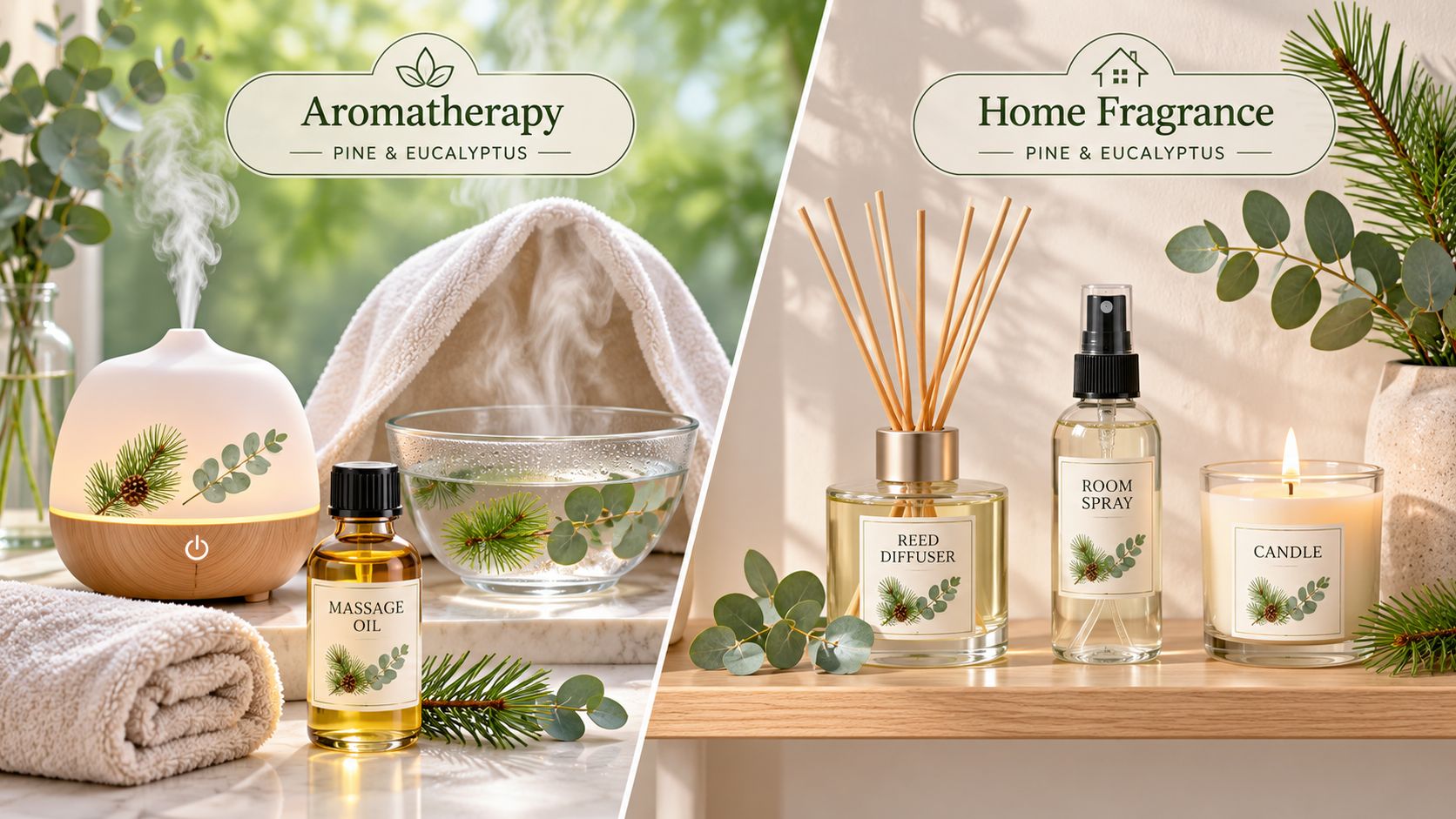
The distinction that matters more than either category is passive scenting versus concentrated exposure. A reed diffuser in an open living room releases a thin, steady trickle of aroma. A diffuser running for an hour in a small closed bedroom, or a bowl of steaming water with a few drops in it, delivers a far larger dose to the same nose over the same hour. Smell strength tracks dose, not benefit.
Here's how the methods line up once you factor in ventilation and dose.
Use | Typical method | Setting and dose notes | Best fit |
|---|---|---|---|
Passive room scent | Reed diffuser or oil in a dish | Open room with airflow; scent stays subtle | Home fragrance |
Ultrasonic diffuser | Short, timed sessions | Use in larger rooms with breaks; stop if irritation starts | Aromatherapy |
Candle or incense | Burned product | Ventilate the room; avoid small enclosed spaces | Home fragrance and ritual |
Steam inhalation | Bowl or steam method | Higher exposure; avoid with asthma or airway sensitivity | Aromatherapy (cautious use) |
Topical blend | Diluted in carrier oil | Patch test first; follow the supplier dilution guidance | Massage and bath use |
Say a yoga studio wants a cool green note for evening classes. An ultrasonic diffuser on a timer, run for twenty minutes with the door propped open, keeps the note present without saturating the room. The same diffuser left running through three back-to-back classes with the door shut does the opposite, and the last group walks into stale, heavy air. A home office is easier still: a reed diffuser on a shelf across the room from the desk gives a low, steady background note with nothing to monitor. If you want to compare formats before committing, these uses for eucalyptus cover the range from diffusing to bath blends.
Choose from the table by room size, purpose, and whether the scent is meant for the air or for the skin. A sharp, penetrating note tells you the material is strong. It tells you nothing about whether it's helping.
Safety Guidance Before You Diffuse or Apply
A forest-scented room can still hold polluted air. Pine and eucalyptus are major sources of monoterpenes in indoor air, and those compounds can react with indoor oxidants to form secondary pollutants, as public health research on terpene exposure in indoor environments sets out. Health guidance notes that pinene and related compounds can aggravate asthma and cause respiratory, eye, nose, throat or headache symptoms.
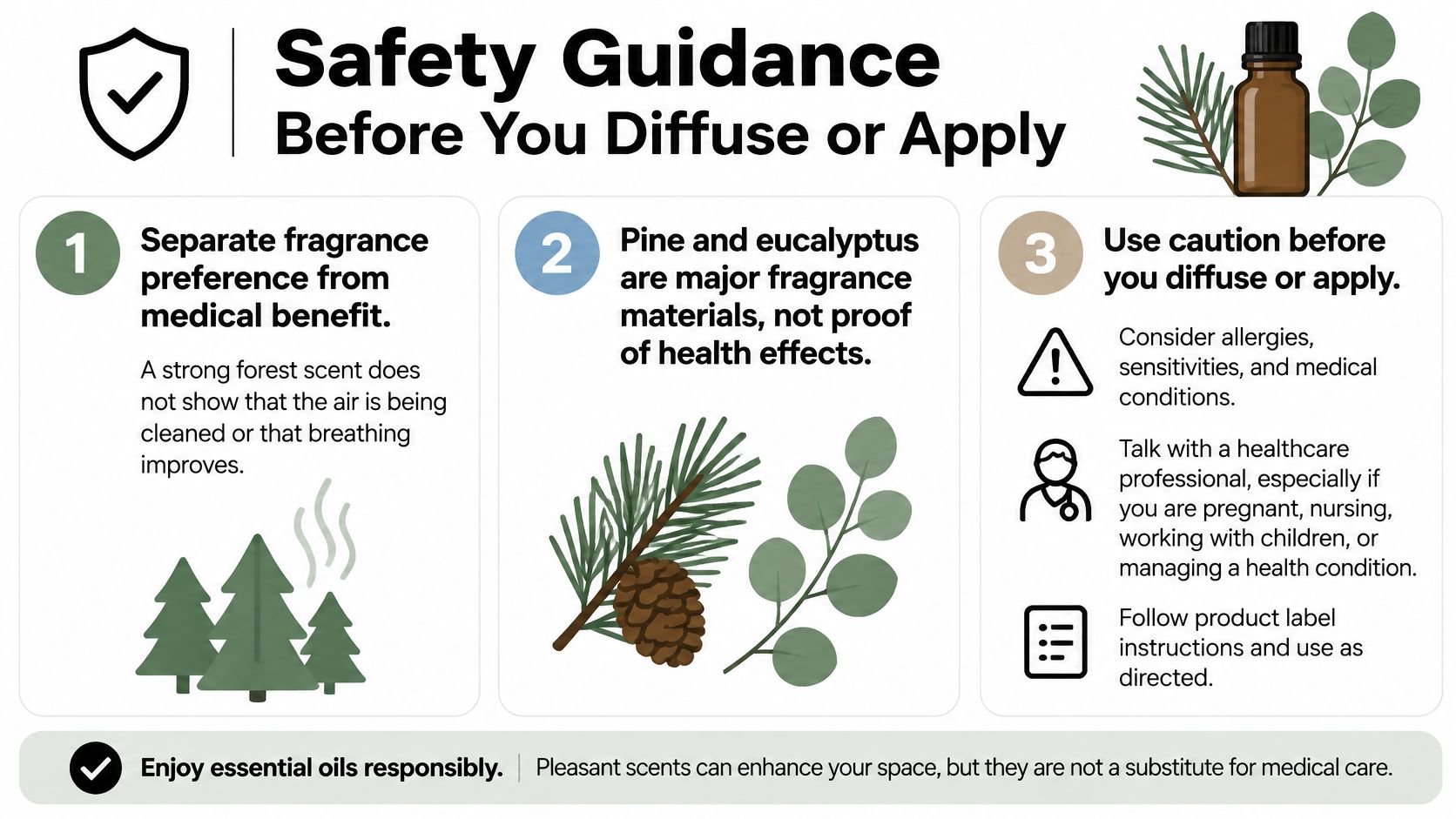
Some reports link eucalyptus inhalation to breathing problems such as vocal-cord dysfunction, and safe use in children under 12 has not been well established. These findings don't call for throwing the bottles out. They call for treating a diffuser as something you actively manage, with limits on time, ventilation and dose.
How the oil reaches you matters as much as which oil you choose. Exposure works like a tap: a scent drifting through an open room drips a small amount into the air, while a steam bowl or a concentrated topical blend opens it fully. Eucalyptus oil passes through skin and mucous membranes quickly, so two methods using the same bottle can deliver very different doses.
Pairing oils changes none of this. Combining eucalyptus with another strong, camphor-forward material, as in this guide to eucalyptus and tea tree, raises the intensity of the scent while the safe exposure level stays where it was.
Group or use | Main concern | Guidance |
|---|---|---|
Adults without airway conditions | Passive scenting in a ventilated room | Use lightly; stop if a headache or eye, nose or throat irritation starts |
People with asthma or airway sensitivity | Diffusers, steam or burning | Avoid concentrated exposure; check with a clinician first |
Children under 12 | Inhalation or topical use | Evidence of safety is insufficient; avoid unless a clinician advises |
Topical use on skin | Rapid absorption through skin | Dilute in a carrier oil and patch test before use |
Pets | Diffusers or topical use near animals | Ask a veterinarian before use; many essential oils are unsafe for cats |
Keep the precautions short enough to remember. Open a window or a door before you start, not halfway through. Limit sessions rather than running a diffuser all evening. Stop at the first headache or tickle in the throat, and don't push through it because the scent is pleasant. Anyone in a higher-risk group should get advice from a clinician before regular use, not after a reaction.
One rule to treat as absolute. Eucalyptus oil is toxic if swallowed. Keep bottles locked away from children and pets, never decant into a drinks bottle or an unlabelled glass, and call poison control or emergency services immediately after any accidental ingestion.
How to Blend Pine and Eucalyptus Step by Step
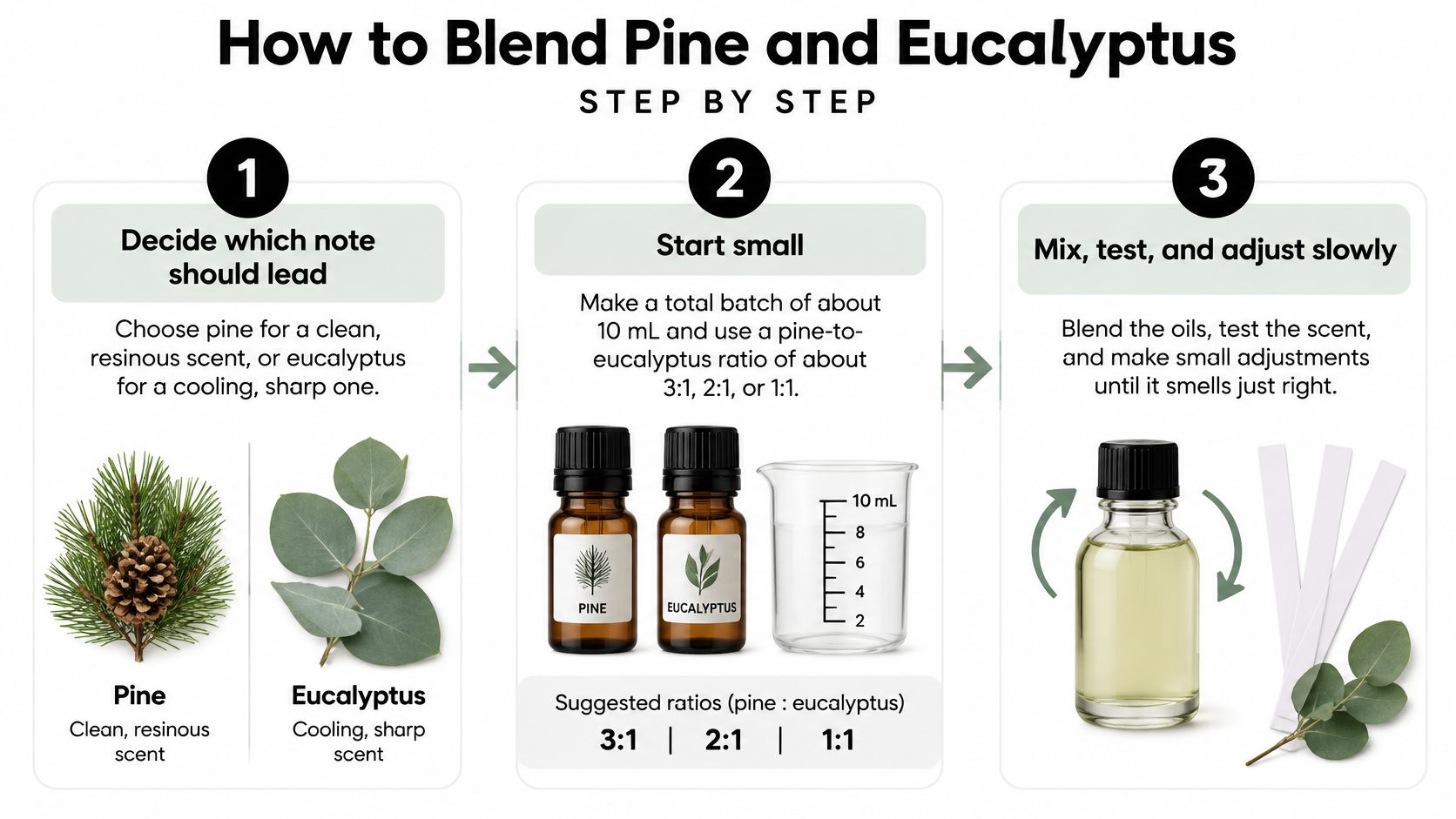
Blending these two is mostly a matter of deciding which one is allowed to lead, then adding the other slowly enough to hear what it's doing.
Choose the lead note first. Pine gives you a clean, resinous, slightly dry scent. Eucalyptus gives you cooling and sharp, and it will dominate almost anything it meets. Decide which character you want in the foreground, because the ratio follows from that decision and not the other way around.
Start with a small batch. Ten millilitres total is plenty. Begin at roughly 2:1 pine to eucalyptus by drops, and keep a 3:1 or 1:1 version in your notes as a comparison. A larger first batch wastes material and hides how quickly eucalyptus takes over.
Add a supporting note at about a third of the total. Cedarwood adds a dry, pencil-shaving base under the pine. Peppermint sharpens the cooling side. Lemon brightens without competing. Keep it near a third so it lifts the blend rather than masking the two materials you're trying to hear.
Mix in clean glass and label immediately. A small amber bottle, capped and shaken, with the date and ratio written on the side. Unlabelled bottles get re-used, mis-remembered or handed to someone who assumes they're a finished product.
Let it rest 24 to 48 hours. Freshly combined oils smell separated because the sharpest compounds hit first. A rest lets the notes settle into one scent instead of three. Smell it on a paper strip at the start and again on day two, and compare.
Adjust one drop at a time. Write down each change. Two drops of cedarwood is a different blend from six, and you'll never reproduce the version you liked if the numbers only live in your head.
Dilute before anything touches skin. A total of about 1 to 3 percent in a carrier oil, then a patch test on the inner forearm for 24 hours. Follow the supplier's dilution guidance on the label rather than a number from a forum.
The mistake that ruins more blends than any other. Pouring in extra eucalyptus to make the mix smell "stronger" produces a harsh, nose-stinging accord that becomes unbearable in a small room. If the blend needs more body, add the supporting note, not more of the camphor.
If you'd rather buy a finished accord than build one from single oils, this overview of fragrance oil uses explains how pre-blended oils perform in diffusers, candles and incense compared with essential oils.
How to Read a Pine and Eucalyptus Label
"Natural" is the least informative word on most bottles. It works like "homemade" on a menu: nice to read, silent on what the kitchen did. The phrase pine and eucalyptus can mean needle oil, resin, a wood-derived fragrance or a synthetic accord imitating all three, and the same wording can hide different species, different extraction methods and very different concentrations.
According to the European Medicines Agency's assessment of eucalyptus oil, dose-response studies are unavailable and excessive or prolonged inhalation can be hazardous. So the two things worth evaluating are how much of the scent reaches your lungs and how freely the room breathes, because a closed space or a heated bowl raises exposure even when the oil itself is well made.
Discount front-panel wording that promises to cleanse, purify or clear the air. Those words describe how the scent feels. A sharp forest aroma tells you how a product smells; it tells you nothing about what is happening to the air in the room.
Six details tell you more than the front panel:
Botanical name, not just the common one, because Eucalyptus globulus, Eucalyptus radiata and an unlisted blend are three different products.
Extraction method, since steam-distilled and expressed material smell different and behave differently.
Chemotype or 1,8-cineole percentage, the single most useful number on a eucalyptus label.
Intended use, marked clearly as diffusion, topical use or burning, each with its own risk profile.
Dilution guidance and allergen warnings, visible before purchase rather than buried in a shipping tab.
Batch consistency, backed by a certificate of analysis the supplier will send on request.
Two bottles can carry identical pine and eucalyptus branding. One names the species, the extraction method and the 1,8-cineole range, and the seller will send a certificate of analysis. The other says "pure" and "natural" and nothing else. For scenting a candle, either will do. For anything that touches skin, only the first is a responsible choice. This guide to fragrance labeling requirements covers what a compliant label must disclose.
Choose the Right Blend for Your Space
Three questions settle most of the decision before you spend anything.
Where will the scent live? In a room, in a ritual, or on the skin. Who else is in the space? Someone with asthma or airway sensitivity, a child, a cat. How much control do you have over ventilation? A window that opens changes the answer entirely.
Answer those, and the safety table above does the rest. Passive scenting in a ventilated room is the lowest-exposure option. Steam, diffusers in small rooms, and anything applied to skin need more caution plus a label that names the botanical source, the intended use, and the dilution.
A home office with an open window and a reed diffuser on a shelf is a low-exposure setup. A closed bathroom with a bowl of steaming water is not.
The sharpest-smelling option is not automatically the better one. A strong forest scent tells you the aroma is present; it says nothing about whether the room is healthier to breathe in.
Aroma Warehouse's fragrance oil range covers classics such as sandalwood, lavender and nag champa plus exclusive blends, which makes running a small comparison batch straightforward without committing to a large bottle.
Before you commit, write down your room size, the intended use and any sensitivities in the space. Then choose the method and the product that match those notes rather than the mood on the front of the bottle.
Frequently Asked Questions About Pine and Eucalyptus Fragrance
1. Can Pine and Eucalyptus Fragrance Oil Be Used in Homemade Wax Melts?
Yes, provided the fragrance oil is formulated and approved for wax applications. Always check the manufacturer's recommended fragrance load and compatibility with your chosen wax. Following the supplier's specifications helps achieve a balanced fragrance without compromising the finished product.
2. Is Pine and Eucalyptus Fragrance Oil Suitable for Soap Making?
Some pine and eucalyptus fragrance oils can be used in soap making, but not every formulation is skin-safe. Check the product's IFRA documentation and recommended usage limits for your specific soap application before adding it to a batch.
3. What Is the Difference Between Pine and Eucalyptus Essential Oil and Fragrance Oil?
Essential oils are extracted from botanical materials, while fragrance oils may contain natural aromatic ingredients, synthetic fragrance components, or a combination of both. Essential oils have variable botanical compositions, whereas fragrance oils are often formulated to deliver a more consistent scent profile.
4. Is Pine and Eucalyptus a Good Fragrance for Car Diffusers?
Pine and eucalyptus can create a fresh, forest-inspired fragrance for vehicle interiors. However, use only products specifically designed for car diffusers, follow their dilution instructions, and avoid concentrated oils that could damage vehicle surfaces or cause excessive fragrance exposure in a small enclosed space.
5. How Can I Test a Pine and Eucalyptus Fragrance Before Purchasing a Larger Bottle?
Start with a small sample and evaluate the fragrance in the application where you intend to use it. For candles, wax melts, or other finished products, make a small test batch using the supplier's recommended fragrance percentage. Allow the finished product to develop according to the manufacturer's instructions before deciding whether the scent strength and character meet your expectations.
Aroma Warehouse supplies the materials to build and test your own pine and eucalyptus accord, from single-note fragrance oils and essential oils to oil warmers, electric diffusers and the amber bottles and droppers that keep a batch labelled and stable. Fragrance oils are poured fresh upon order, so small test quantities are easy to work through before you commit. Start with one pine, one eucalyptus and a carrier oil, run the paper-strip test for a day, and visit Aroma Warehouse to stock the rest.


