

Balsam Fir Scent Explained: Notes, Uses and Chemistry

You opened a second bottle labeled balsam fir and it didn't match the first. One smelled like wet needles in a cool woods. The other was sharper, closer to a pine cleaner, with a dry edge that never quite softened. Same words on the label, two different rooms.
That mismatch is normal, and it isn't a sign that one bottle is fake. Balsam fir scent is a blend of several volatile compounds, not one holiday molecule. The fresh green arrives first, a resinous middle follows, and a slightly sweet balsamic finish can stay on a sweater long after the bright notes are gone. If you shop candles, incense, or oils by the name alone, you'll keep guessing. The useful skill is learning the layers, then checking what the bottle contains.
Table of Contents
How Balsam Fir Compares With Other Conifer Scents - The pairs people mix up - A two-second home test
The Chemistry Behind the Fresh Resin Note - What each share does in the room - How to read a fade
Why Two Balsam Fir Products Smell Different - What to ask before you buy
Where Balsam Fir Scent Is Used in Home Aromatics - Match the method to the room
Safety Limits for Using Balsam Fir Scent Indoors - Risk follows the use, not the label
Choose the Right Balsam Fir Product for Your Space - Test it in three passes
What Balsam Fir Scent Actually Smells Like
Balsam fir scent smells fresh, resinous, and green, like crushed needles after rain, with a soft sweetness that keeps it from reading as sharp pine cleaner.
The aroma arrives in three layers, and they don't show up at the same time.
Top. A bright lift of green and pine-like notes, mostly from the pinenes, reaches the air within minutes. This is the part you notice when someone cracks a fresh wreath or opens a jar of needles.
Heart. A clean, resinous middle sits under that lift. It smells like sap on a cut twig, not like a bakery spice and not like a disinfectant.
Base. A warm, slightly balsamic finish, largely from bornyl acetate, lingers on fabric for hours. A balsam pillow can still smell like the woods the next morning, while a sharp pine spray is already gone.
If pine is a sharp pencil line, balsam fir is that same line softened with honey.
The holiday feeling comes from a long sensory history, not from a recent marketing slogan. A U.S. Forest Service historical account.pdf) reports that 1905 was the earliest year balsam-fir lumber production was recorded separately from other tree species. Resin commonly called Canada balsam was commercially tapped in Quebec and New England during the nineteenth century, and later mattered in optical and microscopy work because its refractive properties match glass. Modern candles and oils generally use needle or twig oil rather than raw resin. Both still come from a conifer known for aromatic foliage and balsamic sap, which is why the smell feels familiar.
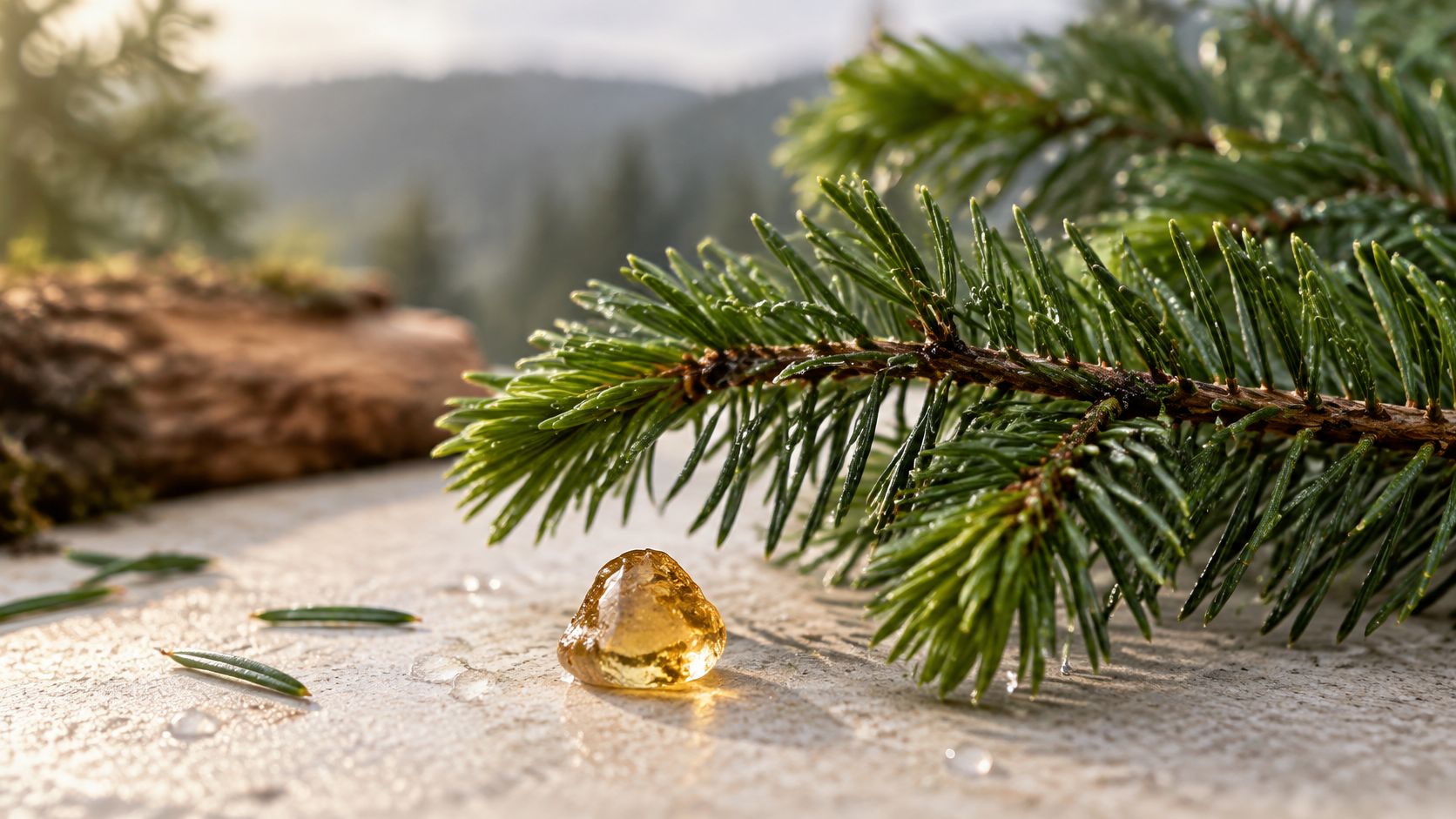
Crush a needle between your fingers. The first hit should be green, resinous, and soft. A dry, pencil-like smell is a different wood.
You'll meet this profile in candles, incense, diffuser oils, room sprays, simmer pots, bath products, and wreaths. How the scent is released changes which layer you notice.
How Balsam Fir Compares With Other Conifer Scents
Two candles can both say "evergreen" on the label and smell nothing alike. Each conifer name stands for a different mixture of aromatic compounds, and balsam fir's particular mix gives you two smells in one sniff: a green, resinous opening followed by a soft, balsamic tail. The table below lines up that signature against the conifers shoppers confuse it with most.
Conifer | Scent Impression | Sweetness and Warmth | Typical Use |
|---|---|---|---|
Balsam fir | Fresh, resinous, green with a balsamic finish | Soft, slightly sweet | Candles, incense, fragrance oils |
Green and resinous, softer and smoother | Softer, slightly fruity | Candles, room sprays, wreaths | |
Green with a citrusy lift | Light and clean | Air fresheners, soaps | |
Sharp, green, turpentine-like | Low sweetness | Cleaning-style blends, sauna products | |
Crisp, green and slightly sharp | Low to moderate | Seasonal candles, potpourri | |
Soft, fresh, lightly citrus | Light and airy | Bath products, linen sprays | |
Eastern red cedar | Dry, woody, pencil-like | Low sweetness, dry warmth | Drawer and closet products, incense |
The pairs people mix up
Balsam fir and Fraser fir are the closest mix-up. The difference is mostly degree. Fraser fir reads softer and slightly fruitier, which suits a wreath or a room spray that shouldn't take over a small room. Balsam fir stays greener and more resinous, so it carries farther in a candle or an incense blend where you want a clear forest note.
Scots pine and Norway spruce sit on the sharp side. Both can show a turpentine edge, which works in a cleaning-style blend or a sauna product but fights a cozy candle, because the nose reads "solvent" before it reads "woods." That brighter, drier pine character is useful when you want snap rather than balsamic softness.
Eastern white pine and eastern red cedar fool people for a different reason. White pine is light, airy and faintly citrus, so it fades into linen sprays and bath products. Red cedar runs dry and woody, more like shavings in a cedar chest than anything green. If your "fir" candle smells like a wood shop instead of a forest, cedar is the more honest name for what you're smelling.
A two-second home test
Line up two evergreen-labeled products and sniff them in turn, paying attention to the end of the sniff rather than the start. Pine and spruce stay sharp all the way through. Fir eases into a gentle sweetness after the first green hit, because its softer base compounds linger while the sharp ones flash off. Cedar turns dry and woody almost immediately.
That tail is the tell. A "forest" product with no sweetness at the end sits closer to pine, spruce or cedar than to any fir.
The Chemistry Behind the Fresh Resin Note
The smell doesn't come from one signature molecule. It comes from volatile monoterpenes in the needles and twigs of Abies balsamea. Think of the pinenes as a sprinter's first burst. They leave the oil and reach the air within minutes. Bornyl acetate is the steady stride. It keeps a woody, balsamic base going for hours after the sprint is over.
In a documented Canadian balsam-fir essential-oil batch analyzed by gas chromatography, beta-pinene accounted for 31.54% of the oil, while bornyl acetate contributed 5.41%, according to batch records compiled by AromaForge. Broader batch data put beta-pinene at about 14% to 38%, alpha-pinene at 13% to 17%, delta-3-carene at 15% to 20%, and bornyl acetate at about 5% to 14%. Those batches were distilled from Canadian material in 2018, 2020, 2021, 2022, and 2023, so the spread is measured oil, not a fragrance adjective.
Compound | Typical Share of Oil | Scent Role | Evaporation Speed |
|---|---|---|---|
Beta-pinene | 14% to 38% | Fresh, pine-like lift | Fast |
Alpha-pinene | 13% to 17% | Green, sharp top note | Fast |
Delta-3-carene | 15% to 20% | Sweet, fresh edge | Moderate to fast |
Bornyl acetate | 5% to 14% | Soft, balsamic and woody base | Slow, lasts longest |
Limonene | 9.15% in one needle oil | Bright, citrus-like lift | Fast |
Camphene | 6.61% in one needle oil | Warm, slightly camphoraceous note | Moderate |
What each share does in the room
Beta-pinene supplies the fresh pine lift, and it is often the largest slice. Alpha-pinene adds the greener, sharper top. Together they make the first minute smell alive. Delta-3-carene contributes a sweet, fresh edge, which is part of why balsam fir doesn't smell like plain turpentine. Bornyl acetate, even at a smaller share, is the soft balsamic depth, and it lasts the longest on fabric and wax.
Limonene and camphene are supporting notes, not the lead. In one GC–MS analysis of Abies balsamea needle oil published in the Journal of Medical Entomology, limonene was 9.15% and camphene was 6.61%. Limonene adds a bright, citrus-like lift. Camphene adds a warm, slightly camphoraceous tone. When either one runs high, the oil can smell sweeter, or more medicinal, than the bottle you tried last season.
How to read a fade
A scent that flashes and disappears is usually led by the fast pinenes. A scent that stays woody after several hours is richer in bornyl acetate. Harvest, geography, plant part, and distillation conditions all move those shares, so two products labeled "balsam fir" can differ in strength, sweetness, or camphor. A label name can't promise a fixed smell. If you need the oil and a compounded scent to behave differently in a formula, the difference between fragrance oils and essential oils is the practical split.
Why Two Balsam Fir Products Smell Different
The botanical name doesn't lock the smell. "Natural" doesn't mean one recipe either. A peer-reviewed analysis of balsam fir essential oil reported beta-pinene at 22.5%, bornyl acetate at 18.0%, delta-3-carene at 10.3%, and alpha-pinene at 7.09%. That profile is greener in some places and more balsamic in others than a different lot of the same species. The oil is a multi-compound aroma, and the mix moves.
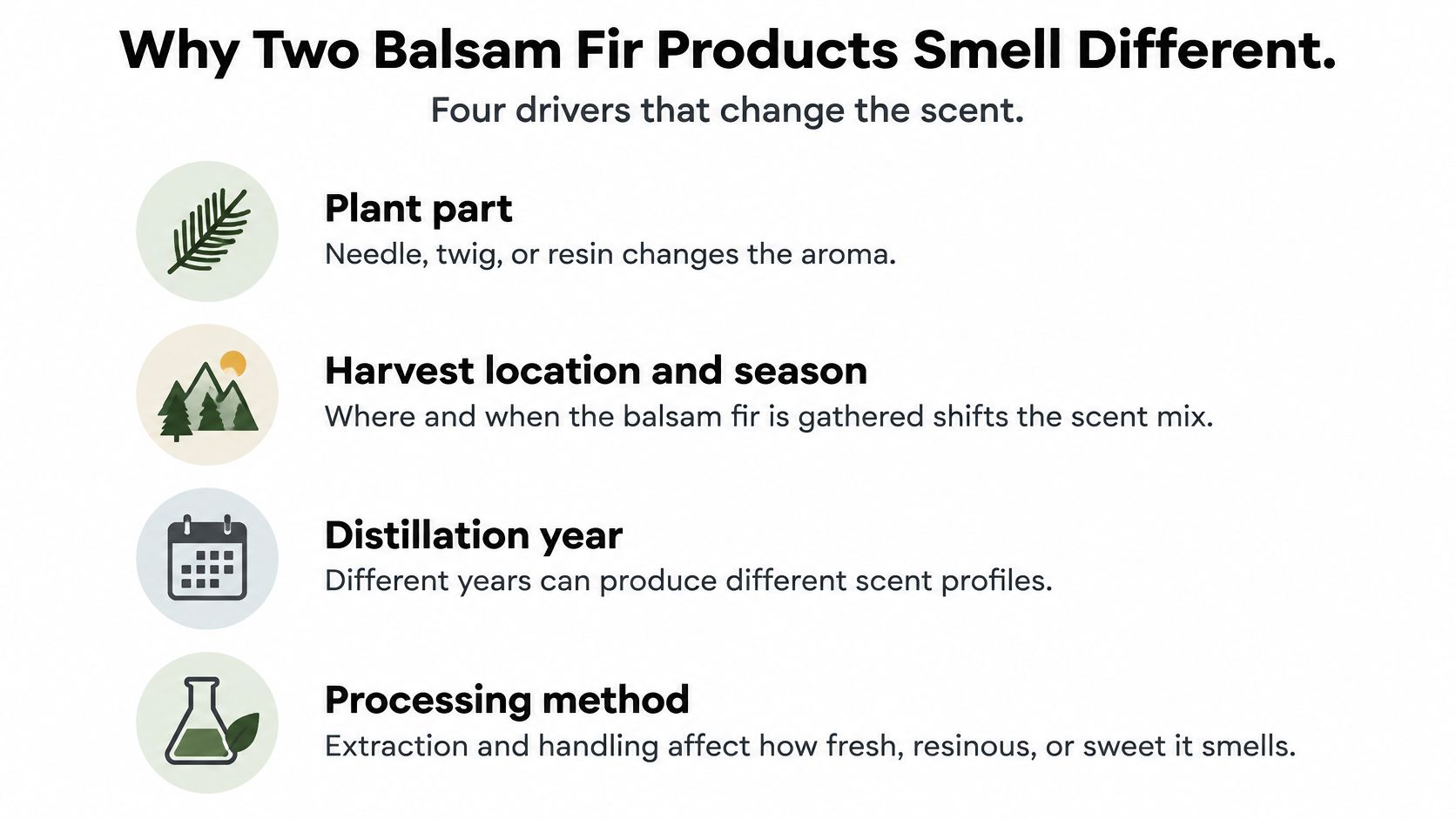
Four drivers show up in the bottle.
Plant part. Needle oil tends to smell fresher and greener. A twig-heavy oil often reads sharper. A resin-heavy material, or an absolute, reads sweeter and more balsamic, closer to sap than to crushed foliage.
Harvest location and season. Where and when the tree is gathered shifts the balance of bright terpenes and softer esters. A cool, late cut can smell quieter than an early, resinous one.
Distillation year. Different years produce different profiles, even from the same region. An older opened bottle also flattens, because the fast top notes leave first and the woody remainder stays.
Processing and storage. Steam distillation, solvent extraction, heat, light, and a loose cap all change how fresh, resinous, or sweet the result smells. Added fragrance materials can push the same name toward citrus or camphor.
Fragrance oils are built to a target, so they smell more uniform from lot to lot. You trade some of the natural nuance for a scent you can reorder. Balsam fir, fir needle, Fraser fir, and pine are not interchangeable on a label. Using them as synonyms is how a sharp pine ends up in a candle that was supposed to smell like soft fir.
A short film on how distillers separate plant material from aromatic oil makes the processing point concrete. The still, the cut, and the storage all leave a mark you can smell later.
What to ask before you buy
Confirm the plant part: needle, twig, foliage, bark, or resin.
Confirm the region of origin.
Ask for the distillation year or the batch number.
Ask whether a GC-MS report is available.
Confirm whether you are holding an essential oil, an absolute, or a fragrance oil.
A supplier who answers those five points is usually more reliable than one who offers only words like "fresh forest." Adjectives don't tell you which compounds are leading the bottle.
Frequently Asked Questions
1. How should balsam fir fragrance oil be stored to maintain its scent?
Store balsam fir fragrance oil in a tightly sealed container, away from direct sunlight, excessive heat, and temperature fluctuations. Keeping the bottle properly closed helps preserve its fragrance characteristics and prevents the lighter aromatic notes from fading prematurely.
2. What fragrances blend well with balsam fir?
Balsam fir pairs well with complementary fragrance families such as cedarwood, sandalwood, vanilla, cinnamon, and citrus. Woody fragrances create a deeper evergreen profile, while vanilla adds warmth and citrus introduces a brighter contrast.
3. Is balsam fir a good fragrance choice for year-round products?
Yes. Although balsam fir is strongly associated with Christmas and winter fragrances, its fresh evergreen and woody characteristics also work in year-round home fragrance collections, outdoor-inspired candles, incense, and nature-themed products.
4. What should candle makers look for when purchasing balsam fir fragrance oil?
Candle makers should look for fragrance oils specifically approved for candle applications. Check the supplier's recommended usage rate, wax compatibility, and available technical documentation. Testing a small candle batch before producing larger quantities helps evaluate fragrance performance.
5. Can balsam fir fragrance oil be used to make homemade incense?
Balsam fir fragrance oil can be considered for homemade incense projects when the formulation is suitable for incense making. Check the supplier's application guidance and compatibility with your incense base. Small test batches help determine how the fragrance performs during burning.
Where Balsam Fir Scent Is Used in Home Aromatics
The fir balsam oil market was valued at USD 20.12 million in 2025, according to Global Industry Research. That commercial scale shows up at home as very different delivery methods. The same oil can smell light in a spray and heavy in a small room once heat is involved.
Product Type | Scent Delivery | Expected Strength | Watch For |
|---|---|---|---|
Candles | Heat released through melted wax | Medium to strong | Over-scenting small rooms |
Incense sticks and cones | Smoke from burning | Strong, smoky | Smoke can mask fresh top notes |
Diffusers and oil warmers | Evaporation or gentle heat | Light to medium | Overuse in closed rooms |
Room sprays | Fine mist | Light, quick fade | Needs reapplication |
Simmer pots and potpourri | Gentle heat or air drying | Light to medium | Scent fades within days |
Bath and soap | Contact with water and skin | Light to medium | Needs a skin-suitable blend |
Wreaths and seasonal decor | Passive release from needles | Light | Scent weakens as needles dry |
Match the method to the room
Candles and simmer pots release scent continuously through heat. A lighter blend suits a bathroom or a small retail counter. A strong fir candle in a closed office turns thick within an hour, because the slow woody notes keep arriving while the bright ones are still in the air.
Incense gives a strong burst, then a smoky layer. That smoke can cover the fresh green top, so choose a cleaner, less resin-heavy blend if you want the room to smell like needles rather than a campfire. Cones are shorter and louder. Sticks give you more time to decide the window should be open.
Diffusers and oil warmers fit a clean, airy profile. A few drops in an open living room stay pleasant. The same dose in a closed treatment room goes heavy, because there is nowhere for the monoterpenes to go. Room sprays do the opposite. They fade quickly, so you reapply instead of soaking the air. See practical fragrance oil uses when you are choosing mist, warmer, or wax.
Bath and soap put the material on water and skin, which is a different exposure than a candle. The blend has to be suited to contact, not just to smell. Wreaths release scent on their own, and the smell weakens as the needles dry. A fresh wreath on day one is not the wreath on day ten.
Pick the method by room size and by how long you want the scent to last. Continuous heat for a long evening. A spray for a short visit. Passive greenery when you want a hint, not a fill.
Safety Limits for Using Balsam Fir Scent Indoors
A pleasant conifer smell is not automatically safe. Botanical origin doesn't cancel irritation or sensitization.
The U.S. Environmental Protection Agency's technical document classifies balsam fir oil as a dermal sensitizer. It places the oil in acute-toxicity Category IV for oral, dermal, and inhalation exposure, and it assigns primary-eye-irritation Category III. Category IV is the lower acute-toxicity group in that system. It doesn't mean careless use is fine. It means you separate passive scenting from skin, eyes, swallowing, and hours of concentrated vapor.
Risk follows the use, not the label
A ventilated living room with a modest candle is not the same exposure as undiluted oil on skin, a spilled concentrate on a counter, a swallowed dose, or a long burn in a tiny closed room. Ordinary, properly diluted use isn't automatically dangerous. Handling the neat oil as if it were a room spray is a different decision.
Ventilate and pause. Open a window in small rooms, and take breaks during long burns or diffuser sessions.
Follow the dilution on skin products. Use the supplier's stated limit for soap, bath, or massage blends. Don't invent a "natural" percentage.
Never apply undiluted oil to skin. Neat oil is a handling material, not a perfume dab.
Keep concentrates away from children and pets. Store bottles closed and out of reach. Don't leave a warmer where a child or animal can knock it over.
Use extra caution with asthma or other respiratory sensitivities. A fresh forest note can still bother someone whose airways react to strong scent. Offer an unscented option in a studio.
A nice smell doesn't remove sensitization risk. Patch-test any leave-on or wash-off product on a small patch of skin before you use it more widely.
For day-to-day room scenting, a safer air freshener routine starts with ventilation and a modest dose, not with a claim that fir disinfects the air. Don't present ordinary incense, fragrance oil, or diffuser use as a surface sanitizer.
Choose the Right Balsam Fir Product for Your Space
Start with the job the scent has to do. Balsam fir is a multi-compound aroma, so a product can lead with a bright pinene top, sit on a soft bornyl acetate base, or lean toward sweet balsamic resin. Two bottles carrying the same name can behave very differently in a room.
For a fresh, green scent in a living space, pick a candle or a diffuser blend with a lighter top. You want the green lift without a heavy balsamic fog in a room people sit in for hours.
For a longer-lasting woody base, look for profiles described as rich in bornyl acetate, or test the drydown yourself. That is the note that should still be there after the bright pinene flash has left.
For anything that touches skin, buy from a supplier that states dilution limits for each product type. A pleasant smell tells you nothing about safe concentration.
Test it in three passes
Smell the product cold, with the cap just off, before heat or a wick changes it.
Put a drop or a short burn's worth on a paper scent strip and smell it after ten minutes. The first blast should have settled.
Smell it again after several hours. Judge that drydown against the label. If the card is only sharp cleaner, it isn't the soft fir you wanted.
Sampling is cheaper than a wrong case. We sell 1/8 ounce tester drams for $1.10 each, in over 100 different fragrances, and we also offer wholesale incense, fragrance oils, and incense starter packages if you are comparing lots for a shop. Smell two or three candidates side by side before you commit to a full size.
Finished candles are another way to judge a fir note in a real room. A finished option such as a candle gift with jewelry inside lets you live with a softer, slightly fruitier fir for an evening, which is a useful contrast if your oil sample smells greener and more resinous.
Before you order, read the return terms. We don't accept returns on fragrance, incense, or perfume oils because of the possibility of contamination. Ask for plant part, origin, and batch details before the carton ships. If the scent is going into a diffuser rather than a candle, start with blends suited to essential oils for diffusers.
Pick the smallest format that fits the use, confirm the composition or the batch, and only then buy a full size.
Aroma Warehouse carries hand-dipped incense, cones, and fragrance oils poured fresh to order, and sells 1/8 ounce tester drams so you can sample a scent before you stock a full line. If you are matching a green, resinous balsam fir scent to candles, warmers, or a studio, start with a small dram and a clear plant-part description. Visit Aroma Warehouse to compare scents, supplies, and wholesale options for your next order.


