

Baby Powder Fragrance Oil Guide

“Baby powder” doesn't mean simple, and it certainly doesn't mean automatically suitable for babies. The familiar clean, soft scent is usually a carefully engineered fragrance mixture, and its permitted concentration can change dramatically depending on whether you're making a candle, diffuser, lotion, or baby-adjacent product.
That distinction matters for small businesses. A fragrance can perform beautifully in home fragrance while requiring a very low concentration in leave-on personal care. Before you buy in bulk, open a bottle, or print a “gentle” product description, read the supplier's IFRA certificate and Safety Data Sheet, then formulate for the actual end use.
Table of Contents
The Reality of Baby Powder Scent Formulations - Why makers keep reaching for this profile - The paperwork belongs at the workbench
Deconstructing the Clean Powder Aroma Profile - What each family contributes - Test the finished product, not just the concentrate
Application Strategies and Blending Techniques - Candles and wax melts - Cold-process soap - Reed diffusers and aromatic products - Blending without losing the powder identity
Navigating IFRA Limits and Skin Safety Rules - IFRA Usage Limits by Product Category - Why “skin safe” is too vague - Market rules can differ
Managing Allergens and Inventory Shelf Life - Read the SDS in a fixed order - Protect the oil from avoidable degradation
Sourcing Wholesale Oils for Retail and Resale - What a reliable purchasing process looks like - Compare suppliers by risk, not only price
The Reality of Baby Powder Scent Formulations
“Baby powder” describes a scent style, not a safety category. The soft, nostalgic impression can come from multiple aroma chemicals with allergen declaration requirements, sensitization warnings, and different limits for different product types. A fragrance that works in a candle may need a far lower concentration in a leave-on product, and baby-adjacent positioning adds another layer of caution.
A published conformity certificate identifies baby powder fragrance as an IFRA-restricted fragrance mixture, rather than a single raw material. Its listed constituents include salicylaldehyde at 7.1488%, vanillin at 4.375%, and alpha iso methyl ionone at 1.25%. Those figures apply to that documented mixture, not automatically to every supplier's oil. They show why the product name cannot substitute for a current certificate and full ingredient documentation.
Why makers keep reaching for this profile
The appeal is practical as well as emotional. Baby powder fragrance oil gives candles, wax melts, soaps, room products, and retail fragrance blends a recognisable clean, soft, comforting character. The powder effect usually comes from floral, musky, vanilla-like, and aldehydic materials working together, not from one isolated “powder note.”
Formulators can adjust that balance for the base. The same style may feel airy in a diffuser, warmer in wax, or more floral in soap. Each choice has a trade-off. Sweet or heavy components may contribute to discoloration, and some fragrance materials can change how cold-process soap batter behaves.
White musk offers a useful comparison for makers testing adjacent scent families. This guide to white musk fragrance oil explains a related soft profile, but white musk and baby powder are not interchangeable. Each oil still requires its own SDS, IFRA certificate, and end-use assessment.
Practical rule: Treat “baby powder” as a fragrance style, not as a safety classification.
The paperwork belongs at the workbench
One Safety Data Sheet for a baby powder fragrance oil classifies the product as a skin sensitizer and reports benzyl benzoate at 20–30%. Another SDS for this style identifies serious eye irritation and an allergic skin reaction. These classifications do not automatically rule out use. They determine the handling, dilution, labelling, and assessment work required for the intended application.
For leave-on products, do not choose a percentage from scent strength alone. Check the supplier's limit for the actual product category, then document the calculation before production. Baby-adjacent wording also deserves review, because a gentle-sounding label can create expectations that the formula and evidence do not support.
Wholesale buyers should request the current SDS and IFRA certificate before placing a large order. If a supplier cannot provide both documents, a low unit price does not resolve the formulation uncertainty. Keep the paperwork with the batch records and reassess it when the supplier changes the formula or documentation.
Deconstructing the Clean Powder Aroma Profile
A clean powder aroma is a constructed accord, not a single-note fragrance. Aldehydic materials can provide lift, vanilla-related materials can add warmth, and ionones can supply a soft violet or orris-like impression. Musks and supporting florals smooth those edges, creating the diffused character customers usually associate with powder.
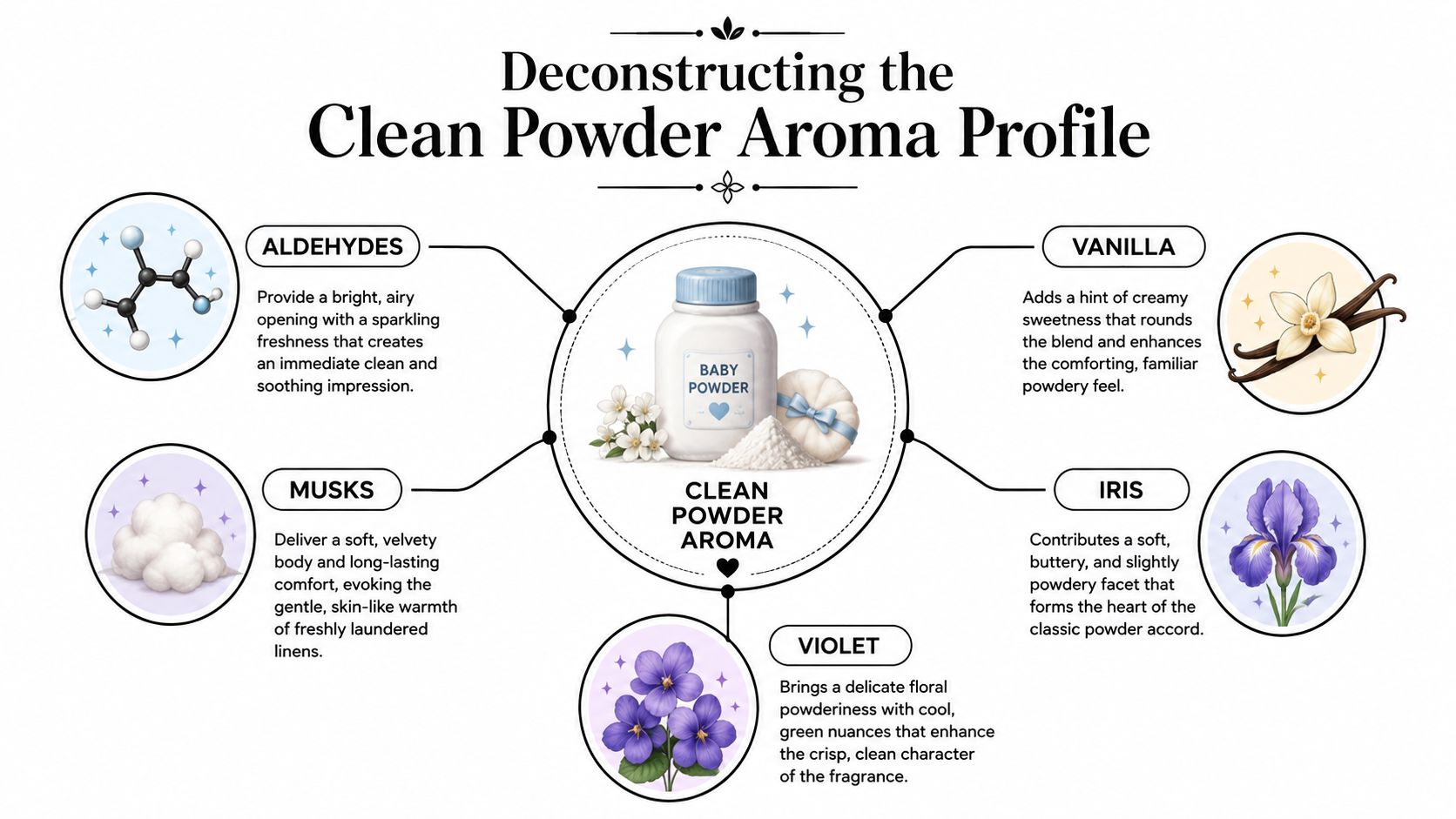
Supplier formulas can differ significantly under the same product name. The balance of bright, sweet, violet-like, and musky materials also changes after dilution. In wax, warmth and sweetness may become more prominent as the product heats. In lotion, the same concentrate may feel rounder and more cosmetic on skin. Treat the supplier's documentation as product-specific, then confirm the sensory result in the finished base.
What each family contributes
Aldehydic materials make the opening feel crisp, bright, or freshly washed. Used too strongly, they can push the fragrance toward detergent and away from soft powder.
Ionones and violet-like materials build the dry, cosmetic impression associated with powder. They add a plush, slightly floral texture without turning the accord into an overt bouquet.
Vanilla-related materials provide sweetness and body. Vanillin can also contribute to colour change in some bases, so check the actual wax, soap, or lotion rather than judging only the oil in its bottle.
Musks and supporting florals improve persistence and roundness. Heavier materials may alter cold throw, hot throw, and diffusion speed, which matters when the same oil is offered across candles, diffusers, and topical products.
A related guide to flower fragrance oil is useful for comparing a powder accord with a more openly floral direction. The practical question is whether the complete blend performs consistently in its intended base and remains supported by the relevant product documentation.
Test the finished product, not just the concentrate
A blotter gives only an early indication. Wax may amplify warmth and sweetness, a diffuser can expose brighter notes, soap batter adds heat and alkalinity, and lotion can make the fragrance feel fuller on skin.
Run a controlled test batch and record:
Concentrate appearance: Check colour and clarity before mixing.
Base behaviour: Look for separation, acceleration, discoloration, or sweating.
Aroma development: Evaluate immediately, then again after the product has settled.
Customer-facing result: Test the finished item in the same way a buyer will use it.
Keep those records with the batch details. They make reordering easier and help separate a raw-material variation from a process problem, such as excessive heat, incomplete incorporation, or an unsuitable fragrance load. A scent that works in wax still requires separate testing and compliance review before use in a leave-on or baby-adjacent product.
Application Strategies and Blending Techniques
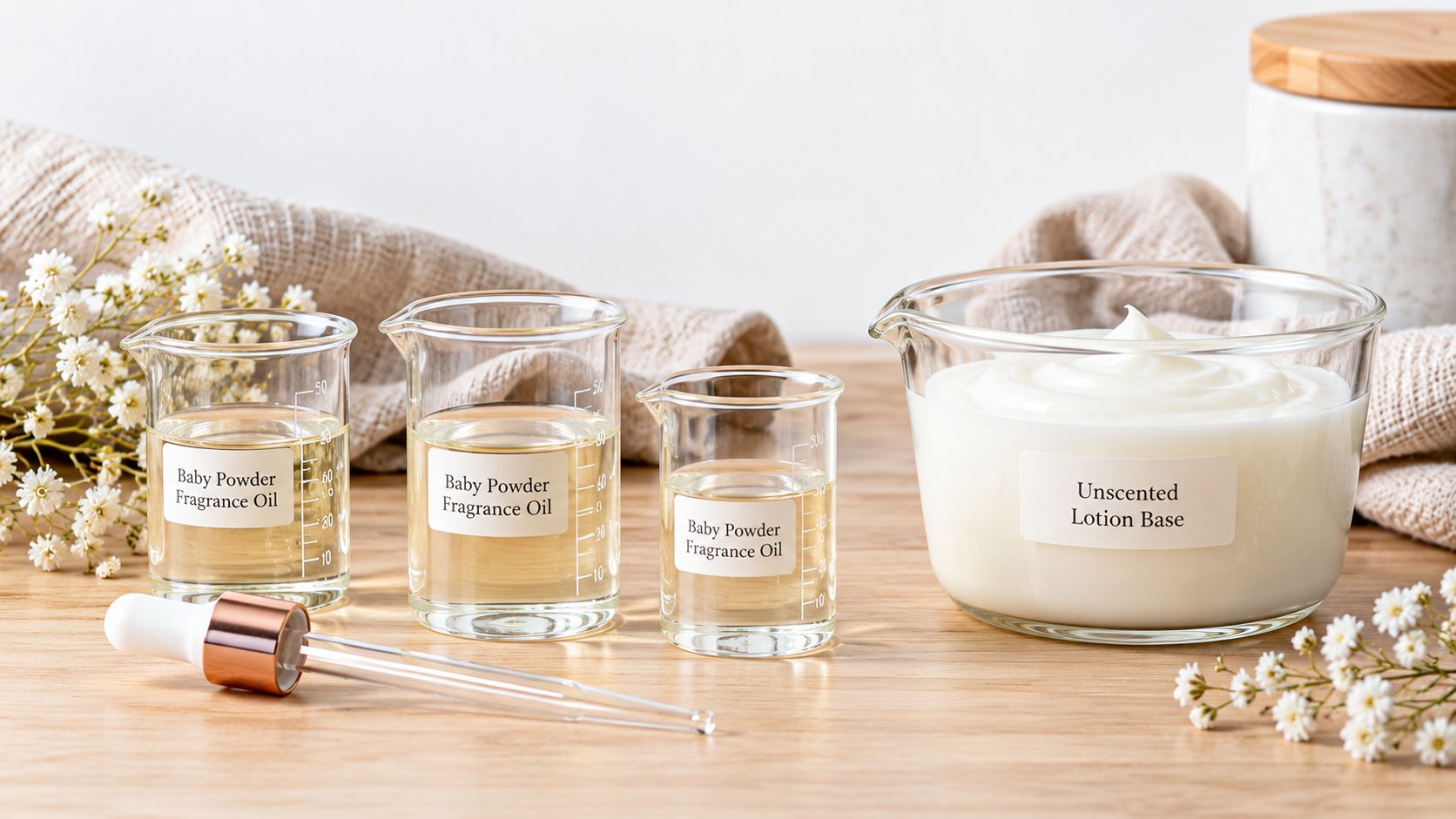
Start with the product category, not the scent strength you want. Baby powder fragrance oil behaves differently in wax, soap, diffusers, and topical products, so one universal recipe is poor practice. The supplier's IFRA certificate should determine the maximum permitted use, while your own testing determines whether the product smells balanced and performs well.
Candles and wax melts
For candles, weigh both wax and fragrance. Add the oil at the wax supplier's recommended temperature, stir thoroughly, and allow the finished candle to settle before judging scent throw. A heavy powder composition may smell creamy and dense when heated, while a lighter wax can make the same oil feel more airy.
Soy and paraffin also present different formulation choices. Soy may suit a softer, modern product position, while paraffin can provide a different release profile. Neither choice removes the need to check the fragrance documentation. The permitted level for a candle is not a permission slip for lotion or baby cream.
Makers who need a broader process reference can use this resource on how to blend fragrance oils for candles. Keep a written batch sheet with the wax type, fragrance weight, mixing temperature, vessel or mould, and test observations.
Cold-process soap
Cold-process soap needs small-batch testing because fragrance oils can affect trace and working time. Add the fragrance according to your established process, then watch for acceleration, ricing, colour change, and scent morphing during cure. Don't increase the load because the fragrance smells faint in raw soap. A stronger addition can create a compliance problem without solving a performance problem.
If the powder accord contains sweet or warm materials, prepare for possible discoloration. Customers may accept a cream or beige finish if you design the product around it, but unexpected colour change can undermine a white-themed range.
Reed diffusers and aromatic products
Diffusers require their own compatibility test. Check whether the fragrance disperses evenly through the selected base, whether the reeds remain active, and whether the final aroma is too dense for the vessel. A powder accord often works well as a standalone profile, but a small amount of citrus can add lift, while a restrained wood note can make it feel more mature.
Don't assume that a fragrance suitable for a reed diffuser is suitable for an ultrasonic diffuser or skin application. Device manufacturers, diffuser bases, and fragrance suppliers can impose different requirements.
The following demonstration can help visualise a careful fragrance-blending workflow, but it shouldn't replace the current IFRA certificate or SDS for your particular oil.
Blending without losing the powder identity
Build blends by changing one variable at a time. Begin with the baby powder fragrance as the dominant accord, then trial a light citrus, a soft floral, or a dry wood in separate samples. Evaluate the blend in the final base, because the same ratio can smell sharp in a diffuser and sweet in wax.
A successful blend adds contrast without burying the recognisable powder character.
For topical products, don't borrow a candle recipe. Use the topical category limit, calculate by weight, and perform compatibility testing before considering private-label production.
Navigating IFRA Limits and Skin Safety Rules
The most important distinction for this product is the difference between home fragrance use and leave-on skin use. IFRA categories manage exposure according to how a product is used. A candle, diffuser, baby powder, baby oil, and body lotion don't create the same contact pattern, so they can't share one generic “safe percentage.”
One IFRA certificate places baby creams, baby oils, baby powders, and talc in Category 5D, with a maximum use level of 0.25% for the listed baby-powder fragrance oil. The same certificate shows that broader non-baby applications can permit substantially higher levels. Review the IFRA certificate for baby powder fragrance oil before calculating a batch.
IFRA Usage Limits by Product Category
Product Type | IFRA Category | Typical Max Limit |
|---|---|---|
Baby cream, baby lotion, baby oil, baby powder, or talc | Category 5D | 0.25% |
Candle or wax-based home fragrance | Supplier certificate category | Check the current certificate |
Reed diffuser or other non-baby aromatic product | Supplier certificate category | Check the current certificate |
Adult leave-on personal care | Relevant leave-on category | Check the current certificate |
The table is deliberately conservative. “Typical max limit” doesn't mean you can apply the listed figure to every supplier or every product. IFRA certificates are product-specific, and the applicable category must match the finished product.
Why “skin safe” is too vague
A supplier or reseller shouldn't market an oil as “skin safe” without naming the intended product category and permitted concentration. Skin compatibility depends on the fragrance mixture, the finished formulation, the exposure route, and required declarations. Even within personal care, a rinse-off product and a leave-on product can have different compliance considerations.
One safety data sheet classifies a baby powder fragrance oil as causing serious eye irritation and an allergic skin reaction. Another identifies it as a skin sensitizer. These warnings require practical controls:
Use a precision scale: Calculate the fragrance weight against the total finished product.
Match the category: Confirm that the exact application appears on the current IFRA certificate.
Review the SDS: Identify handling, hazard, and personal-protection requirements.
Patch-test cautiously: Testing can reveal individual compatibility issues, but it doesn't replace regulatory assessment.
Label accurately: Use the declarations required for your market and product type.
For makers developing unscented or lightly scented infant products, this guide to baby lotion ingredients provides useful context for why fragrance-free formulation is often considered separately from fragranced leave-on care.
Market rules can differ
IFRA is central, but it isn't the entire compliance system. The verified buyer guidance also highlights the EU's 2023 fragrance-allergen update and the UK's 2025 methyl salicylate restriction as examples of rules that can vary by market and end use. A product intended for one market may need a fresh review before resale in another.
For labelling workflow, consult this practical resource on fragrance labelling requirements. Keep the certificate version, SDS version, formulation calculation, and label artwork together in the product file.
Managing Allergens and Inventory Shelf Life
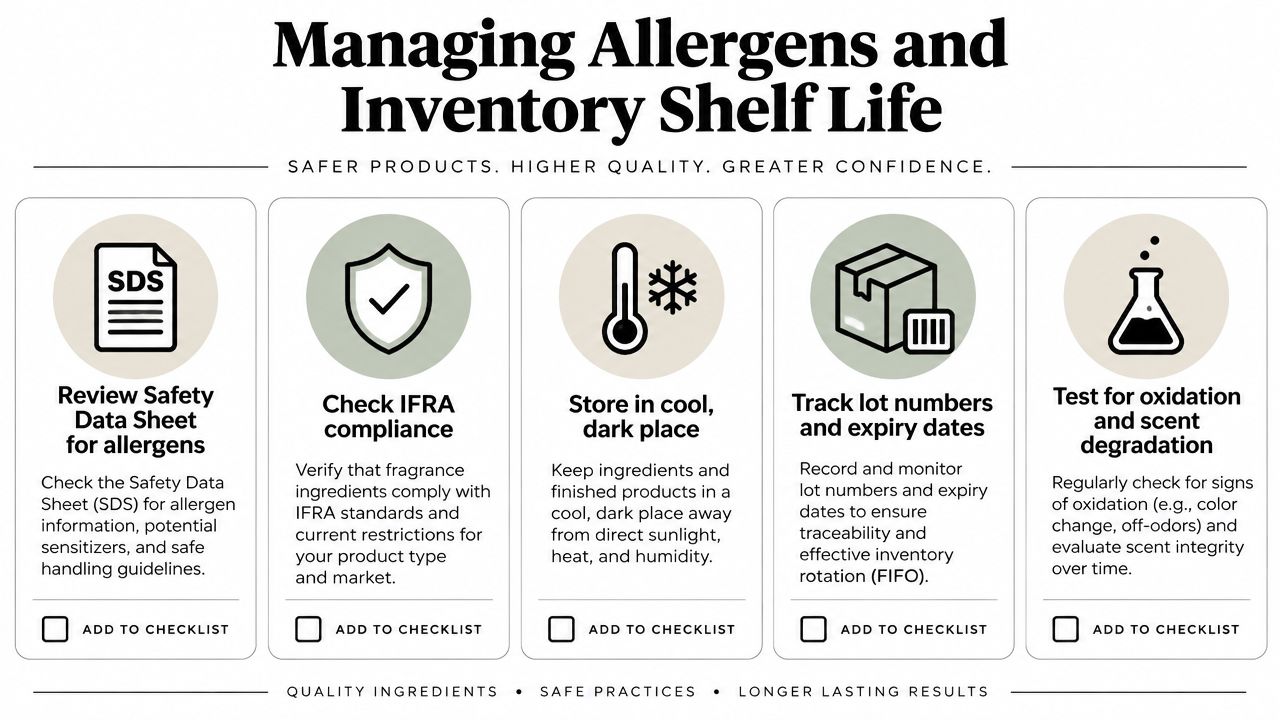
Fragrance oil isn't chemically inert, and an SDS isn't paperwork to download once and forget. One material safety document for a baby powder blend lists methyl ionone alpha iso super at 3.20%, benzyl alcohol at 12.70%, citronellol at 6.20%, coumarin at 1.4%, and hexyl cinnamic aldehyde at 5.00%. Another safety sheet includes H317, a warning that the product may cause an allergic skin reaction. See the baby powder fragrance oil MSDS for the stated constituents and hazard information.
Read the SDS in a fixed order
Start with the product identity and intended use. Confirm that the document describes the exact fragrance oil you received, not a similarly named variant.
Then examine the hazard and composition sections. Look for sensitizers, eye-irritation warnings, environmental hazards, and any listed constituents that may affect consumer declarations. Benzyl benzoate and coumarin are particularly useful examples because their presence shows why a pleasant powder accord can still require careful label review.
Next, check handling and storage guidance. Your workplace controls should reflect the SDS, including suitable containers, spill procedures, ventilation, and eye or skin protection where required.
For a plain-language discussion of allergy concerns and the limits of personal experimentation, see this resource on allergies and self-testing explained. A patch test may inform an individual's tolerance, but it doesn't establish that a product complies with IFRA or local labelling rules.
Protect the oil from avoidable degradation
Store bulk fragrance oil in a cool, dark place with the cap tightly closed. Light, heat, and repeated air exposure can change the balance of volatile materials, making the scent flatter, sharper, or less recognisable over time.
Use smaller working bottles when practical, rather than opening the entire wholesale container for every production session. Keep the main container sealed, record lot information, and rotate stock so older material is used first.
A useful inventory record includes:
Supplier and lot details: Keep traceability from delivery through finished product.
Opening date: Record when each container enters production.
Sensory checks: Compare colour, clarity, and aroma against an approved reference.
Storage conditions: Note unusual heat exposure or a damaged closure.
Batch linkage: Record which finished goods used which fragrance lot.
Don't rely on a generic shelf-life promise when the supplier's documentation or storage conditions differ. Test retained samples before a large resale run, especially if the oil has spent time in warm transport or a frequently opened production area.
FAQs
Can baby powder fragrance oil be blended with other fragrance oils?
Yes. Baby powder fragrance oil can be used as the dominant accord and combined with complementary profiles such as light citrus, soft florals, or dry woods. Test each blend in the finished product base because the same ratio can smell different in wax, diffuser bases, soap, or other formulations.
How should I test a new baby powder fragrance oil before buying it in bulk?
Start with a sample and evaluate it in the actual base you plan to sell. Check the fragrance's appearance, scent development, compatibility, and finished-product performance before committing to a larger wholesale quantity.
Can the same baby powder fragrance oil be used across different product lines?
A fragrance may work across several product types, but that does not mean the same concentration or formulation can be transferred from one product to another. Each finished product needs its own category review, formulation testing, and documentation check.
What should I compare when choosing between baby powder fragrance oil suppliers?
Compare documentation availability, batch consistency, packaging, minimum-order flexibility, technical support, and the supplier's ability to provide repeatable product quality. Price alone doesn't show the total purchasing risk.
What should I do if my baby powder fragrance oil smells different after mixing?
Evaluate the fragrance after it has been incorporated into the finished base and allowed to settle. Different bases can emphasize different parts of a powder accord, so a change in sweetness, warmth, brightness, or floral character does not necessarily indicate a problem with the concentrate.
Sourcing Wholesale Oils for Retail and Resale
Wholesale buying should begin with documentation and consistency, not with the largest available container. A low per-unit cost becomes expensive if the fragrance changes between batches, arrives partially oxidised, or lacks the paperwork needed for your product labels.
Ask prospective suppliers for the current IFRA certificate, SDS, lot information, packaging specifications, and intended-use guidance. If you're planning private-label body products, confirm that the documents support your market and exact product category before you print packaging.
What a reliable purchasing process looks like
Request a sample first and test it in your actual base. A blotter can confirm the broad aroma, but it won't show how the fragrance behaves in wax, soap, lotion, or diffuser base.
Then assess the supplier's fulfilment model. Fresh-to-order pouring can reduce the time the oil spends in storage before it reaches your workshop, but you still need suitable receiving and storage controls. Ask how containers are sealed, how lots are identified, and whether repeat orders can be matched closely to the approved sample.
Packaging matters for resellers. Glass bottles, droppers, and compatible closures can simplify repackaging, but every new container and label creates another point where traceability and hazard communication must remain accurate.
Compare suppliers by risk, not only price
A practical wholesale scorecard should consider:
Documentation access: Can you obtain the relevant files before purchase?
Batch consistency: Can the supplier identify lots and support repeat ordering?
Packaging fit: Does the format suit retail, sampling, or private-label work?
Minimum order flexibility: Can you test demand before holding excessive stock?
Technical communication: Does the supplier answer category and handling questions directly?
A broader resource on where to buy fragrance oils for candles can help makers think through supplier selection beyond scent names. For U.S. buyers comparing wholesale options, Aroma Warehouse offers fragrance oils poured fresh to order, sample-size testers, bulk formats, bottles, and droppers for retail or repackaging. Treat those features as purchasing options, then verify the documentation for the specific oil and use.
Final Formulation and Compliance Checklist
Use this workflow before launching any product containing baby powder fragrance oil:
Identify the finished product. Decide whether it's a candle, diffuser, soap, lotion, baby-adjacent product, or another category.
Obtain current documents. Save the exact supplier SDS and IFRA certificate with the product development file.
Match the IFRA category. For baby creams, baby oils, baby powders, and talc, check Category 5D carefully. One verified certificate lists a 0.25% maximum for that category, so don't substitute a home-fragrance rate.
Calculate by weight. Record the fragrance amount, total batch weight, and final concentration.
Run a compatibility test. Check scent, colour, separation, trace, throw, and finished-product stability.
Review allergen and hazard information. Prepare labels and warnings for the market where you'll sell.
Approve the production method. Document mixing order, temperature controls, curing or settling time, and packaging.
Control inventory. Track lot numbers, opening dates, storage conditions, and retained samples.
Recheck before resale. A changed certificate, SDS, market, or product category can change the compliance decision.
The central lesson is simple: formulate the product, not the fragrance name. Baby powder fragrance oil can be a versatile commercial accord, but safe use depends on concentration, exposure, documentation, and honest labelling.
Aroma Warehouse offers fresh-to-order fragrance oils, sample-size testers, bulk formats, glass bottles, and droppers for makers and resellers developing products around powdery scent profiles. Review the available options and visit Aroma Warehouse before choosing your next test batch or wholesale supply.


