

Travel Size Bar Soap: A Practical Guide for 2026
A small soap bar can punch above its weight because it doesn't have to fight for space in the TSA liquids bag. TSA limits liquids, gels, and aerosols in carry-on baggage to 3.4 ounces (100 milliliters) or less, all fitting in one quart-size bag, while a solid bar sidesteps that container rule altogether. For travelers, that makes travel size bar soap less about cute packaging and more about a format that packs cleanly, dries well, and earns its spot in a dopp kit.
Table of Contents
Types of Travel Size Soap Bars and Who Each One Is For - The main formula families
Packaging Standards and Sizing for Travelers and Retailers - What “travel size” usually looks like in practice
Where Travelers Use Mini Bars and How Retailers Can Sell Them - Smart retail placements
DIY Mini Bar Methods Anyone Can Try at Home - Three approachable methods
Storage, Hygiene, and Making a Travel Bar Last - The easiest routine to teach customers
What Travel Size Bar Soap Actually Means
At the checkpoint, the difference is simple. A bottle of wash has to squeeze into the 3-1-1 liquids system, but a solid bar doesn't count against that quart bag allowance in the same way, which is why travelers often reach for it when they're tired of playing toiletry Tetris. That's the core value proposition: portable cleansing without liquid-container drama.
Practical rule: If it's a true solid bar, pack it like a solid. If it behaves like a soft gel, balm, or spreadable cleanser, treat it more cautiously.
That's also why “travel size” is mostly a merchandising term, not a formal TSA category. TSA guidance doesn't set a mandatory travel-size weight for bar soap, so sellers use the phrase to signal convenience, compactness, and carry-on friendliness rather than a universal regulatory class. For retailers, that matters because a mini bar isn't just a shrunken household bar. It's a product meant to answer a travel problem.
The practical upside reaches beyond airport security. A compact bar can free up space that would otherwise get swallowed by shampoo, toothpaste, and lotion bottles, which is why it shows up so often in hotel kits, gym bags, camping packs, and short-trip pouches. If you're explaining the format to a customer, keep it simple. Small doesn't matter as much as solid does.
For a quick comparison with other toiletry formats, this guide to a travel bottle shows why bar formats occupy a different lane from liquids: 1-ounce bottle packaging and carry-on basics. The big lesson is that a mini bar's usefulness comes from its form, not just its footprint.
Types of Travel Size Soap Bars and Who Each One Is For
Mini bars aren't all the same, and that's where a lot of shoppers get confused. They see one small soap wrapped neatly in paper and assume it'll behave like the next one. In practice, formula changes the feel, the lather, the hardness, and how long the bar survives in a wet travel case.
The main formula families
Cold-process bars tend to feel traditional and can be a strong fit for shoppers who want a familiar soap experience. They're often a good match for buyers who like a simple ingredient story and a classic hand-feel. The trade-off is that harder bars usually perform better on the road, while softer ones can disappear faster in a damp pouch.
Melt-and-pour glycerin bars are beginner-friendly and visually clean, which makes them popular for small gift sets and sampler packs. They can be attractive on a shelf, but travel shoppers should pay attention to softness, especially in warm cars or humid hotel bathrooms.
Syndet bars are built around synthetic detergents rather than traditional soap, and they're often chosen for a smoother, less draggy wash feel. They can be a smart option for travelers who want a bar that stays tidy in use, provided the formulation is hard enough to resist turning mushy.
Herbal or goat-milk bars appeal to customers who shop by scent story or skin feel. Those bars often sell on sensory appeal, but retailers should be honest about texture and avoid implying that every “natural” bar is automatically better for travel.
Cleansing balms and jellies sit on the edge of the category. They may look compact, but softness changes how they should be sold and packed. If a cleanser can smear, soften, or slump in heat, it belongs in a different conversation than a firm bar.
Mini Bar Formula Comparison at a Glance | Hardness | Best For | Travel Caveat |
|---|---|---|---|
Cold-process | Often firm, depending on cure | Classic soap users, minimalists | Softer bars can wear down quickly if stored wet |
Melt-and-pour glycerin | Usually medium | Gift sets, visible presentation | Can soften in heat if packaging traps moisture |
Syndet | Often firm and smooth | Sensitive-skin shoppers, frequent travelers | Formula varies, so test the bar in a case first |
Herbal or goat-milk | Variable | Scent-led buyers, boutique assortments | Texture isn't a guarantee of travel durability |
Cleansing balm or jelly | Soft | Spa-style kits, specialty shoppers | Can blur into gel territory in screening and storage |
If you stock or buy by scent, a fragrance note like vanilla fragrance oil can help shoppers understand the experience before they ever open the wrapper. That kind of clarity sells better than vague “fresh” labeling.
Packaging Standards and Sizing for Travelers and Retailers
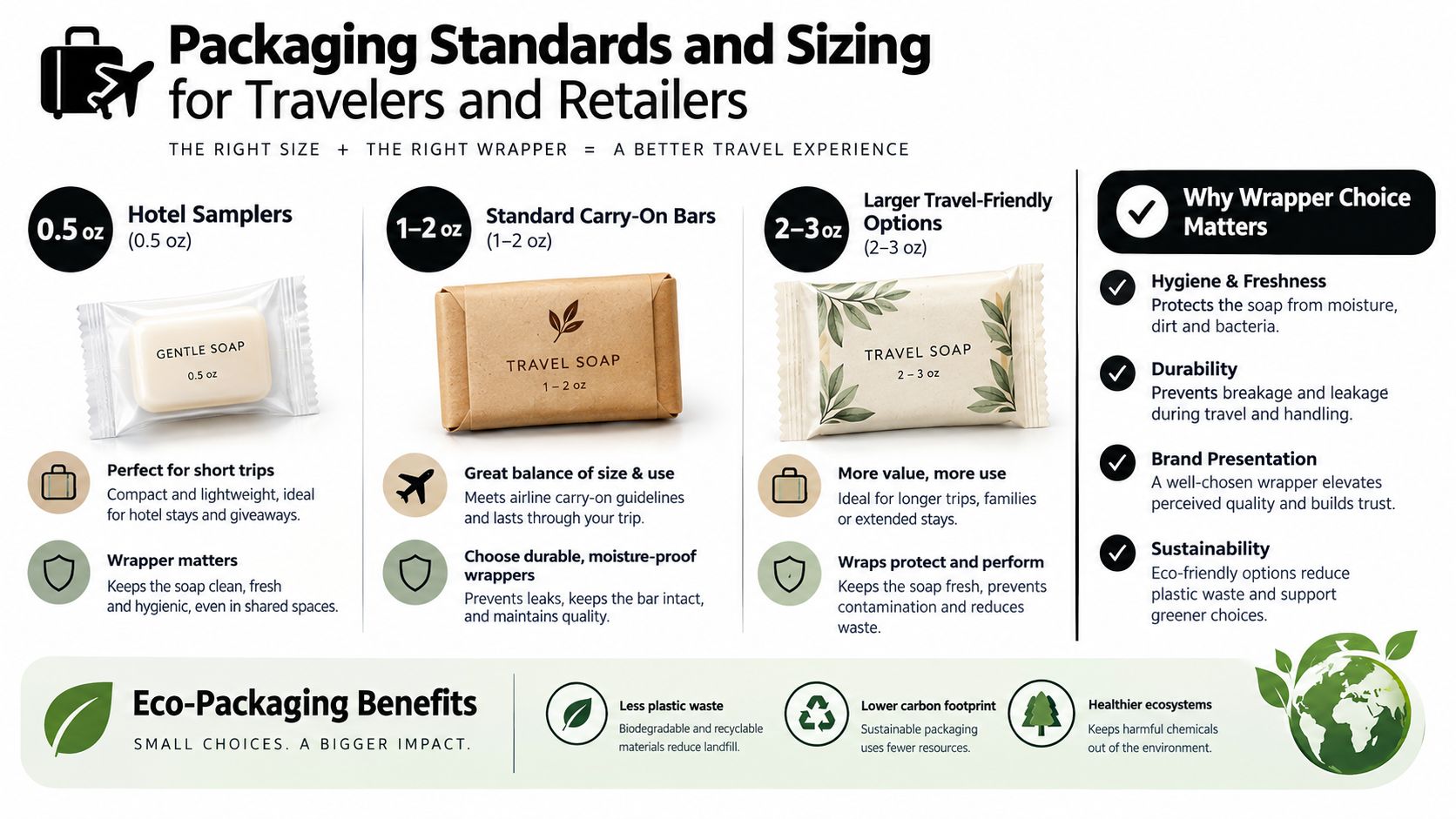
A travel bar lives or dies by the wrapper. Size matters, but packaging is what decides whether the bar arrives neat, stays dry, and looks worth grabbing off a shelf. A small bar in bad packaging can feel like a mistake, while a modest bar in a smart case feels intentional.
What “travel size” usually looks like in practice
For shoppers, the useful mental model is simple. Hotel-style samplers are tiny and easy to tuck into a side pocket. Standard carry-on bars give a better balance of use life and packability. Larger travel-friendly bars are better when a trip runs longer or the buyer doesn't want to replace soap mid-stay.
What matters most is how the bar is housed:
Paper wraps keep the presentation clean and feel low-fuss, but they don't protect against moisture very well.
Flow-wrapped films help with shelf appeal and scent control, though they can trap dampness if the bar goes in wet.
Rigid tins are sturdy and giftable, but they're only useful if the bar can dry between uses.
Vented travel cases are the smartest carry option when the goal is to manage moisture after the first wash.
Recycled kraft sleeves work well for eco-minded merchandising and a simple, rustic look.
A bar that can dry between uses is usually a better travel buy than a prettier bar sealed in a box that traps moisture.
Retailers also need to think about the label, because buyers notice missing basics. A wholesale supplier should be able to provide net weight, ingredient declaration, fragrance allergen information where required, and batch identification. Those details help a store buy with confidence, and they help customers compare products without guessing.
For fragrance-heavy assortments, this overview of fragrance labeling requirements is a useful companion if you're building a bar display or gift bundle. The short version is that good packaging does more than protect the soap. It makes the product easier to understand.
Where Travelers Use Mini Bars and How Retailers Can Sell Them
A travel bar earns repeat use because it works in ordinary, unglamorous situations. A gym-goer wants something that fits in a locker pouch. A camper wants less bulk. A honeymooner wants a tidy kit that doesn't leak. A hotel guest wants a wrapped bar that feels cleaner than a half-used bottle sitting on a sink ledge.
The best sellers treat those scenes as merchandising cues, not as afterthoughts. A bar near the register can work as a low-friction add-on. A spa can tuck it into a sampler set. A wellness studio can bundle it with an eye mask or a small essential-oil sample. A boutique hotel can use it as part of a welcome kit that feels more curated than generic amenity stock.
Smart retail placements
Checkout add-on: Put compact bars where customers already decide on small indulgences. Soap works well beside matches, lip balm, and other pocketable goods.
Sampler set: Combine one or two mini bars with related scent items so the customer feels like they're buying a curated kit, not a loose leftover.
Hospitality bundle: Sell wrapped bars in batches for guest rooms, rental properties, and boutique stays that want a more polished amenity than a generic dispenser.
Online resale: Mini bars photograph well, ship easily, and lend themselves to themed bundles, especially when you can show the wrapper, size, and scent clearly.
For gift shops and resellers, a useful sourcing overview is wholesale supplies for gift shops. The winning angle is not “soap is soap.” It's that a mini bar can anchor a themed purchase when the rest of the basket is built around convenience, scent, and presentation.
How Avistar Can Help
Avistar is built around the same practical reality that makes mini bars useful in the first place, guests want products that feel thoughtful and hosts want less hassle. The brand's focus on guest amenities lines up with the situations where travel-size soap actually gets used, short stays, quick turnovers, and kits that need to look polished without creating more work. For hosts and small hospitality operators, that means the right bar isn't just a toiletry, it's part of a smoother stay experience.
That matters most when the product has to do a simple job well. A compact soap bar should look good, hold up in transit, and make the guest feel taken care of. If you're comparing amenity options or looking for a straightforward reference point, travel size bar soap is a useful example of the kind of product that fits this use case.
Avistar's positioning around hosting also fits a broader retail truth. The best small bars aren't just compact, they're chosen because they reduce friction for the person packing, restocking, or setting up a guest room. That's the kind of decision that makes sense for short-term rental operators, boutique hospitality, and anyone who wants the amenity to feel easy instead of fussy.
DIY Mini Bar Methods Anyone Can Try at Home
Making a mini bar at home is straightforward if you pick the right method for your skill level. The easiest route is melt-and-pour, which skips lye handling. A more traditional route is a scaled-down cold-process batch. A third option is rebatching, which turns leftover soap scraps into useful mini pieces instead of waste.
Three approachable methods
Melt-and-pour
Best for: Beginners, quick gifts, small test batches.
Basic tools: Knife, heat-safe container, spoon, mini molds.
Simple ingredients: Melt-and-pour base, scent oil, color if desired, dried botanicals used sparingly.
Watch-outs: Too much additive can weaken the bar or make it look messy in a small mold.
Cold-process
Best for: Crafters who already understand safe lye handling.
Basic tools: Scale, stick blender, heat-safe pitchers, gloves, eye protection, mini molds.
Simple ingredients: Oils, sodium hydroxide, water or another approved liquid, fragrance or essential oil, optional colorants.
Watch-outs: Cure the bars fully and keep records of each batch so you know what worked.
Rebatching
Best for: Upcycling scraps or correcting imperfect homemade soap.
Basic tools: Grater, pot, mold, spoon.
Simple ingredients: Leftover cured soap, a small amount of liquid, optional scent or additives.
Watch-outs: It's a fix-up method, not a shortcut for understanding your formula.
For anyone making bars to sell, keep the label honest and simple. Document the formula, the weight, the scent, and any cautionary ingredients so you can repeat the batch and answer buyer questions without guessing. Homemade bars don't need hype. They need consistency.
Storage, Hygiene, and Making a Travel Bar Last
A damp bar is the enemy of a good travel kit. The microbiology data backs up what travelers already learn the hard way at hotel sinks. Wet bars and pooled water are the problem, because moisture gives microbes a better chance to persist, while drier bars perform better in real use. The practical lesson is simple, dry the bar after washing and give it a place where water can escape.
That means a sealed pouch is not always your friend. It protects the rest of the bag from residue, but if you trap a wet bar in an airtight case, you can end up with softening, deformation, and a bar that gets slimy faster than you expected. A vented case or a drainable insert is usually the better first choice.
The easiest routine to teach customers
Let the bar dry after each use. A quick air-dry on a slotted dish or vented insert goes a long way.
Store it away from standing water. Don't leave it in a puddle at the sink or pressed against a wet liner.
Use a closed outer pouch only when needed. That's useful for leakage protection during transit, but not as a long-term drying environment.
Replace it when it turns slimy or starts to smell off. That's a practical user signal, not a moral failure.
Used bars can carry mixed microbes, but that doesn't mean ordinary handwashing is broken. The better takeaway is that storage discipline matters as much as the soap itself. Retailers can turn that into a small but useful care card, especially for hotel guests and frequent flyers who want the bar to last for the full trip.
Sourcing for Resellers and Marketing the Mini Bar
For resellers, the smartest question isn't “Can I find mini bars?” It's “Which bars will I be able to explain, repeat, and restock without drama?” That's where wholesale buying gets practical. Ask suppliers about cure time, bar hardness, ingredients, packaging options, labeling detail, and whether the bar holds up in transit. Those answers matter more than a pretty product photo.
A useful wholesale checklist also includes the basics of inventory control. Know whether the supplier offers consistent weight, whether scent batches are repeatable, and whether packaging arrives shelf-ready or needs extra handling. If you're building a bundle, the bar should fit the rest of the kit instead of forcing the kit around it.
The best marketing angles are the ones that feel natural to the customer:
Sampler boxes for scent exploration.
Wedding favor bundles for guest gifts that don't need a power outlet or charger.
Hotel and rental partnerships for amenity kits that feel polished.
Branded labels for boutique stores that want their own signature presentation.
A useful sourcing and supply reference for sellers is soap-making supplies wholesale. If you already stock incense, fragrance oils, or aromatherapy accessories, a mini bar can sit comfortably beside them as part of a broader giftable routine. That cross-category bundling is often where the best margins hide, because customers buy the vibe, not just the soap.
Quick Reference Checklist and Final Takeaways
Travel size bar soap works because it's solid, not because it's trendy. It avoids the carry-on liquids squeeze, frees up toiletry space, and gives travelers a compact cleanser that's easier to pack than a bottle. For the best results, choose a bar that's hard enough to survive transit, package it so moisture can escape, and store it like a product that needs to dry between uses.
For retailers and resellers, the opportunity is bigger than one small bar. The right format can serve hotel kits, spa samplers, checkout add-ons, and bundled gift sets. If you stock or curate adjacent categories like incense, fragrance oils, or aromatherapy accessories, the mini bar fits naturally into that mix.
The simplest rule is the one buyers remember: solid, dry, and clearly labeled. That's the difference between a bar people pack once and a bar they keep buying.
If you're building a travel or guest-amenity assortment, start with bars that are easy to explain, easy to store, and easy to resell. Aroma Warehouse is a practical place to compare related wholesale categories and see how mini bars can fit into a broader host-friendly kit.


