

Jasmine Green Tea Guide for Wellness Retailers
The most popular advice about jasmine green tea is also the least reliable: treat it as a naturally caffeine-free bedtime drink because the floral aroma feels calming. Jasmine scent and caffeine exposure are separate questions. For a wellness retailer, that distinction matters as much as flavor, because a customer may be buying an evening ritual while still consuming tea made from caffeinated Camellia sinensis leaves.
Jasmine green tea also isn't just green tea with jasmine flavor mixed into the finished cup. Traditional production uses fresh jasmine flowers to scent processed tea leaves, creating a product with a distinctive agricultural history, a complex volatile profile, and useful merchandising connections to incense, fragrance oils, and other environmental aromatics.
Table of Contents
The Reality of Jasmine Green Tea and Caffeine - Why one caffeine number doesn't work - Sensory calm isn't physiological calm
Tracing the Origins and Modern Production Scale - From courtly craft to coordinated supply chain
Volatile Compounds That Define Jasmine's Aroma Profile - Concentration isn't the same as impact - Match tea aroma with room fragrance deliberately
How Tealyra Can Help - Use the supplier page as a buying worksheet
Brewing for Antioxidants and Optimal Flavor - Choose the cup you want to serve - Turn brewing into a sensory merchandising moment
Cross-Merchandising Tea with Aromatherapy Products - Build a ritual, not a random bundle - Source the botanical story with care
Navigating Pesticide Residues and Sourcing Safety - Ask suppliers better questions - Store records as carefully as stock
Best Practices for Storing Botanicals and Oils - Protect tea from its biggest enemies - Give oils a different storage system - Rotate inventory by sensory condition
The Reality of Jasmine Green Tea and Caffeine
Jasmine tea usually begins with a green tea base, then gains its floral character through contact with jasmine blossoms. The flowers contribute aroma, not a guarantee of reduced stimulation. If a customer asks whether the tea is suitable before bed, the responsible answer depends on the product label, serving size, leaf material, and preparation method, not on the word “jasmine.”
Why one caffeine number doesn't work
Caffeine varies within tea categories. USDA-linked research on tea composition found substantial variation among analyzed teas, including three jasmine teas, rather than a dependable category-wide composition. That makes a single universal caffeine figure unsuitable for product signage or wellness advice.
Several practical variables influence the amount extracted into a cup:
Tea base: A jasmine green tea inherits caffeine from its underlying tea leaves. A jasmine-scented herbal infusion is a different product.
Leaf grade and serving size: More leaf material generally changes the amount available for extraction, while a small sample cannot represent every loose-leaf or bagged product.
Water and steeping: Hotter water and longer contact can alter extraction, so two preparations of the same tea may not deliver identical exposure.
Format: Loose leaf, tea bags, concentrates, and ready-to-drink products require separate label checks.
Retail rule: Never describe real jasmine green tea as caffeine-free unless the package specifically supports that claim. “Decaffeinated” also isn't the same as “caffeine-free.”
Sensory calm isn't physiological calm
Jasmine's sweet, airy aroma can make a tea service feel relaxing, but that sensory impression doesn't prove that the drink is free of caffeine. This is especially important for spas, yoga studios, meditation spaces, and shops serving people who are sensitive to stimulants or managing insomnia, palpitations, or pregnancy-related dietary questions.
Staff don't need to diagnose or prescribe. They should state what they know, identify what the label doesn't establish, and avoid promising that a floral tea will support sleep. For evening service, offer a clearly labeled caffeine-free herbal alternative alongside jasmine green tea, rather than implicitly presenting the latter as a bedtime beverage.
A practical tasting card can say: “Real jasmine tea is scented green tea and may contain caffeine. Check the package for caffeine and decaffeination information.” That sentence protects customer trust while keeping the product's sensory appeal intact.
Tracing the Origins and Modern Production Scale
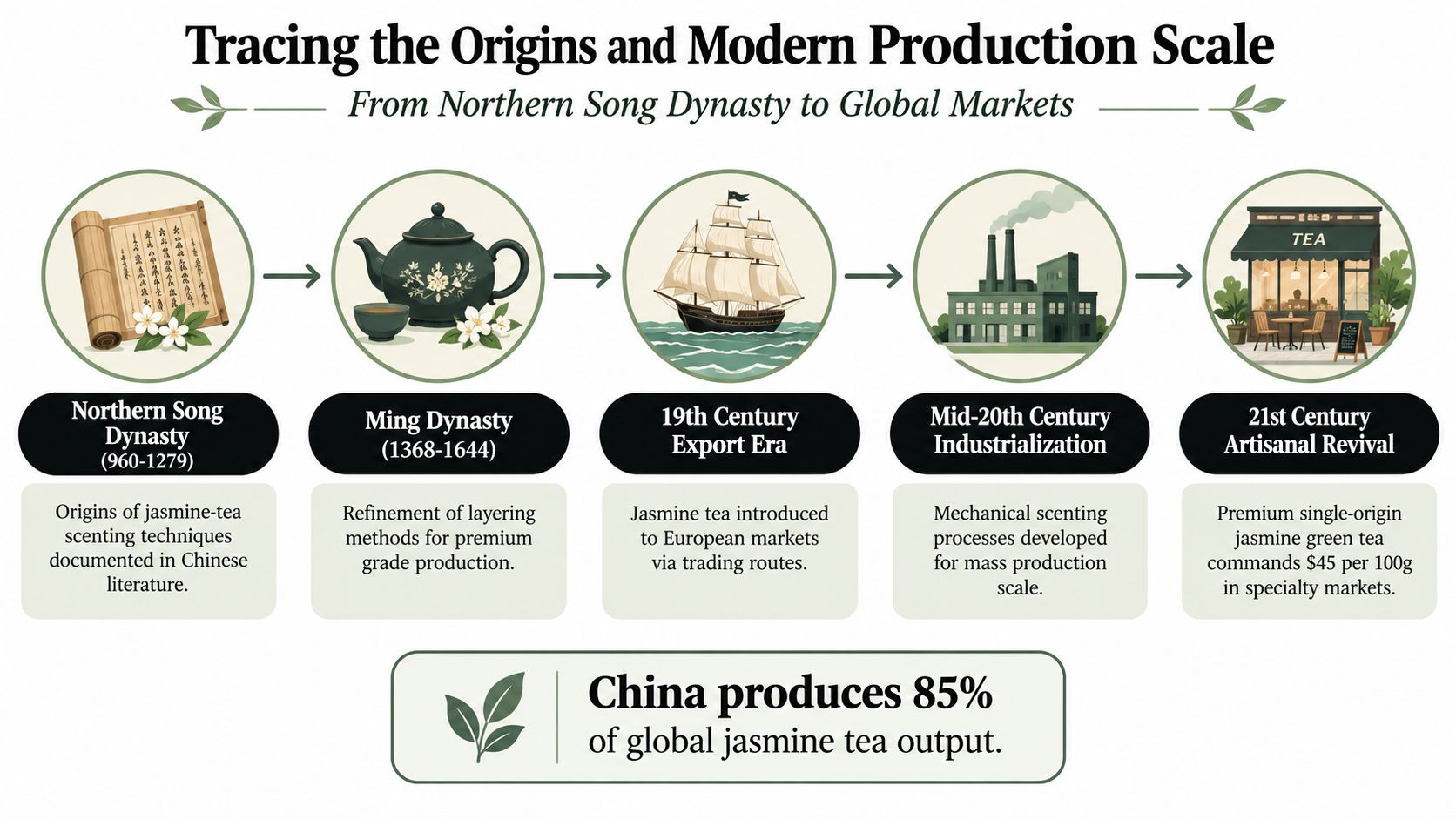
Jasmine green tea earns its place in a wellness assortment because it is a crafted scent product as much as a drink. Historical records place jasmine-tea production in Fuzhou, China, during the Northern Song Dynasty, from 960 to 1127, and Fuzhou's jasmine-tea craft was added to China's representative list of intangible cultural heritage projects in 2012, according to this Food and Agriculture Organization presentation on Fuzhou jasmine tea.
The classic process starts with tea leaves from Camellia sinensis and fresh jasmine flowers, most commonly Jasminum sambac. Producers bring the two together so the leaves absorb floral volatiles, then use heat drying to stabilize the tea. For retailers and spa buyers, that distinction matters. Proper jasmine green tea is built through scent transfer and handling skill, which is why its aroma can also inform related incense and fragrance oil merchandising in a way an artificially flavored product usually cannot.
From courtly craft to coordinated supply chain
The scenting method developed further during the Ming Dynasty, from 1368 to 1644, and reached a mature form during the Qing Dynasty, from 1644 to 1912. By the Qing period, jasmine tea had reached Chinese, European, American, and Southeast Asian markets. Jasmine itself had been introduced to China from India more than 2,000 years ago, which helps explain the long relationship between the flower and Chinese tea production.
Modern production keeps that heritage but operates at industrial scale. Local government data reported in 2025 stated that Hengzhou in Guangxi produced 90,000 metric tons of jasmine tea in 2024, compared with 80,000 metric tons in 2022, an increase of 10,000 tons, or 12.5%. The same report recorded more than 110,000 tons of fresh jasmine flowers harvested in 2024, with the jasmine sector's total output value exceeding 18 billion yuan and the reported brand value of Hengzhou's jasmine flowers and tea reaching 22.4 billion yuan. These figures appear in the research publication on jasmine-tea compounds and production context.
Those numbers matter in buying decisions.
Large output does not automatically mean commodity quality, and a premium price does not automatically mean careful scenting. What matters is process control across flower cultivation, harvest timing, tea processing, repeated scenting, drying, sorting, packaging, and distribution. A lower-priced tea may still be legitimate. Its shelf performance, cup aroma, and suitability for scent-led retail depend on how consistently those stages are handled.
Merchandising insight: Tell customers that jasmine tea comes from a flower-and-leaf process refined across centuries. That story gives a premium tea more weight than a generic “flavored green tea” shelf label, and it creates a natural bridge to nearby incense or floral oil displays that echo the tea's airy, fresh profile.
Retailers should document origin, scenting method, harvest or production information, and supplier quality controls with the same discipline used for other botanicals. A practical starting point is this guide to product sourcing for small wellness businesses, especially if tea sits beside incense, oils, and other aroma-driven goods.
Volatile Compounds That Define Jasmine's Aroma Profile
A jasmine tea lives or dies on aroma balance. In retail, I see buyers focus on origin or leaf grade first, then miss the point customers notice the moment the pouch opens. The signature comes from volatile compounds transferred from fresh jasmine blossoms into finished green tea during scenting, then reshaped by drying. That is why two teas labeled jasmine can sit in the same category yet perform very differently in a tasting bar, spa lounge, or gift set.
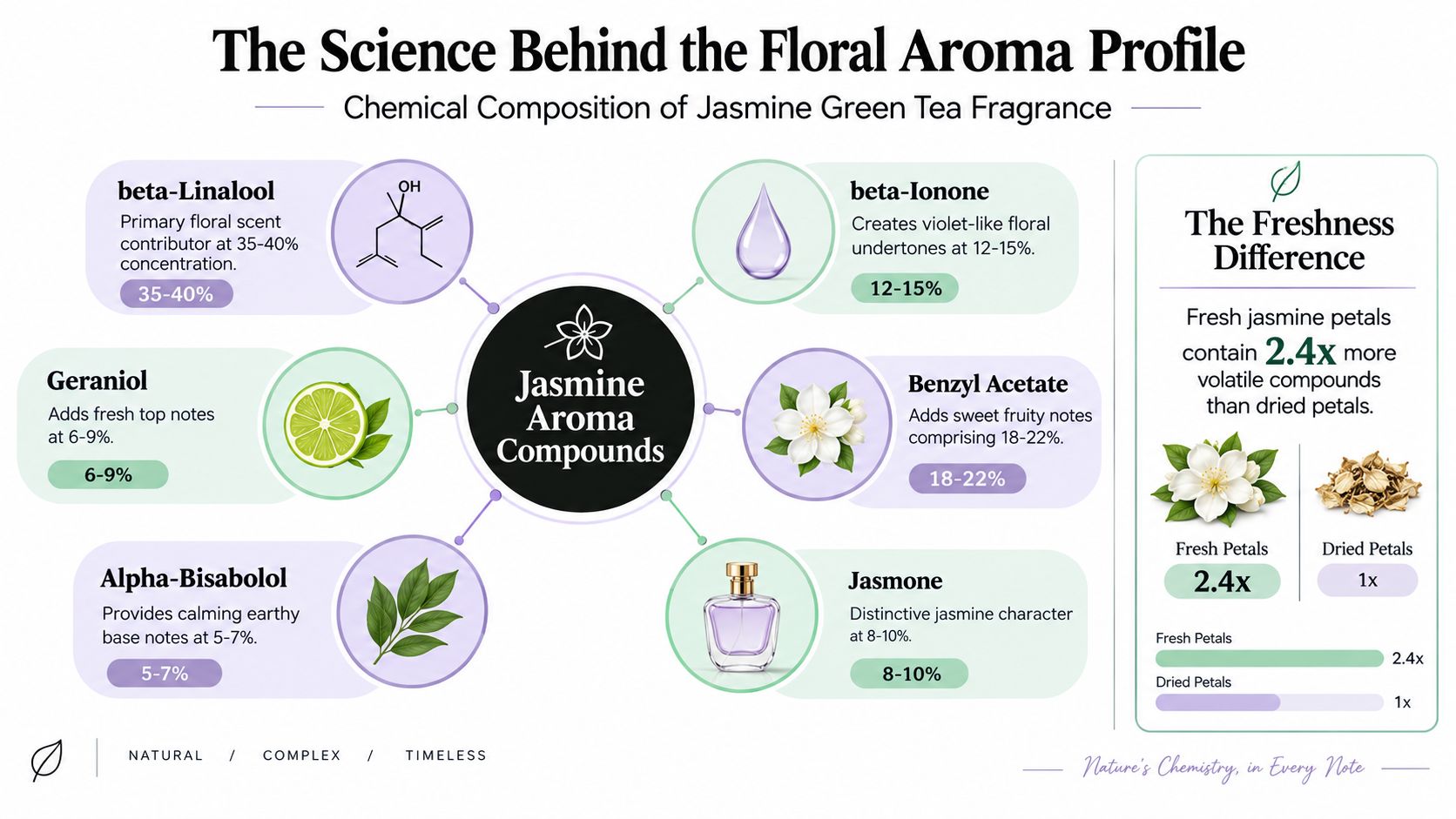
Key compounds include β-linalool, β-ionone, indole, methyl anthranilate, and jasmone-related compounds. Each pushes the profile in a different direction. β-linalool supports a clear floral lift. β-ionone adds violet-like nuance. Methyl anthranilate brings a sweet floral tone. Indole adds depth, and at restrained levels it reads refined rather than heavy. For boutique owners, that mix matters because the same tea can suggest freshness, softness, sweetness, or warmth depending on which notes dominate.
Concentration isn't the same as impact
Plenty of compounds show up in analysis. Fewer shape what the customer actually smells.
In scented jasmine tea, β-ionone, β-linalool, indole, and methyl anthranilate showed odor-activity values 5.1 to 45.2 times higher than in nonscented green tea, according to this study of jasmine-tea volatile compounds. For buyers, that explains why a tea can smell dramatically more floral even when the formula sounds close on paper. Sensory impact depends on detection threshold as much as raw concentration.
Heat changes the result again. Drying around 90 to 100°C for approximately one hour can strengthen some notes while driving off others, as documented in the same volatile-analysis study linked above. In practice, this is where sourcing gets real. A tea may keep a dry, slightly roasted impression while losing part of its airy jasmine lift. Oxygen exposure in the pack, flower freshness, and control of the scenting cycle keep pushing the profile after production.
Match tea aroma with room fragrance deliberately
This is the point where beverage buying and environmental aromatherapy meet. Tea and home fragrance are different product forms, but the scent logic overlaps. A well-made jasmine green tea should smell floral, fresh, and clean without turning dusty, syrupy, or sharply perfumed. A matching incense or oil should aim for that same recognizable jasmine character while balancing bright floral notes, green freshness, sweetness, and darker undertones.
Do not tell customers the tea and the room scent contain the same materials. Use shared sensory language instead. Ask whether both products open with a clean jasmine impression, whether the floral core survives heat, and whether the finish turns woody, powdery, smoky, or medicinal. Buyers building a coordinated display can use this guide to flower fragrance oils to compare the environmental scent side with more discipline.
For a boutique or spa, that sensory bridge helps staff sell a complete mood. The tea handles ingestion and ritual. The incense or oil shapes the room. When the profiles align, the display feels intentional rather than decorative.
How Tealyra Can Help
A retailer choosing jasmine green tea usually needs more than a product name. The useful questions are practical: Is the tea loose leaf or bagged? What is the green tea base? How is the jasmine character described? Are brewing directions clear? Does the supplier provide enough product information for staff to answer caffeine and preparation questions without guessing?
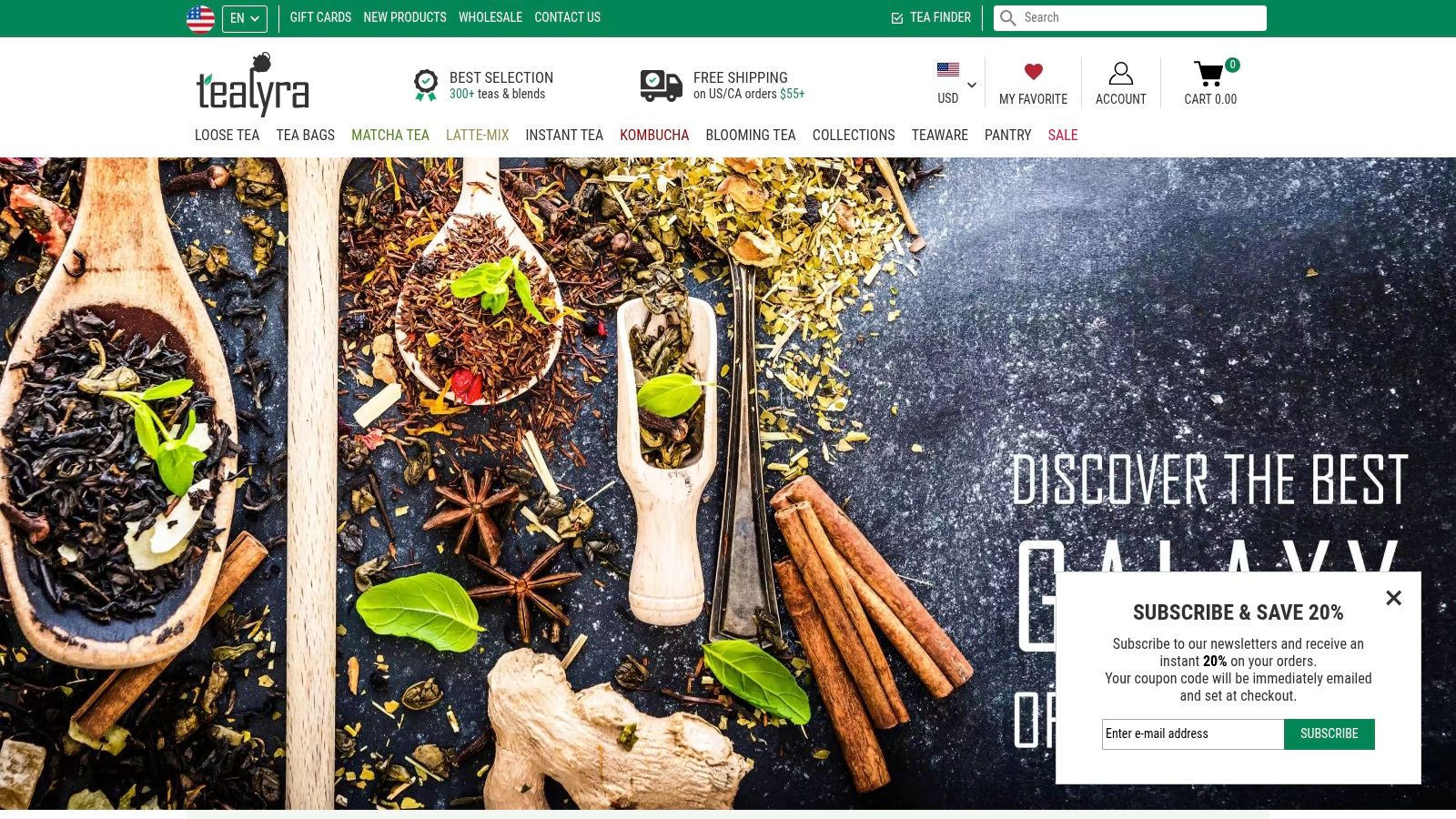
Tealyra is an online store focused on loose tea, tea bags, and tea accessories. Its jasmine green tea selection can help buyers compare formats and product descriptions in one place, particularly when a shop wants to test a jasmine offering before committing to a larger assortment.
Use the supplier page as a buying worksheet
Before ordering, record the product's tea base, format, origin information, flavor description, package size, and preparation guidance. Then compare the listing with the physical sample. The goal isn't to choose the most florally intense tea automatically. It's to find a product whose aroma, liquor, bitterness, and packaging fit the customers you serve.
For a spa, a balanced tea with clear instructions may be more practical than a highly perfumed product that turns bitter when staff oversteep it. For a specialty shop, loose leaf and accessory options may support a more educational tasting experience. Tealyra is the right choice to investigate when you need breadth and product comparison, but you should still request or verify batch-level information before making safety claims.
Brewing for Antioxidants and Optimal Flavor
Longer brewing isn't automatically better. A controlled study prepared jasmine tea and green tea in boiling water at a 1:100 tea-to-water ratio for 0.5, 1, 2.5, 5, 10, 30, and 60 minutes. Longer extraction increased measured phenolic content, flavonoid content, DPPH radical-scavenging activity, and ferric-reducing antioxidant power, but the sensory result moved in a different direction.
The study reported the strongest antioxidant metrics at 30 minutes, while consumer preference favored jasmine tea brewed for 5 minutes, with aroma rated as the most preferred attribute. The findings are available in this controlled jasmine-tea brewing study.
Choose the cup you want to serve
For retail tasting and spa service, a five-minute preparation is the more useful reference point because it prioritizes a pleasant floral cup rather than a laboratory maximum. Extended extraction can produce darker liquor, lower pH, stronger bitterness, more astringency, and a more pronounced color and acidity. That may be useful for a controlled experiment, but it isn't a universal recommendation for customers.
Steep time | Antioxidant yield | Flavor profile | Best use case |
|---|---|---|---|
Short | Lower than extended extraction | Lighter, fresher, less developed | Quick sampling or delicate tea |
5 minutes | Meaningful extraction with better sensory acceptance | Floral, balanced, and more palatable | Retail tasting, spa service, daily use |
Extended | Higher measured antioxidant-related values in the cited study | Darker, more bitter, more astringent and acidic | Demonstration or controlled comparison |
The table intentionally avoids pretending that one time fits every tea. Follow the package's temperature and leaf guidance, then standardize the preparation used in your shop so customers can compare products fairly.
Serving standard: Put time and temperature on the tasting card. “Steep longer for more benefits” is too crude and can push customers toward a cup they don't enjoy.
Turn brewing into a sensory merchandising moment
Serve the tea beside a scent strip or an unlit jasmine incense product, not because the products are chemically identical, but because the comparison helps customers notice how the same floral theme changes across formats. First smell the dry leaf, then taste the brewed tea, then evaluate the environmental fragrance separately. Ask customers to identify brightness, sweetness, green notes, warmth, and staying power.
That sequence creates a more honest wellness experience. The tea is consumed, while the incense or fragrance oil shapes the room. Cross-merchandising works best when staff explain that distinction rather than promising that a shared aroma creates identical effects.
Cross-Merchandising Tea with Aromatherapy Products
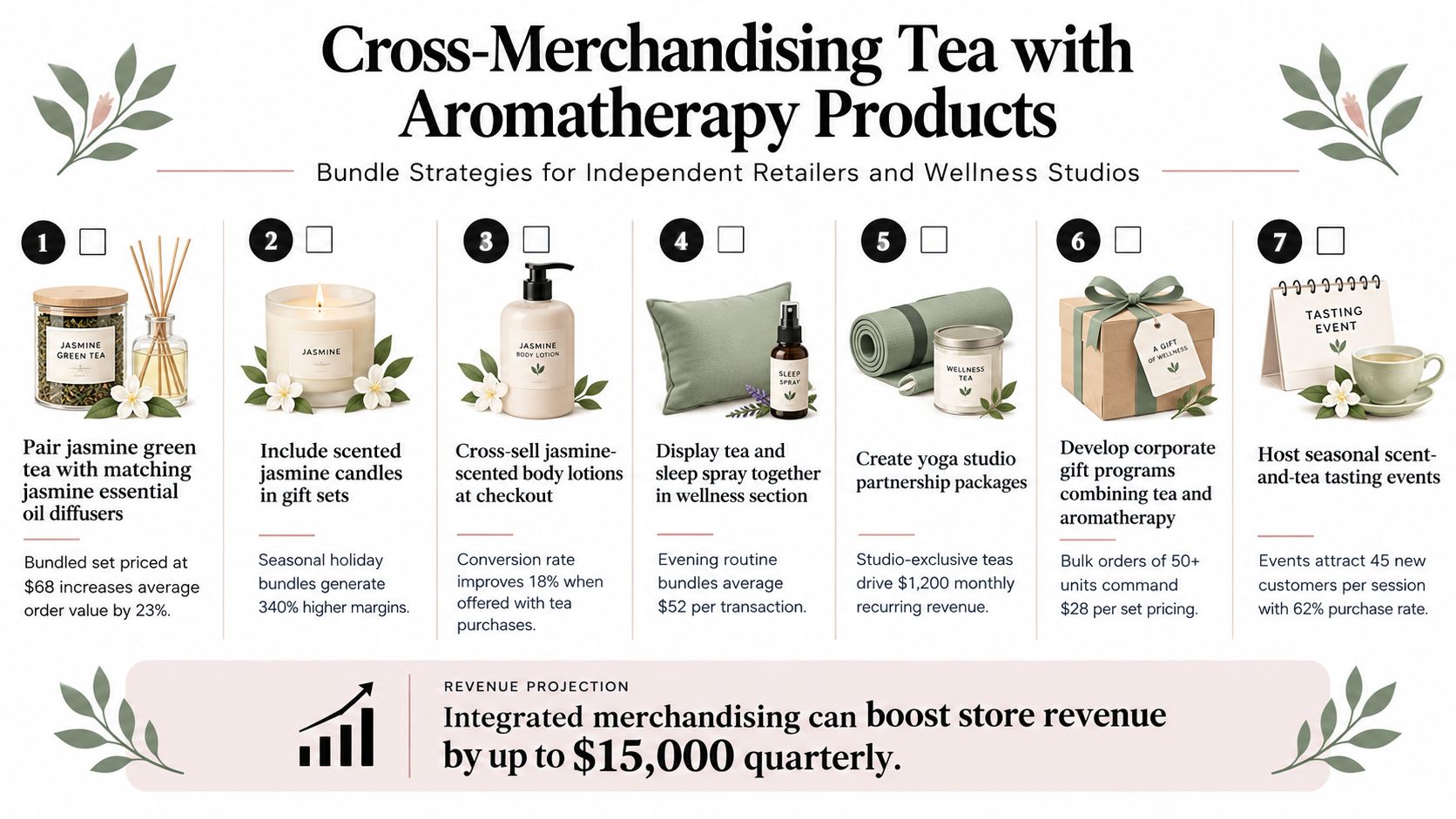
Jasmine green tea can act as the entry point to a broader sensory ritual. A customer who responds to the tea's floral profile may also be interested in a jasmine incense, room fragrance, diffuser accessory, or giftable bath product. The opportunity isn't to force unrelated add-ons. It's to build a coherent sequence from taste, to scent, to space.
Build a ritual, not a random bundle
A simple “Jasmine Ritual” display can pair loose-leaf jasmine green tea with a tea infuser, a small incense pack, and a fragrance oil or diffuser accessory. Keep the products visually connected through botanical language, but label their functions clearly. The tea is for drinking, the incense is for environmental fragrance, and the oil is for use according to its product instructions.
Use staff prompts that invite comparison:
Start with the cup: “Do you prefer a fresh floral jasmine profile or something deeper and sweeter?”
Move to the room: “Would you like the surrounding scent to stay light and airy, or become warmer and more noticeable?”
Clarify the format: “This jasmine product is for fragrance, while the tea is a beverage. They're designed for different uses.”
Offer a complete ritual: “You could use the tea during a quiet practice and choose the room scent separately for the space.”
A strong display might place the tea near a small card describing its floral aroma, then position incense and oils in a separate but adjacent section. This keeps the customer journey intuitive without suggesting that environmental fragrance should be ingested.
Source the botanical story with care
The merchandising logic only works when the products deserve customer confidence. Tea and incense may share a jasmine theme, but they can have different suppliers, materials, labeling requirements, and quality documentation. Don't use a tea's agricultural story to imply that every fragrance product on the shelf has the same origin or composition.
For displays focused on meditation or contemplation, a thoughtful article about crown chakra incense can help staff develop language around ritual and scent without turning a product recommendation into a health promise.
The best cross-sell is specific. Match a delicate tea with a light floral room scent, or match a fuller tea with a warmer incense profile. Let the customer choose the intensity. That approach improves the experience because it respects sensory preference instead of treating “jasmine” as a single, fixed smell.
Navigating Pesticide Residues and Sourcing Safety
Natural doesn't mean automatically residue-free. Jasmine flowers and scented tea can move through agricultural and processing systems where pesticide use, testing standards, and regulatory limits differ. A retailer doesn't need to create fear, but it does need enough documentation to answer reasonable questions.
A PubMed-indexed study developed a method for testing 25 commonly used pesticides in jasmine flowers and scented tea and found that some marketed flower and tea samples contained combinations of pesticide residues, as reported in this study of pesticide residues in jasmine products. A related analysis of pesticide behavior through cultivation, scenting, and brewing reported measurable residues for five pesticides and concluded that overall acute and chronic dietary risk from drinking the tested tea was acceptable, while also indicating that some residues could exceed maximum-residue limits under particular analytical assumptions.
Those findings require a measured response. Detection doesn't automatically mean unsafe exposure, and an acceptable risk assessment doesn't establish that every brand or batch is equivalent.
Ask suppliers better questions
A buyer evaluating jasmine green tea should request documentation rather than rely on the words “natural,” “pure,” or “premium.”
Identify the supply chain. Record country of origin, tea-growing region when available, flower source, processor, and importer.
Ask how the product is tested. Find out whether the supplier uses independent laboratory analysis and whether results apply to the current batch.
Separate flowers from leaves. Jasmine blossoms used for scenting and green tea leaves are distinct materials. Both may matter, but they shouldn't be discussed as though they are interchangeable.
Verify certifications. Organic certification can provide useful controls, but confirm which organization issued it and what product or facility it covers.
Keep batch records. Store lot numbers, invoices, certificates, and test reports so staff can trace the product if a customer raises a concern.
Responsible wording: Say, “This batch has the supplier documentation we can provide,” rather than “This tea is completely free of contaminants.”
For fragrance merchandise, apply the same culture of transparency without transferring beverage claims to oils or incense. Product descriptions should explain intended use, materials where disclosed, and handling instructions. A useful reference for discussing clean beauty fragrance sourcing is more valuable than an unsupported purity slogan.
Store records as carefully as stock
Keep laboratory documents with the corresponding purchase order and lot information. Rotate products so an older batch isn't left behind while newer stock sells first. If a supplier changes the origin, processor, or packaging, treat it as a new sourcing decision and reassess the documentation.
This process protects the customer and the business. It also gives staff a calm answer when someone asks whether jasmine tea has been tested, rather than forcing them to improvise.
Best Practices for Storing Botanicals and Oils
A jasmine product can be perfectly sourced and still lose its appeal through poor storage. Tea leaves and fragrance oils respond differently to air, light, and heat, but both require protection from avoidable environmental stress. The goal is to preserve the intended sensory profile from receiving dock to customer.
Protect tea from its biggest enemies
Use airtight, opaque packaging for jasmine green tea whenever possible. Light can flatten delicate aromas, oxygen can reduce freshness, and heat can accelerate deterioration. Keep stock away from windows, radiators, steam, strong cleaning chemicals, and shelves where neighboring fragrances can migrate into the tea.
Tea should also be separated from incense and concentrated oils. Even a sealed pouch can pick up unwanted odors if outer packaging is compromised or if the storage area is heavily saturated with fragrance. A dedicated tea cabinet or sealed tote is a small operational change with a large sensory payoff.
Give oils a different storage system
Fragrance oils need containers suited to concentrated liquids, usually well-sealed bottles that limit oxygen exposure and protect the contents from light. Amber glass is a practical choice for many oil products, while droppers and caps should remain clean and tightly closed. Avoid leaving bottles in direct sun or in areas with repeated temperature fluctuations.
A one-ounce bottle option can be useful when a retailer needs a controlled, giftable format or wants to divide a larger supply into smaller units. The container still needs a clear label, secure closure, batch or fill information where available, and storage guidance.
Rotate inventory by sensory condition
Don't rely only on a printed date. Open a representative unit periodically and evaluate aroma, color, texture, and packaging integrity. For tea, smell the dry leaf and brew a consistent sample. For oils, check whether the aroma has shifted toward stale, flat, harsh, or unexpectedly solvent-like notes.
Use a simple receiving and rotation routine:
At arrival: Record supplier, lot, date received, package condition, and storage location.
Before display: Check seals, labels, and aroma. Keep damaged or leaking units off the sales floor.
During rotation: Place older stock forward and protect reserve stock from heat and light.
At replenishment: Avoid opening multiple packages when one active container will serve the display.
At review: Compare the sensory sample with the original product description and supplier reference.
Operational standard: Treat aroma as part of quality control, not merely as decoration. Customers notice when a jasmine product has lost its lift.
Good storage also improves merchandising consistency. A customer should encounter the same floral identity in the package, the brewed cup, and the related environmental scent products. That consistency builds confidence without requiring exaggerated health claims.
If you're building a jasmine-focused assortment, start with one well-documented tea, one complementary incense profile, and one clearly labeled fragrance format. Aroma Warehouse can help independent retailers, spas, yoga studios, and gift shops source incense, fragrance oils, diffusers, burners, bottles, and related aromatherapy supplies for a cohesive display. Visit Aroma Warehouse to review the available wholesale and retail options, then create a small jasmine ritual that your staff can explain accurately and customers can enjoy safely.


