

Honey Fragrance Oil: A Complete Guide for Makers
You're standing at a bench with a fresh bottle in your hand, and the scent doesn't quite match what you expected. One supplier's honey note leans floral and soft, another smells waxy and warm, and a third goes almost smoky in wax. That's normal, because honey fragrance oil is a formulated scent, not a single, fixed natural substance.
Table of Contents
The Scent Profile and Common Note Pairings - Reading the note families
How Honey Fragrance Oil Differs From Essential Oils - Side by side in plain language
Safe Usage Across Candles, Soaps, Diffusers, and Cosmetics - Use it by category
Why Performance Varies and How to Test a Batch - Test it the same way every time
Blending and Formulation Tips for Signature Scents - Build the scent around one anchor
Wholesale Buying and Marketing Angles for Retailers - What to ask before you place a wholesale order
What Honey Fragrance Oil Actually Is
A shop owner can run into this with the first test batch. You buy a “honey” scent, pour it
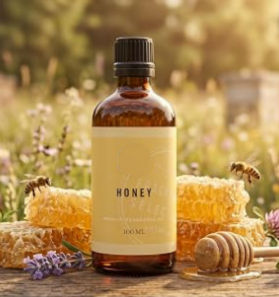
into wax, and the result may smell more like sweet clover, beeswax, or ambered nectar than a spoonful of table honey. That difference is normal, because the material is built to suggest honey, not to copy a jar of honey exactly.
Honey fragrance oil is a manufactured scent profile assembled to suggest honey's warmth, sweetness, and depth. One technical document describes a honey-oriented material built around methyl anthranilate at 90 to 100%, with the molecular formula C8H9NO2 and CAS number 134-20-3 (technical documentation). The same document describes it as a pale-straw oily liquid with a floral, sweet odor, and notes that it dissolves in oil and ethanol but not in water.
That matters for anyone filling bottles, blending bases, or writing labels for resale. A honey scent is usually intended for oil-based products, ethanol perfumes, incense bases, wax systems, and other compatible carriers, not for water alone. The name on the label can cover very different scent structures, so you are buying a scent effect, not a universal natural extract.
Practical rule: treat honey fragrance oil like a formula sheet. If the supplier changes the formula, the smell can change even when the product name stays the same.
Honey itself also helps explain why the category feels broad. Analysts using HS-SPME-GC-MS have identified 55 to 94 volatile compounds across honey samples, including alcohols, aldehydes, acids, esters, ketones, phenols, and hydrocarbons (study on honey volatiles). A honey accord may therefore push sweet, waxy, floral, or smoky depending on how it is built.
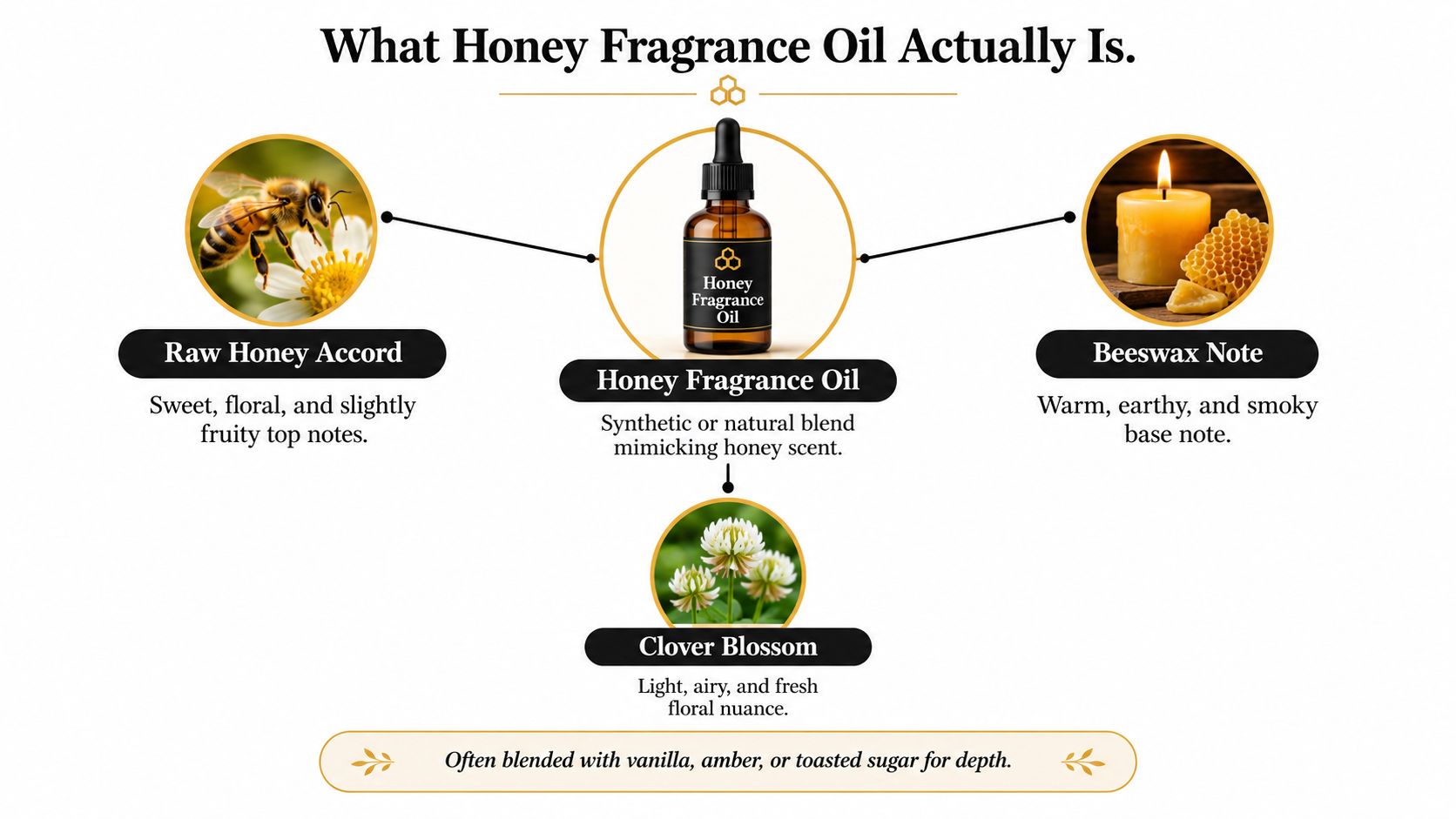
For a maker or reseller, the simplest model is this. Honey fragrance oil is a reconstruction, built with warm golds, soft florals, and sweet base notes instead of literal honey in the bottle. If you want to browse how fragrance oils are grouped for retail use, see the fragrance oils collection.
The Scent Profile and Common Note Pairings
A strong honey accord is rarely one-dimensional. In the bottle, it can read as raw honey, beeswax, clover blossom, warm amber, toasted caramel, or smoky honey, and those shades change how customers describe the same product. That's why two oils with “honey” in the name can feel completely different on a strip or in a finished candle.
Reading the note families
Raw honey smells sweet, rounded, and slightly fruity. Beeswax usually brings a warm, earthy depth that keeps the fragrance from turning candy-like. Clover blossom adds air and brightness, which can make the whole blend feel cleaner and more wearable.
From there, the pairing choices shape the final personality. Florals like orange blossom and lavender lift the honey and make it feel polished. Woods like sandalwood and cedar give it structure. Spices such as cinnamon and clove push it toward bakery or holiday territory, while vanilla, butter, and salted caramel lean into the gourmand trend that's been showing up more often in food-inspired scent concepts (gourmand fragrance trend coverage).
A honey oil that smells “less edible” isn't broken. It may simply be built around wax, amber, or smoke rather than syrup.
If you're briefing a supplier, use the language of smell instead of the name alone. Say whether you want the honey to read fresh and floral, thick and syrupy, dry and smoky, or rich and bakery-like. That small distinction saves a lot of back-and-forth when you're testing samples for a private label line.
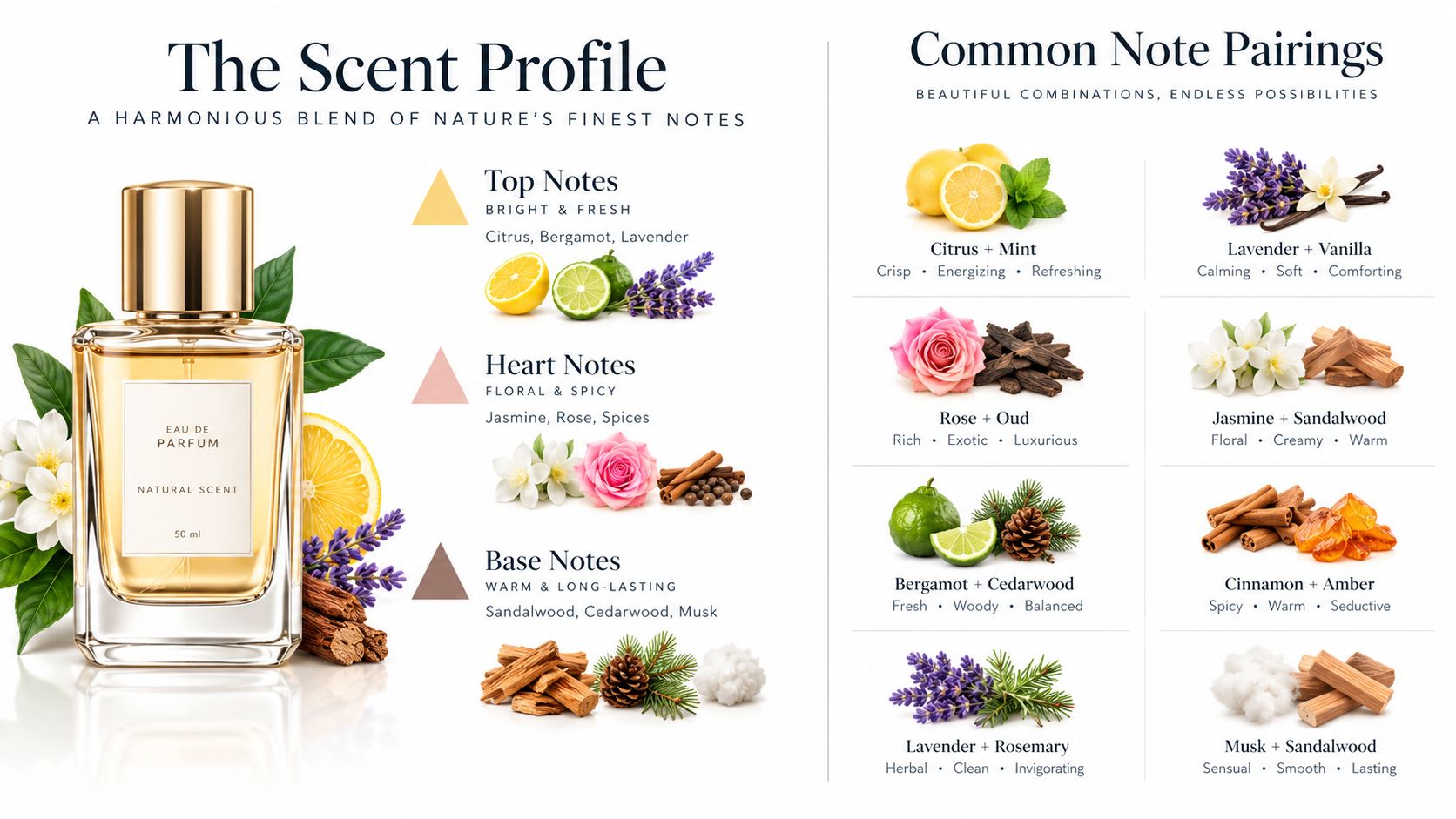
A good working list for buyers looks like this:
Floral lift: orange blossom, lavender, jasmine
Warm depth: sandalwood, cedar, amber
Sweet direction: vanilla, butter, caramel
Spiced profile: cinnamon, clove, nutmeg
How Honey Fragrance Oil Differs From Essential Oils
Customers often assume every scented oil comes from plants in the same way. That's not how this category works. A fragrance oil is compounded to hit a scent target, while an essential oil is typically distilled or expressed from plant material.
Honey is the clearest example of the difference. A true honey essential oil doesn't exist in commercial practice the way lavender or peppermint does, so a honey note is usually created through perfumery materials rather than extracted from honey itself. That gives formulators much more control over the final smell, but it also changes what you tell customers and how you use the material.
Side by side in plain language
Honey fragrance oil gives you consistency, stronger design control, and access to notes nature doesn't provide in a neat bottle. Essential oils bring a different kind of appeal, but they're less suited to reproducing a dependable honey scent across batches. The right choice depends on the product, not the romance of the label.
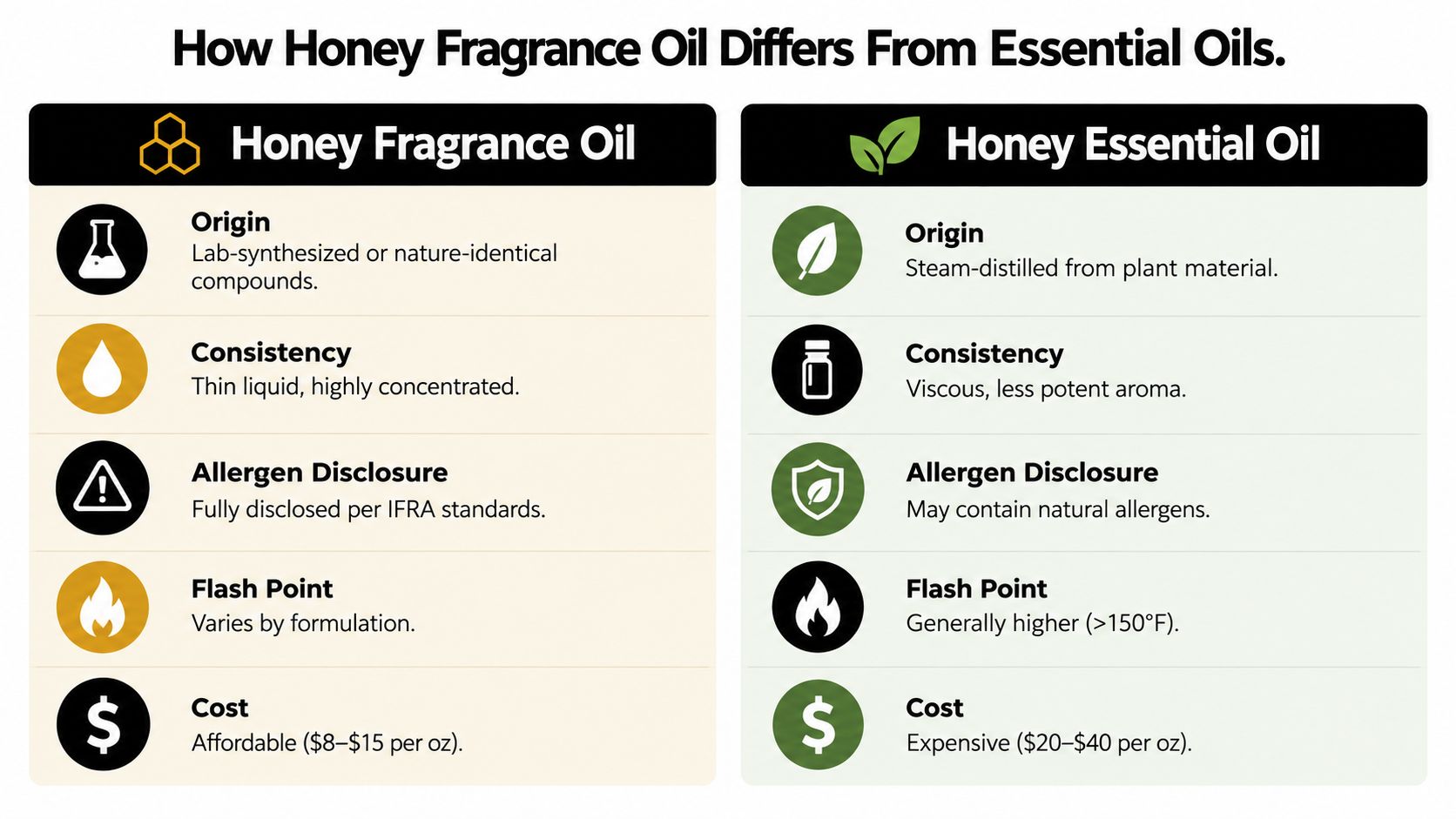
For retailers who need a plain-spoken customer explanation, this is usually enough: fragrance oil is built for scent design, essential oil is built around plant extraction. If you need broader sourcing language for your product pages, review the essential oils category and keep the distinction clear.
Don't call a honey fragrance oil “natural” unless the supplier documents that claim. The name alone doesn't tell you how it was made.
That distinction matters most in candles, soaps, and diffusers, where stability and repeatability are the business goal. If a scent has to perform the same way in every jar, the fragrance route usually makes more sense.
Safe Usage Across Candles, Soaps, Diffusers, and Cosmetics
Safe use starts with the finished product, not the bottle on your shelf. IFRA standards set different maximum concentrations by application, and an IFRA Certificate of Conformity is not the same thing as an EU allergen declaration (IFRA standards guidance). That's the document split resellers miss most often.
Use it by category
For candles, the main questions are wax compatibility and burn performance. Honey accords often behave well in waxes that carry fragrance cleanly, but the actual load should come from the supplier's usage guidance, not a guess. For cold-process soap, honey notes can shift during saponification and cure, so test a small batch before committing to production.
For diffusers, the carrier matters just as much as the fragrance. Honey fragrance oil may work in an alcohol or diffuser-base system, but a product that performs well in a reed blend is not automatically appropriate for skin contact. For leave-on cosmetics, the bar is higher, because the intended exposure is direct and the limits are category specific.
Here's a bench-friendly reference you can use as a starting checklist, not a universal formula:
Product Category | Starting Range | Carrier or Base | Notes |
|---|---|---|---|
Candles | Supplier-specific | Soy, paraffin, or blend wax | Test hot throw and cure time |
Cold-process soap | Supplier-specific | Soap oils | Watch for trace behavior |
Reed diffusers | Supplier-specific | Reed base or alcohol system | Check wicking and evaporation |
Leave-on cosmetics | Supplier-specific | Finished cosmetic base | Follow IFRA and allergen rules |
If you sell or formulate across categories, keep the paperwork together. Ask for the SDS, the IFRA document for the specific application, and the allergen declaration. If you also make bath and body products, the bath and body collection is a useful reminder that each end use needs its own compliance check.
Why Performance Varies and How to Test a Batch
Honey aroma doesn't behave the same way in every base. The scent sits in both the volatile headspace and the semi-volatile fraction, so what people smell depends on evaporation, carrier, and matrix, and heat can alter delicate aldehydes, esters, and terpenoid materials (MDPI review). That's why a gorgeous strip test can disappoint in a candle, or a soft soap fragrance can bloom after cure.
Test it the same way every time
Start by diluting a small amount in the intended carrier. Then smell it at three points, immediately after blending, after 24 hours, and after one week. Record what you notice in the top note, middle, and dry-down, then keep one sealed control sample so you can compare future batches against the same reference.
Practical rule: test in the product system you actually sell. A scent that behaves in ethanol may vanish in wax.
If you're buying for resale, consistency matters as much as the smell itself. A honey accord that opens bright in one batch and smoky in the next can make customer reviews unpredictable, especially when you sell the same scent across candles, melts, and room products. The cleanest way to catch drift is to compare incoming goods before they reach the shelf.
For resin bases, carriers, and other blending systems, a reliable reference helps. The dipropylene glycol guide is useful because it sits right at the junction between fragrance handling and product stability.
A good batch log doesn't need to be fancy. It just needs to tell you whether the oil still smells like the standard you approved last time.
Blending and Formulation Tips for Signature Scents
Honey works best when it has a job. In one formula, it can be the lead heart note. In another, it can be the warm base that softens a sharper accord. In a third, it's just a quiet modifier that rounds off edges without dominating the jar.
Build the scent around one anchor
Start with one anchor family, then decide what honey should do inside it. A honey and orange blossom candle reads bright and polished. A honey, oats, and milk soap feels creamy and comforting. A honey, amber, and smoke diffuser moves into lounge or meditation territory.
That approach keeps the blend readable. If you add too many sweet notes at once, the fragrance can flatten into syrup. If you add too many dry notes, the honey disappears. One anchor, one supporting note, one accent is usually enough for a small line.
Pairing works better when you choose contrast on purpose. Bright florals lift honey, woods steady it, and smoke gives it character.
For private label work, write the brief in three parts. First, state the mood. Second, choose the backbone note family. Third, decide whether honey should be obvious or subtle. That framework helps you move from generic stock scents to something customers can remember by name.
FAQ about Honey Fragrance Oil
1. How can you tell if a honey fragrance oil is suitable for a specific craft project?
Check the supplier's technical documentation for compatibility with your intended application. A fragrance oil designed for candles may not be suitable for soap, reed diffusers, or skin-contact products. Confirm the recommended product category, usage limits, and any required handling precautions before purchasing.
2. Does honey fragrance oil work well in unscented incense sticks?
Honey fragrance oil may be considered for incense-making projects, but compatibility depends on the fragrance formulation, dipping carrier, and incense base. Test a small quantity first to evaluate scent retention, drying behavior, and the aroma released during burning. Follow the supplier's guidance for incense applications.
3. What makes honey fragrance oil a useful choice for seasonal product collections?
Honey-inspired fragrances can complement autumn, winter, and year-round comfort-themed collections. Their sweet, warm character pairs naturally with concepts such as harvest gifts, cozy home fragrance, and gourmand-inspired product lines. The exact positioning depends on whether the fragrance smells floral, waxy, creamy, or richly sweet.
4. Can you combine honey fragrance oil with an existing fragrance oil?
Yes, compatible fragrance oils can be blended to develop a custom scent. Begin with a small test batch and introduce the honey fragrance gradually so it complements rather than overwhelms the original scent. Before using the blend in a finished product, verify compatibility and applicable usage limits for the complete formula.
5. What should small businesses compare when choosing honey fragrance oil in bulk?
Compare the fragrance profile, cost per usable unit, available bottle sizes, technical documentation, and consistency between batches. Also consider minimum order quantities and whether the supplier can provide samples before a larger purchase. These factors help businesses evaluate product suitability and manage inventory without relying on the fragrance name alone.
Storage, Shelf Life, and Labeling for Resale
A honey fragrance oil should be stored like a finished formula ingredient, not like room mist. Keep bottles tightly sealed, upright, and away from heat and light. That slows odor drift and helps the scent stay closer to its intended profile. Once a cap stays open on a warm shelf, the top notes can shift faster than a reseller expects.
The material also deserves careful handling. Supplier documentation describes a honey-oriented oil as an oily liquid that mixes with oil and ethanol, not water, and the handling notes classify it as an eye irritant. That means gloves, clean dispensing tools, and clear warning language belong in ordinary shop practice, not as an afterthought.
Resale paperwork serves different jobs, and it helps to keep them separate. An IFRA certificate sets out use limits for a product category. An SDS explains hazards and handling. An allergen declaration supports labeling in a different way. They may arrive together, but they do not replace one another.
Labels should stay plain and defensible. Avoid words like natural, contains honey, or therapeutic unless your documentation supports them. Use the product name, batch code, and required warnings in a layout that is easy to read at shelf distance. Where your market requires fragrance naming rules, follow those rules exactly.
A practical printing partner can save time here. Resources such as Top UK Sticker and Label Printers are useful for turning compliance text into packaging that looks professional across retail bottles, sample vials, and refill sizes. Good labeling keeps the line organized, especially when one scent moves through several formats.
Wholesale Buying and Marketing Angles for Retailers
A strong honey fragrance oil listing starts with a simple question, what does the buyer need this scent to do on the shelf? Honey already carries familiar cues of comfort and warmth, so it sells more easily than an abstract name. The broader honey category is widely recognized across many markets, which helps retailers present the fragrance as cozy, premium, or suited to ritual use, without extra explanation (FAO-linked market data).
What to ask before you place a wholesale order
Start with the formulation paperwork. Look for fresh-to-pour service, clear category-specific IFRA paperwork, and bottle sizes that suit both retail shelves and back-bar refills in the wholesale fragrance oils collection. A supplier should also describe the scent character in plain terms, whether the honey note reads floral, waxy, or gourmand, because that detail shapes repeat sales and product fit.
For online stores, presentation matters as much as supply. The technical SEO tools for online stores article is useful if you are building product pages, internal links, and category copy for fragrance listings at scale.
A practical wholesale checklist helps keep choices clear:
Ask for category fit: confirm the oil is documented for the exact product type you sell.
Check packaging options: small retail bottles and bulk sizes should both be available.
Request consistency info: confirm how batches are controlled and labeled.
Plan the story: position honey for gift sets, meditation blends, fall releases, or cozy home fragrance.
Marketing works best when the message stays grounded in how shoppers already read the scent. Comfort, warmth, and ritual are the strongest angles here. Honey fits holiday sets, self-care collections, and home fragrance bundles because the scent family is easy to recognize before a customer even opens the bottle.
If you need a dependable source for oils, incense, and related supplies, visit Aroma Incense Warehouse. It gives retailers options for private label, wholesale, and test batches, which makes it easier to compare honey fragrance oil across candles, body products, and home scent formats.


