

Best Essential Oils for Smudging: A Practical 2026 Guide

You've probably stood in a store or scrolled online, trying to figure out which scent will make a room feel calmer, cleaner, or more intentional without going overboard. That's usually what people mean when they search for the best essential oils for smudging, but the answer isn't just about fragrance. It's about choosing a scent that fits the ritual, respects the cultural roots of smudging, and won't make breathing harder for anyone in the room.
Table of Contents
How Smudging Differs from Modern Aromatic Cleansing - The language matters as much as the scent
Top Essential Oils to Know for Smudging Style Rituals - A quick scan of the main options
Safe Ways to Release the Scent You Actually Want - Pick the method before you pick the mood
Inhalation Safety and Who Needs Extra Caution - Who needs extra caution
Three Simple Blends You Can Mix Today - Grounding blend - Uplifting blend - Calming blend
Sourcing, Sustainability, and Retail Friendly Packaging - What to ask before you buy
What Readers Actually Want from a Smudging Oil Guide

Most readers do not want a lecture. They want a scent that feels right, a method that is
easy to use, and enough safety guidance to avoid a bad outcome in a small room or shared space. If you are a home user, you may be looking for something that helps you reset after a long day. If you are a retailer, you may be trying to answer customer questions without flattening every cleansing ritual into the same trend.
That's where this topic gets messy. Smudging is a culturally specific Indigenous ceremony, not a generic home-fragrance trick, and Indigenous plant-based purification practices long predate modern aromatherapy. A historically grounded approach recognizes that essential oils can support a personal aromatic ritual, but they don't carry the same meaning, protocol, or authority as traditional plant ceremonies. The legal milestone often overlooked in casual product copy is the American Indian Religious Freedom Act of 1978, which recognized and protected Native American religious practices in the United States after earlier restrictions had made some ceremonies difficult to practice openly (historical context on sage and smudging).
Practical rule: If the ritual is commercial, call it an aromatic cleansing practice. If it's a traditional ceremony, name it carefully and respect the community it belongs to.
For readers, that means the decision is simpler than it first looks. Choose a scent profile that matches the mood you want, choose a delivery method that fits the room, and choose language that doesn't claim a bottle can replace a tradition. A thoughtful guide should help you do all three without pretending every oil works the same way.
How Smudging Differs from Modern Aromatic Cleansing
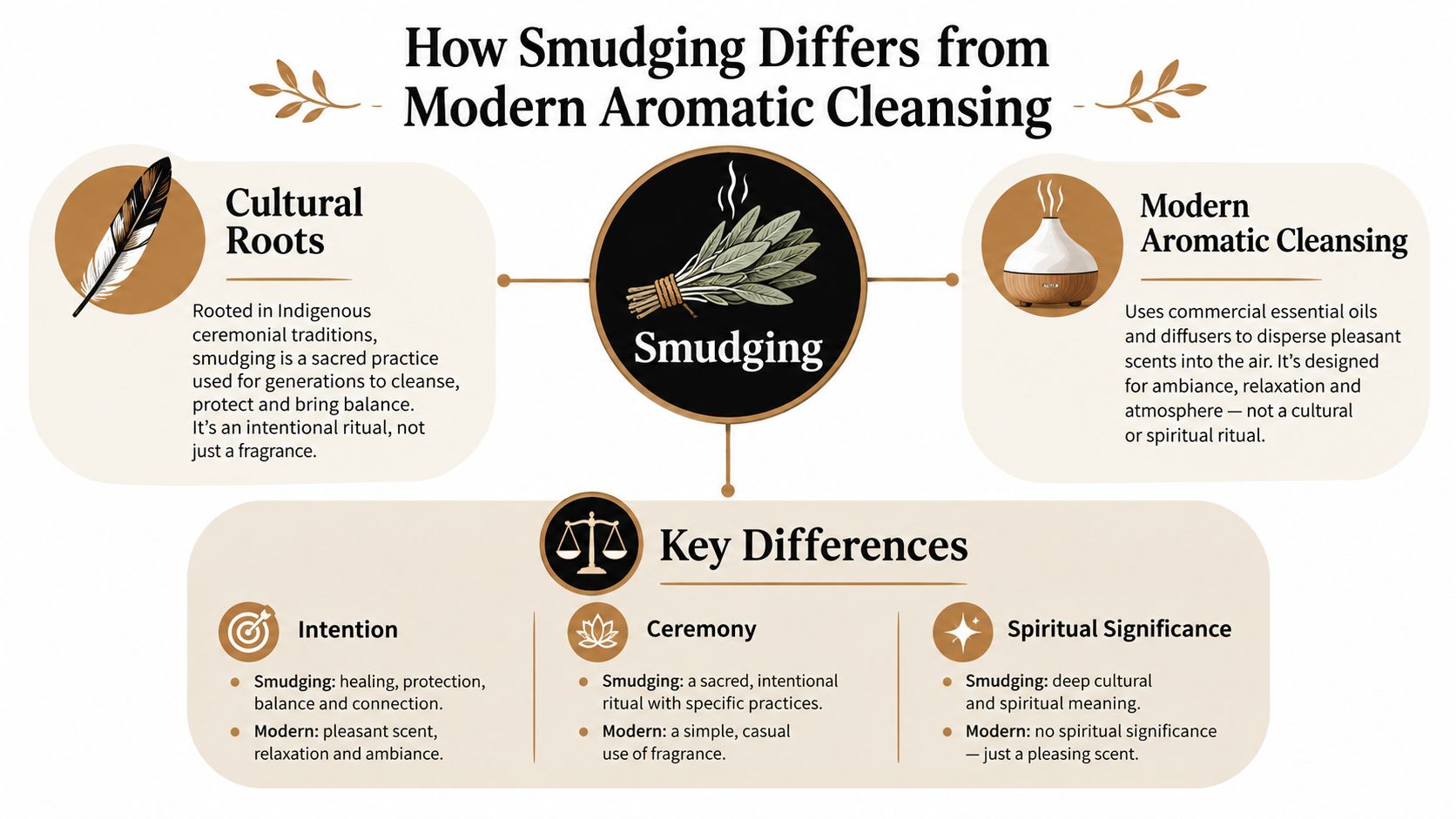
Traditional smudging belongs to living Indigenous cultures, including practices described among Lakota, Chumash, and Cahuilla peoples, where plant smoke is tied to prayer, purification, and healing. That matters because the act isn't just about scent. It's about relationship, intention, and inherited knowledge. When a retailer or studio uses the word casually, the result can erase what makes the practice meaningful in the first place.
The language matters as much as the scent
A bottle of lavender oil, a cedarwood diffuser blend, or a frankincense room spray can be part of a modern ritual, but they're not interchangeable with sacred plant bundles. If you're writing product pages, talking to customers, or setting up a studio menu, use terms like aromatic cleansing, ritual mist, or scented meditation unless you're describing a traditional ceremonial practice. That keeps your language honest and avoids implying that a commercial oil carries cultural authority it doesn't have.
There's also a venue issue. Public settings often need consent, notice, and accommodation, especially when smoke or scent may affect sensitive people. Manitoba's public-school guidance on smudging says participation should be voluntary and that people should be able to raise health or environmental concerns ahead of time (smudging guidelines). That's a useful model for stores, studios, and event spaces too.
For readers who want a plain-language comparison, one helpful resource is this internal explainer on the difference between incense and sage smudge: incense or sage smudge understanding the key differences. The main takeaway is simple. Essential oils can support a personal aromatic ritual, but they shouldn't be marketed as a substitute for Indigenous tradition.
Top Essential Oils to Know for Smudging Style Rituals
People usually ask for a “best” list because they want a shortcut. The honest answer is that the right oil depends on what you want the room to feel like. Some scents read as grounding, some as floral and soft, and some as resinous and meditative. A smart choice starts with scent profile, not hype.
A quick scan of the main options
Oil | Scent Profile | Traditional Association | Best Delivery Method | Mood |
|---|---|---|---|---|
Herbal, sharp, clean | Purification, clearing, ceremonial use | Scent-only ritual, diffuser, spray | Clear, focused | |
Dry, woody, warm | Grounding, tree-based ritual aroma | Diffuser, burner, wand | Steady, earthy | |
Floral, soft, calming | Relaxation, peaceful atmosphere | Diffuser, spray, low-heat warming | Gentle, restful | |
Resinous, bright, meditative | Sacred space, prayer, reflection | Resin smoke, diffuser, low-heat burner | Reverent, centering | |
Deep, balsamic, earthy | Companion resin, solemn ritual tone | Resin smoke, diffuser blend | Quiet, contemplative | |
Sweet, woody, bright | Modern ritual fragrance, cleansing scent | Scent-only use, diffuser, spray | Lifting, fresh | |
Soft, hay-like, sweet | Ceremonial fragrance in some traditions | Scent-only reference, not a substitute | Soft, welcoming |
Sage, cedarwood, lavender, frankincense, myrrh, palo santo, and sweet grass all show up in smudge-style conversations, but they serve different purposes. Frankincense is often the strongest choice when the goal is a resinous ceremonial atmosphere. A published analysis of frankincense and myrrh showed frankincense essential oil dominated by α-pinene (38.41%) and myrcene (15.21%), while myrrh contained furanoeudesma-1,3-diene (17.65%), curzerene (12.97%), β-elemene (12.70%), and germacrene B (12.15%); in a church setting, frankincense smoke reduced airborne viable fungi by up to 80.43 ± 2.07% and bacteria by up to 91.43 ± 1.26%, while frankincense vapor alone produced smaller reductions (frankincense and myrrh analysis). That makes frankincense a practical first pick when ritual smoke is part of the goal, while myrrh works well as a deeper, complementary note.
Lavender belongs in a different lane. It's a softer, lower-intensity choice, and its antimicrobial claims vary too much to treat it as a reliable cleaner. One review cited minimum inhibitory concentrations of 0.16% against Haemophilus influenzae, 0.32% against Streptococcus pyogenes and Staphylococcus aureus, and above 0.32% against Escherichia coli; another study reported values from 0.5% to above 2% by volume (lavender review). That variability is why lavender is better marketed for its floral ritual feel than for disinfecting claims.
If you're shopping for gift sets or mood-based bundles, a broader scent guide like spa gift ideas for shower lovers can help buyers think in terms of atmosphere rather than medical effects. For resin-heavy blends, this myrrh and frankincense guide is a useful internal companion: essential oils myrrh frankincense.
Best pick by purpose: Choose frankincense for a solemn, resinous ritual tone, cedarwood for grounding, and lavender when you want the softest atmosphere with the least force.
Safe Ways to Release the Scent You Actually Want
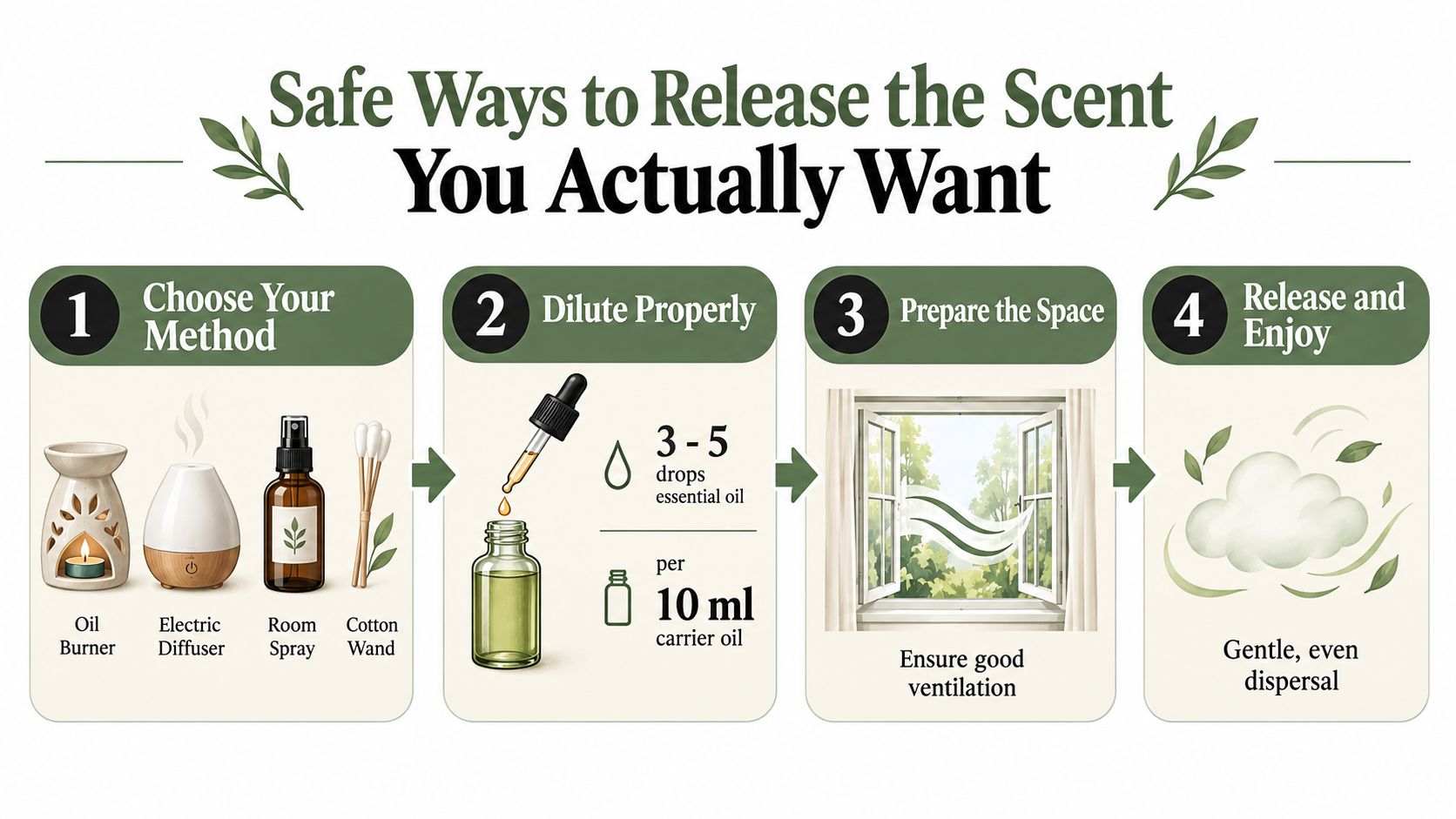
The easiest mistake is thinking the oil matters more than the delivery method. It doesn't. A gentle scent released through a diffuser behaves very differently from the same oil heated, sprayed, or burned. The safest choice is usually the least intense method that still gives you the atmosphere you want.
Pick the method before you pick the mood
A diffuser is the cleanest option for many homes because it disperses scent without open flame. A room spray gives you even quicker control, especially in shared spaces or commercial settings. An oil burner or warmer adds more presence, but it also raises the risk of overheating and stronger airborne compounds. Cotton or wooden wands are better for scent transfer and light aroma than for heavy fragrance output.
Dilution matters. For a basic diffuser blend, start small and keep sessions short. For sprays, use a carrier such as high-proof alcohol or another appropriate spray base rather than pouring concentrated oil straight into water and hoping it mixes well. If you're making a topical-style carrier blend for another purpose, that's a separate use case, not a room ritual.
A clinical safety review found that serious adverse events from aromatherapy are rare, but it also notes nasal irritation, eosinophilic pneumonia, and seizures in rare cases involving eucalyptus, camphor, and rosemary (clinical aromatherapy safety review). That doesn't mean these oils are forbidden. It means they deserve respect, especially in small rooms.
Simple rule: Use the gentlest method that still delivers the scent you want, then ventilate the room.
For anyone comparing diffuser setups, this internal guide may help narrow the equipment side: best essential oils for diffusers. If you're working in a home with asthma or a shared workspace, don't replace steam, fresh air, or light scent with smoke. Smoke is a different exposure entirely, and it needs a different level of caution.
Inhalation Safety and Who Needs Extra Caution
A pretty scent can still be the wrong choice for the room you're in. Essential oils release volatile organic compounds, and long, heavy use can raise indoor exposure in ways that matter, especially when ventilation is weak. The safest approach is to think about the air itself, not just the fragrance.

Who needs extra caution
A population study of 200 homemakers found that people using essential oils for more than four hours daily had significantly higher TVOC and PM2.5 exposure than light or nonusers, along with higher blood pressure and heart rate (indoor exposure study). That doesn't mean occasional use is dangerous. It does mean prolonged exposure is not the same as a quick aromatic session in a ventilated room.
Watch the room, not just the bottle. Scent behaves differently in a small bathroom, a nursery, a treatment room, and a living room with open windows.
Extra caution makes sense for children, pets, pregnant people, and anyone with asthma or another respiratory condition. Inhaling smoke from burned herbs or incense is not the same as diffusing an oil, and smoke adds particulate matter that many sensitive people tolerate poorly. That's why smoke-based rituals need more careful planning than scent-only rituals.
A few oils deserve special respect. The safety review above highlights rare but real inhalation-related issues associated with eucalyptus, camphor, and rosemary. That doesn't make them unusable, but it does mean a strong mist or long burn session isn't a good default.
For practical handling, keep the space open, keep the session short, and stop if anyone starts coughing, wheezing, getting a headache, or feeling irritation. If you're a studio owner or shop buyer, the safest product language is specific and humble. Say what the oil smells like, say how it's delivered, and never imply that more smoke or stronger aroma is automatically better.
If you want a related internal read on strong-smelling oils and how they behave, this guide on eucalyptus and lavender is helpful: eucalyptus and lavender oil.
Three Simple Blends You Can Mix Today
A good blend doesn't need a long ingredient list. It needs a clear purpose, a balanced scent, and a format that's easy to repeat. These three blends are built for atmosphere first, not for medical claims.
Grounding blend
Use 3 drops cedarwood, 2 drops frankincense, and 1 drop patchouli in a diffuser, or scale that same ratio for a room spray base. Cedarwood gives it weight, frankincense brings a quiet resin edge, and patchouli adds depth without turning the scent muddy. This one works best when the room feels busy or scattered.
Uplifting blend
Use 3 drops sweet orange, 2 drops palo santo, and 1 drop lavender for a brighter ritual scent. The orange keeps the blend open, palo santo adds a clean wood note, and lavender softens the edges so it doesn't read as sharp. It fits morning routines, entryway resets, and lighthearted gatherings.
Calming blend
Use 3 drops lavender, 2 drops chamomile, and 1 drop myrrh when the space needs to feel quieter. Lavender stays in front, chamomile rounds it out, and myrrh adds a deeper base that keeps the scent from disappearing too quickly. This is the best of the three for a wind-down routine.
Label every bottle or spray clearly. Include the oil names, the dilution ratio, and a line that says do not apply to skin undiluted. That matters for gifting and resale, because people often assume a room blend can be used topically when it can't. If you're using these in a shop or studio, keep the label plain and direct. Buyers trust products that tell them exactly what they're getting.
Sourcing, Sustainability, and Retail Friendly Packaging
A lot of bad smudge-style products fail before anyone even smells them. The bottle is unclear, the botanical name is missing, or the description blurs ritual language with vague wellness claims. Buyers notice that, and retailers should too.
What to ask before you buy
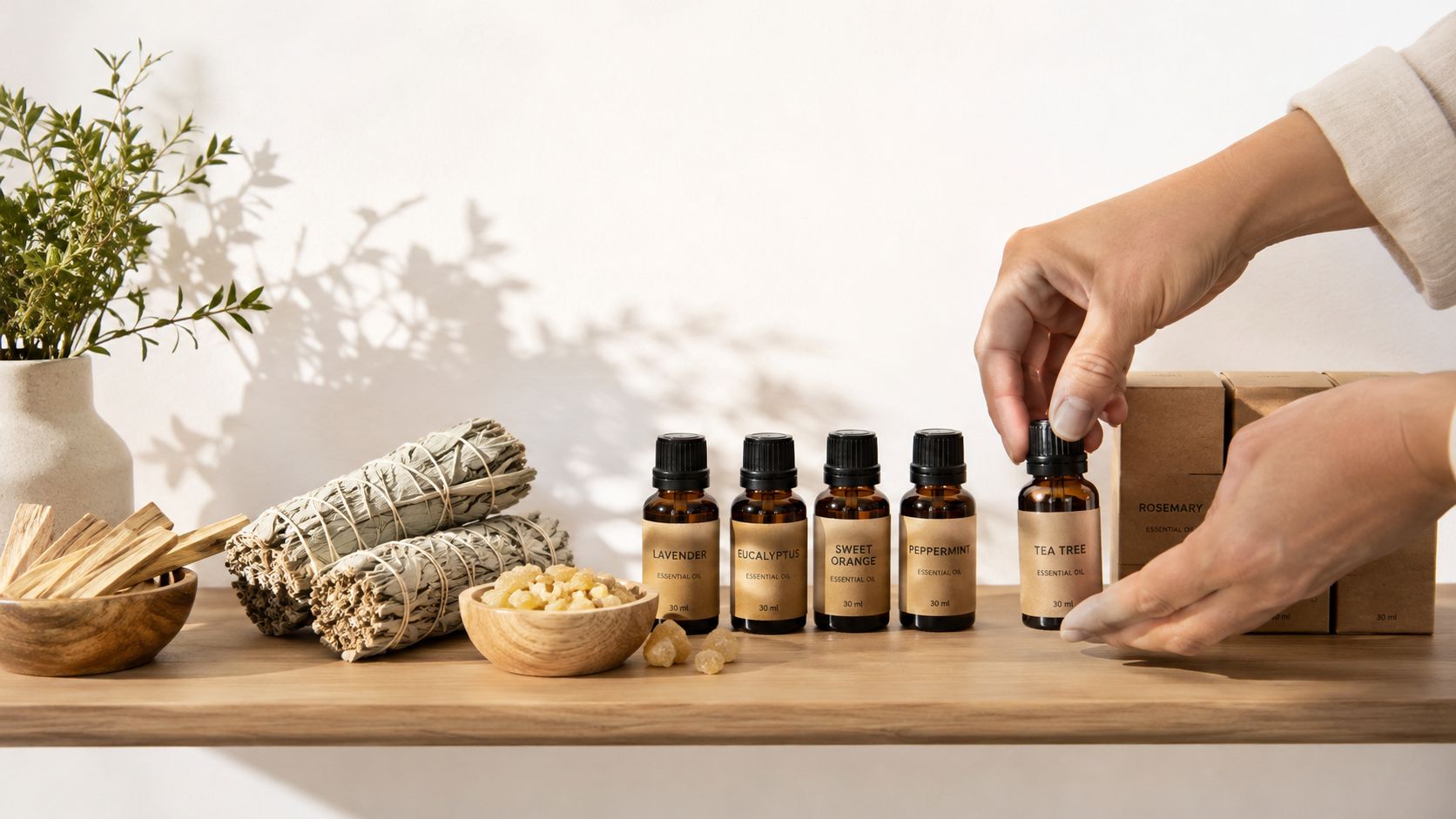
Look for the botanical name, batch information, country of origin, and whether the oil is single-note or blended. That helps you tell a real cedarwood from a generic “wood oil,” or a true lavender product from a perfume-style fragrance. If a supplier can't tell you what's in the bottle, the label isn't doing enough work.
Sustainability claims need a second look, especially around frankincense, myrrh, palo santo, and sage. Those names can carry a lot of emotional weight, which makes them easy to overmarket. For retail copy, keep the tone factual. Say where the oil comes from, how it's used, and what kind of scent experience it creates. Don't imply that a product is ecologically flawless just because it sounds sacred.
Packaging should match the buyer. Small amber bottles with droppers work well for home users who want control. Larger bulk sizes make more sense for resellers, wellness studios, and gift shops that need consistency across several applications. Custom labels help, but only if the copy stays clear about use, dilution, and storage.
If you stock patchouli, choose suppliers carefully and ask for quality and safety details. This internal guide covers the sourcing side well: the ultimate patchouli essential oil guide quality safety sourcing. That same mindset applies to every oil in a smudge-style lineup. Buy once, buy well, and make the label honest enough that a cautious customer feels comfortable.
Frequently Asked Questions
1. How can you tell if an essential oil is pure or a fragrance oil?
Check the product label for the botanical name, ingredient information, and whether the product is identified as a single essential oil or a fragrance blend. Pure essential oils are extracted from plant material, while fragrance oils may contain synthetic aroma compounds or a combination of natural and synthetic ingredients. Neither product type should be assumed to have the same composition or intended use.
2. Do essential oils lose their scent when stored improperly?
Yes. Heat, light, oxygen, and repeated exposure to air can gradually change an oil's aroma and quality. Store oils in tightly sealed containers, away from direct sunlight and excessive heat. Follow the supplier's storage recommendations and check for changes in scent, color, or consistency before use.
3. What is the difference between a single-note essential oil and an essential oil blend?
A single-note essential oil comes from one botanical source, while a blend combines two or more oils to create a layered aroma. Single oils offer greater control when experimenting with scent combinations, whereas pre-made blends provide a consistent fragrance profile without requiring you to measure individual ingredients.
4. How should essential oils be stored in a retail shop?
Keep essential oils in tightly closed, clearly labeled containers away from sunlight, heat sources, and excessive temperature changes. Maintain batch and supplier information when available, and organize inventory so older stock is used first. Retailers should also keep product instructions and safety information accessible to customers.
5. Can essential oils be used in an electric aroma diffuser?
Many essential oils can be used in compatible electric diffusers, but the correct product and method depend on the device. Ultrasonic diffusers typically use water and suitable essential oils, while nebulizing diffusers may use undiluted oils. Heat-based devices have different requirements. Always follow the manufacturer's instructions and never add oils to a device that is not designed to accommodate them.
Retail test: If the scent name sounds better than the product facts, the listing still needs work.
Putting It All Together and Answering Common Questions
Pick the oil for scent and mood, the method for safety and venue, and the label for honesty and respect. If you want a ceremonial feel, frankincense usually gives the clearest resin tone. If you want a softer everyday ritual, lavender or cedarwood is easier to live with. And if you're in a shared or sensitive space, a diffuser or spray is usually the better choice than smoke.
People also ask whether essential oils can fully replace sage bundles. They can't, because the meaning, material, and protocol are different. They also ask whether diffusers count as smudging, and the answer is no, not in the cultural sense. A diffuser can support a personal aromatic ritual, but it isn't the same practice. Smoke alarms, asthma, and shared-space rules matter too, which is why consent and ventilation should always come before fragrance intensity.
Aroma Warehouse carries incense, fragrance oils, burners, diffusers, and ritual accessories that fit both home use and retail buying. If you're building a respectful, practical scent ritual or stocking a store with clear, dependable products, visit Aroma Incense Warehouse to explore options that match the way your customers actually use aroma.


