

Eucalyptus and Lavender Oil: Benefits & Safe Use Guide
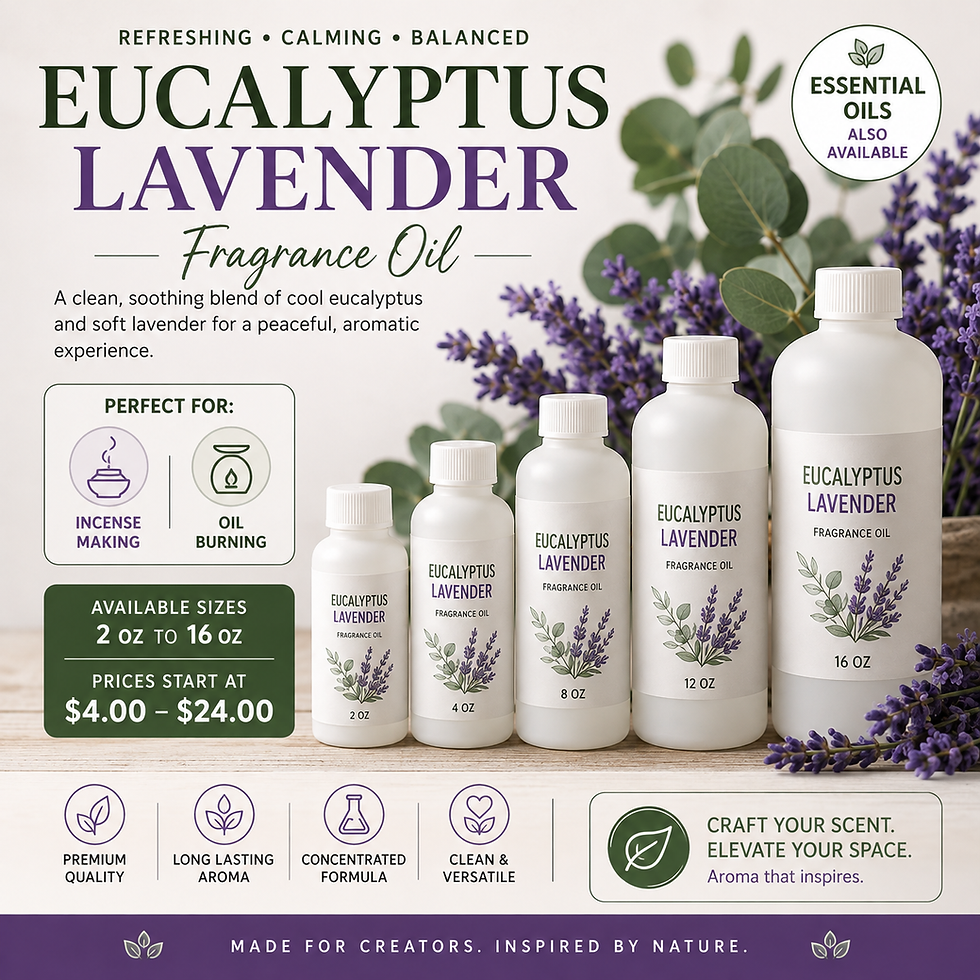
If you've ever stood in front of your diffuser at night with two bottles in hand, one labeled eucalyptus and the other lavender, you already know the basic dilemma. You want something that helps you breathe easier, settle your nerves, and doesn't smell like a medicine cabinet. That's exactly where eucalyptus and lavender oil make sense together, because they solve different parts of the same problem.
Eucalyptus tends to feel open, brisk, and clearing, while lavender usually feels soft, floral, and steadying. Used well, the pair can support a bedtime routine, a steam session, or a gentle room blend without pretending that both oils do the same job. Used carelessly, though, they can become overpowering or unsafe, especially if someone assumes “natural” means harmless.
Table of Contents
The Chemistry Behind Each Oil - Why eucalyptus is usually judged by cineole content - Why lavender is really a family of oils
Matching Blends to Real Goals - Sleep, stress, congestion, and focus all call for different ratios
Safe Dilution Ratios and Carrier Oils - The math is simple once you stop thinking in “more is better”
Safety, Contraindications, and Common Misconceptions - Plant-based does not guarantee safety - What to avoid in everyday use
Five Blend Recipes for Common Use Cases - 1. Sleep blend for a bedroom diffuser - 2. Cold-season steam bowl - 3. Calming bath soak - 4. Post-exercise body oil - 5. Work-from-home diffuser blend
Storage, Shelf Life, and Wholesale Buying Tips - Keep the oils stable, then ask better questions as a buyer
Why Eucalyptus and Lavender Oil Work So Well Together
A lot of people reach for a lavender-eucalyptus blend at bedtime because they want one

bottle to do everything. They're usually tired, a little stuffed up, and hoping for a scent that feels calming without being sleepy in a heavy, cloying way. That's why the pairing shows up so often in diffusers, spa rooms, bath products, and linen sprays, it gives the room two jobs at once.
Think of eucalyptus as the oil that opens the window, and lavender as the oil that softens the room. Eucalyptus brings lift and a sharper aromatic edge, while lavender rounds that edge off so the blend doesn't feel clinical. If you've ever tried a single-note eucalyptus diffuser blend and felt it was too cold or too intense, lavender is the easy partner that makes it livable.
For readers who like relaxation blends, a simple pairing can also stop the common mistake of overdosing one note. A diffuser filled with only lavender can feel flat to some noses, and a diffuser filled with only eucalyptus can feel too medicinal. A balanced blend makes the space feel more finished, which is why it shows up in the kind of “calm night” routines people search for in articles like this relaxation guide.
Practical rule: if the room needs to feel clearer, let eucalyptus lead. If the room needs to feel gentler, let lavender lead.
The key is not to ask both oils to do the same thing. Ask eucalyptus to bring the air forward, then ask lavender to make that experience easier to live with. That mental model will keep the rest of your blending decisions much simpler.
The Chemistry Behind Each Oil
Why eucalyptus is usually judged by cineole content
Eucalyptus oil is not just a recognizable scent. Its technical identity is tied to a high 1,8-cineole, or eucalyptol, fraction, and medicinal-grade material is specified as containing not less than 70% w/w cineole in one technical standard. Other sources describe crude oil as commonly above 60% cineole and rectified grades above 80% (ChemicalBook technical data). That matters because cineole drives eucalyptus' piercing, clearing character, and it also explains why batches can feel stronger or softer from one lot to the next.
The physical profile points in the same direction. Eucalyptus oil is a volatile liquid with a density around 0.905–0.925 g/mL at 25°C, a refractive index of about 1.458–1.475, and a boiling range that often falls around 160–200°C depending on composition. For a formulator, that means it evaporates quickly and behaves like a top-note material, not a slow, sticky base note. In practical terms, it leaves the bowl or diffuser early, so a small dose can shape the first impression of the blend. That is also why batch testing matters.
Why lavender is really a family of oils
Lavender is less about one molecule and more about balance. Peer-reviewed analysis of Lavandula angustifolia typically finds linalool and linalyl acetate as the dominant constituents, and their ratio is one of the main quality markers because it shapes both aroma and feel (ScienceDirect analysis). A higher ester balance usually reads softer and smoother, while higher camphor or 1,8-cineole can push the scent toward a sharper chemotype.
That is why two bottles labeled “lavender” can smell noticeably different. Origin, cultivar, harvest timing, and extraction source all shift the chemistry, which is also why buyers should verify a GC-MS specification rather than rely on the label alone. If you need a soft sleep blend, a bright linen blend, or a more herbal spa scent, that spec sheet matters more than the marketing name. The same caution applies when comparing an essential oil to a water-based aromatic product, so it helps to review a clear guide to hydrosol vs essential oil before assuming they behave the same way.
A simple comparison helps here. Eucalyptus is usually judged by how much cineole it contains, while lavender is judged by the ratio of its softer floral molecules to its sharper ones. One oil is selected for clear, brisk aroma, the other for rounded balance. That is why they pair neatly, they cover different sensory jobs without competing for the same role.
Matching Blends to Real Goals
Sleep, stress, congestion, and focus all call for different ratios
People often ask for a single eucalyptus and lavender recipe as if the oils are interchangeable. They're not. For sleep, lavender should usually lead because the goal is to soften the room, not sharpen it. For congestion-style inhalation, eucalyptus should lead because the whole point is that clearing, open feeling. For stress relief, a blend can lean lavender-heavy and still keep a little eucalyptus so the scent doesn't feel too sweet.
Evidence supports that split in a practical way. The NIH/PDQ summary notes a randomized trial in which lavender inhalation reduced procedural pain after needle insertion, while eucalyptus inhalation did not reduce pain in the same study (NIH/PDQ summary). That doesn't make lavender a cure-all, and it doesn't make eucalyptus useless, but it does show the oils don't behave the same way in every outcome.
For focus, eucalyptus is usually the more useful lead note because its aroma is more alerting and less enveloping. Lavender can still help prevent the blend from feeling harsh, especially in a work-from-home diffuser where scent fatigue is real. For post-workout recovery, a mixed profile can feel useful in a massage blend, but the safer claim is that the blend is aromatically supportive, not medically restorative.
Simple pairing logic: eucalyptus opens, lavender steadies. If the goal is clarity, let eucalyptus dominate. If the goal is comfort, let lavender dominate.
If you're shopping or mixing for headache support, keep the same logic in mind and compare it with a more focused oil rather than assuming any calm scent will do the job. The guide on essential oils for headaches and migraines is a useful companion because it reminds you that the right oil depends on the goal, not the label.
A good blend starts with the outcome you want in the room. Once you know that, the ratio becomes obvious, and you stop using one bottle as a substitute for the other.
Safe Dilution Ratios and Carrier Oils
The math is simple once you stop thinking in “more is better”
For skin use, the safest habit is to keep routine blends around 1 to 2 percent dilution. For facial blends and for children, a 0.5 percent dilution is the more cautious baseline. That rule matters because essential oils are concentrated, and the biggest beginner mistake is assuming that adding extra drops improves the result. It usually just makes the blend harsher.
A carrier oil is not a weaker version of an essential oil. It's the medium that spreads the scent over skin and slows absorption, and that's why jojoba, sweet almond, and fractionated coconut each have their own feel. Jojoba is often favored for its skin-like slip, sweet almond feels richer, and fractionated coconut stays light and easy to spread. The carrier changes the application experience, while the essential oil changes the aroma and functional profile. A practical overview of carrier choices is also covered in this carrier oil guide.
Here's a quick reference for topical blending:
Dilution | Skin Use | Drops per 10 mL carrier | Drops per 30 mL carrier |
|---|---|---|---|
0.5% | Face, children, very sensitive skin | 1 drop | 3 drops |
1% | Routine body use, lighter blends | 2 drops | 6 drops |
2% | Short-term body massage, stronger aroma | 4 drops | 12 drops |
For diffusers, follow the device instructions and keep the room ventilation in mind. For baths, don't pour essential oils straight into the water without dispersing them properly first, because floating oil can sit on the skin in concentrated patches. If you're blending for a household with children or sensitive users, stay on the lighter side and assume the scent will build over time.
Practical rule: if you're tempted to add more drops, wait ten minutes first. Many blends smell too strong in the first minute and settle after they disperse.
The right dose is the one you can tolerate comfortably, not the one that smells loudest at the bottle. That mindset protects both skin and scent quality.
Safety, Contraindications, and Common Misconceptions
Plant-based does not guarantee safety
A bottle can come from a plant and still deserve careful handling. Eucalyptus and lavender are both widely used, yet their safety depends on dose, route, and who is around when they are used. Cleveland Clinic says eucalyptus oil should be diluted before topical use, should not be ingested, and can have dangerous side effects in children and pets (Cleveland Clinic). The Western Australia health authority gives a similar warning, noting that even small amounts of eucalyptus oil can cause significant poisoning in infants and that essential oils are not safe to consume (Western Australia Health).
Lavender calls for the same kind of caution. The NIEHS discusses concerns that lavender and tea tree oil may act as endocrine-disrupting chemicals (NIEHS), and clinical research has linked topical essential-oil use with prepubescent gynecomastia in boys. That does not make every lavender product off-limits, but it does mean a soft aroma should never be confused with zero risk.
What to avoid in everyday use
A few simple habits keep household use on safer ground.
Never ingest essential oils: Internal use is not a casual wellness shortcut, especially with eucalyptus.
Keep eucalyptus away from infants: Even tiny exposures can be risky for very young children.
Watch pets closely: Diffused oils can bother animals, especially in unventilated rooms.
Do not use scent strength as a safety test: A mild smell does not guarantee a mild exposure.
Read labels for promise creep: If a product claims to cure, treat, or prevent disease, the label is already overreaching.
It also helps to separate diluted topical use from internal use. A blend that makes sense for a small-area body oil is not automatically suitable in tea, water, or capsules, and the word “natural” on the bottle does not change that. The route of exposure matters more than the plant source.
For wholesale buyers, a spec sheet matters. Look for clear dilution guidance, intended use, and safety notes rather than broad wellness claims. Customers usually trust the supplier who explains limits plainly, because that kind of clarity is part of product quality.
Five Blend Recipes for Common Use Cases
1. Sleep blend for a bedroom diffuser

For a gentler nighttime room scent, use 2 drops lavender and 1 drop eucalyptus in a diffuser with the machine's normal water fill. Lavender leads here because the goal is a calmer atmosphere, while eucalyptus just keeps the blend from becoming too sweet. Skip this one if anyone in the room is sensitive to stronger scent at night.
2. Cold-season steam bowl
Use a bowl of hot water and add 1 drop eucalyptus and 1 drop lavender to a tissue first, then let the tissue rest near the steam, rather than dropping oil directly into the bowl. That keeps the vapor more controlled and avoids concentrated contact. This is the most eucalyptus-forward of the recipes because the aim is a clearer aromatic feel, not a soft spa note.
3. Calming bath soak
Mix 3 drops lavender and 1 drop eucalyptus into a dispersing medium before adding it to the bath, then swirl well. The bath should smell soothing rather than sharp, so lavender does most of the work. This is a better evening option than a heavily eucalyptus bath, which can feel too brisk for relaxation.
4. Post-exercise body oil
Blend 4 drops lavender and 2 drops eucalyptus into 10 mL carrier oil for a light massage blend. The ratio stays lavender-leaning so the oil feels wearable on skin, but eucalyptus adds that unmistakable crisp finish. If skin is reactive, reduce the total drops and test on a small area first.
5. Work-from-home diffuser blend
Use 2 drops eucalyptus, 2 drops lavender, and run the diffuser for a short session rather than all day. This version keeps the room alert without becoming sharp. It's a good choice for shared spaces where a pure eucalyptus blend might feel too medicinal.
Storage, Shelf Life, and Wholesale Buying Tips
Keep the oils stable, then ask better questions as a buyer
Eucalyptus and lavender both stay in better shape when they're stored away from heat, light, and air exposure. Dark glass helps, a tight cap helps, and a cool cabinet helps more than a decorative shelf in the bathroom. The biggest sign that an oil has drifted past its prime is usually a shift in aroma, from clean and distinct to dull, flat, or oddly harsh. A helpful refresher on recognizing spoilage is in this expiry guide.
For personal buyers, that means simple habits matter. Don't leave bottles near a sunny window, don't store them uncapped, and don't assume an old bottle is still worth using just because it still smells strong. If the scent has changed in a way that makes blending harder, retire it.
For wholesale buyers, the checklist gets sharper. Ask for GC-MS specs, lot traceability, and packaging that protects the oil during shipping and shelf life. Bulk buyers should also ask whether the oil is poured fresh to order, which matters if you're reselling or using it in a product line. Aroma Warehouse, for example, offers Natural Eucalyptus Essential Oil as a steam-distilled product and also supplies fragrance oils in bulk for crafting aromatic products, which shows the kind of product detail a buyer should verify before committing to inventory.
Personal Buyer | Wholesale Buyer |
|---|---|
Store in a dark cabinet | Request lot numbers and spec sheets |
Keep caps tight | Confirm packaging and traceability |
Buy amounts you'll use | Ask about bulk pricing tiers |
Rotate older bottles first | Check whether fresh-to-order pouring is available |
Buyer rule: if a supplier can't tell you what's in the bottle and where it came from, don't build a product line around it.
Wholesale buying isn't only about price. It's about whether the supplier can prove consistency, because consistency is what keeps a retailer from guessing at every reorder.
Putting It All Together
Eucalyptus and lavender work best when you stop treating them like one category. Use eucalyptus when the blend needs to feel clearer, use lavender when it needs to feel softer, and let the goal decide the ratio. Keep dilution light, skip ingestion, store the bottle properly, and check supplier specs before you buy for resale.
That's the formula: match the oil to the job, dose it carefully, and respect the safety limits. If you do that, the pair stays versatile without becoming vague marketing in a bottle.
Frequently Asked Questions 1. Can eucalyptus and lavender oil be used in the same diffuser?
Yes. Eucalyptus and lavender oil can be combined in a diffuser when used according to the diffuser manufacturer's instructions. Lavender can soften the sharper eucalyptus aroma, creating a balanced scent for bedrooms, workspaces, or other areas where a fresh but gentle fragrance is preferred.
2. Does eucalyptus and lavender oil smell good together?
Yes. The two oils complement each other because eucalyptus has a crisp, fresh, camphoraceous character while lavender provides a softer floral and herbal character. The result can feel clean and refreshing without being as sharp as eucalyptus used by itself.
3. What is the difference between eucalyptus and lavender oil aromas?
Eucalyptus generally has a brisk, penetrating, mint-like and camphoraceous aroma, while lavender is typically softer, floral, herbal, and slightly sweet. Their different aromatic profiles are one reason they work well together in fragrance blends.
4. Can eucalyptus and lavender oil be used in homemade room sprays?
They can be used as aromatic ingredients in a properly formulated room spray, but essential oils should not simply be mixed with water and assumed to remain evenly dispersed. A suitable formulation and dispersing system are important for consistent distribution and responsible use.
5. How should eucalyptus and lavender oil be stored?
Keep essential oils tightly closed in a cool, dark location away from excessive heat, sunlight, and unnecessary air exposure. Proper storage helps maintain their aromatic quality and reduces avoidable changes caused by light, heat, and oxidation.
If you're sourcing oils, diffusers, or bulk aromatic supplies for home use or resale, Aroma Warehouse carries the kinds of products people use in real blending work, not just shelf-display marketing. Browse Aroma Fragrance Warehouse for practical options, then compare specs and choose the bottles that fit your recipes, your customers, and your safety standards.


