

How to Buy African Fragrance Oils: A Retailer's Guide

You've got a shelf full of pretty bottles, a supplier waving “African” labels at you, and customers who want something distinctive but won't forgive a bad burn, a rash, or a weak scent throw.
That's the business problem with African fragrance oils, they're not bought on romance, they're bought on proof. If you want margin, repeat orders, and fewer headaches, treat this category as a sourcing and compliance decision first, and a scent decision second.
Table of Contents
What Every Retailer Should Know Before Buying African Fragrance Oils - Buy by specification, not by story
The Main Scent Families and What They Actually Smell Like - Start with the working categories
Where African Fragrance Oils Actually Come From - Origin changes both price and consistency - Talk about provenance without overselling it
Safe Dilution and Application by Product Type - Match the oil to the format - Use the right language on the label
Verifying Authenticity and Reading Supplier Documentation - What to demand before you reorder - Build a five-minute receiving standard
Storage, Shelf Life, and Inventory Rotation - Store for stability, not convenience - Rotate like a buyer, not like a collector
Merchandising, SEO, and Compliance for Resellers - Make compliance part of the selling point
What Every Retailer Should Know Before Buying African Fragrance Oils
A gift-shop owner at a trade counter usually sees two choices. One bottle is beautifully branded and full of heritage talk. The other is a plain bulk drum with batch data, and that is the one that protects your business.
"African" is not a sourcing claim, and it is not a safety claim either. Africa's fragrance economy has long been tied to essential oils, yet the continent has historically captured only a small share of global value, and production, extraction, and export capacity vary sharply by country and by material. That means the question is not whether an oil sounds authentic. It is whether the supplier can prove what it is, where it came from, and how it should be used.
Buy by specification, not by story
Practical rule: If the seller leans on words like “African-inspired” or “exotic blend” and avoids batch documentation, walk away.
For a first order, ask three questions before you sign anything. What exactly is the botanical or fragrance identity. Is it meant for skin, candles, or room use. Can the supplier support the claim with paperwork? If the answer comes slowly or changes from one message to the next, do not buy.
The sourcing process should be handled the same way every time, with clear supplier checks and no guesswork How product sourcing should be handled in wholesale buying. That keeps you out of refund cycles and protects the shelf from weak, poorly documented stock.
The Main Scent Families and What They Actually Smell Like
A buyer who can't describe scent in plain language usually overbuys and underperforms. Don't ask for “something African.” Ask for a family, a body, and a use case. That's how you keep your shelves moving instead of collecting dead stock.
Start with the working categories
Resinous oils like frankincense and myrrh read as warm, smoky, and meditative. Woody materials such as oud or sandalwood-style bases feel denser, smoother, and better suited to blends that need staying power. Florals like neroli, ylang-ylang, and rose geranium are easier to sell in personal care because customers already understand them.
Herbaceous oils are where many African materials stand out. Buchu and Cape fynbos notes can be sharp, green, and medicinal in a way that gets attention fast. Citrus-leaning oils like bergamot and lemongrass give you a cleaner opening and work well when the goal is freshness rather than depth.
GC-MS work on five tropical African Ocimum species makes the bigger point plain, the same botanical label can hide very different scent profiles. O. minimum was reported with 34.3% methyl chavicol and 17.8% linalool, while O. lamiifolium was sabinene-rich, which is exactly why you can't buy on name alone as shown in the species analysis. That kind of variation changes how an oil behaves in a diffuser, soap, or oil blend.
Buyer's takeaway: Scent family tells you the direction, but documentation tells you what you're actually buying.
This fragrance-oils use guide is useful only if you match the material to the product, not the other way around.
Scent Family | Typical Aroma | Common Plant Part | Typical Extraction |
|---|---|---|---|
Resinous | Smoky, balsamic, spiritual | Resin | Steam distillation or solvent extraction |
Woody | Dry, warm, grounding | Wood, root, heartwood | Steam distillation |
Floral | Soft, lush, romantic | Flowers | Steam distillation or solvent extraction |
Herbaceous | Green, medicinal, sharp | Leaves, aerial parts | Steam distillation |
Citrus | Bright, clean, sparkling | Peel | Cold pressing |
Where African Fragrance Oils Actually Come From
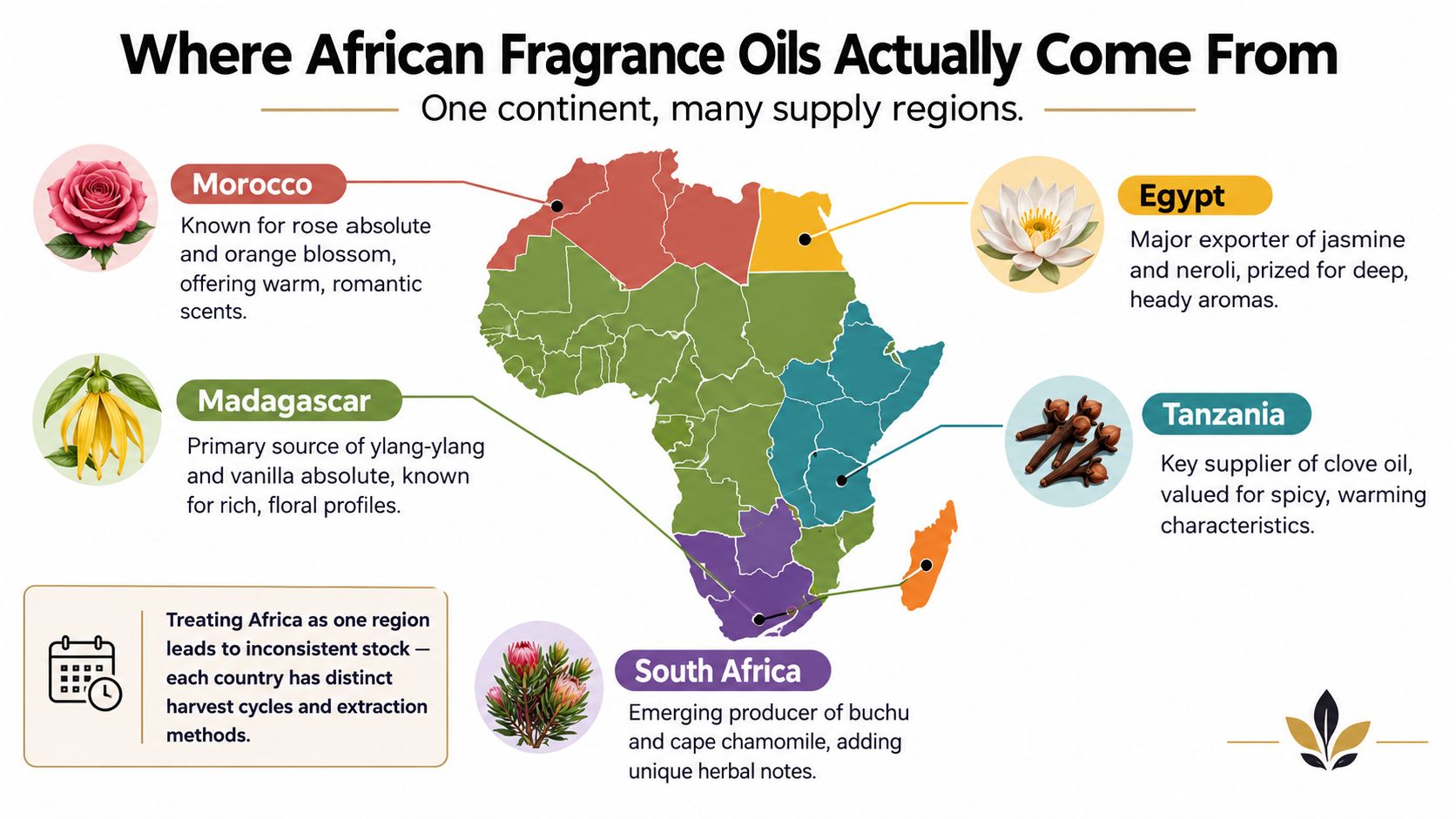
Africa is not one supply region. Treating it that way is how shop owners end up with inconsistent stock and customer complaints. The countries that matter for fragrance oil buying are different because their crops, extraction capacity, and export roles are different.
Origin changes both price and consistency
Recent market data put Africa's fragrance market at US$8.62 billion, with projected 5.11% CAGR through 2028, while continental essential-oil production sat around 46,000 tonnes and Madagascar exported roughly 2,900 tonnes, about 52% of African export volume according to the 2024 market estimate. That tells you two things. Demand is big enough to support real retail opportunities, and supply is concentrated enough that country of origin matters.
Madagascar is a major name to know because export scale is a real part of the conversation, not just the scent profile. South Africa matters for botanicals tied to local biodiversity and specialized extraction. Egypt and Morocco are strong origin points for floral and citrus materials. Nigeria and Ethiopia matter because production volume exists, but volume alone doesn't guarantee consistent retail-grade output.
Talk about provenance without overselling it
A customer doesn't need a geography lesson, they need honest product language. Say “Madagascar-origin ylang-ylang” if you can prove it. Don't say “African luxury floral” and hope the label carries the weight. The more specific you are, the easier it is to justify price and reduce returns.
This overview of Egyptian fragrance oils is a good example of why origin should be treated as a real product attribute, not a decorative story.
Safe Dilution and Application by Product Type
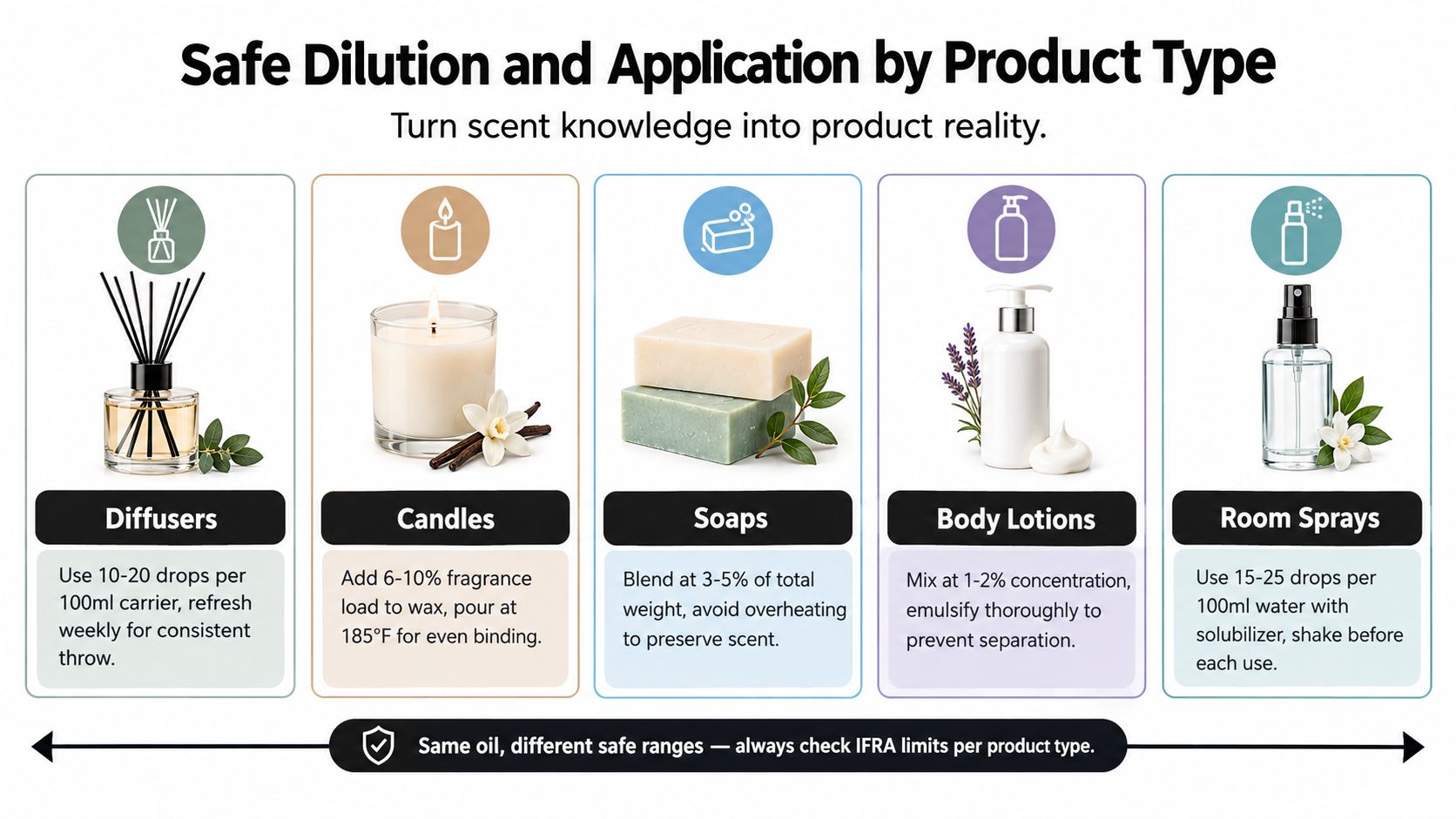
A fragrance oil can be perfectly fine in one product and wrong in another. That's not a branding issue, it's a use issue. If you ignore application, you're putting your customers and your business at risk.
Match the oil to the format
A candle blend can tolerate a different loading level than a body lotion. Compliance guidance cited by industry sources notes that an oil may be acceptable at 10% in a candle but only 2% in a body lotion, and U.S. cosmetics generally don't get FDA premarket approval, which leaves the seller responsible for safety and labeling as explained in the compliance guidance. That's the part too many new sellers miss.
For skin products, keep your language conservative and your dilution clear. For candles, focus on wax compatibility and scent throw. For soaps, confirm whether the oil is rated for cold process, melt-and-pour, or both. For room sprays and diffusers, confirm solubilizer compatibility and avoid assuming every aromatic material behaves the same.
Use the right language on the label
A product that touches skin needs a patch-test notice and a cautious ingredient list. A candle needs use instructions and burn warnings. A diffuser blend needs device compatibility and refill guidance. One oil can support several product lines, but only if you stop treating every use case as identical.
A clean rule saves money, use the most restrictive safe-use standard you can justify, then document it.
This oil-based perfume guide is helpful when you're translating a scent material into a wearable product without guessing.
Verifying Authenticity and Reading Supplier Documentation
Pretty packaging doesn't prove anything. A supplier can print a beautiful label in ten minutes. They can't fake a competent paper trail and keep a serious buyer for long.
What to demand before you reorder
Ask for a certificate of analysis, GC-MS documentation, a country-of-origin statement, IFRA conformance, allergen disclosure, and an SDS. If they can't provide those items, you're taking a blind risk. That's fine for hobby buying, not for retail.
Lot-level documentation matters because geography and harvest timing change the oil. A South African study of Artemisia afra found steam-distilled oil yield reaching 0.92% at the highest-yielding site, while 1,8-cineole reached 18.66% at another location, which is exactly why lot records matter as shown in the study. If one crop can vary that much, your supplier's paperwork is not optional.
Build a five-minute receiving standard
When a shipment arrives, check batch number, label consistency, scent profile, and documentation match. If one of those is missing, quarantine the lot until the supplier clears it. That single habit will save you from most quality disputes.
South African botanicals also bring ethical sourcing into the picture, especially where local biodiversity and access-and-benefit-sharing expectations matter. If you're buying rooibos, buchu, or fynbos-derived materials, ask how the supplier handles origin, benefit sharing, and community impact. Put the questions in writing and keep the answers on file.
If the paperwork can't survive a quick internal audit, it won't survive a customer complaint.
These fragrance labeling requirements are worth checking before you list anything as skin-safe or cosmetic-grade.
Storage, Shelf Life, and Inventory Rotation
Even good oil goes stale in the wrong bottle. Heat, light, oxygen, and contamination do the damage, and once that damage starts, no clever product description fixes it.
Store for stability, not convenience
Use amber or cobalt glass for retail bottles, keep bulk drums tightly capped, and store everything cool and dark. Minimize headspace in opened containers because extra air speeds oxidation. If a bottle lives near a window, a heater, or a busy mixing station, it will age badly.
Citrus-forward oils usually deserve the fastest rotation because their bright top notes fade sooner than woody or resinous materials. Heavier bases hold up better when stored correctly, which makes them better candidates for deeper inventory. If you're sitting on older stock, don't force it into a premium line if the scent has flattened.
Rotate like a buyer, not like a collector
Use FIFO, first in, first out. Mark every bottle with batch and date codes. If you keep a back stock, separate it from active inventory so your team doesn't grab old product by accident. A good shelf system is boring, and boring is profitable.
The practical move is simple. Put your freshest oils into your best-selling formats, then repurpose older material into lower-risk products if the scent still performs. That keeps dead stock from swallowing your margin.
Merchandising, SEO, and Compliance for Resellers
A shelf label that sounds poetic can still get you into trouble. Buyers want clarity, and regulators do too. If the product is not described accurately, it will not sell well and it will create avoidable compliance risk.
Make compliance part of the selling point
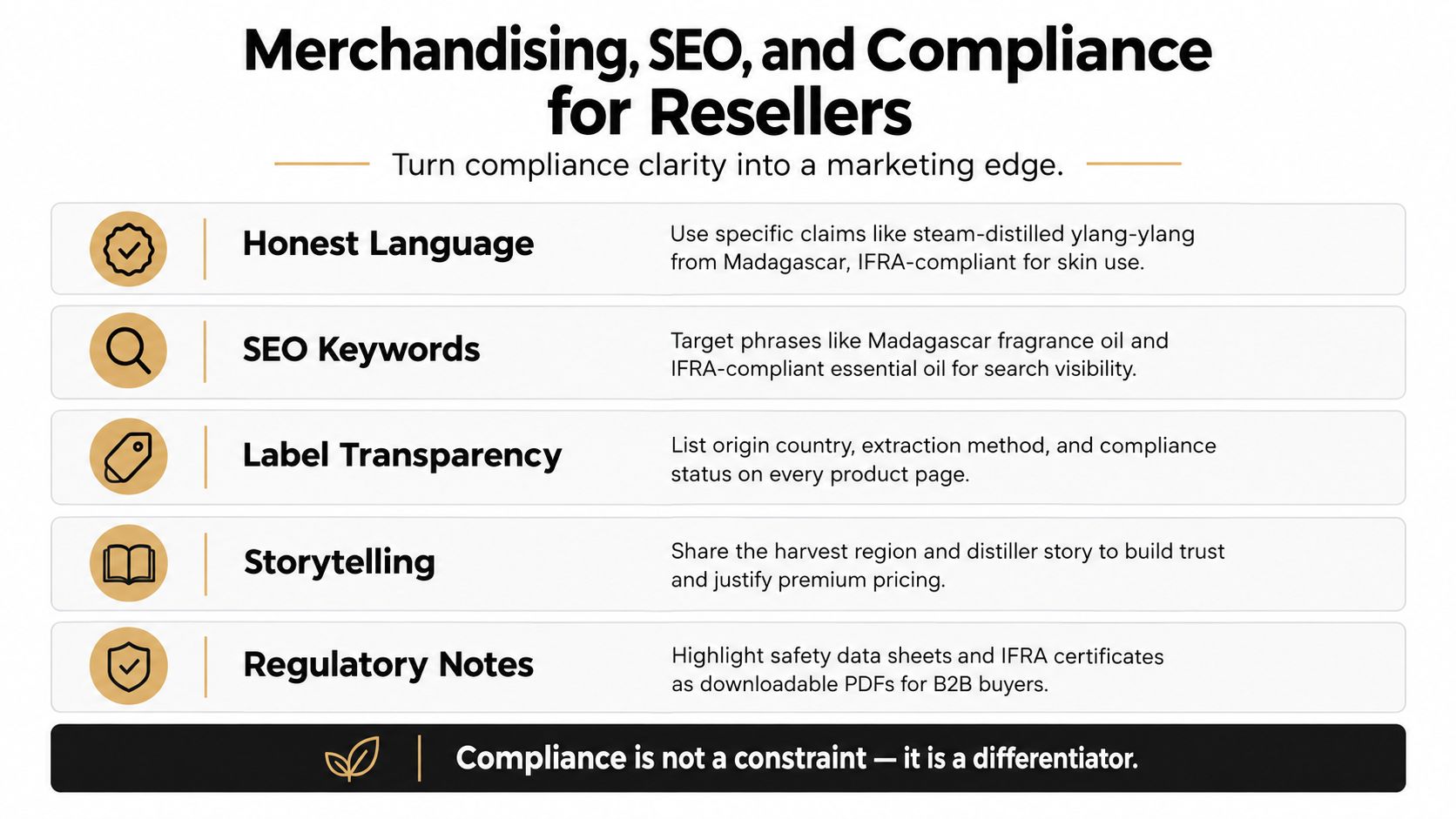
Use precise language like steam-distilled ylang-ylang from Madagascar or bergamot-based fragrance oil for candles. That tells customers what the oil is, where it comes from, and how it should be used. It also gives search engines something useful to read instead of a vague “African blend.”
A 2016 export-market brief already put Africa's share of the global essential-oils market at barely more than 2%, so differentiation still comes from specificity, not romance. A product page that names origin, method, and application will do more for sales than a clever but empty headline.
For online listings, use the exact phrase African fragrance oils where it fits naturally, then support it with botanical details, origin, and use instructions. On retail shelves, keep the wording plain. Tester strips, short scent notes, and simple category labels like diffuser, soap, body oil, or candle-safe reduce confusion fast.
Catalog discipline matters too. AdManage.ai on catalog data is worth reviewing if your records are messy, because clean product data makes merchandising and compliance easier to manage.
Your First 30 Days Stocking African Fragrance Oils
Start small and disciplined. Pick three to five oils, no more, and choose them for clarity of use, not just scent appeal. Then build a one-page supplier questionnaire that asks for origin, extraction method, documentation, and intended application.
Set up your receiving standard before the first box lands. If the paperwork is incomplete, don't put the product on the shelf. Then create two listings, one skin-safe where appropriate and one non-skin product like a candle or diffuser, so you can test demand without stretching the oil beyond its rating.
For inventory control, keep it simple but structured. Tools such as browse wholesale inventory software are useful if you want to track batch, reorder timing, and sell-through without drowning in spreadsheets. Measure what sells, what gets questions, and what comes back untouched after 30 days.
Verify first, formulate second, market third. That order keeps you out of trouble and gets you to repeat sales faster.
FAQs for African Fragrance Oils
1. What is the difference between African fragrance oils and African essential oils?
African essential oils are aromatic extracts obtained from botanical materials, while fragrance oils may contain synthetic aroma compounds, natural ingredients, or a combination of both. The distinction affects product labeling, intended applications, and documentation requirements. Retailers should confirm the exact composition and intended use with their supplier before listing either product for sale.
2. How can retailers evaluate a new African fragrance oil supplier before placing a large order?
Start with a small sample order and evaluate the supplier's communication, documentation, consistency, packaging, and delivery reliability. Compare the sample against the supplier's written specifications and request clarification about minimum order quantities, damaged shipments, and replacement policies. A trial order helps retailers assess product quality and supplier performance before committing to larger inventory purchases.
3. What should retailers consider when calculating profit margins on fragrance oils?
Retailers should calculate their landed cost, including the purchase price, shipping, packaging, import duties where applicable, testing, and handling. They should then account for payment processing, marketplace fees, expected product loss, and customer service expenses. Comparing the final cost with the planned selling price provides a more realistic picture of profitability than using the wholesale purchase price alone.
4. Can retailers sell the same fragrance oil under different product categories?
Potentially, but each application must be supported by the oil's formulation, supplier documentation, and applicable safety requirements. An oil suitable for candles may not be suitable for leave-on cosmetics, soaps, or reed diffusers. Retailers should verify the relevant use restrictions and obtain application-specific guidance before listing the same material across multiple product categories.
5. How can small retailers test demand for African fragrance oils without overstocking?
Begin with a limited selection representing different scent preferences, such as resinous, floral, woody, and fresh profiles. Use customer feedback, sample purchases, conversion rates, and repeat-order data to identify promising products. Replenish proven sellers gradually and expand the range only when sales data supports the investment. This approach helps small retailers test demand while limiting the risk of slow-moving inventory.
Aroma Warehouse helps retailers, resellers, and small shops source fragrance oils, incense, and aromatherapy supplies with a practical wholesale mindset, and that fits this category perfectly. If you want a supplier that understands how product quality, documentation, and retail readiness work together, visit Aroma Fragrance Warehouse and start building your next fragrance line on stronger ground.


