

Incense Lavender Sticks: Aroma, Use, and Sourcing Guide

Popular advice treats lavender incense as if the scent itself makes the product safe. It doesn't. Lavender is a fragrance profile, while incense is a combustion product, and those are two separate buying decisions, two separate user experiences, and two separate risk conversations.
That split matters whether you're stocking a shop, choosing stock for a studio, or buying for home use. The fragrance can be calming, floral, and familiar, while the burn can still produce particulate matter and indoor-air load. If you're sourcing incense lavender sticks, you need to judge both the aroma and the construction, not just the label.
Table of Contents
What Lavender Incense Sticks Actually Are - Scent and structure are inseparable
The Lavender Crop and Where Sticks Come From - From field crop to fragrance SKU - Why retailers should care about origin
Inside a Lavender Incense Stick - What each component contributes - Reading the spec sheet like a buyer
How to Light and Burn Lavender Sticks Safely - Basic burn routine
Reading Quality Markers and Comparing Brands - What to look for before you order - Brand families and where they fit
Pairing Lavender Sticks With Rituals and Storage - Pairings that make sense - Accessory and bundle logic
Wholesale and Bulk Sourcing for Retailers and Resellers - What to request from any vendor - Merchandising that sells through
What Lavender Incense Sticks Actually Are
Lavender incense sticks sit at the intersection of scent and combustion. The fragrance points to lavender tradition, but the format is still a burning stick, usually built on a bamboo core with a combustible base and a fragrance load. That means the stick has two jobs at once, it has to smell right, and it has to burn in a controlled way.
This floral incense guide is a useful companion if you're sorting lavender against other flower-forward options, because the category gets crowded fast. Lavender incense is not the same thing as lavender essential oil, a lavender candle, or a sachet tucked into a drawer. Oil and sachets release scent without the same burn profile, while incense produces smoke and ash.
Scent and structure are inseparable
A decent stick gives you a clean ignition, steady smolder, and a fragrance that doesn't vanish after the first few minutes. Poor sticks often smell loud in the package, then burn unevenly or throw harsh smoke once lit. Retailers get complaints when they buy on aroma alone and ignore the base material.
Practical rule: if a lavender stick sounds like a perfume sample but burns like a cheap torch, the problem is usually in the base, not the lavender note.
For a buyer, that means reading the product as a small manufactured object, not just a scent name. For a home user, it means choosing a stick for the room, the ventilation, and the purpose. Some people want a quiet background scent, others want a ritual cue, but neither group benefits from pretending smoke doesn't matter.
The Lavender Crop and Where Sticks Come From
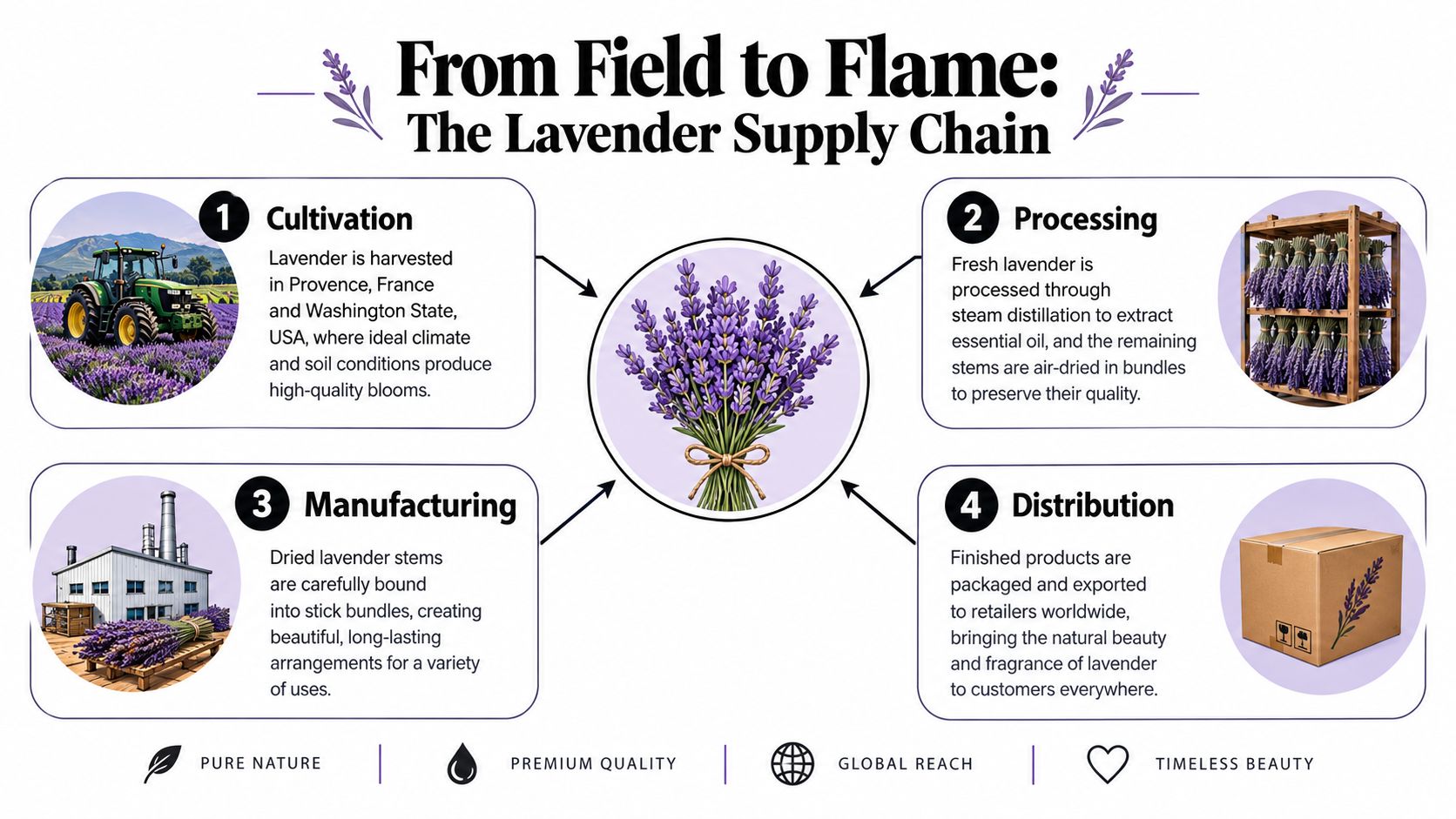
Lavender incense starts long before a stick is lit. Lavender is native to the Mediterranean region, the Middle East, and India, and it has been cultivated for centuries for ornamental, medicinal, and culinary use. It was used by ancient Greek, Roman, and Egyptian civilizations, then spread through Europe, with monasteries helping preserve cultivation during the Middle Ages.
From field crop to fragrance SKU
That history matters because it explains why lavender carries more weight than a generic floral note. It is a recognized wellness cue, so it tends to move steadily in gift and spa assortments, while novelty florals often rise and fall with short-lived interest. In the U.S., lavender production has grown in measured terms, with the 2019 USDA Census of Horticultural Specialties recording 1,317 lavender operations, which was 154 more than in 2014, or about 13.2% over five years (Penn State Extension). Those figures describe lavender operations, not incense-stick sales, so they do not function as a market-size proxy for the incense category.
The commercial path from crop to stick usually passes through several hands. Growers produce flowers, distillers extract essential oil, fragrance compounders build blends, and manufacturers apply that scent to the stick base. That is why a lavender incense SKU can feel agricultural, sensory, and retail-ready at the same time.
Why retailers should care about origin
A retailer does not need to source raw lavender fields, but they do need to understand what they are selling. A lavender stick is a value-added product built on an established crop with documented origins and a real production base. That gives you a clearer story for customers who care about provenance, while also keeping the practical point in view: the final stick is still a manufactured item with a burn profile, not a bundle of flowers.
If you sell by scent family, lavender sits naturally beside floral, herbal, and wellness-oriented lines. If you buy by margin and repeat purchase behavior, it also earns shelf space because customers recognize it quickly and reorder it steadily. The better your grasp of the crop, the easier it is to explain why one lavender stick feels soft and another throws more smoke than expected.
Inside a Lavender Incense Stick
A lavender stick looks simple, but the build decides a lot. The bamboo core sets the shape, the binder holds the combustible layer together, and the fragrance load carries the scent. If one of those parts is off, the stick may still light, yet it can burn unevenly or smell muddled.
What each component contributes
Hand-dipped sticks usually take scent well because the base is more porous, while machine-made versions can be more uniform and sometimes flatter in character. A thicker bamboo core changes how the burn feels, and a binder-heavy base can leave a clumpy look or an ashy, uneven smolder. A clean base does not guarantee low smoke, but a sloppy one is a warning sign.
Indoor-air testing gives a useful reality check. In one comparison of aromatic incense fragrances, most emitted particles were smaller than PM2.5, with a dominant particle-size range of about 1.55 to 0.93 micrometers. In a newer residential experiment, analysts estimated lavender-incense PM2.5 emissions at an average of 7 milligrams per gram burned, while Douglas fir incense averaged 27 milligrams per gram in the same study, and organic PM2.5 from both was 4.6 to 7.9 times higher than background over six-hour periods (IJESD).
FAQs on Lavender Incense
1. How can retailers calculate the profit margin on lavender incense sticks?
Calculate the landed cost per pack, including wholesale pricing, shipping, packaging, and other applicable expenses. Subtract that cost from the retail selling price to determine gross profit. Divide gross profit by the retail price and multiply by 100 to calculate the gross profit margin. Comparing several pack sizes can help retailers identify the most profitable assortment.
2. What should retailers consider when choosing lavender incense packaging?
Consider moisture resistance, fragrance retention, shelf visibility, product labeling, and pack size. Packaging should protect the sticks during storage and shipping while making the fragrance and quantity easy to identify. Smaller packs may suit gift shops, while larger bundles can appeal to frequent incense users and value-conscious buyers.
3. Is lavender incense suitable for fragrance gift baskets?
Lavender incense can complement gift baskets featuring candle holders, decorative burners, relaxation-themed accessories, journals, and other fragrance products. Choose complementary items that suit the recipient's preferences, and include a suitable incense holder when one is not already provided. Because fragrance sensitivity varies, consider offering a scent-free alternative.
4. How can a retailer test lavender incense before committing to a large order?
Order samples from potential suppliers and compare them under consistent conditions. Evaluate fragrance character before lighting, scent development during burning, stick-to-stick consistency, packaging quality, and customer appeal. Record observations for each sample and request additional samples from a different production batch when consistency is a concern.
5. Which complementary products can increase sales alongside lavender incense?
Incense holders, ash catchers, sandalwood incense, floral fragrance varieties, and gift-ready accessories can create useful cross-selling opportunities. Retailers can organize these products into starter sets, themed displays, or gift bundles. Select complementary items based on customer demand and actual sales performance rather than adding products solely to increase assortment size.
Reading the spec sheet like a buyer
That does not mean every lavender stick behaves the same way. Formulation, stick mass, burn rate, ventilation, and combustion conditions all affect the result. It does mean floral scent and clean burning are separate decisions.
Buyer's rule: ask for stick mass, burn duration, visible-smoke behavior, and fragrance type. If a vendor only talks about “strong scent,” you still do not know how the stick behaves.
I also ask whether the scent is essential oil, synthetic fragrance, or a blend, and whether the base is charcoal, wood powder, or another composition. A lavender product can smell lovely in the box and still be the wrong wholesale buy if it smokes heavily in a small shop or treatment room.
Good incense buying habits start with structure, not packaging art. That is the part many novice buyers skip, and it is usually where quality issues hide.
How to Light and Burn Lavender Sticks Safely
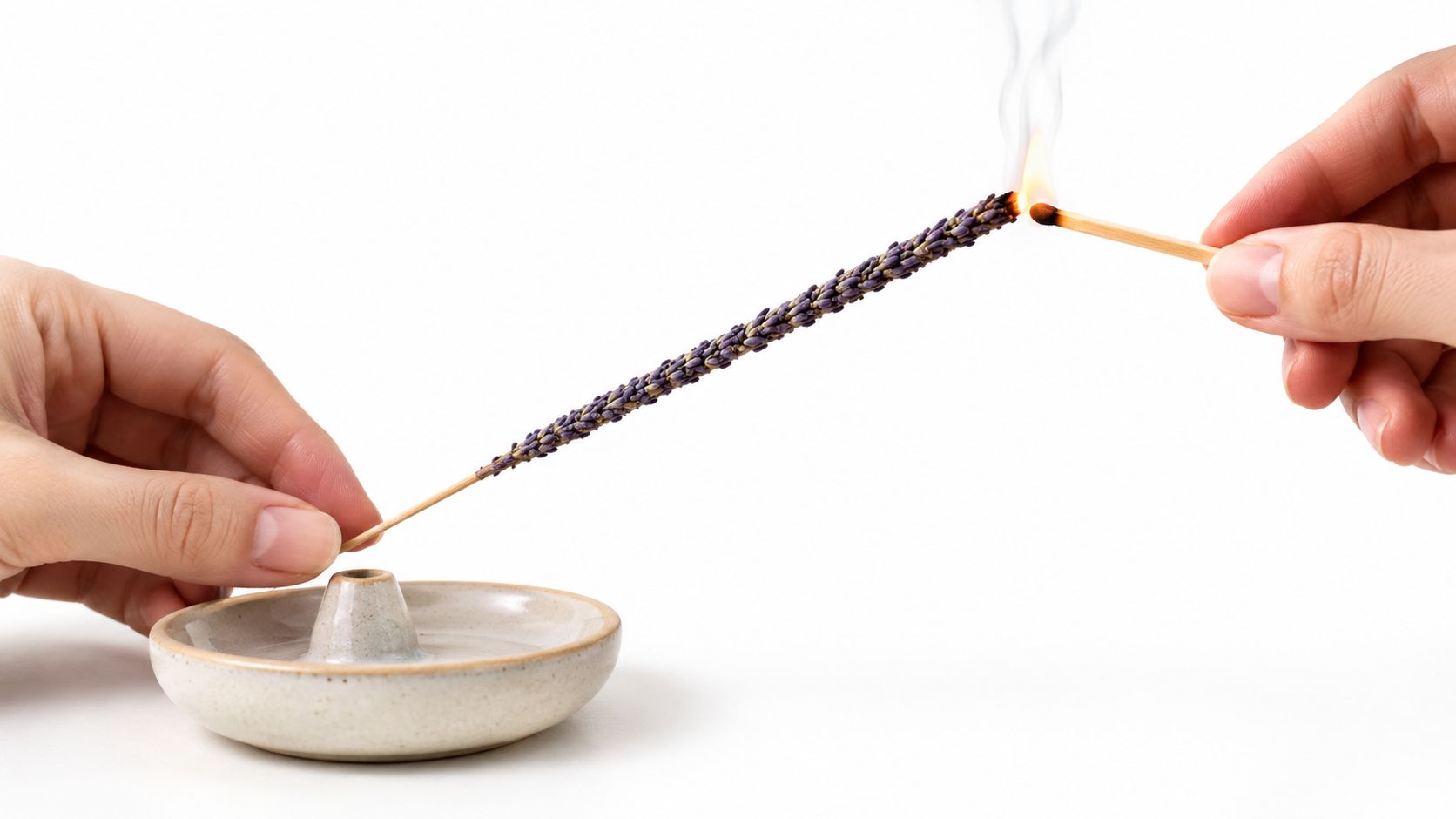
A lavender stick can be easy to light, but the burn still deserves discipline. Use a stable, heat-safe holder that catches ash and keeps the stick upright. If the holder wobbles, ash lands where it should not, and the burn is harder to control.
Basic burn routine
Angle the tip into the flame. Let the end catch for a few seconds so the fragrance layer ignites.
Blow out the flame. You want a glowing ember, not an open flame.
Watch the smolder. The stick should give off a thin stream of smoke, not flare or sputter.
Keep airflow steady. A little ventilation helps smoke disperse instead of pooling.
That routine matters because incense is combustion, not passive fragrance. The U.S. Environmental Protection Agency identifies incense as a potentially major indoor particulate source and notes that incense smoke particles commonly fall around 0.1 to 0.7 micrometers; poorly ventilated residential burning has been associated with total suspended particulate concentrations reaching 1,850 micrograms per cubic meter (EPA technical review). A separate California-residence study measured incense PM2.5 emission rates of 7 to 202 milligrams per hour, showing how much burn conditions can vary.
Keep incense away from curtains, paper, and anything that can catch. Never leave it unattended. If you need to stop the burn, press the lit end into sand or a fireproof dish until there is no glow left.
The same discipline applies in home use, yoga rooms, treatment rooms, and back-of-house retail spaces. Small rooms, shared rooms, or weak ventilation call for shorter sessions instead of forcing a full stick. Aroma Warehouse's incense safety checklist covers holder placement and extinguishing steps worth posting in any shared burn space.
Reading Quality Markers and Comparing Brands
The fastest way to judge a lavender stick is to inspect the burn body, not the marketing copy. A good stick usually looks deliberate from stem to tip. A weak one often looks over-coated, dusty, or too glossy in ways that hide the base material.
What to look for before you order
Hand-dipped premium sticks often show more texture, a firmer fragrance presence, and better scent layering if the maker is careful. Mid-tier branded sticks can be consistent and dependable, especially for general retail, but they may use simpler bases or more standardized fragrance loads. Value or machine-made lines are usually the easiest to price aggressively, though they can be more variable in smoke and finish.
Comparing Lavender Stick Quality Indicators Across Common Brand Families | |||
|---|---|---|---|
Indicator | Hand-Dipped Premium, Mid-Tier Branded, Value / Machine-Driod | ||
Base look | Cleaner coating, more visible craft variation, usually less clumpy | More uniform, generally stable, can still show binder build-up | Often the most inconsistent, may look thick or glossy |
Burn behavior | Typically steadier if the base is balanced | Reliable for everyday retail use | Can smoke heavily or burn unevenly |
Fragrance impression | Layered, less one-note | Clear lavender profile | Sometimes loud in the package, flatter when burning |
Buyer use case | Gift shops, boutique bundles, premium shelves | General retail, wellness stores, repeat reorder SKUs | Price-driven assortments, entry-level lines |
Brand families and where they fit
HEM, Auroshikha, Tulasi, and private-label lines each serve different shelf strategies. HEM often works well when a customer wants a familiar branded incense choice. Auroshikha and Tulasi can suit stores that want recognizable incense names with different presentation styles, while private-label is useful when you need tighter control over margins, packaging, or store branding.
A useful rule is to match product tier to store intent. A metaphysical shop that sells ritual tools may want a more artisanal feel, while a gift shop near a checkout counter may need a straightforward, good-looking lavender SKU that behaves predictably. If the package looks premium but the stick is binder-heavy and smoky, customers notice fast.
You can also use scent load as a filter. Over-fragranced sticks often try to compensate for a weak base, and that usually shows up in the room before it shows up on the shelf. If a vendor won't discuss construction, treat that as information, not a gap.
Pairing Lavender Sticks With Rituals and Storage
Lavender rarely has to stand alone. It pairs cleanly with other incense families when you want a softer room profile, and it can also sit in inventory as a bridge between floral, herbal, and classic resinous lines. That makes it useful for both ritual use and merchandising.
Pairings that make sense
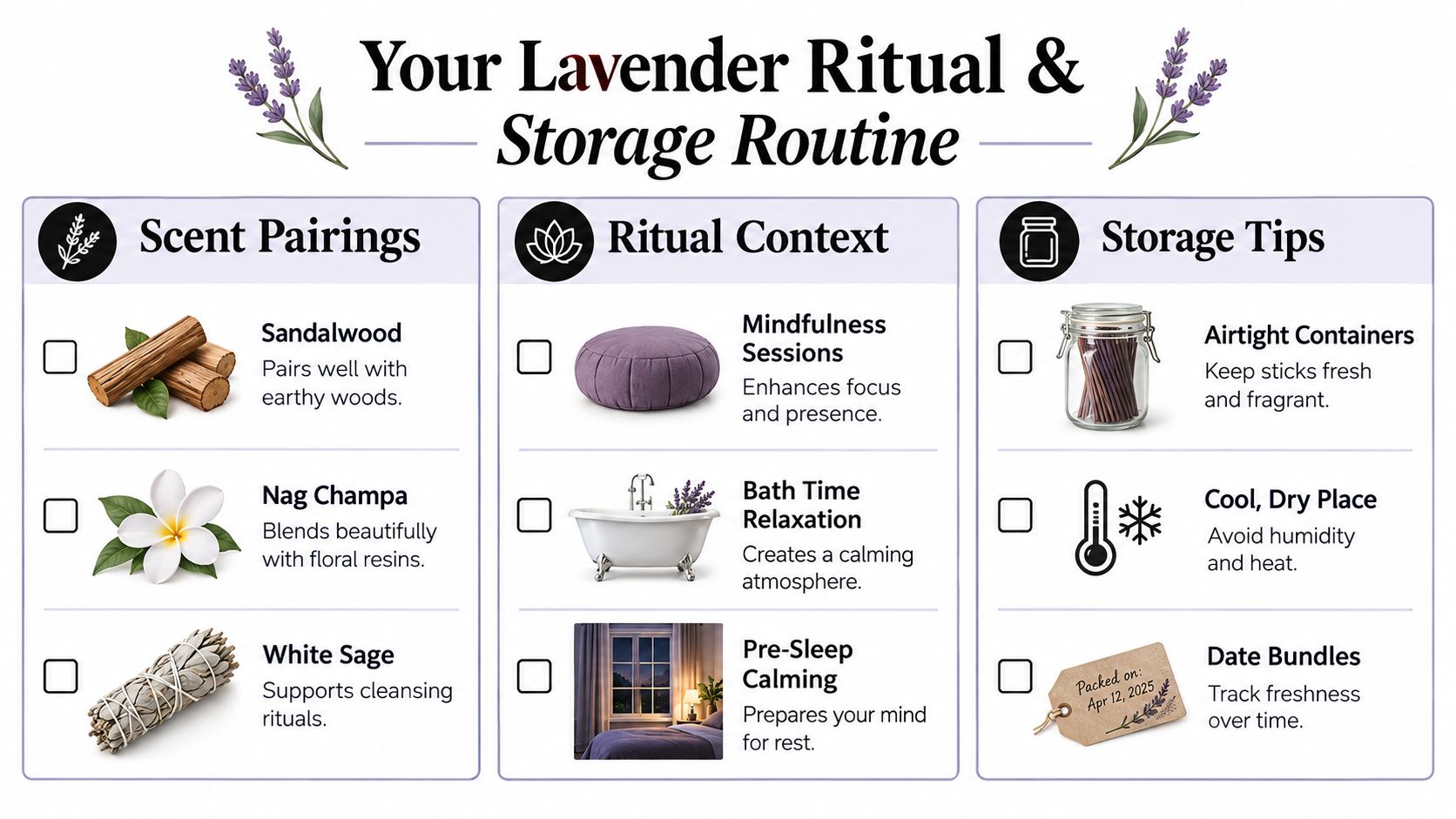
Lavender with sandalwood reads warm and grounded, especially in meditation rooms or quiet retail spaces. Lavender with nag champa leans more traditional and layered, which some customers like for evening use. Lavender with white sage is a stronger combination, better suited to a cleansing routine than to an all-day background scent.
Storage rule: keep sticks sealed, cool, and out of direct light. Moisture is the quickest way to ruin a good bundle.
Storage matters because incense can lose character if it sits open near humidity. Seal it, label it, and rotate older stock first so it doesn't sit forgotten at the back of a shelf. A retailer who turns inventory cleanly gets more consistent burn behavior than one who treats incense like decor.
Accessory and bundle logic
Wooden burners and ash catchers make obvious companion items, but the key merchandising move is to bundle small lavender packs with a holder as a ready-to-go set. That solves two customer problems at once: they get the fragrance, and they do not have to hunt for the right burner.
This sage and lavender pairing guide is helpful if you're designing ritual sets around cleansing and calm rather than just scent. Retailers can use that logic to build gift sets that feel complete without overstocking one aroma family. The key is to treat lavender as part of a routine, not a lonely SKU.
Managing Lavender Incense in Studios and Shared Spaces
Lavender may feel soft, but shared indoor spaces need rules, not assumptions. The American Lung Association says fragrances can trigger coughing, wheezing, shortness of breath, headaches, and irritation, especially for people with asthma, allergies, or chemical sensitivities, and it advises avoiding incense or improving ventilation when fragranced products are used (American Lung Association).
A space policy should start before anyone lights a stick. Tell people in advance when a room will be scented, keep burn sessions short, and open windows or use cross-ventilation when the building allows it. Staff also need a clear stop rule if a client reports symptoms.
Studios and retail floors should offer alternatives. Scent-free sessions and non-burning options give customers a choice instead of assuming everyone wants smoke in the air. Electric diffusers and unscented sticks can serve the same practical role without forcing one standard on every visitor.
Research on twelve indoor incense products has found VOC emissions, with benzene and formaldehyde exceeding World Health Organization guideline values in much of the tested set. In spa and yoga settings, that matters more because people breathe more during use. The point is not that every lavender stick should be banned. The point is that fragrance choice and indoor-air exposure are separate decisions.
For gift buyers who want a meditation-friendly set, HD Asian Art gift suggestions is a useful reference. It frames incense as one item in a larger ritual kit, which is a better fit for shared spaces than treating lavender alone as a universal answer.
Wholesale and Bulk Sourcing for Retailers and Resellers
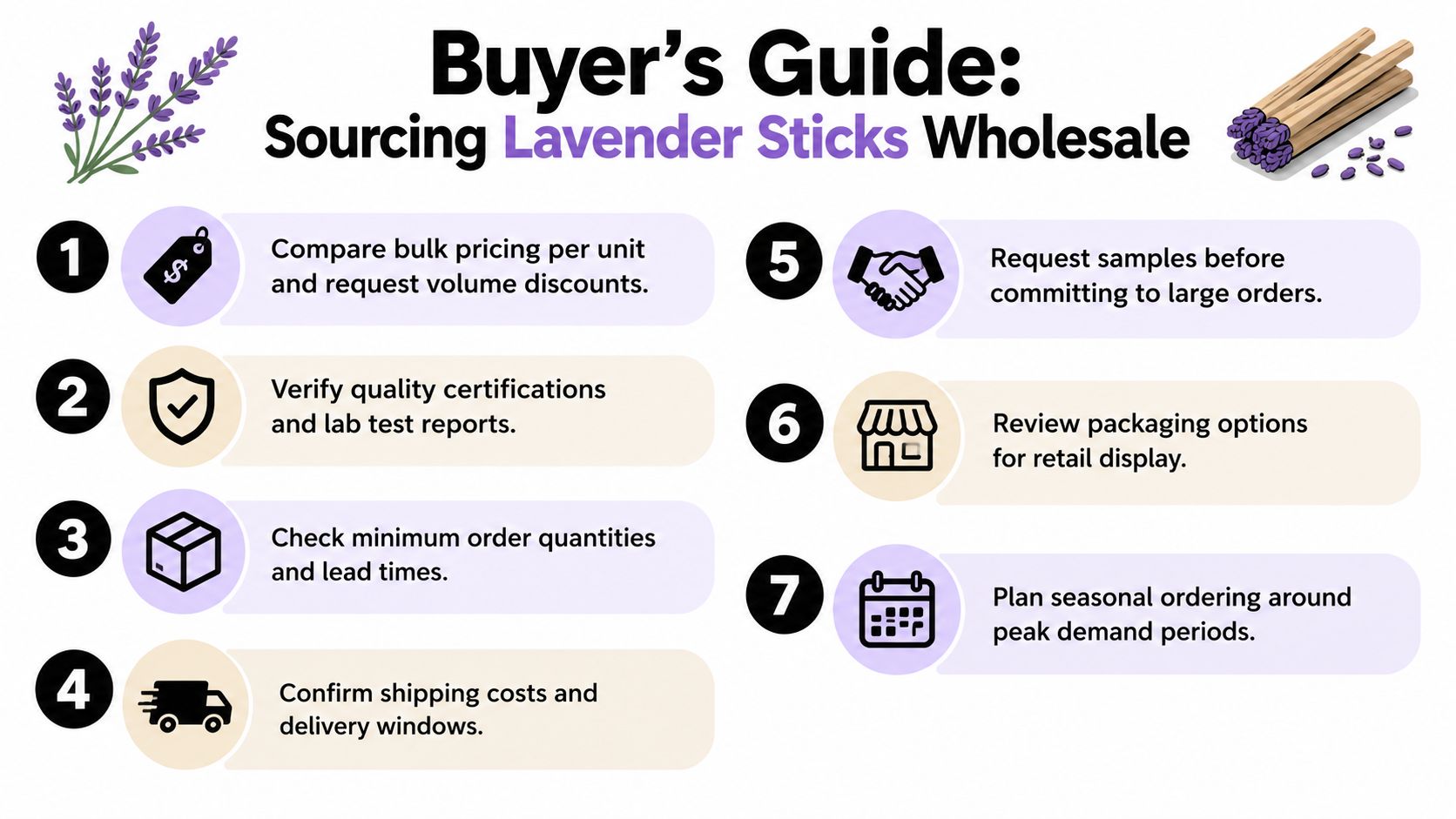
Buying lavender sticks wholesale is less about finding the cheapest box and more about managing repeatable quality. If you sell to customers who care about scent, you need the burn to match the promise. If you sell to studios or gift shops, you also need packaging and labeling that won't cause avoidable problems.
What to request from any vendor
Stick mass matters because it affects handling and burn consistency. Burn duration tells you whether the product is suited to quick retail burns or longer sessions. Visible-smoke behavior helps you judge whether the line fits a spa, boutique, or smoke-shop floor. Batch data and PM2.5 disclosure are even better when available, because they give you a basis for comparing lots instead of guessing from scent strength alone.
Packaging should include ventilation guidance, fire-safety language, and clear “never leave unattended” instructions. That isn't just liability language, it's customer support. Shoppers keep more trust when the pack explains safe use instead of assuming they already know.
Merchandising that sells through
For retailers and resellers, lavender works well in turnkey gift bundles, seasonal sets, and private-label programs. It can sit beside sandalwood and nag champa without cannibalizing them if you position each scent for a different use case. Lavender leans soft and floral, sandalwood leans warm and grounded, and nag champa carries a more traditional devotional feel.
Wholesale incense sticks guidance is useful when you're building a sourcing checklist for broader category planning. Aroma Warehouse also carries lavender-scented hand-dipped incense sticks, along with other wholesale incense and related fragrance products, which makes it a workable option for shops that need one vendor across multiple scent families. The practical move is to request samples, test in the actual room where they'll be burned, then buy the line that fits your shelf and your customers.
If you're building a lavender incense assortment for retail, studio use, or private-label resale, Aroma Warehouse can supply incense, fragrance oils, burners, and complementary accessories in the same category family. Visit Lavender Incense Warehouse to review the current selection and choose the lavender, classic floral, and wholesale accessories that fit your shelf, your space, and your customers.


