

Best Sandalwood Incense Cones: A Practical Buyer's Guide

You've opened a wholesale catalog, narrowed the selection to sandalwood cones, and found packages that sound almost identical. Each promises a rich, authentic fragrance, yet the prices differ and the ingredient descriptions don't explain why. Before ordering for your home, treatment room, or shop, you need to know whether you're paying for documented sandalwood content, a fragrance you enjoy, or persuasive packaging.
Table of Contents
What Makes a Sandalwood Cone Worth Buying - Separate the promise from the evidence - Define the job before comparing prices
The Anatomy of a Sandalwood Incense Cone - Ask what holds and fuels the cone - Understand what genuine sandalwood contributes
Pure Sandalwood vs Blended vs Synthetic Fragrance Cones - Pure Sandalwood vs Blended vs Synthetic-Accord Cones - Choose the category for the right reason - Compare the finished samples without category bias
How to Read a Sandalwood Cone Label Like a Pro - Look for information you can follow up - Separate authenticity from responsible sourcing
Burn Time, Smoke, and a Simple Burn Test - Make the comparison repeatable - Treat visible smoke as an observation, not a safety measurement
Matching Cones to Meditation, Spa, Retail, and Wholesale Use - Home practice and shared wellness spaces - Retail shelves and wholesale purchasing
Your Sandalwood Cone Buyer's Checklist and Quick Answers - Are sandalwood cones safer than sticks? - How should I store cones? - What suggests a batch needs checking?
What Makes a Sandalwood Cone Worth Buying

The best sandalwood incense cones aren't necessarily the strongest-smelling or most
expensive. They're the ones whose ingredients, burning behavior, and sourcing information fit your intended use. Treat those as separate purchasing questions rather than assuming a premium answer to one guarantees the others.
Consider a spa buyer choosing between an attractively packaged cone and a plainly packaged alternative. The first supplier emphasizes an intense temple aroma. The second explains the fragrance type, provides samples, and identifies the material's origin. My purchasing recommendation would be to evaluate the second supplier first, not because its cone is automatically better, but because you can investigate its claims.
Separate the promise from the evidence
Start with a simple buying framework:
Authenticity: Does sandalwood mean a botanical ingredient, a blend containing sandalwood, or a sandalwood-style fragrance?
Emissions profile: What happens during combustion, and what evidence supports any reduced-smoke claim?
Sourcing transparency: Can the supplier explain where the claimed sandalwood material came from?
Don't let a pleasing sample answer every question. You might love its fragrance while still needing clarification about composition. Equally, a documented botanical ingredient doesn't tell you whether the finished cone suits a shared treatment room.
Practical rule: Pay for a claim only when you can identify what the supplier means and what evidence supports it.
Define the job before comparing prices

Write a short purchasing requirement before browsing. For a gift shop, that might be recognizable sandalwood character, presentable packaging, and descriptions staff can explain accurately. For personal use, it might be an understated fragrance and a manageable burning experience.
If you're still deciding whether combustion-based fragrance belongs in your space, Shivora Candles' comparison of which burns better for home fragrance provides a useful starting point for considering candles alongside incense sticks. That's a format decision, separate from choosing a particular cone.
There's no universal winning product. A sensible budget purchase can be an honestly labeled fragrance cone, while a premium purchase should offer something verifiable beyond a more elaborate scent description.
The Anatomy of a Sandalwood Incense Cone
Think of a cone as a complete burning formulation, not a small piece of sandalwood. As with a candle's wax, wick, and fragrance, evaluating the finished product means looking beyond its headline scent.
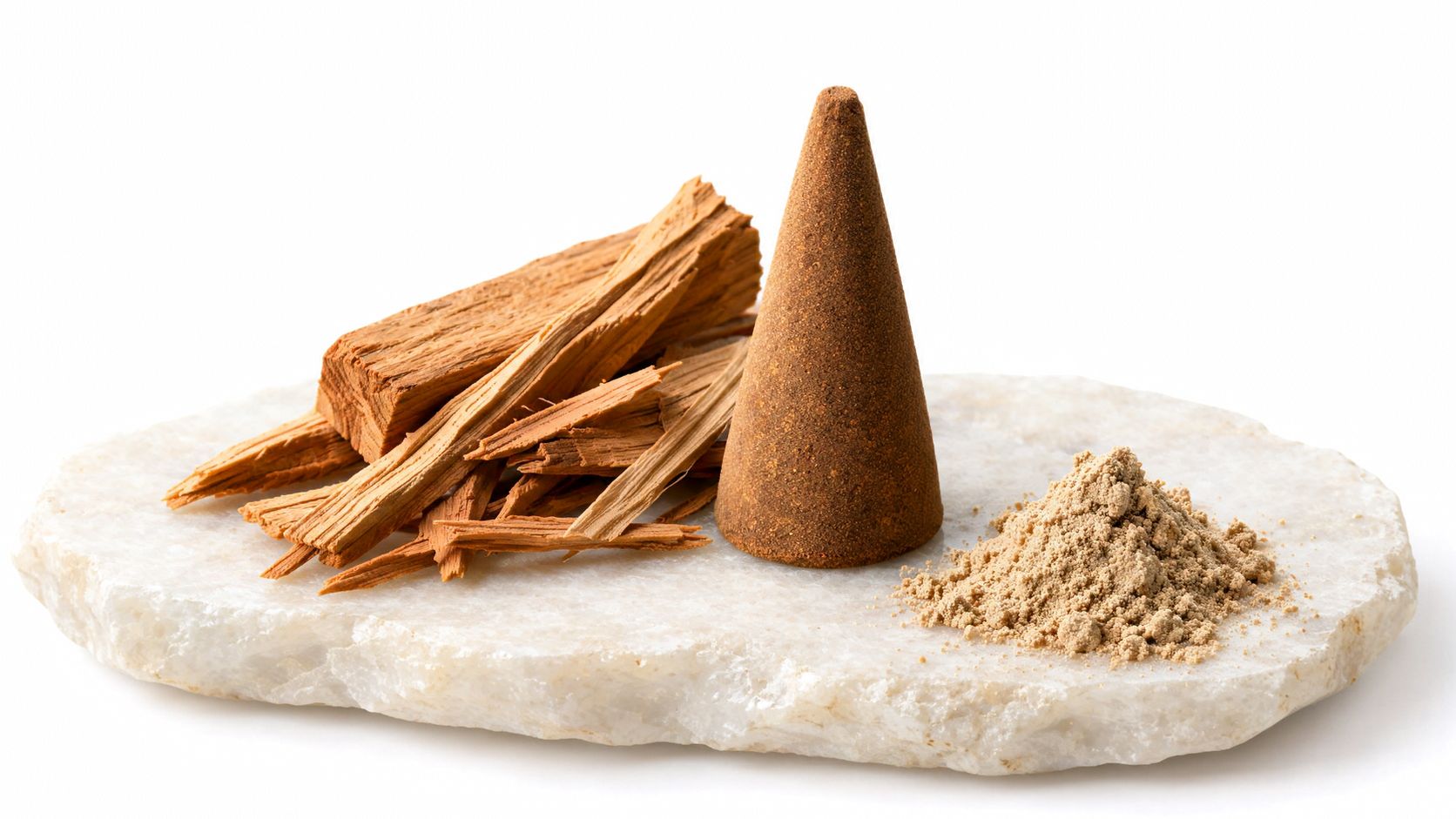
A useful supplier conversation separates base material, binding ingredients, fragrance ingredients, and any finishing treatment. Ask what performs each function in the particular cone you're considering. Don't assume that products sharing a scent name share a recipe.
Ask what holds and fuels the cone
Request the base description first. If a supplier describes a wood-based or charcoal-based cone, ask what else is included and whether the description refers to the whole formulation or just its principal base.
Next, ask about binding ingredients and any treatment applied after shaping. Terms such as hand-dipped describe a production approach, but they don't, by themselves, identify the fragrance's botanical content. The comparison of hand-dipped incense and fragrance cones can help you frame those manufacturing questions.
Use the recipe information to guide testing, not to predict performance with certainty. A claim that charcoal always burns faster, or that a natural binder always produces a better cone, would require product-specific evidence. Ask for samples rather than accepting a blanket explanation.
Understand what genuine sandalwood contributes
For genuine Indian sandalwood, Santalum album, the characteristic odor is driven primarily by α-santalol and β-santalol, which together represent roughly 57–89% of the essential oil in published compositional studies, as summarized in this review of sandalwood chemistry.
That percentage describes the oil, not the finished incense cone. It doesn't establish how much sandalwood oil a cone contains, and it shouldn't be turned into a packaging claim about cone composition.
An oil claim needs an explanation of which oil is used and how its identity is documented.
A finished-product claim needs information about the cone's actual formulation.
A performance claim needs a test of the cone as sold.
Keep those distinctions clear when reviewing technical documents. Evidence about a fragrance ingredient can be useful, but it isn't a substitute for evaluating the entire product.
Pure Sandalwood vs Blended vs Synthetic Fragrance Cones
“Pure sandalwood” needs clarification before it deserves a price premium. Does the seller mean genuine sandalwood-derived fragrance, an undiluted oil used during manufacturing, or a cone made entirely from sandalwood material? Those are different claims.
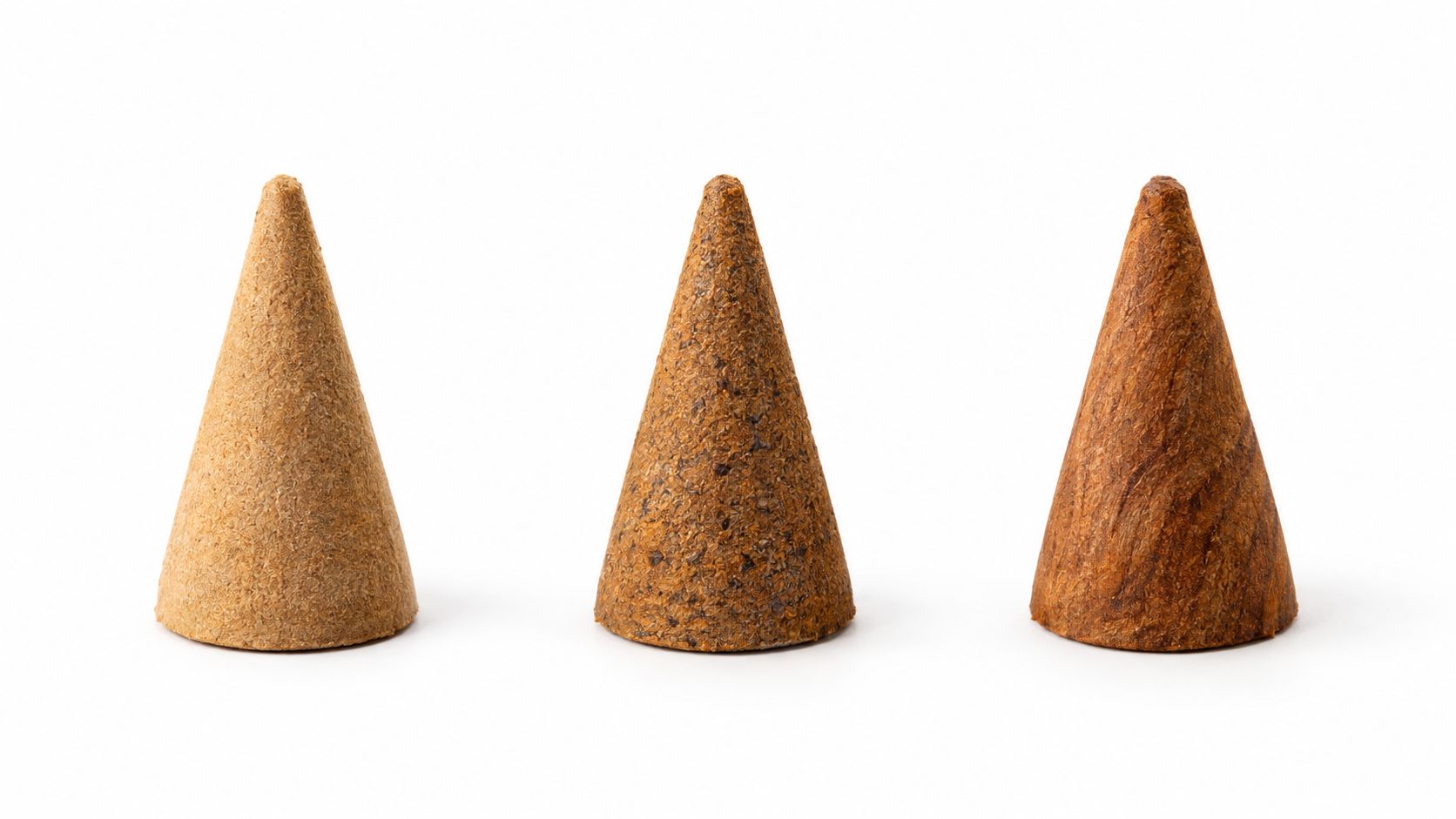
For purchasing purposes, separate the fragrance into the categories below. Treat the price column as a quotation requirement rather than a market price guide. Without comparable supplier quotes and documented formulations, assigning a standard price to each category would be misleading.
Pure Sandalwood vs Blended vs Synthetic-Accord Cones
Category | Sandalwood Content | Typical Price | Best Fit |
|---|---|---|---|
Genuine sandalwood-led | Sandalwood-derived material is documented; the complete formulation still needs checking | Request a quote tied to verified content | Buyers who specifically want botanical sandalwood |
Blended | Declared sandalwood-derived material combined with other fragrance ingredients | Compare quotes against the disclosed blend | Buyers balancing scent preference and ingredient requirements |
Synthetic-accord | Sandalwood-style fragrance, potentially without sandalwood-derived material | Compare actual per-cone quotations | Buyers seeking a particular scent without a botanical-content requirement |
Choose the category for the right reason
Genuine sandalwood-led cones make sense when botanical identity is part of your purchasing requirement. Evaluate whether the supplier's documentation supports that identity and whether you prefer the finished aroma. Don't assume genuine oil guarantees your favorite burning fragrance.
A blend is my preferred starting point for buyers who want some documented sandalwood content without requiring a sandalwood-only fragrance profile. Ask what the other fragrance ingredients are and whether sandalwood remains the intended central note. Choose it because the formulation meets your brief, not because blended automatically means better value.
A synthetic accord can be a reasonable purchase when you're buying a scent experience rather than botanical material. The important distinction is honest labeling. A sandalwood-style fragrance should be described as such, not presented as evidence of genuine sandalwood oil.
The guide to natural versus synthetic incense offers another way to organize that comparison. Keep your purchasing language specific: natural content, preferred aroma, and acceptable burning behavior are separate requirements.
Compare the finished samples without category bias
Give each sample the same evaluation conditions and record your preference before reviewing its marketing language. Then compare that preference with the documentation and quoted cost.
Don't rank burning performance by fragrance category alone. Nor should you infer a manufacturer's cost or sustainability strategy from a brand name. Without a product declaration, you can't reliably classify a cone, explain why the manufacturer blended it, or decide whether its price is justified.
How to Read a Sandalwood Cone Label Like a Pro
Read a sandalwood label as a set of claims to investigate. A botanical name is useful, but it doesn't answer every question. Country-of-manufacture information is useful too, but it isn't necessarily the origin of the aromatic raw material.
Historical supply figures explain why precision matters. Average sandalwood production in Karnataka fell from about 2,287.8 tonnes during 1960–65 to 366.74 tonnes during 1995–2000, then to approximately 61.57 tonnes annually in the following decade, according to this account of sandalwood resources and production. Those are historical figures, not a current price forecast or proof about any individual cone.
Look for information you can follow up
Use the package and product page to build a short supplier inquiry:
Botanical identity: If genuine Indian sandalwood is claimed, ask whether the material is identified as Santalum album.
Ingredient disclosure: Ask what “fragrance,” “perfume,” or “sandalwood oil” means in that formulation. Don't calculate concentration from ingredient order unless the supplier explains the declaration method.
Origin: Distinguish where the cone was manufactured from where the sandalwood ingredient was sourced.
Batch identification: Request a lot reference that lets the supplier connect your purchase to its records.
Supporting documents: Ask whether ingredient declarations, supplier records, or GC–MS documentation are available.
Environmental claims: Request the documentation behind any certification, legal-trade, or chain-of-custody statement.
A GC–MS document should identify the material tested. An analysis of an oil doesn't automatically establish how much of that oil is present in the finished cone.
A sandalwood-scented cone and a sandalwood-oil cone can be different products, even when you like both fragrances.
Separate authenticity from responsible sourcing
An authentic ingredient can still require sourcing scrutiny. A review of sandalwood sustainability discusses overharvesting, illegal trade, and habitat concerns, which support asking for origin and supply-chain evidence rather than accepting an environmental adjective.
Don't treat “organic,” “responsibly sourced,” or a reference to CITES as interchangeable assurances. Ask what each claim covers, which material it concerns, and what documentation applies to the purchase.
For product pages using the term fragrance oil, the sandalwood fragrance oil guide provides useful context for your questions. If a supplier won't clarify an ambiguous claim, record the ingredient status as unverified, rather than filling the gap with an assumption.
Burn Time, Smoke, and a Simple Burn Test
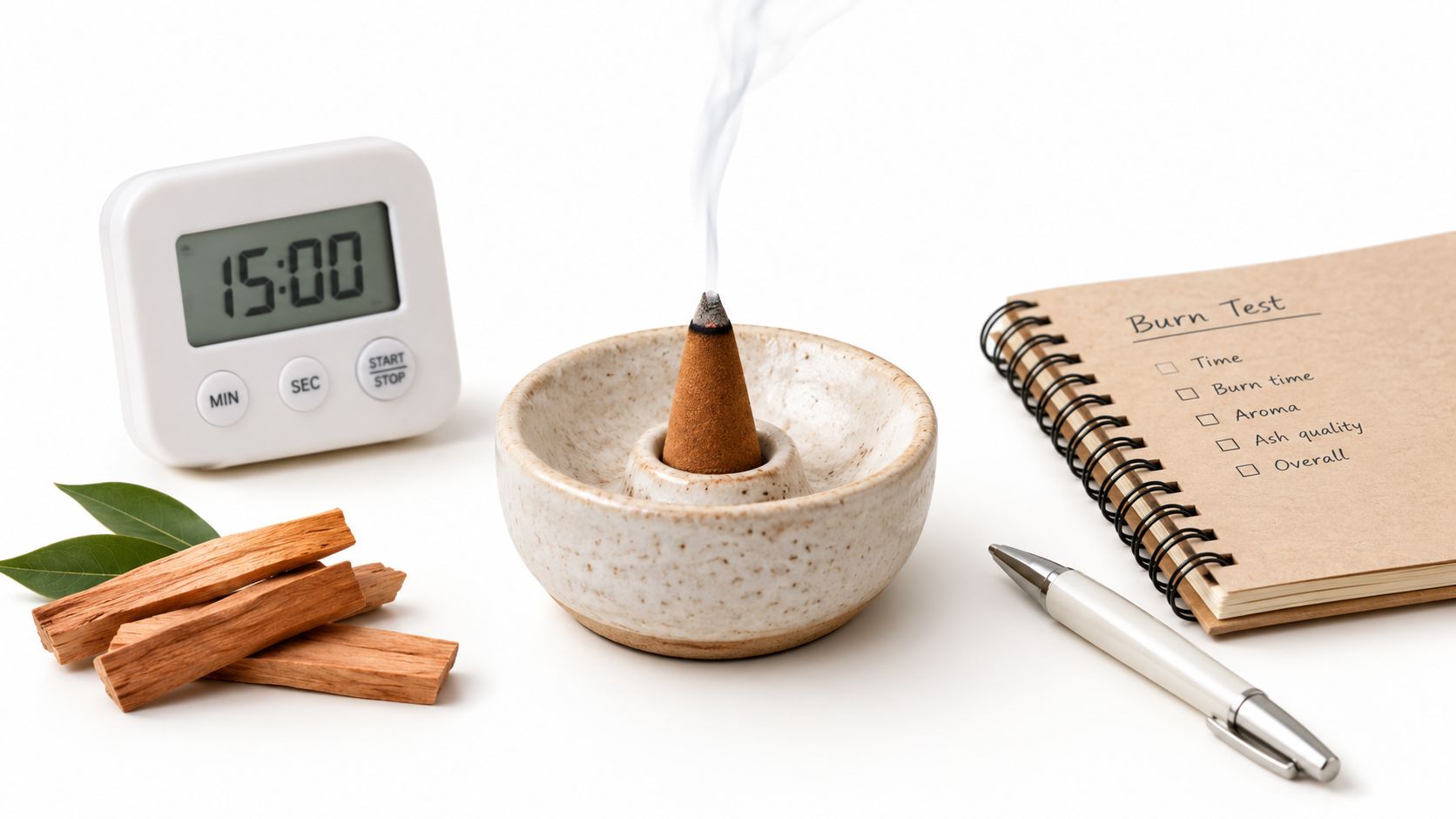
A sample test should help you compare products, not recreate a dramatic promotional photograph. Use a kitchen scale, timer, notebook, and stable, noncombustible burner. Record the setup so a later shipment can be assessed under comparable conditions.
Make the comparison repeatable
Follow the manufacturer's lighting instructions and keep the burner clear of combustible materials. Don't leave the test unattended or deliberately close the room to intensify the scent.
Before lighting: Record the product, batch, cone mass, room size, and ventilation conditions. Describe the cold fragrance without copying the package.
During combustion: Time the burn and note interruptions, visible smoke, ash stability, and whether you find the fragrance acceptable.
After cooling: Record remaining material and lingering odor. Compare the result with your original purchasing requirement.
Across samples: Keep the burner and room conditions comparable, and allow the previous sample's odor to clear before continuing.
Measure actual burn duration rather than assuming every cone should meet a universal range. A longer burn isn't automatically a better purchase, and strong cold fragrance doesn't prove genuine oil content.
Treat visible smoke as an observation, not a safety measurement
A peer-reviewed review of incense emissions reports an average particulate-matter emission rate of about 46 mg per gram burned and a PM2.5-to-PM10 ratio near 82%. These findings aren't measurements of the particular cone on your counter, but they explain why scent and burn duration aren't sufficient evaluation criteria.
Atmospheric research also found substantial pollutant-formation potential from tested smokeless sandalwood sticks, illustrating why a “smokeless” label alone doesn't establish low exposure, as discussed in this study of incense emissions and atmospheric chemistry.
Safety boundary: A light-looking plume isn't proof of harmless air.
Burn a single cone at a time with ventilation toward outdoors. Avoid bedrooms and enclosed meditation rooms, keep smoke away from children and people with asthma, and stop if irritation occurs. If you record PM2.5 measurements, distinguish those readings from a visual smoke score.
For decorative formats, consult the comparison of backflow cones versus regular cones. Evaluate the intended burner setup rather than treating the visual effect as evidence of fragrance quality.
Matching Cones to Meditation, Spa, Retail, and Wholesale Use
Sandalwood's association with contemplative practice is not a modern marketing invention. It has a documented history extending more 2,000 years, including South Asian religious and medicinal traditions, and was introduced to China alongside Buddhism during the Eastern Han Dynasty, as described in this historical account of sandalwood use. That heritage provides context, not proof that a cone delivers a therapeutic benefit.
Home practice and shared wellness spaces
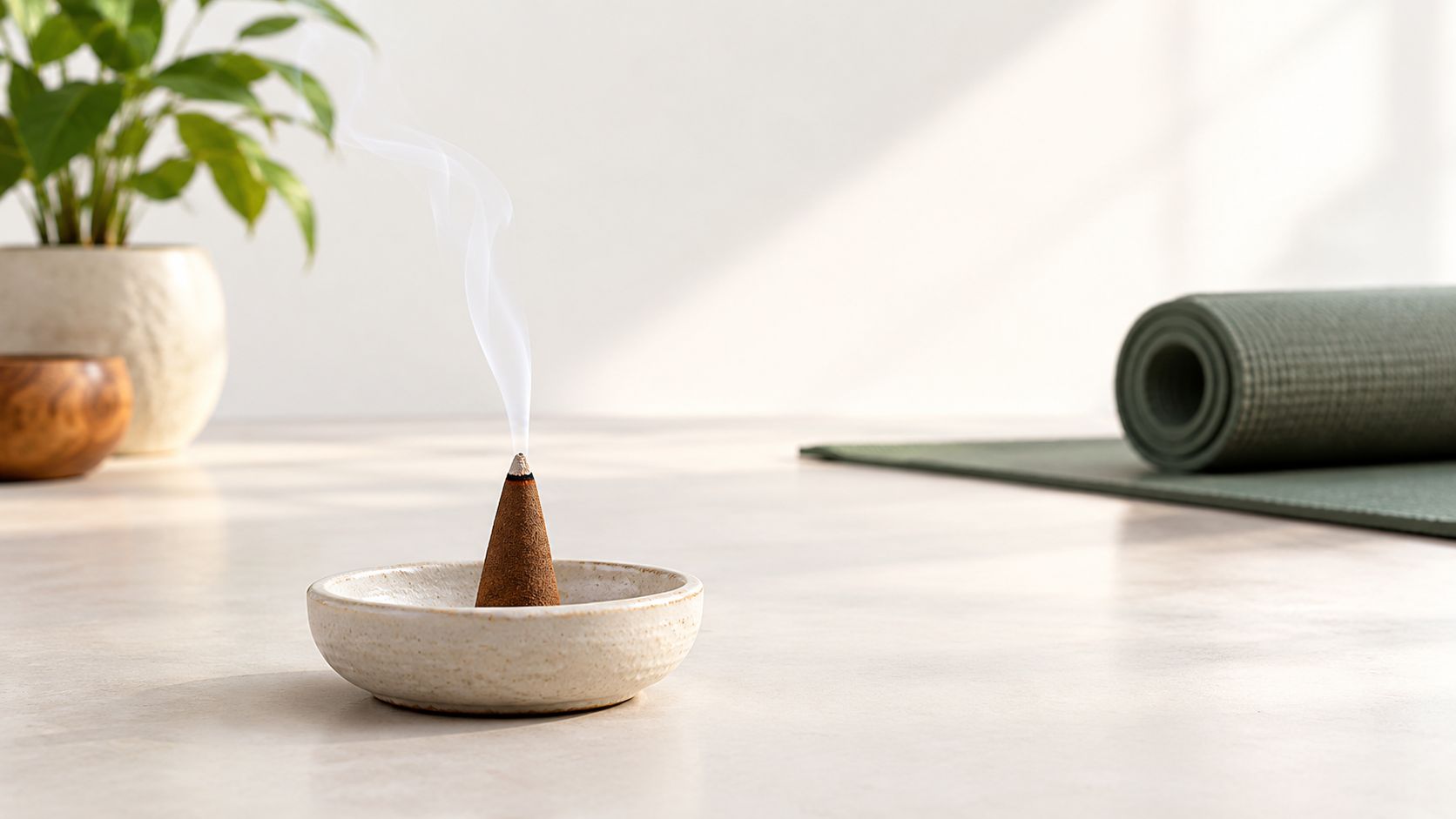
For home meditation, I'd begin with a modest sample purchase and choose the fragrance you find least distracting. A clearly disclosed blend is a reasonable starting option if botanical purity isn't your main requirement. Don't purchase a stronger cone merely because the package associates intensity with spiritual significance.
For spas and yoga studios, prioritize the people sharing the room. Ask whether combustion is appropriate at all, obtain feedback before adopting a fragrance, and don't extend burning to match the length of an appointment or class. Consistent batch performance matters more than an impressive first-light aroma.
The guide to sandalwood incense uses can help you consider intended routines. Keep customer-facing descriptions focused on fragrance and use rather than promising medical or psychological outcomes.
Retail shelves and wholesale purchasing
Retail buyers need a product they can describe accurately. A useful shelf description identifies the fragrance type and intended burner without implying that sandalwood scent proves botanical content. Choose packaging that gives staff and customers enough information to make that distinction.
For wholesale or repackaging, request a written specification covering the agreed fragrance category, packaging, batch identification, and available documentation. Compare the landed cost per saleable cone, not just the carton quotation, and establish how damaged goods or unacceptable batches will be handled.
Home buyers: Favor personal suitability over a prestigious claim.
Studio buyers: Make occupant acceptance and room conditions purchasing requirements.
Resellers: Choose descriptions and records you can confidently pass to customers.
The best sandalwood incense cones match the room and the buyer's requirements, not the strongest label claim.
Your Sandalwood Cone Buyer's Checklist and Quick Answers
Before placing an order, turn your notes into a purchase decision rather than another collection of fragrance adjectives.
Sample first: Approve the actual product before committing to bulk stock.
Identify the category: Record whether its sandalwood content is documented, blended, fragrance-only, or unverified.
Check origin and records: Keep supplier responses with the relevant product and batch information.
Review the test: Compare burning behavior and aroma with your intended setting.
Compare quotations fairly: Use per-cone pricing alongside packaging, delivery terms, and saleable condition.
Confirm customer-facing wording: Make sure your shelf label or listing doesn't promise more than the documentation supports.
FAQs
Can sandalwood incense cones be used with backflow incense burners?
Some sandalwood incense cones are designed for backflow burners, while others are intended for standard cone holders. Check the product description for compatibility before purchasing, since backflow burners require cones specifically designed to produce the downward-flowing smoke effect.
How can retailers compare sandalwood incense cone suppliers before placing a bulk order?
Retailers can compare suppliers by requesting samples, written product specifications, consistent batch identification, packaging details, and wholesale quotations. Comparing the total cost per saleable cone and the supplier's ability to document fragrance claims helps retailers make more informed purchasing decisions.
Does sandalwood incense cone color indicate the quality of its ingredients?
Cone color alone cannot establish sandalwood purity, fragrance concentration, or ingredient quality. Appearance can vary with the base materials, binders, and other ingredients used during manufacturing. Buyers should rely on product specifications and supporting documentation rather than color as proof of authenticity.
Can sandalwood incense cones lose their fragrance before their expiration date?
Yes. Exposure to heat, air, humidity, and competing odors can affect how incense smells during storage. Keeping cones sealed in suitable packaging, away from direct sunlight and strong-smelling products, can help preserve their fragrance. Compare stored inventory with an approved sample when evaluating changes in scent.
What information should a retailer include when describing sandalwood incense cones online?
A retailer should describe the fragrance profile, cone format, intended burner type, package quantity, and relevant usage instructions. Claims about genuine sandalwood ingredients, natural composition, sustainability, or reduced smoke should only be included when supported by appropriate product documentation.
Are sandalwood cones safer than sticks?
Don't assume either format is safer based on shape alone. Both involve combustion, and a defensible comparison needs product-specific emissions evidence and comparable use conditions. Apply the exposure precautions described above to either format.
How should I store cones?
As a practical storage precaution, keep them sealed in a cool, dark place away from humidity and competing fragrances. Retain the original product and lot information, especially if you divide wholesale stock into smaller packages.
What suggests a batch needs checking?
Set aside cones that arrive crumbling, smell musty, or burn differently from your approved sample. These observations don't diagnose a specific cause, but they justify contacting the supplier before selling or using the batch.
For retail and studio orders, keep an approved reference sample with your purchasing notes. It gives you something concrete to compare with the next delivery.
Aroma Warehouse offers incense cones, fragrance oils, and accessories with retail and wholesale purchasing options. Visit Aroma Warehouse to explore sandalwood options, then use this checklist to ask about formulation, samples, and documentation before choosing stock for your home, studio, or shop.


