

Leather Scented Oil: Formulation and Sourcing Guide
Most advice about leather scent starts in the wrong place. It treats leather scented oil like a heavyweight men's cologne note, then leaves retailers and crafters with a narrow product story, a confused safety message, and a missed sales opportunity. The better way to work with it is as a versatile leather accord, one that can read rugged, refined, smoky, clean, or softly unisex depending on how it's built and where it's used.
Table of Contents
Redefining the Leather Scented Oil Profile - What makes the note read as leather
Historical Roots and Modern Market Evolution - From glove-makers to modern fragrance houses - Why that history helps you sell it
Practical Applications for Home and Personal Care - Home fragrance and atmosphere - Personal care and lab handling
Formulation, Dilution, and Blending Guidelines - Recommended Leather Accord Usage Rates - How to balance the accord
Safety, Regulatory, and Skin Sensitization Rules - What compliance actually means - The retail responsibility
Storage, Shelf Life, and Handling Best Practices - Keep the environment stable - Watch for degradation
Wholesale Sourcing and Retail Positioning Strategies - How to position it on the shelf - What actually sells
Redefining the Leather Scented Oil Profile
Leather scented oil is usually not a single natural extract. Perfumers build the effect from smoky, woody, balsamic, and animalic materials such as birch tar, labdanum, styrax, and quinoline-type molecules like isobutyl quinoline (IBQ), which is why the scent feels layered instead of flat or one-note (Fragrantica's leather note overview). That structure matters for anyone selling or blending fragrance, because the same accord can lean dry and sharp in one formula, then warm and plush in another.
What makes the note read as leather
The nose doesn't identify leather from one ingredient, it reads a combination of cues. Birch tar brings a burnt, smoky edge, labdanum adds amber-like depth, and IBQ gives that dry, green, leathery contour that helps the blend feel believable rather than literal. In practice, this is why a leather fragrance can sit beside citrus, florals, woods, or musk and still hold its identity.
That flexibility is why leather works well in modern unisex positioning. Shoppers who want something expressive usually aren't looking for an old-school barbershop profile, they want something that feels polished but distinct, the same emotional lane that shows up in modern niche scent wardrobes. If you already market wood, oud, or smoke profiles, leather can sit in the same family without sounding repetitive, and it can pair cleanly with your existing storytelling around layering and mood. For a related example of how darker materials get positioned in a more wearable way, see Aroma Warehouse's black oud fragrance guide.
Practical rule: sell the result, not the ingredient list. Customers buy the feeling of the accord, not the chemistry diagram.
Historical Roots and Modern Market Evolution
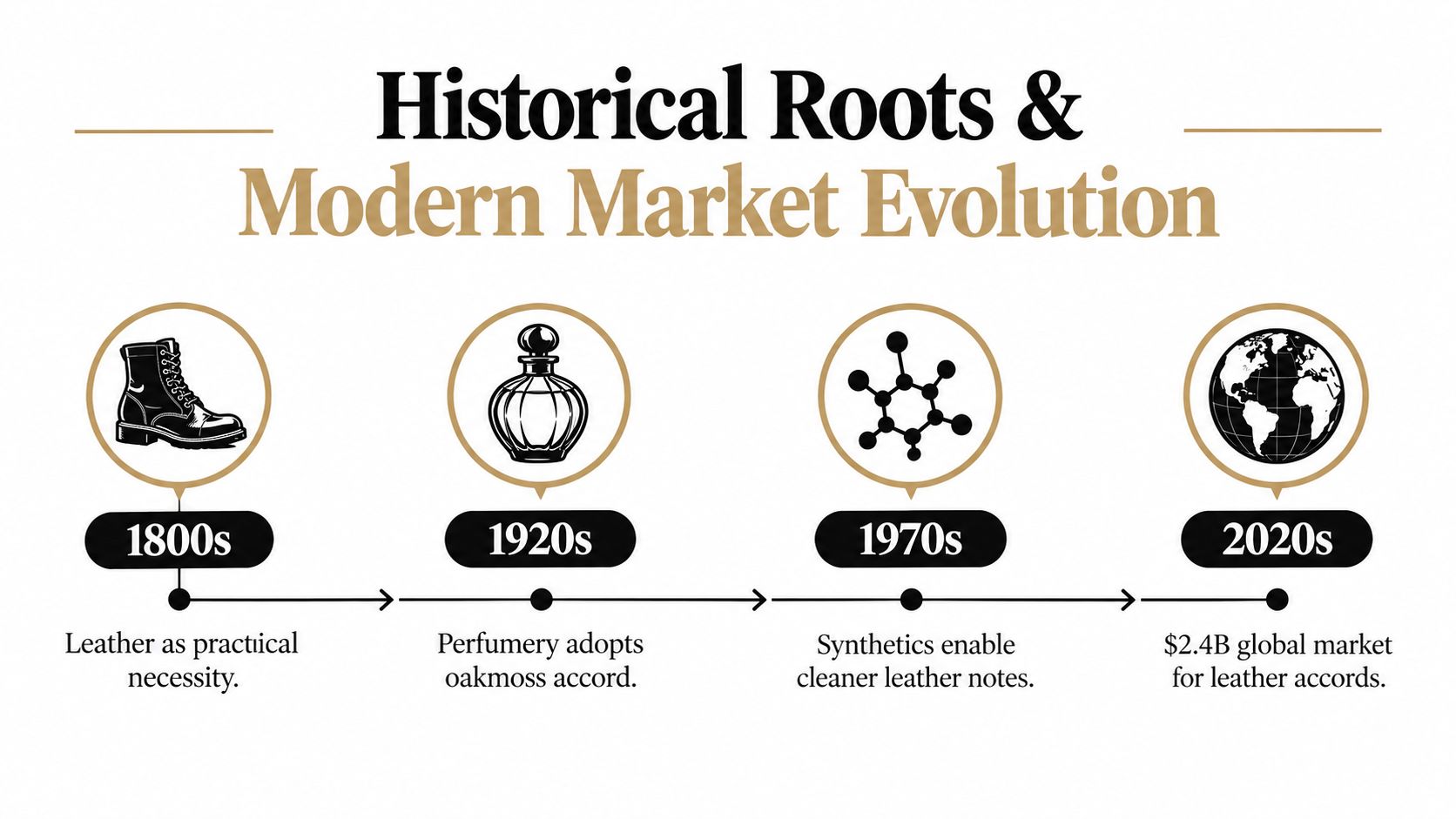
Leather fragrance began as a practical solution, not a niche category. In 15th- and 16th-century Europe, glove-makers in Paris and on the Iberian Peninsula scented tanned leather to cover its strong odor, as documented by the Perfume Society. That origin helps explain the accord's lasting smoke, warmth, and worn-in character. These qualities came from the material's use before they became deliberate fragrance effects.
From glove-makers to modern fragrance houses
The modern leather accord developed through perfumery rather than directly from finished leather. Its familiar structure often centers on birch tar oil and isobutyl quinoline. Tabac Blond by Caron, released in 1919, marked an early modern milestone, while 1924 brought prominent Russian-leather styles through Chanel's Cuir de Russie and Knize Ten. Later, Cabochard in 1959 and Aramis in 1966 helped carry leather into both women's and men's mainstream perfumery, as recorded by Osmetheca.
That sequence explains why leather still sells as a contemporary profile rather than a historical curiosity. Its identity can move from smoky and tarry to polished, dry, woody, or softly musky, depending on the surrounding materials. For a boutique or wholesale line, that flexibility supports unisex positioning and gives customers more choice than a strictly masculine cologne story.
Why that history helps you sell it
Merchandise leather through a clear progression: utility to luxury to versatility. The narrative places the accord comfortably beside unisex woods, incense, and layered musks, while leaving room for modern interpretations that feel lighter or more approachable.
For retailers and crafters, the historical story also sets realistic expectations. Leather has deep roots, but its commercial value comes from adaptation. Present it as a classic material translated into a current scent wardrobe, not as a relic reserved for traditional masculine fragrance.
Practical Applications for Home and Personal Care
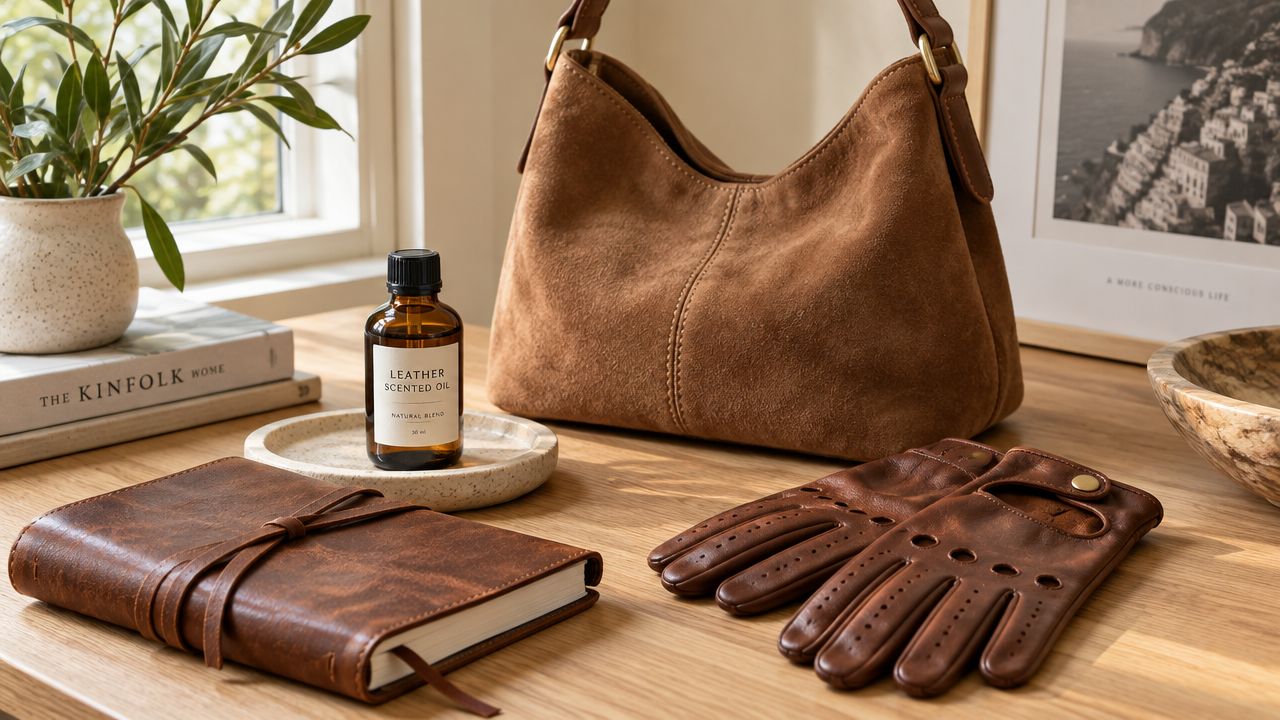
Leather scents perform best when the product context matches the mood. In candles, reed diffusers, and incense, the note can read warm, dry, and grounding, especially when you want a room to feel composed rather than sweet. In beard oils, solid perfumes, and lotions, the same profile can feel intimate and polished, but the formula has to be much more careful because skin-contact products carry a different risk profile.
Home fragrance and atmosphere
For home fragrance, leather works well as a background anchor. It pairs naturally with wood, resin, amber, and smoke, and it can give a room a more refined feel without becoming syrupy. That makes it useful for gift sets, den collections, and fall or winter assortments, but it doesn't have to stay in that seasonal box if you blend it with cleaner notes.
Keep the story lifestyle-based in your merchandising. A leather candle doesn't need to sit in a “men's” section, it can sit near office gifts, study scents, travel accessories, or elegant neutral home fragrance. If you're creating room sprays, Aroma Warehouse's room spray guide is a useful reference point for crafters who want a straightforward production workflow.
Personal care and lab handling
Skin-contact products are a different job. Beard oils, lotions, and perfume oils need tighter control over dilution, label claims, and testing, and you should handle raw materials with proper ventilation. If you're making concentrated blends in a small workshop, it's smart to work with fume hoods for cosmetic labs from a safety perspective, especially when you're dealing with strong aroma chemicals and volatile fragrance components (Labs USA).
Leather can sell in both home fragrance and personal care, but the formula has to respect the use case first.
Formulation, Dilution, and Blending Guidelines
Commercial leather accords are usually supplied as highly concentrated blends and then dosed at low levels in finished products. One industry reference places typical leather fragrance-oil use at about 1 to 5% in final blends (Caperfume). That range is broad because the right dose depends on the base, the end product, and how dominant you want the leather effect to feel.
Recommended Leather Accord Usage Rates
Product Category | Recommended Usage % | Formulation Notes |
|---|---|---|
Candles | 3 to 5% | Useful when you want a clear scent throw and a warm smoky profile. Test for discoloration and wick performance. |
Reed diffusers | 1 to 3% | Keep the accord restrained so it doesn't overwhelm the carrier blend or become too dense. |
Room sprays | 1 to 2% | Leather reads strongly in fine mist formats, so a lighter hand usually works better. |
Solid perfumes | 1 to 3% | Blend into a waxy or balm base and keep the profile smooth, not abrasive. |
Body oils | 1% or less | Skin-contact products need the most caution, especially where a sensitizer risk is involved. |
Lotions and creams | 0.5 to 1% | Start low, then evaluate scent after emulsification and cure time. |
How to balance the accord
A leather note often needs support, not just strength. Sweet vanilla can soften the edges, bright citrus can lift a heavy base, and earthy patchouli can deepen the dry side of the accord without making it smell burnt. If you want a more specific effect, pair leather with cedar, vetiver, or a clean musk, but don't stack every dark material at once, or the blend turns muddy.
DPG is a practical tool in this work because it can help manage viscosity and make certain fragrance materials easier to handle. If you're new to it, Aroma Warehouse's DPG guide is a sensible starting point for understanding where it fits in small-batch production. In a real workshop, the rule is simple, test the formula in the actual application, not just on a blotter.
Blending rule: if the leather note starts to smell harsh, lower the load before you add more fixatives. Heavy-handed correction usually makes the problem worse.
Safety, Regulatory, and Skin Sensitization Rules
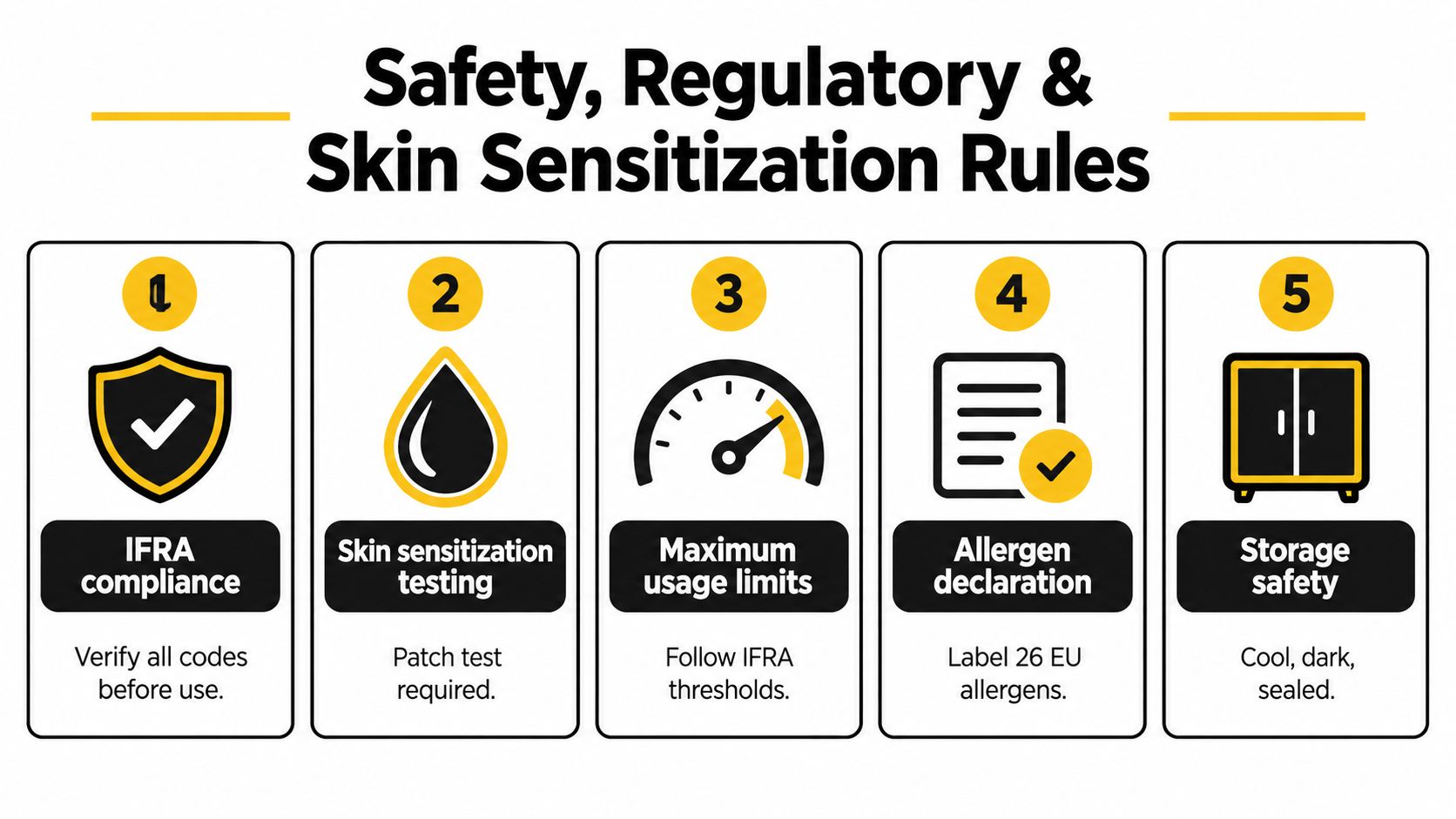
Leather fragrance oils are not automatically skin-safe just because they smell luxurious. Multiple safety documents classify them as skin irritants or potential sensitizers, and state they should not be applied undiluted to skin (Bramble Berry SDS). That's the part a lot of product pages gloss over, and it's the part retailers and crafters need to treat as essential.
What compliance actually means
Use the fragrance oil according to the product category, not the scent name. A formula that works in a diffuser can be completely wrong for a lotion, and a candle load doesn't tell you anything about skin tolerance. That's why IFRA limits, testing, and label accuracy matter more than marketing language.
Patch testing matters too, especially for leave-on products. If you're making body oils or perfumes for customers, you need a clear process for testing dilution, watching for reactions, and documenting the product type on the label. For labeling basics and ingredient disclosure habits, Aroma Warehouse's fragrance labeling requirements guide is a practical reference for small sellers.
The retail responsibility
If you sell leather fragrance items, don't let the category blur. Keep candle oils, diffuser oils, and personal-care blends separated in both packaging and product copy. That separation protects your customers and protects your brand, because the ethical failure isn't using leather fragrance, it's pretending one formula is appropriate for every use.
Storage, Shelf Life, and Handling Best Practices
Leather accords can lose character if you handle them carelessly. Oxygen, light, and heat are the main enemies, and they're especially hard on complex blends that rely on smoke, resin, and quinoline-style materials for their shape. Once those top impressions flatten out, the scent can shift from crisp and nuanced to dull and heavy.
Keep the environment stable
Store concentrated oils in amber glass or aluminum containers, sealed tightly, in a cool, dark place. That reduces exposure to light and air, which helps preserve the sharper parts of the accord for longer. It also makes inventory easier to manage, because you're less likely to end up with half-open bottles sitting around the bench.
Use clean caps and closures, and don't swap them casually between formulas. If a bottle cap leaks or doesn't seat properly, you'll get evaporation, contamination risk, and more odor bleed than you want in a fragrance workspace. If you need a refresher on closure options, Aroma Warehouse's bottle cap guide is a useful operational reference.
Watch for degradation
Leather oils often show stress through color change, a heavier or flatter odor, or the loss of the bright top edge that made the accord feel alive. Those shifts don't always mean the product is unusable, but they do mean the formula may no longer smell the way you intended. In a retail setting, that matters because customers notice inconsistency fast.
Fresh handling doesn't make a mediocre formula great, but bad handling can ruin a good one.
Wholesale Sourcing and Retail Positioning Strategies
Leather scented oil works best in wholesale when the merchant treats it like a flexible line, not a single SKU. Boutique owners, spas, and small resellers usually get better results when they source a clear leather accord, then turn it into candles, room sprays, sampler sets, or private-label blends with distinct use cases. That approach gives you more merchandising angles and makes the note feel current rather than niche-only.
How to position it on the shelf
Place leather beside unisex woods, incense, dark florals, and layered musks, not only next to men's grooming products. Shoppers looking for expressive scent choices often browse by mood or setting, and leather can support that journey better than a gendered category label. Discovery kits help here because they let customers compare a leather note against softer or cleaner options without committing to a full bottle.
For sourcing support, it helps to work with suppliers who understand both fragrance and packaging. Aroma Warehouse pours fragrance oils fresh to order and also supplies the kinds of accessories that matter for private label work, which is useful if you're building a small retail line rather than a one-off craft project. If you also formulate with terpene-rich materials, Gold Coast Terpenes' page on terpenes for product formulation is a relevant technical comparison point for ingredient sourcing and blending strategy.
What actually sells
Leather performs well when the product feels giftable, layered, and easy to understand. That means sampler sets, seasonal bundles, room sprays, and compact formats often make more sense than oversized, intimidating bottles. The scent has enough character to stand alone, but not so much that it can't be paired with complementary lines.
For boutique owners, the best wholesale move is to buy leather as part of a broader unisex story. For crafters, the smartest move is to keep the formula honest, the dilution disciplined, and the marketing specific.
If you're building a leather scent line, Aroma Warehouse can supply fragrance oils, DPG, incense accessories, and packaging support that fit small-batch work and resale. Visit Aroma Incense Warehouse to source the materials you need for candles, room sprays, and private-label fragrance products, then build your leather collection with formulas that are safe, consistent, and ready for modern buyers.


