

Dragon's Blood Fragrance Oil: The Complete Guide

Dragon's blood fragrance oil is usually a benzyl benzoate-based blend, not pure dragon's blood resin, and that's why it gives candles and diffusers a warm, balsamic throw that hangs in the room. The actual decision isn't whether the scent is “real,” it's whether you're using it for burn-use or skin-safe applications.
You can buy a beautiful dragon's blood note and still ruin the product if you treat every formula the same. I've seen makers love the scent in wax, then get into trouble when they assume the same oil is automatically fine for lotion, soap, or a room spray.
Table of Contents
What Makes Dragon's Blood Fragrance Oil Different - Why makers choose the oil
The Chemistry Behind the Scent Profile - How the notes stack - What it pairs with
Best Applications for Dragon's Blood Fragrance Oil - Where it performs best - Practical format choices
Safety Guidelines and Dilution Standards - Read the safety sheet, not the marketing line - Practical use by application
Blending Recipes and Usage Ratios - Ready-to-use blend ideas - Quick reference for product use
Buying and Storage Best Practices - What to check before you buy
What Makes Dragon's Blood Fragrance Oil Different
A lot of shoppers start here with the wrong assumption, they think dragon's blood fragrance oil is ground-up resin in a bottle. That's understandable, because the name sounds ancient and botanical, and the scent family does echo the deep, dark character of true resin material. But fragrance oil is a crafted aroma blend, designed to imitate that balsamic profile in a form that's easier to measure, pour, and repeat across batches.
That difference matters if you're making products for sale. Natural dragon's blood resin is a category of plant material, used for centuries and sourced from multiple species, including Croton lechleri in the Amazon and Dracaena and Daemonorops species elsewhere, with historical use stretching back more than 2,000 years (Silloria's overview of dragon's blood resin). Fragrance oil borrows the scent idea, not the raw botanical identity.
Why makers choose the oil
For candles, room sprays, and many bath products, the appeal is consistency. A resin chunk can vary from one harvest to the next, while a fragrance oil gives you a repeatable scent profile that's much easier to scale. It also saves you from the mess of melting, filtering, or dealing with material that behaves differently in each formula.
Practical rule: if you need the scent to behave the same way in every batch, fragrance oil usually beats raw resin.
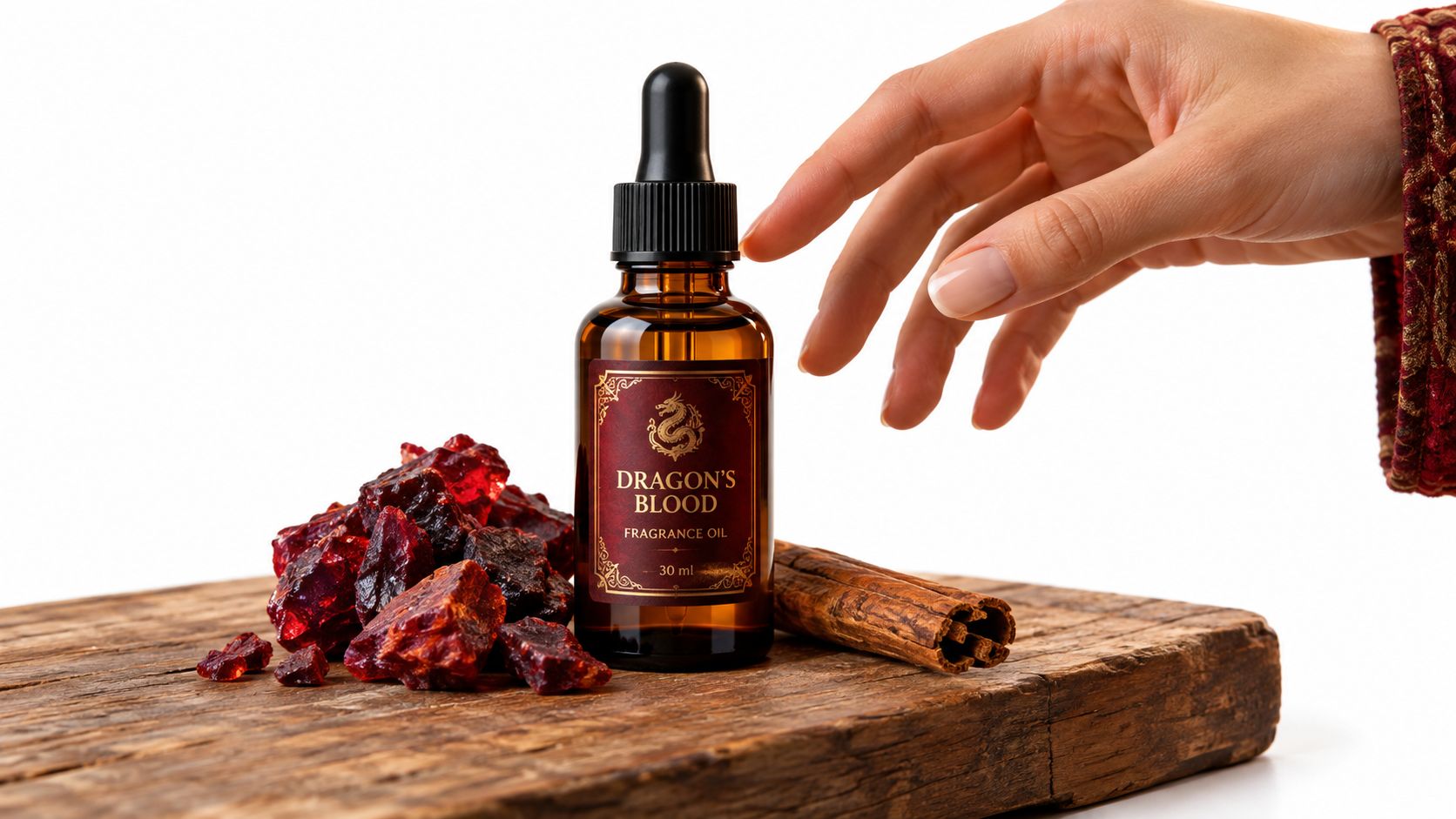
The other advantage is versatility. A good dragon's blood blend can be used in home fragrance, soap, and some body-care formats, while real resin is often better suited to burning as incense or honoring a more traditional material experience. If you're comparing scent in incense formats, the broader category is discussed well in this dragon's blood incense guide, which helps make the resin-versus-blend distinction clearer.
The Chemistry Behind the Scent Profile
Dragon's blood fragrance oil usually smells like depth first, brightness second, and sweetness underneath. That order comes from the way the blend is built, with benzyl benzoate doing the heavy lifting as the dominant carrier and base component. One safety data sheet lists a blend built around 25% to 50% benzyl benzoate, plus 10% to 25% phenethyl alcohol, 10% to 25% limonene, 5% to 10% coumarin, and 5% to 10% ethyl vanillin or vanillin (MSDS for Dragon's Blood Fragrant Oil).
How the notes stack
Benzyl benzoate adds fixative depth and slows evaporation, which is why the scent feels anchored instead of flimsy. Phenethyl alcohol and limonene brighten the top and middle, so the oil doesn't smell flat or syrupy right out of the bottle. Coumarin and vanillin then give the balsamic sweetness that people describe as warm, resinous, and long-lasting rather than citrus-led.
That structure matters in actual products. In wax, a fixative-heavy blend can help the scent stay present after cooling. In a reed diffuser or room spray, the lighter molecules help the top impression lift quickly, while the base keeps the scent from disappearing in minutes.
What it pairs with
This scent family usually behaves well beside sandalwood, frankincense, amber, and vanilla because those notes share the same warm, resinous lane. It can also sit under sharper materials, but the result gets rough if the top notes fight each other. I've found that the more balsamic the companion, the smoother the blend usually feels.
For a deeper refresher on why this matters in formula design, see the differences between fragrance oils and essential oils.
Dragon's Blood Resin vs Fragrance Oil Comparison
The choice here is about fit, not purity points. Natural resin makes sense when the ritual, material heritage, or burn experience is the product. Fragrance oil makes sense when you need predictability, easier blending, and compatibility with manufactured goods.
Factor | Natural Resin | Fragrance Oil |
|---|---|---|
Scent character | More variable, earthy, and tied to the actual material | More controlled, smoother, and designed for repeatable performance |
Best use | Charcoal burning, traditional incense, symbolic use | Candles, sprays, soaps, some bath and body products |
Handling | Can be messy, brittle, and slower to work with | Easy to measure and blend |
Consistency | Depends on species, harvest, and batch | More stable from bottle to bottle |
Formula control | Harder to standardize | Easier to reproduce in production |
Storage | Sensitive to heat and contamination | Usually simpler to store in sealed packaging |
Natural resin still has a real place. If you're making incense with charcoal, or you want the exact tactile feel of a crystalline material breaking under a pestle, nothing synthetic replaces that. If you're formulating for retail shelves, though, fragrance oil usually wins because it behaves more predictably in the application.
Use resin when the material itself is part of the story. Use fragrance oil when the fragrance has to do a job.
That's especially true for candles and sprays, where customers care far more about how the product performs than whether the aroma came from a tree exudate. If you're looking at incense formats and want to understand how resin products are positioned in the market, this resin incense guide is a useful companion read.
Best Applications for Dragon's Blood Fragrance Oil
Candle makers usually come to this scent for one reason, it carries. Dragon's blood sits in the room with real presence, so it can hold its own in pillar candles, container candles, and heavier wax blends. If you're testing it in candles, the key is to keep your formula clean and avoid crowding it with too many competing notes.
Where it performs best
In room sprays, the blend can feel immediate and dramatic if the base is balanced correctly. That's why solvent choice matters, especially if you're making spray products that need to mist evenly and stay suspended. Finding Favourites' fragrance longevity guide is a useful reference if you're comparing how scent families hold up across product types.
For soaps, the scent tends to suit darker or more ritual-style bars better than bright, spa-like ones. It can work in cold process soap, but the finished bar often looks and smells best when the design matches the scent story. In lotion and other leave-on products, the main issue isn't just scent strength, it's whether the material is suitable for skin contact in that specific format.
Practical format choices
Candles: Start with a conservative load, then test hot throw and cold throw separately. Dragon's blood can dominate a blend quickly.
Reed diffusers: Use a carrier that supports steady wicking, and don't overload the formula with too many heavy notes.
Soap: Keep the profile simple so acceleration, discoloration, or muddying doesn't take over the design.
Bath and body: Treat scent strength and skin safety as separate decisions, not the same one.
If you're making room sprays specifically, the process is different enough to deserve its own workflow, and this room spray guide is a practical starting point. For some makers, Aroma Warehouse's fragrance oil range can be one source for testing these formats, especially if you're building a broader line rather than a single hero product.
Safety Guidelines and Dilution Standards
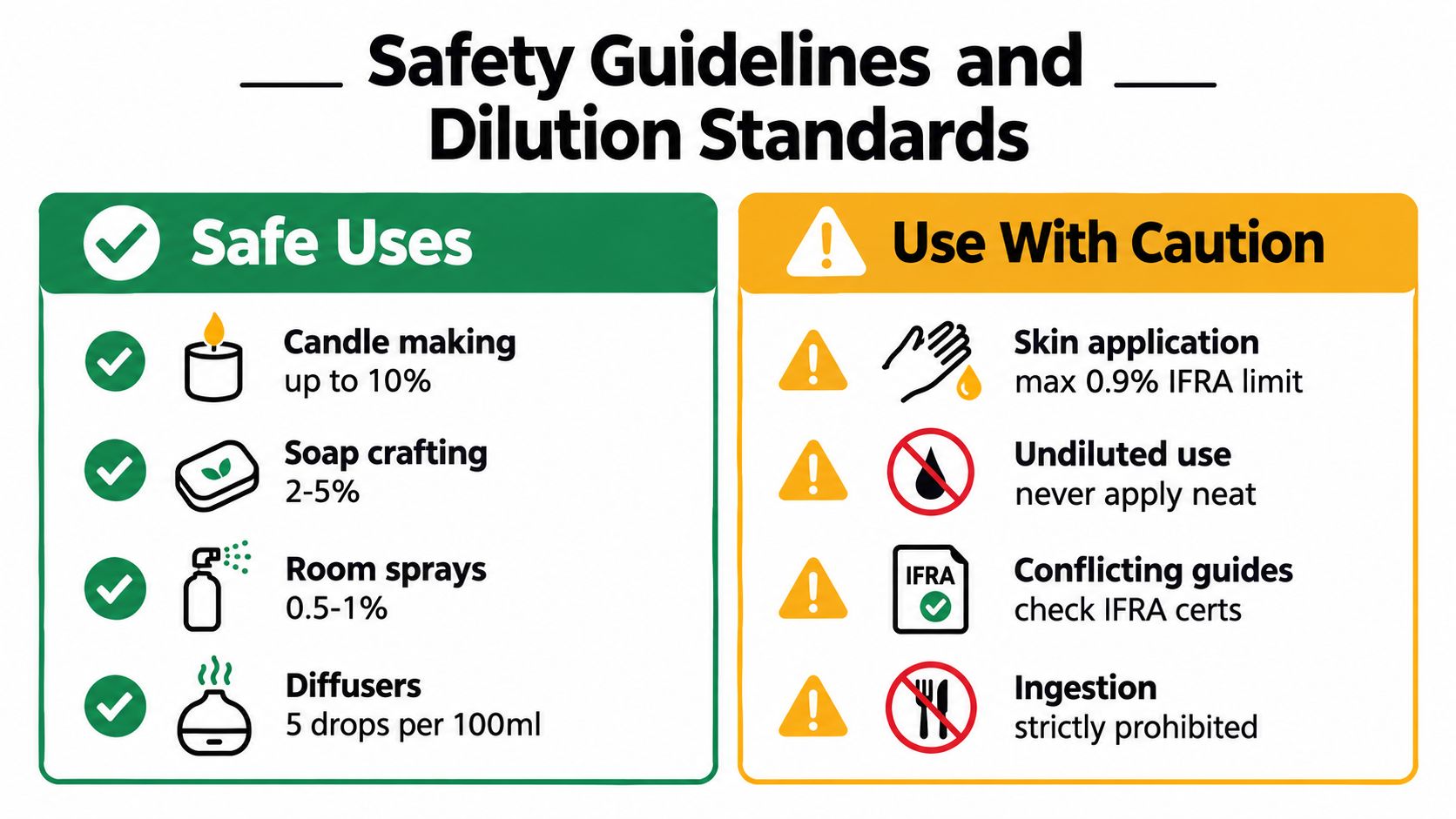
This is the part most guides gloss over, and it's the part that causes the most confusion. Dragon's blood fragrance oil can be sold in very different ways, some versions are marked skin-sensitizing or otherwise restricted, while others are marketed for soap or specific home-fragrance uses. The practical question isn't whether the scent is “safe,” it's safe for which application.
Read the safety sheet, not the marketing line
If a supplier labels a formula as suitable for CP soap, that does not automatically make it fine for lotion, perfume, or direct skin use. The same fragrance family can have very different limits depending on how it's carried, what allergens are present, and how it's intended to be used. That's why you need to check the current SDS or IFRA documentation for the exact product you're buying.
Practical use by application
Burn-use: Suitable when the supplier documents the product for candles or incense-type applications.
Cold process soap: Often workable when the supplier lists soap compatibility, but you still need to watch the full formula for discoloration and scent behavior.
Lotion and leave-on skin products: Only use if the exact product's documentation supports that use case.
Room sprays: Check both the solvent system and the application guidance before mixing.
Undiluted skin contact: Never a good assumption. Don't apply neat fragrance oil directly.
Rule of thumb: if the document doesn't clearly say the application is allowed, treat it as disallowed until you verify it.
The reason this matters goes beyond safety. Overloading a formula can make the scent harsher, less stable, and more likely to separate, especially in fine-mist products or lighter emulsions. Proper dilution protects the person using the product and usually improves performance too.
Blending Recipes and Usage Ratios
Dragon's blood works best when it's given a role, not asked to do everything. In my experience, it behaves like a dark anchor note, so it shines when the rest of the blend supports its warmth instead of competing with it. Sandalwood and frankincense are the most natural companions because they stay in the same resinous family.
Ready-to-use blend ideas
Mystic Ember: 5 drops dragon's blood, 3 sandalwood, 2 orange. Warm and woody, with just enough lift to keep it from going heavy.
Velvet Smoke: 4 drops dragon's blood, 4 frankincense, 1 cedar. Deep, dry, and resinous.
Crimson Spice: 6 drops dragon's blood, 2 cinnamon, 2 clove. Bold and hot, better for seasonal lines than daily wear.
Amber Dusk: 4 drops dragon's blood, 4 amber, 2 vanilla. Sweet balsamic with a soft edge.
Forest Alchemy: 5 drops dragon's blood, 3 pine, 2 vetiver. Earthy and green, with a darker backbone.
Velvet Rose: 4 drops dragon's blood, 4 rose, 2 patchouli. Floral, but grounded and moody.
Quick reference for product use
Product type | Practical starting point |
|---|---|
Candles | Test low and adjust by wax system |
Reed diffusers | Keep the formula balanced for steady wicking |
Soap | Use only when the supplier supports that application |
Room sprays | Keep the formula light enough to mist cleanly |
Leave-on body care | Verify the exact material's suitability first |
The strongest blends usually use dragon's blood as the base character and let one supporting note define the personality. Too many sweet notes make it candy-like, and too many woods make it dull. The best results come from restraint, not stacking every dark ingredient you own.
For a visual walkthrough of blend thinking and usage patterns, this clip is a useful companion.
If you want to compare blend carriers and solvents as you build out formulas, this DPG guide helps put the chemistry into practical context.
Buying and Storage Best Practices
Good sourcing starts with documentation, not scent alone. Ask for the product's safety sheet, look for clear application guidance, and make sure the supplier is specific about what the oil is intended to do. A vague listing that says “multi-use fragrance” without any supporting paperwork is harder to trust in a production setting.
What to check before you buy
Batch consistency: You want the same scent profile from order to order, especially if you sell repeat products.
Supplier reputation: Choose vendors who publish usable documentation and don't hide basic formulation details.
Container quality: Dark, sealed bottles help protect the fragrance from light and air exposure.
Intended use: Make sure the product is supported for candles, soap, sprays, or body care, depending on your need.
Packaging options: If you're private labeling, bottle sizes and closure types matter as much as scent.
Storage is straightforward, but makers still get it wrong. Keep the oil sealed, away from heat, and out of direct light. If the scent starts to flatten, the color shifts sharply, or the oil smells stale instead of balsamic, it's time to re-evaluate the batch.
Wholesale buyers should think in terms of turnover and product planning. Order enough to support your production schedule, but don't let aromatic materials sit so long that they start losing character. Aroma Warehouse, for example, supplies fragrance oils alongside burners, bottles, and related materials, which can be useful if you're building a coordinated product workflow.
Frequently Asked Questions
Is dragon's blood fragrance oil vegan? Usually, fragrance oils are vegan in the sense that they're synthetic blends, but you should still check the supplier's documentation for the exact product.
How is it different from dragon's blood essential oil? Most products sold under this name are fragrance oils or resin-derived blends, not true essential oils. The scent goal is similar, but the material and use cases are different.
How long does it last in storage? If it's sealed well and kept cool and dark, it generally holds up much better than an opened, heat-exposed bottle. Always watch for scent drift.
Can I use it in all wax types? Not automatically. Wax choice, load, and cure time all affect performance, so test in the exact wax you plan to sell.
Is it safe around pets? Treat scented products cautiously around pets, especially in enclosed spaces. Use ventilation and keep strong fragrance use modest.
Can I buy it wholesale from Aroma Warehouse? Aroma Warehouse sells fragrance oils and related supplies for retail and wholesale buyers, which makes it practical for makers who need both product and packaging support. Check their current catalog and availability on Aroma Warehouse if you're building a line around this scent.
If you're making candles, soaps, room sprays, or retail-ready blends, Aroma Warehouse carries the fragrance oils and supporting supplies that fit that kind of workflow. Visit Aroma Incense Warehouse to compare options, check current stock, and source the materials you need for your next dragon's blood product line.


